
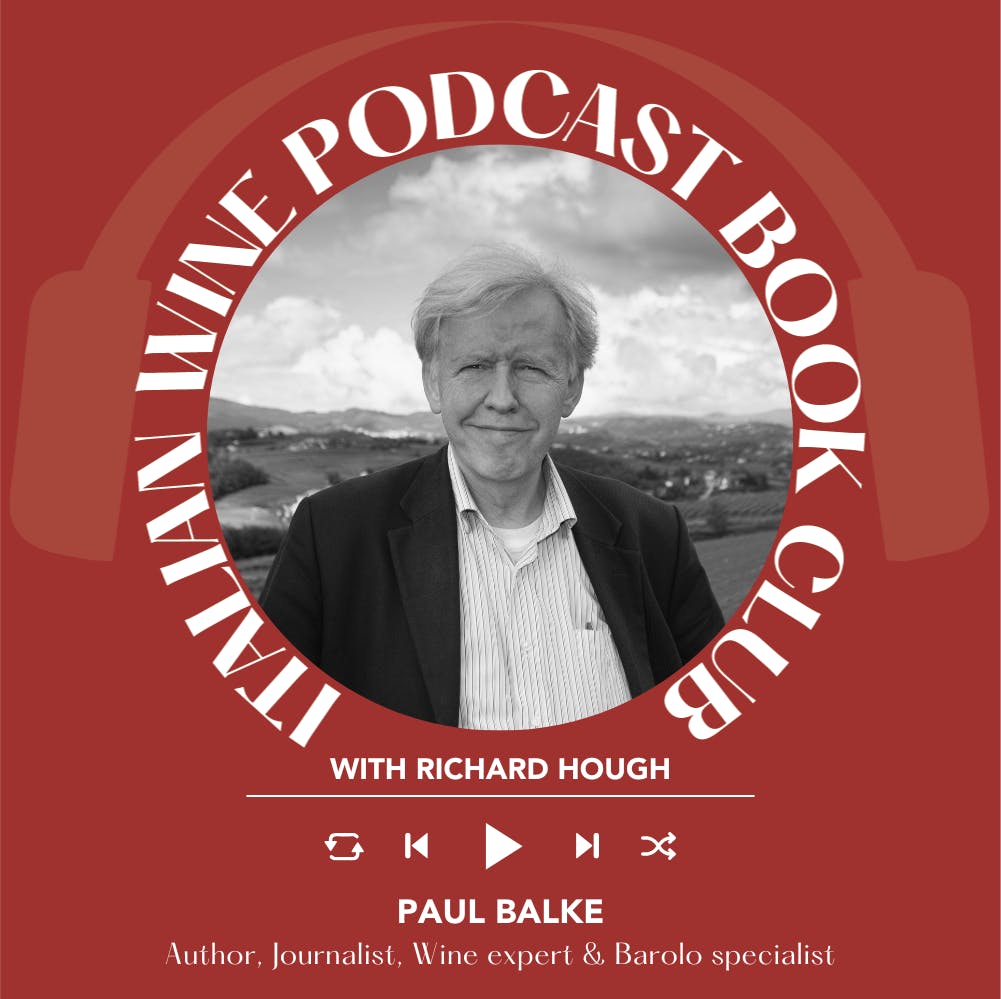
Ep. 2411 Paul Balke | Book Club with Richard Hough
Book Club with Richard Hough
Episode Summary
Content Analysis Key Themes and Main Ideas 1. The personal and professional journey of wine writer and Barolo specialist, Paul Balk. 2. The evolution and current trends of the Dutch wine market, including consumption and local production. 3. In-depth exploration of specific Italian wine regions, particularly Piedmont and the North Adriatic (Friuli-Venezia Giulia, Slovenia, Croatia). 4. The advocacy for and philosophy behind blended wines as a means of quality, biodiversity, and naturalness. 5. Paul Balk's engagement in wine production, education, and organizing immersive tours for wine professionals. 6. The intersection of history, culture, and gastronomy in European wine regions. Summary In this episode of Book Club with the Italian Wine Podcast, host Richard Woodard interviews Paul Balk, a wine writer, educator, and Barolo specialist. Paul shares his unconventional journey from studying law in Utrecht, Netherlands, to becoming a prominent figure in the wine world, initially sparked by South African wine and later deeply influenced by Italian wine after his first visit to Vinitaly in 1994. He discusses the significant transformation of the Dutch wine market from a traditional, French-dominated sphere to a diverse, international one with increasing consumer knowledge, even among younger generations, and the surprising growth of local Dutch wine production. Paul delves into his expertise on Italian regions, particularly his ""home"" region of Piedmont and the complex, historical North Adriatic area (Friuli-Venezia Giulia, Slovenian Karst, and Croatian Istria), which he covered in his books. A significant portion of the interview is dedicated to his passion for blended wines, arguing for their superior quality, naturalness, and role in preserving biodiversity, often contrasting them with single-varietal wines and mainstream market trends. He also touches on his personal wine brand, which focuses on natural blends of indigenous Italian varieties. Lastly, Paul describes the immersive wine tours he organizes for journalists, highlighting the unique experience of exploring cross-border wine regions like the North Adriatic, and discusses the challenges and joys of writing about wine in multiple languages. Takeaways - Paul Balk transitioned from a legal background to a successful career as a wine writer, educator, and producer. - The Dutch wine market has diversified significantly, moving beyond French dominance to embrace international wines and showing increased consumer knowledge. - Dutch wine production, though small, is growing, aided by climate change, with quality examples found in areas like Maastricht. - Piedmont remains a foundational region for Paul Balk, known for its diverse indigenous grape varieties beyond Nebbiolo. - The North Adriatic region (Friuli-Venezia Giulia, Slovenia, Croatia) offers a rich, historically complex, and culturally intertwined wine experience. - Paul Balk strongly advocates for blended wines, viewing them as more authentic, natural, and crucial for biodiversity preservation compared to many single-varietal wines. - His personal wine brand embodies the philosophy of using local grape varieties in blends to create unique regional expressions. - Immersive wine tours for journalists are designed to uncover lesser-known regions and highlight their high-quality wines, such as Taurasi in Campania. - Multilingualism, particularly Italian, is essential for deep engagement with and understanding of Italian wine culture and history. Notable Quotes - ""I was affected by the Italy virus. Yeah. And I'm still affected by this."
About This Episode
The speakers discuss the Italian wine industry and its importance in the development of wine. They touch upon the success of the wine industry and its potential for expansion due to climate change. They also discuss the importance of blending different varieties in a blend for maintaining the natural taste and character of the wine. They mention the challenges of writing in English due to language barriers and offer plans for future tours and book sales. They end the conversation by thanking the speakers and reminding them of the show notes and book sales.
Transcript
One of the most interesting areas for an interesting customer is that area in Fury and in Pennsylvania in Croatia. Mhmm. Because there is such a mix of influences from Slavic Kitchen, Australian kitchen, German kitchen, Italian kitchen, all on the same menu. It's very interesting. Yeah. Absolutely. Hello, and welcome to book club with the Italian wine podcast. I'm your host touch it off, and I'm delighted that you're joining us as we get between the vines with some of the best wine writing out there. So sit back, put yourself a glass, and enjoy the show. With the Italian wine podcast. This month, our guest is the wine writer and Barolo specialist, Paul Balk, who has written three books, the ones that are of particular interest to us on the Italian wine podcast, the piedmontywine and Travel Atlas and North Adriatic. Hi, Paul. First of all, did did I get your pronunciation correctly? Sorry. I should have checked that before we started. Yes. Hello, Richard. Yes. My name is Paul Balker. That's how we take in my language. Okay. And in every language is always it. Oh, yes. I have that same problem myself here in Italy with my with my surname. There's so many so many variations depending on on where you happen to be. So, yes, I I understand that you grew up in Utrecht, where you studied law. In fact, you're a a first guest on the book club from the Netherlands. Could you tell us something then about your personal background? What got you first interested in wine and then Italian wine in particular? Yes. Well, I have in my family, there was sometimes a bottle of wine opened, but there was near not really a wine education, not at all. And the idea, of my education was not to be in this business. Not at all. I was going in the direction to become lawyer. I did not have, much affinity, which that that kind of job, and It's just just by chance that my brother came back from South African Visible for wine and said, shall we do something with that? They would be happy to have an importer. We can help them. And let us, the the flesh that I, started to think about wine I had never solved about it. And, I started to study to go through testings, and I started to understand that this is a fascinating role. Okay. So it was South African. And why really that that sparked your imagination? Yes. And then, one month later, just by chance, I was in Brussels, and I met a son of a winemaker from France, and he, told me a lot. He said, you have to come here and you have fitted me which I did, then I I got more information. I I started to realize that this is a very interesting world. I went to study and study and I I I have stopped. I'm still studying. Yeah. It's a lifelong passion, I suppose. But but what is what is it then about why in that as of most interest to you? Is it, the the history, the culture, the the scientific aspects? What what was it that that captured your imagination? It's all together. It's the combination of everything. It's not the only thing it's, that you are sitting with friends and enjoying a virus. Which is nice. Of course, it's always interesting. But it's a world that is very rich and, has a lot to tell. It's, a way to discover countries to meet people in many countries in the world. It's the combination of wine and history and culture and, it's a scientific aspect which interests me too. It it is all together. And it makes that you have never a boring day. Yeah. And we we make Paul very briefly earlier this year at VIN Italy. So your your your interest in mind from being this passionate soon became a career and a career as a a wine writer, and a wine educator, and a wine producer, which will come on to talk about. But what I'm interested to know is how how does this lawyer from utrecht become a a leading expert on Italian wine regions when did you first become interested in the wine of Italy? Well, it's by chance. I was not really fo out of start, I was really focused on France because in the Netherlands, everybody, in that period was focused on France. France was the country for wine. There were even people saying the only wine that exists is divine from France, and they're, all other, liquid is not really wine. They're acting physics quite arrogant statements, and I don't agree with it now with my knowledge now. But I have to, tell you that at the start, I was not very knowledgeable, and I started to discover the binary reasons of France, which I think, are very interesting because France is a very important country. Then in nineteen ninety four, it was the first time I've visited it immediately, and that was another flesh. I I was affected by the Italy virus. Yeah. And I'm still affected by this. Yeah. And what was it about VINitale in in nineteen ninety four? I I'm imagining quite, intoxicating, but also quite chaotic experience back then. What what was VINitale like back in nineteen ninety four? It's oh, it was not very different from today. It was smaller. Yeah. There there are not that many holes like today. But the people were very passionate, and they they transmitted their passion to me. Which they did very well, especially the guys I met from Tuscany. In fact, the the the first winemakers, which which I really had a connection, and I started to face it where from Tuscany from Moschino. I started to understand more about Italy, and I started to understand that I really had missed something. Yeah. And were you writing a bit wine at that point as well? Were you importing what was your activity? In that period, no, in nineteen ninety four, I was just starting my, business. It was, my business was not really business at this moment. It was more, starting like a hobby that becomes more professional and more professional. Every year, a step up. And then, I went to the chamber of mercy, got my registration, and I started. It was more or less in this period, but it's it's also a difficult period because, it was not easy to sell wines in the Netherlands. Because man, it's a very traditional world, and when a young guy comes, in this market and shows something, not everybody is open for that. And, they have their, traditional, circuits and they're sticking to those. So that is about thirty years ago. And in the meantime, this has completely changed. So I was, one of the first, small importers who are working by themselves, dispassion representing some of the smaller wineries that you meet in France, in Portugal, in Italy, etcetera. Those were the countries I was working with. And, it was it was very difficult. So I only could survive by doing work as P and A. Ah, yes. Which helped me because I could make a lot of money at the end. Okay. I want to ask you about your career as a musician as well as a as a pianist, but first, I'm also interested. As I mentioned earlier, you're a first guest from the Netherlands. So I thought it would be interesting just to take a little dive into that wine market. And perhaps you can tell us something about how the wine market in the Netherlands has changed in the last thirty years since you've been involved, what are the current trends and current consumer preferences in the wine market and have they changed over the years? Yes. There is a lot of change in the Netherlands. Now today, you can, go around in the towns and meet, people of twenty or twenty five years old that have already a rather good knowledge of wine. Mhmm. In the past, it was impossible. The people who knew something about wine were the lawyers and the doctors and the notaries who had a seller, under their house, and they had, some anchors of Bordeaux, and that was the most important wine in that period. And, the real connoisseurs had also some balconies, and they had to spend something for that, which was still a very few people in the Netherlands who were doing that in that period. The rest is was, a cheap stuff from from Germany, France, and Spain. And that's all. Mhmm. It has totally changed. The the the market has become from very traditional French oriented to very international. You can find everything, every country, every corner in the world is represented from the Netherlands. What you see is that France in in certain way has suffered because the percentages of the the dominance of front French wines is not anymore there, but the fr French do not suffer that much because they're still selling more or less the same volumes. It means the consumption of wine is much Right. Increased. And, also the age of people who drink wine has changed because people from, twenty years old did start to go to wine tasting and, and the courses. I had the first website online course in the Netherlands in nineteen ninety nine. Mhmm. In that period, it was easy for me. To to to, attract people and to give the wine course. In fact, the basis for my success was the wine course because I started to educate people, and people started to see that this is very interesting. Yeah. There's still a lot of people in the Netherlands will say that they have really had their first introduction in this world by me because I I did a lot of education. Then five years later, there was some it's a in two thousand and four, it was on fire. There was so much conference in a short time. It's a really, revolution title. There were many websites and, in now twenty years later, you can find a wine course and wine education on every corner in the streets. So why it has become very popular. It was, it was a fashion. So my activity was one of the first, one of the first in this market, and now you can see small importers. You you can see consulting. You can see people. Giving consult for investing for how to organize tastings a lot. So the market is really, really very different now. Yeah. That's very interesting. Especially what you're saying in relation to younger consumers and increasing knowledge amongst consumers and consumers having an increased appetite for tastings and getting to know wines from different parts in the world. Particularly given that there's a lot of talk in the industry at the moment about a crisis of young people not drinking wine anymore. Yes. Well, I think that, a part of this trend is also seen in the Netherlands. It's, the young people are very much sensitive for trends. And, you see this also in the Netherlands that there is a little bit of decrease in wine consumption, and they are going to other things. Yeah. It's it's true, but I'm still saying that the the the the divine mark is much more mature in general. And, you the restaurants also are offering a wide range of wines, many different wines, also from smart corners in Italy, etcetera. Yeah. You can't you can really enjoy buying on many places in that, it's an interesting wine. Interesting. And and what about on the production side, Paul, I was quite surprised when I discovered him preparing for this interview that there are something like a hundred and eighty commercial vineyards in the Netherlands. So What can you tell us about the emergence or the development of wind production in the Netherlands? Well, there is absolutely an increase in production too. The the same thing that you see with the consumption is also there. People start to have more interest and, the climate is favor is in favor. In the past, we did have wine production, also in the middle middle age. We have very old worlds words in our language like wingard, which indicate that there has some been something with wine in the past too. We know that in the southern part of the Netherlands between the the south of the rivers, there was wine production in the middle ages. But probably it was not a very good wine. Probably, it was a bit sweet and low alcohol. And, that that's what it was probably. Now you can have very good wines near Maestryst. Maestryst is, by the way, interesting because in that area, you have a cross border destination, the Masphalais, which is, the the Usern Apasson, partly in the Netherlands, partly in Belgium, is the first in Europe. And, when I'm going around, especially in the area, between Fudy and Slovakia, they don't know it. And, there is also there. There's talks about cross border denominations. Belgium and the Netherlands have made the first example, and the European Union has, given the okay. So that that's important, and I think it's interesting. You have in that area, hills with very sick layers of chalk and chalk, the white chalk hills in that area are fantastic for a great environment. They're this is very suitable. And, the wines from some produce, they are really good now. With the climate definitions today, you can have, interesting wines there. Wow. They're even starting with red wines, but I think the best are Muleturigau, some riesling, and some other grape varieties. And of course, you have a lot of the new, PV varieties like souvenir, Greece, etcetera, because still the Netherlands is more humid than many other, violations. So you need also great varieties that are more efficient and can plant diseases that are coming up in humid conditions. Okay. That's interesting. As I said, I was quite surprised to learn that there was such a wealth of commercial vineyards in that part of the world is Climate change got anything to do with the expansion or the development of of wind production in the net Netherlands. Does does a change in climate make that more viable? Absolutely. Yes. Yes. Absolutely. And what about the market for for Dutch wine or for wine from the Netherlands? Is that mainly domestic or are they exporting as well? Well, I don't think that's the that is much chance for export. Yeah. I haven't seen it at the supermarket shelves in Verona. That's for sure. Oh, and, the Netherlands has eighty million people. And as I told you, the market is quite, imported. So most of these sellers, they can easily sell. And also the Dutch airline, the KLM, did a lot of promotion. They had some of these brands in their business class. And Alright. It's a very good promotion for the bank. Yeah. Okay. And next time, I I fly KLM. I'll keep an eye out for the the Dutch wine. Okay. This is the Italian wine podcast. So let's move over then to Italian wine, and I know that you divide your time. You spend a lot of time now in Italy. So which Italian regions are or which styles of wine are are of most interest to you at the moment? Well, my my in a certain way, my home reaching my basis in Italy is key multi. Mhmm. I lived there some time. And, I know Barolo very well, I've been visiting, I think almost one hundred and fifty or one hundred and sixty sellers in Barolo. Wow. I tried also to visit those that you don't find in the international reviews. There are some, and there can still be very interesting. And Pemonte is after the, a world on its own for a while. It's fantastic what you can find there. And there's still new developments going on now. So I I really want to continue following this because otherwise there are new things that that you don't know. There, it's not only Barolo. It's it's a world of maybe it's they have three hundred different grape varieties growing in the area of of Piamonte. And forty or fifty of them are commercially grown. And it's not only Nebula. It's also Barbia. It's also Frasza. I'm a term that's friend of Friza, and I'm promoting, and I'm not the only one. I'm there in a good team Mhmm. Of some of the top barolo producers who are still continuing and believing in the France and grape variety. Fries of us one that years ago, the most important variety, from Piamon. Apart from Piamon, I know quite well, which I think it's internationally not really fallout and that's a pity because it's a wonderful reason for why. Then you have, follow the Olster. Of course, now I know for Yuri very well because I wrote my book about that area, and I know Campania very well because I I have been working on a book, and the the work on the book stopped because I I'm not sure if I can make it, but I know Compania very well, and it's it's one of the most fascinating languages in the world. Compania absolutely should be more discomfort for a while. Absolutely. Let's come back to Campania and also to the the North Adriatic in a moment, but I I think it's a good time just to mention your your book, Pemonte, wine, and travel at least, which is two hundred and fifty six pages of full color photo, special design maps, texts about wine, from the region, its culture, and its history. Do you want to give us a reading Paul from Pimonte wine and travel at least just to give us a flavor? Yes. Piamanta has not always been a country of prosperity and well-being though at Surant, the ages, the mountains and hills of Piamonte have been the stage for siege's battles and even open warfare. And then came the Resargimental on a clear day one can see the ops from nearly every vineyard in Europe in Pemonte, the Alps from a natural barrier, not only for the weather, but also for other factors crucial to wine culture and have helped contribute to the development of regions own unique identity which the PMT firmly believe in continuing with the production of their own wines from domestic graves. And this is very important because, Pemonte is not the area for, cabinet, Melau, or you can find also that. But it it's very much the reason that is believing and continuing with their own local grape varieties, and I I like that. Yeah. You're paying a very, very thick of that magnificent and very famous wine region, one that you know intimately through your many, visits to the region. Yes. Probably a a region that is is less well known. Certainly, on a in an international context as a wine producing region as the North Adriatic region, which has been described as Tuscany by the coast. So for our listeners who are not so familiar with that region, could you just Tell us what you mean by this area, North Adriatic, where is it what's so appealing about it, and what are its flagship wines? Yes. First of all, you have to understand it. I wrote a book about the North to Best of Italy, In fact, my book on piedmont is covering more or less the northwest. So I spoke, I'm doing the northeast. Mhmm. And that's fruity. For your even at Chardinia. Yeah. When you study for Yulin, you will understand that it's everything there is related to some areas that are in Pennsylvania and now, and their vice versa. So you have to understand the the history and the traditions there in the combination. And after a lots of study, I understood that the region it has to be called North Adriatic because it's on the northeast border of North Adriatic, and it includes all the wine regions in fruiting, starting with Porta Nona and the flat areas near, Udina, which is called the freeway gravel. Mhmm. Then you have the other flat areas, fury, ania, fury, Latisana, and fury is also in Aquillaria. Aquillaria, by the way, is very important because it was the first important town of the north of the Roman Empire two thousand years ago, and now it's a village in the flat area not far from Croatia in the northeast. And, still, it it's very interesting. Then you have the hills in the area there that is Cody orientani, cardio, and carson, and which is cars. In those areas, you'll find a wealth of interesting wines. Then when you take the area of coriol, you will understand that, there's a border and that border was created artificially in nineteen forty seven. And cutting through Vineets, through fields, through houses, and, dividing also families. And, now there is no border, anybody because Shannon came up and, Sylvanias in Shannon and also Croatia. So the border is not anymore there. But in the period between nineteen forty seven and nineteen ninety one, the soldiers of the yokoslavia army were patrolling through the vineyards there. But now there is only, peaceful area. It's an interesting story to tell. It was for the local people. It was difficult. It was dramatic. But for us now understanding how it was and how it is now. It's interesting. So in Slovakia, you have four small regions, burda, v Pascual Luna, Slovanian cars and Slovakia and then in Croatia, you have to part istria and corn. That all together is the North Adriatic, and it's one of the most fascinating regions in the book. And also, I I think one of the most beautiful we traveled last summer to Croatia on holiday driving through Trieste and then down the coast and it I was struck by how beautiful it was. We stopped off in, Pieran on our way home and Even that is just a small coastal, traditional coastal. Yes. P. That's the side town, which was, was wonderful. As you say, it's also that complex and intertwined nature of the culture and the history of the region that that gives it so much, resonance as well. I I was struck by the the words of Moreno Coronica from the the Coronica winery in Easter. And she explained that Her grandfather was born an Austrian. Her father was born an Italian. She was born a yugoslavian, and her daughters were born Croatian. So that just gives you a sense of how that particular region has It's a real borderland territory that that has changed hands so much in in recent years. Well, the the history has been dramatic. As you told, the, it, the people who were living there, they were living in many countries and they're still continuously living in the same house. So every generation called a new passport. Yes. I mean, you can they they really hope that for the next, hundred generations, there will be no more change in Yes. We don't want any more new passports. That's for sure. No. I can't understand. Yeah. Absolutely. And the same thing when you go to a boundary, they prefer to not talk about the history, and they prefer to talk about the environment. Absolutely. And they are right because They want to leave the history. Yes. You can understand. I think they are. Yeah. Absolutely. The only thing is I think, for us, people from abroad, I think the understanding a bit of the history there is, it's very important. That's also the reason I wrote my book. Yeah. Because when you understand the region, you understand better what happened there, and you understand what, con contrast is the peaceful area now and the fantastic wines that you make and the the the gastronomy, which is fantastic. You go to Italy for astronomy, but I think one of the most interesting areas for high gastronomy, an interesting customer is that area in fury and in Pennsylvania in Croatia. Because there is such a mix of, influences from Slavic kitchen, Austrian kitchen, German kitchen, Italian kitchen, all on the same menu. It's very interesting. Absolutely. Do you want to give us everything from your book on the North Adriatic is to give us a flavor. It's it's a beautifully presented large lavish coffee table style publication. So can you can you give us just a sense of that book? Yes. Well, also here, I paid a lot of attention to grape varieties because also this area, apart from the chardonnay, the pinot v, etcetera, they have a lot of grape varieties, and, it, I think it is part of the wealth of this area. So I wrote this. The rich epitome of grapes is not only important for preserving biodiversity. It also has high cultural importance. The rich heritage of grape varieties of a territory should be considered as one of its most important cultural treasures. The North Adriatic boasts a great number of varieties, although during the centuries, many have been lost Some of those indigenous varieties may be still become important one day in the future methods and knowledge of Viticulture are advancing, so it's now possible to create interesting minds of some of them. And some producers are doing it. Some markets are keen on wines from original grapes, and there is a fashion for indigenous, which is driving increased interest for the lesser known grape varieties. That is about the North Andrea. Yeah. Very interesting. And I as I said, it's it's a beautiful region and and from Verona, just a couple of hours drive in the car, and and you're in the heart of that North Adriatic environment, from Verona to Venice is one hour. Many people, maybe also many listeners go to Venice. But after Venice, where shall you go? I would recommend to to do a stop of several days in the North Adriatic and visit Corey orientani Coryo, Aquilaria, Verda, cursed, the pastel arena, go to the village of Vipava, and see how the river of the Vipava is coming right from the from the mountains behind some buildings, and then flows seventy kilometers long. So a beautiful valley where they have fantastic little villages in every village, there is a small vine producer, fam family who makes vines from local grapes. Yeah. Very, very good recommendations there, Luke. We'll put some details of those specific recommendations in the show notes that accompany the the podcast so our listeners can can take a deep dive into those particular recommendations Another area, Paul, that is of great interest to you, I understand, is around the idea of blending. So could you tell us a bit more about your personal involvement or your personal passion for promoting blended wines and and why you're such an advocate for blended wines? Well, I want to upgrade them because I think they are in very interesting. And I think in a part of the wine world, we are at the point of forgetting the importance of these wines. And I considered that a pity. In Italy, but also in Germany, Switzerland, Slovakia, Croatia, and in other countries, many producers of wine are focusing on single grape wines, and they're doing it often very well. And I don't want to criticize that, but when you only produce single variety wines, you lose a part of the interest of wine. Wine of a blend of grape varieties can be highly interesting and there are several aspects that I want to point out. First of all, when a producer makes a wine of only one variety, sometimes he's obliged to use some additives to create a vine that is easy wincable in the the first years after selling. This is allowed. It's legal. So you come up with a little bit of acidity, to add to the buying or, Portisakaridio or other stuff, it's all legal. The European Union and all individual countries of buying, they have a legal, there are laws about what you can add to a wine. And I say that the best wine is always divine without all that stuff. And the best wine is the most natural wine, and I want to go for the most natural wine. Without additives. The only as an adjective that you really have to use, you cannot do without is so fine. You have to use it only a little bit, not much. If you work well, you can allow yourself to add only a small amount that's much be below the legal, limit. But when you make a vine as a blend of several drugs, you can do without all those additives. And that's a very important point. I'm not saying that every producer is always using them, but it happens often. Yeah. It's it's very interesting that there was, if I remember correctly, a master class that we need to leave this year. That took a number of blended wines from different international regions and contrasting them. A master class led by Robert Joseph, if I remember correctly. Multi Vintage blends, that that was the concept of this master classic? Well, that is, again, another concept. And, it's also a brand, and I, I think it's okay. I'm not talking about combination of vintages. I think, I think it's partly also about mindset. Sure. The producers today, they have a mindset of one grape and from that grape. I have to do the best to make the best wine. Yeah. What you see now is it very often the white wines have a le alcohol level that's a bit too high for the market. That's one problem. And they're now seeing the problem. My system of branding is a is a very good solution. Instead of going to do artificial, tricks in getting a lower alcohol wine, why not use old local varieties that can lower a little bit the alcohol and the acidity in the wine or get at acidity. Very often the producers say, but that grape variety is not interesting. You cannot make good wines from it. Yes. You cannot make garnish from it when you make a wine from that variety alone, but there are grape varieties that can be very useful they are only should not be used alone. They should be used as ten or twenty percent of another wine, and then they can make the wine richer. Also, this is a very good way of preserving varieties and biodiversity, which is also important. I don't believe in vineyards, that are covering an entire hill and only one variety. I think it's it's it's not the way we should go. I think, a hill should not be covered at all of its own diviners. There should be some forest and all the plants to have more biodiversity. But also different grape varieties. Yeah. Very interesting. Then you have also the blends like field blends. That's also okay, but I'm not talking about it. I I'm talking about different vines from different grape varieties. Blended in, a very, how to say in perfect English, doing the the the highest care you can to to to try to find the balance between the wines that you have in a scene in that vintage. It is a natural product because wine is not mathematics. So you have to blend very carefully according to the acidity of one grape, the the alcohol, the glycerin, the the substance that you find in the olive grape, to find the right match. Mhmm. So every year when you, for example, when you have Aviner four grape varieties, every the percentage of the bet will be in order to to find the balance. You need other balance every year. You see it in Bordeaux. Every Chateau in Bordeaux is is having auto balance between Melau and Cabernet each year. It's, and I think that's that's great. And I think that's a great example of how how to blend. And I think in in France, there are much there are many example of people who are really doing in Ferrival. Also, for example, when you go to the Langdok or Roana for France, when young winemakers, of twenty, twenty five years old there, going out in weekends. They have come to their cellar, and they have made a new blend, and they are within ten guys, and every guy has made a new blend just to see what you can make and how to how it work because they already know that when there is one person, this person's difference here and there, the wine changes. So it's an art. And, I remember that I produced my wine with a producer in in Pulia, It's a five grape varieties. This one, they always produce these grape varieties. They never had the idea to make a blend of it. So it's negronaro, it's primativo, it's near Latoya, It's, Malthus Janera and Susan Munoz, and then he makes really great wines of each individual variety. So, they are worth sitting out. And then we were sitting at the table of finding a blend, and we learned a lot from it, and he was there, his brother, his analog, his cellar master, his Somoye, we were sitting. They have never done it. And now they are seeing that this wine is a puglia. It shows the sun, it shows the character of puglia, and the alcohol level is much lower. And so that brings us on to this Paulbulk brand of wines that, you know, involved very much in in the production. Yeah. Is that the philosophy then behind this brand? Are you blending local grape varieties to create waiting that represents a particular region? Yes. Because I want to show that you can make great wines in Italy when you do the right blend and the correct blend with local varieties. There are many blends which are, a blend everywhere in Kianti, in Pimonte, and also in South Italy, there are blends of sangiovese or Barbera or Naviola, with cabinet, etcetera. And I did not want to go that way. I wanted to show that when you take a range of local varieties, you can make a very interesting drinkable wine, and it can be a great wine. My wine in Pia Mountain, that's, is already sold out now, and I'm looking for a new new vintage in a new cellar. It is forty percent Nebula, thirty Friza, twenty five Babbera, and five Coratina. And it was a wonderful one, aged seven months in, used oak. It was very rich in taste. It has the character of the amount, but it's it's has different, taste, character and different flavors. And it was very authentic, and it was a wonderful line. Would love to get my hand on a bottle of one of your wines, but it sounds like every person's dream, you know, to come from the Netherlands of my case from Scotland or from wherever and and to start producing your own wine in Italy, but I'm sure that process is not without its challenges. What what are some of the challenges or difficulties that you encountered in in bringing your mind to market? Yes. Well, the first challenge is, financial because I am not a person with, a lot of financial means. So, I have not the possibility to have my own wine, it's my own cellar, etcetera. So I'm very happy that there are very, very good sellers, that are able to work with me. They are open to work with me to make this project work. So at this moment, I I made a wine in this style with a seller in Pemonta, and he bottled it, divine and produced according to the principles that I, wrote down. He was agreeing, and he he made the wine. So he is the wine maker. He's the owner of the vineyard, and I cannot say that I am the wine maker. I'm creating the the concept, and I'm creating, the ID of the wine. Maybe I'm creating the taste. You could say that he is taste creator, maybe. Somebody in there said he is, Phyllis of of wine. Anyway, or a visionary, but that's what I'm doing. And, the winery produces the in the wines. And the vine, on the back label, will always cover also the name and the legal side of the winery. So it is will always be clear that he is making it, and I want that. I don't do not want the concept of Kylie Mayock that you have a number in, re in this unreadable where you can eventually check the identity of the binary that's not my style. I am working with the winery, and sometimes I present the winery also to to the plants together with the winery. They're involved in this. So we shouldn't compare you to Kylie Munoz. Is that what you're telling us? No. She's a better singer than me. But she can't play the piano. I don't know. No. I don't know either. That's a good question. Can she play the piano? I don't know. Who knows? Okay. Another another another aspect of your work, Paul, is the tours that you organize for wine journalists and and wine professionals. Can you you talk us through one of those tours? What what does that typically involve when you take a group of wine journalists on a on a tour of a particular wine region? Well, we are doing now Taurasi. In Taurasi, is, in my view, one of the most important things from Italy. It's hard. It belongs to me, on the on the same scale as or level as Bruno and Barolo. And I want to try to get there, and I'm working with producers to to to present the wines to the journalists. So they have to taste the wines. So we we organize very professional taste. Tastings for the journalists, exclusively. And, each day, I think they had to taste around forty or fifty sample of of this morning. And I may say that, most of the producers are happy and are participating. And I get, journalists from everywhere because everybody is interested to discover this new wine because for many people, it's a new wine. It's a very old wine because, the wines from that area were already sold in the eighteenth century by the master of Veradino family when the wine Barallo did not even exist yet. Sort of, the tradition of winemaking that area, it's very old. But Taurasi still is, is, quite small in production volume. And, for some reasons, it had not really developed. And, I find now that there are at least forty or fifty labels that are really of very high standards. In the past, there are some people were saying the, the quality is not sufficient. I don't agree. There are still everywhere in every vine or region in the world. There are some bottles of wine that are not giving sufficient quality for what you think that they should. But here we are, and, the the journalists they did agree, and you can read a lot of publications in many countries now where the the press has written about the urgency, and I think that is very important. I over here, I'm now in the Netherlands, and I hear that many people are starting to understand tolerancing and they're starting to search for it. Yeah. And that is what I want. Very interesting. And I I've seen some interviews and through your website, you can you can get access. To various media related activities surrounding your your tours and they do do look very, very interesting and and completely freely immersive. You you get to see parts of the region and producers that probably you wouldn't otherwise have access to without someone who had, intimate local knowledge of the region. What what about your your writing habits? You are multilingual. I suppose you you speak seven languages, is that right? Well, you can say it every day, more or less, I speak four languages. The Slavic language is not really fluent. I understand a little bit. Am I my Spanish was better in the past. It has been replaced by it. I mean, but you can't understand the data. I think by any by any standard, that that's a pretty impressive, degree of multilingualism, but the the your books the the second to any with the ones based on Italian wine regions, they're written in English, which obviously is your a second language for you. So what are the challenges or how do you go about writing in English. Do you write first in your native language and then translate? How do you tackle that process? Yes. Most of them, but I, I have also times that I write American English because English has become so normal language with me now we are talking English. It's happened so often that it's has become a very normal language. It's I I can dream in it. E even if I'm still speaking, and I really know that my English is really not like a native speaker. Yeah. Yeah. Writing is different, discipline. You have to be very careful with, what you're writing. And, I understand that my writing is still a Dutch man that sometimes is translating this Dutch into English. For the books, have always had an English if you were who did the review of all the text for the language. Yeah. I learned that my my my language is still far from sufficient for really writing down. Yeah. I I think that's quite a an honest assessment, isn't it of be because I I mean, I know from from personal experience as a learning Italian that, you know, I I can understand it. I I also started to dream in Italian some years ago, but I I would find it impossible to to write a book in Italian or to to, you know, even to write an article in Italian that would find extremely difficult because the level of fluency required is is is just at another level. And even if you are fluent as you obviously are in English, for for written English as a non native speaker, it it's still always difficult, but those challenges as as you say are not insurmountable. Yeah. I I also use some, for vocabulary systems, Grammarly, and also Google translate. They have really been working well because they are really, working better in several languages, especially English and also Italian. And also German, for example, which I also have to write sometimes. And then you can, improve your your written language, also very fast. Yeah. Absolutely. There there there are a variety of tools and we shouldn't even mention artificial intelligence as a as a tool as well, but yeah, particularly impressive that that you're writing about Italy and English as as someone from the Netherlands. So Yes. Very impressive. But I, I have to tell you that I could never have written this wish out, knowing in Italian. I have access to a lot of text in Italian, and, many important stories and many important knowledge about Italian wine, Italian life and country is only available in countries. When you don't read them, you can have no access to it. That's a good point. Yeah. Okay. And, what about reading for pleasure. I know you played the piano for pleasure, but what what do you have on your your bedside cabinet? What are you reading for pleasure at the moment? I'm just reading a book by Pascal Masshe and, I like very much gray and green. And but I have every period I have an underwriter that I am fond of, and I am following. And then next year, it'll be another one. I always, try to continue reading. I I love reading. And what language are you reading? And often, I try to get in in Dutch because it is here. Yeah. But I easily, read, novels also in English, and also in French, and also in German. Italian, I read several in Italian, but, it's it's it's I can read it. Yes. Yeah. Yeah. I I I have to agree. I mean, I I moved to Verona fourteen years ago, and probably one of the the mistakes I made early on was was trying to read book in Italian. I thought that would be quite an effective way to learn, but it's it's quite a frustrating experience. I think if you just want to relax and wait for pleasure to pick up a book in a language that you're not so familiar with this, is not particularly an enjoyable experience. So when I'm reading for pleasure, I tend to do so in English, when I'm reading for work or for research purposes, then I then I can do so in Italian. The the book I'm reading at the moment is, called normal people by Sally Uni, and that's a a two thousand and eighteen best seller that teams have taken the English speaking world by storm. It was adapted into a a BBC television story as well. And it's it's basically a a coming of age story of this quite unusual Irish couple, a couple of teenagers who who grew up together in the story of their developing relationships. So that's one that I'm enjoying on my bedside cabinet at the moment. What about your future plans? Do you have future tours coming up? Is there another book in the pipeline? Well, I'm speaking with the authorities in Calabrio to see if I can make a book there. And I'm writing actually a book about my personal experiences because I have a lot of personal experience during these years of all my visits to many wine countries. And there have been experiences that, have created many interesting stories. So there will be more personal stories, not wine stories, but more, like, small short stories. And I would be happy if I can publish. And what about tours? Are there upcoming tours that that you're organizing? I am organizing actually now, North Adriatic tour, which is proof of journalists. Next week, I will guide thirty people from the Netherlands in the North Adriatic in Philly and Slovakia. Two weeks later, I will guide nine international journalists from all over Europe against who the North Adriatic shows through Furi Corio, Coruscantani, it's also, etcetera. And then, burdavík, Parst, Israel, so they will visit, one region in three countries, which is a pretty unique for any journalist worldwide, where will you go for a wine tour and have to visit three countries? That is one of the unique aspects of this tour. Yeah. Yeah. It's it's a very good point. Yeah. The geography of these countries, you could probably in a single day across the border two or three times? Yes. Yeah. Very interesting. So they sound fantastic. I have to say these highly personalized immersive tours. They sound a fantastic way to get to know a particular language. What what about your books and where where we can follow you. You've got a website, which is extremely interesting. It it has a lot of really interesting material that you've written or interviews that that you've participated in. That's Paul bulk with an e. Dot com. But but where can we follow you? Where can we buy your get hold of your people? You can follow me on social media on LinkedIn, on Facebook, on Instagram. You can follow me. There is, some of my music in YouTube, I'm very happy to say that my books are available. My not available is available through the Academy Library. They're starting to sell my book, and I'm very happy with that. Yeah. The it's a fantastic selection of books that the Academy Duven Library has. And so, yeah, we'll we'll put links to your social media account and hang to the outlets where where we can get hold of your books on our show notes for this episode. Paul, thanks very much. For being my guest today. It's been really interesting. And I particularly enjoyed hearing about your, not just about your knowledge of Italian wine, but for me, it's been very interesting learning something about wine in the Netherlands, both the consumption and production. So thank you very much for your time this morning. Yes, Richard. It's very, very happy. Thank you very much. And have a a fantastic summer. And I'll I'll perhaps see you next year at VIN Italy. Yes. Sure. Thanks for listening today to book club on the Italian wine podcast. Join us again next month where we'll have another fantastic wine writer to chat to and learn from banks again for listening. Thanks for joining us on book club with the Italian wine podcast. Tune and again next month when we'll get between the binds with another great wine book. Remember, our show notes, including full details of all the books we discussed today, are available at Italian wine podcast dot com or wherever you get to the orders.
Episode Details
Related Episodes

Ep. 2789 ColleMassari: a long-term vision rooted in Montecucco with Giuseppe Di Gioia | On The Road With Stevie Kim
Episode 2789

Ep. 2788 Ep. 14: Austria and Hungary | Study Smart for your WSET Level 3
Episode 2788

Ep. 2785 From Volunteer to Speaker at TEXSOM with Samantha Cole Johnson | TEXSOM 2026
Episode 2785
Ep. 2766 Inside the U.S. Non-Alcoholic Wine Market: What Wineries Need to Know with Jill Sites | Masterclass US Wine Market
Episode 2766
Ep. 2761 Winemaking and Consulting Across Sicily with Alessandro Serughetti | Wine, Food & Travel with Marc Millon
Episode 2761

Ep. 2759 Part 2 – The VIA Educational Program & Italian Wine | Heart-to-Heart Conversation with Sarah Looper
Episode 2759