
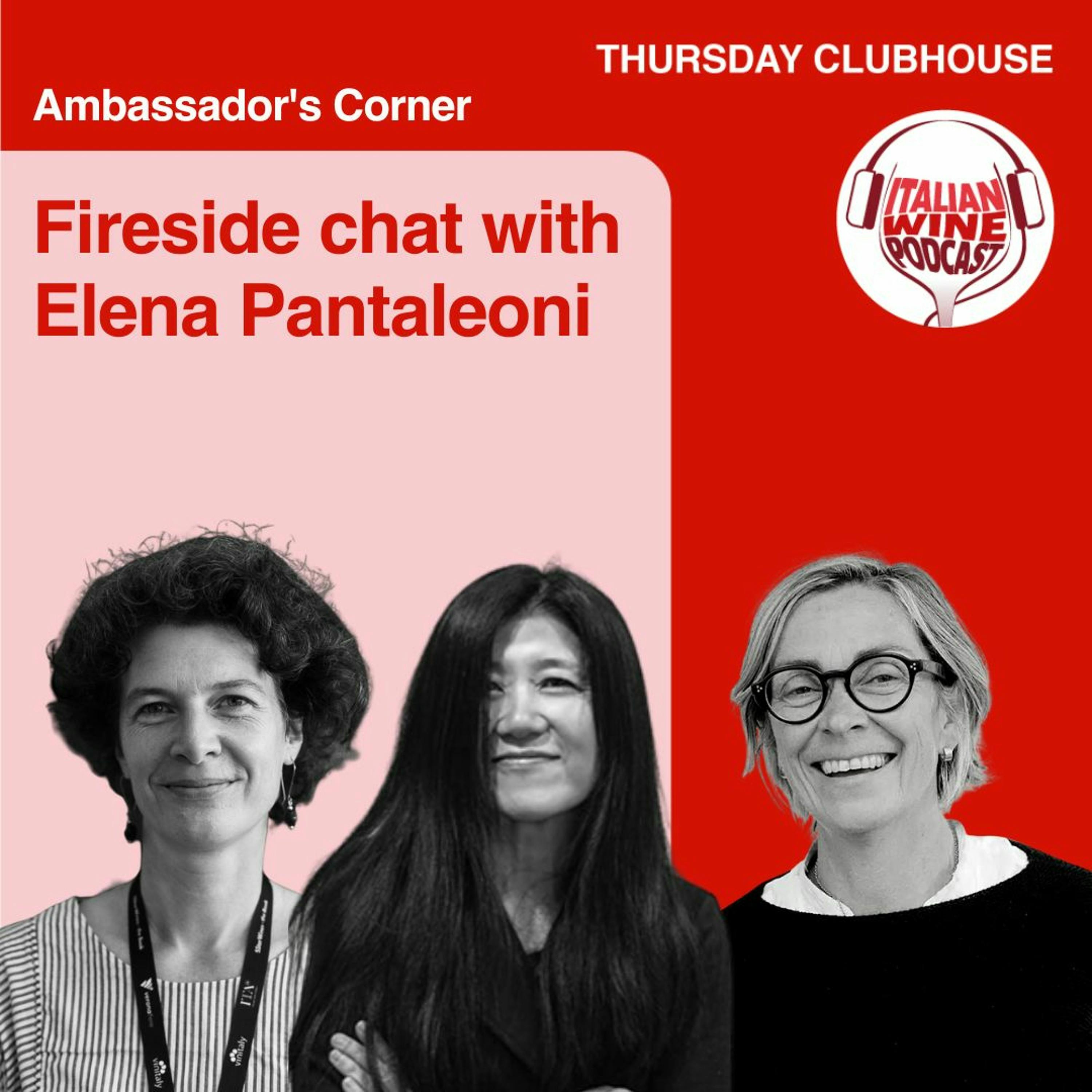
Ep. 1381 Fanny Breuil Interviews Elena Pantaleoni | Clubhouse Ambassadors Corner
Clubhouse Ambassadors Corner
Episode Summary
Content Analysis Key Themes and Main Ideas 1. The importance of regional identity and indigenous grape varieties in Italian winemaking, particularly in Emilia Romagna. 2. Commitment to organic farming, minimal intervention, and traditional winemaking techniques at La Stoppa. 3. The philosophy of ""craftsmanship"" and ethical business practices in the wine industry, prioritizing quality and respect over trends. 4. The strategic aging and unique vintage release approach to highlight the full potential and complexity of wines. 5. Adaptation to environmental changes and challenges, such as climate variability. 6. The integration of enotourism with sustainable agriculture, offering a holistic farm-to-table experience at the winery. Summary This special Italian Wine Podcast broadcast, recorded from a Clubhouse session, features an interview between Fanny Brei and Elena Pantaleoni, the owner of La Stoppa winery in Colli Piacentini. Elena recounts her journey taking over the family estate in 1991 after her father's passing, initially without a strong passion for wine but growing into her role. A pivotal decision was shifting La Stoppa's focus from international grape varieties (like Chardonnay and Cabernet Sauvignon) to indigenous ones such as Barbera, Bonarda, and Malvasia di Candia Aromatica, to establish a unique regional identity. Elena details La Stoppa's certified organic farming practices and non-interventionist winemaking philosophy, including spontaneous fermentation and long aging in large barrels. She champions ""craftsmanship,"" favoring collaborations with small artisans over industrial approaches, believing it fosters better quality and more meaningful relationships. Pantaleoni also elaborates on La Stoppa's distinctive wine range, including the entry-level Trebiolo, the representative Macchiona, the 100% Barbera Camporomano, and the long-macerated white wine Ageno. She explains their practice of releasing wines based on readiness rather than strict vintage order, demonstrating the aging potential of wines from a region often known for young, easy-drinking styles. The interview touches on adapting to climate change, Elena's inspiration from young, ethically-minded individuals, and the enriching experience of making wine internationally (e.g., in Chile). Finally, Elena discusses La Stoppa's enotourism efforts, which include a restaurant featuring produce from their own vegetable garden and animals, emphasizing a farm-to-table dining experience and the importance of sustainable agriculture. Takeaways * La Stoppa, under Elena Pantaleoni, has purposefully shifted to focus on indigenous grape varieties (Barbera, Bonarda, Malvasia) to express regional identity. * The winery operates with certified organic practices and a minimalist approach in both the vineyard and cellar, avoiding sulfites during vinification. * Elena Pantaleoni values craftsmanship, quality, and ethical practices, seeing herself as an artisan supporting other small-scale producers. * La Stoppa's red wines include Trebiolo (entry-level), Macchiona (flagship Barbera/Bonarda blend), and Camporomano (100% Barbera). * Their signature white wine, Ageno, made primarily from Malvasia di Candia Aromatica, undergoes extensive skin maceration, showcasing the potential of ""orange wines"" from the region. * Wines are often released years after harvest, based on their optimal drinking window, demonstrating significant aging potential for Colli Piacentini wines. * Elena finds inspiration in promoting a business model where ethics and respect are as important as profitability, serving as a mentor for artisan winemakers. * La Stoppa offers a holistic enotourism experience, integrating wine tasting with farm-to-table food from their own diversified agricultural production, including a vegetable garden, chickens, and bees. * Working with nature requires adaptability, as seen in La Stoppa's approach to varying vintages due to changing climate patterns. Notable Quotes * ""I always ask myself, why people come here to buy the wines, why we can sell our wines all over the world, because this is not a very known appellation. And so, to make Sauvignon Blanc or to make Pinot Noir, I thought that even if it was very good, it was always a copy of something that was already done from others."
About This Episode
Speaker 3, a wine expert, discusses the importance of small and craftsmanship in small and medium sized businesses. They use organic grapes, river soil, and wood to make their wines and emphasize the importance of maintaining balance between acidity and sweetness. The success of their company depends on the market and clients, and they have released twenty vintages and are selling twenty one wines. They emphasize the importance of being open and curious to taste wine and visit local wines. They also emphasize the importance of adapting oneself to the environment and being mindful of their work.
Transcript
Hey, guys. Check out Italian wine unplugged two point o brought to you by Mama jumbo shrimp, a fully updated second edition, reviewed and revised by an expert panel of certified Italian wine ambassadors from across the globe. The book also includes an addition by professoria Atilushienza. Italy's leading vine geneticist. To pick up a copy today, just head to Amazon dot com or visit us at mama jumbo shrimp dot com. Welcome to this special Italian wine podcast broadcast. This episode is a recording off Clubhouse, the popular drop in audio chat. This clubhouse session was taken from the wine business club and Italian wine club. Listen in as wine lovers and experts alike engage in some great conversation on a range of topics in wine If you enjoy listening, please consider donating through Italian wine podcast dot com. Any amount helps cover equipment, production, and publication costs. And remember to subscribe and rate our show wherever you tune in. Welcome to Club House Ambassador Corner. My name is Joy livingston, and I'm standing in for Stevie Kim. And Stevie and Leica are in Monte Falco right now, and they their internet connection is is a bit funny, I think, or they're in a winery with lots of echo. But nonetheless, I'm taking over tonight. And tonight, we have Fanny Brei, who will be interviewing Elena Pantaleoni. So, Fanny is from Anget in the loire and has always been into wine, and she studied agronomy, engineering, and inology. Worked as a winemaker in France, Italy, and Chile, and then as a salesperson for a wine importer in the USA. And in two thousand eight, she founded her company, genuine wines, with a deep willingness to help wine growers located in lesser known or underappreciated wine region. But that had, great potential, and she started with the Jura and Emilia Romagna. And since then, she's been helping them with their export markets as part of team. And aside from her main activities, within export, she also has a small Italian wine importing venture in France, and she also works on La Badans. A wine project. She makes wines along with Tomasui, a fellow wine lover. So, Fanny, that was, that was a lot of, words that I may have mispronounced. But, how are you doing today? Thank you, Joy. I'm doing very well. Hi, everyone. You didn't mispronounce anything. Actually, you did a very good job for all French words. Thank you. So I guess before I basically stop talking, I should ask you why you chose Elena pantaleoni. To interview tonight. So, for many reasons, mostly because I think Elena is a person who know how to prove her own road and to trust her own beliefs. This is how she led the estate into a organic farming and working without any chemical additions very early on at a time where no one was talking about natural wines, and she continued the work of her father who always wanted to produce quality wines, in Emilia Romania. You can't rely on the reputation of the ablation to sell your wines. Instead, you have to prove that your wines are of quality because the region is unfortunately, well known for quality. So there's lots of works, lots of fairs, lots of people to me to test your wines, and above all, you have to know how to keep your focus. And today, I know she inspires many winemakers, and I'm very happy to spend this hour and her company to discuss the wines and introduce her to to people who are not yet acquainted with Elena and La Stoper. That's great. So on the geekier side, is there any specific points that you really want the audience who's, you know, to take home with them, after the conversation today. First, the the importance given to the octopus grapes variety in this, small polypecentine region, which has always been an important topic for for many of us, also an introduction to the wines produced, from the white grapes in this region, which are beautified, world cluster, at Lastopa, with a full skin maceration, and also or the importance of, craftsmanship in the production of unique wines far from standardization. And this has always been l and s focus. And I think this is really important today to be a a away from standardization. This is a a topic that we've never be so important than now. That's great. So I guess without further ado then, I should mention that this conversation is going to be replayed on the Italian wine podcast, in a couple weeks. And at the end, I will come back after your conversation and find out if there's any questions for either of you. Elena, are you there? Yes. I am. Perfect. Okay. So I guess mine, I will just stop talking now and I will I'll talk to you guys after. Thank you, Joy. Hi, everyone. Let me introduce you, Elena, Elena Pantaloni, and I will share with you shortly here bio. Elena was born in Pecinsa in nineteen sixty five. She's Nate in from Coli Picientini, where she makes wine today. She's the last of three siblings, and she has a brother and sister. She first started working with books and music and had her own store in Petientsa. In nineteen ninety one, Elena Pantaroni took over the family state last stop at, located in River Garro on the first slopes of the Appenine Montane and worked a combined by Julia Armani. The domain extends over fifty eight hectares of which thirty are planted to vines and the remaining twenty eight are left to nature. Lastopa was bought by her family in nineteen seventy three, and before was run by a lawyer named Jencarlo Agino who discovered the place to be up for winemaking and started the production of squine with significant and curious names such as bordeaux, b o r d o, Pino, p I n o. Since the mid nineteenth, Lesopha decided to mainly cultivate the late barbera and Bonardo for the whites, all focus and the vineyard is made according to organic methods, specified by swallow and salutate. In the cellar, wood aging of the wine allows the wine to breathe and mature slowly. This is a necessary practice for the wine of Lastopa, which are made from grape, grown in a hot and dry climate. And bottle aging is also very important process, to improve and balance every element of the wine. At Lastopa, production is made with no desire to follow trends. In nine in twenty fourteen, Elena was one of the four producers in the movie of Jeanette Nassita, and it is without question that Helena pantaloni is a new spiral woman for many winemakers, especially those making artisan wines. She's also very super attemptive to the wine gras in her origin and spreading the words about wine from Coli Picientini and their specificity. Sure, Elena. Thank you. Thank you for this introduction. Anyway, so let's start the interview. The general question to start, can you introduce us last stop? The location, where is it, and the specificity of your one region? Yes. So last stop, as you mentioned, there is on Colley Piacentini area. So Piacenza is between Milano and Parma. So it's the law, it's the northers and the western province of, Mila Romania, very close to lombardy and to That's why our main varieties are Berbera and Bernardo. And, for example, we don't plant Lambrusco in our area, which is the main variety for the rest of Amelia. And, all the area is about five thousand hectares of vines, only on the hills. So potentially quality production because the yields are lower. And, we are on the first hills at about one hundred and fifty meters on the sea level. On a very red clay. So very rich in iron, very poor in nitrogen. So that's why we make these, long aging wines mainly. What made you decide to take over the demand in nineteen ninety one? Unfortunately, because my father passed away. And, my mother at that time asked me to try to help her and to give an opportunity to myself and to my family to take over something that, wasn't really my dream or my goal, not to have, a winery, but mostly my, my father, vision and my father, dream. And so at that time, I was twenty six. And I said, to myself, yes, I can do it And, so I I came, in a very, I would say, humble way because, the estate was already established and there were people working here. So you mentioned Julia that is still working with me. He started in nineteen eighty. So he was here already, and I gave myself an opportunity to, you know, to make this job and to find the the way to, to make this job more closer to me. To my because as you mentioned, I had a bookshop. This is my other passion, reading, and, and books. And and so it was, I would say it was a sad, opportunity. It was a sad moment, you know, because my father, passed away. So But at the end, it was a good reason, a good, a good thing. At the end, I have to say that. I wasn't born with my with wine as a passion, you know. This was something that came along in time. In the nineteen eighties, at La stopa, there were parcels of traditional French grapes, chardonnay or sauvignon, cabernet sauvignon. Can you explain what made you change the vineyard's grape variety from French to local grapes. After a few years, I was here. We were making pinot noir. We were making sauvignon blanc, and, and then I said, we we have to work on identity. I always asked in the past also now, I always ask myself, why people come here to buy the wines, why we can sell our wines all over the world, because this is not a very known appelation. And so, to make sauvignon blank or to make pinot noir. I thought that even if it was very good, it was always a copy of something that was already done from others. And so I didn't want to make, a copy, even a beautiful copy. So I thought it was better to make something with, with more identity and working with more local varieties, such as Barbera and Bernardo and Malvasia, mainly, that are very suitable for this climate, for this type of soil, to give more personality and identity to the wines and to the estate. That was the reason. So I started in ninety six to replant. So every year, one year, one actor, two actors. We started from Pinonoa, from Savignon, and then, then, also, Cabernet, and Yes. I think, above all, you wanted to produce wines that really reflect the the area, the terroir, from which the grapes are from. Can you tell us more how do you work in the vineyard and how do you work in the salon? Yes. So we have certified organic since long time. As I mentioned before, the soil is very rich in iron, very poor in nitrogen. So climate, you know, talking about climate now is kind of, tricky thing. But, usually, here is quite dry and windy. And so, during all these years, we thought that, long aging wines with, structure, were the more suitable for this type of place. And so we work very few in the in the vineyard. So we just cut the grass and we work we make a very superficial, work of the soil. And, we work mainly by hand. So we make some treatments with, copper and sulfur, of course, with the tractor. All the rest is made by hand pruning and harvesting of course. And then in the cellar, we make spontaneous fermentation. We don't use sulfites during vinification. So we want to preserve the characteristic of the place and, of course, also, of the vintage. So we change, every vintage according to the quality the grapes, the time of skin contact, or the the type of working. We use mainly in ox tanks for the fermentation and the maceration. We have some concrete tanks too, and then big, barrels in, in both be for the aging for most of our wines. So we are very respectful, and we try to to preserve, you know, the characteristic of the place and of the vintage in every in every wine and everything from a more general point of view, you are very sensitive to craftsmanship, and this guide's choices for collaboration with suppliers in the wine world, and even beyond, how do you see this word of craftsmanship today, and, does it have a surface a sufficient, place. Talking, especially of Italy, the, really, the, the strength of Italy is all these small artisans in any field that really is, I think, the strongest point of our country. And I'm also an artisan. So I prefer to give my money to someone like me that works very good way in terms of quality, in terms of passion, and it's a small thing. But I always say we have very, very few freedom, but for sure, we are free to choose every day how to spend our money and our to spend our time. And so I prefer to spend my money with artisans instead of industry. And in a way, I think I support this type of companies. It's a it's not I don't think they have sufficient place in our time, the work of craftsmanship, but I I like to to be one of the few, maybe, that support them. I like to deal with them also because if there is a problem in in any field or in a machine or wherever, I can talk directly to the people who make this tool or whatever or a buffing machine or what or a pamper. And so it's a very it's a more interesting conversation, I think, not with these people. Yes. Yes. That's some truth. Well, back to the wine, Lastopa produces many red wines, from Barbera and Bonara. We we we we talked about it just previously. Can you describe the wine range you produce at the domain? Yeah. So we make, an entry level wine called Trebiolo. She's, also Barbara and Bernardo from young guys or from the lowest part of the vineyards, in the vineyards that are berries that are bigger. So there is a different relationship between skin and juice. And, so they are more suitable to make this type of fresh, and easy drinking wine that make no aging in wood, just, in ox, and so we release the wine more or less one year after the harvest. And this is the first, the entry level wine, Trebio. And then we have Machona, which we think is the most representative wine of our estate. So also Berber and Bernardo, usually it's fifty fifty. And this is the selection from all vines from the per part of the vineyard. So where the berries are smaller, and we make about one month on the skins. They are not co fermented because Berbera arrives before Bernardo. So at about ten, fifteen days before. And then we make the the blending, and it's, very long gauging wine in, in big bottles. So these wines could be good, which is the oldest, the DOC of our eye area. We are out of the DOC because we chose like this for many reasons. But these are very traditional, traditional wine. We stopped making, spartan wines in the two thousand fourteen. So we are just making steel wines. And so we were better and Bernard together, we make these two wines. And then we make a Berbera, one hundred percent called the camperomano. And, it's been modified like, macchiana, so a long maceration about forty days, and then a long aging in, in barrel. And these are, the three wines that we make out of, berber and Bonata grapes. There is not only wild grapes. There are also whites. And one of the grape is, alvasia de cande aromatico, or trogos, a very local grape. What's the specificity of these grapes and what type of wine do you do you produce? Let's talk about Malvasia deica and aromatica. We know there are different Malvasia. Yours is the specific Malvasia deica and the aromatica. Our Malvasia is the among the most aromatic ones. So it's very close to Moscato that maybe is more known as a very, as a as a quite big cluster, and it's quite productive, as a very thick skin, but, the specificity of of the grape is really these, romanticities, really, very fruity, very interesting grapes. And also, it's very, in a way, it's rustic. It doesn't suffer too much of, rain or bad conditions. So it's very resistant. And in Italy, I think there are, like, sixteen different type of, grapes, all called the Malazilla. There are also some red Malazilla, some, non aromatic But this one is mainly cultivated in Piacenza in Parma and more or less this is the source of this, of this variety. And we make, two wines out of this grape. One is a genome that is our dry white wine. We only make one dry white wine, and it's with very long skin contact maceration about four mumps, three, four mumps. And the percentage of Trebbiolo and tortruggo now is very low. Because, we planted more Malazia. So now it's mainly ninety percent and ninety five percent Malazia. And we have been making this wine since two thousand two. So it's twenty years that we have been making it. We so we stopped making in the sauvignon bla in ninety five, and then we were without any dry white wine for, seven years. And we were thinking that if we wanted to make a wine that really reflect the, the place, why changing the minification according to the color? Of the grapes. So probably in this area, it's more suitable. It's better to make a wine also with white grapes as a red, not with long skin contact macerish. And, and the geno is the name of the founder of the estate. So it was like, an homage to to the first person who really gave value to this place. And then we make aceto. So, we lay the grapes outside in the sun in order to concentrate the sugar, and we make now it's called Vino del volta, and it's a Malvasia Pacita. So, the shirt wine, suite one. These are the two wines that we make with Malvasia. Just about the suite Malvasia, here, we just talked before war, how much this is important to make wine, taking care of the environment. And here, this is a great example. Right? You are in a you have a warm and dry after season and to to produce this for each wine. Yes. Of course, the the quantity of, of sugar raised, we we have been making this wine since ninety five. So at the beginning, for sure, the wine was less sweeter. Now it's sweeter, but still has a good balance among acidity, among, freshness and, and sweetness. Yes. Italian wine podcast, part of the momo jumbo shrimp family. I agree. I have always heard you saying, that the wines need time. They wines made at last top. They need time to develop their full expression, the complexity, the potential. What are the vintage available today? And do you still have a reserve wine, that you you continue selling. Our current release of Barbara of Campo Romano, for example, is twelve. So we have, we haven't made all the vintages, but we still have a lot of vintages after twelve. And, of Machiana, we we go back until two thousand two. We don't have all the vintages, but we have two thousand two, six, nine, ten, and twelve on sale. And we just released, fourteen, just in Magnum. Because it was a very difficult vintage, a lot of rain. So we we could make just few liters, so we decided to make just magnum. So the only reason we can have all the wines to sell is that we introduced more, that we usually sell. And this is the only way to keep some bottles. And for us, it's very important to have all the wines on sale to show that the, really, the aging potential that these wines have. And also, because this region is most known for very, easy and young wines, but, it's not just that. We can make very, very long gaging wines also in Amelia. And does it mean that the vintage already one after another or or can you that it or it doesn't matter if you you can switch from, vintage, twelve, and then fourteen or back to nine to nine. Yes. Yes. Yes. We for example, in the case of talking about Machona, we released before thirteen, and then, afterwards twelve, because, every vintage has a different profile. And, so there are vintages that are, ready before. There are vintages that need more time. And so, we have this freedom. Not in order to give a better wine for our clients, you know, we decide to keep some some vintages longer and some others to release before. And and do you feel the customers, realize the luck to play like this with different vintages, how is it welcome to the market? But it depends on the markets. It depends on the people. Of course, it's it's a challenge. Always, a good part, a big part of my of my time and my, my, is also to choose the the right client for these type of wines. We don't make millions of bottles. It's very important to choose the right clients that really can, appreciate what we do. And and when they trust us, they trust us also, and they and they follow us also on this, changing of vintages and, so it's just a question of wine and and I give you the wine when it's ready. And when it's good to to be drunk. So, of course, Trebbiolo is a different story. You know, Trebiolo is the entry level one. We release twenty one. Now we are selling twenty one. In few months, we will release twenty two and and this is more, normal, I would say. But the other ones, you know, people, life also that. A general, we released before seventeen, and then we released nineteen and sixteen together. And then we released eighteen, and now we released twenty. And, yeah, no, no. It's, people understand. So so, a a vintage is, a little like, the weakness of a moment now a year of how was the the climate all along the season. Having still the two thousand twelve reminds you how was the vintage. Do you see changes more recently with the more recent vintage or or not that much? Yes. We we see things change very, fast. So, for example, in the last four vintages, nineteen, twenty, twenty one, and twenty two, we had, surprisingly more production. The wines are lighter in a way. And we had, in total, I mean, generally speaking, you know, in terms of of wine, we have fresher wine. So we had rains in the, in the good period, not much, but we had rain. We had, cooler periods too. And what what what has changed, is that, really, and the seasons are not so, as before, not so spring was, I don't know, rain and and cool weather. And then summer. And then now it can rain in summer. It can be very warm in springtime. So it has changed in terms of, we have a lot of rain all in once, you know, can be also. And, but, you know, if you work with, with nature, you have also to accept that, things change and, also accept that, You have to adapt yourself to the place where you are and to the and to the conditions that you can't control. And the wines will be the result of these, changements. And this is the way we you have to deal with nature. Otherwise, it's better to change job because you can't control a lot of things when you make wines. All the risks to take on the the winemaking. So without ever positioning yourself, as a leader, you are along with, friends of yours. I'm thinking of, Elizabetha Feradore or more, just occupying. You are mentor to to many winemakers. Who work also, who makes also artisan wines. Where do you find you the inspiration to go forward? No. I think, I still enjoy a lot my my life because, you know, after a while, you don't consider your job, just a job. This job is is our life, and, gave me so much and still gives me much in terms of satisfaction and passion and good people, around I believe that we can do some, some changes. I believe in every person who can, of of the power of each single person. And, I am lucky to to be I have a lot of young people around me, and, that works with me or that follow us, and, and this, to see these young people. So, series on on on environment on, on this idea of the community, you know, and also to be to see that a different way of making money in a way, you know, to making to make a company is possible in, putting ethic, putting respect as a goal. No? And and in any way, these, these estates can be profitable without thinking all the time at money. I don't know if I can explain well what I'm thinking. So this this gives me the the the inspiration and the strength to to go forward and to and to, and to follow with, with our ideas, with our wines, and to use our bottles as a media, you know, to talk about the, the choices that we took and, and, and, of course, how how privileged, how lucky we are, you know, to to work in nature, to live in beautiful places, and and to and to have people listening to us also. And so it's also, like, at night. Yes. It's also a big responsibility, but but makes we only make wine with consciousness and with passion, and we are we try to be serious. And this is something that we can share with a lot of people. And if we can also be like an example of making a good company with, good people around, respecting the people, respecting the place, the soil, the environment. It's it's a lot. So it's, yes, it's something that still inspired me. Yes, my job. And the people I have around. I think this is a good words. I'm arriving almost to the end of my question, but, if, any of the audience, if you have a question, you're you can use the chat. Don't hesitate. It's it's going a little outside of Italy, but you also do wines in Chile, also from local grapes, from chile, local grapes. So does it does it making wines outside of Italy? Does it help you also? Understanding more what you do in Italy? Is it helpful to to to have different experience? It's twice harvest a year. It's good. It's a train. Is it a place for you to continue understanding more where you are and where you live? Yes. For sure. What help does, a lot help me is to be open and curious and and taste a lot of wines and and visit a lot of places where people make wine. And this helps a lot to open your mind. And to focus more, on identity. So, also Chile, you know, Chile is such an amazing place because, it's the only place in the world where I where I saw thousands and thousands of actors of plants without, how do you say, Progressive? Without, rootstock. No. How do you say? I see, yeah. Yeah. They're rootstock. That's Yeah. This is where. This is the work. Perfect. Fortinet. And so and and they have, like, two hundred, three hundred years old plants, Pais, of, moscatel delexandria of, see, they they don't have any auto tone varieties, but, if the the Spanish people know, they they the conquerors went there and, and, like, five hundred years ago, And so and then you see all these, cabernet sauvignon from Chile or, chardonnay or sauvignon on. And they have such a treasure. So full of identity and full of tradition, and that's a very, like farming purpose part of the of the life of the people, not this type of wine that you that you drink during parties and And so, of course, yes, every every travel, every experience is also is always very in in writing, enriching, enriching, enriching. Yes. It's a tough, organization to have a two to being too harvest in one year and so far away, but, but it's interesting. Yes. Easy person. Thank you very much, Elena. I am for for your time. I was very happy to to to share with everyone your your experience and and also this, pioneer, position now on being in a lesser known region and and doing wise of high quality, far from, the the the usual and what's easy, you know, keeping the wines so long time, aging, not being afraid of, selling, two thousand two. I'm very admit admitted. And, I think this is, really a a change for our wine world. Thank you so much, sir. Thank you for this opportunity, Fanny. And, if I can add something, Fanny came to, to our state in, what were ninety nine? Ninety eight? Wasn't with ninety ninety nine. Yes. She arrived here to make a stache. And, from that moment, we always We have always been friends, and also, Yufani was such a great, experience to, to get to know you. And she she has she was a hard, very, very hard worker. It was nice working in this great domain. Thank you. Thank you for this opportunity to you and to all, of the people of this, Italian wine community. And, thank you for the people who are listening. Thank you so much. Well, that was that was fantastic. I, I did, I'm not sure there's any questions. I do have a question, though, or two. Actually, I noticed on your website, do you have an inotourism thing going on? Do you guys grow a lot of your food on your on your property? And and then you make it what kind of things do you do for the inotourism? And, like, are you pair it with your wines? Or Yes. So I think it's very important to leave our to have our wine that is open to visitors. And so we organized, our team in order to have, people that speak languages and can attend people, that want to to see where the wines are produced. We opened a restaurant, free lunches, free services, a week. So, Tuesday, Friday, and Saturday. So you can come and visit, or you can come and visit, and avalanche. And we have added in the last years, some other reductions, such as by the first word, bees for the honey. And then we have a big vegetable garden, and we mainly cook our vegetables. And then in the last two years, we added chicken and goose and duck, and so we add eggs. And, and so this is also very important because, you know, people come here and are ready to pay for the visit because we make wine. And, to have this part, the more, like, farming part gives me the, the opportunity to talk about farming and to talk about how important is what we eat every single day. And also is, something that we wanted to to add to to the production of wine. This is what we we do. So Okay. So with the the farming and the and the vineyards, and I I could be wrong here. I I heard last year there was quite an issue with water. Did you have any problems with water? And if you did, We have a yes. We but not on not on the vineyards by now, hopefully, won't won't be in the future. Of course, with the vegetable garden, yes, it's more an issue. What we did, for example, we we use a lot of things also to to to transform. For example, like the tomato sauce. So we had, much less tomato sauce, but was, very good. Of course, you have to choose, for the vegetables, you need water. We make ice. And, boom, and that's it. Yes. It still is tasty. Okay. No. That was I was just wondering because I know that, you know, last year, it was really hot. So then a lot of people were complaining about the water. And so then, you know, I'm assuming this year will be the same, but it seems like you already, it's fine. It's it's it's not a problem. So For the for the vineyards, I mean, we also planted the two new vineyards, last year. And, yes, they they are not really suffering at the moment. For the vines, for the rest, they are old. The roots are very deep. At the moment, no problem. But it's true that we produce very, very low. So we don't we don't push too much the production. So Well, Fanny Elena, I think this brings us to the end of our discussion. I don't see oh, I see something. What does this say? Ah, Andre, but Keelan. Hi, Andre. Awesome. Hi, Andrea. He he want to say hello, and also from a Franchesco Pascucci. That you know very well. And, he's he's texting his wines right now. Benny, thank you. From Faraway, from Latonia. I'm just adding Yeah. I'm adding, an important information. We have that stope is celebrating the fifty years this year. So Elena, he's not doing only one event. It's, the festival for the whole year, and also she has organized in the domain different events, once a month You can meet, of course, you can taste plus topa wines. It's, the birthday party, but she also gather with friends or the winemakers, and this is a very nice way. That explains also how he's now when I was saying to bought in wine brewers. Well, it's you can go and taste in April. It was with Pimonte producers, then they are from, CCD or, or Trento. So that's very nice. And, happy birthday, Elena. Thank you. Thank you so much. Thank you. Good night. You guys. Thank you so much, and thank you to everybody who is who's listening. And there will be another clubhouse, likely next Thursday as we do this every Thursday. And, thank you to everyone. And then, Fanny, thank you for for everything tonight. That was a great conversation. Thank you. Goodbye. Have a good night. Bye. You too. Listen to the Italian wine podcast wherever you get your podcasts. We're on SoundCloud, Apple Podcasts, Spotify, email ifm, and more. Don't forget to subscribe and rate the show If you enjoy listening, please consider donating through Italian wine podcast dot com. Any amount helps cover equipment, production, and publication costs. Until next time.
Episode Details
Keywords
Related Episodes

Ep. 2793 The Importance of a New Approach to Wine Education with Alexandre Centeleghe and Lisa Lazzaretto IWA | Clubhouse Ambassadors' Corner
Episode 2793

Ep. 2771 Ep. 11: Dordogne & South West France | Study Smart for your WSET Level 3
Episode 2771
Ep. 2764 Ep. 10: South of France | Study Smart for your WSET Level 3
Episode 2764

Ep. 2758 Ep. 9: Southern Rhône | Study Smart for your WSET Level 3
Episode 2758

Ep. 2753 Part 1 – Changing How America Learns about Wine | Heart-to-Heart Conversation with Sarah Looper
Episode 2753

Ep. 2747 Ep. 7: Beaujolais | Study Smart for your WSET Level 3
Episode 2747