
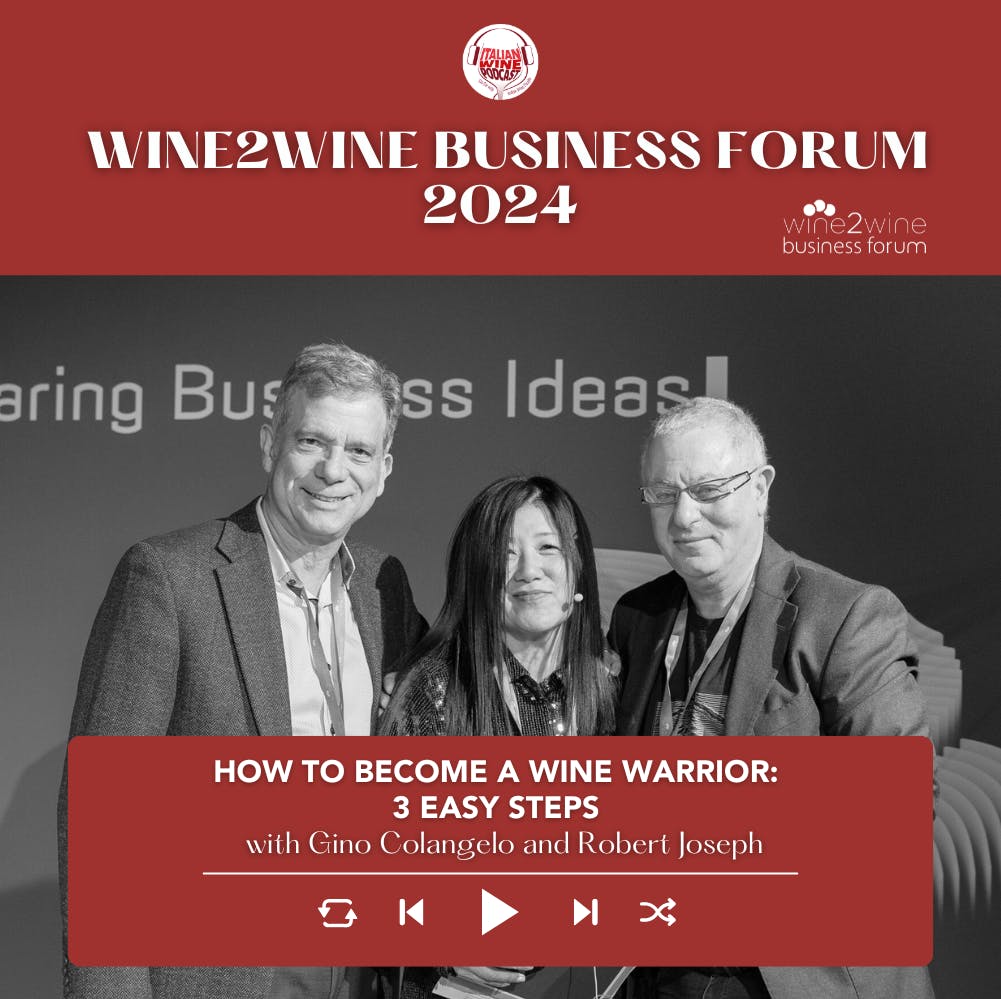
Ep. 2231 How to become a Wine Warrior: 3 Easy Steps | wine2wine Business Forum 2024
wine2wine Business Forum 2024
Episode Summary
Content Analysis Key Themes and Main Ideas 1. The declining global wine consumption and the industry's need for adaptation. 2. The debate surrounding promotional campaigns like ""Come Over October"" versus health-conscious trends like ""Dry January"" and ""Sober October."
About This Episode
The speakers discuss the importance of embracing every aspect of fermented grape juice in the wine industry, including adopting it into the broader lifespan and acknowledging loneliness and alcohol. They emphasize the need for social media and coffee to combat loneliness, promoting the past and highlighting historical shifts in consumption. They also emphasize the importance of finding ways to insert wine into a broader life style, creating connections and engaging with consumers, and celebrating the enjoyment of life and stopping talking about risks and risks in the industry. They emphasize the need to stop shooting at each other and be active on social media to create connections and engage with consumers.
Transcript
As an industry, we have to stop shooting at each other. We have a circular firing squad. If I talk about bourbon barrel wine or fruit flavored wine, or non alcoholic wine, or whatever, I can guarantee there are people in the wine industry who say, no, that's not wine. Wine should be this. No. We need to embrace every broad aspect of fermented grape juice. And we need to insert fermented grape juice into the broader lifespan. Official media partner, the Italian wine podcast, is delighted to present a series of interviews and highlights from the twenty twenty four wine to wine business forum. Bringing together some of the most influential voices in the sector, we discussed the hottest topics facing the industry today. Don't forget to tune in every Thursday at three pm or visit Italian one podcast dot com for more information. Where do we start? We have so much to cover. There's so much going on in the wine world right now. And first of all, we do have to address come over October. Now, first of all, how many of you have heard about dry January? Okay. I would say forty percent. Yeah. I think moved to heart. I think more. How many of you have heard about sober, October? Maybe a bit less before coming to wine to wine. Okay. A lot less. Okay. So, of course, Gina is one of the partners of come over October. And I don't know if you've been following this in August, Robert Joseph had this editorial. He runs an editorial. It's at mining earth wine business, and it's called the devil's advocate. Right? So and he had sober October versus come over October. And then, of course, Gina being one of the founding members he did an op ed. So, Robert, why don't we start with you? Why don't you tell us a little bit about what you've written? So I love the idea of speaking up for wine, and I'm gonna come back to that in a minute. However, I have some strong reservations about come over October. Very briefly. Number one, it stemmed from Karen's absolute dislike of dry January and sober October because she actually penned a piece which was said why I hate dry January. So the first thing I'm gonna say is what is dry January? It's a month where people don't wanna drink. It started out for charity, by the way, it's for cancer charity by a woman who is gonna run a half marathon and she needed to get fit and she stopped drinking alcohol for the month. And I have Sommelier friends. I've got lots of professional friends who don't drink alcohol during January. So I have very little patience with anyone in the industry saying, Hey, you have to drink every day. We talked about the betting industry. If we said, oh, I'm gonna take a month off betting, how would you feel about the betting industry saying, no, you've got a bet every week. We don't. So that's number one. Secondly, there is the concept that wine is going to combat loneliness. This is implicit in some of the the the messaging. Actually, if you do look, there's been a lot of research into loneliness and alcohol. And to be fair, it is not conclusive. However, there is a lot of evidence that suggests that lonely people rely on alcohol as when they're by themselves. So having them over to your place and giving them something to drink is not necessarily the concept. Thirdly, I don't like the idea initially that it was October. Yeah. Why not do this all year round? And lastly, why does it have to be just wine? I'm gonna come back to that in a minute, but if we really care about loneliness, let's just get people to come over and have a convivial time because, ladies and gentlemen, here is the little secret. Why is not the convivial drink? Tea is globally a far more convivial drink for more people in more countries. And by the way, beer is a pretty damn convivial drink. And last night, I went out with two people in the room and we had some gin and tonics and vermouth, and they were pretty damn, convivial. And for people who like it, weed is convivial, and for the people standing outside office blocks sharing a cigarette that cannot smoke inside their building. Those cigarettes are convivial. So let's look at this rationally. I love the idea of doing something for wine, but we're coming back to this. I think It's trivial. I think we are whistling or playing the violin fiddling while Rome is burning. At the moment, the most recent statistics I have seen say that only thirty four percent of Americans of any drinking legal drinking aid ever drink wine. That thirty four percent includes people who only drink once or twice a year. So we have to talk about the sixty six percent of the American public who don't drink wine at all. And we also need to talk about the thirty seven percent of French consumers today who don't drink wine at all. We've got a huge problem, and I don't think sober October is going to be the answer. Okay. Gina. Mister Gina Colangelo, would you have something to say? Now I can be equally self critic Karen's video that she posted was tongue cheek. You need a sense of humor from saying that. We may not have the same sense of humor. We needed to make a stand. We felt we needed to make a stand for wine. We are wine professionals, wine communication professionals, It's okay to get together without a glass of wine, but the point of that campaign of our campaign is to get together. And there is a lot of isolation in the digital age as a lot of isolation coming out of COVID. There's a lot of acrimony in the US right now. I assume everybody here is aware we have a, an election tomorrow. And come over October absolutely struck a cord with Americans from importers and distributors and retailers to consumers, ultimately consumers determine the success of the campaign, and people embraced it. And they embraced the message which is wine does bring people together. I failed to see a lot of people drinking tea at dinner last night when I was out in verona, and I failed to see much interest in beer. I see lists of hundreds of bottles of wine to pair with my meal, but there might be three beers on that menu. So I reject the idea that wine is not the communal beverage for eight thousand years that brings people together. And I think we all need to celebrate wine and actively promote and not engage in semantics and sophistry. October's past now. Right? We're officially in November. What are the plans for the campaign? So we have a spring campaign that we will launch in the coming weeks. It will be something to Robert's point. It's not good enough to promote just for one month. The next campaign will have legs. Let's say, throughout the year, but we will focus the campaign in the spring. And then we expect come over October twenty twenty five to be even bigger, much bigger than this year. As you can see, they have two opposing views, if you will. Opposing views on how we communicate. Yeah. But not opposing views in terms of we both celebrate wine. We both love wine. We're both in the business of wine. Yes. Absolutely. I was about to say that, but it's okay. That's okay. No mansplaining. Allegantly put Yes. Okay. But, you know, the great thing about wanting to line is that we have this community of sharing business ideas. And this is what we do, and I knew I could count on them. We met last night at a bar, at a restaurant, and we had this topic, what we can talk about. So there are many things that came to our minds, the historical shifts in consumption, you know, the confronting the health narratives. Of course, we've touched a little bit about the health versus well-being moderation in lifestyle trends, purpose of wine related campaigns. There's just so much that we can broach, right, the convivial nature of wine which Robert has addressed, and expanding inclusivity. And something that we did also touch that maybe we can talk a little bit about this historical shifts in consumption. There's no more denial. Right? It's no longer a fad because we have to think about whether it's a fad or a trend. It's definitely a trend. So seeing that we have very little time, given the steady decline in wine consumption, what strategies could the wine industry adapt in your opinion to retain appeal I know you guys hate when I save this among both younger and other demographics. So, by the way, just a quick statistic, wine consumption last year, wine sales in the US dropped by eight percent. Spirits went down by four percent. And the trend away from wine has been going on since nineteen seventy, which have fifty years during which spirits and beer have been moving up, and wine has been moving down globally. Now how do we fight that? We actually stop obsessing with wine. We stop thinking that it's all about wine, and wine has an entitled place, and all we need to do is just get more people drinking it and the people drinking it actually drinking more of it, because it's a natural thing for them to do. It isn't. There was a moment when we actually stopped on horseback. Until then, horses were what we had. And we've had horses for eight thousand years, and then we stopped. There is no reason why the US consumption shouldn't go down by eight and another eight and another eight. So what do we need to do to your question? We need to look outside wine. We need to start inserting wine into a broader life style in every sense, in media, in messaging, in conversation. So essentially, every time we talk about travel, every time we talk about food, every time we talk about culture in all sorts of ways, we should be looking at ways to insert wine of every kind into that. And the second thing is, as an industry, we have to stop shooting at each other. We have a circular firing squad. If I talk about bourbon barrel wine or fruit flavored wine, or non alcoholic wine, or whatever, I can guarantee there are people in the wine industry who say, no, that's not wine. Wine should be this. No. We need to embrace every broad aspect of fermented grape juice, and we need to insert fermented grape juice into the broader lifespan. Because as I said, we have thirty seven percent of French and sixty six percent of Americans who never touch it. Those are the people we need to insert wine into because wine consumption, alcohol consumption per capita is going to go on going down not because of WHO, cancer warnings, but because of general well-being, wellness. How do I feel in the morning on a Wednesday morning after I've had a drink last night? That kind of mindfulness, which a lot of us think is a good idea, is going to grow. I, agree that wine needs to be inserted into more conversations. I think we all need to be more social with wine. Wine is a social beverage, and there's a lot of stories behind wine that to tell. So be active on social media, but beyond your typical circles, go to consumers, meet consumers where they are to Robert's point in whatever lifestyle position, you know, wine with food, wine with travel, There are companies in the US doing a really good job. Jackson Family, for example, is now sponsoring the NBA. So you could, you know, have a glass of wine while you're watching a basketball game, which was typically a domain for beer, for example. But coming back to the social aspect, Stev is probably the best example I know of somebody who has built audiences and engaged new people in the world of wine through social media. You can do that from your computer, from your vineyard. You can reach new consumers, you can tell stories. You can be personal with your messages. You can talk about that you love to ski. You love to race motorcycles. You, you know, make yourself available and human to those consumer audiences and be on social media. And, conversely, to that, be present in the market, at least for the US. It's just so critical to make human connections. As Karen mentioned in her video, AI has enormous capacity for learning and for quick access to information, but it also can further distance ourselves from each other. And the wine producers who are in the market, connecting to consumers, gathering data, saving emails, sending a follow-up, those are the ones who are gonna be successful ultimately in the market. I would ask how many people are collecting email addresses of everybody who visits your winery and how many people are sending follow ups with special releases or scores or interesting things that are happening at the vineyard. It's a concert in order to insulate. Give me an example last night. Can you share that? Give without naming the wondering. Yes. Okay. So I have a client, an unnamed client. Let's not get specific. Okay. But I'm a substantial one. A substantial client who won a major major major award from a major major publication, and their importer imparted a lot of that wine and didn't sell right away. And I asked that producer if there was a shelf talker on the retail shelf promoting the wine of the year designation. If there was something on the bottle, if there was some promotion to the distribution, a cell sheet, something basic. Right? No. No follow through. So following through in the most obvious simple steps that to us communications people, our second nature, are not always so obvious to producers or to import us for that matter. And just to pick up on that, I was talking about, because I produced wine in in in France, we were lucky enough to get a sticker, sorry, ninety two points from the enthusiast. We got a listing from Costco, not because of the ninety two points but because of the sticker, we put on the bottle, saying ninety two points, we then sold the wine in Costco because of the sticker, and they reordered it for that reason. And I'm gonna say just quickly picking up on on what you were both saying. My New Year's resolution for twenty five picking up what we're gonna do. I'm looking at fashion shows. I'm looking at bookshop. I'm looking at art instal art events or whatever. I'm looking anywhere where there's a gathering of people who might be the right kind of people to buy my wine and saying, can I insert my wine into that event where people who don't read wine columns or wine magazines don't even necessarily go into wine shops that often are exposed to my wine on an occasion where they might be in the right mood to remember it? But I need to pick it up on Gina's point. I need to get their, whether it's their email, whether it's their Facebook or Instagram. I need to find a way to go on communicating with those people on the long term. Okay. So last topic that no low. What are we going to do with that? No low. No and low alcohol? Yes. No. I'm making it. So that's my answer. Is it the answer? No, but it's one answer. We have to acknowledge that there are a lot of people who, for whatever reason, do not want to drink wine today. It may be that they don't want to drink wine at all, but the statistics in America show that the people who are drinking non alcoholic beverages are the same people who drink alcoholic beverages often on the same occasion. So I am trying to do it. We'll see whether it works. All I'm saying is you guys in the industry, I don't mean in this room, don't shoot at me for doing it. Watch what I'm doing. If I and other people succeed, maybe follow it. The beer people are doing really well with it. They're doing it better than us, but they're doing up to ten percent now of sales of some beers, some beer companies are non alcoholic. So if you ignore it and in Italy, you've got laws against making it, which is crazy. To be, it is part of the fermented grape juice market. You're addressing beer. Beer is much more conducive in the brewing process to making an a no alc. A wine no alc actually requires a lot of intervention, a lot of energy and a lot of even chemical interventions. So I'm not a huge fan, but I will say this. The biggest consumers of non alcoholic wine are wine drinkers. So there is a place for it on the in the market in our campaign for come over October. You know, we acknowledge that some people don't want the alcohol, and then they should have a non alcoholic wine or something equivalent. I think there's a place for it in the market. I don't think that ultimately it's the most natural or even healthy beverage because of the additives to it. So personally, I'm not a big fan. And I think there are some, low alcohol wines that are low alcohol naturally and have always been low alcohol, like, Chaculae in Spain, for example, or Moscato. And you could drink those wines all day long, but they're made as they were intended to be. Just quickly, we can have a longer conversation about additives. There's no reason for any nonalcoholic or de alkalized wine to be any less healthy than the equivalent wine. So that's a separate argument, but I think we're on the same page there. Can we just quickly do the three steps? I thought we already did, but I No. The recap of the three steps. So first, I would say be social. That means social media, but it also means engaging can consumers where they live, be present in the market. There's no substitute for meeting your consumers and then following up with them with an email or meeting them at your winery or meeting them at a wine dinner in New York. And three, be creative. Be creative about yourselves, your own live. Everybody here has interesting lives that are doing interesting things and be willing to share that and be creative in your communications. I think you've actually covered most of the things I'd like to say, but I'm gonna say just go back to it. Celebrate wine, but celebrate the enjoyment of life. All this stuff about risks and so on. Everything we do has a risk. So anybody saying, oh, there's a risk of x of getting cancer, we drink wine. Actually, there's a risk of driving from here to Rome. So if you're going to Rome to have fun, it's gonna be part of your life. So number one, to actually stop talking about that, but actually just focus on wine being one of the good things, one of the good things in life and insert it into all of those other places where people are enjoying good things. Listen to the Italian wine podcast wherever you get your podcasts. We're on SoundCloud Apple Podcasts autify himalaya FM and more. Don't forget to subscribe and rate the show. If you enjoy listening, please consider donating through Italianwine podcast dot com. Any amount helps cover equipment, production, and publication costs. Until next time, Cheaching.
Episode Details
Keywords
Related Episodes

Ep. 2793 The Importance of a New Approach to Wine Education with Alexandre Centeleghe and Lisa Lazzaretto IWA | Clubhouse Ambassadors' Corner
Episode 2793

Ep. 2771 Ep. 11: Dordogne & South West France | Study Smart for your WSET Level 3
Episode 2771
Ep. 2764 Ep. 10: South of France | Study Smart for your WSET Level 3
Episode 2764

Ep. 2758 Ep. 9: Southern Rhône | Study Smart for your WSET Level 3
Episode 2758

Ep. 2753 Part 1 – Changing How America Learns about Wine | Heart-to-Heart Conversation with Sarah Looper
Episode 2753

Ep. 2747 Ep. 7: Beaujolais | Study Smart for your WSET Level 3
Episode 2747