
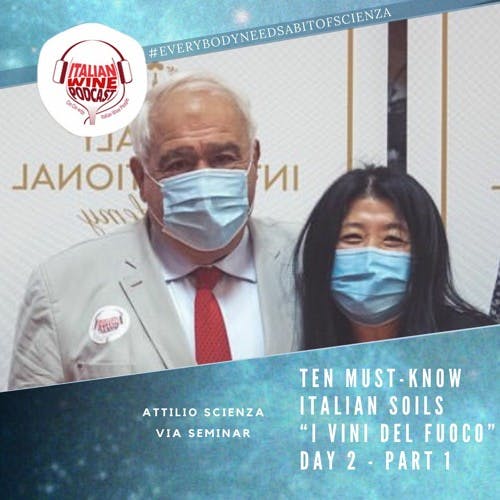
Ep. 643 VIA Day 2 Pt. 1 | Everybody Needs A Bit Of Scienza
Everybody Needs A Bit Of Scienza
Episode Summary
Content Analysis Key Themes and Main Ideas 1. The geological history and formation of Italian wine-producing soils. 2. Specific focus on ""Evinid elmare"" (wines of the sea) – soils of marine origin. 3. The role of plate tectonics (African and European plaques) and ancient sea level changes in shaping Italy's terroir. 4. Distinction and characteristics of various soil types, particularly marine deposits and flysch. 5. Linkages between specific Italian wine regions (e.g., Chianti Classico, Barolo, Primitivo, Abruzzo) and their geological soil origins. Summary This segment of the Italian Wine Podcast features Professor Chienza's ""Advanced Wine Seminars"" from the Vinitaly International Ambassador Certification course, with Francesco Marcio translating. The focus is on ""Evinid elmare,"" referring to wines produced from soils of marine origin. Professor Chienza explains that these are not wines made *in* the sea, but from ancient marine deposits. He details Italy's geological past, highlighting the African plaque's collision with the European plaque, and the dramatic event around six million years ago when the Mediterranean Sea dried up, leaving vast salt deposits in areas like Sicily and Tuscany before refilling. These geological shifts led to the formation of Italy's current landscape, including the Apennines. The discussion differentiates between older marine deposits (around 50 million years old), found in regions like Chianti Classico and Primitivo, and more recent ones (around 6 million years old) associated with Barolo and Abruzzo. The segment also clarifies ""flysch,"" which are terrigenous deposits that slid into and solidified under the sea, characterized by distinct layers of sandstone and clay that easily break down to form unique agricultural soils. Takeaways * ""Evinid elmare"" refers to Italian wines from soils with ancient marine origins, emphasizing geological formation over production location. * Italy's geological landscape, particularly its wine regions, was profoundly shaped by plate tectonics (African and European plaques) and dramatic ancient sea level changes. * The Mediterranean Sea once dried up entirely, leaving significant deposits that contributed to modern soil formation in areas like Sicily and Tuscany. * Italian marine-origin soils vary significantly in age, impacting the characteristics of wines from regions like Chianti Classico (older) versus Barolo (more recent). * Flysch are a specific type of soil, terrigenous in origin but solidified under the sea, characterized by layered sandstone and clay that are easily broken down into fertile agricultural land. Notable Quotes * ""So the the wine of the sea process professors are wise that have been formed on, material deposit of marine origin."
About This Episode
The Italian wine industry has experienced rapid rise in water levels due to the Magraep plaques and the pressure on the African plaque. The European version of thecut off of the Mediterranean Sea is pushing towards the European version of thecut off of the Mediterranean Sea. The rise in ocean temperatures and the presence of marine deposit. The European version of thecut off of the Mediterranean Sea uses "flow" in the word "flow" and is created with "flow" in the form of sandstone and Clay. Speaker 2 reminds listeners to subscribe and rate the show.
Transcript
Welcome to another installment of everybody needs a bit of Shenza. Glass is in session. Follow the professor, in his advanced wine seminars during the Venetal International Ambassador Certification course flagship edition in verona. Seminers were on the ten must known Italian soils, Evinid el Foco, Evinid elmare, and Evinid el gacho, just in fire, water, and ice. Very game of thrones, but way more nerdy, and of course, starring our very own superhero Professor Chienza. Oh, and for all those English speakers only in the house, Chienza's sidekick Francesco Marcio was there to back him up all the way. Translating all the material on the spot. Chinchin wine nerds. Hi, guys. I'm Joy Livingston, and I am the producer of the Italian wine podcast. Thank you for listening. We are the only wine podcast that has been doing a daily show since the pandemic began. This is a labor of love and we are committed to bringing you free content every day. Of course, this takes time and effort not to mention the cost of equipment, production, and editing. We will be grateful for your donations, suggestions, requests, and ideas. For more information on how to get in touch, go to Italian wine podcast dot com. Now back to the show. Delmarie. So the the wine of the sea process professors are wise that have been formed on, material deposit of marine origin. So you make a joke. So so are not wise produced in the sea. Just the name that we give to them. In effecting, Genoa Lithuania, in the altera in Matioreno. The the the key role, for for the the creation of this this sedimentary soil was played by the Adriatic Sea. So the shape of Italy changed a lot and, that's a, a key point on, to understand how this soil were formed. In the first slide. The question, the first of all, so the the the meeting in Indiana. Yes. So the first slide is is like what Italy was looking like. I mean, it was, like a mountain coming up from the sea. So, all the country, most of the country were under the water. And, once again, a key, a very important factor was the push of the African plaque towards the European plaque. That was the first things that happened. Okay. The second the second thing was that around six million years ago, at the beginning of the quaternary area, Jibilterra closed down. So the sea that, the Mediterranean Sea just dry up with the closed Jibilterra. The question. And what's happened that the Mediterranean Sea became a big desert in some deposit were left in a big assault to deposit in Sicily and also in Tuscany. Then the the push, of African plaque is still ongoing. And what's happened at the Jibilterra Jibilter open ups again, and the sea once again filled up the, from the ocean, filled it up the Mediterranean sea. And this take one thousand years. Now you can move to slide three. And what's happened was the, actually, the water was, the level of the water was much higher than before. So the water came through, you can see from slides free, that the level of the water was much higher. Now, we we go in details. Let's see what happened. The Africa. So what what we can see from here was the pediatric sea cover almost entirely, puglia. And, Tuscany is, just, some little island and, Sicily, actually, what we see is the, the African plaque, the African plaque, the Magraep plaques push up, as as we know, and that's what is left from that big push. And and we have the happenings. The happenings are still there. Also they are originating from the push from the African plaque. The you can see from this, a slide that we have five stars. Oh, nice. Last name. So free are red which are the oldest one, and two are yellow, which are the more recent one. The, the yellow one are those, that are more recent. So we say a million yanifa. Sure. Two. Around six million years ago, we're four. Eliatris in Guam. More of your accuracy. And the and the red one was around fifty million years ago. On the reds, we have, the call you, the county classical, the, and the primitivo on the yellow one, the more recent, we have Barolo and a brusso. Hey, guys. This is a brief intermission to give a shout out to our new sponsor Federal Wine The largest wine store in Italy since nineteen twenty. We are delighted to have them on board and thank them for their generous support and our new t shirts. Find out more on Italian wine podcast dot com. Now back to the show. Because, you performed The we have two different colors. So the majority of the deposits are for marine, origin, and are those on on the brown color. And those started fifty million years ago, and then some of them are more recent. Like, we just we just say it like, Barolo, for example. In green instead, we have, these are not from marine origin, but from alluvional origin. Basically, there was the, the, the, the, the, the flat plane of, of poor river that that's actually make it of the positive from the full fluvial origin. We will return to the funeral. The positive marini. So the positive the reason is because of all deal. Yes. We will talk today, mainly those on brown color. We identify some area that the professor going to talk about. Of course in Italy, we have more of these areas, but these are, important to be discussed according to professor. And that is mentioned the definition of Flash. So Flash are, the positive of the region's origin. So there are not marine deposit. There are other regions. But what's happened basically during the rain, the erosion, bring all this deposited down into the sea. And then they slide all into the sea and solidify inside the sea. So, the region is the regionous, but they actually they inform under the sea. To to clarify what's the difference between the regionals and marine. So first of all, the word flesh is a word of German origin and means to to slide him. So the flesh, they're really different from, marine sediments because they are made of layers, of, Arinaria, Sanstom, Arjilla, and Clay. While, from Maureen's deposit, they are not made of layers. They are much more homogeneous and are made of sand. So it was the sand to make the flesh. It was the sand that came through from from the hills, from the mountains, and deposit into the sea, and compact, and became, a compact layer of sandstorm. And then on top of that was the clay, and then the sandstorm again. So that's how the flesh actually created. Kristi Strati, she will, you know, bezel Marie, interim and Marie. Yes. We have some slide that will explain that. It's the pressure. Then the, press these materials and make different layers. So sandstone and clay and sandstone and clay. And that's how they are formed. The cream. Christibanki, the area, uh-uh, the, the, yeah, one characteristic of the flesh is that that easy to to break down. If you go to call you, if you go to Kianti, you you can see you you can easily break the the rocks and this break break down or make origin of the agricultural soil. This part of, this area, the soil is originated from from fish, also agricultural soil. No. Not all flesh are the same. Actually, the they they vary, they are very values because, it depends on the moment they were formed. And, some of them, there are more clay, some other more sand, but it's important to remember that, it's the sand that want to be washed away first by erosion, and then the clay stayed. Listen to the Italian wine podcast wherever you get your podcasts. We're on SoundCloud, Apple Podcasts, Spotify, email ifm, and more. Don't forget to subscribe and rate the show. If you enjoy listening, please consider donating through Italian wine podcast dot com. Any amount helps cover equipment, production, and public
Episode Details
Related Episodes

Ep. 2789 ColleMassari: a long-term vision rooted in Montecucco with Giuseppe Di Gioia | On The Road With Stevie Kim
Episode 2789

Ep. 2788 Ep. 14: Austria and Hungary | Study Smart for your WSET Level 3
Episode 2788

Ep. 2785 From Volunteer to Speaker at TEXSOM with Samantha Cole Johnson | TEXSOM 2026
Episode 2785

Ep. 2766 Inside the U.S. Non-Alcoholic Wine Market: What Wineries Need to Know with Jill Sites | Masterclass US Wine Market
Episode 2766
Ep. 2761 Winemaking and Consulting Across Sicily with Alessandro Serughetti | Wine, Food & Travel with Marc Millon
Episode 2761

Ep. 2759 Part 2 – The VIA Educational Program & Italian Wine | Heart-to-Heart Conversation with Sarah Looper
Episode 2759