
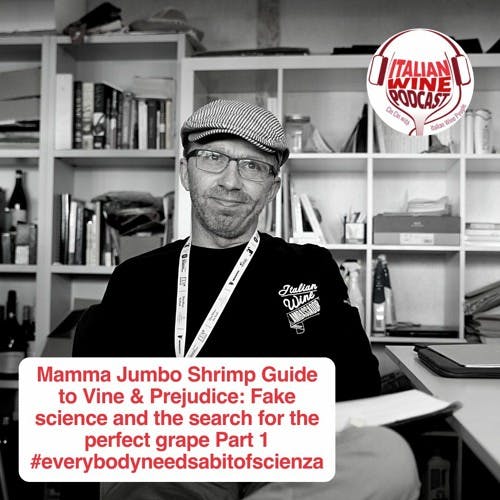
Ep. 866 Vine & Prejudice Chapter 1, 2 & 3 | Everybody Needs A Bit Of Scienza
Everybody Needs A Bit Of Scienza
Episode Summary
Content Analysis Key Themes and Main Ideas 1. The historical evolution of scientific thought, particularly in biology and genetics, from creationism to modern understanding. 2. The interplay between science, society, and ideology, highlighting how scientific concepts have been misinterpreted or misused. 3. Critique of pseudoscientific theories like social Darwinism, eugenics, and race-based classifications, and their harmful societal impact. 4. The argument that the concept of human race is a cultural, not biological, construct. 5. The importance of critical thinking, continuous revision, and resisting ideological biases in scientific inquiry. 6. The brief mention of historical prejudice against American vine species in viticulture as an example of ideologically-driven assumptions. Summary This Italian Wine Podcast episode features a sneak peek from Professor Attilio Scienza's book, ""Mama Jumbo Shrimp Guide to Vine and Prejudice, Fake Science and the Search for the Perfect Grape."" The segment explores the historical development of science, particularly biology and genetics, from the 18th century Enlightenment through the 20th century. It traces the shift from creationism to the acceptance of evolution and heredity, acknowledging pioneers like Mendel and Darwin. A significant portion of the discussion critiques how scientific ideas have been distorted and weaponized, focusing on the rise of ""fake science."" It delves into the harmful origins and impact of racial classifications, social Darwinism, and eugenics, citing figures like Gobineau, Galton, and Fisher, whose work underpinned horrific policies like those of the Nazis. The episode strongly argues that studies of human genetics have rendered the biological concept of race meaningless, asserting it as a cultural construct. It concludes by emphasizing that science is not immune to prejudice and ideology, advocating for constant revision and critical examination. As an example, it highlights the historical denigration of American vine species in winemaking, not based on objective evidence, but on prejudiced cultural assumptions. Takeaways * Scientific understanding, especially in biology, has progressed from creationism to complex theories of heredity and evolution. * Science has often been influenced and distorted by societal ideologies and prejudices, leading to ""fake science."
About This Episode
The Italian wine podcast discusses the history of natural selection and political ideologies, as well as the origins of various scientific theories and myths. The discussion also touches on the negative impact of deductive logic on scientific findings and the importance of history in revisiting themes like race classification and political climate. The transcript ends with a brief advertisement for a wine podcast and a promotion for a daily show.
Transcript
Welcome to the Italian wine podcast. This episode is brought to you by Vineetili International Wine and Spirits. The fifty fourth edition of Vineetili was held from the tenth to the thirteenth of April. If you missed it, don't worry, go to benitely plus dot com for on demand recordings of all the sessions from the exhibition. Welcome to Professoria Tioshenza's newest book translated and narrated by Richard Huff. This latest publication is part of the mama jumbo shrimp series. Entitled, mama jumbo shrimp guide to Vine and Prejudice, fake science and the search for the perfect grape. This is a great way to get a sneak peek at the book before it hits the shelves, so listen in and let the geeky knowledge seep into your ears because we all need a little bit of Shinsa. Chapter one, the birth of biology and genetics. In Western societies of the past, science and reason only played a minor role, adherence to the principles of creationism meant that biology was subordinate to religion well into the eighteenth century. Then the enlightenment introduced the simple concept that the more mankind rationally understood the world, the more it would be able to bend the arc of history towards its own materialistic needs. But with scientific advancement came a certain skepticism, mistrust in science has been in evidence since the eighteen thirties, the year of the romantic rejection of newtonian principles. Increasing in the early nineteen hundreds and culminating in the wave of anti scientists and anti modernism that struck in the late nineteen sixties. The four Mendo's experiments on the cross pollination of peace The artificial crossing of plants was used as a tool for studying the origin of species, the great problem that had long permitted the mind of man, but not yet as a mechanism for developing new plants of agricultural significance. If Mendel was the father of modern genetics, it was only in the early twentieth century that the basic concepts of heredity and evolution to come a more dynamic approach with the development of population genetics, while Darwin and the Mark's theories shared the same fundamental belief in the evolution of species They diverged considerably with regards to the French scholars' famous fourth principle, the so called law of the inheritance of acquired characteristics. For Darwin, on the other hand, it was random mutations and the subsequent process of natural selection that determined the major changes in the characteristics of a species. At that time, the church and civil society were fierce opponents of both Darwin and Lamar observing in their theories which linked the origin of man to the orangutan, a dangerous notion at odds with the creationist vision of the old testament, Darwin's descent of man significantly reduced the importance of natural selection. Attributing greater significance to the role of inheritance of acquired characteristics converging with Lamar's own findings, and at the same time, offering the church a materialistic doctrine that could be adapted to reflect a biblical message while also conforming with the scientific knowledge of the time. Chapter two, the classification of species and fake science. The eighteenth century was a groundbreaking period for our understanding in the field of natural sciences. Ophon, in relation to animals, and the nails with regards to plants, established some of the fundamental categories for classifying the diversity of living organisms known at that time and created a nomenclature capable of identifying and categorizing all animal and plant species. The history of taxonomy, the science of biological classification, is an extraordinary journey into the diversity of life, a journey full of twists and turns, which underpin the nineteenth century's understanding of the human race. It also spawned some of the era's most abhorrent scientific theories and political ideologies. Indeed, the notion of superior and inferior races emerged during this period. With the publication of an essay on the inequality of human races by the French aristocrat Joseph de Gobignon. The study created a typology based on largely subjective criteria, such as beauty of farm, physical strength, and intelligence, criteria that would subsequently be used by the Nazis to distinguish between Jews and aliens. The English statistician, Frances Galton, inspired by the work of his cousin, Charles Darwin, invented the term Eugenics. He applied at a social level, the belief that natural selection ensures the diversity of species and the survival of the most suitable individuals starting from the selection of the most desirable human qualities and the elimination of the least desirable. In the nineteen thirties, Eugene Fisher, a member of Hitler's magic circle, obtained funds to conduct experiments on the children of mixed race. His ideas underpinned the concept of the pure aryan race. Led to enforced sterilizations and the prohibition of racial interbreeding and culminated in the anti Semitic and racial laws of nineteen thirty five, which prohibited marriages between Jews and those of pure German blood. Is pseudoscientific drift of social darwinism and eugenics, culminated in the elimination of less desirables, who are identified in concentration camps through blood, and tissue sampling, and cranial measurements. Fisher invented a pseudo scientific scale to determine the racial origin of concentration camp prisoners based on the color of their hair. The purest were those with blond hair, where the most impure had black or shades of red. There are few supporters of such theories today, at least in the scientific community because studies of human genetics have shown that the concept of race based on apparent biological differences is meaningless. In nineteen seventy six, the Italian geneticist, Luigi Sportsa, challenged the meaning of race, replacing it with the term population or ethnic group. He argued that while the concept of race has a certain cultural significance, It has no basis in biological science. The main characteristics that allow us to assign an individual to a particular race are skin color, hair, shape, and color, and body shape particularly the features of the face. However, characteristics typical of a certain race are products of genetic adaptation to the environment in which most of the lifespan of the population has existed over tens of thousands of years. Among these environmental considerations, the most important is climate. Furthermore, races are by no means homogeneous. In fact, there exists enormous variation within individual races. In reality, races are populations, a hundred or a thousand times smaller than what we commonly term to be a race. These populations are made up of the descendants of individuals who lived hundreds and thousands of years ago with occasional genetic mutations accompanied by certain specific defects. A similar story to this can be told about the genre of the grapevine. Chapter three, mythology and biology, the power of ideology. Science, over the course of its temporal development, has been the subject of continuous revision including to its conceptual structure while always retaining at its core a history of problems to which a solution must be found. In many cases, the great questions of the past survive in the modern world, so many of the current debates cannot be fully understood unless their history is also understood. Science needs to be constantly revised. The erroneous interpretation of a study often ends up becoming myth, handed down from generation to generation. Even if its interpretation reflects a contemporaneous state of knowledge, the zeitgeist of the period in which it emerged. Science also has its prejudices. We like to imagine signs free from discrimination and partial neutral. In reality, like any other human activity, scientific discovery, never operates in a political vacuum. On the contrary, it often crudely reflects the political climate that surrounds it. On the subject of discrimination in every field there is much to say, and it's important to examine all the scientific positions on any given issue highlighting the distinction between what is proven and what is not. Resisting the lure of ideology. When we talk about science, we focus on the exploits of heroes. We don't stop to evaluate the discussions that took place around a discovery When linears define the criteria for the classification of plants, there were clashes of ideas with scientists who did not agree with him, and the loss of this context greatly reduces the value of the discovery. To challenge the rhetorical mechanism that feeds the common assumption that American grip species are the enemy of quality of Viticulture, that assumption must be interrogated. However, it is not possible to do this to adopt an inductive or deductive logic, but rather an abductive one through which we will discover that the hostility towards the American species is not the result of scientific findings based on objective evidence, but rather the consequence of unscent deductions from an era in which the wine of the so called American wines was linked to the poverty and hunger of the venetian peasants who cultivated Clinton. In fact, the denigration of the American species owes more to the expression of an traditional sentiment which associated the wine of the European vine with the golden age of European culture, a false myth rather than an absolute truth, as the American psychologist James Helman said, we are not conditioned by the past But by this story, we make of it. Thanks for listening to this episode of the Italian wine podcast brought to you by Vineethly International Wine and spirits exhibition, the biggest drinks trade fair in the world. Remember to subscribe to Italian wine podcast and catch us on SoundCloud, Spotify, and wherever you get your pods. You can also find us at italian wine podcast dot com. Hi, guys. I'm Joy Living's Denon. I am the producer of the Italian wine podcast. Thank you for listening. We are the only wine podcast that has been doing a daily show since the pandemic began. This is a labor of love and we are committed to bringing you free content every day. Of course, this takes time and effort not to mention the cost of equipment, production, and editing. We would be great for your donations, suggestions, requests, and ideas. For more information on how to get in touch, go to Italian wine podcast dot com.
Episode Details
Keywords
Related Episodes

Ep. 2793 The Importance of a New Approach to Wine Education with Alexandre Centeleghe and Lisa Lazzaretto IWA | Clubhouse Ambassadors' Corner
Episode 2793

Ep. 2771 Ep. 11: Dordogne & South West France | Study Smart for your WSET Level 3
Episode 2771

Ep. 2764 Ep. 10: South of France | Study Smart for your WSET Level 3
Episode 2764

Ep. 2758 Ep. 9: Southern Rhône | Study Smart for your WSET Level 3
Episode 2758

Ep. 2753 Part 1 – Changing How America Learns about Wine | Heart-to-Heart Conversation with Sarah Looper
Episode 2753

Ep. 2747 Ep. 7: Beaujolais | Study Smart for your WSET Level 3
Episode 2747