
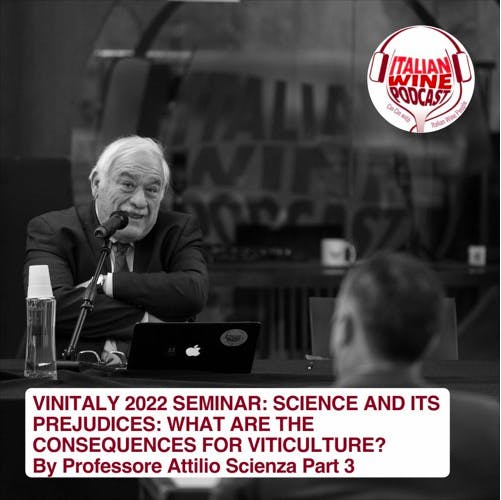
Ep. 903 Science & Prejudice Part 3 | Everybody Needs A Bit Of Scienza
Everybody Needs A Bit Of Scienza
Episode Summary
Content Analysis Key Themes and Main Ideas 1. The impact of prejudice against science on viticulture. 2. The historical and ongoing resistance to genetic innovation and hybrid grape varieties in winemaking. 3. The role of producers as a primary obstacle to adopting new scientific technologies. 4. The promotion and benefits of fungus-resistant (PIWI) grape varieties. 5. The necessity of collaboration among businesses, producers, and researchers to find solutions for viticultural challenges. 6. The broader phenomenon of science denialism, both historically and in the present. Summary This episode of the Italian Wine Podcast presents a seminar by Professor Attilio Shenza, titled ""Science and its prejudices: What are the consequences for Viticulture,"" translated by Richard Huff. Professor Shenza explores the deep-rooted resistance within the wine industry to chemical and genetic improvements. He argues that the primary hurdle to embracing genetic innovation, such as hybrid grape varieties, often comes from producers rather than consumers. The seminar highlights the work of organizations like PV International in promoting fungus-resistant grape varieties (PIWI) as a vital step forward for the industry. Professor Shenza emphasizes the critical need for collaborative efforts among businesses, producers, and researchers to overcome these prejudices and find effective solutions for the future of viticulture, using a comparative metaphor to illustrate the dangers of ignoring progress. Takeaways * Prejudice against scientific advancements, particularly genetic innovation, significantly hampers progress in viticulture. * The wine industry has a historical and ongoing challenge in accepting hybrid grape varieties and genetic modifications. * Producers, rather than consumers, are often the main barrier to the adoption of new, scientifically-backed agricultural methods in viticulture. * Fungus-resistant grape varieties (PIWI) offer a promising and sustainable path for future wine production. * Effective collaboration between industry stakeholders, growers, and researchers is crucial for addressing current and future viticultural challenges. * Denialism towards scientific progress is a recurring pattern observed throughout history and in contemporary society. Notable Quotes * ""science and its prejudices. What are the consequences for Viticulture"
About This Episode
Speaker 2 discusses the consequences of chemical or genetic improvements and the need to respond to this problem. They also address the issue of acceptance of science and the need for a solution to the pandemic. Speaker 3 asks a question about a study on genetic innovation and Speaker 2 explains that it is a labor of love and offers to donate equipment and suggest ideas for future episodes.
Transcript
Today, on the Italian wine podcast, we welcome you to this special seminar led by Professori Atilio Shenza entitled science and its prejudices. What are the consequences for Viticulture, which took place during Vineitelli twenty twenty two, held in Italian and translated into English by Richard Huff. Tuning each week to be a part of this special event and remember for more great Shinsa related content, check out our sister channel, mama jumbo shrimp on YouTube. Farming for quincy, de la cuinción, de la, the Aquimica, Equinina, the una, agricultural, biologic. The problem. So just to return to the the previous slide for this, this very specific question that we have to to answer, how do we respond to chemical or genetic improvements, which which do we prefer? And on the the next slide, we see the results of a study of the impact of farm to fork and biodiversity strategies. Just to focus on the the data on why the big problem is the significant increase in price, which is just over thirty percent. And that represents, a problem. And it also means that we can't afford to reject genetics. The machines, and problem. Not sure to have it. Into the mode, into the lingua, into the in Mondo, the second question, which the professor highlighted here is acceptance of science. Just a recent or contemporary problem I know the the next one, you can see some examples of denialism not just today, but across Europe across the world going back and historically as well. You got a propane, so, and, So the the problem really is that we have never accepted hybrids. We've never accepted genetic innovation. And so the the first obstacle to overcome is in fact not the the consumer, but the producer A system, Mobi Maine, TOCashicama, PVfinsand, Afrika, it came Momento Nafe, in Germany and particularly. Tricodatory, vertical tory, a trichomonitori, quili moderni, stronger in this So this is the the organization PV International that originated in in Germany, and it promotes the advantages of fungus resistant grape varieties, and the the benefits of producing wines from grape varieties with resistance properties, and this kind of promotion represents, an important step forward, and and for the future of of Italian mind. The a request to Afrescoque in Nuneville, Vicinovenencia, some some Okay. Yeah. Just to summarize very very quickly the the previous slide is the the the translation more or less everyone, in favor of of public utilities. So if we if we work together, businesses, producers, and private researchers, we can we can find a solution to some of the problems currently facing us. And then just very quickly again on the the last slide, this picture by tiepolo which took took place two years after the the French revolution when we had this foreign army arriving in Pietris and Marco for the first time. And the the the metaphor is very similar to to where we are today. People not looking at the horizon and the blue the blue sea, but instead preferring to look at the the showman and the the magic being performed in the lantern of the the showman. I I don't know if you have time actually for questions or if there are questions, My apologies to be. I have a question. To to tell him, to tell a general engineer. The my uncle, they're they're they're, they're, they're, they're, the the the the the the No. It's somewhat. It is. I'm not really interested in. However, it's COVID. Oh, since I told you, it's in a clinical, uno, paracione, the genetic, a motor sophisticated car, it was proof So camino, Alright. That's it. I'm gonna cut it off here because we're running late as usual with Professor Okay. Let's give it up for Professor Shenza and Richard Hoth. Listen to the Italian wine podcast wherever you get your podcasts. We're on sunk out Apple podcasts, Spotify, email ifm, and more. Don't forget to subscribe and rate the show. If you enjoy listening, please consider donating through Italian wine podcast dot com. Any amount helps cover equipment, and publication costs. Until next time. Hi, guys. I'm Joy Lemings Denon. I am the producer of the Italian wine podcast. Thank you for listening. We are the only wine podcast that has been doing a daily show since the pandemic began. This is a labor of love and we are committed to bringing you free content every day. Of course, this takes time and effort not to mention the cost of equipment, production, and editing. We would be grateful for your donations, suggestions, requests, and ideas. For more information on how to get in touch, go to Italianwine podcast dot com.
Episode Details
Related Episodes

Ep. 2789 ColleMassari: a long-term vision rooted in Montecucco with Giuseppe Di Gioia | On The Road With Stevie Kim
Episode 2789

Ep. 2788 Ep. 14: Austria and Hungary | Study Smart for your WSET Level 3
Episode 2788

Ep. 2785 From Volunteer to Speaker at TEXSOM with Samantha Cole Johnson | TEXSOM 2026
Episode 2785

Ep. 2766 Inside the U.S. Non-Alcoholic Wine Market: What Wineries Need to Know with Jill Sites | Masterclass US Wine Market
Episode 2766
Ep. 2761 Winemaking and Consulting Across Sicily with Alessandro Serughetti | Wine, Food & Travel with Marc Millon
Episode 2761

Ep. 2759 Part 2 – The VIA Educational Program & Italian Wine | Heart-to-Heart Conversation with Sarah Looper
Episode 2759