
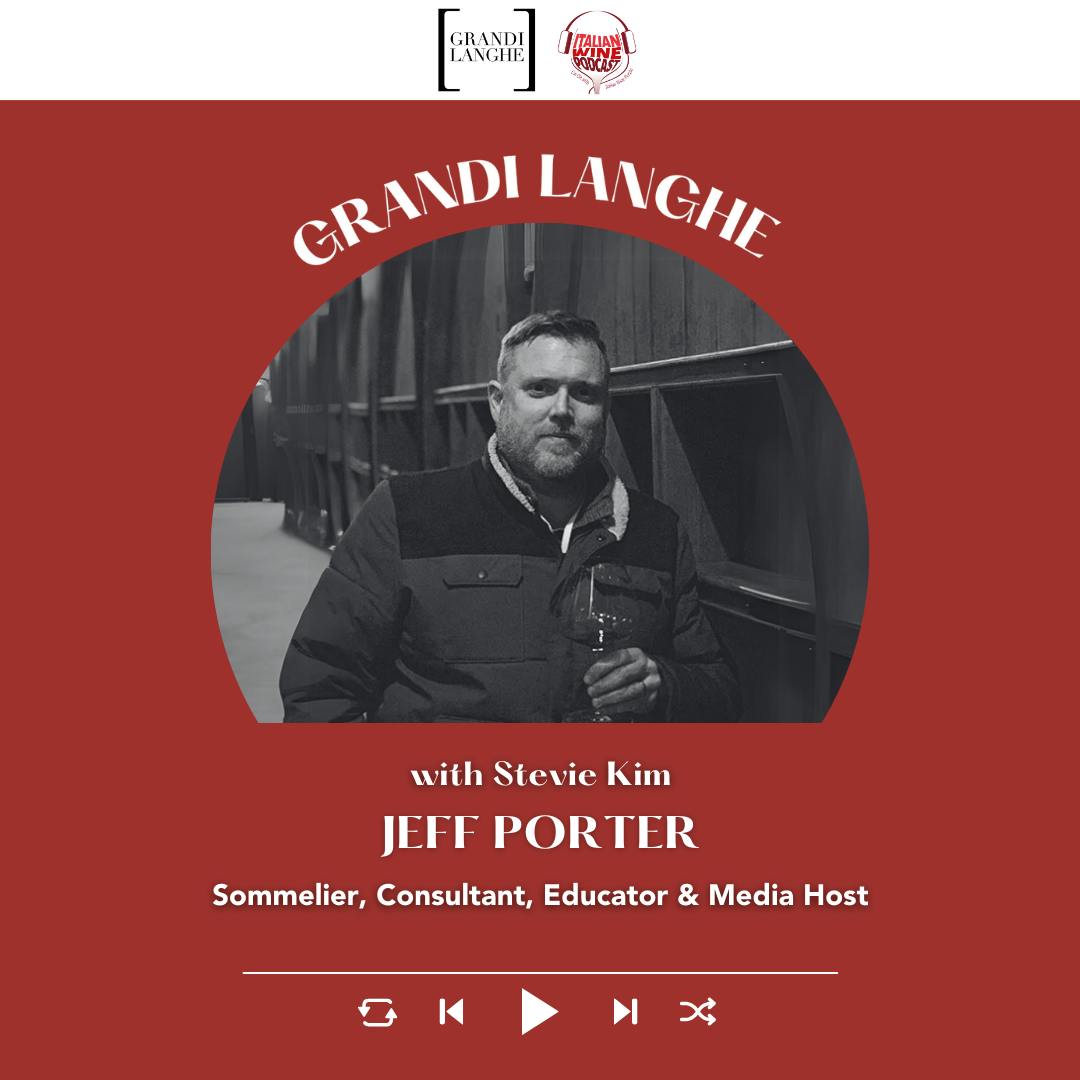
Ep. 2259 Jeff Porter | Grandi Langhe 2025
Grandi Langhe 2025
Episode Summary
Content Analysis Key Themes and Main Ideas 1. Opportunities for Piedmont wines in the American market through education and cultural promotion. 2. Emerging trends in Piedmont winemaking, including whole cluster fermentation and intense vineyard management. 3. Shifting consumer preferences towards freshness and drinkability in wines. 4. The value of specific Piedmont wine regions and lesser-known varietals like Gavi and Grignolino. 5. The importance of industry events and face-to-face interactions between producers and experts. 6. The personal experience of living and working as a wine expert in Turin, Piedmont. Summary In this special edition of the Italian Wine Podcast from Grande Langhe 2025, host Stevie Kim interviews Jeff Porter, a wine expert living in Turin and specializing in Piedmont wines for Wine Enthusiast. Porter discusses the significant opportunity for Piedmont wines in the American market, emphasizing the need to educate consumers on the region's diverse grape varieties and how different wines suit various occasions. He highlights key winemaking trends such as the increasing use of whole cluster fermentation for brighter, fresher wines and the paramount importance of vineyard management over cellar work. Porter notes that American consumers are currently seeking freshness and drinkability, even in wines with higher alcohol content. He praises producers like Gheddo and Laraya, and surprising discoveries like the aging potential of Gavi and the appeal of Grignolino. The conversation also touches on the invaluable nature of events like Grande Langhe for fostering connections and knowledge exchange. Porter shares his favorite Piedmont food and wine pairing—Agnolotti del Plin with aged Nebbiolo—and concludes by describing his upcoming Vinitaly masterclass on ""fun, delicious, in-the-moment wines,"" balancing seriousness with joy. Takeaways * The American market for Piedmont wines can be expanded by educating consumers about the region's vast diversity of grapes and their suitability for various occasions. * Piedmont winemaking is increasingly focused on vineyard management and less chemical intervention, leading to higher quality and more expressive wines. * Whole cluster fermentation is a growing trend in Piedmont, particularly for red wines, contributing to freshness and ""pop."
About This Episode
Speaker 1 discusses the opportunities for selling wines in the Italian wine industry, including learning and growing the culture and diversity of grapes. They also talk about trends in the wine industry, including the use of whole cluster techniques and attention to detail in wine wines. They emphasize the importance of attention to detail and drinkability in wine making, and the value of wine wines and their potential for updating one's taste. They also discuss the success of American wine production, including meeting with wines from Piamonte and the importance of tasting wines in the context of knowledge sharing. Speaker 3 promotes VPARally, a master class for wine pairing, and reminds Speaker 1 to subscribe to their podcasts and donate through Italian wine podcasts.
Transcript
So looking ahead, what are the biggest opportunities for Pemonte wines right now in terms of for let's talk about American market? I think the biggest opportunity is to teach and grow the culture and conviviality of wine and how the diversity of grapes just within this one, one region, just like the rest of Italy, but specifically in Piamonte, they have so many different wines. That there's a moment and a win for every specific occasion in explaining that to the consumer, I think, is where the successful lie. As the official media partner, the Italian web podcast is excited to present exclusive coverage from Grande Lang twenty twenty five. This series feature firsthand a perspective from top producer and buyers as they navigate new styles, vigner denervation, and shifting global markets. Discover, expertise, hidden gems, and the trends shaping the region's future. Tune in every Friday, eight three PM, or visit italian win podcast dot com for more. Hello. My name is Stevie Kim, and welcome to the Italian wine podcast. Special edition here at Grande Langgett two thousand twenty five where we get to chat up some wine friends. And what a fine wine friend you are, Jeff Porter? Thank you, Stev. How are you? I'm very well. You know, and it's crazy because he's a New Yorker. Actually, a tech son, ex New Yorker, and now Torine's. Fortatoro. Sorry. My Yvette friends. Yeah. Actually, the president of the region was here just before you. I interviewed him, and he's a Yventine. Oh, we can't all be perfect. Exactly. How are you doing? I'm doing really well. This event, it's amazing. It's in this super cool building that used to be where Train Italian used to fix their trains. And now it's this really cool commercial space that's used for events. I really love this building. I love this building. I love this building. The only thing I actually told the president, I wish there was some natural light. Agreed. Because especially for an wine event, it's like, I don't know if it's date night or you know, whatever outside. Right. It's kind of like Vegas. So this is the Vegas of the wine, but we're all winners here. That's the best thing. The house is not winning, the tasters are. Yeah. So how has it been living in First of all, you live not too far away, right? I live not very far away. I live on the other side of the po. Living in Terino's amazing. This is a beautiful city. What I like about it, the city doesn't have a lot of tourism or a lot of, I guess, American tourism. So a lot of Italians that come here. A lot of people from Germany and Switzerland. So my day to day outside my house is in Italian. So it's helping me grow my Okay. Yeah. You need some work there. Yeah. Alright, Jeff. So what have you been doing in Corino? Like, you're duke going about tasting the wines for wine enthusiasts. So for wine enthusiasts, I taste with the various consortium of Northern Italy of the regions that I represent. So, like, last year, at this time, the consortium of Borrolo, Barbara, put together, tasting of the twenty vintage, and I'll be doing the same in, like, two or three weeks. So piemonte is your area for wine and pieces. Piemonte is my area. So I I've done tastings with gavi with Ulto Piamonte, with Nitza, with Montorato Barber, all the major groups. And then on the other side, I also go visit, and I give tours to clients from back in the state. I set up, like, gastronomic or winery tours. Okay. In Piamonte. In Piamonte. Okay. Alright. So we have a super specialist of Piamonte sitting right next to us. So we'll ask him some questions. Question number one. Number one. Which New or emerging Piamonte wine styles have caught your eye recently? I think the thing that's happening across the board, not just with, let's say, Barolo or Barbasco is more people using whole cluster fermentation. Kind of that semi carbonic. You're seeing it in La Guiano's. You're seeing it Dolceto and Barbara, and it's producing this, if done correctly, and it's it's in an experimental phase right now, so not everybody's doing it perfectly. But when done really, really well, it just can really lift the wine, specifically in, like, a vintage, like, twenty three. So if you have, like, long a nebulo twenty three, it's really hot and dry. So a little added whole cluster can, like, lift the wine. And give it a more of a brighter pop, which I really like. It increases the drinkability. Wow. And this is a trend? Absolutely. We're seeing it a lot across the whole region of people who are making red wine. Wow. Okay. Any other specific trends or vineyard management techniques? I mean, I think the coolest thing that we're seeing, even in a vintage that was as challenging as twenty twenty four this year. Because it was challenging. It rained a lot. Yeah. But the vineyard work. What people are like The attention to detail in the vineyard. The biggest change, I think, over the past twenty years, is twenty, twenty five years ago, the thought was wine was made in the cellar. And today, everybody, the wine is definitely made in the vineyard. That's very interesting. And, and it's a big change, and you can taste it in the wine. Tannon management is supreme now. But, like, with twenty four, people, like, don't think there's good and bad vintages. All vintages are unique within their own right. There are great wines that are gonna be made in twenty twenty four, people that pay detention and work super, super hard, and when you saw them after harvest, they were so tired. Yeah. And so exhausted because the amount of time they were were just like hustling to get grapes in. The wines are gonna really be beautiful. So I think the trend is is just the true attention to detail in less chemical intervention is across the board in the region. Wow. Okay. Very exciting, very insightful there. And I mean, are you going back and forth now stateside? Yeah. I go back every like ten weeks. So what are, you know, your colleagues you know, from stateside, like, buyers or the consumers that your colleagues are working with. What are they currently looking for in terms of Pemonte wines? I think they're gravitating first to freshness and drinkability, and it doesn't mean it has to be interesting because you'll, you'll, you'll, I'll be with some people and we'll be tasting a wine. And let's say it's from twenty two or twenty three, like the warmer vintages, and those are like the barberas or the grignolinos or the Ruce or Frreza or glunga and Avolo, And they'll still be thirteen five, fourteen percent alcohol, and they'll be like, wow, this is so fresh. I didn't realize it was still Right. Buying alcohol. And that's just kind of where the alcohol levels are today. But through proper vineyard management and some techniques in the winery, the wines are fresh and they're fun, and they're fruity, and drinkability is paramount. So despite the higher alcohol level, if you will, on the palate, the taste is still fresh. Fruit forward Wow. And zippy and fun. Zippy. I like it. Zippy. Zippy wines. And what producers or labels surprise you the most recently? I mean, I recently I was taking some colleagues who came in from LA recently. We went to a producer named Ghetto, g h e, umlout, d d o? Yeah. Young grower. It sounds swedish more than Pemontez. It's a Pemontez phrase. I forgot what the name means, but it's a word in Pemontez. Oh, okay. It's a dialect. But in in then another producer, really, really excited about. I love Engavee Laraya. They've been established for a while, but the sun has really taken over the past few years. And the, you know, Gabby's not a wine. I think a lot of fancy pants, sommelier's we're talking about, but I'm here to tell y'all, delicious, great value, and they can age like no one's How long can it age? I had some twenty, twenty five years old that blew my mind. Oh my gosh. And there's value there. Yeah. Wow. Interesting. Okay. Very good. And have you encountered I mean, you know everything, but anything unexpected, great varieties, or, I don't know, like up and coming terroirs. I mean, Gavy really surprised me. Mhmm. I also think Grennalino is, I think, one of the most fun greats. It's also fun to say. It is. It is fun to say. And it's just delicious. I think the thing that I'm most excited about Piedmont is the switch in everyone's minds is this goes for the top wines as for just like the introductory wines. They can be drunk now and they can be drunk later. It's a wine for whatever moment, whatever feeling you have. It's not good or bad. It's just different when things age. And I think that mentality coming back to just experiencing the wine as it is, I think it's a really cool perspective seen from the producers. So looking ahead, what are the biggest opportunities for Pemonte wines right now? In terms of for, let's talk about American market. I think the biggest opportunity is to teach and grow the culture and conviviality of wine and how the diversity of grapes just within this one, one region just like the rest of Italy, but specifically in Piamonte, they have so many different wines that there's a moment and a wine for every specific occasion in explaining that to the consumer, I think, is where the successful line. Okay. And here, I mean, of course, you know, you move to Torino. You're very partial to Piamonte, but even here, like, at an event like this, I mean, there are five hundred producers. Is it helpful to meet up with them face to face, even to try some wines or even more over your colleagues. Do they, in any ways, meeting your colleagues or friends from all of the world? Do they, in any way, influence your perceptions? My friends? Yes. Absolutely. Tasting you know, because I'm like an asylum, right? I live here. This is the wine that I drink most often. And so it's cool when when they come and they ask questions that I just either escaped my mind because I just, I live it and When you're face to face with the producers and you're able to have that interaction, it's invaluable for knowledge growth and knowledge sharing across the board. And lastly, how many ta wines have you tasted here? I don't know a lot. My mouth hurt yesterday. Not just your feet, man. No. My my feet hurt because I walked a lot and my mouth hurt because I tasted so many wines. I don't know. Maybe yesterday was in a hundred and fifty plus And what are what are what are the main takeaways, like, you know, which you would love to share with your folks back at home? I mean, for Barolo, twenty one Vintages, you've probably read, is a phenomenal vintage. It has. It's interesting. I was talking to a producer. This goes back to it. Yeah. It has the stuffing of nineteen. But the elegance of, like, eight, you know, and I guess that's getting really deep into, to, like, just the fact that I taste a lot of these wines. But the other thing is just seeing the variety. I like having the producers from Gave, Monfirotto, and Nitza, and just being able to go back and forth with, like, let's say, an Araboluce from Monteo Piamonte, and then going to a spark, an Alta Longa, in between the Nebulaolos. It's like a smorgasborg and a Disney land of For wine right now. Okay. So bonus question because you've been living here for how long now? A year. A year. Okay. What is your favorite? I mean, I actually don't really believe in food and wine pairing, to be quite honest. I mean, I'm not, you know, it's fine. But what is your favorite? Food and wine pairing for piemonte local dish and wine. Alright. My favorite? Yeah. Favorite of all time. Okay. All time, I love Anulotti de Plien in, like, in a reduced Sugo Yeah. With an aged Nebulaolo. That's perfection. Yeah. Perfection to life. Okay. What are we doing at Vinitally? We are going to talk about I don't mean to put you up. Delicious. I think I pitched my idea was, like, fun, delicious in the moment wine. You know, you can take wine seriously and you should, but at the end of the day, it's about joy. And it's combining those two things together, the the joyousness of being serious. Okay. So, so, so, so. About drinking? Yes. Fun and joyful, delicious wines. This will be the master class conducted by Jeff Porter at Vinitally. So see you all as well. See you all there. And that is a wrap. Thank you very much. Listen to the Italian wine podcast wherever you get your podcasts. We're on SoundCloud, Apple Podcasts, Spotify, email ifm, and more. Don't forget to subscribe and rate the show. If you enjoy listening, please consider donating through Italian wine podcast dot com. Any amount helps cover equipment, production, and publication costs. Until next time, chi chi.
Episode Details
Keywords
Related Episodes

Ep. 2302 Markus Holmberg | Grandi Langhe 2025
Episode 2302

Ep. 2293 Ryan Lewis | Grandi Langhe 2025
Episode 2293
Ep. 2284 Reeze Choi | Grandi Langhe 2025
Episode 2284

Ep. 2275 Michaela Morris | Grandi Langhe 2025
Episode 2275

Ep. 2266 Wojciech Bonkowski MW | Grandi Langhe 2025
Episode 2266
Ep. 2251 Jessica Dupuy interviews Sergio Germano | Barolo Barbaresco World Opening
Episode 2251