
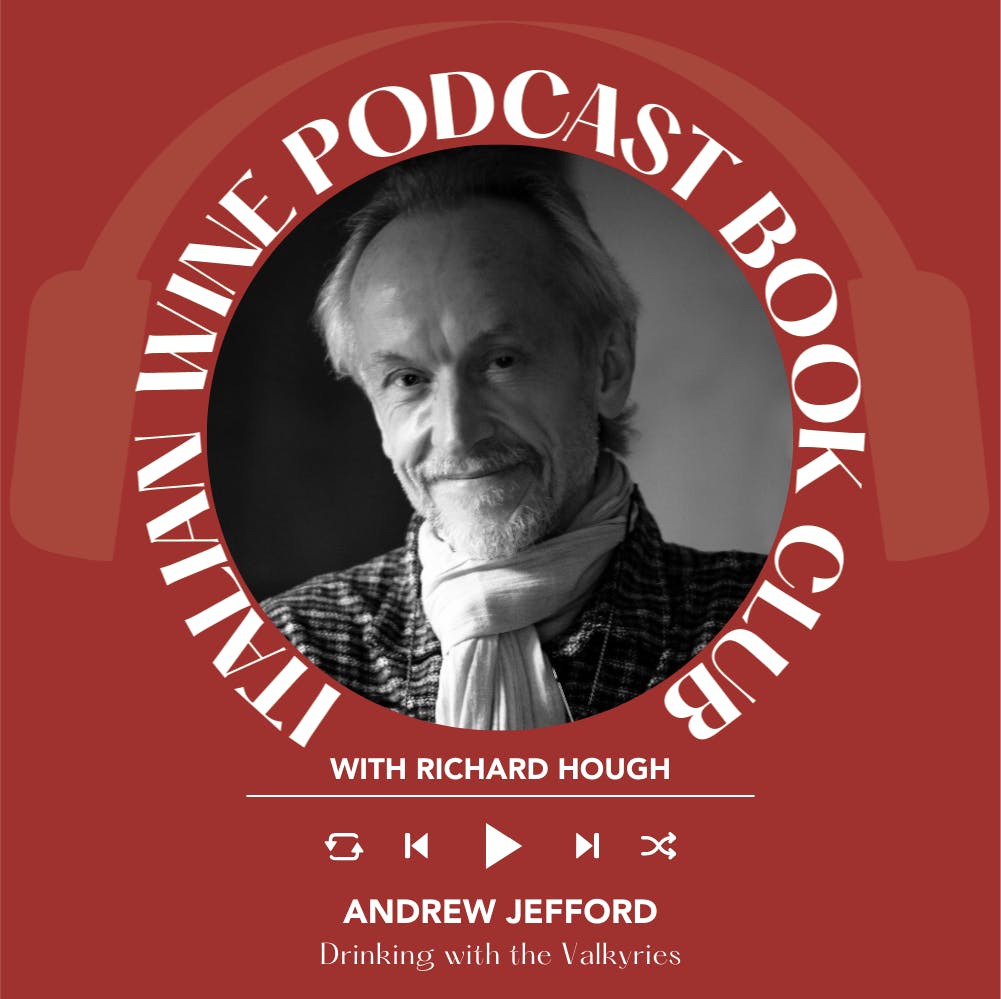
Ep. 2050 Andrew Jefford featuring Drinking with the Valkyries | IWP Book Club With Richard Hough
IWP Book Club With Richard Hough
Episode Summary
**Content Analysis** **Key Themes (max 5 points)** 1. The formative influence of early experiences on a lifelong passion for wine. 2. The intersection of creative writing and wine writing, and the value of literary craft in wine communication. 3. The evolution of a career from editing and publishing to wine writing and criticism. 4. The importance of experimentation and curiosity in both wine making and wine appreciation. 5. Reflections on the parallels between literary achievement and excellence in wine creation. **Summary (max 200 words)** In this episode of the Italian Wine Podcast Book Club, Andrew Jefford discusses his journey into wine, beginning with homemade country wines in his youth and leading to a distinguished career as a wine writer. He reflects on his education, including time spent alongside Kazuo Ishiguro, and how his background in editing and publishing shaped his approach to writing about wine. Jefford emphasizes the value of curiosity, experimentation, and the literary craft in communicating the pleasures and complexities of wine. The conversation also touches on the parallels between literary achievement and the art of winemaking, as well as the evolving role of wine in different cultures. **Key Takeaways (max 6 points)** - Early exposure to wine making can spark a lifelong passion. - Creative writing and editing skills are crucial for effective wine communication. - Transitioning from editing to wine writing can provide a unique perspective. - Experimentation and curiosity are essential in both wine making and wine appreciation. - Literary achievement and excellence in wine creation share common values. - Wine writing can bridge cultural and generational gaps in wine appreciation. **Notable Quotes (max 3)** - "That, if you like, was what sort of buried the seed." - "It was great and interesting. And, yeah, one of the pieces in the Valkyries book, a piece called Lessons from the Laureate, is in a way a sort of comparison between what he's been able to achieve, in the literary field with what others might be able to achieve in the wine creation field." - "And that was an enormously useful, process. It it it got rather boring in the end, and I was keen to get out of it. But but it did really help me, when it came to actually writing for myself." **Follow-up Questions (max 3)** 1. How do you think your early experiences with homemade wines influenced your approach to wine criticism? 2. What advice would you give to aspiring wine writers who want to develop their craft? 3. How do you see the role of wine writing evolving in the future, especially with the rise of digital media?
About This Episode
The Italian wine community is hosting an event for the Italian wine podcast club to learn about the history and process of making wine. Speakers discuss their early experiences with creative writing, their desire to return to their family, and the importance of context in people's experiences. They recommend a subscription to various titles, including The New Statesman, The World of Fine Wine, and The New Statesman, as well as a subscription to The New Statesman. The World of Fine Wine is a major cultural and political journal, and is a attraction.
Transcript
Who wants to be the next Italian wine ambassador? Join an exclusive network of 400 Italian wine ambassadors across 48 countries. The Italy International Academy is coming to Chicago on October, and Valmatti, Kazakhstan from November. Don't miss out. Register now at vinetti dot com. Welcome to the Italian wine podcast club. Each month, we select the great wine book to share. We chat to the author and get your opinions. Stay tuned as we read between the vines with the Italian wine podcast. Hello, and welcome to Book Club with the Italian Wine Podcast. This month, our guest is Andrew Jefford, a writer whose work I'm sure you are all already familiar with, not least because some of his writing has already featured on this show. It's a real pleasure to welcome you to the show, Andrew. You're so highly regarded in the wine community that your name has already cropped up several times in our conversations on book club. So it's great to have this opportunity to speak to you in detail about your life and work. I'm also, as you can probably guess from my accent, passionate about Scottish whiskey, so I'm looking forward to speaking to you about that aspect of your writing as well. Great to be with you, Richard. Thank you. First of all, let's talk about your background and early experiences of wine. I read in the introductory pages of your most recent book that you discovered the pleasure of wine in your early teens growing up in Norfolk. So without incriminating yourself, could you elaborate on that and tell us about your early relationship with wine? Sure. Well, I grew up in in the Norfolk countryside, a wonderful place to grow up, I have to say. Lovely people and plenty of big sky overhead to dream, at. My dad was a priest, an Anglican priest. I had two brothers, so that meant there were, four males in the family. My poor mom was outnumbered. And fairly soon, I decided that what, you know, our our usual rations, as far as alcohol was concerned, which was a bottle of cider for Sunday lunch, was probably not quite enough. And I decided that, I had to do something about this. So I began making wine, using, well, grape juice concentrate, but also carrots and nettles and elderflower and whatever else I could lay my hands on, country wines, as they were called back then. We used to have a series of demijohns quietly pop, pop, plop, plopping away in the background as we we'd sit and, sit together in the evening. And that got me very interested in, you know, in what wine was and the process of making it. That, if you like, was what sort of buried the seed. But it took a little while for the for the seed to sort of, take and flourish. That was quite a long ten year period before I ever came back to wine professionally as it were. Okay. That's interesting. And I I'm one of three boys as well, so I think my mom had similar problems. But I have to say my early experiences of wine were much less creative. I think the New Year's were probably involved at a suburban park somewhere in in Glasgow where wine was merely an intoxicant. And in contrast also to to my son who's growing up here in Italy, he has a completely different introduction to wine, but, that's that's very interesting to hear that you started making wine at such an early age. You went on to study creative writing, and one of your your classmates, I believe, was the the Nobel Prize winning author Kazuo Ishiguro, author of, among other things, The Remains of the Day. What was that experience like, both the the course in general, but also studying alongside someone like that? Sure. Well, a little correction. I I wasn't actually on the creative writing course myself, although I did apply to go on it. But, Malcolm Bradbury, who was running it at the time, suggested I actually did the the MA course, which was a course in the nineteenth and twentieth century, novel comparative literature course, really. And so I did that. But but he was kind enough to say I could sit in on the creative writing course, along alongside, I think there were six students that particular year. So I had a chance to, you know, to watch all of that unfold. And yes, I did get to know, Ish reasonably well. We were students together, all good friends. The creative writing students took two units, from the the taught MA course, and then they had the creative writing was another two units. So they were spending at least we spent at least half our time, you know, taking courses together. It was a great experience. It was at University of Lisenga, which, I, you know, heartily recommend as an educational establishment. That was certainly my, my happiest year of education anywhere throughout my entire, academic, trajectory. And it you know, of course, Ish was just one of the other students back then. He wasn't in any way a famous person. In fact, he sort of arrived on the course as a as a bit of a failure in a way because he'd wanted to be, I think, the British Bob Dylan. He he would want to be a songwriter, and he tried to get that career going and hadn't particularly taken off. And so since he'd had, since he'd written a radio play or two and, you know, quite liked the act of creative writing, and he fell back on that. And of course, well, the rest is history. It was great and interesting. And, yeah, one of the pieces in the Valkyries book, a piece called Lessons from the Laureate, is in a way a sort of comparison between what he's been able to achieve, in the literary field with what others might be able to achieve in the wine writing or sorry, in the in the wine creation field in creating wines. It gave me a chance to think a little bit about that as well. Okay. So how then, Andrew, did you transition into the wine industry? What what were your early experiences as a as a wine writer? Well, I I spent, between the the postgraduate studies in in the end, I did three three years of postgraduate study and and wine writing. And the transition period between those was a period of four years as a book editor, up in London. And actually, that, I have to say, was an enormously useful time, in terms of learning how to write well. I learned much more I was working for a mass market publisher, Octopus Books. So, you know, we weren't working with famous authors. We were often working with celebrities who'd been asked to write a book, and they sort of happily agree. And then, you know, I get a phone call, about three weeks before the manuscript was due to say, having a little trouble here. Yeah. And so, you know, I was often working with with pretty basic text, and I had to to deconstruct the sentences and deconstruct the paragraphs and try and give it some order and make it work. And, you know, it was it was sort of car mechanics, the literary equivalent of car mechanics, really down at the bottom, grungy, oily, dirty end of it all. And that was an enormously useful, process. It it it got rather boring in the end, and I was keen to get out of it. But but it did really help me, when it came to actually writing for myself. So, after four years, as I say, I was getting a little bit bored with it. And and, through publishing contacts, I I heard about, you know, various wine projects that were going, in particular, a book somebody wanted written quickly and cheaply on port. I could be quick. I was definitely cheap. So I I said, can I have a go? And they said, yes. And that got reasonably well reviewed, that book, and that gave me the confidence to to go freelance as well as a wine writer, sort of half editing, half writing. And fairly soon, the wine writing took over. So so that was that was really how I got into it. It was through through the editing and the publishing side of things rather than a bit rather than the wine end of things. Although I have to say, when I first, when I first left university after the six years, I was sort of unemployed for a while. And I did work, for nine months at that point for in a wine shop, one of the wine shops that Tony Lathw
Episode Details
Related Episodes

Ep. 2246 Steve Hoffman, A Season for That | Book Club with Richard Hough
Episode 2246

Ep. 1994 Hermione Ireland featuring Académie du Vin Library | IWP Book Club With Richard Hough
Episode 1994
Ep. 1959 David Way featuring The Wines of Piemonte | IWP Book Club With Richard Hough
Episode 1959

Ep. 1866 South of Somewhere by Robert Camuto | IWP Book Club With Richard Hough
Episode 1866