
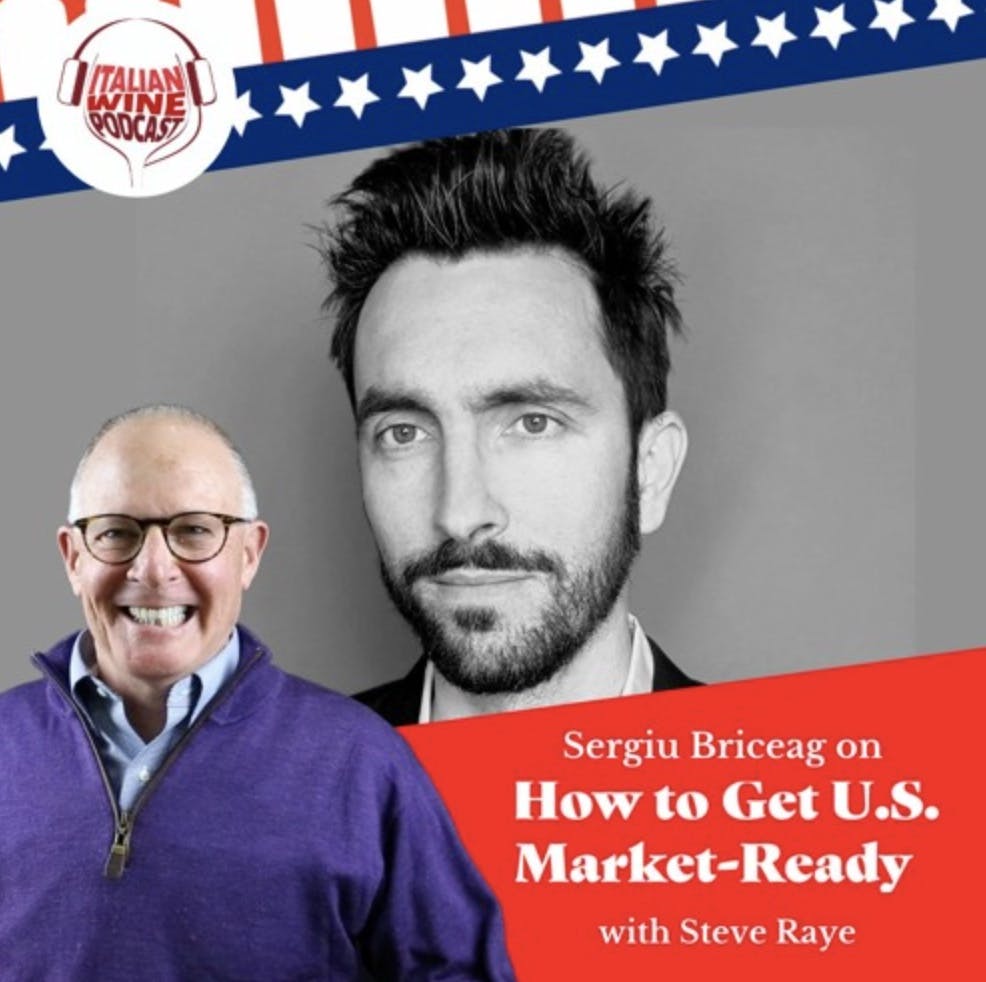
Ep. 599 Sergiu Briceag | Get US Market Ready With Italian Wine People
Masterclass US Wine Market
Episode Summary
Content Analysis Key Themes and Main Ideas 1. Introduction to the ""Get US Market Ready with Italian wine people"" podcast and its focus on industry personalities. 2. The function and historical development of Best Wine Importers as a global database and resource for wine producers seeking importers. 3. Effective strategies for wine export and market entry, with a specific focus on the complexities of the US market. 4. The importance of thorough research, strategic marketing, personalized relationship building, and realistic expectations in the wine business. 5. Leveraging digital tools and adapting approaches to traditional trade shows for successful international business development in the wine sector. Summary This episode of ""Get US Market Ready with Italian wine people,"" hosted by Steve Ray, features Sergio Brysag, co-founder of Best Wine Importers. Ray introduces his new series, which delves into the experiences and strategies of Italian wine sector professionals in the US. Brysag details the 15-year journey of Best Wine Importers, explaining how their global database helps wine producers find reliable importers and distributors. He emphasizes the platform's advanced search capabilities and its utility in market analysis. The conversation heavily underscores the need for producers to go beyond cold calls by conducting extensive research on potential importers, understanding the nuances of markets like the US's three-tier system, and presenting their wines as ""business solutions"" rather than just products. Both Ray and Brysag advise on the crucial role of marketing, brand strategy, setting realistic expectations (aiming for the ""next meeting"" rather than an immediate order), and effectively utilizing both digital tools and evolving trade show formats to consummate business relationships. They stress that authenticity and continuous effort are key to success in a competitive global wine market. Takeaways - ""Get US Market Ready with Italian wine people"" offers insights into the US Italian wine sector. - Best Wine Importers provides a valuable global database and tools for wine producers to connect with importers and distributors. - Successful wine export, especially to the US, requires diligent homework and a strategic, personalized approach beyond generic outreach. - Understanding market-specific complexities, such as the US three-tier system, is crucial for pricing and distribution. - Effective marketing involves presenting a wine as a business solution to an importer's needs, not just as a product. - Trade shows are increasingly suited for deepening existing relationships (""consummating a relationship"") rather than initiating new contacts. - Producers must set realistic expectations, aiming for the next conversation or meeting as a primary goal, rather than immediate orders. - Authenticity, leveraging technology, and consistent effort in marketing and relationship building are essential for long-term success. Notable Quotes - ""don't rely on shortcuts. Do your homework and it will pay off."
About This Episode
The speakers discuss the benefits of their search engine and the use of their database for marketing strategies. They recommend cold calling clients to present themselves as a solution to their problems and use a price structure tool for winery importers. They stress the importance of finding niche importers in specific markets and setting realistic expectations for results. They also advise against cold calling clients and emphasize the importance of researching each lead and finding the importer's financial strength and portfolio. They stress the importance of setting realistic expectations and bringing value to the perspective of the importer and distributor.
Transcript
Thanks for tuning into my new show. Get US Market Ready with Italian wine people. I'm Steve Ray, author of the book how to get US Market Ready. And in my previous podcast, I shared some of the lessons I've learned from thirty years in the wine and spirits business helping brands enter and grow in the US market. This series will be dedicated to the personalities who have been working in the Italian wine sector in the US, their experiences, challenges, and personal stories. I'll uncover the roads that they walked shedding light on current trends, business strategies, and their unique brands. So thanks for listening in. And let's get to the interview. Hi. This is Steve Ray, and welcome to this week's edition of Get US Market Ready with Italian wine people. This week, I'm I'm pleased to have as my guest, somebody who's not from Italy. They're actually from Romania, but I think you'll see the connection, in a little bit. Sergio Brysag. Sergio, welcome. Thank you for having me, Steve, and, hello to everybody. So you may be wondering why I'm talking to somebody in Romania. Well, the the background on this is I had a, a database that I had created called Importer Connect, actually trademarked. And, it was, a labor of love, but it was not very accurate. And I came upon this site called Best Wine importers and found that they had done a much better job of that and beyond just importers in the US. They had a database on global importers. And and that was the question I was getting from many of the producers. If not most of the producers, I was working with, can you help me find an importer? So we connected and had good, you know, conversations. And then it turned out I got invited to give a presentation in Romania. They're in Romania. They're in Oradia, which is in the far west of the country. Kinda northwest of where, Vlad the impeller's castle is. And, I went for a visit, and, we learned a lot about each other's business, and we've been helping each other, ever since. So, Sergio, why don't you give us a background on, start off with what the company is doing now relative to helping brands who wanna export to other markets and then then give us a history of how it developed. Of course. Well, for the last fifteen years, we've been helping wine producer from all over the world to find, reliable importers and distributors and basically get in touch with them via various marketing channels. The we being let me interrupt you. The we being best wine importers dot com. Yeah. Yeah. Exactly. The first best wine importers database basically was launched, as I said, fifteen years ago, in two thousand and five. It was a time when wineries were becoming increasingly interested in, expanding their exports, especially after the massive growth of the Asian market. And there were very few reliable databases, which provided contacts for, worldwide importers. A lot of people had the old Excel files with, emails and names collected from expos and stuff like this, but after one or two years, the data was no longer usable because people kept changing their jobs, phone numbers. So it was a nightmare to keep this database updated to have someone in your marketing team constantly checking for contacts So we managed to create a database, with some people who are, back then working in various data analysis fields. And, we started with a smaller database, maybe five thousand companies and the website. The database was a modified Excel file that we kept updating every few months. And, things started moving amazingly Well, we started to some smaller wineries, mainly from the Italy, Spain, France. And over the years, the product became very popular, and, we started seeing some big names to, for example, Some of our Italian clients are, group of Cabiro, Marquesientinori, Zamin, Kavith, group Oonelli. So a lot of the big names now also use our database as part of their marketing strategy. Because, let's be honest, every business which relies on a sales team will need a list of potential customers. So the more targeted and focused this list, the better. And creating such a list can take a very long time and a lot of resources. You have to get someone in your company to do this for a number of hours each day when he is probably more focused on selling, and he should contact people and try to present the product not the creating databases. Most of our clients saw value of, instantly having access to something like this, which is, updated. It's ready to use. You can give it to the sales team, and they can start contacting people. So, yes, the majority of our clients are happy to have us as a a partner. And, I will there are a number of, scenarios where they use the database So beyond the database, one of the things that you've done is enhance it with, a bunch of tools and resources. Can you talk about some of those things? Yes. Initially, the ingredients of the database were the name of the company it's email, its website, and, contact person for it. But now, we've added a very advanced search engine. For example, people can search for importers of a specific brand, of a specific wine variety. They can see, which importers work with, which, other companies. There are a number of filters, which also allow people to target markets, And this can be very useful if, winery, for example, is looking to create a market analysis. For example, they want to see, okay, we want to find some money in Eastern Europe, which country would be best, Romania, Poland, I know Bulgaria. So they can go to the database, check out each of these countries and see the number of importers, their strength. We also have financial data for some of the companies, which can be very useful to see the top importers based, and you can filter this by standard. Their revenue and, number of employees. I wanna jump in here and and and make a a point as I counsel my, clients. Having a contact name, especially if it's the right one is absolutely wonderful. It's necessary, but it is not sufficient that before you cold call somebody and just say, hey, I've got a product, are you interested in porting it? Is to do a little homework on that person and that company, which is relatively easy to do with Google and LinkedIn and all kinds of tools like that, find something out about them and present yourself as a solution a business solution to their problem. Maybe you see in their portfolio, they don't have, a product from your particular region or the varietal or the style of wine or whether you're biodynamic, whatever it happens to be. That you can find some opportunities to present yourself as a business solution to their needs as opposed to just another product. And so I I look at a a a tool like Best Wine importers as a really great place to start. But that'll only get you to a cold call. You've gotta move yourself to a warm call. So make sure you go to LinkedIn. Check these people out. Who else works? They are any connections that you have? What is their area of specialization? Check out their, top people. Have they given any speeches? That have been published. Have they attended any conferences or something? You'll have a much better insight as to what's going on in a way to introduce yourself to these people and turn a cold call into a warm call. So one one of the other, tools that Best Wine importers has is a, price structure tool. And it's something that I provide for my clients, and I've shared freely with, Sergio and his team because I think it's something that many people from, we call it overseas outside the United States don't understand on how the three tier system works and how it impacts margins and what the differences between margin and markup and so on and so that's one example of the tools that are there, a a price structure tool both for spirits and minds. What are some of the other specific tools that that you are offering that you can talk about? Yeah. The price structure tool was very important because, like, you say, many people have this idea that, okay, we have to get to the US market. There's a lot of money there. If we make it, it's gonna be a crucial step for our company. But from this idea to actually implementing it and finding an importer is extremely difficult because maybe you can do this in Europe or, maybe even in Asia, but in the US, because of the free tier system and the the state structure, things get a lot of far more complicated. So the price, the price structure tool, was created was one of Steve's ideas. We worked with our programmer, and, we offer it for free on our website. We've actually got a lot of positive feedback from it, but it still requires quite a lot of understanding. So, a winery will need to get someone from their financial department or, an export expert probably to identify each of those fields and to really know what data to enter in, each of those fields to get the an accurate estimate of their wine price in the US. Other tools that we offer for the database is, as I mentioned, the opportunity to find very niche importers in very specific markets. We had a client from Israel, for example, who was looking for only importers of Israeli wine, and he managed to use the filters in the database combined with the the advanced search, and he found a number of very interested importers in Germany, and he was super happy with the database. So, especially for these niche producers who have us very specific product, the database can be a very powerful tool. But it can also be for any regular winery, but it has to be combined like Steve said with a very solid marketing approach. Because almost any winery has great wines like what I would like to say. And the the difference between producing a an excellent wine and the selling a wine at the an excellent price is quite large, and it's the the job of the marketing and the sales team. One of our main advices is to do they do your homework and, like, Steve, like, Steve said, use all the new technologies. Go to their LinkedIn page. Maybe like their Facebook page. Get in touch with them there, restart their portfolio, friend them on any social network, use WhatsApp, try everything to get their attention and, start a conversation going. Yeah. I think there's a tendency. I know there's a tendency, I've been doing this long enough for people to think that, oh, all I need is the name of somebody to reach out to. And it it clearly is not that simple, and I think it's a lot harder in the US. I can't comment on other countries, and their database applies to, I mean, exporting to everywhere from Vietnam to Romania, Chile, any country in the world that that you can think of. So it's kind of unique in in having that level of detail, but it it It's it's as I say, it's it's a place to start. And one of the other tools that I would recommend for suppliers. Again, this goes for wines as well as spirits is, use the tools that best wine importers has certainly the price structure tool, but also on on my website, Devology inc dot com. I on the blog or I'm sorry on videos, I post a whole bunch of webinars and seminars that I've given, including the one that I gave in, Romania, by the way. On understanding how the US market works. Now there's some other tools that are out there. Obviously attending trade shows had in the past been a big one. It will continue to be a big one, but I think it's fundamentally going to change. Can you talk about how somebody can use your database in regard to having plans to attend in Italy or, Provine or Vinexpo? Yeah. But we see a lot of, movement and activity in the period of the year when the main trade shows, our schedule. For example, Projana, in February and, in Italy. A lot of companies invest a huge sums of money to get a nice stand to ship their wines there. But the the main objective is to get actually get importers and get to get new people at the stand and set up tastings. Try to to improve your business. So, most importers will schedule a few, campaigns and, invite the importers and distributors at their stands This honestly is, not always gonna end up as planned because a lot of importers, who we met at trade shows said that, they mostly use the time at the at an expo to, consolidate their current contacts. So they need importers. They they're already working with and distributors. They try to maybe expand the portfolio of wines to show them what they've been doing during the last year, present them some new wines. So it's not so much about getting new people as to, consolidate the relationships and, try to to upsell. Yeah. I think, what what we're seeing is, certainly at, in Italy and also at provine, they've integrated a bunch of tools that allow you to identify, and create a schedule and, initiate conversations with people and then organize them. And, of course, admittedly itself. It's that's really important because it's like, walking around an entire city to get from one end to the other can take you about forty five minutes. But but the the point being, I've I've said that it's I think the role of a trade show these days is not to initiate a conversation, but rather to consummate a relationship. So you should be doing as much as you can off well, you talk about it. Go ahead. It's exactly like you mentioned, things have moved probably in the ten years ago. There were, few, fewer wineries and, more importers who are, looking for wines, especially people from Asia who were, trying to get new and interesting varieties of wines to to Asia. But now, with such a large variety of producers, so many, the varieties of wine, you really have to, consolidate your, your business. My recommendation to people is use the tools that, these trade shows have, certainly attend them because it's still there's nothing like meeting with someone in person, but it's a lot better when you're meeting someone in person who you've already established a relationship with online. Again, the idea of consummating, that relationship And I've seen it it it work, better. And as the trade shows are evolving post COVID, I think using those two sets of resources together is gonna result in, give you a better result for the individual producers. The other thing, do you have a comment on let's talk about American importers and distributors, attending these trade shows and and in general. And then more specifically, do you find them using your database? So not just the wineries themselves who are searching for them, but, importers and distributors who may be looking for things on their own. How would they use the site? One one aspect about, creating the database is that, not only our team adds new companies, and we also allow importers and distributors to be added to the database. They can easily contact us on the website or write us an email. And, we get a lot of, feedback, actually. And, we get the importance to say, okay. I'm really looking now for some new wine varieties that, I would like to be added to the database. What will happen next? So what will happen, we have at the company, at the contact details, the contact person, and quite soon, the wineries will start contacting, the specific importer and, show them their, their offers, their, new, they, send new announcements, and, they try to set up, meetings that expose, for example. So we have, importers and distributors from the US who are doing this. We have importers and distributors from Australia. An interesting fact about Australia and the Proine We've met some of our clients from Australia during our last visit of Proine and, very, very few Australian, wineries who are using a similar databases. A lot of them had really old system with, printed Excel sheets with, the names of importance or distributors, and they were super excited to to know that there's, a non line system like this, based in the cloud, which is, constantly updated. Yeah. I imagine that's gotta be real important now when, basically, the China market has collapsed for the Australians and they're refocusing their efforts. We see a lot of activity from, wine, Australia, on the US market. And these tools become really, really important. Okay. So we've kind of talked about, a bunch of things here. Can you boil it down to, what what the big takeaway is of Somebody was listening to this thing. What are the three things they can walk away with and put to use immediately? The most important thing that we try to tell our clients is don't rely on shortcuts. Do your homework and it will pay off. So you also focus on this in your book, Steve, how to get US market ready, and it was amazing. Thank you for, offering us this, during your last visit. Producers should dedicate time and, research each lead and try to get the maximum potential out of it. Try to see where the headquarters is located in which area they operate. Try to see their size, their financial strength, their focus. Try to see what their portfolio includes now and what's missing. And when they eventually contact them, they there's a far better chance of a positive reply if, the importers also sees that, you've the producer put some effort and, did the homework before approaching them. If the producer allocated some time and effort to get a meeting, the importer, might as well try to do the same thing. And, it's far better than just sending out the generic emails describing your why. The second advice would be to work with a good marketing team and to identify your niche as I said before, almost everybody has great wines, but in a sector with fierce competition, solid innovative, and the well implemented branding and marketing strategy can get you far better results. If, the producer doesn't work with a marketing expert, we advise wineries to use our platform to, and take time to create good emails, make them different. Always think in terms of what the importers has to gain if he decides to work with that winery. Basically, what's in it for him? After the first contact, always follow-up. And, try to see if you can get some feedback. Try to turn a cold call into a warm call like you said. Test new things each time. Try to improve the things that work less time and change the ones that didn't get you results. Try to come up with new ideas in a world where marketing has become essential and you have to constantly be in tune with the latest trends, be active on almost all the new social media channels. Importters also watch these these things and, there's a lot of reporters that, work with wineries that are super popular on social media. Also, many winemakers, especially the more traditional ones, I think that using, ninety percent of the resources to make an excellent wine and a ten percent of their resources for marketing will be enough, but this is a very big mistake. And, for advice, this is also an very important one is to set realistic expectations. I think that we see with our clients who start using the platform is that many of them just email campaign, and then, they might complain that they didn't get orders from it yet. Let's be clear. You're not going to get amazing results with the minimal efforts. If you're going to send out a mass email and expect the orders and a few containers, for example, that's not going to happen. What you want is to get the first meeting. You have to move them to another to another meeting and, discuss your particular need or interest in more detail. You've moved what, what's just the contact into the realm of prospect. Okay. The so the next step would be to turn a suspect into a prospect, and that's what we mean by setting up a next meeting. That's an achievable objective, and, getting an order quickly is not so much. I I would I wanna just add, reinforce that point that a lot of people think, oh, I can send out a mass email as you said and expect something to happen. Don't confuse don't confuse action. With results. And the end to end result may be a container order, but there are many steps in in between. And in the case of your first outreach to, prospective importers or distributors, the goal with the objective is to get the next conversation. So if you can start the relationship and set up, an an agreement to have another conversation, and provide x y z information. All of a sudden, you are took a giant leap towards getting the results, the ultimate results you want. But the key is get the next meeting. Focus on what you're trying to do right now, and that is to get the next meeting. Rarely is that going to happen with a mass email? The second thing I would add to yours is it's not about the product. It's all about the business solution that you are bringing to the perspective importer and or distributor. And that requires a little bit of understanding of their business. So take ten minutes. Look at their website. Check out the people on LinkedIn and what they're doing and where they've been, and and that kind of thing. You'll gain some tremendous insights and opportunities that you can bring up in a conversation, even if it's as something as simple as saying, oh, I see you went to Purdue. I had a cousin of mine who went to Purdue. How did you like it? Now, of a sudden, you're turning this into a conversation as opposed to a pitch, and you've made it a little bit easier to have that conversation. So we we had asked for it. That that was a big takeaway. We got about five of them, and every one of those are really great. I I think that the big thing I'd wanna leave people with is Look, we recognize if you're a wine producer, you may be, you know, a farmer, a small producer and so forth. You're not an expert marketer. Well, with the tools available today, you don't need to be. I think, but if you focus on the needs and interests of the people you're trying to talk to, and be yourself is all about authenticity. Don't try and be something you're not. And if what you're all about is passionate about the soil and the land and the his three of the place, then that's what, you know, you've got to sell. Turn that into some reason why it's of value. One example I would use is some research I've seen about the the the difference in the perception of the word organic versus the word sustainable. In the US, organic has a very specific definition. It's regulated not by the TTV, but by the USDA, and it appeals to a niche. The word sustainable is not regulated because it doesn't have a specific designation. It's something that everybody's interested in, and that pretty much every winery can claim. So my recommendation is talk about the benefits that you bring to the party. And if you're sustainably produced, talk that up. You don't need a biodynamic certification to say that your winery is, or or that your wines are or spirits are sustainably produced. Let's bring this to a close. I wanna I wanna say thank you to Sergio and congratulate him on his great English. My discovery of the wonders of Romania. I look forward to the opportunity of going back there, but really for everybody who's listening here, use the tools and add value to the tools and, grow your business. That's gonna be the thing that that is gonna certainly from my perspective, that would please me the most. And I think, Sergio, from from yours as well is to see people, get results. Thanks again for having me here, Steve. And like you said, the thanks to the technology nowadays, even small wineries, can get results just be authentic, invest some time and, try to set realistic expectations. So a big thank you to Sergio Bryce Ag of best wine importers at best wine importers dot com. And this is Steve Ray signing off for this week for Get US Market with Italian wine people, and we'll be back next Monday with another interesting podcast interview. Thank you for listening. This is Steve Ray. Thanks again for listening on behalf of the Italian wine podcast.
Episode Details
Keywords
Related Episodes
Ep. 2790 Italian Wine in the US: Building a Narrative and Reaching Asian American Consumers with Susan R. Lin MW | Masterclass US Wine Market
Episode 2790
Ep. 2783 The Suburban Gold Mine: Insights into New Jersey’s Wine Market with Brittney Abell | Masterclass US Wine Market
Episode 2783

Ep. 2772 A Surprising Partnership between Japanese Sake & Italian Wine with Monica Samuels | Masterclass US Wine Market
Episode 2772

Ep. 2748 Florida Wine Market & Vinitaly USA with VIA Italian Wine Ambassadors Stefano Campanini & Daisy Penzo | Masterclass US Wine Market
Episode 2748
Ep. 2742 Wine Marketing Insights: Positioning, Occasions & New Consumers with Molly Bossardt | Masterclass US Wine Market
Episode 2742

Ep. 2730 Wine Storytelling That Drives Consumer Engagement with Heather Daenitz | Masterclass US Wine Market
Episode 2730