
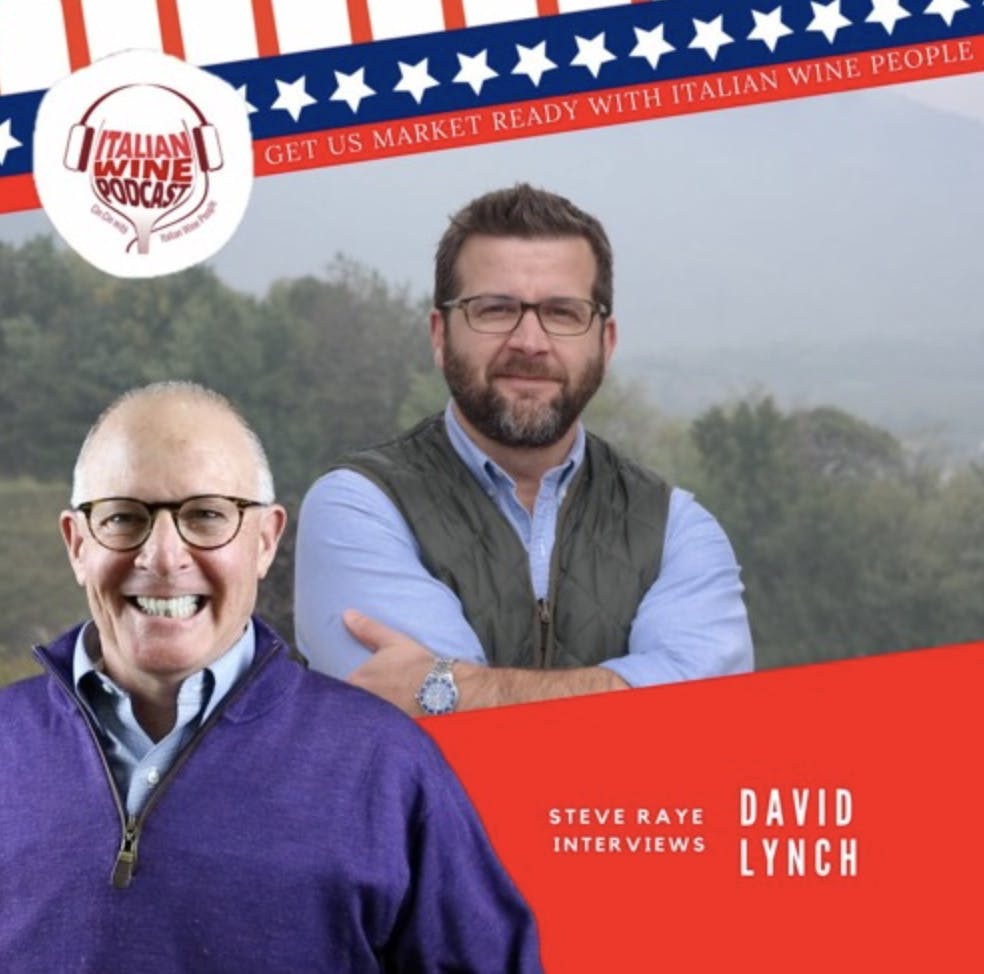
Ep. 634 David Lynch | Get US Market Ready With Italian Wine People
Masterclass US Wine Market
Episode Summary
Content Analysis Key Themes and Main Ideas 1. The unique e-commerce model of SommSelect, focusing on curated, authentic wines. 2. David Lynch's multi-faceted career path, spanning sommelier, writer, restaurant owner, and now editorial director. 3. The importance of storytelling and expert content in differentiating an online wine retailer. 4. SommSelect's target audience: discerning wine enthusiasts seeking quality and narrative over simple discounts. 5. Challenges and practicalities of direct-to-consumer wine sales, including shipping costs and the three-tier system. 6. Advice for wine producers and importers on successfully navigating the US market, particularly for platforms like SommSelect. 7. The significant role of Italian wines within SommSelect's portfolio due to their value and authenticity. Summary In this episode, host Steve Ray interviews David Lynch, the Editorial Director at SommSelect, an e-commerce platform for wine. Lynch details his extensive background as a wine writer, sommelier, and restaurant owner, which informs SommSelect's unique approach. He explains that SommSelect prioritizes expert curation, offering ""authentic"" wines from ""real people in a real place,"" often small, indie producers, and emphasizes storytelling rather than just price-driven transactions. While SommSelect ships directly to most US states and focuses heavily on Old World wines (especially Italy and France) and California, Lynch discusses the challenges of operating within the US's complex three-tier system and managing high shipping costs in a market shaped by Amazon's free shipping expectations. He also provides practical advice for Italian wine producers and importers looking to enter or grow in the US market, highlighting the need to understand national pricing structures and the value of professional wine presentations. Takeaways * SommSelect differentiates itself by offering expertly curated, authentic wines with rich stories, moving beyond typical e-commerce discounting. * David Lynch's diverse experience in wine (writing, sommelier, restaurant) underpins SommSelect's content-driven approach. * ""Authenticity"" for SommSelect means wines from dedicated producers, often small and family-owned, with a strong connection to their region. * Italy is a crucial market for SommSelect due to its ability to offer high-quality, authentic wines at compelling price points. * The US three-tier system and high shipping costs pose significant operational challenges for direct-to-consumer wine sales, making competitive national pricing essential. * Effective storytelling and valuable content are key to converting and retaining SommSelect's discerning customer base. * Wine producers and importers aiming to work with platforms like SommSelect must consider national wholesale and retail pricing to ensure competitiveness. Notable Quotes * ""I'm a hybrid of a Sommelier and a writer, and it all came together upon joining Psalm Select."
About This Episode
The speakers discuss their approach to e-premise sales, emphasizing the importance of storytelling and the transactional nature of e-premise sales. They emphasize the importance of finding authentic and transactional wines, finding the right way to present them, and finding the right way to be a professional and loyalty-impacted. They also discuss the challenges of writing short and long, the importance of customer retention, and the importance of being a professional in e-premise sales. They provide their email and social media handles for reaching out to them.
Transcript
Thanks for tuning into my new show. Get US Market Ready with Italian wine people. I'm Steve Ray, author of the book how to get US Market Ready. And in my previous podcast, I shared some of the lessons I've learned from thirty years in the wine and spirits business helping brands enter and grow in the US market. This series will be dedicated to the personalities who have been working in the Italian wine sector in the US, their experiences, challenges, and personal stories. I'll uncover the roads that they walked shedding light on current trends, business strategies, and their unique brands. So thanks for listening in, and let's get to the interview. Before the show, here's the shout out to our new sponsor, Ferrawine. Ferrawine has been the largest wine show in Italy since nineteen twenty. Have generously supplied us with our new t shirt. Would you like one? Just don't add fifty euros, and it's all yours. Plus, we'll throw in our new book jumbo shrimp kite international grape varieties in Italy. For more info go to Italiancoin Podcast dot com and click donate or check out Italian One broadcast on Instagram. Hi. This is Steve Ray, and welcome to this week's show. I'm pleased to have as a guest David Lynch, who is an editorial director at Psalm Select. Soundselect is an interesting twist on e commerce, bringing sounds into the equation, and we're gonna hear more of that from David. So David, welcome to the show. Thanks for having me. Can you give us a little bit of background on you and, your history in the industry and how you got here, I understand you've been a Sam, you've been a restaurant owner manager, a writer, and are conflicted about what exactly you are. Give us a little history. I'm a I'm a hybrid of a Sommelier and a writer, and, it all came together upon joining Psalm Select. My my first experience in the in the Hawaiian world was as a writer in the magazine business. I started out in the in trade publications that covered the beverage industry in New York. Well, the the publication was in New York. The beverage industry was everywhere. And my first b was spirits, really, which was, you know, tequila, Scotch, and all those very powerful brands and companies behind those brands. And then, I switched over to the consumer side and worked at wine and spirits magazine under Josh Green, who's the editor and publisher there forever. And That was my real immersion in wine and in kind of building my my name as a as a wine writer. And, after several years at wine and spirits, my old friend Joe Bastianich and I, Joe being the proprietor, Bobo, and, son of Lydia Bastianich, owner of Felidia, the own Beto together. He and I went to college together and and were, you know, sort of on these. I wouldn't call him parallel career tracks, but I was just covering the industry that he was a part of, and we decided to collaborate on a book called Vino Italiano, which I spent the year two thousand researching and writing. And upon returning to the US, I kinda changed directions and went into the restaurant business came, the wine director at Babo in New York City in two thousand one, was there for seven years. Bounced around, kinda bounced back into writing a little bit, ended up coming out to San Francisco, where my wife is from, and, in two thousand nine, joined up with Quentin and Catonia Restaurants in San Francisco where I was the wine director, then I eventually opened my own restaurant in San Francisco called Saint Vincent. And all the while, I was I was still doing a fair amount of writing. I had a column and bought a petite for a while. And upon closing my restaurant in twenty sixteen, I had the opportunity to join up with Psalm Select, and it was at that time, Psalm Select was about two, two and a half years old at that time, It was founded co founded by Ian Cobble, who was in the documentary film, Psalm, one of the four principles in that film and, pretty, pretty famous guy who very shrewdly you know, took the notoriety from that film and and turned it into a business, basically. And so the idea behind some select is a very simple one. And that is we've got some really credible people spending a lot of time looking for authentic value wines. We're not talking about a line I came up with in the in the early going with standouts, not closeouts. We're spending our time seeking out wines the way we would if we were writing a restaurant wine list. I mean, that's that's really the criteria. What I wanna on a wine list or not, And because, you know, in retail, I think that you can divorce yourself from the, you know, be you can divorce yourself a little bit more from the idea that this is what people will like. You also when you're in some way, you you not only consider that, but you also consider, obviously, what do I like, but what what what do I feel like reflects well on on me and the restaurant? What works what works the best for everything that we're trying to accomplish? So that mentality, and then the the follow through is the other big thing about Psalm Select. We send out the original model was a daily offer focused on a single wine. So it was very much the Flash sale model There are other people in that space. But what ours aim to do is to go deeper to provide a little more context to provide the kind of expert advice and or information you might receive tableside in a restaurant. From a skilled sommelier. So it was a way to kind of it's it's a way to personalize the the experience of buying wine online in a way that doesn't exist in a lot of places. You know, these these offers are really coming from the heart. You know, so rather than say that we have an algorithm that picks what we think you'll like, it's a little more analog in that regard, and it's us. And and that's what I came aboard to do was to sort of broaden and refine the voice of the site by writing these offers. Originally, I was just doing it as a, you know, on a freelance basis kind of consulting, and it turned into a a full time job. And what I like about it as I said is that we're able to connect with our customers in a way that I don't think was is necessarily possible in a lot of e commerce environments. In other words, there we have subscriber. We we call our our customer subscribers. Because they're not simply it's it's beyond transactional. I think that there's a relationship that we develop with customers via the offers that we write and the content in those of those offers. There are so many customers that will say whenever I see your name pop up, I'm not gonna I don't even look at it sometimes because I know if I look at it, I'm gonna buy the wine. So there's this. I think there are a lot of people who follow our offers with interest and read them for the information that they provide, but don't necessarily buy the wine. So there's that too. But there's a there's an ongoing relationship there that I think transcends this thing that I kinda cancel against on on e commerce, which is just that it's so transactional. You know, we're not really discounting. We're not we're looking for value, but we're looking for inherent value, not this used to cost forty. Now it costs thirty. So it's a different proposition that we're making to people. And that is we tasted, you know, over the course of the year, we're now up to two offers a day. Over the course of the year, we're tasting thousands of wines thousands and thousands and thousands of ones and only a small percentage of those make it through to being up on the platform. So it's it's a it's it's a I think a very personalized and and expert, obviously, but, you know, we're trying not to necessarily be like oracles and more about, look, we really are trying to find the best. We're we're trying to find the best most authentic wines too. So we're really not we're not we're not selling brands as much as we're selling places and people and, really authentic products. So define authenticity to me in your construction? It's a it's a It's a big word for me. It's a big word for us. And the best way I can describe it in the context of wine is that it's a real wine made by real people in a real place as opposed to something that is purchased in bulk and branded. So I'm talking about a specific farm of a specific dimension that produces generally speaking, the producers that we're featuring are are pretty small and, you know, more of an indie producer, mentality. And they are often families that go back hundreds of years in their respective regions. So these are very much the when I think about authentic, I think about someone that has been in their place for a while. Someone who, if they haven't been in their place for a while, has this really deep appreciation the place that they're sourcing their grapes, and that's something that we're seeing a lot in the domestic wine businesses. This huge liamization of specific vineyard sites. You know, the the the house on the hill model of American wine doesn't really exist anymore unless you're a tycoon. Right? You know, you you you you can go in and you can buy your way in and buy a winery in in in a state, but most people are working on the contract almost micro negotiating model. Which is let's see if I can make a connection with the owner of the Evangelo vineyard and see if I can source a little of the move head from there and make something that has some soul. So I think Wines with soul is a shorter definition of it. But wine wines with the real story is another definition of authenticity for me? I think that's the big part of it right there. I mean, It's all about stories. Everybody's been talking about that, the internet and all the other tools that we have, social media, and so forth, reinforce that and deliver value to consumers. And it's one thing to have a story. It's a whole another thing to tell a story. So is that something that you can say that some select does perhaps differently and better than because the authority or the credibility of the voice is a little bit more rigorous and perhaps academic? Professional? I'm always reluctant to toot my own horn, but yes. I just did. It is yours. Yes. And that's another that's another tagline I came up with over the years, was we don't just sell you a wine. We tell you its story. I love it. I love it. So let's go back to some, practical things. I think philosophically, we got what you guys are all about. Are there types of wines or countries of origin that some select specializes? I would say Old World Europe is the number one focus, even though we're based in Sonoma, France, Italy, Spain, Germany, Austria, Greece, Greece, but, obviously, we are also very tuned into domestic wine, Oregon Pino noir is a huge category for us. Washington State, of course, California, especially Napa Valley, but, also Sonoma Coast, Santa Cruz Mountains, one of the most underrated wine regions in the world, So we're we're we're pretty polymorphous although I would say that other new world beyond California gets less attention. Chile, Argentina, South Africa, Exactly. Australia. I mean, we do a little South Africa, but I would say we're a little I would say we're Eurocentric plus California. So where does Italy fit in? Italy's hugely important largely because of, I mean, partly because of me. I mean, one of the things that because of my focus on Italian wine all these years because of the book, because of my ongoing relationships with suppliers there. It's a probably our second biggest category. Ian Cobble is a little more of a Franco file. So I I tend to be pretty pretty intimately involved in all the Italian programming and write most of the Italian offers. That is I don't know the exact percentages, but a a very substantial percentage of what we do. Italy still has a great hold on the lower price points of the market and sort of over delivering at those lower price points. They still have a great. And we're seeing a lot of people try to challenge the throne now, Portugal, as I mentioned, France, which maybe didn't used to is now really strong at that at that end. So, you know, what you can get for, let's say, thirty bucks a bottle or twenty five bucks a bottle out of Italy is almost unmatched in terms of as we talked about authenticity, but also just in terms of quality for dollar. That's really the the shopping we're trying to do. Is how much can we get a wine to overdeliver at whatever price point we're we're putting it at. Okay. So in terms of practicality, how, are are people buying it from you and then you guys ship it out via common carrier directly to them, or does it go through a retailer? No. No. No retailers. We're we're direct. We we maintain a warehouse in Sonoma. We, do all the packing ourselves, and then we contract with shippers to get it to folks. There are only about, I think, five states now that we're not able to ship to. So we're pretty national at this point. It's safe to say we can ship just about anywhere. There are a few no no states that still exist that are, you know, this is a function of the the sort of the last I mean, the three tier system is very much alive. Let's put it that way. It's not, going anywhere. But there are a lot of mechanisms in place that enable us to get into these markets and it's not gray. We're, you know, we're meeting sales taxes and we're, you know, it's it's a straight straight to consumer model that, obviously, I think COVID in a lot of ways maybe had has people looking at whatever restrictions remain in a new way. Can you give us a sense of size in terms of dollars sold number of bottles sold or were twice as large as wine dot com or, you know, how can you put this into some context? I I I can't because it's proprietary, but I can tell you that we're not as large as wine dot com or or wine access where heading in that direction, we hope. There's been great growth over the last well, all the years that I've been there have been pretty ex no. I wouldn't say exponential, but really significant growth. And in some years, exponential, but to get to that scale is gonna be the challenge for us because the kinds of wines that we offer aren't necessarily mass scale wines. In many cases, they're, you know, there are some wines that we offer for which there may be a hundred, two hundred cases in the entire country. Plus, I would say that your customer base is more narrow than, a broader thing like wine dot com or traditional retail store. Yeah. I I think that it's probably we are one of the things that we have used in our marketing, and I think it is true is that we ask them to we ask our customers to think of us as their neighborhood retail store online. I do think that the focus of I mean, we are gonna we're gonna encounter we're not there yet, but we're close where we're gonna encounter these these issues of scale and be like, okay. I still think there's room for us to get to a really nice number using the wines that we prefer to use, which are, you know, wines that we consider to be special. I also think that we're we're at a slightly higher price point than a lot of our direct competition. That that was my next question. In fact, what price categories or tiers do some? You know, averages are probably in the thirties as opposed to a lot of places that are probably trying to be in the low or even under twenty. Model. And I can just tell you that and I'm not looking to besmirch anyone, but the costs of shipping are so enormous that to be able to offer a really discounted low priced one and ship it to someone for free is you're not getting much of a wine in the twenty dollar range. You know, the the the cost of shipping are enormous. And so So in your model, do you charge for shipping, or is it incorporated into It's incorporating it at a certain, you know, at a certain cutoff, you know, that's we'll we'll charge for it if it's a single bottle being shipped somewhere, but usually there are there are a series of incentives to get free shipping that aren't really that onerous. Actually, they're they're quite generous, you know, six bottles. Usually, you get free shipping on something. So and the free shipping, of course, is something that you you I don't wanna get political, but, you know, Amazon has kind of ruined it. Amazon has established the standard that, unfortunately, everybody has to be measured against even when it's in an industry governed by a three to care system, which makes it practically impossible for us to do it. Yeah. I mean, the difference between us and Amazon is that Amazon defrased their shipping costs to I mean, basically defraised them to their customers eventually, but to other providers on their, you know, there's I'm not gonna get into that because Right. Well, it's not. I'm I've been on a anti monopoly kick lately, so I'm I'm sorry. I'm a little bit I hear you. I hear you. So how if if a wine wanted to say, Hey, this is kind of neat. I'm a real somewhat a friendly wine. I used to have a let's put him into two cans. Someone who has already been in the US, maybe had a good business and the on premise business is tanked. And then someone who is not in the US at all. How could they get into Sun Select? Well, we, first of all, I will say that we're purchasing a lot of our wines in much the same way as we did when we ran rest front wine programs, which is through good importers who are on the stick and kind of can see what our needs are and put some stuff in front of us that we can work with. We have our world is somewhat governed by wine searcher. Which is a pretty big powerful institution tracking pricing around the country. So we have to be mindful of the fact that even though we're in California, we're putting these wines out to a national audience. And therefore, if somebody in New Jersey has the wine for a dollar less than what we paid wholesale for it in California, which is an issue that we run up against a lot, then we have a we can offer it. So there are a lot of ones that gets dequeued, not based on quality, but just based on their pricing structure in the US. If they're coming across the US from the East Coast and getting marked up accordingly, by the time that they make it to us, we're not able to be competitive. So a lot of Obviously, we're working with some great West Coast importers that are bringing stuff through the port of Oakland so we can be competitive on price. Well, that's okay. But Italy is the other way around. So some suppliers could go direct to you, but tradition but I think from what you've described, the best route to some select is through an importer. So are there importers that you work with that you find particularly receptive and collaborative with your model? Yes. There are importers that we work with that I consider very receptive and collaborative. I would say that yes, we do direct we are able to direct import wines, but that's a logistical piece that we have to add into the mix and it takes more time whereas in working with an importer, we obviously have the luxury of having had all that logistical piece taken care of already. In terms of importers that we have great relationships with, out here on the West Coast, there's Oliver McCrum wines, which from an Italian standpoint is a wonderfully focused very nimble importing company who else do we work with North Berkeley imports whose portfolio was originally very French focused but has blown up on the Italian side, and it's a very good Italian portfolio, blown up in a good way. Rosen thought wine merchant, of course, a very strong player in the, Italian world. Out here, there's a company called divinity, another strong importer in the Italian world, l y r a. Another, I'm trying to think of some of our other I should look at our offer sheet and see who's, I'm not hearing Wingo. I'm not hearing Scernick. I'm not We're doing some stuff weinbo, the difficulty with Weinbo is that they're national, and that when they put their wines, it's the same with, Skernic, for example. Michael Scernic Wines made a big play on the West Coast, and they're trying to be competitive as as much as they can. But Just the function of getting these wines overland to California, sometimes some of the big boys like Weinbo, we have to we have to tour trying to work with them direct from New York when we can. But, yeah, Weinbo is has been great. Actually, we've done I've got a winebo wine. I've got it right up right now, the Montevtrano from, from, Salerno and Campania. So we're definitely doing some business with the big boys as well. No doubt. I mean, at this point, I consider Rosenthal, pretty big. North Berkeley is pretty big. You know, they're not wine bow big, but, we're still we're still doing it when we can. Okay. Let's, shift gears a little bit and and talk about what you've learned in the four years that you're three to four years that you've been doing this. What kind of insights have you made since you've been there and texting and talking to all these people? On how people shop in differently in e commerce versus traditional retail stores and potentially even on premise. Let me just kinda talk a little bit about that. We've spent a tremendous amount of time analyzing content that in a lot of ways, you can't analyze quantitatively where, you know, we're only just now starting to get into trying to maybe AB test in different offers. We've struggled over the years with the length of our offers. And what kind of information we The length of the copy is is supporting them? Okay. Yeah. The length of the copy. Yes. But also, how do we start these offers out and to what degree are we really selling, like, how much salesperson ship are we inserting into these offers? And we found over the years that we do need to make a pretty impassioned case for the wine. Because we're not using price as that impassioned case. We're not drawing a line through one price and putting a lower price underneath it. What I found is that much as I would like it to be otherwise the power of that is probably more powerful than words, you know. So we're we're constantly trying to figure out the right way to present a wine so that the person reading it finds it as indispensable to their life as we do. My insight into what works online is that what I want to believe works versus what I think actually works are two different things. I believe that and maybe we're not there yet, but I believe that a more personal, impassioned approach works. What actually works is more transactional price driven. Like a thirty five dollar wine at a twenty five dollar price. You're not discounting the wine, but you're putting it in some perspective. So we're we're basically searching for the formula that doesn't do that because, it's it's, it's not where value resides. V value resides in a whole different set of of markers for us. And those are Well, I'd I'd like to explore that because I'm I've I've been, I've said many times that people wanna know two things. This is based on Mike. Not years in the industry, also some research and a lot of people buying at liquor store or retail stores. They wanna know what it tastes like in words that they understand and is gonna go with what they're having for dinner tonight. I think people who are shopping at a site named Son selects are not those same sort of people that they have a different set of interests. So can you elaborate on what you just said? I'll I'll give you an example. I have a friend. We just spent the weekend with her and her family. And she belongs to a club that sends her very inexpensive wines, every month. And she likes the wines well enough. And she basically said, I don't know if I can afford your I don't know if I can afford some select. I was like, well, I think it's really, like, it becomes what is your threshold for what you wanna spend on a bottle of wine? There are certain people who simply don't don't care. And there's a there's a there's a there's a ceiling on what they're willing to pay for a bottle of wine. And frankly, that market is the one that scales. The the the market that doesn't scale is the stuff that's real that most people aren't gonna be able to necessarily tell the difference. So you're I'm trying to find the people that in the same way that some people will buy us whatever tomato sitting there versus some that are gonna touch every single one of them before they pick the one that they think is right. We have to find those consumers that touch every tomato. And I don't wanna, you know, anytime I and then let's say a restaurant that has a terrible wine list, I'm just gonna order a beer. You know, I just I don't wanna just drink wine for the sake of being wine. And, of course, some of those wines are barely wines in in any kind of real way. But I'll just drink a beer because I I want the I I need an, like, an ex I I don't know. For me, it's it it's not that I'm researching every single farm that every single thing I put in my mouth has has come from, obviously. And we have lately seen a great surge in interest in sustainability and winemaking in organic practices where the vast majority of wines that we're offering are organic, often certified organic. In their home country, probably not in the US. Yeah. You know, US is tough organic, you know, very sort of tricky, expensive organic standards that not a lot of people are able to, you know, meet. But, yeah, so I think, I'm sorry. I I went off on a little bit of a tangent there from your original question, but I feel like what I here's another here's another thing that maybe is too philosophical. So forgive me. When I first got out of college, I was also interested in advertising. I mean, I mainly wanted to be a writer. But what e commerce is, like, completely turns what I first sort of saw on its head in that You know, I was this is the late eighties, early nineties, and there were still ad agencies that were pitching customers saying, we think the customer will really respond to this, this, and this. And marketing today is just send it to that guy, you know, that particular guy in Oklahoma, send it to him. He's gonna like it. So it's such a different mindset and that I've had to, you know, the idea of someone who used to write for magazines needing to sort of think about inserting keywords into his copy that are going to resonate. Or, obviously, we have to factor in what the label looks like when we put this a very visual medium. Right? It make if you put a wine with a horrible label, up on the site, it's not gonna sell. Right. And that's a whole another issue about not only what it looks like, but what how much information is included on the, you know, looking at German wines, for example, versus some more kind of spacey, American wise. But if I can boil it down, you've been talking about the idea of story. We know that that's something that people relate to. But in this particular case, I've read some of the reviews, and I get the feeling that it's more of a personal dialogue not a lecture and that the idea is to find something that's compelling to that consumer that gets them to engage maybe, vicariously in the experience of being at that wine or even though they're not going to be able to physically ever get there, but make them feel like the analogy is the old gap catalogs. They made you feel like you were an adventurer, you know, with a pith hat walking through the jungle lawn was ever going to do that. You're walking down fifth avenue, right? But gave you the, the kind of experience or photo experience. Who was the guy? Jay Peterman? Yeah. Yeah. Yeah. Yeah. That guy. That guy. Like, you're riding a horse with a big duster and a hat and the whole thing. Right? A duster. Exactly. You know, it's I think that there are a lot of similarities, frankly, between that sort of Jay Peterman style of marketing and what we're doing. There there are a lot of similarities. And I think that the difficulty is that, one of the things that I've seen online is that, you know, content is super important and yet it's been devalued in a in a pretty major way in the sense that that people, you know, it's like, oh, people don't wanna read. You know, this was the same thing that I found with the magazine is that everything got shorter and shorter and shorter. That was that's been the the mentality. Everything's gotta be a nugget. Everything's gotta be much shorter and to the point And I often find it's harder to write short than it is to write long. It takes more time to write three sentences sometimes than it does twenty, you know, because we really have to boil the message down really reduced You know, like the most reduced sauce ever, you know, so that it could it can be digested quickly. And so the attention span thing is a tricky one to navigate too because how how much of these offers are the folks reading? How much of it is just a Click. Okay. I like the look of that bottle. Okay. I like where the wines from. I'm not gonna read any of it. I'm just going straight to the cart. How much of that is happening? And and there are e commerce sites that do exactly that and that that they're set up for that. No no argument. One that I think of is the one from Gary Vander to empathy wines, very little description, very, very not bland, but very simple labels with not a whole lot of information, but I think that's going to a different audience. I think the people who are and reshopping at some select care about one more. No, a lot more about one and want to engage perhaps on a different level than that. We're we're definitely we're at this sort of Not a crossroads, but we're at an inflection point where we need to step up our game on a couple of levels, which, we're excited to do and we're we're in the process of doing, which is get more int more video content, more visual content, and really try to, you know, continue that engagement in a way because some people won't read a five hundred word piece on a specific line, but they might watch a video. So so that's something that we we really need to explore But I think that the where some selected successful is that, and and where we have been successful throughout our history is customer, sort of retention and loyalty. Once once someone become, like, There are some people that bounce immediately. You know, they're they join a million different things, and then they kinda bounce out of there or they get too many emails and they don't wanna, you know, they don't wanna go. But once someone becomes a Psalm select sort of member, so to speak, and it's, you know, it doesn't cost anything to join. You just have to be willing to receive emails from us. We find that that their sort of lifetime value is incredibly high. So we're able to do quite a lot with not a huge subscribe, you know, not not a humongous subscriber. We're like carpet bombing the world with with emails. We're we've got a pretty focused list and of that list, a very focused list of people that are actually purchasing wine. So the the the the value of the individual Psalm Select member is very high. Okay. We're kind of running out of time. I I like to end, we're we're speaking, by the way, with David Lynch, the editorial director of Psalm Select, and I I found it really interesting. It's a very different model of e commerce, not only, or not specifically in terms of structure, but, the target audience in the way that you've engaged them. If somebody were listening to this, What's a practical takeaway that they can apply and think of most of the listeners are in the industry? It's not a consumer, I don't think. And, yeah, so somebody was listening to this and said, oh, okay, I'm going to try that or do that or now that I know that I'm gonna do something to what might that be? Well, you're speaking in terms of someone in the Italian wine world who wants to have their wines featured on our platform. That was that the the right way to address it? The listenership as we understand it is mostly US trade. Secondarily UK and third small is Italy. So it's not producers. It's the US trade, and that could include important distributors, retailers, on premise, the whole range of things. So in the context of guys that you would meet at a trade show, or people you would meet at a trade show, what might somebody like that takeaway from this conversation? Well, I'm you know, it's it's a little it's a little nitty gritty. It's a little inside baseball, but, you know, the the the pricing structure for us, you have to kind of look at us as as someone who's a basically a national buyer as opposed to a strictly California buyer. And So the the best way to work with us is to sort of, first of all, look and see how these wines are priced nationally because what we're finding is that there's lots of wines we would love to feature because of where they are on wine searcher and where they are nationally. And some guy in New Jersey has got it for what we're paying wholesale in in California. It's not even worth considering. So I think a lot of people frankly don't do their homework before they sort of come to us with with ideas. It's really about ideas. It's really about in the same way that you go to a restaurant, I always found as a restaurant buyer. You the the the the really good distributor reps, the really good importer reps looked at what we were doing and gave some thought into what they were bringing through the door as opposed to just rolling a bag of whatever their they got told to try to sell. And, you know, sort of gave some thought to, like, what would actually work for this buyer for the, you know, obviously, the more experience you have, the more oh, this guy hates this kind of wine. I'm not even gonna bother bringing it to him. But that that sort of advanced, advanced, you know, sort of intel that you can gather about a wine. And in the case of us, it's mostly, can these guys make it work with all their shipping costs and still get it out there reasonably competitive? We're not trying to be the lowest price on searcher, but the fact that we're not a discounter and we're not at a scale where were, you know, necessarily gonna purchase so many cases that you can give it to them for your FOB price. You still, have to be mindful of how it plays nationally. I think that's a huge a huge component of it. And you have to also weigh the value of having a professionally prepared presentation of that wine that you could conceivably use in your own market like look what Psalm Select said about it. I don't wanna assume people are doing that, but I think that they are because I'll have a lot of producers say to me, you know, I we just did a wine from Irae in Oregon. And Jason Lett was like, man, that that was a great write up. I I'm gonna use that. I was like, great. Thank you. You know, I'm I'm honored that you would you know, so that's what we're going for with all these write ups is that we would want that producer to sort of highlight it and say, this is this is the right way to this is the right way to present our wine, you know? Present my wine. Yeah. That's great. I like that. Super. Okay. Once again, we're we're speaking with David Lynch, who's the editorial director at Son Select e commerce solution in United States, David. I want to thank you for your time. You've been very eloquent and, interesting to talk to. So thank you very much for, participate. Did you want people to be able to reach out to you? Give us a if you want to, can can you give us your email address and your social media panels? I would be happy to hear from anyone good or bad. My email is david at some select dot com. And my social media handle for both Twitter and Instagram is at lynchwine. Not to be confused with the movie director. I don't know what his is. I still got Twitter followers looking for the movie director, even though it says lynchwine. This is Steve Ray. Thanks again for listening. On behalf of the Italian wine podcast.
Episode Details
Related Episodes
Ep. 2790 Italian Wine in the US: Building a Narrative and Reaching Asian American Consumers with Susan R. Lin MW | Masterclass US Wine Market
Episode 2790

Ep. 2789 ColleMassari: a long-term vision rooted in Montecucco with Giuseppe Di Gioia | On The Road With Stevie Kim
Episode 2789

Ep. 2788 Ep. 14: Austria and Hungary | Study Smart for your WSET Level 3
Episode 2788

Ep. 2785 From Volunteer to Speaker at TEXSOM with Samantha Cole Johnson | TEXSOM 2026
Episode 2785
Ep. 2783 The Suburban Gold Mine: Insights into New Jersey’s Wine Market with Brittney Abell | Masterclass US Wine Market
Episode 2783

Ep. 2772 A Surprising Partnership between Japanese Sake & Italian Wine with Monica Samuels | Masterclass US Wine Market
Episode 2772