
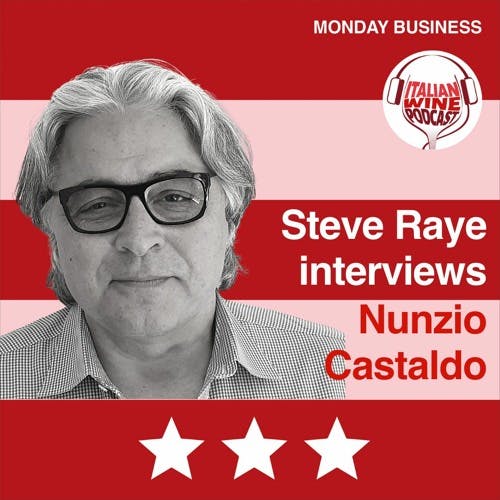
Ep. 679 Nunzio Castaldo | Get US Market Ready With Italian Wine People
Masterclass US Wine Market
Episode Summary
Content Analysis Key Themes and Main Ideas 1. The journey and strategic evolution of Panenbianco Wines under Nunzio Castaldo in the US market. 2. The significant impact of the COVID-19 pandemic on wine distribution models and the necessity of adapting business strategies. 3. Panenbianco's unique approach to importing and distributing Italian wines, focusing on boutique, family-produced, and sustainable labels. 4. The growing importance of direct-to-consumer engagement, digital marketing, and ""omnichannel"" strategies in the modern wine industry. 5. Encouraging consumer discovery of diverse and value-driven Italian wines. Summary In this episode of ""Get US Market Ready with Italian Wine People,"" host Steve Ray interviews Nunzio Castaldo, a seasoned veteran of the US wine industry and head of Panenbianco Wines. Castaldo recounts his extensive career, including 32 years with Winebow before acquiring Panenbianco. He describes Panenbianco as a boutique importer and distributor, emphasizing its commitment to unique, rare, and territorially authentic Italian wines from family-run, often organic or biodynamic, producers. The discussion heavily features the transformative impact of the COVID-19 pandemic, which forced Panenbianco to pivot from an 80% on-premise business to significantly increasing its off-premise sales, a strategic shift crucial for its survival. Castaldo highlights the future of wine distribution, stressing the need to get closer to the final consumer through digital tools and targeted marketing in specific market ""pockets."" He encourages consumers to be daring in their wine choices, exploring diverse Italian varietals that offer exceptional value, and advises producers to meticulously optimize their online brand presence. The overarching goal for Panenbianco, he explains, is to ""bring Italy to them"" for US consumers who cannot travel there, fostering a ""day by day, bottle by bottle"" approach to market growth. Takeaways * The US wine market, despite being a top destination for imports, remains complex for Italian producers to navigate. * Agile adaptation to market shifts, like Panenbianco's pivot from on-premise to off-premise sales during COVID-19, is crucial for business resilience. * Smaller, boutique importers can thrive by focusing on unique, family-driven, and sustainably produced portfolios that cater to discerning consumers. * Digital marketing, e-commerce optimization, and close consumer engagement are becoming indispensable for wine sales and brand building. * Italian wines offer exceptional diversity and value, with many high-quality options available in the $15-$25 range. * The pandemic inadvertently trained consumers to discover and appreciate higher-quality wines for home consumption at more accessible prices. * Producers are responsible for ensuring their brand's online presence (e.g., on Vivino, Wine-Searcher) is accurate, high-resolution, and up-to-date. Notable Quotes * ""My career is very, I would say, like, strange because, I only work with the two companies in this, in this years. One is Winebow, and the other one is Panenbianco wines."
About This Episode
The speakers discuss the importance of personal stories in the Italian wine industry and how their company has pivoted to avoid losing their business due to the pandemic. They emphasize the need to be closer to the final consumer and finding the right partners for this market. They also discuss the challenges of selling wines and how retailers and distributors need to understand their habits and use social media to promote their brand. They emphasize the importance of discovering new wine styles and being a small guy in the wine industry. They offer advice for consumers during the pandemic and encourage them to use social media platforms to promote their brand.
Transcript
Thanks for tuning into my new show. Get US Market Ready with Italian wine people. I'm Steve Ray, author of the book how to get US Market Ready. And in my previous podcast, I shared some of the lessons I've learned from thirty years in the wine and spirits business helping brands enter and grow in the US market. This series will be dedicated to the personalities who have been working in the Italian wine sector in the US, their experiences, challenges, and personal stories. I'll uncover the roads that they walked shedding light on current trends, business strategies, and their unique brands. This episode is proudly sponsored by Vivino, the world's largest online wine marketplace. The Vivino app makes it easy to choose wine. Enjoy expert team support door to door and honest wine reviews to help you choose the perfect wine for every occasion. Vivino, download the app on Apple or Android and discover an easier way to choose wine. Hi. This is Steve Ray, and welcome to this week's edition of Get US Market Ready with Italian wine people on the Italian wine podcast. My guest this week is, an old friend in the industry, somebody who has a great reputation in Italian wine, Nounzio Castaldo, who is, head of Panavianco wines now and also had a a very long career, building the Italian wine portfolio with, wine boat. Dunzio, welcome to the show. Thank you, Steve. And, Hello to everyone at the listening. Yes. My name is Nuncho Castaldo, and I started in the business. About thirty five years ago, my career is very, I would say, like, strange because, I only work with the two companies in this, in this years. One is weibo, and the other one is Panenbianca wines. I worked for weibo organization for thirty two years almost. And, since twenty seventeen or eighteen, actually, I acquired a small company called the Pana Bianca now Pana Bianca wines. Okay. And, tell us a little bit about Pana Bianca, just kind of an overview of, the kinds of wines you handle, the number, the type of business that you do, where you do it, and so forth. Gladory. But in Bianco wines is a a small company. It's, what do they consider a boutique wine company? But in Bianco wines was, founded by a gentleman that now has passed. Leadio Panenco, which I had a great, respect and I admire him for, for his, sense of, scouting and, tastings and palettes. But in Bianco was founded, as I said, you know, twenty five years ago. Has been always, based in, New York City for the past two, twenty four and a half years, only, distribute imported Italian wines. Now, Panenbianco is a little bit different since I acquired the company. We are distributing also non Italian wines in New York and New Jersey directory with our Salesforce. We have a selection of, Italian wines that we bring outside the borders of these two states. And presently, we are about to twelve or thirteen states that, you know, that where we can see the third party distributors. And what states were the of to the west coast, or are they concentrated on the Northeast and Atlantic? Mostly on these calls. You know, we would like to consolidate the first of the, the Easter corridor, what do we call? So we are in New Hampshire, Massachusetts, Connecticut, Connecticut, Pennsylvania, Ohio, Kentucky, Illinois, missouri, Florida, and soon, we're gonna be in the middle of the middle Atlantic. We're also in DC, but, we're organizing a little bit better. The the DC Maryland Okay. Talk a little bit about the on off premise mix. I mean, early on, the you guys, I believe, are very on premise focused. And, obviously, that business has taken a big hit. How have you pivoted and reached responded to that and what impact has that had on the business? Good question. I have to say that, you know, that, when when did the pandemic forced us to have the first lockdown, March twenty twenty, we were, really in a dark call because, our revenue was responsible for eighty percent on premise, a twenty percent off premise. That is the direct distribution. And that time, we had only two distributors and not almost, twelve like now. So it was very scary moment for the company. But we reorganized ourself. We brought in some brands that will be more useful for the off premise and, little, we ramped up to from a twenty to forty percent on the off premise, and now we are sixty percent on on premise. So that really saved us from this, very deep curve that we had in our, in our business. What were the criteria used for deciding which brands to bring in to ramp up this off premise part of the business? The criteria was very, I would say articulated because, we couldn't really bring in wines that, you know, that they were, less expensive work that we had because our reputation was, and it still is, a hub of, brands wines, that they are, unique, rare, and, true to the territory. And, that's why we like, to work with the producers that, you know, that they're involved with the farming, that are bidenamic, or organic, or sustainability process. So, we had to go to, you know, to brands like that as our mission is. It is what it is. But we basically, change it a little bit of the, you know, the, the search. Meaning that we, you know, we went after commodity wines. So Sanjulis, a Canticlassico, CNG, pinotrigio, and, and then after that, prosseco and and so on, But always kept to the same type of approach going to the current producers that we had or new one and say, we would like to have these wines if you have it with organic process rather than, go and have a discounts because at the end of the day, there's there's gonna be always someone that they will be less expensive than you, you know, and that is a lost war in our world. Okay. Interesting. So, following on that point, We've talked about the impact that that this whole the COVID thing has had on your industry. What do you see as the changes that are happening in the industry overall, not just the ones that that impact you and are factoring into where you're planning to take the company in the future. Well, that is, a million dollar questions. Obviously, the future, you know, for us at this moment, especially for organization like ours, which they are still connected to families and to employees that, you know, that, that more passionate than, you know, than, than salespeople. I will say that, you know, that, we want, and we will like to be still focused on what we believe in it. So representing families, there was, varietals, as I said before that, you know, that we can bring it to the American people with, you know, with, with that kind of diversity that only the Italian Italian territory we can represent. Our goal is to really be, leaving more focus on the pockets over the market and I explain what I mean by that. We know that, you know, that our portfolio is performing very well in Brooklyn, for example, rather than Queens or, you know, Austin or rather than, I don't know, Los Angeles. So So we would like to, you know, to really, you know, close that kind of, distance from, us as a distributor to the final consumer or us as an importer to a distributor that can understand what really means the Parendanca wants the selection. The future, I believe that, you know, that we needed to really looking at is to get closer and closer to the final concern. So building on that, I believe this is going to air on the first day of wine to wine twenty twenty one. And I'm gonna be giving a presentation on, e commerce and direct to consumer. And one of the fundamental principles that I've seen, the the trend is it's not going around the three tier system because everything has to go through the three tier system. But the responsibility of marketing, products and communicating to, the retailers and ultimately to the consumers through all the new tools that we have, whether it's through e commerce or wine oriented websites or food and wine oriented websites has really changed the game. And I've identified, like, seven different categories of how all this stuff manifests itself with probably ten different suppliers in each of those categories. And I know we have a lot of listeners from Italy and and certainly overseas that they find the US complicated and difficult now with e commerce entering the the the lexicon. How are you guys addressing that? And are you dipping your toe in the water. Thank you for that question. First of all, if somebody's, is confused and is very, I would say, scared about the the the American market should read your book, you know, because It's a very self explanatory and, kudos to you that, you know, that you put together such a beautiful explanations, but, it still is a very, difficult to penetrate in this, in this market, even though it's the number one market for everybody wines at this point, especially for certain type of wines. So we have the kind of responsibility as Italian producer to look at this market in every single, you know, perspective possible and the cash, you know, the minimum opportunity to get in because only if you are in in this market, you are part of it. The export, the design that you have for your company. That is what I will say to a producer. The other thing that, you know, that is important tends to this, new I would say social media revolution is that, we needed to be we are more and more closer to the final consumer, as I said before. The the consumer that drinks the wine, that buys the wines, and they comment on the wine. That is the key for the next future. You know, I would say that, you know, that, according to what we have to respect as an important distributors for the, three tier system, I would say, protocols, we can do very little to go after that kind of a consumption. So that's why, as I said before, we needed to find the right partners, you know, if he's a distributor, if he's a retailer, so if he's a wine, wine director or so many that can transport, you know, whether we choose to bring in the United States to the table, to the home now of, of a defining consumer. So, yes, it is still something that, you know, that we are trying to mold. But I think that in COVID was accelerated because that process was already placed, and it was already in motion before March twenty twenty. So one of the ways I like to say it is, is to get people, normal people who buy mine to tell your story and their words to their friends. I mean, that's what social media is all about. The recommendation of someone you know or someone who has some legitimacy or, uh, reditation not necessarily academic, but seems to know what they're talking about. There's a million different tools out there to do it. Everything from informing them on dedicated sites like, Vivineau or, wine searcher, or vine pair, as well as the ecomm only sites, like line dot com and, Paul Mabray is, starting on a new one called Pix, which I'm very interested in. But it's really up upsetting kind of the the way things are going. What kind of reaction do you hear from retailers with this, change in responsibility in who to communicate with and how? Well, it's a very interesting question because when you go to And I said before, you know, pockets of the market, you know, that is the key now. When you go to downtown, for example, you see that, you know, that there is a smaller, one shop that, you know, that takes pride of what selects for a shell for the for the shelves, for, for his customers, those kind of stores, you know, that, the hands on stores, they're still performing well because they have the time, they have the culture, and they have the habits to explain them by the wines. The big one, they're organizing with the different tools, you know, with drizzlers, for example, a wine, a wine bottle, all those platforms that, you know, that allows them to be exposed, you know, to many, many, many ways. And in many locations, and even distance locations. Now, you know, we never really imagined, you know, three or four years ago, and Steve and I, we can say that very freely that, Uber could ship a bottle of wine to upper east side, for example, from a store, you know, especially in the crisis and during the pandemic, or the restaurants could, sell a order of pasta with a bottle of candy to go. You know? So things like that that are changing the concept of how purchasing because at the end of the day, the consumer is guided by habits, and they don't wanna lose these habits now. So they the the the the retailers and also us as an important distributor, we have to understand what is gonna be the new habits because that is what there would be the, the the disengagement or the old to the new way to make, available to mine to define a consumer. So the word I've heard that describes that is omnichannel, and that's, you know, all the conversation that takes place and all the influencing that takes place can happen online, can happen in store, can happen in person can happen many, many different places, which is separate and apart, but not distinct from the actual purchase. Sometimes somebody could look it up online and go to the store and buy it or they can do click and collect or or any of these varying things. Which makes data critically important. You alluded to this earlier in our conversation, the value of real time data, inventory information and and being able to measure the results of marketing programs that you use. Now you're not, you know, a a huge company like Mindbow, which has lots of people and lots of resources to invest in these things. How do you take advantage of new opportunities? And one that I'll use as an example, I've been impressed with is City Hive, which powers the ecomm side of about twenty five hundred retailers across the country. We've been doing some pretty interesting programs with that, but a lot of it is related to the fact that you have access to real time inventory and sales data, and so can react immediately. When you're doing programs. Can you comment on that? All defense, what kind of, of, portfolio you have. And many, many companies, especially medium and large and extra large sizes, they adopt their portfolio to the target auto to the to the grow of, their company into the market. Company like a Panadienco wines, and there are hundreds like, you know, the, like, powers, like us in the States, They have to have a different approach. You know, we have to be in the market, with the the wines that, you know, that, they can fit in that segment of, or maybe, you know, twenty or twenty five percent that we can, I would say, get closer, you know, to our customers that, you know, that, once, once, once, have his customer, having an experience rather than, a value wines? And I'm what I'm what I mean by that is this, we represent wines from, the smallest population, like a faro, you know, in Messina, to the largest one is, like, you know, like, the the prosaic from the other In the middle, there are the, some, the small producers like Marissa Cuomo, like, Nani copay, like, Lulusey, like, you know, many of these small producers, they have to be still explained, still tell still, you know, communicated it in different ways. Handsold but canceled in today's reality. It isn't necessarily physically person to person. Yeah. Exactly. Exactly. So, absolutely. And that is, you know, the challenge that we have And and for that reason, our team is really formed by seasoned guys, you know, seasoned reps, seasoned people that they have passion, people that they know the market very well. So they don't have to go through the drill of, reaching you know, the attention of a retailer that wants a eleven ninety nine product. And the and behind you, there is like, you know, like a a football team that has the same eleven ninety nine wines that, you know, that you're trying to sell So this our approach is a little different. You know, from the moment that we search to the moment that we sell, and we hope that, you know, that pipeline will finish to a beautiful and great experience for the final customer. Well expressed. It was good. Back to one of the earlier points, I kinda we skipped over it, but I think it's really important. So your model is essentially in the New York area, self distribution. So you've got your own Salesforce of people who are calling on that. Is that because of distributor consolidation? Is that because it's the model that Pana Bianco had before, or is it because of some other reason that you feel that's the best way to sell your port well, obviously, that this is the reason. It's the best way you think to sell the portfolio. But It's a different model. And a lot of producers, you know, are looking for an importer and then looking for distributors and to a lot of degrees that introduces noise or friction into communication obstacles almost. You comment on that? About how you're structured. Sure. Sure. Speaking about the Italian producers, there are thousands of producers that, you know, that that they don't have a voice. They don't have a chance to be in the United States markets if they will not be Panet Bianco wines imported or distributors. And this can be in Portugal, Oregon, on Charleston or anywhere else, you know, between San Francisco and New York. So we dig a very, you know, very serious, you know, the, that kind of, message, you know, and and project and the business that we want to bring. We have about forty eight producers And, maybe only about ten of those producers, they reach more than, I would say, like, a fifty thousand cases productions. So our target, as I said before, is it very clear. You know, we would like to have, first, we want to study the abolition, then the family, you know, we like to work with the multi generational people in the in the company. And, but I also, you know, that, you know, that, very difficult to sell, but they are very, I would say, curious from the from the consumers now than before, like, I don't know, Casavecchio, or maybe, you know, the, the, the, the, the, the, the, the, the, the, for example. So that's where we are messaging, you know, and, it's very difficult, you know, sometime to compete with the big guys, you know, obviously. And I was part of that, And you know that quite well. You did it for many years. Please. Maybe, you know, I have a little bit of trojan horse in that kind of, you know, system that I can play with. But I like to, you know, to really think that, you know, that, Panadienko wines is one of the company that is still needed. You know, for, first of all, for the producers, but also for, the consumers that once again, I'm gonna use a a word that is very important, especially nowadays, for the right experience. If they cannot go to Italy, we can bring a eatery to them. Do you want to elaborate? I've I love that concept. If they can't go to Italy, let's bring Italy to them. How do you do that? Well, I believe that, you know, that, nowadays you can be, you know, sitting your couch at eleven o'clock at night and, scrolling your social media, you know, networks, and that could be, anywhere, you know, especially Instagram. And you scroll, you know, scroll and scroll, you know, all those images and videos and over Mofficos, over Capri, or you've, you know, Portofino, or even dolomites, you know, and you wanna be there, you know, you miss that because, you know, we've been really gauged, you know, for the past two years. In this, horrible situation, and we cannot wait, you know, to spring out, you know, once again. And that is what, you know, with, wines and food and, is, you know, a good instrument, you know, a good tool. You know, to, to use that kind of, or to keep it, that kind of a link or bridge that kind of, aspiration and desire. So how can you do that? Is, well, that is, that's the, is the, you know, the challenge. We don't have the main power, you know, to, obviously, to, you know, to invest in a big, huge social media, marketing, you know, plan. But, you know, at the end of the day, our world, you know, is still about networking. A little bit little little. You can pop, you know, a re, you know, and you have more people that, you know, that they like your, Marissa Cuomo, and that you built on that. You know, there are more people that, you know, they like that, you know, there's a couple of style from I work with a French burgos style from Italy and you ramp on that. So it's a a day by day bottle by bottle business. You know? That part of it hasn't changed. You know? I wanna introduce here an interesting story. I didn't participate in, but somebody told me the story. They were talking to somebody and they asked them, have you ever been to Italy? And the guy says, why would I wanna go to big Italy? I got Little Italy right here. To to comment on your point, Raff, we can't bring them to Italy. Can we bring Italy to them? That's kind of they brought it along with them as immigrants. And it's established itself kind of as a, you know, Italian and America, as you know, coming from Southern Italy is very different from, Italy as it is now, and certainly Italy as it is in all the various regions. A lot of people who eat, you know, red gravy, you'd never find that in the north as you know. So, so out of all the things that we talked about, we're kinda running tight on time here. So I wanna jump to a conclusion of, is there anything or what is the one thing somebody could take away from this this conversation that they could put to use immediately, not necessarily, run this program or do this, but, perhaps a philosophy of, how to approach sales of Italian wines in America in a post COVID world and an internet driven. Post COVID world? Well, first of all, I would like to give an advice to, you know, to the consumers that are listening to us this morning. During COVID, I I received many, during the pandemic, you know. Time, I received a many calls and says, listen, what kind of wine I should taste? You know, you know, what what do we should do, you know, when are we entertaining us and, as a family, blah, blah, blah. And and I, you know, I advise them in a very simple way. Person, do you want to have a really, a good experience and a good, like, you know, fun time? You know, just go online, you know, like I said before, now we have this kind of, advancement, go online and, buy six bottles different than the others, you know, spending between fifteen to twenty five dollars and and three whites, three reds, you cover the bottles, you and you open with, you know, with your friend, and and you can find, you know, some really cool things because Italian wines, you know, if all, then, you know, brings one thing diversity and value. You can spend, like, the fifteen, twenty, twenty five dollars and really you know, you know, drink for a bottle of wine that, you know, that, you think of it as a fifty or sixty dollars. The good thing that happened during the pandemic in a staying home time is that, you know, that consumers now finally, they approach the more expensive wines with less money. You know, and the, I would like to elaborate on that. You know, the consumers, you know, they, they went to restaurants to, I don't know, to discover ethanol wines or bulgari wines, So or or or even, you know, Barolo and barbaresco for the matter, you know, and spending, they had to spend between sixty to one hundred and sixty dollars of wine, you know, for a bottle of wine. Now, you know, they find out that they can have the same bottle of wines from forty to eighty dollars. And if you are, like, you know, with the two or your roommate or with the two couples in a, in a parking stock because you cannot get out, you order the, you know, you order the food, and you order the ones that you you drank at restaurants, pay maybe twice or maybe three times. So that it was a good, I would say training, gym training for the wine, the palettes, you know, because now we elevated the quality and the expertise and, and the pleasure of your pallet. And that is what I was referring before because at the end of the day, human being doesn't wanna give up what he likes. If it's bad, good or worse. And for your health, you don't offer anything. So and they, they are looking now to, you know, to those kind of wines. And that they discovered that if they spend that twenty five dollars, you know, twenty dollars for a bottle of wine, let's say, like, a samuel Blanca from outdoor they discover a new world with the less money, and that is a good thing for us, good thing for the producers, good thing for, you know, for the Italian wines in general, good thing for imported, and the exhibitors, and so on. Because and that's what we need to go to the market with, value, and, experience, and most of all diversity. You use a a critical word and, we hear it all the time with, all all the conversation that's going on on the web is discovery and stories. People wanna discover new things. Discover new things to them. Used to be that you could go into a, like, Buena Spears store and ask the guy who may never have been to Italy, but he knows enough to say, well, try this try this Valentina, which you never would have heard about much less have encountered before. And we're pretty lucky because we get to go to all these tastings, and taste all of these wonderful wines. And I know a lot of people are jealous about that. But there's plenty to discover out outside the the range of the three hundred or four hundred varietals you and I might have been. So discovery is kind of a, I think, a big thing, and the more we can reinforce discovery by the positioning of information in places that people already gather. So if they're going for an education on wine to Vinepere, then getting your messaging on Vinepere. Same thing with wine searcher. And one of the recommendations I make kinda answering my own question here is for everybody to make sure your opti your brands are optimized online. And by that, I mean, look at how your brand appears on Vivino, on, wine searcher, on, vinepair on even liquor dot com and all of these others. Do they have the current vintage? Do they have the correct label? Is it high resolution? Does it appear well? Do you have your current scores? All those kinds of things are things that you can impact and change, and there's a different way to do it for each and every one. So I can't go into that. But the point is you're responsible for how people see your brand. It's not something that you can delegate to the importer. Now that puts a lot of burden on you guys as the importer to do that. And I I see a lot of people pushing it back to the supplier, but at the end of the day, I think it's a mission critical thing. You need to be it's it's the equivalent of a a floor display in the liquor store. Right? If you see it on the web and the picture is squished because the aspect ratio was wrong, no one's gonna buy that wine. And if you didn't know that was happening, you know, that's a barrier to sales. I I agree with you a hundred percent and that we No. No. But you're an expert that we are, you know, so in this kind of a, you know, I would say dynamic that, only the United States offers because, you know, we have, we have a very, a typical system here, you know, So, importers and, and the distributors, they have to rely on these, filters, you know, if it's a retailers or or or one, or restaurants. But at the end of the day, I do believe that, you know, that, Italy has, or Italian wines, has a great, great, opportunity. We have to always remember that, you know, that for every four bottles that we drink in the United States, three bottles are American wines, and one bottle is from, import. And thanks to the pinot grillo prosaicco and Moscow, you know, out of that bottle, one third, this Italian wines. So it's very difficult that, you know, that, you go to a store, or your local retailer, and you don't see Italian wines. What I encourage, you know, the new consumers is it to be a little bit daring. You know, when you find a bottle of, like you say, the Fangina or can be, Nerello Mascaise, who could be a Canal or even a Grenarino, just take that bottle home. Of course, it cannot be like it, but if you like it, you will discover a new world in front of you. Really new world. And, if you do, just the, you know, put the picture on the, on, on Instagram. And because that is the only way that you can help us as a consumer to bring more and more those ones that, you know, that they are so fun to train. Well, thank you for your comments, Nousil. This has been, a special pleasure to talk to you. And an insight into, a side of the business Not often recognized. It's the small guys who really can make a difference in the wine industry in communicating, you know, closer directly to consumers. So I wanna thank you for joining me and sharing your time with me. And, I look forward to seeing you either in New York or in Italy sometime soon. Absolutely. Absolutely. Absolutely. Thank you so much. Still for inviting me and to give, the voice of a small and very dedicated, a passionate producers that we're dealing with every day. And I thank you all to listening to, you know, today to us because, more you listen, more you're curious, and more you drink Italian wines. This is Steve Ray. Thanks again for listening on behalf of the Italian wine podcast. Hi, everybody. Italian wine podcast celebrates its fourth anniversary this year, and we all love the great content they put out every day. Chinching with Italian wine has become a big part of our day and the team in verona needs to feel our love. Procing the show is not easy folks, hurting all those hosts, getting the interviews, dropping the clubhouse recordings, not to mention editing all the material. Let's give them a tangible fan hug with a contribution to all their costs, head to Italian wine podcast dot com, and click donate to show your love.
Episode Details
Keywords
Related Episodes
Ep. 2790 Italian Wine in the US: Building a Narrative and Reaching Asian American Consumers with Susan R. Lin MW | Masterclass US Wine Market
Episode 2790
Ep. 2783 The Suburban Gold Mine: Insights into New Jersey’s Wine Market with Brittney Abell | Masterclass US Wine Market
Episode 2783

Ep. 2777 VIA Advanced Tasting Sessions with Sarah Heller MW | Masterclass US Wine Market
Episode 2777

Ep. 2772 A Surprising Partnership between Japanese Sake & Italian Wine with Monica Samuels | Masterclass US Wine Market
Episode 2772

Ep. 2748 Florida Wine Market & Vinitaly USA with VIA Italian Wine Ambassadors Stefano Campanini & Daisy Penzo | Masterclass US Wine Market
Episode 2748
Ep. 2742 Wine Marketing Insights: Positioning, Occasions & New Consumers with Molly Bossardt | Masterclass US Wine Market
Episode 2742