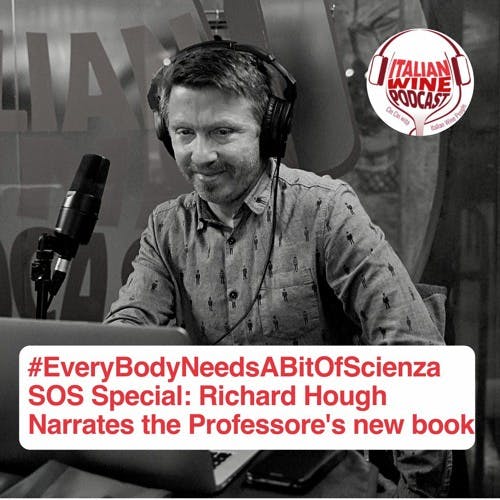
Ep. 856 SOS Special Edition | Everybody Needs A Bit Of Scienza
SOS Special Edition
Episode Summary
Content Analysis Key Themes and Main Ideas 1. Challenging the Myth of Purity in Viticulture: The core idea revolves around dissecting the concept of ""purity"" in grape varieties, particularly regarding cross-breeding, and the associated stigma. 2. Historical and Ideological Parallels: The chapter draws strong, controversial parallels between the rejection of ""impure"" grape varieties and historical concepts of racial purity and eugenics, including references to Fascist Italy and Nazi Germany. 3. Societal and Symbolic Value of Wine: Discussion of wine as a symbolic object that conveys abstract cultural values and is endowed with ""symbolic efficacy"" in eliciting predictable responses. 4. Evolution of Legislation Regarding Hybrid Grapes: A detailed overview of Italian and European Union laws concerning the cultivation, classification, and vinification of hybrid grape varieties, highlighting past prohibitions and current regulations. 5. New Resistant Varieties and Genetic Engineering: The text touches upon modern developments in viticulture, including the recognition of fungal-resistant varieties (PIWIs) and the implications of genetic engineering (GMOs and genome editing) for future wine production. 6. Challenges in Communication and Nomenclature: The difficulty of naming new grape varieties without confusing consumers or misrepresenting their lineage. Summary This content is a segment from ""Challenging the Myths of Purity,"" chapter thirteen of Professor Shenza's new book, narrated by Richard. The chapter critically examines the concept of ""purity"" in viticulture, particularly concerning the cross-breeding of grape varieties, and the historical stigma attached to it. It delves into the quasi-mythological status of wine and how it shapes attitudes towards altering grapes' natural state, drawing controversial parallels between the ideological rejection of ""impure"" wine and historical eugenics laws that sought to preserve racial purity in Italy and Germany. The discussion then shifts to the legal landscape, detailing Italian legislation from 1931 and 1965 that severely restricted or prohibited the vinification of grapes other than *Vitis vinifera*. It outlines current European Union regulations (EU 1308/2013) that, while generally allowing hybrids for common wines or those with geographical indication, still maintain specific restrictions on certain varieties. The chapter also addresses challenges in naming new hybrid varieties to avoid consumer confusion and highlights the emergence of new fungal-resistant French varieties (e.g., Artaman, Florial, Vidoc, Voltis) that are gaining community recognition and overcoming previous legislative hurdles for appellation wines, even for Champagne. Finally, it briefly touches on genetic engineering and genome editing as distinct modern techniques regulated by EU directives. The subsequent discussion between Joanne and Richard reflects on the density and style of the academic writing, questioning whether the extensive historical and esoteric references detract from or enrich the core message for an international audience. Takeaways * The concept of ""purity"" in wine, particularly regarding cross-breeding, has deeply rooted historical and ideological underpinnings. * Historical parallels are drawn between ""grape purity"" and human racial purity laws (e.g., Italian Fascist and Nazi eugenics). * Italian legislation was historically among the most severe globally in prohibiting hybrid grape cultivation and vinification. * Current EU regulations allow hybrids for common and GI wines, but specific varieties remain prohibited for classification. * New fungal-resistant grape varieties (PIWIs) are gaining acceptance and are being integrated into traditional wine regions, even for prestigious appellations like Champagne. * Nomenclature for new hybrid varieties is a complex issue, balancing consumer understanding with producer claims. * Genetic engineering techniques (GMOs, genome editing) are distinct from traditional cross-breeding and are subject to specific EU directives. * The writing style of the book, typical of Italian academic work, is dense with historical and esoteric references, which may pose challenges for a broader international audience. Notable Quotes * ""Purity has a religious significance cross breeding different species with the European vine means contaminating the natural state of the grape..."
About This Episode
The Italian wine podcast is live and in-person in Pavilion six. Richard narrates the book challenging the myth of purity, which is part of the mama jumbo shrimp brand and part of the Italian wine podcast. The book provides insight into the natural state of the grape and helps restore the connection between religion and wine. The use of hybrids in the production of wine and the history of the European Union legislation of the European Union recognized the use of names of existing varieties. The importance of writing in a clear way is discussed, along with the use of names on the label of existing varieties and the importance of translating individual sections in a written text. The podcast has been doing a daily show since the pandemic, and thanks the audience for their contributions.
Transcript
Welcome to the Italian wine podcast. This episode is brought to you by Vinitally international wine and spirits exhibition, the fifty fourth edition of Vinitally be held from the tenth to the thirteenth of April, right here in verona, to discover more about Vineetalee and get your tickets, visitvenetalee dot com. This year, the Italian wine podcast will be live and in person in Pavilion six. Stand a seven. So come on down and say hello. Welcome to our special SOS, everybody needs a bit of Shinsa install This is shout out to all the wine geeks out there. We need some feedback on the professor's new book, the English version of jumbo shrimp guide to the origins, evolution, and future of the grapevine. The Italian wine podcast is part of the mama jumbo shrimp brand and mama jumbo shrimp is all about breaking down difficult concepts into small bite sized pieces. The issue here is that the new book is well a bit difficult to chew at this point. So we want to invite wine lovers out there to give us their input and advice to make the final product more reader friendly. So have added wine lovers, don't be shy. Send your comments to info at italian wine podcast dot com. Now on to the show. Hello. Again, Richard. Hi. It seems seems like we're, together every day, Joanne. I know. So welcome. People to SOS special edition. Everybody needs a bit of Shenza. This is, minus Professor Shenza. He's not here. This is actually Richard narrating Professor Shenza's new book that he has translated into English and, of course, we are doing this because we are I'm stepping in for Stevie who usually does this, but essentially the IP. I'm stepping in for the professionals. Oh, dear. We're in trouble. I'm not saying that for you. I'm saying yes. No. I I I'm a a cheap imitation. Oh. As am I as am I. So let's let's let's see what we can do here. Yeah. We are, doing this because we would like listeners to listen in. And, if they have any comments, ideas, opinions, anything that can help us to essentially keep working on this book in English to make it more palatable for the everyday reader. I've said this in every episode that I've I've done. This was intended for the the jumbo shrimp guide series, which takes complex concepts and makes them simple so that everybody can enjoy the information. So, that is that is what we're doing here today. Go ahead and tell us what chapter you're reading and, then, take it away. Okay. But this is, from chapter thirteen, which is called challenging the myths of purity. And basically, this chapter is about cross breeding and in particular the stigma associated with altering the natural state of the grape to also explore the the quasi mythological status of wine and how that shapes our attitude towards it. So again, because it's shen's a it's a chapter that's rich with references to, history to alchemy, to the esoteric movement, and even mind camp for for good measure, I'm afraid. So, yeah, the question, I guess, as as you explained for, for our listeners is, as whether these references, these historical references detract from the, the core message of the book cover that are actually useful and interesting part of the the narrative. So this is chapter thirteen, challenging the myth of purity. Purity has a religious significance cross breeding different species with the European vine means contaminating the natural state of the grape, contaminating both those who produce that wine and those who consume it. It means disrupting the link between classical tradition and modernity. Through the purity of the wine obtained from the European vine, the esoteric movement aimed to restore that link between religion and wine and in so doing restore nature to its superior state reawakening an air of mystique. The search for varietal purity and wine evokes the same principles as those of natural and organic Viticulture through the ideological rejection of modern onological techniques, which are regarded as a kin to an alchemical workshop. On the nineteenth of April nineteen thirty seven, the first fascist racial protection law was enacted in Italy to preserve the Italian race from impurity of blood in the language of eugenics nation, race, and state were frequently interchangeable terms. Hitler stated in mankampf, the mixing of the superior and the inferior races is clearly against the intent of nature and implies the extinction of the superior aryan race. Whenever aryan blood has been mixed with that of inferior people, the result was to eliminate those who are bearers of culture. Wine is a symbolic object capable of conveying abstract cultural values. It is also endowed with a symbolic efficacy capable of producing predictable and repeated responses such as pleasure, deviance, elegance, and refinement. For this reason, it is considered an emblematic mythological drink with social value in relation to communication. It conveys values that are not far from those of the ideal man of beauty, health, and intelligent, those very characteristics that Eugenicists wanted to preserve from racial contamination, why are we not scandalize when we eat an apple, another mythological object in Western culture? Was the result of a spontaneous crossing. The first American vine to reach European soil was the Isabella or strawberry grape, a natural cross between Vitez LaBroska and Vitez Vrineifera, which appeared in France around eighteen twenty. Italian legislation relating to the cultivation of hybrids was the most severe in the world. The laws prohibiting the sale of wine produced from species other than VITis Finifera date back to nineteen thirty one, a prohibition reaffirmed in article twenty two of the presidential decree number one hundred and sixty two of the twelfth of February nineteen sixty five, which prohibited the VINification of grapes other than Vites VINifera. Currently, with regard to the use of hybrids in the production of wine, European Union regulation thirteen o eight, two thousand and thirteen is enforced, which establishes common rules for all member states. However, the different ways of registering vine varieties in national registers opens up a regulatory vacuum which, in fact, creates a gap for the discretion of individual members. Article ninety three of the above mentioned regulation allows the production of wine made from hybrids, but only for common wines or wines with a geographical indication. Regarding the classification of vine varieties, regulation number two three eight nine eighty nine provided that one grade varieties could be classified as recommended authorized or temporarily authorized depending on whether, respectively, they were currently cultivated in the community and belonged to the Divitas VINiferous species or came from interspecific hybrids whose aptitude for cultivation was recognized as satisfactory and which normally resulted in wines of good quality. As regards classification, Article eighty one established that member states may classify as wine grape varieties, only those belonging to the VITis finiferous species are coming from a cross between VITis finiferous species and other species of the VITis genus and excludes, for example, Noah Othello Isabella Jacquelineton and Herbertmont, and all those obtained from Vites LaBRusca. From the combined provisions of the two articles, it is clear that hybrids can be classified as wine grape varieties, but only for common wines or with geographical indication, the prohibition to classify the six varieties expressly listed by article eighty one remains in force. The problem of the nomenclature of the name used to indicate the new grape variety, and in particular, the association with the name of a noble grape variety of undisputed quality of fame is considerable. There are two main trains of thought in this regard. First, allowing the presence in the name of the noble parent risking confusing the consumer or prohibiting it, preventing the producer from boasting the noble lineage of the cultivated vine. And secondly, the consumer is understanding at least in part of the origin of the product consumed. Both arguments are pros and cons. There is also a resolution of the international organization of Vine and wine, which states for new varieties It is necessary to avoid the use of names that may lead to possible confusion with the name of other existing varieties, especially when these are already used and officially approved label of existing commercial products, Artaman, Florial Vidoc, and Vol dudes, are the first four French grape varieties resistant to fungal diseases developed by the French National Research Institute for Agriculture, food, and environment that have been recognized by the community plant variety office. They are therefore officially part of the traditional European varieties and can be cultivated to produce dark wines thus overcoming the European legislation which recognizes only the vines of the European species, which is Renifera, for the production of the nomination wines. In particular, the voltage variety was permitted in the production of champagne due to the characteristics of its wine, which is not very automatic. Initially, only up to five percent of the production area of each farm was authorized, and it couldn't exceed ten percent in a blend. For the new techniques of genetic improvement, directive two thousand and one eighteen EC of the European Parliament, of the council regulates the deliberate release into the environment of genetically modified organisms. Organisms obtained with techniques involving the use of genetic engineering must comply with the provision of the directive itself including also the genome editing technique in which the genetic mutation takes place by applying new plant within techniques that allow the modification in a precise way of specific DNA sequence of the plant without alternating its natural position. Okay. That's that that that that touched on some some touchy touchy subjects there. I did, note. Yeah. I mean, reading it back, it's evident that there's a lot of information, a lot of maybe too much information. Maybe we just need to to in the in the written format anyway, there's there's some explanatory notes and there's some foot notes. So, yeah, that seems for me as well just to kinda jump from one one topic to another without always explicitly emphasizing why or what the what the argument is. When you read his writing to translate it, do you feel like, you know, is this, you know, something that is always done by, you know, somebody who is a professor, such as him, or is it also a cultural thing in terms of the Italian, you know, how Italians they they they love to explain and and and furnish a lot of their. I mean, of course, it's, the language of amore. But, do you think that comes out here in the writing? This is a very controversial area, and I don't want to get into trouble by by, by saying one thing or another, but I think there's no doubt that Italian writing has a particular flow and a particular style. And a particular, tone. And so trying to adjust that for a, an international audience and also even just the the simple act of translating that into English. Of course, what what sounds fantastic in Italian doesn't always sound right in English or to actually challenge. I always find that I always find that, you know, In English, you can say something, like, quite concisely, you know, one sentence, but then once you put it into Italian, it, it ends up being so much longer, two or three sentences. Yeah. Yeah. So that's that's what I'm wondering here. Yeah. I think so. And I I mean, I think there's also, I mean, speaking for myself, again, that I was always taught and always encouraged to write in short simple clear sentences, whereas an Italian the opposite is true. Right. And I I mean, I had a conversation on this topic quite recently with someone, and they explained to me, like, if you write an Italian twelve words per sentence, you sound like a caveman, Right. So the the Italian style of writing is really just about, but there's a rhythm to it as well and there's a flow. And if that's what you're used to, then that's that's fine. Now you are translating it into English. So They are there's some really, really important points to be made here and it's important arguments, it's just whether we're doing it in the right way and in the way that has the the the clearest and most effective impact. That's probably the question I suppose for for our audience here. And for me as well, I reading these chapters out, I haven't I haven't spent the last couple of weeks and months translating this process of reading it out is actually quite useful because it's the first time really I get a sense of how it's going. And then it's one thing to be looking at a screen and looking at individual words and translating individual sections, but then when you when you have to read out the whole thing and say, well, how is an audience gonna respond to that? That's quite a a useful process because it really does clarify your mind a little bit, I think, and I'm beginning to realize what what needs to be changed and what need what what needs to be retained? Well, on that note, if any listeners have any ideas or any thoughts or want to just comment. Yeah. Even a thumbs up for a thumbs down. Whatever. Yeah. Just, contact us through our social media handles. You can find those in the description notes below. And My email, if you want to contact me directly is Hoff, which is h o u g h at just do the work dot I t. Okay. So with that, it is a wrap. And, I think Lunch time. It's lunch time. Bye, guys. Thanks for listening to this episode of the Italian wine podcast brought to you by Vignitally International Wine and Spirits exhibition, the biggest drinks trade fair in the world. For more information about VINitalean tickets, visit VINitalee dot com and remember to subscribe to Italian wine podcast and catch us on SoundCloud, Spotify, and wherever you get your pods. You can also find us at Italian wine podcast dot com. Hi, guys. I'm Joy Livingston, and I am the producer of the Italian wine podcast. Thank you for listening. We are the only wine podcast that has been doing a daily show since the pandemic began. This is a labor of love, and we are admitted to bringing you free content every day. Of course, this takes time and effort not to mention the cost of equipment, production, and editing. We would be grateful for your donations, suggestions, requests, and ideas. For more information on how to get in touch, go to Italian wine pot s dot com.