

Ep. 2426 Jessica Dupuy interviews James Tidwell of TEXSOM Conference & Awards | TEXSOM 2025
TEXSOM 2025
Episode Summary
Content Analysis Key Themes and Main Ideas 1. The evolving philosophy of TexSOM, emphasizing hospitality, community, and personal well-being for wine professionals. 2. Addressing current challenges in the wine industry, such as tariffs, climate change, and declining wine consumption. 3. The ""back to basics"" approach for wine craft, service, and customer experience. 4. The importance of self-care, personal values, and philosophical considerations within the wine profession. 5. TexSOM's role in fostering genuine connections and ""resonance"" among attendees, distinguishing it from typical conferences. 6. The promotion and growth of the Texas wine industry. Summary In this episode, co-founder and producer James Tidwell discusses the upcoming 2025 TexSOM conference. He highlights the conference's core philosophy, which extends beyond professional craft to encompass hospitality, community, and the personal well-being of wine professionals. Tidwell details how TexSOM addresses current industry challenges like tariffs and natural disasters by weaving these topics into various seminars. He emphasizes a ""back to basics"" approach for sessions on wine service, tasting, and customer care, alongside new seminars focusing on self-care, personal values, and the philosophy of wine. The interview also covers the diverse educational opportunities available, including WSET and specialist certifications. Tidwell articulates the ""ineffable spirit"" of TexSOM, stressing its aim to foster genuine connections and ""resonance"" among attendees rather than just networking. As TexSOM celebrates its 20th year, Tidwell announces his rare stage appearance to discuss the conference's history and evolution. The episode also features a segment promoting the unique and growing Texas wine culture. Takeaways * TexSOM 2025 prioritizes holistic professional development, including mental and emotional well-being, alongside technical wine knowledge. * The conference content is curated to address pressing contemporary issues in the global wine industry. * There's a renewed focus on fundamental aspects of wine service, sales, and customer experience. * TexSOM offers extensive pre-conference educational programs and certifications from various wine bodies. * The event's unique atmosphere fosters deep, authentic connections among attendees. * James Tidwell, a key figure, will share insights into TexSOM's two-decade journey in a special session. * The Texas wine industry is presented as a vibrant and rapidly developing wine region. Notable Quotes * ""we can't take care of the guests if we're not taking care of ourselves."
About This Episode
The speakers discuss the challenges faced in the wine industry, including tariffs, flooding, and natural disasters. They emphasize the importance of personal and mental health for guest experiences and the need for industry shifts to address these issues. They also discuss upcoming seminars and events, including one in Texas where a doctor is a doctor in the area, and the challenges faced by the industry. The speakers emphasize the importance of learning about the quality and taste of wine and connecting with attendees through connections and education. They also mention the impact of the conference on their personal and mental health and the importance of community and being around for attendees.
Transcript
Yeah. And beyond care for our guests, there's also care for ourselves. And I think that was one of the things that I looked at this year as I was looking at seminars is in this environment that we're in now. How do we care for ourselves? And that might be how do we define our values? How do we take care of ourselves, mentally, physically, emotionally, because we can't take care of the guests if we're not taking care of ourselves. And in addition to that, there are things like, what about the philosophy of what we do? So we have Julie Colkin coming in to talk about philosophy and wine, and and things like that where we go beyond just the craft itself to how are we taking care of ourselves so that we can do what we do in an environment that is challenging. And I think there are several seminars this year that speak to that. Shall y'all? I'm Jessica Duppuis, guest host for a special Texom series on the Italian wine podcast, covering the twenty twenty five Texom Conference in Dallas, Texas. Join me in the heart of the lone star state as we dive into conversations with key speakers and attendees, exploring career paths, challenges, and the latest trends shaping the wine industry today. This series is proudly sponsored by the Texas Department of Agriculture' Uncourt Texas wines program. Which celebrates Texas wine culture by promoting local wineries and grape growers, both in state and around the world, building a vibrant community around the Texas made wine. Be sure to subscribe and rate the show wherever you get your podcasts asks. And don't miss our Texas wine tidbit in every episode. A fun little fact, insight or story that highlights the people and places behind this exciting wine scene. Well, James Tidwell, I am so glad to welcome you back to the Italian wide podcast for this special TexOM series. Thank you for spending some time with me today. Thank you for having me. I look forward to it. Yeah. So, you know, it's funny. I literally was asking you. We've been friends for so long. I mean, more than ten, fifteen years. I can't I don't even know that I was I had to qualify what exactly your title is because I just don't even talk about your title. So so for everybody out there, James Tidwell is the co founder and producer of TexOM. I just call you my buddy. So y'all can call him that too if you want to, I guess. But, I'm so glad we get to yeah. I'm glad we get to talk about TextM again. You know, a lot's happened in the past year since we spoke last. And you guys have literally just officially kind of dropped the official speaker list for this year. You've you've got everything organized, so to speak, you know, maybe a little bit a little bit left to do, between now and the actual conference. But How's it feeling? Like, how are you ready to go? Oh, we're never quite ready to go, but we feel good about it. Doing events is interesting. You never quite feel ready, but at the same time, we really do enjoy what we do. And it allows us to prepare by starting well ahead. So we're we're on track. We're on track. Yeah. That's good. Well, I'm excited to visit this year. And I think, you know, perhaps the best place for us to start this conversation is based on kind of just what's been going on in the wine industry this past year. I feel like as this producer of Texom, you're kind of like this person that's constantly observing the field and aware of what's going on on multiple levels because by nature that you're just a curious and interested person. And I'm just, you know, I'm thinking that it'd be interesting to kind of hear your perspective on some of the big issues that have really been hitting the wine industry this year. Yeah. Well, I think we have multiple issues that are hitting the wine industry this year. You know, from tariffs to the flooding in Texas and other natural disasters to just the downturn in wine drinking, so to speak. And some of the things have been really covered in the media. We don't necessarily address those directly in any one seminar at TexOM, but what happens is that we address them throughout seminars at TexOM. So you won't necessarily see a seminar directly related to tariffs. But that will be addressed in multiple seminars. And so that's how we tend to address things with our conference. I know other people do it in different ways, and we all have our ways of you know, making sure that those areas are covered and that people are aware of what's going on. But certainly, there have been a lot of challenges in the industry in the past year or two. I suspect those will continue. So part of it is preparing for that. And this continuation, uncertainty is such a difficult thing, you know. And I think that the uncertainty around tariffs has been one of the major issues Hopefully, once there's some resolution there, things will even out. Yeah. No. I think I mean, I think we all hope that too. And, certainly, there's been a little bit of a yoyo. You can use any sort of metaphor yoyo. Pendulum, all sorts all sorts of back and forths, if you will, in terms of what to expect or how to allow people within the industry, whether you're an importer, distributor, retailer, etcetera, how to plan for your business, just general business. I'm curious, you know, this year, as you're watching things like this happen and you're thinking about how you wanna curate the seminars for twenty twenty five, what are some of the themes or industry shifts that kind of stood out to you this year that you felt really could use some attention at at Tech SON? Like, what are some things that you felt like, you know, were possible for you to really address based on the network of people that you're able to bring in? Well, some of it is back to the basics. So we have a couple of general tasting seminars. We have a seminar on service. You know, I do read a lot. I tend to pull things from outside the wine world where, you know, people like Glen Adamson or Richard Senate or others who've written on Craft really have affected my view of how we do things in the wine world. And so we do have a couple of seminars on the basic craft of what we do. And I think that's really important when we're in an era that we're having to justify our existence. I mean, we are looking at AI generated wine lists and things like that now. So what are the important things that we do at Solmier's, particularly, and for that matter retailers, it's not just Solmier's. There's so much retail now that is related to the same things that Solmier's doesn't do and vice versa that I think taking it back to that craft perspective of serving wine, making sure that it's served correctly, making sure we know how to sell wine, making sure we understand how to buy wine, but then also understanding customer service and really making sure that the guest feels comfortable in what they're doing. That's the key, I think, to making sure that wine continues to be relevant is making sure that the guest is comfortable with what we're selling. Yeah. I love that. This is one of the things that I think really drew me to Texom and to I mean, I'm not a floor sommelier or anything, but drew me to this industry was in the early years of Texom, this idea of hospitality being so crucial to what it is that y'all do. And you can't replace hospitality with AI. And there's so many wonderful things and tools that AI could be used for that, you know, perhaps when you're a seminar on that could be important, maybe not this year. But I think that the underlying reason that y'all do what you're due, you do is the hospitality. Of course, the wine is something you love and we're all passionate about, but what's the point of being passionate about wine if you can't get other people to also be passionate about it? And that involves this service, this care, this attention to detail that I think you guys, especially early on, really, really hit on so well with, you know, service, demonstrations and how to taste and all of these things. I thought it was really watching it over the years has been really fun. Yeah. And beyond care for our guests, there's also care for ourselves. And I think that was one of the things that I looked at this year as I was looking at seminars is in this environment that we're in now. How do we care for ourselves? And that might be how do we define our values? How do we take care of ourselves, mentally, physically, emotionally? Because we can't take care of the guests if we're not taking care of ourselves. You And in addition to that, there are things like what about the philosophy of what we do? So we have Julie Colton coming in to talk about philosophy and wine and and things like that where we go beyond just the craft itself to how are we taking care of ourselves so that we can do what we do in an environment that is challenging And I think there are several seminars this year that speak to that, whether that's, you know, the metrics of success where it's not just about your metrics in terms of business, but it's also metrics of success in terms of your personal life. And what are you doing for your personal life? There's living your values through work. There are various seminars that are going to be addressing this idea of how do we as an industry take care of ourselves so that we can take care of others. That's beautiful. I love that. And it it is a different approach than I think we've seen in the past. So I think that's a really especially in more recent years, it feels like it's a much more important way to look at things. I'm curious for this year. Now that you've kind of got everything in place in terms of who's speaking and what's being talked about, what are some things that you're most excited for? Like, if if you weren't James Tidwell, cofounder and producer, what would you wanna and not to play favorites, at all. So everybody who is a speaker don't take it personally, but I'm just curious what were some things that, like, popped to your mind is, like, that's one I'd wanna sit in on for sure. I really have trouble with this question because they they are they are all my favorites. You know, out of all the seminars that could be done, these are the ones that we have. And so it's really hard to choose amongst them. And we get this a lot from our attendees. Oh my goodness. It was so hard to choose. And this happens every year. And so I feel like we're doing a pretty good job of making sure that we're covering things that people are interested in that really affect the industry. Maybe some things people don't even know they're interested in yet, but, you know, really address needs of the industry to badly quote the rolling stones. You may not get what you want, but you get what you need. And so, you know, I think that that is something that's really I'm looking forward to is this idea of people having a difficult time choosing. I hope that's the case. Thanks. Thanks a lot for that. In a good way, you know, that that you can't decide which one to go to because they're all interesting to you. So I hope that's gonna be the case. I think we've got a great lineup this year and really would have trouble choosing myself. You know, we've got some faces that have been before, but then also some some fresh faces that are coming in, you know, who are some people that you were excited to be able to bring in that may be first timers to speaking at TexOM. Oh, wow. There's quite a few new people involved. You know, we try to get a mix of people who have been there for a while, and then people who are coming in as new speakers. And this, really goes to the idea of what we do with volunteers as well. We always like to have a mix of new volunteers as well as volunteers who've been there before. And to a certain extent, it's nice to see that amongst the attendee group as well. And so to the idea of any of these, whether they're new speakers, new attendees or new volunteers, the hope is that the people who've been attending, in any of those capacities can help sort of introduce them to Texom and what the idea of Texom is because I don't think that saying it's a conference quite encompasses what TexOM actually is. But, you know, I think in terms of people who are going to be there, a lot of our speakers are returning speakers, whether they are returning speakers from several years previous or or whether they are returning from last year. But, you know, it's nice to see that Tim Gazer is back because he was there for the very early days of TexOM, you know, really helped us establish what tasting was going to be at TexAM. And so this year, he's coming to talk about his approach to tasting, which he's written a book on. So I think that that will be a lovely seminar In addition to that, you know, Ren pair who's with babe Wine Bar is going to be there and as one of our newest speakers, I look forward to hearing Ren's perspective on the industry and living values through work. So we have this broad range of people who really either coming back to TexOM after a while or coming to TexOM as brand new speakers along with quite a few who've been there before in some capacity in recent years. Yeah. I'm really glad that you brought up Tim Gazer because I feel like he was one of the first people that really inspired me to jump into all of this because he made the deductive tasting experience so approachable to me. And I love that you said at the beginning of this conversation, like, in a lot of ways, we're getting back to basics on some of these seminars because it really is kind of our foundation for why we do what we do. And I think he's just such a marvelous vessel for kind of sharing that with people. In the book that he's written, I can't tell you how many times I've referenced it in the past couple of years. It's not a like, I see all the books on the back of your of your, in our background here in your library, which I know you're quite the collector. His book is a little tattered and not very pretty right now because I've used it so much. It gets paper back, but, like, I think that that's some an example of, you know, someone who definitely has something to share that people can learn from and selfishly, I'm also really excited that Julie Colkin is talking. Yeah. You mentioned her earlier. So for those that don't know, she'll actually be on one of the episodes that we do later, but she's actually a Texas wine producer. So for those that are unfamiliar, there is quite a Texas wine industry going on here. And that's part of who Julie Colkin is, but the other part is, you know, she's a PhD. She's highly educated and really does have this great background on philosophy. And so I love that you've kind of brought that in. And I'm actually really, like, I have to read, like, the name of her seminar is just Philosophy and wine. It's a wide open seminar. That could be anything. It could be anything. It could be anything. And I'm leaving it up to Julie to address what she wants to address with that because she is the expert in the area. I will say though that things like authenticity often come up in our business, And authenticity is actually a huge philosophical exploration. And there are numerous books written on authenticity from a philosophical perspective. So I think there are some interesting concepts like this that could creep into that seminar and really open up some minds about what we're doing with our industry. So I'm looking forward to her seminar for sure. Yeah. And then the other one that I wanted to see about is the wine culture of Turkey with Gillette Canar, like, So cool. Just because it's like we don't talk about Turkey very much. It's such a it's such a historic important piece of the puzzle when it comes to the history of wine in Europe, etcetera. Like, what was kind of the thought behind wanting to spotlight this. And and, I mean, she's a perfect person to be doing it. Well, I've seen her present on Turkey before and really enjoyed it. It opened my eyes. I remember going there for wine the first time and really being blown away by the wines being produced. In very challenging environment. And so I think this speaks to some of what's happening in the US right now is how do we deal with a challenging environment as well when you're producing good wines, but there are challenges to selling them. And so I think that there will be several things introduced in that seminar along those lines, but I do think that in terms of just overall wine quality, there's surprising wine quality coming out of Turkey, not in terms of overall surprise at the quality, but rather that we don't see it very often. Yeah. Yeah. And so the wines are imported. There are quite a few different importers of Turkish wine, but they tend not to be national importers. So you don't see them across the US, like you see some other wines. And so I really wanted to do something that would introduce people to that idea of great quality wine coming out of an area that we don't always see. Something new and different, and also this idea of producing wine in a challenging environment. Beautiful. I mean, again, personally excited about that one. So and again, it is it's gonna be hard to choose, but I wanna do at least highlight a couple of those. So I'm just curious you know, we've talked about kind of the seminars and what, you know, what's happening during the core of the conference, but I think also one of the things that you guys have always really excelled at is kind of, you know, cushioning or book ending and particularly write up front at the beginning of the conference, the opportunity for people to deepen their own education and wine through some of the certifications based on the different wine education and beyond wine education. I think you've had tea Oh, yes. In the past, you know, so so certifications, talk to me a little bit about what's available this year that people can take advantage of if they can come a little early. Oh, we have quite a few things available this year. So we go from very broad things like, the level two WSTT in wines, the level two in wines, two things like the Sherry and Champagne specialist from Napa Valley Wine Academy and also from the wine scholar guild. And so we go from broad to very narrow in terms of education. But then beyond that, there's also the opportunity to really introduce some groups that do education on a broader perspective as well, such as Gilt Psalm, the Institute of Masters of Wine. And so we're going to have gatherings for a number of these with Wine Scholar and some others where they have gatherings that you can really meet the people and understand what they're doing. In addition to the early education on Sunday, Saturday and Sunday this year. We also have the Court of Master Solmias will be exhibiting at the conference itself. So they will be there as well. So we have pretty much all the major groups who are going to be involved in the conference this year in terms of education partners. Yeah. I think it's good. And I I would encourage people that are planning to come to try to check those out. I mean, that that's where I did. I mean, many years ago, just like the level one of the CMS that, you know, my first kind of taste into all of that. And then I was hooked after that. I mean, I always hope so. We're probably the rest of my life, but I think it's a great service that you do by being able to offer that to people to get even more involved in the community. Well, we certainly try. We do want to make sure that people have other opportunities than what are in the conference So it provides the opportunity for people to experience things that we may not be able to get to in the conference, but they can do as bonus education. And it is a good way to really come and introduce yourself to what's happening at TexOM by taking some of these earlier bonus education opportunities. We've talked about seminars and so kind of what's happening during the conference and also this education segment that happens before if you wanna take advantage of it. But let's talk about the deeper aspect of some of the things that happen at Texom, which is we've used the words community, wellness, taking care of ourselves, making sure we're focused on things that are are good and and positive and true, if you will, authentic, how would you define kind of what happens among the attendants, or of of Texom? You know, like, I feel like this is an opportunity for me every year. I walk away feeling like I've just come home from camp. Right? Like, where it's like, okay. I've reconnected with my people. These are people we speak the same language. I love them. I don't get to see them very often. I I sometimes, you know, this is my family reunion, if you will. And I just wonder if you could talk a little bit about that. Was that something you expected would happen when you started this whole conference almost two decades ago. Is that how what we're dealing with now? Yeah. We are. It's our twentieth year and you Yeah. No. We had no idea what to expect out of this conference. It was started as a way to help the industry. It was not started as a business. And we did it the first year and made a little bit of money and decided we would do it the next year. And by saying we made a little bit of money, I mean, we had enough money to start the next year's conference. So we decided that we would go ahead and do that. And that's kind of the way TexOM has developed ever since is, you know, okay. We get through with it and we have enough to get through the next year and make sure that we can do the conference and So it it's been an interesting progression of starting with something that was strictly to help the business and now has grown into something it was never intended to be, actually. It was never intended to be this large. It was never intended to be this involved. I'm not complaining. I'm glad it's helped that many people and that people are benefiting from it. But I think there's this sort of ineffable spirit of taxonom that is really something that is hard to define, and I've had trouble defining it myself. I think that there's a camaraderie companionship community all these wonderful words that we use that could be applied, but at the same time, none of that happens without everybody. And it really is the spirit of community and being there together that allows it to happen. Because as I said earlier, we have people who've been there a while and new people coming in each year. And it's the people who've been there a while that carry that legacy forward of what's happened to benefit people and how it's done and what TexOM means, and it carries forward to the new people. So there is some paying it forward aspect to TexOM, I think. But it's really something that's hard for me to define and I've never been able to quite put my finger on it. That's okay. I don't think you have to. But I love I literally had to write this down. The ineffable spirit of Texon. That's beautiful, and we're gonna do something with it. I don't know what it's yet, but I don't know what it is yet, but I think it gets to the core what what it is about. I think that's awesome. And it it is, I think, something that people truly feel whether you've only gone one time or you've gone since the beginning. You know, it's something that there's a reason people keep coming back. And I think that's that it that it is that. And of course, we wanna know more. Of course, we wanna be educated more. And the topics that we cover here are fantastic, but You know, let's be honest. I could take a webinar if I wanted to on the wines of Turkey, which I'm not gonna do. I'm not I'm just but, you know, like Yeah. There's something more here. There is. I think that we still do things in a very old school kind of way. And there's nothing wrong with big data, but we're not big data. We do things a little bit differently. It provides a different look at the industry, I think, because of that. I think it also provides an opportunity for people to really connect. I'm read this book resonance by Hartman Rosa, and it's called the sociological history of our world, I think. As a subtitle. He's a sociologist who really gets into this idea of what is resonance. And Christie Frank, who knows I'm interested in this subject, sent me a note yesterday as a matter of fact, saying that she was reading an article on Chinese wines where somebody was quoted as saying that resonance is one of the things that's wanted by the public now. It's that idea of connection. Right? And one of the things that Rosa says in his book is that some of the best connections are actually the ones that are surprised They're the beautiful, you know, morning sunrise that you weren't expecting or connecting with a friend while you traveled that you weren't expecting to see or any number of other things that aren't engineered. There are ways of doing things that are surprising. Yep. And that's one of the things that we've deliberately tried to create at TexOM is this idea of the random occurrence of resonance at TexOM, I think, where we don't give out an attendee list because we don't want people to sit in a room with a list and just go down a list and target certain people to contact. Yeah. We want people to make actual genuine connections. Yeah. And so that happens within the conference. And, certainly, people collect business cards and business details and all these things, and we encourage that, but we don't want it to become about data. Right. We want it to be about these connections because data is a huge benefit to our industry in so many ways. But going back to what we do on the floor as retail specialist or as only a's, this is about people. And so I think that's one of the things that we really try to concentrate on at TexOM is this idea of connection and resonance. That's beautiful. And it's working. If you do it, it does it does happen. So I wanna wrap up this with the big question of the day for me. So I feel a little selfish on this, like, because because I get to have you one on one talking about techsom and just getting you to speak in general for this podcast, but you have allowed yourself to sit on stage and get questioned about Texom for this year. And, like, for people who've never been, like, James is the consummate background guy. Right? Like, he you're the guy that is always there, always in the background, clearly pulling levers and making everything happen, but we never see you on stage. And not that that's where you wanna be. I know it's not. And therefore, the fact that you're actually gonna be on stage for one of the seminars and have, you know, the wonderful Lane Chuck and Brown interview you about, well, everything texts on. And I'm just curious what made you say yes and maybe Elaine bullied you. I don't wanna No. No. Not at all. No. It's the the inspiration was inside the actor's studio. So we're gonna see you as Elaine. Elaine can make me cry on stage. We might get the proof questionnaire. You never know. Okay. But, yeah, it it it was an opportunity to really clarify some things about TexOM. Great. TexOM is now in its twentieth year things have changed remarkably in our industry, especially in the last few years. A number of things have changed with TexOM over the years. Fortunately, our foundational principles still remain, and they will remain. But some of the look of TexOM and things like that have changed. Consequently, there's lower around TexOM that sometimes is correct and sometimes isn't. And so I really wanted to be able to sit on stage and talk about how TexOM was created and why it was created, what we intended to do with it, how it's changed over the years, how that has hopefully helped the conference and the people attending it, because ultimately that's what we want is to help the people attending the conference in their lives. So it was an opportunity to really focus on some of the things going on with Texom. I'm sure we'll get into some personal things too. Elaine is known for that. So we'll see how that goes. But, yeah, I've decided to sit on stage for, I think, only the second time. I think I did an interview with somebody at one point many years ago, but it's been so many years ago. I don't even recall all the circumstances of that. I don't even get to sit through seminars really. I pop in and see what's going on with seminars. I love to we record a number of them for my personal use. We don't really put them out at this point, but we have them for internal use and for me to be able to see how things went with seminars. I really enjoy being able to hear those things. Unfortunately, I don't get to sit down and really see the seminars myself. I think the only seminar I've sat through the entire seminar was search Ocha in twenty eleven. What Chateau moves are. So That was a good that was a that was a Which was the seminar that put tax on on the map for a lot of people. Yeah. That was a memorable time. Yeah. And that was that was six years into the conference, you know, but a lot of people really hadn't heard of the conference till then. I can't believe that was six years in. That's interesting. Yeah. Because the first conference was o five. So Yeah. Yeah. Yeah. Yeah. Well, James, I am grateful for your time and, I'm grateful that we can share a little bit of, few tidbits about what's gonna happen this year and what people can expect. But as we've kind of said here, like, you really don't know what to expect unless you're, you know, and you you don't get to experience that unless you actually go. So for those that have heard of it and haven't been and have thought about going, I really hope that you make the effort to do it because TexM is a special experience. And James, I'm grateful to you for carrying on through all sorts of things over the past twenty years. And also thank you for being willing to sit on stage this year because I think people will really get a lot of out of what you have to say. Yeah. Not my most comfortable spot to be in, but I'll, I will, I'll endure So, yes, as as Texom has for twenty years. So we're looking forward to it. You know, there are several ways to be involved. You can volunteer volunteer application. Well, they're not really applications. They're just expressions of interest to So you can put your expression of interest in. You can attend. And, of course, if you want to sponsor as a winery or wine group, we would love to have that. So there are lots of ways to be involved in TexOM. And we'd love to see everybody there this year. Thank you for having me. I'm grateful. One for our friendship and being able to do this, but, also grateful for Italian wine podcast and everybody involved for having me. Thank you. Yeah. Thanks so much, James. We'll see you soon. Alright. See you soon. Thank you. Alright. Texas wine is more than just an emerging region. It's a living, breathing example of how tradition and innovation can collide in the best possible way. Over the past few decades, Texas has transformed from a curiosity on the French of American wine, into one of the most dynamic, fast growing wine cultures in the country with more than seven hundred wineries and a landscape that spans everything from desert plains to limestone hills, Texas offers a wild kind of beauty. And a diverse winemaking playground. You'll find Mediterranean varieties like Temporio, Vermontino, and San Giovanni, thriving in the high elevation soils of the Texas high plains, and the sun soaked limestone of the hill country. These wines aren't just grown here. They belong here. Wine makers aren't trying to copy Europe. They're drawing inspiration from it and making something distinctively Texan. And the best part The Texas wine community is tight knit, passionate, and deeply connected to place. From generational family growers to next gen winemakers, they're not just building a wine industry. They're cultivating a culture. So if you haven't explored Texas wine yet, consider this your invitation. It's bold, it's heartfelt, and like Italy, it tells a story with every sip. This series is proudly sponsored by the Texas Department of Agriculture' Uncourt Texas wines program, which celebrates Texas wine culture by promoting local wineries and grape growers, both in state and around the world. Building a vibrant community around the Texas made wine. Be sure to subscribe and rate the show wherever you get your podcasts. And don't miss our Texas wine tidbit in every episode. A fun little fact, insight or story that highlights the people and places behind this exciting wine scene.
Episode Details
Keywords
Related Episodes
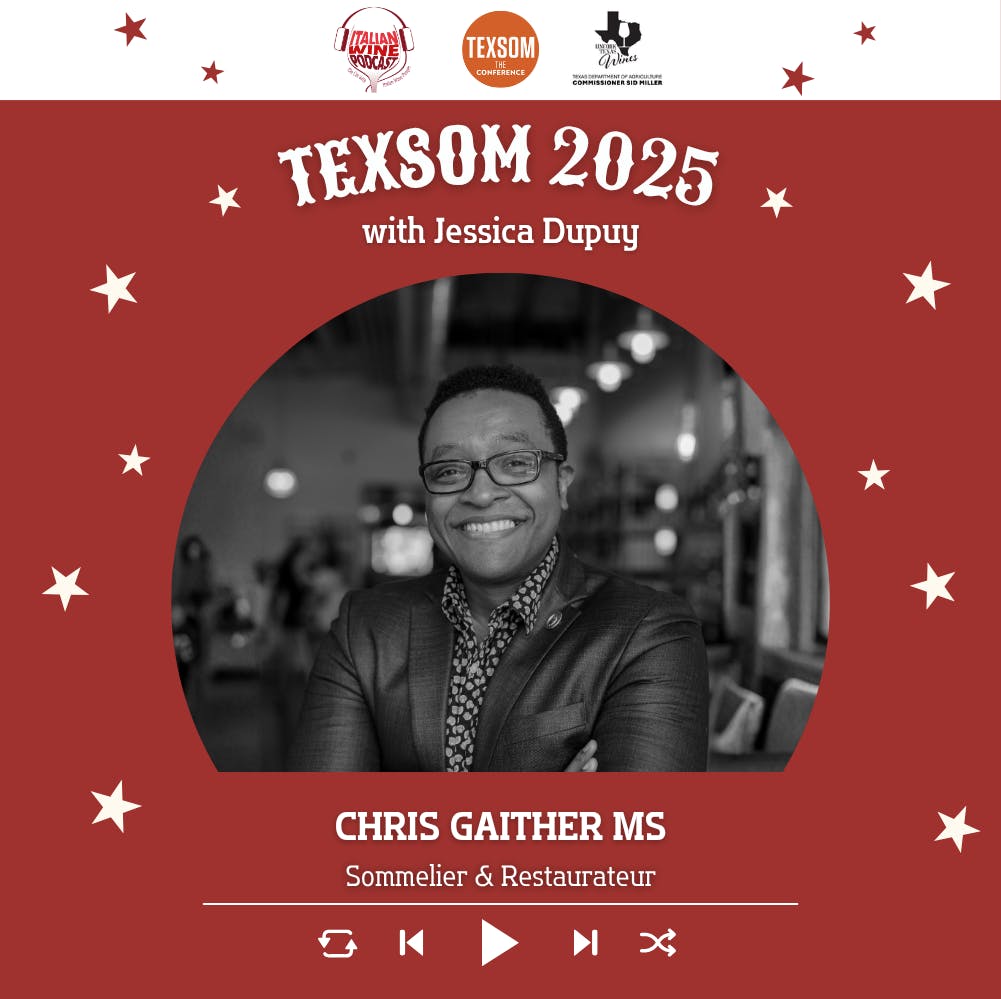
Ep. 2508 Jessica Dupuy interviews Chris Gaither MS | TEXSOM 2025
Episode 2508

Ep. 2501 Jessica Dupuy interviews Kathleen Thomas | TEXSOM 2025
Episode 2501

Ep. 2493 Jessica Dupuy interviews Steven McDonald MS of Pappas Bros. Steakhouse | TEXSOM 2025
Episode 2493

Ep. 2487 Jessica Dupuy interviews Maryam Ahmed of Maryam + Company | TEXSOM 2025
Episode 2487

Ep. 2480 Jessica Dupuy interviews Shana Clarke | TEXSOM 2025
Episode 2480

Ep. 2473 Jessica Dupuy interviews Amanda Barnes MW | TEXSOM 2025
Episode 2473