

Ep. 2440 Jessica Dupuy interviews Tim Gaiser MS | TEXSOM 2025
TEXSOM 2025
Episode Summary
Content Analysis Key Themes and Main Ideas 1. The non-traditional career path of Master Sommelier Tim Gaiser from music to the wine industry. 2. The challenges and strategies involved in mastering deductive blind tasting for wine professionals. 3. The significance of Italian wine culture, its deep connection to regionality, food, and history. 4. The evolution of wine education resources and the importance of mentorship and focused study. 5. The historical impact of Italian immigrants on the development of the Texas wine industry. Summary This episode of the Italian Wine Podcast features an interview with Master Sommelier Tim Gaiser, who shares his unique journey from a background in music to becoming a prominent figure in the wine world. Gaiser recounts his serendipitous entry into the restaurant business, which eventually led him to pursue the Master Sommelier certification. He delves into the intricacies of deductive blind tasting, a skill he initially struggled with, emphasizing its importance for quality assessment in the wine industry and offering insights into his teaching methods, including the concept of ""evil dwarves"" (challenging grape varieties). The conversation also explores Gaiser's deep appreciation for Italian wine and food culture, highlighting its unparalleled integration and regional diversity. Additionally, the episode touches upon the transformation of wine education resources over the decades and concludes with a ""Texas wine tidbit"" underscoring the historical contributions of Italian immigrants to Texas viticulture, exemplified by Valverde Winery, the state's oldest continuously operating winery. Takeaways * A career in wine, even at the Master Sommelier level, can be non-linear and draw from diverse professional backgrounds. * Mastering deductive blind tasting is crucial for wine professionals to accurately assess and judge wine quality. * Effective blind tasting involves mental discipline, structured grids, recognizing ""impact compounds,"" and understanding cause-and-effect relationships. * Italian wine culture is profoundly intertwined with its culinary traditions, history, and distinct regional identities. * Early Italian immigrants played a foundational role in establishing and sustaining Texas's wine industry. * Wine education has evolved significantly, with more accessible resources now available compared to past decades. Notable Quotes * ""So I have two degrees in music... And then the default place to work was restaurants."
About This Episode
Speaker 1 and Speaker 2 discuss their career as wine educators and independent contractors in the orch away. They also discuss their past experiences in a tasting group and their journey as a professional tater. They stress the importance of tasting and learning a grid and understanding the nuances of wine certification programs, as well as the challenges of learning about the differences between fruit and vegetable wines and tasting wine. They also discuss the importance of practice in learning and rehearsing the tasting method and the use of bubbly wines. They mention a book on deductive blind tasting and offer a gift for the caller. They also discuss the importance of tasting wines and their love for Italian wine culture and the French and American wines. They mention a wine tasting seminar at TexOM and a trend called " Italian wine" that is still present in Texas.
Transcript
I have two degrees in music, meeting my wife, Carlos. She was a violinist in the orchestra. I played trumpet. We moved to San Francisco where we lived for thirty three years. You know, I was able the first four or five years. I was doing quite a bit of playing. Trump at freelance, you know, I got to play with the San Francisco opera orchestra, but at the same time never making a lot of money. So there was always the restaurant business as a default flowback. At some point, they just took over. I had the opportunity to open a new restaurant help run a multimillion dollar wine program and be a full time Sommelier. That was in nineteen eighty nine or ninety. And at the same time, the owner of the restaurant John Cune had mentioned, well, you know, there's this program called the master Sommelier. You ought to go check it out. Mike is Just like going to, you know, a convenience store for milk and bread. Ciao y'all. I'm Jessica Duppuis, guest host for a special Texom series on the Italian wine podcast. Covering the twenty twenty five Texong Conference in Dallas, Texas. Join me in the heart of the lone star state as we dive into conversations with key speakers and attendees, exploring career paths, challenges, and the latest trend shaping the wine industry today. This series is proudly sponsored by the Texas Department of Agriculture' Uncourt Texas wines program, which celebrates Texas wine culture by promoting local wineries and great growers, both in state and around the world, building a vibrant community around the Texas made wine. Be sure to subscribe and rate the show wherever you get your podcasts. And don't miss our Texas wine tidbit in every episode. A fun little fact insight or story that highlights the people and places behind this exciting wine scene. Well, welcome, Tim Gazer. I'm so excited to have you on the show. Known you, I feel like for a number of years, this is a different way to get to have a conversation with you and share it with the rest of the world. So welcome. Thanks for coming on the Italian wine podcast. Well, thanks for having me. I wonder if you don't mind kind of giving us a little bit of your background as a master sommelier and kind of your work as a writer, wine educator, kind of what you've done within the field of wine. Sure. I think like many people in the wine industry, I came to wine through restaurants, but my training, there's a lot of people who are have been in liberal arts or performing arts. And, I was no different. So I have two degrees in music. And then the default place to work was restaurants. First job was blessing, you know, tables in a pancake house here in Albuquerque from six PM to four AM. And then, you know, getting, an undergraduate grade music history, and then meeting my wife, Carlos, she was a violinist in the orchestra to play trumpet, and then going to the University of Michigan, getting a master's in trumpet. And then at the same time, I mean, in Michigan, bartending at two restaurants that had huge wine programs. And that's where I really got interested in wine. And afterwards, we moved to San Francisco where we lived for thirty three years. And, you know, I was able the first four or five years. I was doing quite a bit of playing trumpet freelance you know, I got to play with the San Francisco opera orchestra, but at the same time never making a lot of money. So there was always the restaurant business as a default fallback. And at some point, then it just took over. You know, I had the opportunity to Open a new restaurant, help run a multimillion dollar wine program and and be a full time Sommelier. And that was in nineteen eighty nine or ninety. And at the same time, the owner of the restaurant, John Koonen mentioned, well, you know, there's this program called the master Sommelier. You ought to go check it out. Mike is Just like going to, you know, a convenience store for milk and bread. So, you know, having seven years of college down the drain, studying really obtuse things like medieval music history, Renaissance's music history, I started to study about wine seriously, and I'd already started to collect it, and I was reading, wine publications. I mean, this is when the wine spectator was like a community newspaper. Yeah. And, and then, took the intro course in, nineteen ninety in March and got the highest score on the exam and was told to be in Chicago three months later to take it to advance. And I was a bartender. Certainly, I've got, you know, a lot of experience waiting tables too. But then, I was just told being Chicago in three months, to take the advanced. And I did and somehow passed it, which is remarkable because I really had no clue about tasting. Tasting really eluded me for the longest time. And then I took the MS exam nine months later and passed the theory in the service. And then Christ and burn on the tasting. Fortunately, you know, and I'm not exaggerating. It was so bad that I can't remember who all my examiners were. The beta blockers are so strong. I don't remember. I think that's good. You know? And then I would though, it was so fortunate because I was in a tasting group with three brilliant tasters. I mean, Peter Grantoff. No. Late Mike Bonacorsi, and then, Steve Morey. And those guys were they were godsend because they helped me so much, so much. And then, the second year in ninety two when I took the MS, just the tasting, I was able to pass it even with a bad cold because the work I'd done. You know, we, at the time, we had our daughter Maria was about three and a half, and then we wanted one more kid, and and Patrick was born in June of ninety three, three months premature too. And so then I went to work briefly for a distributor as an educator, but then I went to work for an opportunity. Came up with the Heights family in Napa. Amazing opportunity. And so I, for two and a half years, I was there in Northern California person. So I did sales marketing and education. They were great to work with. Oh, that's great. Yeah. Amazing wines. And then afterwards, Peter Grenoff, who I mentioned, opened this business that was called virtual vineyards. So he and his brother-in-law, Robert Olsen, who is from Sun Microsystems, Literally opened what was the very first detailer of any kind on the web called virtual vineyards. That was July of ninety four. And I went to work for them in April of ninety six and was with them for five years. Till it was unplugged, like so many other dot coms in that first generation. And then from then on, I was an independent contractor. I was also the education chair and education director for nine years for the court in the US. Okay. And then I had clients otherwise. And then at the end of twenty eleven, I stepped away from that, and I've been in, you know, an independent contractor since. So that's that's my story. It is a completely unrehears sideways series of career moves. I'll just say that. I think that is the story of many sommeliers who have gotten into the industry and fallen in love with wine and found a way to make, living at it. And, I mean, in others as well, like, I mean, I'm I'm very, a very similar story of being a history major who found a way to work in journalism and then all of a sudden figured out that, oh, history and wine actually do connect in great way, many beautiful ways. And I can write about that So here we go. Let's just, like, make that all come together. And I think that that's what's beautiful about wine is, you know, who was I talking to the other day? I think it was Jack Mason who's another master of Sommelier saying that, you know, if you're interested in chemistry, if you're interested in anthropology, if you're, like, somehow wine has a little piece of everything that anyone can grasp onto. Yep. And it just it's the great binder, if you will. Yeah. That's the connector. And it also touches so many things, you know. Everything from the humanities, sociology, to psychology, to history, to agriculture, and and chemistry, everything. Yeah. It's it's remarkable. It really is. It is. Well, I'm just curious so we can tie this in, like, how has your journey led you to Texom in twenty twenty five? I know you've been a few times before, so that's where I first covered you. Yeah. James did well as a good friend. I didn't go to the first one, but I went to the second one. Whenever that was, when it was in Austin at the four seasons. Oh, yeah. That was two thousand and six. Okay. Well, there you go. So, and then intermittently as he's needed people to help, you know, for several years, I actually wrote the Somolier competition, that is tech Sump. Also, you know, just spoken on panels and did, done presentations. And to me, it's, you know, it's the Bestommelier festival, you know, or whatever you wanna call it in the country and certainly one of the top wine festivals too. In terms of the quality, in terms of the attendees, in terms of the presenters. I mean, there's really nothing like it. Yeah. I agree. I must have been it must be interesting to have been from the very early beginning all the way to coming back even this year, you know, it's certainly evolved as you would expect, but it still does draw in some amazing content topics to discuss and then the people to discuss them among. You know? Yep. So I wanna go back to tasting because I remember I have interviewed you before about how tasting eluded you that it was, like, hardest thing to master for you, so to speak. And so much so that you've obviously conquered it and want to talk about it because that's actually a text on what you'll be discussing this year is how to become a better blind taste why is that such a valuable skill? But also for those that are extremely intimidated by it, what are your ways of kind of helping people get past the hump? Several living thoughts about that. You know, first of all, spelling and tasting and remembering what things smell and taste like we all do that from the time we're infants. So then what we're asking people to do who are wine students is just basically to redirect that to a real specific context of wine in the glass. And from there to learn, you know, a certain vocabulary, but, you know, they already have the skills to do it. And so this is basically kind of like tweaking what they already do in terms of how they think. But, also just, you know, learning a grid, a tasting grid of some kind, and then, being able to focus in the moment on being present to the wine, you know, and just, you know, it's always the question is what what's there. And then being able to identify things, recognize them, and just describe them. Cause I mean, that's what we really do. The end goal, of course, and for regardless of what wine certification program you're in is, all of us, you know, want to become really good professional tasters and the cornerstone of that is being able to judge quality. Because any job in the wine industry ultimately depends on you as a professional being able to judge quality, whether it's, you know, ten dollar Merlows for a grocery store or it's you have to pick between, you know, ten, Jeffrey somberton from you, cruise, or whatever. It's you know quality, all these different levels, and you can judge it. And you can explain why. I think that's a really important key because I I've heard some people say like, oh, I you know, I love the whole Sommelier thing because if you can blind taste, you know, you've got this great parlor trick, you know, you've got this great opportunity to entertain people with your with your clear Jedi skills. And, like, well, that's not why they do it. I mean, yeah, it can be fun, or it can be, you know, it can be impressive those that don't see it on a regular basis, but I love that you, like, immediately went to quality and being able to assess certain things, like you said, whether it's for retail, restaurant, being able to evaluate. I feel like I taste with a lot of winemakers who only taste their wines, Yeah. And they're not used to how to compare what their wines are doing. And if you can give that kind of feedback, those are the things that kind of help build credibility in the wine industry. Yep. Absolutely. So from your perspective, what are some of the key techniques you talked about, like, deductive reasoning, working with a grid. What are some things some of the great varieties that you have helped people overcome that can be particularly challenging? Right. So there's a a chapter and message in the bottle that's called confronting the evil to orbs. Yeah. I love it. So, yeah, there's a subset of white wines made from semi aromatic white grapes like pinot gris, Elmerinio, Grootar Valena, Blanc, riesling, pinot grigio. And then, you know, red grape from relatively speaking, thinner skin red wipes, so red wines, you know, things like ganache, pinot noir, Camille, Sanjay, maybe even Neviola, maybe not so much. But anyway, those those wines, many of them look alike. They have similar fruit qualities. But the thing is is they all have different impact compounds and different structural sets. And so, it's a way of looking at them and differentiating them so that you don't confuse them in a blind tasting. But I'll say in that way, you really get to learn them. And it's all about recognition and memory, really specific kinds of memory. Yeah. I think that's a really good way to say it. I'm curious, you know, from your perspective, but one of the biggest challenges is in teaching people, like, what are some of the corners that they work themselves into when they're doing some tasting? That's a good question. I think the first thing is, you know, your nervous system can only do one thing at a time. You know, so it gets to Yes. Feel flight, fight, freeze, something else. I forget what's Yeah. There's four. Or you can control your nervous system in an exam context, and you can bring your game. So I think the first thing is to really, to be able to shut the world out and be present of the wine and then be really curious more than anything about what's there. I mean, what are you seeing? What are you smelling? What are you tasting? And then the deductive part of deductive tasting is pattern recognition is putting the important bits together because, you know, on either the WSTT grid or the MS grid. I mean, there's there's dozens of things. And so it's being able to see patterns of really important what I call impact compounds, which are non fruit type aromas and flavors, but then being really accurate with structure. And underneath that all, there's the whole ethos of cause and effect. Right? Why does the wine look the way it does, smell the way it does, it takes the way it does. Why? And so putting those pieces together, but it's your brain limiting itself to about, you know, five to seven pieces of information and going, you know, what? You know, x y z and all this, you know, this wine has to be Algarena. Right? And this does because it's floral. It's got lee's contact. It's got flanox, bitterness, and it's got high acid. And, yeah, something like that. Or why is it not gonna go without leaner? Because all the botanical white pepper stuff is missing. Yep. And something I recommend in the book more than once is that you have to taste wines in pairs because our brains learn quickly and binary. And so to be able to taste wines from those subsets, of evil dwarves and taste them in pairs, you know, you learn them much more quickly than tasting them say in the flight. So we've mentioned your book a couple of times, but let's go ahead and do it officially. And that is you wrote this book called message in a bottle Yep. Kind of dives into the whole topic of deductive blind tasting, and I have to confess I use it a lot. Good. I'm glad you do. Yes. And I I give it as a gift often actually too. Like, I'm doing some MW studying and have used that to share with others because it's definitely very helpful to calm your mind and have this, you know, this guide so to speak to kind of really revert to. So so tell me about that. What made you wanna write it? You know, probably the major impetus was me being so bad at tasting. Okay. That was it. And just feeling really frustrated. I was using, someone who things didn't come easily for, but, yeah, I was always someone who if I applied myself to learn something and to do what I could do. Right? So I think about the playing the trumpet, I think about learning other things. And so blind tasting to me was just really mysterious and impossible. Right? Yeah. And the funny thing was is, like, many people internally am a a visual creature. So I think in pictures and movies. And what the difference between when I actually got, quote, unquote, the deductive tasting method versus before is that I didn't know the MS grid well enough to where it lived inside. So, you know, when you're a tasting grid, and I'll say this at TexOM during my first seminar, the grid has to live inside of you. It has to be something where you always know what's next, and it's funny because that's not practicing tasting wine that's you thinking about it. And I thought obsessively about the grid, especially when I caught a bad cold a few days before the second MS exam. I couldn't really smell or taste, but what I could do is I could internally rehearse my best memories of classic grapes and wines, which is what I did. And at some point, the grid just went inside, and it's still there. So if I think about it, like, I can think about it right now and look outside, and it's the size of a billboard and it's got lights on it. Right? So it always lives there. That's where the that's what the grid has to become to someone is they have to make it theirs. And and by theirs, they have to put be able to see it in their internal IMAX theater. Okay. So that's the first thing. But that also presupposes a couple things. One, it's a long term memory because you can see it, but two, that means you can explain it. You could teach it. Because it's funny most people want to get to a place where they're teaching, which is a great thing. And to be able to do that, you have to know, you know, their tasting method, whatever it is, that well. Okay. So I think that's the first thing. And then from there, you know, the three pillars to me are, again, are cause and effect and impact compounds and structure. So if I had to go study for the MS tasting exam again, I would focus on those three things. I would also practice those subsets of the wines I told you about all the time, and then I would rehearse them mentally internally, like, five times as much as I tasted. Because again, it still at the moment, in an exam, it's all perception recognition and memory. So that's what I do. Okay. So that's no answer to your question, but to answer your question, so I wrote the book over a long time, at least ten years, And I started writing it in two thousand five. That's when I wrote the first few chapters of it. And I wrote it, you know, a lot of the chapters were in response to student or a group of students having problems with something. Like having problems assessing acidity in wine, or somebody couldn't smell, pyrazines, or somebody couldn't, the a roma was so strong that they couldn't smell anything else. So then I would you know, work on it individually, but I would also, I mean, I have, you know, this community of amazing tasters, all the other messes. And I would farm out questions and say, hey, what are you doing? What works? And so then I started a blog after I stepped aside and Shane Burinholm took over the edge education director. He's done a brilliant job. And then I started to write a blog, and the, really, the intent of the blog was to write a tasting book. And I said, oh, I could do this in three years. In three years, turned into ten. And really, in twenty twenty, when life came to a screeching halt, was able to assemble it and then write the last several chapters. Yeah. Okay. Okay. Well, it's an extremely helpful book, and I'm grateful to have it selfishly, and and anyone who's studying should be able to have it. I think that it's interesting too because when you consider the early nineties, when you were kind of getting into everything, I don't I wanna assume because I wasn't doing it then, but there seemed to be a different level and abundance of resources people can use for studying wine, whether that's for the Court of Master or Sommelier's or for WSET master of wine, then there were back then. And I'm curious, you know, kind of what how you've seen that evolution, how happen. For me, like, I feel like what your book did was fill a need, fill a an empty space that didn't exist. Well, yeah, I'm back. You know, we had to use books. Number one. And we decided to find the books There was no guilt form. Yeah. Yeah. Yeah. There was no guilt, and there was no internet, actually. Yeah. And also the books had conflicting information, and sometimes we would end up writing, you know, consortiums or writing wineries in France or whatever just to get answers. And certainly if we visit if we go to a year, we could. But, you know, the thing is is that you have this proliferation of information, plus you have a wine world that's expanded exponentially. Yeah. You know, I mean, the wine world in nineteen ninety was really much small. Dollars. And so countries like Greece and, you know, Argentina and Australia. I mean, they were marginally important, but even it was hard to find mines. But the the thing is now, even though there's so much more in the wine world is bigger, the challenge of the exams are still the same. It's you learning the information and and being able to master it. And then in a tasting exam, at least ours, you know, the MS exam, being able to come in for twenty five minutes, really focus, calm your nerves to an extent to where you, and then know the grid and not be creative, but really accurately assess the lines, you know, tell us what's in the glass. And so that challenge is never it's never changed. But at the same time, it's like an audition, and any wine exam is like an audition. So, you know, you have to deal with your nervous system. Yeah. That's very true. Well, I'm curious to tie this into Italian wine, is there something about Italian wine culture? I know you spend some time quite a bit of time in Italy for different education reasons, but is there something about Italian wine culture in itself that that resonates with you or your love for wine. Yeah. I I think I don't know. It's kinda tough to pride apart. First, you know, we were talking before we started recording. And I said, yeah, if there was one country, I would, you know, spend the rest my life eating and drinking, and it would be Italy hands down. I'm not sure that you can pry apart the food and wine from the rest of the culture. I don't think you can do it because it's so deeply embedded and it's been embedded for life. Centuries, millennia, and also the regionality, you know, for a company that frankly is not very large, and regionality is like dark. And we were talking about Eltoeta Jay, which is my client for a number of years, and, you know, going there and seeing that they don't speak Italian. They speak German, And they're good drivers and they're punctual, and they're just they're great different people. And the wines are alpine wines. They're just etched and precise and just focused and just transparent and amazing. And then Sicily, which I love just as much. Which is closer to Africa than Rome. And, to me, one of the most historic and amazing places in Europe, period. And the wines there are so different, but they're just as amazing. I call, at Narosa, I call it volcanic burgundy, you know? Yes, so transparent, and yet just the spirit of it is so different and amazing. And yet, and yet, I don't know. There's so many wines. And, to me, also, I would say this at the risk of my French friends going off of me, and I'm sure they will. Is that, you know, for me, Italian food and wine together work better than any other place. They just do. Yeah. Yeah. I agree. And, you know, it's okay. It's okay to poke at the French a little bit. They don't mind. Yeah. They do. But I think, you know, I think it's fascinating that you said that because another person I interviewed, Julie Hogan, who's a Texas wine producer. She said the same thing. She said it's so strange to me, but when you have tasted wines from all over the world, but when I smell Italian wine, I immediately think of food because it smells like food. Yep. And then I want the food that's supposed to go best with it, you know, and I'm all immediately thinking like this wine needs something with mushrooms and you know, a deep meat sauce, you know, and she's like, and that just isn't, of course, with other wines you start to get there, but it's immediate with Italian wine. And I think it's funny that you also made kind of the same correlation. So if you could have a wine adventure anywhere Italy. I know this is so bad because you just said, basically, the whole country. Yeah. Which region would you visit first? Is there one you haven't gone to or what? Yeah. You know, it's funny. You asked me this question. I thought it was really not a fair question. And, you know, I actually wrote a list and it's got, like, twelve or fourteen lines on it. Yeah. And so it is funny because, I'm probably, you know, tomorrow morning during my morning writing. One of the next blog post will be about those lines. Oh, perfect. That's it. And, I mean, there's everything from, Sorella Branca Presecco. You know, there's, El Padione Vincanto. There's two wines from Cantino Turlano. I mean, the La grime reserve at periphery, which is amazing. The Pino Bianco Voorburg. Yes. You know, there's, Mosquariello Barolo, which is just, like, unbelievable. Yep. But there's also clearly a Romano's fiano di avelino, which I love that wine. You know, the wines are delicious, but they're it's funny because they're delicious in a really grown up way, especially the red wines because they are dry, they tend to be acidic, and many of them are tannic. And so, yeah, they need food, but they're not like Hello Kitty. You could just have a glass next to the swimming pool. So they they kinda command your attention. They command some thought. They work better with food. Although, you know, you and me probably have an endless tolerance for acidity. So we think they're all great. So, yeah, I you know, if I had to start with one glass, I you'd have to be from Chacorta, you know, because I love those wines. And the best way to start any meal is with bubbly. So bubbly. Yeah. Yeah. So I'm thinking of the, Catabasca, the Prestige Cuve. And Raya Luisa. I mean, that's that's great stuff. So I didn't answer your question, but, you know, I'll start with the French recorder, or maybe I'll start with a negroni, because I think the negroni is a perfect cocktail. And also I was introduced last year. I don't know how this was off my radar Would it a bravo Chicago? I haven't experienced that, and that is the most delicious adult thing I've had in a long time. So I love it. I do I'm the same way. And now I can't have bravo any other way. It has to be a chocorada. So great. Well, I think what we've at least determined since this is an interview leading up to TexOM is that we should grab dinner while we're at TexOM and have all of these things. Yes. That would be great. Yep. At least cross them off the list. Yep. Well, just before we sign off, I wanna be able to mention so you, you know, message in a bottle is the first book that you've written and is an extremely valuable resource, but you also recently just put out in twenty twenty four. When is it released? Yeah. December of last year. Okay. Strong water. So can you tell me about what that is? Yeah. Yeah. Strong water. You know, it's a collection of essays on food wine and restaurants. I mean, it has, you know, essays that are personal anecdotes about, you know, working in the restaurant business as a busser and also a sommelier. It's got really unfortunate tragic things that experienced on wine trips. There's just essays about food, favorite foods. Yeah. It's a fun book. It's a perfect airplane book. The essays are all the thousand to fifteen hundred words. It's meant to be funny. It's not serious. It's a little sparky. It's a little, sarcastic at times, but it's meant to be a fun book. Oh, that's good. Well, I have it on my desk. And as I mentioned to you, I haven't really been able to read much for my own personal interests in a while because I'm working on a book as well, but I will get to it. And I wonder if you could just let us know where can people find either of these books and where can they find you if they wanna learn more about, like, your blog that you mentioned? Yeah. So both the books are available on Amazon. If you you can also order them from Ingram Spark. You know, my website is just my name tim Gazer dot com. The blog is there. Okay. I also write. I'm publishing either a blog or a sub stack, and my sub stack is called hits and missives. And that's all the non wine things. Because, you know, I write, you know, I write every day, practically. And so, and it's not always about wine. Could be about classical music. It could be, you know, raising kids. It could be life in New Mexico. Could be a lot of stuff. So, yeah. I love it. Well, Tim, thank you so much for spending the time with us, and I look forward to sitting in on your tasting seminar at TexOM and learning more and also just getting to catch up. I will see you there. Yeah. Look forward to seeing you there and look forward to, techsom too. Alright. Thanks so much. Take care. Here's a Texas wine tidbit with an Italian twist. While most people think of California as the birthplace of American wine, Texas actually planted Venice vinifera earlier. Back in the late sixteen hundreds, when Spanish missionaries were making their way north from Mexico. The very first vineyards were established in what's now El Paso, but by the eighteen hundreds, most of those early vines had vanished, except for one, a two hundred acre vineyard near Laredo planted by Italian immigrants along the Mexican border. It was a small but meaningful reminder of Italy's agricultural spirit making its way into the Texas frontier. About three hundred and twenty kilometers north in Del Rio, another Italian name would leave a lasting mark. In eighteen eighty three, Frank Qualia, a Northern Italian immigrant settled in the region and noticed wild linnoir grapes growing along the Rio Grande inspired by his winemaking roots back home, he took cuttings and planted them in the areas calcium rich loamy soils. That vineyard became Valverde winery, named for the county, and it's still standing today. During Prohibition, the winery served by producing Sacramento wine for the churches. And now more than a hundred and forty years later, Valverde is operated by the fourth generation of the Qualia family, making it the oldest continuously running winery in Texas. Though Italian immigrants never settled in Texas in large numbers they did in New York or California, their impact is unmistakable from early vineyards near Galveston and the Brazas Valley to family farms that quietly carried on wine making traditions even through difficult times. So the next time you sip a glass of Italian wine, remember there's a little piece of Italy living on the vineyards of Texas two. This series is proudly sponsored by the Texas Department of Agriculture' Uncourt Texas wines program, which celebrates Texas wine culture by promoting local wineries and grape growers, both in state and around the world, building a vibrant community around the Texas made wine. Be sure to subscribe and rate the show wherever you get your podcasts. And don't miss our Texas wine tidbit in every episode. A fun little fact, insight, or story that highlights the people and places behind this exciting wine scene.
Episode Details
Keywords
Related Episodes
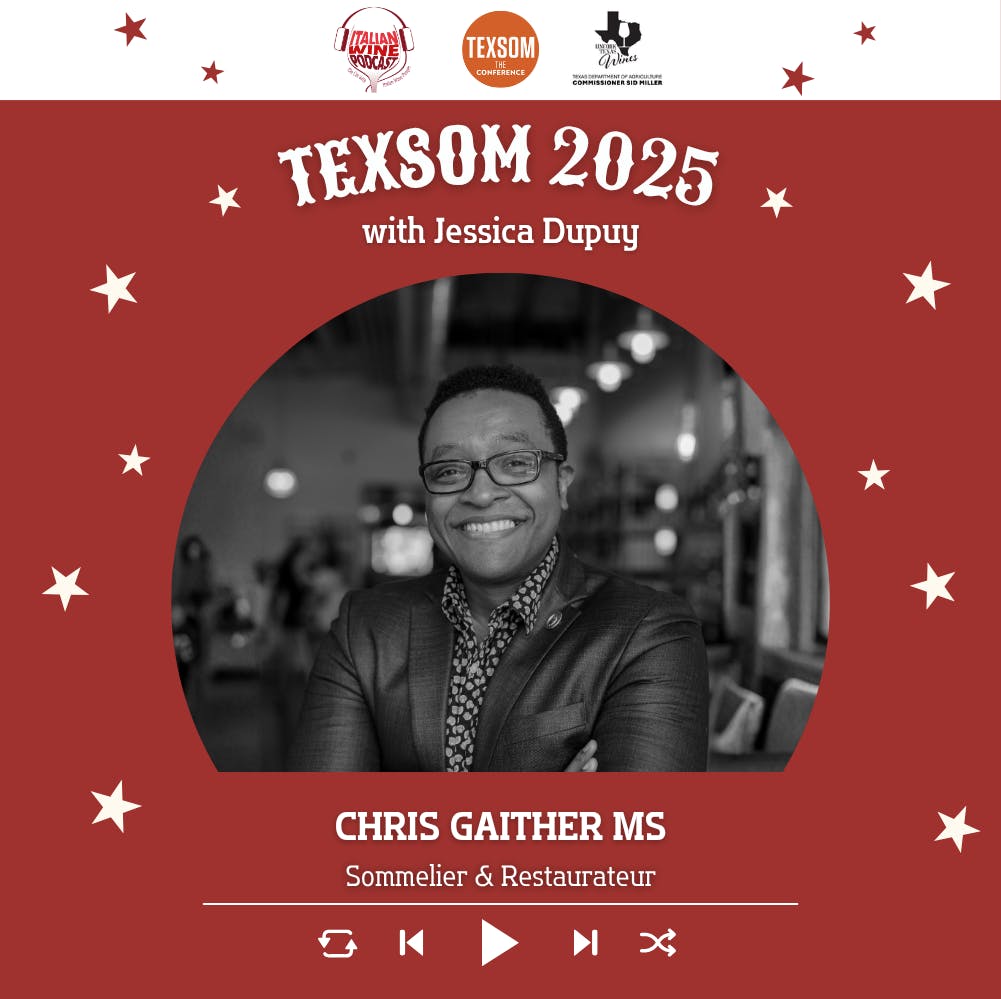
Ep. 2508 Jessica Dupuy interviews Chris Gaither MS | TEXSOM 2025
Episode 2508

Ep. 2501 Jessica Dupuy interviews Kathleen Thomas | TEXSOM 2025
Episode 2501

Ep. 2493 Jessica Dupuy interviews Steven McDonald MS of Pappas Bros. Steakhouse | TEXSOM 2025
Episode 2493

Ep. 2487 Jessica Dupuy interviews Maryam Ahmed of Maryam + Company | TEXSOM 2025
Episode 2487

Ep. 2480 Jessica Dupuy interviews Shana Clarke | TEXSOM 2025
Episode 2480

Ep. 2473 Jessica Dupuy interviews Amanda Barnes MW | TEXSOM 2025
Episode 2473