
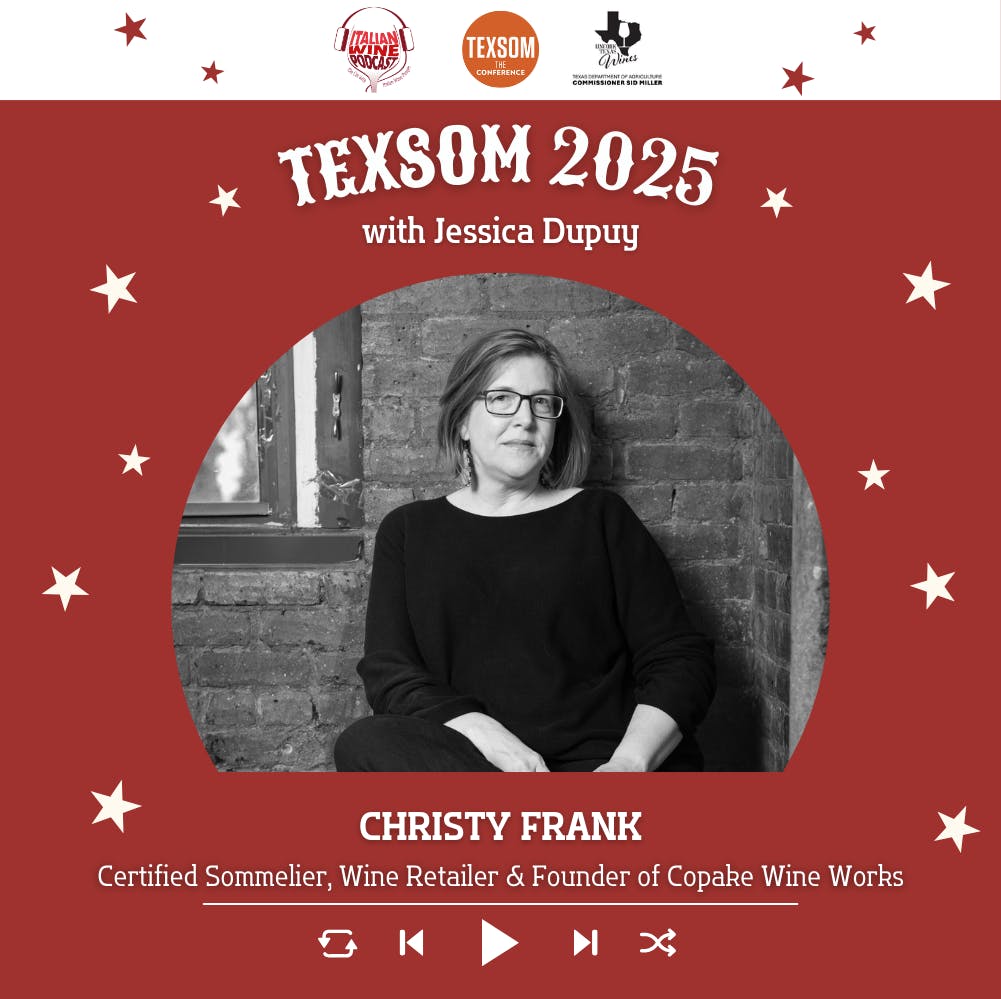
Ep. 2452 Jessica Dupuy interviews Christy Frank of Copake Wine Works | TEXSOM 2025
TEXSOM 2025
Episode Summary
**Content Analysis** **Key Themes and Main Ideas** 1. The multifaceted career of Christie Frank in the wine industry, encompassing retail, wholesale, brand work, education, and consulting. 2. The complexities and financial realities of owning and operating a wine shop. 3. An overview of the Texsom Conference and its focus on holistic aspects of the wine industry. 4. A preview of Christie Frank and June Rod Deal's seminar at Texsom, focusing on metrics for success in on-premise, off-premise, and personal life aspects of the wine business. **Summary** This podcast excerpt features an interview with Christie Frank, a highly experienced figure in the wine industry. Frank discusses her diverse career path, which includes owning wine shops (Frankly Wines and Copate Wine Works), working with large brands like Moët Hennessy, teaching WSET classes, and consulting for aspiring wine businesses. She emphasizes the often-overlooked financial challenges of running a wine retail business, highlighting the importance of understanding operational costs and profit margins. The interview also previews a seminar she's co-presenting at the Texsom Conference with June Rod Deal, focusing on key metrics for success in the wine industry, encompassing both business and personal well-being. **Takeaways** - Owning a wine shop requires a deep understanding of retail operations and financial management. - A successful career in the wine industry can involve diverse roles and experiences. - The Texsom Conference offers valuable insights into various aspects of the wine business. - Christie Frank's seminar at Texsom will provide practical guidance on measuring success in the wine industry. - Financial planning and holistic well-being are crucial for long-term success in the wine business. **Notable Quotes** - "I always say that ‘I love wine’ is not a business plan." - "Just digging into those numbers, what does it cost to pay people? Like, what is the hourly…and make sure you understand you're grossing it up and all the things that come along with that?" - "This will be the second panel that I've done with June…and it was basically kinda called ‘follow the money.’ Show me the money." **Related Topics or Follow-up Questions** 1. What are the most common financial mistakes made by new wine shop owners? 2. What are some key metrics that wine shop owners should track to assess their business's performance? 3. How can wine businesses balance the demands of running a successful business with maintaining a healthy work-life balance? 4. What are some of the unique challenges and opportunities facing the wine industry in Texas? 5. What are some of the key trends shaping the future of the wine industry?
About This Episode
The speakers discuss the challenges of selling wine in retail stores, including high costs of ownership and the need for understanding the cost of the business. They emphasize the importance of measuring success and sustainability in business, and emphasize the need for control and transparency in business decisions. They also discuss the challenges of selling wine in a different way and the importance of understanding the numbers and working with distributors to manage prices and margins. They stress the need for caution when covering the topic of tariffs and the importance of understanding the three tier system for shipping costs. They also discuss the success of their wine tasting classics and their love for Italian wine.
Transcript
I always say that I love wine is not a business plan. And so many people think they want to well, especially for retail, because it I think it just seems a little bit more manageable than a restaurant. People at least seem to understand that there are a lot of moving parts in a restaurant. But in a retail shop, you know, you walk in and, oh, there's the same little shop owner that I see all the time. How hard can it be? And it's like, well, do you like retail? Cause if you don't like retail, you're not gonna like, a wine, running a wine shop, owning a wine shop. Yeah. And just digging into those numbers, what does it cost to pay people? Like, what is the hourly and make sure you understand you're grossing it up and all the things that come along with that? And if you think you're going to open the shop and then pay somebody to be there full time, well, boom, there goes your profit. So, yeah, looking at all these fun things. Channel y'all. I'm Jessica Duppuis. Guest host for a special Texom series on the Italian wine podcast covering the twenty twenty five Texom Conference in Dallas, Texas. Join me in the heart of the Lone Star State as we dive into conversations with key speakers and attendees, exploring career paths, challenges, and the latest trends shaping the wine industry today. This series is proudly sponsored by the Texas Department of Agriculture' Uncourt Texas wines program, which celebrates Texas wine culture by promoting local wineries and grape growers, both in state and around the world, building a vibrant community around the Texas made wine. Be sure to subscribe and rate the show wherever you get your podcasts. And don't miss our Texas wine tidbit in every episode. A fun little fact, insight or story that highlights the people and places behind this exciting wine scene. Alright. Well, Christie Frank, I am so glad to get to sit down again with you this year for the Texom series on Italian wine podcast. Thank you for joining me. You're excited to be here. I wonder if you could, you know, for people that listened last year or can go listen again to that series from last year, and you can kinda catch up on the things that Christina and I talked about. But For those that are new, could you maybe kinda give us a background? Who are you? Tell me about kind of your work in the wine world because it's kind of multilayered. And I think interesting in in every one of those layers. Yeah. I need to get better at, like, answering that question. Because I've been I I was like, what to say? And I mean, I could talk twenty minutes just about that. But I've been in the industry officially full time since two thousand. So that is more years than I'd like to count. And even before that, I had my first job was a part time retail job in Boston in between the corporate job and my apartment. So retail, I guess I think of myself sort of first and foremost retail is sort of where my heart is. And I had a shop in Manhattan called Frankley wines, which is still there. I don't own it anymore, but it is doing just fine under Liz, who's the new owner. And I have a shop up in the Hudson Valley. Technically, my husband has a shop because of rules, but it's called Copate wine works. And that shop is about ten years old, which is awesome because when we first opened it, I didn't want to shop for ten years. And now ten years later, here we have it. So just the way licensing works, it was kind of then or never. In addition to that, I have worked for Moa, Tennessee, which initially started when it was Shefflyn and Somerset. So I have this sort of big brand experience as well as with the big distributors, and, which is something very, very different, completely different from the New York, the way that the New York world works. So I've kind of got this in a way unique experience in terms of national big brands as well as the weirdness that is New York. And I work the occasional shift at Chambers, which is Pascalein Pulpeltier's restaurant, I'm her blind casing coach. I teach WSET classes at the International Wine Center, and I do tutoring. I am starting to do more consulting and advisory work for, at the, at the very, very beginning of the process for people who are thinking of opening a wine shop or thinking of starting a spirits brand. And probably the last thing that I should mention is that I do have a canned cocktail called Hamlet hound, which new to the world started that from scratch about two, three years ago, kind of just to see if I could put into practice all these consulting things that I'm always telling people to do. And, it's doing very well for being the last thing that I've mentioned during that very long speech on what I do. The reorders are great. It's a lot of fun. So yeah. That's great. And I I I mean, it is talk about being diversified. You've done it. I love it. Well, and so so a lot of ways that this could have happened, but kinda tell me how your journey led you to text on how long have you been involved I mean, I know it's where I met you. That would be that would be math that I actually haven't done. I met James at a trip to Chatea Musar to Lebanon, which was probably at least ten years ago, if not more than ten years ago. And after that, I came to Texom, part of the the summer camp between the between the conference and the wine awards. I had been to the wine awards quite a few years before I finally made it to the conference. And so through that, I've just you know, I just love to go to Texas once or twice a year, and now they can't keep me away. Did you ever think in your life that you would say that? Like, I love to go to Texas two times a year. You know, I never I'm from Ohio. So going to Texas is not, you know, beyond the realm of possibility. There you go. I love it. Well, this year, you are doing a seminar at Texom with June Road Deal. Mhmm. And that one is called metrics for success on premise, off premise, and in life. So I'll just have to chunk the life part on there and make it look a really big topic. But I wonder if you can kind of break that down. Like, what's what's kind of the idea behind that and what are things that you guys are hoping attendees will take away from the session? Well, this will be the second panel that I've done with June. And the first one was either two or three years ago, and it was basically kinda called follow the money. Show me the money. And it was based on the idea of let's actually pull out our spreadsheets and let's get into the nitty gritty of what it takes to open, in my case, a small wine store, and in her case, a restaurant. And it was very well received because nobody pulls out spreadsheets at these sort of things, but we were like, let's do it. Let's show, I had this great little slide that had a, an iceberg. And it showed the tip of the iceberg, which was like a cute little wine store. And then underneath it was all of the other things that are built into it, do you get your health insurance from your spouse? Did you start with a large fortune? Do you own the building? This, that, and the other thing, like all these things that people don't necessarily think of when they see this cute little wine store? And June brought almost the total opposite perspective because she has partners, and it's a restaurant group. So it was just this really deep dive into the kinds of things you need to think about. And this is to sort of continue that, but like looking at the business from an ongoing basis. So what are the numbers that you need to be looking at to run your business to track to see how it's going to be like, are you measuring your success and sustainability and and what are those numbers? And then the and life part was kind of just tacked on at the end where we were like, well, we should probably talk about that as well because Texom always tends to go beyond just the product, beyond just the line and sort of look at things more holistically. So I'm actually looking forward to thinking about what
Episode Details
Keywords
Related Episodes

Ep. 2769 The Younger Wines from the Volcano with Giulia Monteleone & Darya Nagornyak IWA | Clubhouse Ambassadors' Corner
Episode 2769

Ep. 2745 Discovering the "Rive" of Conegliano Valdobbiadene with Lucia Fragoso IWA & Alessandro Favaro of Rivaluce Winery | Clubhouse Ambassadors' Corner
Episode 2745

Ep. 2683 Alberto Rivera IWA interviews Andi Punter of Franz Haas winery in Alto Adige | Clubhouse Ambassadors' Corner
Episode 2683

Ep. 2660 Elena Barattini IWA interviews Ondine de La Feld of Tenuta di Tavignano in Marche | Clubhouse Ambassadors' Corner
Episode 2660

Ep. 2645 From Cheese to Wine: A Food Scientist’s Role in the Wine Industry — with Rebecca Siefring | Next Generation
Episode 2645
Ep. 2638 Ekaterina Vislinskaya IWA interviews Andrea Pieropan of Pieropan Winery in Soave, Part 2 | Clubhouse Ambassadors' Corner
Episode 2638