
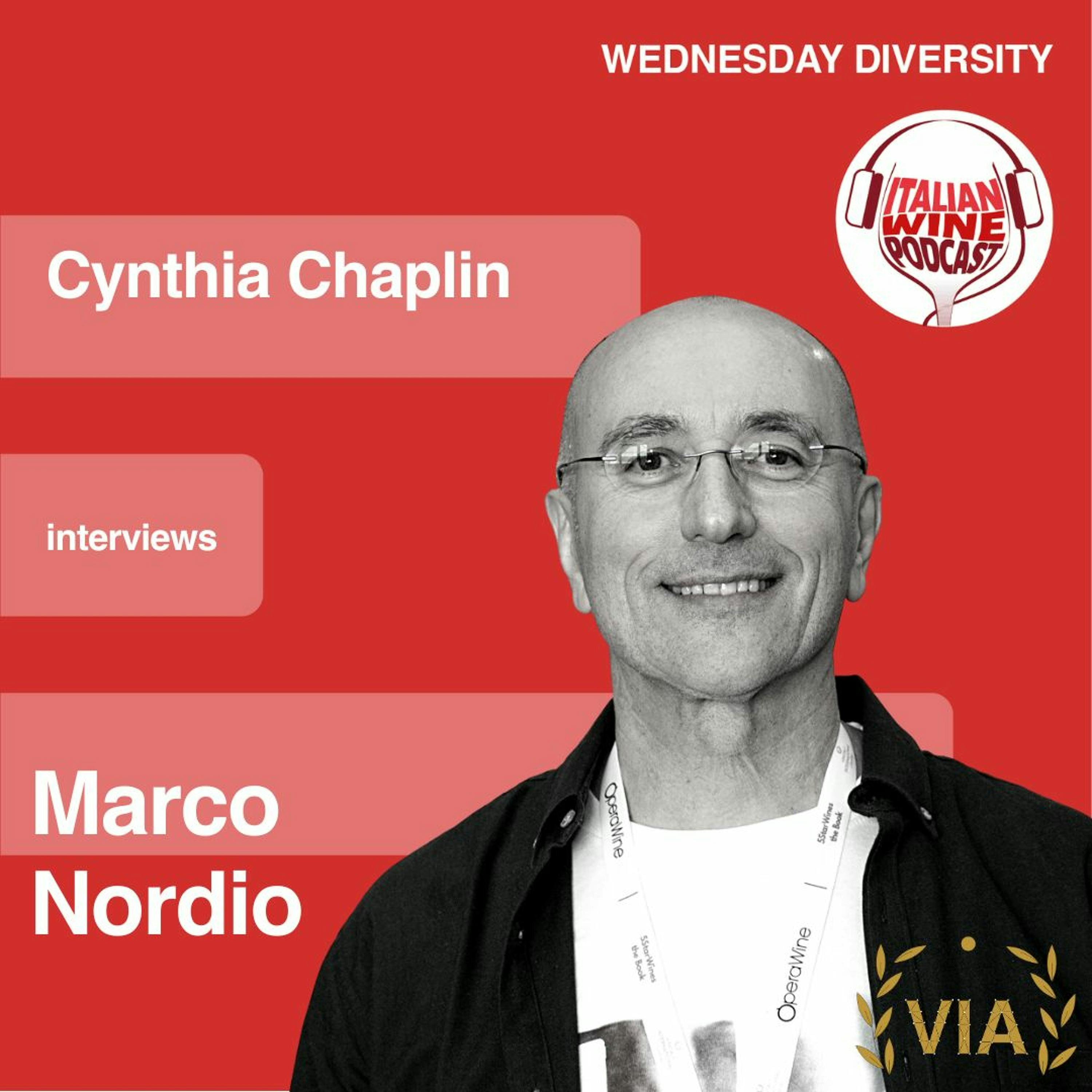
Ep. 1362 Marco Nordio | Voices With Cynthia Chaplin
Voices
Episode Summary
Content Analysis Key Themes and Main Ideas 1. The importance and impact of specialized wine education and community building (e.g., Vinitaly International Academy). 2. The personal journey and experiences of wine professionals, bridging cultural and geographical divides. 3. The evolving market for Italian wine globally, particularly its growth and reception in non-traditional markets like New Zealand. 4. The significance of storytelling, cultural context, and the diversity of native grape varieties in promoting Italian wine. 5. Strategies and challenges in increasing the accessibility and consumption of Italian wines internationally. Summary In this episode of the Italian Wine Podcast, host Cynthia Chaplin interviews Marco Nordeo, an Italian wine importer based in New Zealand, on the ""Voices"" segment. Marco shares his incredible personal journey, including a three-year sailing trip from Italy to New Zealand for a change of lifestyle. He discusses his professional path from attempting winemaking to successfully importing Italian wines. A significant portion of the conversation focuses on his experience at the Vinitaly International Academy (VIA) Italian Wine Ambassador course in Verona, where he highly praises the strong community, the educational value of professors like Attilio Scienza (despite translation challenges), and the insightful masterclasses, particularly those led by Sarah Heller MW, who emphasized wine texture. Marco also details the New Zealand wine market, noting its local varietal dominance but a growing curiosity for diverse Italian wines. He stresses that while Italian wine quality is outstanding, the main challenge lies in better promotion, communication, and getting people to physically taste the wines to appreciate their unique stories and breadth. Takeaways * Specialized wine education programs like VIA provide significant credibility and foster a strong, supportive global community for wine professionals. * Personal stories and the rich cultural history behind Italian wines are powerful tools for engaging consumers. * Italian wine, once ""underrepresented"" internationally, is now gaining widespread recognition and returning to its rightful position in global markets. * Despite New Zealand being a wine-producing nation focused on specific varietals, there is a growing curiosity and demand for Italy's diverse native grape varieties. * The primary challenge for Italian wine in new markets is not quality, but rather effective promotion, communication, and facilitating direct tasting experiences for consumers. * Describing wine texture (as taught by Sarah Heller MW) is a highly effective and insightful way to communicate about Italian wines. Notable Quotes * ""I found a lovely community there. I think this is the best thing about this course apart from educational side, obviously, very useful. But the this kind of connections that you create, with people from all around the world and such a enthusiasm, the passion that is so contagious."
About This Episode
The Italian wine podcast is being hosted by Miserio and Cynthia Chaplin, who share their experiences working in the field and share their experiences with Italian wine. They discuss the importance of diversity, equity, and inclusion in the Italian wine industry and share their experiences with Italian wine and how it benefits their personal and work life. They also discuss the increasing demand for Italian wines and how it is a wealth of native varieties, and how people are embracing new varieties and being curious about the story behind it. They discuss the challenges of translating from English, Italian, and English to the audience in Italian wines, and the success of the course in creating a community for their community. They also discuss the challenges of importing Italian wines and the importance of letting people know about their quality. They express their desire to bring wines to people and tell them their story and their plans to become Italian wine ambassador and promote their brand.
Transcript
By now, you've all heard of Italian wine Unplugged two point o. The latest book published by Mamma jumbo shrimp. It's more than just another wine book. The fully updated second edition was inspired by students of the Vin Italy International Academy and painstakingly reviewed and revised by an expert panel of certified Italian wine ambassadors from across the globe. The book also includes an addition by professor Atilio Shenza. Italy's leading vine geneticist. The benchmark producers feature is a particularly important aspect of this revised edition. The selection makes it easier for our readers to get their hands on a bottle of wine that truly represents a particular grape or region to pick up a copy, just head to Amazon dot com, or visit us at mama jumbo shrimp dot com. Welcome to the Italian wine podcast. I'm Cynthia Chaplin and This is voices. Every Wednesday, I will be sharing conversations with international wine industry professionals discussing issues in diversity, equity, and inclusion through their personal experiences working in the field of wine. If you enjoy the show, please subscribe and rate our show wherever you get your pods. Hello, and welcome to voices. This is Cynthia Chaplin. And today, I have Marco Nordeo with me, who is one of our Vignitally International Academy students, when we held our Via Verona flagship Italian wine ambassador certification course here in verona, the week before the Vini Touli wine and spirits exhibition. Marco's joining us from New Zealand. So thank you so much, Marco, for making the time to come on the show today. Hi, Cynthia. Very nice to talk to you. And you. I just wanna let our listeners understand a bit about our Via students. What on earth made you decide to come all the way to Verona, a twenty seven hour journey from hell to, take the Via International academy, Italian Wine Ambassador course. Yes. Definitely. You're right. It was a very long trip, and there's been a very long trip to come back as well. But I can tell you it was very much worthwhile. And, the reason is, I found a lovely community there. I think this is the best thing about this course apart from educational side, obviously, very useful. But the this kind of connections that you create, with people from all around the world and such a enthusiasm, the passion that is so contagious. I really loved it. And and you asked me the reason why I wanted to join. Well, first of all, I am an importer of Italian wine. So it would it would be natural for me to, I mean, I I'm naturally an ambassador of Italian wines. I've got a lot, a lot of, important brands here to represent in New Zealand. But having the the taking the course, he he adds to the credibility of what I'm doing, and, it would really benefit. But, you know, apart from the business side, there's also the personal, passion for Italian wine, but there's been has been going on for all all all my wife really, Cynthia. Well, and, of course, you have Italian background. So you are a native Italian. What are you doing in New Zealand? Yes. Yeah. Many people ask me this question, and, because they say, oh, Italy is so beautiful. Why are you here? But, you know, what? I I came here in the year two thousand. So it's a long time ago. And, I came here by, a long trip because I took a sailing boat, me and my wife, and we sailed all the way from Italy to New Zealand because we wanted to, change of lifestyle, you know. Oh my gosh. How long did that take? It took us three years. So it I mean, we went slowly. We went through the Caribbean, the Atlantic Crossing and then Panama Canal, and then we crossed the Pacific, and then we literally landed in New Zealand with our boat. And then what what we did, we sold our yacht and we bought some land near Auckland, and then we started, a new life because New Zealand is a country where you can start afresh. You can start a new life. It's a it's a country where you reinvent yourself. That's such an amazing story. It's like one of the, you know, Italian explorers from from the middle pages, like Marco Goldo heading off. So you have the right name, actually. So a three year trip across going, I guess, counterclockwise from east to west. That's a very long way. I'm not even sure how many nautical miles that would have been, but many, many, many, And you ended up in New Zealand, and now you're importing Italian wine. So how did that happen? Yeah. Basically, it happened because, I came here, and then I I started wine at the Oakland University. So I did a course in, in wine science that was very useful. And then I planted a little bit of a vineyard. So I tried to, learn how to, to make wine. It was just a, like, a hobby at the time. I mean, I took over an existing company, this importing company. So and then, things snowball from there because I I've witnessed, I mean, the continuous growth of Italian wines, and this is true probably worldwide. So New Zealand represent very well what happened in other countries. So Italian wines is really, really I mean, going back to the position, it should be. It was kind of underrepresented overseas for many reasons. It was underrepresented. And now it's going back to the the the kind of position they should have. And in New Zealand, we probably not there yet, but, I think we are very, very close. And, I can see more varieties, more wines, more Italian wines in New Zealand. And it's been a very, very exciting story so far. Well, it I can't imagine getting any farther from Italy. I think if you went across the globe, New Zealand is about as far as you could possibly get. So what's the Italian wine market like in New Zealand these days? Well, it is very, interesting because, you know, New Zealand is a wine producing country. So, obviously, people here are used to drinking wine. So you you don't need to explain the pleasure of wine. They they know about that. The only thing in New Zealand is a very limited in terms of varieties. They're they're pinot noir. It's very it's a world class pinot noir. The sauvignon blanc. Obviously, it's very, very good. But apart from that, you will struggle to go beyond this two varieties. And, obviously, what Italy has to offer is, as we all know, it's a huge wealth of native varieties. And what I I I saw in the last few years is that people are embracing kind of new varieties, more obscure varieties. Actually, they're curious. And so it is is is becoming very interesting. There is a a growing demand for Italian wine. So, obviously, the Italian restaurants are helping because Italian food is considered the best in the world. We I mean, many people think of it. I certainly think think bad. I I agree. I completely agree with that. And, obviously, that helps having, hospitality industry that's helping New Zealand, Italian wines, but it's not only that because, apart from food, there is more. There there is a people are really curious to know the story to know the, what is behind the Italian culture. That is a very, very interesting. That's so true. I think a lot of our, marketing, which is kind of a a harsh word for actually telling a very good story. You know, revolves around that in Italy. We do have these amazing, you know, family stories, ancient history, people traveling across Italy, when you were here studying, of course, Professori Chienza was talking about people migrating across Italy over the, you know, over the ages and bringing grapevines from here to there. It is the story of Italy and wine is endless and and very profound and very moving in many cases. So I think telling those stories is becoming increasingly, important as we try to spread Italian wine around the world. Are you enjoying this podcast? Don't forget to visit our YouTube channel, mama jumbo shrimp for fascinating videos covering Stevie Kim and her travels across Italy and beyond. Meeting winemakers, eating local foods, and taking in the scenery. Now, back to the show. Absolutely, Cynthia. And, you know, one of the most interesting part of the course was really listening to Professor Shenza about these heroes, you know, that's heroes in wines, these travelers with, these people that, went on on a mission, and the wine was integral, was a a very good, a very important part of their story. This is so inspiring. And, I mean, in modern times, you can you can find parallels. You can find similar stories. And this is the correct way, I think, to people to introduce Italian white to to to introduce the stories, the heroic stories. I don't know, like, Barlochi, we know other stories of Bellochi over Supertasca, how they out from scratch, They introduce something new out of a of an of an existing, territory. They they they created value in the territory. They leverage the story of a territory, creating something new something new out of the tradition. This is very, very inspiring. I completely agree. I completely agree. And I I think that's why we chose to incorporate all of that new material and new research from Professor Shenza into the new Italian wine unplugged two point o book that we used as the textbook for the course just to give people that, really profound, technical, historic, background that's so important to understanding Italian wide. Yes. And I I can't agree more with Stevy King when she said we need to translate or translators when a professor chancellor speaks because you know, I I couldn't understand him in in Italian. But I can relate to the difficulties or translating from from English, Italian, English and and to the to to the to the audience because it was no easy. But I I I was I I think I was privileged to learn that to to hear the the subtleties of professional, professor Chancellor was a little bit hard to translate in English. He often goes rogue as well. Since I'm one of his translators, he often goes rogue and, and heads off onto a a whole another conversation that we didn't expect him to have. Which is one of the beauties of him and one of the challenges of him. But, so you came to Veruna to take the via course, and I am assuming that you studied all the online material beforehand. And you were here for four days of of tasting and master class in the exam, and you succeeded, and you became a Via in Italian wine ambassador. So congratulations, first of all. And thank you for the kind words the community because we work very hard to create, what I think is a very special community for all of our Via students over twelve hundred of them now who've taken the course. Now we're up to three hundred and forty ambassadors who've been certified, but everyone who takes the course becomes part of that community. And you had to do a video project with your fellow students. How did that go? Did that help build that sort of network and and sense of of being a wine family? It did. It did, Cynthia. And, especially, it was very useful because it was a kind of a homework to be done before coming to verona. So before coming to verona, I already had some connections with the people part of my group. And, that that was fantastic. Look, honestly, I, I, I'm Italian. As you know, I had to make this comment, but, I'm kind of glad that the course is organized by non Italians. But even if you are kind of elective, Italians, now you'll and and, you know, as TV. And, but because Italians are not as good to organize stuff like you, you, your girls are. So I really congratulate you because you created the right up the right environment for create for for putting people together. And this is something that Italians generally struggled with. Thank you, Marco. That's really kind. This was a special one for us. It was our twenty fifth edition of the course. And it it meant a lot to us to have a a big group. We had sixty four students from twenty five countries, and thirty three new ambassadors, were certified, which is our highest ever pass rate. And they came from twenty countries. So For us, it's so meaningful to to go to the effort to organize it. It's not easy as you can imagine. But to get people here from all over the world to study together to have the master classes. This year, we had eight master classes with our supporters, various consortiums. What did you think about those as an importer and as a student? Were those helpful to you? Absolutely. They were very, very helpful. I remember Cabarini for have a Montefalco, consortium, very creative, very personal, and attached, and the the wines and professional. You know, he wouldn't speak about his own wines. Despite is a producer, obviously. But, you know, I I I appreciate very much of it because it was a little bit on the casual side, but very professional and, and very instructive, very educational. All the other master class were fantastic. Look. I think the course I know most of the students had the WST diploma, but everyone made the comment that there is nowhere with death in the the details. Of on Italian wise that you can get in any other course worldwide. So I think, VIA is is becoming it's probably already is a benchmark for Italian wine education. Well, we like to think so. We we our goal is to become and remain the gold standard of Italian wine education. We're here in Verona. It's meaningful to us. We we all live very near, if not in vineyards, and and as you said, Steve and I and and many of our team are not Italians, but, you know, if you cut us open, I think we probably bleed red, white, and green, it's it's it's important to us and really our passion. So I'm glad that that you felt that over the week, you tasted one hundred and fifty one wines. I don't know if you knew that, but but you did. Did you feel that you had, you know, an appropriate amount of opportunity to taste, you know, the top sort of benchmark wines to get a really good understanding. You're Italian. So, of course, you know more about, the specifics, the textures, the things that make Italian wines unique. But do you feel that we needed to do more or less? Did you have enough time? How was the course for you in terms of the tasting sessions on with our faculty and with our master classes? Sarah Heller was really, really outstanding. I think she was able to create an image on the wines. Just, just listening to her, we were able to have on our mind, I think on my mind, in particular, I've already an idea of how to depict of our graphic, as well to have an idea of a why. She was very, very good. I think it's been very inspirational as well. I think she's a really, a top top, educator and, tasting for for Italian wine, especially stressing the texture side of Italian wise. And you're referring to to Sarah Heller, who's a master of wine, and And as you said, also a a graphic artist, with her very beautiful visual interpretations of wine, she is such a special person with a really unique perspective. So I'm glad you enjoyed that. We all love having Sarah with us. She's an amazing teacher. Cheers. Cheers. And look, also, the the the small things, the definition, the the way to describe it, why I'm already using with, you know, whenever I introduce Italian wise in particular. I'm already stressing this side of, of a texture, and people are really kind of opening up and say, oh, that's true. You know, this is very, very useful whenever you describe Italian whites. Oh, I'm so glad that you've taken that away with you. You're gonna be a perfect Italian wine ambassador for us in New Zealand. What have you got coming up in the future? What are you still growing grapes? What kind of grapes are you growing? Well, I quickly realized that it is easier to import Italian wines than producing Italian because I had Italian grapes planted here in New Zealand, then making Italian. And so I have a lot of respect now for producer because they know how difficult it is to make good wines. Exact what what grapes were you planting when you had them? I have a a pinot grigio and Nebula. Wow. So pinot grigio. Yeah. Pinot grigio was able to sell the grapes eventually to other wineries in New Zealand. Nebula, I made wines, myself with the help of a wine maker. And the but, you know, it is nowhere near maybe all from Piamonte. Well, I think you picked, you know, one of the more difficult grapes to work with. So, you you cut out a hard row for yourself there. So you're not you're not making wine now, and you are still importing. What do you see yourself doing with your new, title Italian wine Ambassador in the next couple of years? What are you hoping to achieve? Well, look, I want to really every New Zealand there to enjoy the varieties available from Italy. You know? There's a lot of, communication, a lot of, promotion to be made to it I think Italian was the only thing they're missing because the quality is absolutely there. It's a promotional side. We need to come across. That's so true. Yes. We we need to let people know that there is something outstanding here. The moment you offer a taste, the there's like they open their eyes. Oh my god. I never tasted something like that. You know? But the difficult thing is to get to the point of physically tasting the wine. So this is my challenge. That's that is incredible. And I think you have just defined your role as an Italian wine ambassador perfectly. Bring the wines to the people, get them to taste it, and tell them the story. And I know you're gonna be excellent at doing that for us, Marco. So Thank you so much for being one of our students. And once again, congratulations on winning the title and and being certified. And I know that you'll be a great member going forward, of our Via community mentoring others and and networking and welcoming others who come in. So thank you so much for your time today. Oh, thank you very much, Cynthia. It's been a privilege, and I look forward to see you somewhere sooner in some of the other adventures of the community. Okay. Take care, Marco. Tellcha. Thank you for listening. And remember to tune in next Wednesday when I'll be chatting with another fascinating guest. Italian wine podcast is among the leading wine podcast in the world, and the only one with a daily show. Tune in every day and discover all our different shows. You can find us at Italian wine podcast dot com, SoundCloud, Spotify, Himalaya, or wherever you get your pods.
Episode Details
Keywords
Related Episodes

Ep. 2651 Diversity in the Wine Industry and Wine Tech Innovation with Jeremy McCarty | Voices with Cynthia Chaplin
Episode 2651

Ep. 2627 Regenerative Winemaking, Mentorship & LGBTQ+ Perspectives with Terah Bajjalieh | Voices with Cynthia Chaplin
Episode 2627
Ep. 2545 Building Inclusive Wine Spaces Through Storytelling with Amari Collins | Voices with Cynthia Chaplin
Episode 2545
Ep. 2531 Winemaking Journey from Mumbai to Napa with Priyanka French | Voices with Cynthia Chaplin
Episode 2531

EP. 2517 Sarah Looper | Voices with Cynthia Chaplin
Episode 2517

Ep. 2505 Ren Peir | Voices with Cynthia Chaplin
Episode 2505