
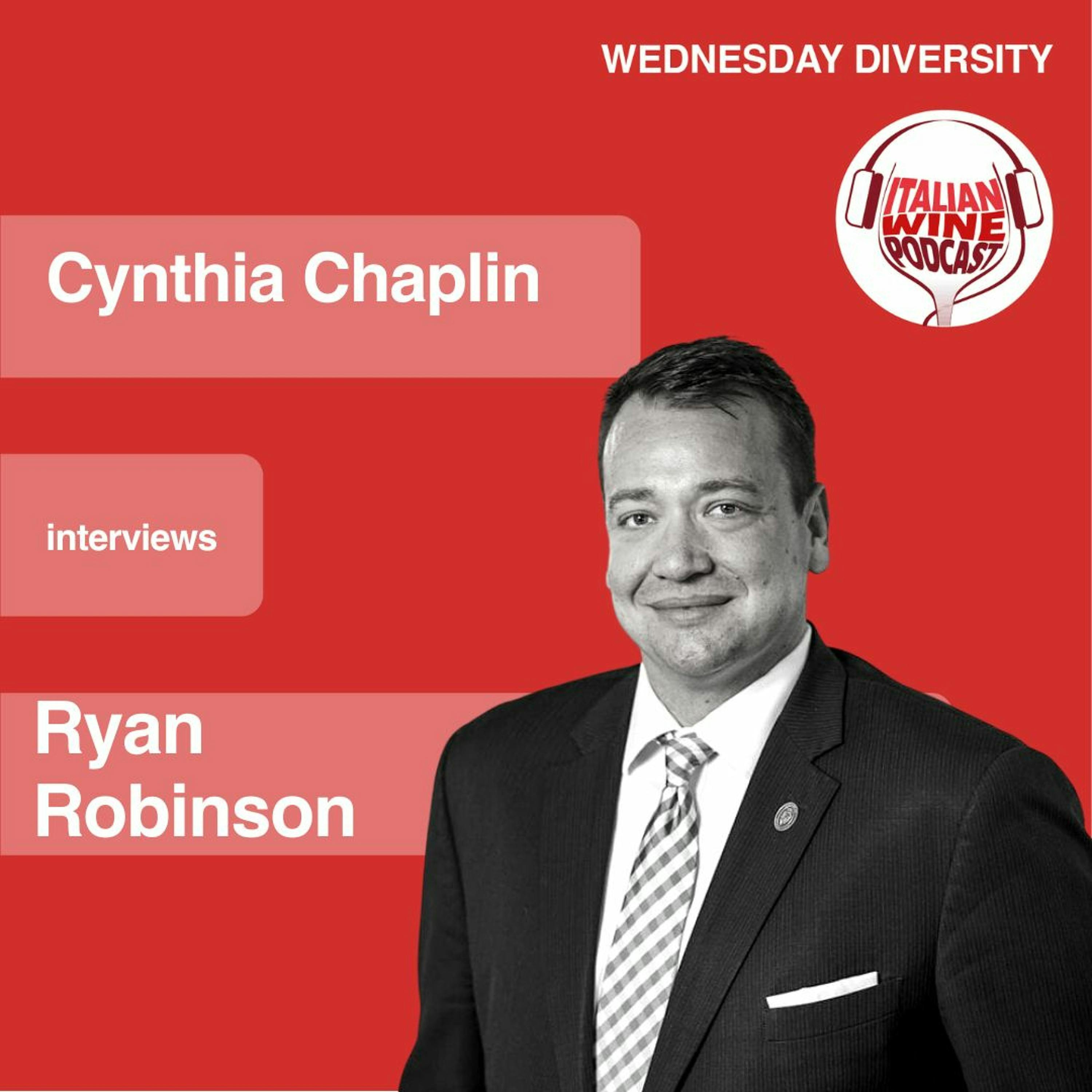
Ep. 1407 Ryan Robinson | Voices With Cynthia Chaplin
Voices
Episode Summary
Content Analysis Key Themes and Main Ideas 1. Ryan Robinson's diverse background and journey in the wine industry, from sommelier to educator. 2. The rigor and impact of the VIA Italian Wine Ambassador program on wine professionals. 3. Innovative approaches to wine tasting and education, particularly Sarah Heller's methodologies. 4. The importance of making wine approachable and accessible to new generations and emerging markets. 5. Opportunities and challenges for Italian wine in international markets, such as South Korea and the USA. Summary In this episode of the Italian Wine Podcast, host Cynthia Chaplin interviews Ryan Robinson, an advanced sommelier, WSET educator, adjunct university professor, and a recent student of the VIA Italian Wine Ambassador program. Ryan shares his unique path in wine, from fine dining restaurants to becoming a prominent educator, and even expresses his passion for sake. He discusses his experience with the challenging VIA course in Verona, emphasizing the invaluable learning from Italian producers and the transformative impact of Master of Wine Sarah Heller's innovative tasting approach. Ryan, who unfortunately didn't pass the VIA exam on his first attempt, expresses his determination to return, viewing the setback as motivation to become an even better Italian wine specialist. He highlights his current role as a wine director, including building wine lists for new restaurants in South Korea, and discusses the potential for Italian wine in non-traditional markets if presented approachably, often through ""by the glass"" options. He stresses the collective responsibility of wine professionals to engage and educate younger consumers to ensure the industry's future. Takeaways * Ryan Robinson boasts a comprehensive wine background, including an advanced sommelier certification, WSET educator status, and a university teaching role. * The VIA Italian Wine Ambassador program is exceptionally rigorous, requiring deep commitment and knowledge. * Direct interaction with Italian wine producers and consortiums during the VIA course provides invaluable insight. * Sarah Heller's unique tasting methodology, which emphasizes tactile sensations and relatable analogies (e.g., fabrics), offers a fresh and unintimidating way to teach wine. * Making wine education approachable and less intimidating is crucial for engaging new and younger consumers. * There are significant opportunities for Italian wine in emerging markets like South Korea, especially through accessible ""by the glass"" offerings. * Ryan views his initial failure to pass the VIA exam as a catalyst for deeper learning and greater specialization in Italian wine. * The future growth of the wine industry depends on successfully attracting and educating young people. Notable Quotes * ""I will never completely understand the world of wine. I'll never know at all."
About This Episode
Speaker 0 introduces a series of conversations with international wine industry professionals about issues in diversity, equity, and inclusion, including a new book on Italian wine called Unplugged 2.0. Speakers discuss their backgrounds and interests in working in restaurants, music, and tasting. They emphasize the importance of education and bringing their own country to their own success. They also emphasize the importance of learning about wine to help students understand the language and connect with it. Speaker 3 talks about their experience with learning and passing exams, and how they become a better wine professional. They emphasize the importance of being a master of wine and being a student in a course on learning wine and taste.
Transcript
Hey, guys. Check out Italian wine unplugged two point o brought to you by Mama jumbo shrimp, a fully updated second edition, reviewed and revised by an expert panel of certified Italian wine ambassadors from across the globe. The book also includes an addition by professoria Atilushienza. Italy's leading vine geneticist. To pick up a copy today, just head to Amazon dot com or visit us at mama jumbo shrimp dot com. Welcome to the Italian wine podcast. I'm Cynthia Chaplin, and this is voices. Every Wednesday, I will be sharing conversations with international wine industry professionals discussing issues in diversity, equity, and inclusion through their personal experiences, working in the field of wine. If you enjoy the show, please subscribe and rate our show wherever you get your pods. Hello, and welcome to voices. This is me Cynthia Chaplin. And today, I'm really happy to have Ryan Robinson with me. Ryan was one of our Vineet to the international academy Italian wine Ambassador students just a couple of weeks ago here in verona right before Vineet to leave wine and spirits Commission. And he hails from Connecticut. So thank you for giving your time to come on today, despite our big time difference. Welcome to the show. Thank you so much for having me. I'm really excited to be here today. Oh, it's a great pleasure. As my listeners will know, I've been trying to do a series of various people who participated in the Via course this year here in Brona, our flagship course, just so that people can get an understanding of who comes, who wants to do this, what is your background? How'd you get in it and and how various everybody is. So I'm really happy to speak to you today. Obviously, you're in Connecticut where I spent quite a lot of my, educational time. I haven't been there for a long, long time, but it still has a very fun place in my heart. And you come from quite a a Psalm background in the USA. So I was just wondering if you could fill us in a little bit about I know you're in advanced some with a quartermaster Smelier in USA. And you do some WSET educating too, but fill us in a little bit on your background because your point of view is a little bit different. Yeah. Absolutely. I think my background is a little bit complex and I think somewhat unique compared to my my colleagues that I the opportunity to finally meet in person, while we were in Verona. So my background started with a court of master sommelierge. I've worked in restaurants for for quite a long time and I started out behind the bar in fine dining restaurants and moved up through management. And I had a very influential summary that I quite looked up to at one of my first restaurants. And after working there, I thought, you know, I will never completely understand the world of wine. I'll never know at all. One thing that you can't tell here, I mean, that you already know something is, so I'm quite tall. I'm six foot nine or what? Two hundred and five centimeters. Yeah. Seriously, tall. I love shaking your hand. I feel like you're gonna take my whole arm with you. Like this. So I confirm an athletic background. And what I liked about the originally in the wine industry is that it can be quite competitive. And a lot of that competition is is definitely with yourself, to see how much better you can be and how much more you can know. And so all of this sounded appealing to me. And that's how I originally got in involved with the Court of Master, some of the ace, but I came from, like, a very quiet, a very rural place. And so it took a lot of traveling for my education, traveling on my own dime to learn more. So kind of fast forward where I, passed the advance exam, which was quite difficult. Yeah. Congratulations. It's not easy. I did some of my studying at quartermaster songs in London. So it's it is not easy. It's not for the faint of heart for sure. It is not. It took a lot of commitment. Now two years prior to passing the advance, I finished a full Ironman. I finished the Cord Lane Iron Man and, at six foot nine to finish a race of that long was the most difficult thing that I'd ever done in my life. And it was not I can't even begin to imagine. Yeah. That a marathon at the end of all those miles is ridiculous. So I wanted when doing the advanced preparing for the advanced, it became the most difficult thing that I've ever tried tried to do. In my first attempt, I was unsuccessful. At my second attempt, I passed. And so after that, I was like, I want to learn more and I want to grow more. And I was with a a restaurant group at time, really wonderful restaurant group. And I was told I had to leave to state that I lived in if I wanted to find a group and a community. And so that brought me to to New England. And this is where I am now. So I'm a a master's candidate. I set for a master's vary in, like, what, twenty seven days? I think Oh my gosh. So sorry to be bothering you right now. It's it's coming up right now. So working in restaurants, running wine programs, I really like the service aspect of the court. And then it wasn't until, COVID came along in twenty twenty that I I wanted to learn more and I wanted to grow more. And I start and I got acquainted with WSTT. I took the wine level three, and I enjoyed the challenge of it. But what really piqued my interest was the was socking. Now see here's where we're friends. And this we did not get to discuss when when you were here in Verona because you were studying like a mad person and I was running around with my tail on fire. But I am also a a sake person and I've judged a few sake competitions in Japan. So I'm gonna hear what you have to say about WSET sockets. Yeah. Absolutely. I wish I would have known this, and we could have had so much to talk about and are very limited to no time at all while we were together. Exactly. So I did this in twenty twenty, like, during the shutdown. And While I've been studying wine for quite a while in spirits and beer, anything fermented, sake was fascinating to me. It was unlike any other thing that I've studied, the process, the history, even the lack of popularity, It's on the rise now. At least within the United States, sake is growing tremendously and we're the largest export country of sake, but Shockingly in London and Paris as well. Even Milan, it's it's making its way. Really? Yeah. I was talking to to one of the students from South Africa. It was there as well, and sake is just such not a thing in South Africa. And I I find it boggling because of the lack of a way to classify it. And so there's not a lot there. So I I think There's potential for lots of growth with sake. After I did level one, and then I did level three, I was like, I want to know more. And because of the shutdown and you weren't allowed to travel to Japan, I took the WST educator training. And it was held in in the United States, and I think there were five of us, and two of us were non Japanese speaker. And it was just ridiculously, challenging, which I found fascinating, and I ended up passing my ETP. And so now I teach students here in Connecticut, like, in the middle of a level three socket course, And it's great seeing people who start out behind the bar or people who are are psalms just when they start trying different types and different styles of specialty sake, how exciting they get because it is so it's so unique and so complicated. I find I find it quite fascinating. So in the midst of all of this sake passion, which I can really understand, and and we won't we won't go down that rabbit hole, but we'll do it in progress. How did you hear about Via? What made you decide to go down what is, you know, widely known to be yet another profound endless limitless black hole of knowledge Italian wine. Oh my gosh. That is an understatement. I think on any student who applies for it. I think that needs to be put on the application that last statement because it was so much more than I had ever anticipated or to dream up. I got involved with an Italian importer. I'd worked with this importer, quite a bit in the past, and some of my favorite Italian producers are represented through this importer in the United States. And it's just just a wonderful company. I think they're based actually out in Trentino. And I had the opportunity to visit, admittedly, in twenty nineteen and meet a lot of their, the, their producers from this company. And it was fascinating to see if those producers come and, represent to the students during via so as at this time, I was like, well, Italy is Italy can be quite fascinating. And Italy is also varied. There's so many different identities. And just the indigenous grapes from the whole span of the country, I was like, I don't think people know enough about this in the in the United States. And so we, I mean, we import more Italian wine than any other country, but I think there's so much left unturned or not looked at. I completely agree. And, of course, when we say, you know, we import more Italian wine and any other country into the United States, we're not talking about all high level fine wine quality. So people do have an interesting perspective on Italian wine in the US because there is so much of it available, but not Not a huge percentage of it is is the top quality. Absolutely. I I think that's a really good statement. So I me, if I see, like, a lack in cells or a lack in, presence, I fall back on education. I'm like, okay, mate. It's just a lack of understanding because with education comes confidence and the ability to to venture out and try new things and feel comfortable in purchasing new things. And I realized while I was there, there's all these wines that I've never spirits to someone who has been studying for the last ten years, that I wanted to know more. And I had missed the cutoff on the previous one that was held in person. And so that's how I got involved with the one that I just attended. Fantastic. Well, you were lucky because, this this most recent one, our twenty fifth edition, was sixty four students from twenty five countries, and it was our highest pass rate ever. And you weren't one of those people who passed, and I was really sorry about that. But, you know, considering you're a grown up and a very experienced professional, how did you feel the course went for you? Knowing that, you know, it it wasn't the outcome you wanted, but how was the course for you, and how do you feel about coming back and giving in another go? You know, you bring up a really good point. And also, you know, kind of a very tender point as as well. Like, everyone wanted to pass, and it was fantastic seeing, like, people within my study group that I had connected with prior to the van, passing. But I I wasn't like you said, I was not one of those people. Well, that was discouraging. My personality type is the that pushes me to learn more and to be better. And so many people do not pass it on the first go. It is this is an exam that we know is rigorous. We we don't make any about it. But we do welcome people to to come back, and we we love it when they do. So I'm hoping you're going to. Absolutely. My full intention is too. I think I look at it this way. If I had passed, I'd be like, okay. Great. The knowledge level that I have I've passed, and now and now I I have this accolade. By not passing, I think it forces me to be a better wine professional and to eventually become a better Italian specialist because that's where I want to end up and specialize in Italian wines. I love that. I love that. I I I like that taking taking what you what you put into it and and then what you gained while you were here in Brent and taking that back into your professional life as well as carrying on with your studies. That's that's really what we wanna see happen. So What are you doing now? What's your day job? Yeah. So my day job, I am a, a wine director for a a large restaurant group and multiple restaurants throughout the United States. And I really have been inundated by opening new restaurants in Seoul Korea right now. Wow. Yeah. So putting lists together for that. In addition to that How are how are Italian ones doing in Korea? You know, I there's a lot of room for opportunity. When we look at the, like, the full Korean market, I think, what is the eighteen percent of the population of Korea are are drinking, great based wine. So there's a lot of room for opportunity. And from my experience, just completely inundated with this with twelve different distributors working on these projects, is that, the United States is very well represented. France seems to be has the biggest representation there. Most well known, best marketing. They've been at it for three hundred years. Can't blame them. Right? And just I think that the style from the United States to California style, the the big alcohol, big fruit, big o, those seem to be somewhat in fashion, not always my favorite style. But I think there's there's room for opportunity for Italian on all the lists that I've been working on. I've really been focusing on making sure that those that Italian regions are represented, and then, offering some alternative Italian options by the glass poor things that wouldn't be as so mainstream here in the states. So that's very cool idea. That's a cool approach. I like that. Giving people the opportunity to to taste by the glass rather than having to buy a bottle that maybe then they don't like it. Yeah. When you have a when you have a demographic where the majority only eighteen percent are drinking wine, That's kind of a tough bet to get people to spend more money on a bottle on something that they've never had. So I think doing half glasses and full glasses are a great way to ease people into it, and it allows for more more freedom of expression and freedom of sampling. Absolutely. You walk into a bakery and they give you a little piece of a broken cookie so that you you know what you want. I think giving people a a half glass of wine is is definitely gonna lead to more sales. And then you walk out of that bakery with, like, at at least a dozen of those cookies. That's the one. That's the one. Well, let let me ask you, what was your favorite part of being here in Verona? What was what was the best part of the course for you, you know, as a takeaway, something that you can really use as you go forward in your Italian wine. I hate the word journey, but I'll use it anyway. Right. So, you know, the the answer I should say. There's the answer I should say, and then I'll give you the real answer. Okay. Okay. The answer I should say is that, it was the experiences and the connections and the other students, the people that I met, and the fun that I had, that should be my biggest takeaway. But for me, that that wasn't so much my reality. I was so focused on the knowledge and trying to get as much information as I can on the course, because it's a very difficult course that I think I could have been better at making those interpersonal relationships. And when I go back, that's something I want to focus on. But for me, like, to sit in the classroom and to listen to the actual producers. So these producers that I've been selling, I've had in my restaurants for years, to have them stand in front of me and talk about talk about their wines was one of the biggest takeaways. This was our biggest year of master classes. We had eight this year. This was the most we've ever had with producers and consortiums coming in. So I'm glad you loved it. Are you enjoying this podcast? Don't forget to visit our YouTube channel, mama jumbo shrimp. For fascinating videos covering Stevie Kim and her travels across Italy and beyond, meeting winemakers, eating local foods, and taking in the scenery. Now back to the show. That was invaluable just to have, you know, those people, these wines that I've seen as iconic wines here in the United States, to just sit there and listen to, like, a few times it was surreal. Like, am I really here listening, in this moment? And to me, like I said, that experience is invaluable as well as leading up to the experience, both, we had most of our time with Sarah. But to be able to watch videos with the two of them, and then to listen to her in person, I think she's got such a unique approach to tasting and identifying wines, things that I don't even think about, things that I don't read in books, that also left a very big impact on me walking away. Of course, that's our faculty, Sarah Heller, who's a master of wine, and Henry Duvard, who's an Italian wine expert. And they are. They're such a great team because they are different. Sarah does have this really unique sort of ethereal visceral way of talking about wine. And Henry has this profound knowledge of history, and culture, and the two of them are such a good balancing act. We're very lucky to have them. I like how they play off each other, and they are quite opposite from each other. It would have been amazing to have him there in person as well. They are quite funny when they're together in person. But the banter before, like, from the screen to in person was great, but the way that Sarah tastes, and I've I've never really thought about it, and I've been tasting for so long preparing for this exam. Her approach to tasting has completely changed how I think about wine and how I think about assessing wine, talking about a texture versus friction and talk about actual, like, tactile sensations. Rather than just talking about, you know, the cornucopia of flavors. And I think as wine professionals, we get stuck in this, we're like, oh, I, you know, I get, like, kumquat and guava and, like, tangerine essential oil and a long walk on the beach when, like, I don't really understand what you're trying to describe, that she puts I I I just enjoy her approach that there's more there's more theory and there's more substance to tasting rather than how many markers can you identify in Well, we I think Via has made a huge effort through Sarah and Henry together, to to create a tasting grid. And and as you said, a whole approach to tasting that is you know, very structured, but offers a whole new language, not keeping us in the, you know, medium, plus, medium minus kind of thing, but giving us more more ways to look at it linear, you know, shapes, rectangles, circles, and you know, fabrics and textiles and sheer colors of paint and different things that nobody learns the same, and no one sees the same. And no one smells the same, and no one grows up in the same sort of place as eating the same sort of food. So I think for me, as an educator and as a student, being able to move away from really constricted language and into a new construct that is more, embracing of lots more things has I've grown just the same. I've learned so much over the years with Henry and Sarah and my tasting notes are completely different now from what they were before. It's just it's a, it's a really fascinating approach to me. So one thing I did to talk about is I also I wear multiple hats in Connecticut. So I am a W SED educator director of wine for a large restaurant group, but I'm also an adjunct professor at the University of New Haven, and I absolutely love this position. So I teach wine appreciation and top shelf wine and spirits. And one of my biggest struggles in teaching wine appreciation is teaching college students how to taste. I always start my first class off with if you're stranded on a desert island. What one wine would you bring with you? It could be a specific wine. It could just be like, oh, a pink wine. And it's kind of a playful way of me trying to assess their their knowledge level. And they all say, I'll take the biggest box of franchise. I can possibly get my hands on. Wednesday on it's always ninety percent of the class, barefoot, miss Scott. Which is great. They can name a wine. Right? But I've always struggled with trying to teach tasting because when you hear people or when you hear white professionals talk about tasting, it's very intimidating. And as I mentioned, they they talk about, you know, whole cornucopia of flavors and aromas. But it doesn't really speak to the wine. It's kind of a flex to see how many things you could say. And so the big takeaway that I took away from this is that I am going forward. I'm going to change how I teach my classes at university based more on these other alternatives that I learned it be, about, like, texture and colors and associating wine with, like, with fabrics, things that we have everyday contact and knowledge with. I I really like that approach. It resonated well with I think it works well with university students too. I also teach, university students on their semester abroad in Rome. And so they're all nineteen, twenty, twenty one. And they don't have that, you know, sort of very old fashioned wine language that WSTT still uses, and and is moving away from, but is still gonna be using for the foreseeable free trip. And they don't understand a lot of those terms, they don't they're not connected to them. They don't resonate with them. So, in Rome, we're lucky. I I say, look, go out to the flower carts, tell people you're studying wine, you know, sniff all the fruit and vegetables, feel the flowers, do all of that. But it's great. I think you're absolutely right. Sarah and Henry have put us as be a student on a track where we can explain, you know, and be better ambassadors in a way that people who don't have that WSTT background can really connect with and and really put into place with Italian wine and and find something that jumps out at them and and hooks them into the glass of Italian wine. So I'm so glad you got that part of it. And you're taking it to your classes. Lucky students. Well, I I hope so. I hope so. We're in finals week. We'll see how lucky they are now, but it's just, you know, wine can be very intimidating. Learning about wine can be intimidating. And and unfortunately, for me, within within the court. Some of my colleagues don't help that ease of intimidation. I think wine should be fun and it should be approachable because it is. And when we start talking about it, from a viewpoint of things that we can better identify with, where it really is rooted in education and learning and not so much as, like, a mental flex or a professional flex, I think we'll see more appreciation because we need to do what we can to help the growth of wine right now. If we don't get young people involved right now, nobody's gonna be drinking wine in fifty years. So we it's our responsibility. Well, Ryan, this is so great. I'm I'm so glad to speak to you and and to hear your point of view because it is so different from a lot of people who were in the class you know, most of whom are, educators or cheerless or, you know, doing other things within the world of wine, and you coming at it as a sum perspective, and a teacher and and a sake guy I mean, I always say sake is all dependent on the water and the polishing, and wine is all the terroir and the grape. So they're not that dissimilar, but, it's it's very interesting to compare those too. So I love what you had to say about the course, and I'm so glad you were with us, and I'm going to nag you to make sure you come back and sit that exam again because I know you can pass it. Oh, I will definitely be there. And it's also introduced me to the there's other events, right, outside of EA. There's other like, programs. Absolutely. We've got our wine to wine business forum. We've just started working on it. It'll be in November this year here in verona, which is our b to b event, all on different topics, tracks, innovations, things like that that we do every year. This is our tenth anniversary. So you'll definitely be invited to come to that. Well, fantastic. I look forward to just being as much involved as I can going forward to not only better prepare myself, but in the long run, to be a better ambassador of Italian wine. Well, we'll have to get you on some of our Jitascolastica, our academic trips that we take around Italy to various regions, different producers, and everyone who's in our VA community is invited to apply for those. So it's it's worth getting involved and and taking the horrible heart exam just to be part of that. Absolutely. I really enjoy that. Alright. Well, thank you so much. I really appreciate you coming on, and I hope I get to see you soon. Alright. That sounds wonderful. Thank you so much, Cynthia. It's been a pleasure. Take care, Ryan. Chiao. Chiao. Thank you for listening. And remember to tune in next Wednesday when I'll be chatting with another fascinating guest. Italian wine podcast is among the leading wine podcast in the world, and the only one with a daily show. Tune in every day and discover all our different shows. You can find us at Italian wine podcast dot com, SoundCloud, Spotify, Himalaya, or wherever you get your pods.
Episode Details
Keywords
Related Episodes

Ep. 2651 Diversity in the Wine Industry and Wine Tech Innovation with Jeremy McCarty | Voices with Cynthia Chaplin
Episode 2651

Ep. 2627 Regenerative Winemaking, Mentorship & LGBTQ+ Perspectives with Terah Bajjalieh | Voices with Cynthia Chaplin
Episode 2627
Ep. 2545 Building Inclusive Wine Spaces Through Storytelling with Amari Collins | Voices with Cynthia Chaplin
Episode 2545
Ep. 2531 Winemaking Journey from Mumbai to Napa with Priyanka French | Voices with Cynthia Chaplin
Episode 2531

EP. 2517 Sarah Looper | Voices with Cynthia Chaplin
Episode 2517

Ep. 2505 Ren Peir | Voices with Cynthia Chaplin
Episode 2505