
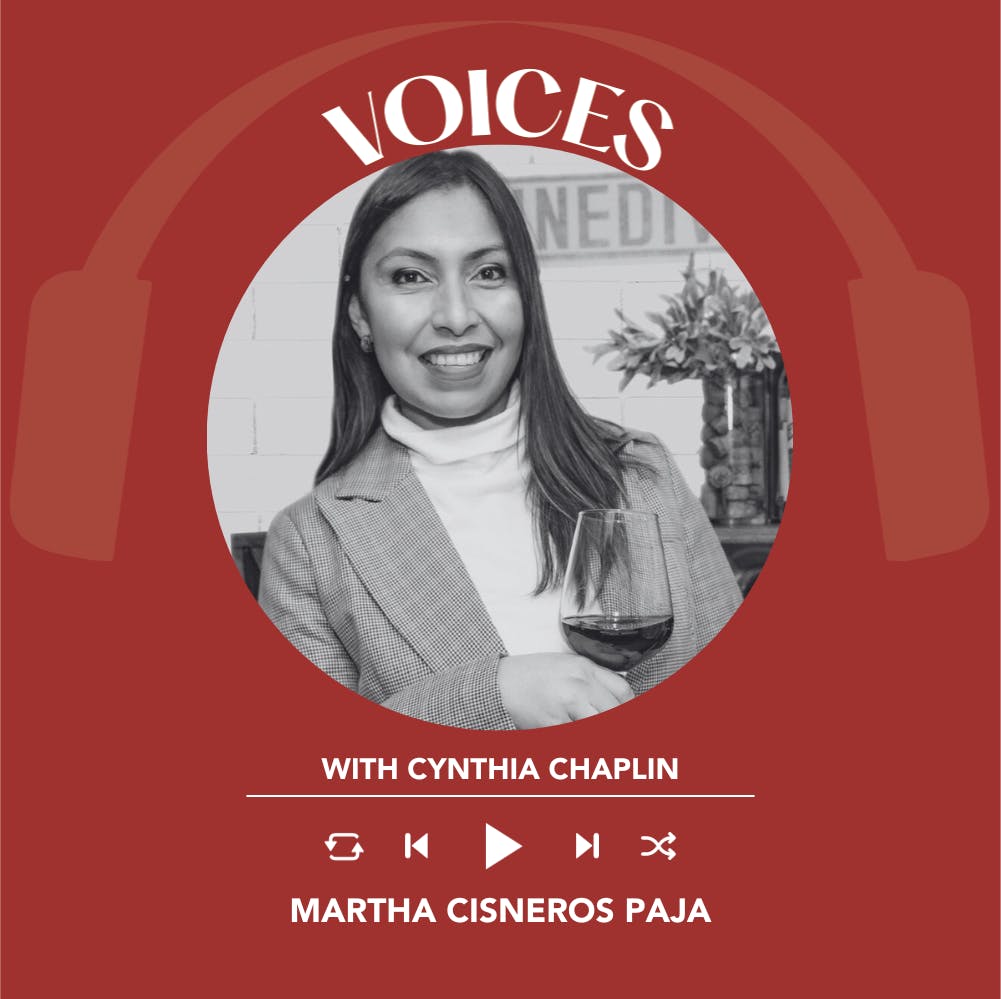
Ep. 1723 Martha Cisneros Paja | Voices With Cynthia Chaplin
Voices
Episode Summary
Content Analysis Key Themes and Main Ideas 1. The personal journey of Martha Cisneros Pajares from Mexico to becoming a wine professional, social media influencer (""Wine Diva""), and advocate. 2. The transformative role of cultural immersion (in Spain) and the strategic use of technology (Instagram) in wine education and career development. 3. The foundation and advocacy efforts of Latina's Wine Club, focusing on diversity, equity, and inclusion for Latinx professionals and consumers in the wine industry. 4. The growing potential and consolidation of the Mexican wine industry, emphasizing quality, tourism, and expanding regions beyond Baja California. 5. The evolving interests of new generations (millennials, Gen Z) in wine, particularly their desire to learn about emerging and niche wine regions. 6. The intersection of passion, authenticity, and strategic planning in building a successful career and platform within the wine world. Summary In this episode of the Italian Wine Podcast's ""Voices,"" host Cynthia Chaplin interviews Martha Cisneros Pajares, known as ""The Wine Diva"" and founder of Latina's Wine Club. Martha shares her unique path into the wine world, beginning with a childhood in Mexico where wine was not part of daily life, to her ""seductive"" discovery of wine's cultural significance during university studies in Spain. She explains how she leveraged social media, specifically Instagram, as an authentic ""tasting journal"" to share her wine journey, fostering a loyal community. A significant portion of the discussion is dedicated to Latina's Wine Club, which Martha founded in 2020 during the COVID-19 pandemic. Driven by her observation of a profound lack of Latinx representation in wine education and professional settings, the club aims to empower and advocate for fellow Latinos. Its strategy includes grassroots efforts, digital content, one-on-one coaching, and a wine school. Interestingly, the wine school's students, primarily millennials, show a strong interest in emerging wine regions like Georgia and Greece, indicating a shift from traditional old-world focuses. Martha also delves into her recently published book, ""Mexican Wines: A Guide to Fall in Love with Wines in Mexico."" She highlights that the Mexican wine industry, though relatively young, is experiencing consolidation, focusing on quality, and possesses significant potential for wine tourism beyond its famous beach destinations. Throughout the interview, Martha attributes her rapid success to her passion and her engineering background, which equipped her with a strategic approach to content creation and team building. She concludes by outlining her future ambitions, including an artistic project for Latina's Wine Club and pursuing her sommelier certificate. Takeaways * Personal and cultural experiences can powerfully shape one's entry and dedication to the wine industry. * Authenticity and consistent, engaging content are crucial for building a significant and loyal community on social media platforms. * There's a pressing need for increased diversity, equity, and inclusion for Latinx professionals and consumers within the global wine sector. * Grassroots initiatives, combined with strategic digital outreach, are effective in addressing representation gaps and providing targeted education within the wine community. * Newer generations of wine enthusiasts are actively seeking knowledge about emerging and non-traditional wine regions, suggesting a future shift in educational emphasis. * The Mexican wine industry is a dynamic and growing market, characterized by a focus on quality and strong potential for wine tourism. * A combination of passion, strategic thinking, and continuous skill development can lead to rapid career advancement and impactful contributions in specialized industries like wine. Notable Quotes * ""So I just became amazed that so many things can fit into a glass of wine like the soils. Right? Winemaking styles or stories behind the wineries and the culture around wine. It really made me fall in love."
About This Episode
Speaker 0 introduces Italian wine podcasts and introduces Martha cisneros paja de voices, a wine enthusiast who found wine in university. They discuss the importance of social media and building skills to achieve goals, including creating a successful wine club and partnering with ambassadors. Speaker 3 talks about their success in social media and online presence, their involvement in a community outreach campaign for their own brand, and their involvement in a community outreach campaign for their own brand. They also discuss the success of their wine school and expand their wine education program, as well as their plans for the next couple of years, including enhancing their service skills and completing a certificate k.
Transcript
The Italian wine podcast is the community driven platform for Italian winegeeks around the world. Support the show by donating at italian wine podcast dot com. Donate five or more Euros, and we'll send you a copy of our latest book, my Italian Great Geek journal. Absolutely free. To get your free copy of my Italian GreatGeek journal, click support us at italian wine podcast dot com, or wherever you get your pots. Welcome to the Italian wine podcast. I'm Cynthia Chaplin, and this is voices. Every Wednesday, I will be sharing conversations with international wine industry professionals discussing issues in diversity, equity, and inclusion through their personal experiences, working in the field of wine. If you enjoy the show, please subscribe and rate our show wherever you get your pods. Hello, and welcome to voices. This is Cynthia Chaplin. And today, I am so delighted to welcome Martha cisneros paja de voices. Martha was raised in Mexico, and she's an engineer with a master's degree in information science, but much more important for us. She was named to wine enthusiasts list of future forty taste makers for twenty twenty three. And she's known on social media as the wine diva, and she founded Latina's wine club in twenty twenty to empower Latinos through wine education. So very much my jam, and I'm so glad to have you on the show, Martha. Thank you so much for making time. Oh, thank you very much, Cynthia, you. Thank you for that warm welcome. Well, let's talk about how you got into wine. You said that growing up in Mexico, wine was not part of your table. There was beer or tequila, but never wine. And then you went to University in Madrid and Barcelona for a while, and you reconnected with your Spanish roots, and that experience sort of inspired you to learn more about wine. So tell us what happened. How did you get interested and what did you do to get yourself into the wine world? And I grew up in a place with no wine, and I found wine in university too. So I'm excited to hear this story. Thank you, Cynthia. Yes. You know what I think that's, many of us, you know, take college to explore alcohol and beverage, and, you know, take the opportunity to travel. So that's kind of like what happened with me. As you mentioned, I spent some time studying in Madrid where I learned from my fellow students about the strong connection between wine and family traditions when I worked in Barcelona, having wine after work or during special meetings was kinda like expected. So it was different from from my experience in Mexico. Right? Like in Mexico, if you drink after, like, you know, like, after work every day, it's kinda like you're, like, a drunk or something like that. No. But here, it was kinda like part of the life, the work life. So I had to learn very quickly or at least try to at least how to to taste wine. But I had to say I had great colleagues in Spain, you know, Spanish people is is really, really very kind. So my colleagues were from different parts of Spain, Another word from catalonia. And it was always such a fun time. They were sharing with me so many insights about the wine. Even though they were not experts because I was working in technology, and studying about technology. It was part of their everyday culture. So I just became amazed that so many things can fit into a glass of wine like the soils. Right? Winemaking styles or stories behind the wineries and the culture around wine. It really made me fall in love and kind of like naturally, I really wanted to learn more. I so get that. I I lived in Barcelona as well for a couple of years, when I was just getting interested in wine. And as you said, I mean, catalunya, I like the fact that you said some of your colleagues were from Spain and some were from catalunya because it is really different. But, people did. It was part of everyday life, and and everyone talked about it even if they had nothing to do with the wine industry, and it is so seductive. So I'm glad it caught you in the net. It it definitely caught me too. So You've been very open about your early steps in the wine sector, you know, starting out and reading back labels and and sharing your wine journey on Instagram. And I know you're a millennial. So how did that help you shape your wine journey and and the content that you put out, you know, going from not doing anything about wine to learning a bit in Spain and then starting up, you know, your Instagram path. Yeah. So, well, before I left to to Spain. I was living in Mexico, and we were having kind of, like, sweet wines, you know, like, I'm not gonna say brands, but it was, like, you know, like, a la brusco that was, like, super sweet. So being in Spain, I had things, like, so many different wine that I have never exposed to in Mexico. Then I came back to to Mexico for a while before immigrants to to America. And, you know, I was, like, reading the back labels of the wine bottles And I noticed that you can find helpful information in some of them, not all kind of like a note of the winemaker, parents' suggestions, or but at least in all of them, you will find the importer's name. And as someone that really pays attention into details, I've learned to follow the importers of the wines that I enjoyed and try more of their portfolio because my thought was like, oh, if I like this and they are importing this wine. So maybe they have something else that I am interested and being a millennial, kinda like that was my lead, you know, like following the people that I trust, their palette, and I have tried many of their portfolios, and I can I keep doing that until this day? I am also interested in where my wine comes from, or, and whether it's sustainable or organic with easy access to technology. I can quickly research the wine that I'm selecting with just a few clicks on fun as you know, technology has become definitely, you know, more accessible for my generation, and research is way more easy. Information has been more is more luckily and readily available. That's so true. If I'd had Instagram and Google when I was starting out in wine, I'd be a master of wine, like, running the wine universe by now. That didn't exist back then. So I love hearing about people who you know, really use that power for good and you did. Yes. And on top of that, I have always and you're sharing the knowledge, right, like, spreading the knowledge, like, oh, I learned these and I share. And in the early days of my Instagram account, that's it was in Windiva. I used it as a tasting journal to snap pictures of the wine I was drinking and share my tasting notes. While aesthetics were in a significant part of the platform then, my audience was very interested in my perspective and cultural background. By being authentic, I build relationships with both members of the audience and importers who send me samples and continue, and I continue to try new vintages. Have even become friends with some of my audience because at the end of the day, it's a social network where you are meant to be social. And the cherry on top is that sharing that glass of wine in real life is is really a great time. Of course, on Instagram and Facebook, the algorithm has changed over time with the addition of real videos and other digital configurations, but I remain true to myself. And I think that's something that people even tell me. Like, oh, you are, like, exactly the same as you are online when I meet them in person. So I remain true to myself and to my followers. I am selecting with the samples that I receive or the pay collaborations that I make. But if I do not have an elaborate opinion about something that I don't boast about it. Yeah. Well, I think that's such a key to your success because I mean, I feel strongly about not ever, you know, writing about wine that I haven't tasted. And your your Instagram, you know, over the years that you've been curating it, your your personality is the same. I can see, you know, I haven't met you in person. I hope I will someday soon, but, I can see what people mean that, you know, you really have stayed the same. And your content just gets better and better, but you remain the same person, clearly, really authentic. You're never hesitant to say, wow, I didn't know about this wine, and now I found it. And it's very approachable and very accessible. So I love that you took that point of view and really put your foot down and insisted that you weren't ever going to, you know, be something you're not just to get more likes or to, you know, get more free wine or whatever. So And I think that is a pitfall with, you know, social media nowadays, but you're so right. It was meant to be social. So I'm delighted to hear that you've become actual friends in real life, you know, not just sort of cyber friends with people who follow you. You've also become a Kava brand ambassador, a writer, a blogger, an educator, a Sherry specialist, and you published a book recently on Mexican wines, which we will talk about in a minute. But most people take years and years and years to get to this point in their wine career, and you did it all in, like, seven or eight years. You know, what is driving you to do this? You've got over eighteen thousand followers on wine divas. You know, I'm sure you have more in other places as well. So how did you combine your love of wine and social media and create this enormous approachable, really likable success that you have. Well, I have a literary coach who told me that my passion is what drives me to keep going, and I swear by it. It's the passion. I have spent seven years working on winediva dot com, but it took me many more years to build the skills to achieve that. For instance, I have logbooks since I was seven years old, and I always thought that I will be a journalist, but my Erlix posture to technology through my engineer father. Let me to become proficient with computers. While in college, I personally agree in technology engineering, but my heart has always been drawn to communication. During my time in college, I hosted a radio show. I organized music concerts, and I was always reporting on their dogs, which is something that I still do today as it relates to white. It took me seven years to establish myself in the wine industry through the creation of wine diva dot com and Latinos wine club and my book, but it took me way longer to work on the skills needed to write a book. I invested in a creative writing coaching you know, I I completed a bachelor's in a master degree in technology engineering and information science, which I think has been those skills that I build out during college. And and my master degree helped me to learn about is strategy, content, social media marketing, and, of course, now into optimization of of task. I also built a team that I trust to get the job done. So my team and I believe in storytelling with a strategic approach, We have developed the ability to repurpose long form and content into shorter formats and keep track of editorial calendars, BOLatin, Zweycom, and Yintiva. That's so important. I understand that from the business end of the wine sector that I work in here at wine to digital and Vineitally international. So I think you really got your feet under you before you got your face out in public. So let's talk about Latino's wine club for a minute. You founded it in twenty twenty. With the goal being clearly to help other Latinos believe they belong as wine consumers and wine professionals. What gave you the idea? You know, it was COVID times. What were you thinking about and seeing in your community that prompted you to start Latinos wine club. Are you enjoying this podcast? Don't forget to visit our YouTube channel, mama jumbo shrimp. For fascinating videos covering Stevie Kim and her travels across Italy and beyond, meeting winemakers, eating local foods, and taking in the scenery. Now back to the show. During common times, I was living in Astoria Queens, and it was so palpable. Right? Like, you can see the business is going down. I have a couple of friends that love their jobs and restaurants, many other wine bars very close to me. They were close, closing the business. And I was reflecting entirely on what was happening in the industry. So then I've thought what I can do to help. So I knew how to do social media. I had Waindiva for some time already. I started another it's different page to share stories of Latinos in wine, and that's how Latina's Quandlaude started. Since I already had a passion for wine, getting to know the stories of Latinos in wine, give me, like, a an idea to advocate for my community on the wine industry. The advocacy to support fellow Latinos, interested in wine or early career professionals, it became kinda like the base to for me to create an incorporate Latinos wine club. We leverage the Instagram page to a platform that educates Latin consumers and celebrates and promotes Latinas and wine. Also, I want to say more Latinas and wine. When I started professional studies, I was the of the only Latinos in the room, and that often repeated. I participated in many master classes here in New York, and I was the only Latino. The next time I joined WSTT class, I thought it was gonna be different that I will I will find more Latino professionals or, like, students. And again, I was the only Latino, then another master class, and I was the only Latino. So I started to notice a pattern, and it's been challenging, but rewarding, journey so far. And I am excited to see where it takes me next. Well, it it has been super interesting to watch, and you've got some very, very serious goals for Latinos wine club. You know, you've said you want to help Latinos pursue aspirations for holding managerial positions and becoming wine curators for stores and restaurants, you know, and just simply bringing about awareness for the need for more diversity and wine. As you said, you know, getting more Latinos in the room, you know, all the room in the Psalm room, in the tasting room, in the classrooms, all these places. So tell us about your strategy for achieving these goals. I know you are a big believer in strategy. So what is Latinos wine club going to do to engage people and and help them actually get these things into their life, get their foot in the door, get their seat at the table. What's the strategy? Yeah. Well, in person, we are actively involved in, like, ras root efforts as well, of course, as the strategy on the digital aspect of our work. Along with creating and sharing content based on our wine school topics or editorial calendar, we have also started involving our ambassadors to produce content. However, we still believe in the one on one communication with our consumers and early career professionals through texting, Emily, and personal interactions. Recently, I heard a great success story of one has become a very good friend. It's one of the ambassadors here in New York she's becoming a sommelier at a very well known restaurant in Manhattan. And I remember when she told me, oh, I I had the opportunity to become a sommelier in in this French restaurant, and I was like, okay, let's take you there. And we shared the knowledge. She came to the wine school. I shared some books that she had to read, and she did it. We have been coaching her for a while. And now we're looking to expand this model to other chapters. And, of course, through potential partnerships. Yeah. This is these are you are active. It's not just a lot of words. You are taking action and calling other people to act with you. As you said, partnerships as well, And I'm fascinated by your, you know, the educational arm of Latina's wine club. I'm a wine educator. I work with Vineetili International in the Italian wine Ambassador Program that we have, and I teach for WSTT and a professor of Italian wine as well. So I wanna hear about the wine school that Latinos Wine Club has now and how you're running it, how the aspect is going, how many students do you get per semester, and what's their feedback like, you know, Are they getting jobs after they take your courses? You know, are you breaking down these stereotypes and helping really support these people into the industry? You know, how is the wine school gonna grow? Fill us in. Yes. Definitely. Well, this is this is the third year of the wine school. And I have to say the the first year and the second year, it was kinda like the we put out the content that we thought we needed to, like, win basics and, like, you know, the top regions of the world, like France, Spain, Italy. But then, at the end of the second year, we ask our our members, a, why do you want to study? And they fill out this survey, and we we were amazed had to receive that they were interested in in getting to know, like, different, upcoming regions, like, wines of Georgia, wines of Germany or, like, Austria or Greece that maybe these are, like, not you know, bridges that are established, but for, like, coming from millennials mostly, it was very interesting to see that they were interested in getting to know, like, different regions that we do not talk often. So this third year, we had classes around winds of Georgia, winds of Greece, winds of Australia, and their feedback was just great. They were absolutely engaged with the content inviting friends For the virtual part of the wine school, we do, Zoom classes and, we often have in between fifteen to twenty five people. For the in person events, we do in personal events in New York. And, in Austin, we have, like, one or two events per year. It's just two partners on Latinas wine club, and we're really very busy. So Yeah. I know. I know. Yes. We we have great dreams, in the sense that we even plan to be a certified provider there with WSTT, but there's a long waiting line there. So we might be incursionating that later, you know, maybe by the fifth year, now we're gonna still driving it with what our consumer base wants to know and still running the digital and day in person events. Well, it's so interesting what you said about your students' feedback because, you know, we we all hear these terrifying messages, you know, in the news recently about young people aren't drinking wine, and they're not interested in wine, and how to get them back involved in wine, how to keep the wine industry young and vibrant and interesting and on its feet. And the feedback that they want to really learn about emerging markets more than old world markets is fascinating because of course WSET know, being a global certification and having been in business for, you know, what it must be now about seventy years, you know, they they focus on old world wines. There's no two ways about it. They talk about new world wines, but the focus is really on old world wines. So your students asking for Georgian wines and emerging wines and, you know, sort of more niche regions, grease, things like this is fascinating to me. I think this is really the future. You know, if we want people to get involved in wine education, we have to give them what they want to learn about. So I think you're on the right track there. That's that's amazing to me. So I can't wait to see where you go with that. As you said, it's only the third year of the school. So goodness only knows what you'll achieve in the next couple of years, but I wanna talk about your book too before I let you go back to your day. Your new book, Mexican wines, a guide to fall in love with wines in Mexico, which you published just this year. So first of all, huge congratulations on that. That's that is amazing and quite an achievement. And, obviously, Mexico is your birthplace, so it makes sense for you to write this particular book. So why are there not more books about Mexican wines? You know, tell us what you discovered during your research and the writing process you know, how is the wine industry in Mexico? And what do you think of the wines and their ability to take a bigger place in the world? This is another emerging market. You know, I'm sure your students are asking for more info about this. Yes. Exactly. Well, I I thought it was the first book about Mexican wines, but through my research, I found out that there were a couple. I think one or two in English, just about Viol de Guadalupe. But what is different about my book is that I wrote it in a time, that the Mexican wine industry in Mexico is consolidating. And by that, I mean, it's expanding to just not baja wines. There are more wine regions in Mexico. On top of that consolidation of the wine industry means that there are many actors involved, not just the producers, of course, the importers have a very important part they are creating their roots to export from Mexico. The these wines, the white roots, some of them are not in place. Also, the distribution, it's still something that it's growing in America and other countries. The wine industry in Mexico is fairly new. It's a it has, like, around thirty years, or so. And I think the main shift that I have seen, of course, for the last thirty years is that they are focusing on quality over quantity and getting back to the point of the actors involved. I think the support of the local government in supporting the different wine regions and the wine routes that in Mexico are kinda like consolidating is going to be great for the next years. Mexico is very big for tourism on the beaches, but I think wine tourism is just gonna get at some point to that level because they have the potential. They have the magical towns close to many of the wine routes. And I think that we're gonna see exponential growth on that side. That will take definitely bigger place in the hearts of the wine lovers because, and I'm talking about American consumers being so close to Mexico. It's just like, I mean, of course, we want to go to France in Italy, but Mexico is so close. And we can get there, like, you know, just enough few hours, be there and enjoy the Mexican wines and the experience of the of the people, the Mexican people. Right? Absolutely. What who's your favorite producer? I mean, that's a terrible question. It's like, who's your favorite child? But who's your favorite producer in in Mexico? Or who do you think is sort of leading the charge right now. Leading the charge, I think around the 1970s, there were a couple of wineries that really shifted, their view, their vision, and they wanted to focus on quality. And those producers, I'll say one that I'm the most impressed with is Montechanic because Montechanic has understood, and has focus on quality and not also quality of the product, but also of the quality of the experience, the winery in Baja is impressive. The distribution in America is getting there. The importer is very engaged, you know, working together with, you know, with the distribution and all that. And I think that we're gonna see great things coming from Montana. Just to mention, they did recently won the best covenant of the world in a recent competition by concourse from the other person. So I think it's a is a producer to watch monthly time. Absolutely. Absolutely. And it's it's interesting what you said about, you know, the it's sort of a three hundred and sixty degree experience with them. You know, Anno tourism is big now. You have to have, a winery that welcomes people to come and visit, to see where the grapes are growing, to see where the wine is made. You know, as you pointed out, you know, millennials and and gen z and everyone else so interested now in where their wine comes from, and is it sustainable, and is it organic. And Monticechnic is really, thrown open the doors and, and welcome people and really created a, a tourist experience that draws people in and they're telling their story. So I'm I was thrilled when they won the prize, and I'm glad to hear you say that the distribution is going well because I I didn't know much about how they were doing that way, and that sounds great. And it's good to know that they're getting out there now, especially after that win. So, Mexican wine, I think, is gonna be, yeah, definitely something to to watch. So I know at the moment, you're in New York, and there's a very vibrant wine scene there and has been for, obviously, such a long time, no matter whether you're a wine lover or a wine professional or something in between. So what are your plans for the next couple of years? You know, what projects have you got coming out? Because I know you never sit still, and I know that, Latinus wine club is gonna grow and wine diva, you're always so busy. So what have you got coming up for twenty twenty four in the near future? Yeah. Of course. Well, for Latinez wine club, I am working on a I'll say artistic, project, that is aimed to showcase a diverse range of individuals, Latinas associated with the club where there are consumers or professionals to a broader audience. I think this project will also help highlight the opportunities available within our niche to those who may not have recognized it yet, especially within the industry. So it's gonna be something big, and I'm very excited. And then I am considering also taking time to focus on complimenting, completing and passing the certificate k, some of your program that I started two years ago. I got a scholarship through the cohort master of some of my years, and I passed the introsomular exam, but I still have to buy the certificate. So my primary focus will be to enhancing my service skills. So definitely working on that. And I think I'm already working on my second book, which is more related to to the experience of being Latino in the wine industry in New York. That's fantastic. Well, We wish you so much success, and I'm so happy that you had time to talk to me today. I know so many of my listeners are gonna be really, really interested to hear your story. And, you know, not only sort of the challenges, but the achievements that you've had and all of the goals you've got coming up and the exciting new projects. I'm gonna keep my eye on that for sure. So thank you so much, Martha. I really appreciate it. Thank you, Cindy. It has been a pleasure. Thank you for listening, and remember to tune in next Wednesday when I'll be chatting with another fascinating guest. Italian wine podcast is among the leading wine podcast in the world, and the only one with a daily show. Tune in every day and discover all our different shows. You can find us at italian wine podcast dot com, Sound Cloud, Spotify, Himalaya, or wherever you get your pods.
Episode Details
Keywords
Related Episodes

Ep. 2651 Diversity in the Wine Industry and Wine Tech Innovation with Jeremy McCarty | Voices with Cynthia Chaplin
Episode 2651

Ep. 2627 Regenerative Winemaking, Mentorship & LGBTQ+ Perspectives with Terah Bajjalieh | Voices with Cynthia Chaplin
Episode 2627
Ep. 2545 Building Inclusive Wine Spaces Through Storytelling with Amari Collins | Voices with Cynthia Chaplin
Episode 2545
Ep. 2531 Winemaking Journey from Mumbai to Napa with Priyanka French | Voices with Cynthia Chaplin
Episode 2531

EP. 2517 Sarah Looper | Voices with Cynthia Chaplin
Episode 2517

Ep. 2505 Ren Peir | Voices with Cynthia Chaplin
Episode 2505