
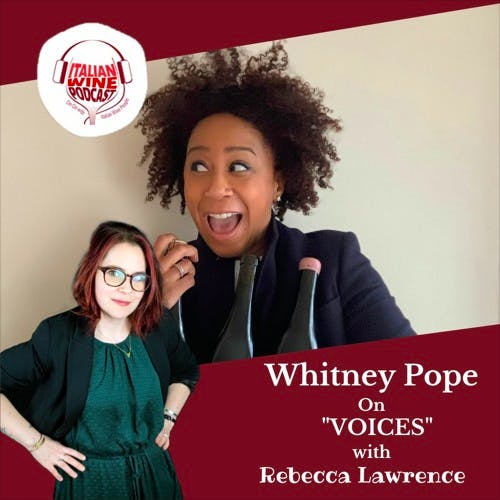
Ep. 601 Whitney Pope | Voices
Voices
Episode Summary
Content Analysis Key Themes and Main Ideas 1. Whitney Pope's personal journey and career transition from fashion marketing to the wine industry. 2. The establishment and focus of ""Wit and Wine"" as a platform for natural wine education and community. 3. The challenges and perseverance required to build a career in the wine industry, particularly as an entrepreneur. 4. The importance of approachability, authenticity, and quality in creating engaging wine content, especially on social media. 5. Demystifying natural wine, its definition, misconceptions, and practical advice for beginners to explore it. 6. The role of local wine shops and building relationships within the wine community for learning and discovery. 7. The broader theme of inclusion, diversity, and individual expression within the wine industry. Summary In this ""Voices"" episode of the Italian Wine Podcast, host Rebecca Lawrence interviews Whitney Pope, founder of ""Wit and Wine."" Whitney shares her unconventional path from a career in fashion marketing in New York City to becoming a prominent voice in wine education, particularly focused on natural wines. She discusses the challenges of breaking into the industry, including numerous rejections, and how she gradually built her wine career alongside her full-time job. Whitney highlights the genesis of ""Wit and Wine"" during the pandemic as a ""micro wine blog"" on Instagram, emphasizing her commitment to creating approachable, fact-checked, and authentic content. The conversation delves into natural wine, its often misunderstood nature, and practical advice for listeners on how to explore it, suggesting local wine shops and specific books. Whitney stresses the importance of quality over quantity in online content and advocates for an inclusive industry where every wine and every person has their place. She also touches on her signature style and the intentionality behind her online presence. Takeaways - Whitney Pope transitioned from the fashion industry to become a wine educator, demonstrating a non-linear career path. - Her platform, ""Wit and Wine,"" specializes in approachable natural wine education through in-person and virtual events, and Instagram content. - Breaking into the wine industry often requires persistence, resilience, and willingness to adapt, as shown by Whitney's experience with ""ghosting"" in job applications. - Natural wine can be explored by beginners through local wine shops, specific books like ""Natural Wine for the People,"" and by engaging with knowledgeable staff. - Quality, authenticity, and relatability are paramount for effective online wine education and content creation. - The wine industry benefits from diverse voices and perspectives, and there's a growing need for inclusive representation. - Developing relationships with local wine shop staff can be highly beneficial for wine enthusiasts. - Misconceptions about natural wine (e.g., sulfur use) are common, and a nuanced understanding is encouraged. Notable Quotes - ""I have my full-time day job, and but then I have my, so I have, I have a wine business on the side, or focus on natural wine education through in-person events now that we're back together."
About This Episode
Speaker 2, a wine business owner, talks about her passion for learning about wine and how she had to manage her own wine business. She discusses her experience with alcohol and working in wine events, as well as her journey to find a new career in the wine industry. Speaker 1 and Speaker 2 discuss Speaker 2's decision to pursue a new career in wine and the importance of finding a comfortable place to work. They also emphasize the importance of learning about natural wines and finding the right one, as well as the excitement of the Italian sparkling wine industry. They suggest starting small with reading and going to a local wine shop to learn about the philosophy and use it as a learning experience. They also discuss the importance of shelf stabilization and the need for proper shelf technology during the creation process. Speaker 2 expresses excitement to continue teaching consumers about natural wine and offers events and trips to the US.
Transcript
Welcome to the Italian wine podcast. I'm Rebecca Lawrence, and this is voices. In this set of interviews, I will be focusing on issues of inclusion diversity, and allyship through intimate conversations with wine industry professionals from all over the globe. If you enjoy listening, please consider donating to Italian wine podcast dot com. Any amount helps us cover a quick production and publication costs, and remember to subscribe and rate our show wherever you tune in. Welcome to the Italian wine podcast. You are listening to the voices series with me Rebecca Lawrence. And I'm joined this week by Whitney Pope. Welcome to the podcast Whitney. Thank you so much, Rebecca, for having me. So I like to start by asking you to introduce yourself and what you do to our listeners so they can find out a little bit about you. Sure. Well, my name is Whitney Pope, and I'm based in Washington, DC in the United States. And I've been in the wine industry for over ten years, but I did not have an interest rate in narrow path. I actually, first was working in the fashion industry when focused on marketing and realized quickly as, like, I don't really want this. I like wine and began my pursuit of, my passion for wine as a side hustle. And currently still do have my full time day job, and but then I have my, so I have, I have a wine business on the side, or focus on natural wine education through in person events now that we're back together. Of also virtual events, and most of my content is found on Instagram. Wow. So you're still doing two jobs, which is amazing. I like to say to my husband was like, okay, I've got work work, which is marketing and events, for a large corporation and hospitality space. And then I have my wine work. So I do my nine to five, and then, you know, five to seven will do wine work as I need. And so you said fashion, and I have to say that that really now makes sense when I see your glamorous in Deepagram because you clearly have just such a lovely style. And I'm gonna get to that in a bit, but how did you discover wine? Like, how did that become something that you wanted to make your side hustle and then presumably now your wine work? Yes. No. That's a great question. So I went to school in New York City, so they had person's school of design. And for the longest time, since I was a little girl, I really thought I'd wanted to be a fashion designer, and that led to be a merchandiser, and then was like, no. No. I really love the marketing space. And was working for a for a large luxury retailer at the time and sat down with my roommate. And it's like, you know, I really love wine. Like, I go to all the free wine tastings that I can on the weekends, and We're just making a short list because we were both in our early we were both in our, like, mid twenties at the time, and, like, just kind of burnt out. We've been doing the same thing for a number of years and just lost our, like, zeal for what we were each respectfully doing. And, just made these short lists. It was, like, I love events. And I love wine and, like, learning about it. So, like, maybe I can do something down the road. I took a evening adult course at the French Colony Institute in New York about wine and met with a chef after, and she was really lovely. And she's like, look, we're looking for interns. Like, you know, here's my card. Why don't you send me your resume? I was like, okay. Sure. And that was, like, my big, quote, unquote, wine break. But previously, like, I was lucky enough to work in wine events for a Italian wine merchants in New York. That was my first wine job. I don't sometimes skipping around. But Italian Hawaiian was my first buying job, and I was doing events, evenings, and weekends, and learning, you know, really quickly on the fly. Like, how do you really describe a nineteen ninety five Bureau to someone as their in a corporate they either in a corporate event and they're chowing down on a really beautiful array of food, but they kinda want the tidbits and, like, they'll something that's a quick takeaway. So that's kind of where I got my start in terms of, like, how to think fast on your feet and talk about wine. And get someone to have, like, one one nugget that they walk away with. It's a long story short. I I I got bit by the bug, by just going through random tastings, through New York because there were so many open tastings throughout the week and especially on the weekends and just sell lot of self taught learning, asking friends, hey, do you know anyone that works at a wine shop that, like, I could talk to, and that's really how I got into it. And I guess maybe you'll ask this, but I'll go ahead and say it. My aha line that was, like, the, oh my god. I'm drinking crap. Like, this is amazing stuff because, like, fully admit, like, most people, like, especially, like, I'm I'm in my late thirties. And So when I was first starting drinking Yellowtail was, like, the wine in the US, like, it it was as big as any other, like, box big box brand that you can think of today. Like, there was so much marketing and was, like, the cool thing to be drinking. They literally went from Yellowtail. To, like, working my way up and slowly swapping lines. And it wasn't until work trip out to San Francisco, and we spent the weekend and, going to the wineries in Napa that that was when I had the experience of, like, oh, this is what expensive wine tastes like. Really truly taste like this as well before I worked at Natalia Wine merchants, and it just blew my mind. And so the the wine for me was this one that was like, wow, this is different. This is really special. What is this? That's gonna be quite an aha moment as well. You you chose a good wine to have it with. Well, I I was still, like, broke. Pre just a few years out of college, like, had this work trip, so I was very lucky, but, then split the tasting with a colleague. We're like, this is forty dollars a person. Like, I'll give you twenty. I'll buy a third twenty. So we split the the two, three ounce for, and it was pretty amazing regardless. That's such a savvy approach to that kind of thing. I was gonna ask you actually about advice you'd give for people who are trying to make the transition because knowing that, obviously, you you're I mean, you're in both spaces now, but you're still in both spaces and you've managed to find a way to make this transition as mean, not safe because it's never safe, but, like, in such a way that you can learn and enjoy wines while still managing to support yourself and and find your way into the industry and into a space that you are comfortable in, into a space that you are the industry. So I wondered if you were gonna have, you know, any tidbits of advice. And I like the savvy one about getting in with a friend and and splitting the cost of getting into wine in some of those experiences because like you say, not all tastings are free. And it can be really difficult to get into that position where you can taste things that you really wanna taste when, yeah, you're still paying off the debts from college and working on internships and it is a lot, and I think everything happens for a reason. And in my journey, as I said, it was over ten years. Like, I went through the Fridge colon and institutes wine studies program in twenty twelve, And prior to that, was working for about a year and change on and off doing wine events in New York City. So it's just a very slow crawl, and I spent two and a half years voraciously interviewing for brand management, wine marketing jobs, and and while I was still living in New York at the time, and ultimately, like, nothing felt there. It was a lot of we love you. Okay. Now the position's on hold, or, like, we're now moving on to second and third round candidate, and then the job would just disappear. So it was a ton of ghosting and a lot of heartbreak and disappointed. So, like, I just wanna remind everyone, it's as much as you put your heart out there and you study hard. It sometimes is just locked. Like, you just can't get a break, and you have to make the decision to continue. And for me, I had a personal choice. I needed to move to Washington DC to now be with my now husband because we spent three years almost long distance. And, it was just like the right time. It was just this wine wasn't working. Shining a full break into line wasn't happening. And so I made the choice and moved, really am happy because it got me into doing events full time, which is my other passion, and continuing still with the lens of, like, doing marketing because I was doing business to business events, but that also gave me the freedom to work part time in a wine shop. So I was able to still pursue that. And I've always done wine, retail, and events, so that that's those are my happy places when it comes to wine. You know, it just you may not have it overnight at success. Like, I definitely don't think wit and whine is an overnight success by any means. It might look like that because I started it lap this time last year during the pandemic, and I've had great traction and I've met a number of wonderful people. But that is all to say, like, that was the perfect story. Right? Everything happens for a reason. We were home. Everyone's tracked. They're like, I I have all this free time. What do I wanna do? And for me, it was like, well, I'm furloughed for my job. I am already drinking a lot of wine, and I've always I, like, need to probably go back. It's been several years of, like, doing any type of study. Let me go dust off my books. Let me start doing formal tasting groups again. And, you know, while I'm at it, let's just start this, like, micro wine blog on Instagram. I've always wanted to do that and share what I'm drinking and what I know in particular about natural wine with other people. And that's how it brought me to meet numerous people, and that's how I got connected with you, Rebecca. So it's pretty cool. Like, it just it's not gonna happen overnight. You just have to do the slow burn. It's sometimes very painful. I will fully admit that because you have everyone has contemporaries that they compare them some split to. And you just have to remember their journey is theirs and yours is uniquely yours and just buckle up. And actually speaking of that, one of the things I I love about your blog and your social media, I've I've already touched on it a little bit is your style. Like, it just you have a particular style and it really shines through and you are approachable, but serious. You know, everything looks beautiful. But not in an intimidating way. It really shows this, you know, fashion design background, also your eye for marketing, obviously. So how I imagine this takes actually a lot of work behind the scenes to make something look so effortlessly you How do you manage it? Thank you. I'm currently sitting on fifteen pages of content that I've been working on for three months because I think even if I'm due, I've done this for a year, it's still that scary. Like, I don't wanna post this. Like, what are what's the reaction gonna be? It does take time because it's a lot of fact checking. And you're an educator, so you understand too, because you wanna make sure whatever you're putting out is factually correct, but also in a way that's gonna be received by the audience. So I'd I do a number of drafts. I start with everything handwritten, and then I type it up, and I edit down. And I I my husband is my editor, basically. It's like does but he's my editor in the way of, like, does this make me sound like an asshole? So, like, Is this okay? It's like, yeah. Okay. So I'm not talking over to someone or talking at them, and just it's a a way to, alright, let's remain relatable. And then sometimes I do think about my outfits. Like, well, what am I what is this gonna look like? What's the background gonna be, but still really simple. So it carries, like, who I am through, whether it's, a lot of the colors, like, pink is my signature where what I like to call power color. So you see a lot of pink that pops through, but it it's, I think you if you feel good in what you're wearing, and that's why I learned through working in fashion, and it conveys through the marketing aspect of if you feel good and what you're wearing, you're gonna feel even better in your own skin, and then you'll have that confidence to connect with someone, even if it's virtually. Especially if it's for that. I think that's increasingly important though. Obviously, we're having this discussion particularly in this series about inclusion and diversity in the industry. And I think it's incredibly important to have figures such as yourself such as Tahira Habimi who we spoke to recently on the podcast who are just unabashedly themselves and want to show themselves in the industry and demonstrate to people that, you know, the industry doesn't look or sound one way. It doesn't have to approach content in one particular way. It can be joyous, but also educating. And I that's why I was just so drawn to what you're doing because I think you found this really perfect little space to do all of that. And like you say, because you're doing the work you are fact checking, it's the content is correct, which again is really important. So it gives you that level of of credibility even more so. Thank you. No. And it's I love to hear it, and I know you've also had Jabe Marley on this, podcast. So, like, it's an honor to be alongside them. But, you know, in the cadence, I'm just thinking of, like, the the this, the cadence of your episodes. There, it's a good group of to be, in company with. Yeah. It's fact checking. And I think, but you can always I don't know if you find this to be true at other aspects of your life, but, like, when you're talking about the social media and the education piece, or connecting with one another on social media. I think everyone wants to be quantity, quantity, quantity. And I think there's something just about the quality if you just stop. And, like, what is the nugget that someone is going to have the most questions about? Like, how can you break down you know, I've done and Ed's I've even noticed now. I'm, like, I have to go back and redo it. Like, I did one of my first wheels in educational reels was about what is natural wine. And, like, that, like, was well received. It was just, like, boiling it down to this simple thing. And then The extension of that was a slider about, like, well, actually, like, there's a spectrum of natural wine. It is not funky and crazy and, you know, just all this wild and raw quality. That's, like, one aspect of it. But then you have winemakers that have been making wine natural, low intervention for ever just because that is how they've always approached it. They're coming from it from a very traditional, agricultural approach, whereas we're so, especially in the United States, inundated with, commercial lines. And there's nothing again, I just talked about yellowtail. So there's nothing wrong with commercial line. Everyone has its place. So similar to Tahira, just being, you know, every person has its place with in this industry, just being themselves, like, we are we should be the same about, like, what the wine types that we're interacting with and we are we are consuming. Every wine has its purpose in place and every person has its purpose in place and industry exactly as they are. That's such a great perspective because some people can be so dogmatic about the type or the style of wine that they consume, but I I personally like to think that I'm an an equal opportunities drinker, and we'll take something on its merits. So But I do wanna dive a little bit into natural wine because obviously it's your passion. And I know that recently you've you've picked up your WSTT level two award again, and you've been in your studying hard. So I But obviously, quite a lot of these qualifications don't really touch so much on natural wine. You know, the formal qualifications don't really talk about it so much. So how do you help people getting started in natural wine? Cause I think some people are worried that maybe it's intimidating. You know, it's a it's a a group that, might be hard to break into. They don't know where to start. So what are your tips for our listeners about how they could get started enjoy a natural wine? No. That is it's actually your first year. Correct. It's not spoken about really informal, W SCC line education and for me looking back, the culinary program I went through for the French culinary Institute, that was I studied under several master songs, like, they they taught the course work, and the lead instructor did speak about natural wine, but only really in the sense of, like, Nicholas Sholi and just how he was approaching biodynamic. So that's where it was learning about it more from the the farming and Viticultural aspect versus the dogmatic philosophy that we've we're now experiencing, as, like, this is clean line, this is natural line, and this is all other, which is more of a scare tactic. We'll get into that later. But there is there there is a lot, and it can be overwhelming. I think for anyone, it's just you could start by googling. Like, that is a simple way. Like, in the United States, Vinepeyr, and seven fifty daily. They're, and punch magazine. Those are three industry, but also consumer facing. There's some elements are consumer facing. They have excellent articles about what natural wine is and just sign up the philosophy and, like, examples of what to find at Alice firings, you know, our natural wine for the people is an excellent book, and I think that easiest digestible way, Though the other the other books that are out there are textbooks and kind of meaty and heady. So I think the best thing to do is is start small with a reading, go into your local wine shop and just say, like, I'm really curious about this. What you have on the shelf. That's natural wine. Or, you know, at minimum, just ask, like, what's minimal intervention? Like, you know, I'm looking for wine made without any slip of the synthetics, with native ease, what you have. And just start by there and begin the dialogue with your wine shop, and they should be able to help you and learn too. Right? And that could be like a partnership between the two of you. We talked about earlier of splitting the costs with someone. Becoming best friends with someone in your wine shop is actually really a great idea one, because they'll they really will be on the journey with you and not lead you in the wrong direction. But two, there might be some fun perks out of it. Like, you never know. They could be like, here, we got this crazy sample in with the group we've tasted it. Would you like to have a taste? Like, there's some really great opportunity there. Yeah. Definitely. Like, when people come to me and they're starting in wine and they say, you know, I don't know what to buy. How how do I go about it? It's a go to one of your local independents, someone who's got gonna have trained staff and just ask for help because they're never gonna wanna give you a bad wine because they want you to come back. They want to have that relationship. And they really don't want you to be intimidated by wine because they're just as passionate about it as they've always been, and they're gonna wanna share that passion with someone else. So I really think that's, like, the best tip to give anyone. So just go in and ask and say, oh, I hear people talking on Instagram about Natural Wine. What does that mean? Do you have any? And like you say, that could be the start of, you know, a really lovely conversation with people and a partnership exactly as you're saying. You know, they get, like, they're gonna give you samples of stuff. Lots of people have stuff open to taste, and you can taste stuff before you buy. You can have a conversation about what flavors you like. It's super useful. Just become your your fitness best friend. Yes. And you just said that you had a good piece there and that it's just like asking what their philosophy is. They're just gonna borrow sort of what you said. Like, what is it? Like, I'm curious what natural line. What do you think it is? And then you can also have that conversation to define it for you. I just was telling someone recently, you know, we touched very quickly on dogma. It's like, who can there's dogma, like, there's dogma for every aspect of our life. Right? But we all pick and choose, like, what is meaningful for us and how we approach it? Or whatever the topic could be. It could be as serious as religion. It could be as serious as, like, how your work ethic, how you approach anything in life when the case we're talking about life. So the dogma around natural wine is an ideal But, like, what is it in practice, or what is in practice for your wallet and for where you live? And just being open to finding what that means, I think that's really important and not feeling pressure to be drinking what, you know, quote unquote, the cool kids are drinking on Instagram. It's like, that's probably highly all allocated wines. That's very hard to find. And, and that's totally fine. I know I've I've definitely have shared some highly allocated wines, but it's also, like, I've also plan each shared great wines that are twenty dollars. That are the spectrum, they're natural to me. Right? There is no edits. There's no sulfur during fermentation because that to me is a complete load to know. I don't care if you have to add additional parts per million. I can't split hairs over that. I think there's other things you can should be splitting hairs about when it comes to wine. But it's a agricultural product that needs to be shelf stabilized. Sulfur is frankly nature's deodorant. So, like, it's okay. And it's found in so many foods that we eat. It's not a big deal. Using it during the fermentation process. Yes. I think that is a very that's a big deal. But Yeah. I completely agree. I'm I have that conversation with so many people about, you know, it's it's not the the most evil thing in the universe. Honestly, it's not, but everyone has the different different definition of what and I think in some ways, that's why the conversation about natural wine is so interesting because, you know, you can take it to mean what you want it to mean and you can broaden or narrow that as you prefer. And I think that's super exciting. And having people like you in the industry who are making it fun and approachable is helping that to say, well, yeah, what is it for you? It doesn't have to be the same as it is for me. So of course, we have to talk about Italian wine. So and I actually hadn't realized that you've worked, in that kind of sphere, but I've seen that you're a fan of pet nat, and I kind of wanted to, because we're a little bit short on time, talk about maybe both of them together because coming out of Italy, there is some really exciting pet net at the moment. I wonder if there's a pet net or or just a natural wine, a store wine that you've particularly enjoyed from Italy if there's or just generally, you know, where you go for for Italian wine, which which regions you're heading to or grapes or styles. So, I think this is an excellent question, and I'll be as brief as I can So you you think about Italian sparkling wine, like, you automatically, I think, from the ambassador, oh, Italian, that has to be, you know, persecco. It's like, okay. At least in the US, like, there was a huge push with persecco That is true, but there is, which is the what I think is, like, the natty girls version of, like, prosecco, because it's still second it's secondary fermentation in the bottle. You're still using glarea, and They're just great, Adami, which is part of the VDC. It's a d a m I. Adami has a co phone bill that is really lovely, and that's about twenty nineteen to twenty two dollars a bottle. And that I think is of DOCG, actually. Really excellent, very bright. And then if we are moving away from the perseco world, and we're gonna move over to Emilio Romana, Mirco Marieti, does a couple of different sparklers that I love, Samerson, s m a r a z e n. Am I pronouncing that right? You're asking the British person. I I can't speak for the Italians. But still, that is really that is a where his land is is not too far from the water. And so there's a really beautiful salinity that comes through. So, like, they'll the this one, in particular, it's like biting, I think, into a Viracol, into a Moroccan lemon. So, like, you've got this tartness, the saltiness, really refreshing quality. I I I think they're great, and that's a Trebiano blend. So, yeah, Mircom Mariete, and then the, Adami. Those are like two great Italian sparklers. I think Colfondo Prosecco is really quite an exciting category that I I hope is gonna I mean, there's a lot of it in Italy, obviously, but it's not quite found its way out as much. So in the UK market, there's there's not a lot of coal funder around, but you get all those lovely aromatics as well as that analytic character, and it's just such a lovely way to do something different with Clara that, yeah, super exciting. Unit, really, like, for the long well, this time, I sort of was like, ugh, I don't because you're missing that analytic character. So the East D, quality, you're missing that in per second, I think. And but coming through the Colfone doe way, it's you're right. It just it brightens it up, and you're like, this is a lovely, great. And it just is a better it's a really unique way of showcasing it. So, Whitney, this has been super exciting. I have to ask before you go, what's next? Now things are opening up. You've got events. You've got your blog. It's just like growing. I know you've got these thirteen posts you need to work on. But where where where are you heading? Where? What do you want to be next? That is an excellent question, and I have some ideas of what I would love to do. I think one of the biggest thing is just to be able to continue teaching consumers about natural wine in a really fun and approachable way, just so they're able to take it with them and feel confident to go to the grocery store because in the whole foods in the United States, you can actually find a number of natural wine or middle intervention wines. We can't get at major stores, but, like, they wanna they're located near Whole Foods. It's like, be empowered to go and buy their wine from the market there and be also equally as power to find it at their local wine shop and that building that relationship. So just giving people the tools to succeed. And just have fun. I mean, I'm I'm headed to my first wine trip in a couple weeks, in several years. I'm really excited, to be going back to California, and in going through Napa and Sonoma. Oh, wow. I'm I'm so jealous. I love Italian wine, but I love American wine so much. And I have a a friend based in in Seattle, and I I keep trying to get him to chase some of the wines that are close to him because I'm like, if I can't taste them because it's quite difficult to get here, like, please taste them for me. So I'm I'm excited, for things to open up a little bit and maybe for some trips to be coming in the near future. Yes. And, plea, well, if you ever come to the states, let me know. I think that's the most exciting thing. I'm excited to to visit wineries. But I'm more so excited to meet all the wine friends that I've made in the last year and, like, see them in real life. It's like, oh my god. We're gonna have dinner. This is fantastic. Or just share a glass of wine and real put in person. Wendy, thank you so much for joining me today on the Italian wine podcast. Where can our listeners find you online and on social media if they haven't found you already? Sure. I'm on my Instagram at underscore wit and wine, and then my website is wit and wine dot com. So I'm always open to questions, and I love just meeting to new people and chatting all things wine and a little bit about fashion too. So Guys, seriously, go and check out what Wendy's doing because it's it's just so joyful and so beautiful and yet so educational. I'm I'm a huge fan. Thank you everyone for listening. Don't forget to follow us on social media, subscribe, and of course donate on our website so we can make sure these great conversations keep flowing. Listen to the Italian wine podcast wherever you get your podcasts. We're on SoundCloud, Apple Podcasts, HimalIFM, and more. Don't forget to subscribe cribe and break the show. If you enjoy listening, please consider donating through Italian wine podcast dot com. Any amount helps cover equipment, production, and publication costs. Until next time,
Episode Details
Keywords
Related Episodes

Ep. 2651 Diversity in the Wine Industry and Wine Tech Innovation with Jeremy McCarty | Voices with Cynthia Chaplin
Episode 2651

Ep. 2627 Regenerative Winemaking, Mentorship & LGBTQ+ Perspectives with Terah Bajjalieh | Voices with Cynthia Chaplin
Episode 2627
Ep. 2545 Building Inclusive Wine Spaces Through Storytelling with Amari Collins | Voices with Cynthia Chaplin
Episode 2545
Ep. 2531 Winemaking Journey from Mumbai to Napa with Priyanka French | Voices with Cynthia Chaplin
Episode 2531

EP. 2517 Sarah Looper | Voices with Cynthia Chaplin
Episode 2517

Ep. 2505 Ren Peir | Voices with Cynthia Chaplin
Episode 2505