
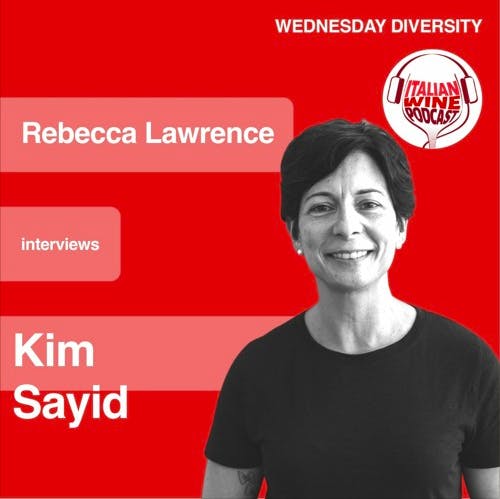
Ep. 707 Kimberly Sayid | Voices
Voices
Episode Summary
Content Analysis Key Themes and Main Ideas 1. Kimberly Saeed's career journey in Italian food and wine, from sales to importing. 2. The intrinsic connection between Italian food and wine culture, contrasting it with US market perceptions. 3. Emerging trends in the US market for Italian wine, including authenticity, autochthonous varieties, and diverse winemaking techniques. 4. The significant impact of the COVID-19 pandemic on wine consumption and buying habits. 5. The value and depth of Italian wine education, specifically highlighting the VIA program. 6. The personal passion and historical roots influencing Kimberly's dedication to Italian food and wine. 7. The potential and versatility of misunderstood Italian wines like Lambrusco. 8. Future plans for promoting niche, autochthonous Italian wines in the US market. Summary In this ""Voices"" episode of the Italian Wine Podcast, host Rebecca Lawrence interviews Kimberly Saeed, founder of Loficina Delvino, New York. Kimberly shares her extensive 30-year career in Italian food sales, transitioning into wine marketing and ultimately becoming a licensed importer. She discusses the fundamental cultural link between food and wine in Italy, which contrasts with their separate distribution in the US. Kimberly highlights current US market trends, noting a growing consumer openness to discovering new Italian wine flavors, histories, and especially autochthonous grapes, moving beyond ""internationalization"" towards authenticity and tipicity. She details how COVID-19 led to a significant increase in wine sales and influenced buying habits toward both comfort and adventurous exploration. Kimberly praises the VIA program for providing a uniquely deep and culturally contextualized Italian wine education, which she found more fulfilling than other courses. She shares personal anecdotes, including her academic background in Italian medieval literature and an early formative experience with Verdicchio that sparked her wine passion. Kimberly enthusiastically champions Lambrusco, describing it as ""sexy, sophisticated, diverse,"" and perfect for challenging preconceptions. She concludes by outlining her future plans to launch an online sales portal exclusively dedicated to autochthonous Italian wines, aiming to further integrate her love for Italian food and wine. Takeaways * Italian food and wine are culturally inseparable, a concept Kimberly promotes in the US market. * The US consumer market is increasingly receptive to exploring diverse Italian wines, particularly indigenous grape varieties. * Winemaking trends are moving towards authenticity, using varied aging vessels, and rediscovering unique autochthonous grapes. * The COVID-19 pandemic led to a surge in wine consumption and diversified consumer buying strategies. * Specialized educational programs like VIA offer unparalleled depth in Italian wine study, connecting it to history and culture. * Lambrusco is a highly versatile and often-misunderstood wine with significant potential for broader appreciation. * There is a growing market for niche, authentic Italian wines focused on ""autochthony,"" ""tipicity,"" and ""authenticity."
About This Episode
Speaker 1 and Speaker 2 discuss their interest in exploring new flavors and cultures, including taste and simplicity in wine. They also talk about the impact of COVID-19 on buying habits and small producers' desire to experiment with new foods. They express their love for Italian wine and how it changes their lives every day, including their desire to live and work in Italy at any cost. They also discuss their plans to launch an online sales portal and continue working with other brands. Speaker 3 thanks Speaker 2 for their time and mentions their plans to continue sharing updates.
Transcript
Welcome to the Italian wine podcast. I'm Rebecca Lawrence, and this is voices. In this set of interviews, I will be focusing on issues of inclusion diversity, and allyship through intimate conversations with wine industry professionals from all over the globe. If you enjoy listening, please consider donating to Italian wine podcast dot com. Any amount helps us cover equipment, production and publication costs, and remember to subscribe and rate our show wherever you tune in. Welcome to the Italian wine podcast. This is the voices series with me Rebecca Lawrence. This week, I'm joined by Kimberly Saeed of Lochina Delvino, New York. Welcome to the podcast Kimberly. Hello, Rebecca. Thank you. So I like to start many of these conversations by asking my guests to introduce themselves to our listeners So maybe you can tell us a little about who you are and what you're currently working on. Sure. Again, my name is Kim Saeed. And although, currently been traveling through Italy for a few months, I am from New York, I truly love Italian food, wine, and culture, and I've built my entire career working around these elements. I've been involved in Italian food sales for about thirty years. And in Italian wine marketing for almost six years. During that time, I spent two decades with the Barilla pasta company, which is the world's largest pasta company, then time with Prencipe salumi, Galloni, Prashutobicarma, Monte vinegar, and several other smaller Italian companies. And now over the past year, I've recently become a licensed wine importer, and I'm awaiting my New York state wholesale license as well. Wow. That's pretty exciting. I hadn't realized that. Yeah. Yeah. So one of the things I love is that you've really taken your experience, this, like, long backgrounds you have in the world of Italian food, and now you've combined it with Italian wine just as is the case culturally in Italy. So I wanted to ask at what point you knew that this was the kind of new direction that you wanted to move into? Well, in many ways, food and wine in the US are seen as, two separate things. And even distribution and management, for example, are handled very distinctively, while you said, in Italy, they really go hand in hand. In Italy, you're not even served, a drink or a cocktail without some food accompanying it. And I think to have, three sixty degree handle an authentic Italian culinary tradition and modern lifestyle is very important to commingle both food and wine. And in terms of my direction, I noticed that people in America are now actually just as open to discovering new flavors in wines as they are in food, and they're just as open to discovering new histories and stories in their glasses as they are in their plates. And therefore, for me, wine is definitely the new frontier in discovering Italy. You have this long background, obviously, in in working with brands and bringing them into the US market. I wondered if there are particular trends right now that you can point to that you're seeing growing. Obviously, like you say, people are beginning to explore a little bit more Italian wine or maybe unusual grapes. Is there something in particular that you're seeing in in the US market? In terms of wine, let's say, I I think the beauty of wine is that everyone, looks for and can find something different. Right? Wine is so personal. And for me, personally, you know, I like, high acid. I like freshness, vibrance. I want to taste the fruit, the soil, the air, the true essence of the origin of the wine in my wine. I look for simplicity and truth in in it. And just like Italian cuisine generally differs from, let's say, French cuisine, for example, again, in its simplicity, freshness, few ingredients, little manipulation. I want the same approach in my glass rather than internationalization. Personally, I try to promote authenticity, tipicity, and, autoctomy, which I think are some new frontiers. In terms of trends, yes. Of course, there's kind of this dichotomy. Right? Of course, there's always something boiling in the pot. And from one end, you have two older trends, let's say, that are still quite strong in the US. One is this, oxidation, right, the so called orange wines with, skin maceration, use of amfar eggs as aging vessels that is still going strong. And also the parkerization, of wine is still going strong and hasn't slowed down. Producers aiming for a particular, say, international, a very fruit or wood forward profile that scores high ratings and, and drives sales. Those two older ones are still continuing, but there certainly are new trends, on the horizon that I find, quite exciting. You know, one playing with and mixing new vessels with old vessel cement tanks with or without the glass linings, eggs, larger ovals, a lot of blending and different passages among them, of course mixing stainless steel and wood thrown in there, but a lot of exploration and trial at the end of the day. With the goal of preserving inherent flavors, I I find that really, really fascinating. And I've visited several producers these few months here in Italy doing that. And the second is, I'll talk to me. So discovering, rediscovering, unique, and indigenous, almost forgotten grapes. And Italy has so many of them, kind of a returning to the roots, right, Anad, to the, to the underdog. And that one for me is actually the most captivating I think of all this concept of a talk to me. I think that has also a huge amount of potential longevity for Italy because as you say, there are so many autochnous varieties here. Each of them tied very specifically to a place and therefore tied to a story. So you can really take that into the market. And you sell not only the wine, but it's it's culture, it's background and story, and that just gives a little bit more to the wine in your glass to a consumer. The whole experience. Yeah. So we still are talking about COVID. We're still not quite through it. So and I hate to bring it up and and constantly in my own space, but I'm interested to see or to hear from you if if you think that this has changed the buying habits in the US, have you seen, you know, particular increases or drop shops off in interest, has there maybe been? I wonder if there's been a return to people going for what they know, focusing on that kind of comfort of what they know, or if this has really been a time where there is this push to experiment with or toxic disparities, maybe something that consumers haven't had before because they need a bit of adventure. Well, COVID has absolutely affected buying habits. I think we we started drinking like fish in America of sales skyrocketed in all categories, whether it be wine, beer, spirits, both in stores and online. At this point, the stockpiling may have slowed down a bit, but the consumption is still going strong. And clearly every facet grew, whether it be, you know, any price point or positioning, whether it be common, you know, well known brands and wines that people are familiar with, or even the new ones, everything went, and is still going strong. You know, absolutely infected in I mean, that could be positive and negative. Very positive for sales, maybe negative. In other ways, but definitely very strong. Yeah. I feel like that's been mirrored in the UK market, which is my specialism and very much we saw a huge increase. You know, people can't go out to restaurants. They can't share wine with friends. So the home consumption went up, and this has really aided small independence, I think, in the UK. But has allowed, a space for a mixture of both buying the same thing and having that comforting, the glass that you, you know, you're gonna like, you know, you're gonna recognize, but also I think there's been a capitalization on the while I'm sitting at home, and, you know, I'm doing the same old thing every day. So maybe actually I'll choose this variety that I don't know. Maybe someone's doing a a Zoom tasting and they're talking about an area of Italy that I've never heard of. Maybe I'll go out and buy that wine. So I think you're right that there's been yeah. And it's been, yeah, both positive and potentially negative at times, but it's nice to hear about people taking that leap to experiment. Yeah. Wonderful for small producers, for small importers, and for those indigenous or attackness grapes that don't usually have a lot of opportunity to shine. So speaking of that kind of deep dive into Ortoktonu, we actually met when you attended the Via flagship course in Verona earlier this year. And and this is, of course, that really, as well as talking about these hundreds of varieties of octopus grapes, also embed Italian wine in this much broader context, talking about food, but also a lot of history and cultural background, and I wondered if given your diverse background, if this was one of the things that drew you to the Via course in particular. Yeah. You know, Rebecca, I chose, via because, obviously, I have always enjoyed Italian wine, but I'm relatively new in the wine sales world. I was in search of a very credible program that was respected both in Italy and abroad. But I also wanted a program that would teach me more about Italian wine down to the very gritty level that I really feel I need to achieve my goals. I've done the ice program in the US. I did ISG levels one, two, and three, w set levels one, two, and three, but I never felt fulfilled with the knowledge and depth of Italian wine education that I got from any of them and with the almost non existent, obviously ice focus on Italian wine, but very superficially in the US. And VIA is the only program that I've found, in years that have ever, that gave me that. Yeah. It's one of these that really drew me to the program as well that there's there's so much more than just this. Okay. You need to know these denominations and these great varieties. It's more than Pino Gree joined Cianti out there for Italian wine study, you know, really challenging, but really fulfilling. I think it manages to hit the balance of that very well and just keeps your interest sparked because there's always something that you can go back to and go, wow, I didn't realize that actually, you know, Vadikio came from this completely other region and it traveled around and you've got all these sort of slight mutations and people traveling with graves and different cultures. I was blown away, but I'm blown away, by the class. Yep. I'm coming back. Well, I'm always tempted to just sit and enjoy it anew every time because of course the other thing is having the inside of Shenza, and all of this new genetic material that he's constantly doing the research on, that again was something that really drew me to the program, this idea that you know, every year, it's gonna be slightly different because there's this huge source of up to date genetic material, and it's super geeky, but it's also amazing. Oh, it was a star a full immersion in Italy. And it was wonderful. Now speaking of Italian history, if I've done my research correctly, I understand you have a degree in Italian medieval literature. Yes. Yes. So I know it's a while back, but as as an ex lit student myself, although much more modern. I wonder what drew you to that genre. It really feels like there's been this beautiful thread of Italian history culture through your life from from very early on. Yes. My mom was born in Italy and her whole family, so that was a little bit of the thread. But that's an interesting question. And you're right. It was quite a while back. We don't need to address that topic. There were definitely things, that sparked my interest in food. In in college, like, you know, Travani Bocachos mountain of, parmigiano regiano, the, Venus tortellini Shea belly button, Dante's, sinful gluttony's, I mean, the lots of food, right, in Italian medieval literature. But in reality, my dream, I think growing up was always to be a pediatrician. And then on my first trip to Italy, when I was about, sixteen years old, I think I fell in love. I I I fell in love, not only with the beautiful landscape, of course, and and the delicious flavors, but, again, to use the word geeky, more so with the unique, regional relationships that, food and ingredients had in Italy. And I know it sounds very weird, especially for sixteen year old, but, you know, pasta, for example, never forget, being blown away by the learning and discovering in Italy that the fact that each, area region, even village, as different pasta shade. And these shapes are born from that village's particular geography, topography, history, much like wine, I guess, right, being shaped from the particular soils and climates. Because you know, growing up in America, even as an Italian American, we see one pasta shape basically equivalent and interchangeable with another. If you go to the store to buy one, to spaghetti and they don't have it, you buy pendant, you know, whatever. But instead, there's hundreds of thousands of years of history behind each and every shape, and they pair with very specific sauce, and they're actually not interchangeable at all. So as I said, I, I, it's they're not. You, you would, you would change the entire menu before changing the shape. Which simply wasn't what I was accustomed to. So as I said, you know, coming to Italy, it was enamored. I threw away the entire idea of being a pediatrician, and I decided I wanted to live and work in Italy at any cost. And I made it my personal goal to visit each and every region and to discover the unique food and wine and tradition of of each of those regions. And about sparking my interest in wine, I, my, literally, literary study actually is responsible for my wine passion. I I never forget my first glass of wine, which I was studying in Italy, one summer. And we had to read passages of Petraka out loud while standing in front of the class in the middle of the rolling hills of Urbino in La Marque. And, of course, it was breathtaking and, very stimulating. And one evening, we got a bottle at Verdicchio, you know, one of those fish shaped ones, right? And drank it on the hillside, and that was my first wine, and I think I was eighteen at that time, and never turned back. Wow. I just have this beautiful image of of you standing in those homes just getting What washed over with this kind of like love. It's weird, completely changing everything. Of course, in the eighties, I also had pretty big curly hair and, you know, from Long Island, a lot of jewelry, but it was, really wonderful. It was, it it changed in my life. Top. So that experience, actually, of the Vericchio ties beautifully into my next question, because I always like to ask my guests about their favorite Italian wine, maybe something. Either they're drinking a lot of currently or maybe something they wanna add to their portfolio or a historically sort of favorite wine. So is there something particular that's sparking your Italian wine joy right now? I love basically every Italian wine. So many and and you, of course, your chain tastes change daily, depending on the weather, where you are, the mood, the meal, the people. But if I had to pay so I could talk about anyone, but if I had to choose one, I would say, you know, working for Barilla for so long, which is based in Parma. I came to Emil Romania, many, many times a year, and unfortunately never took enough advantage of Lambrusco at the time. And, and I took it for granted while being there. And today, you know, be in the US, I find it quite challenging often to find excellent, lambrosco's, like, the ones that I was always drinking in Parma or in Italy. Absolutely not the sparkly bubble, rio needy, a nice, you know, type of product that we remember from the 70s and 80s, commercials. But Lambrusco, I, I think today is sexy, is sophisticated, diverse, you know, can go anywhere from dry and savory to sweet, anywhere from light to dark, playful to serious. It's wonderful with food. It's affordable. It's hip. It's modern. It's young. Definitely something that I is so versatile and one of my favorites. Even, you know, to serve at home, wouldn't have guessed. I I never a doubt. I love hearing people talk about Lamrosco because it was a real eye opener for me coming to Italy and going to bologna for the first time and being served, Lambrusco, I could say it with food and there are so many different types. I'd always been, like, kind of snobby and super, kind of dismissive of sparkling red wines, you know, my only other real experience had been sparkling Chiras for my WSTT studies, which I'm not a huge fan of, I think probably have been because of context and seeing the wine in that context with the local foods that go with it, sitting and having it for an aperitivo, I really began to get the idea of Lund Rosco, and it's been one of my kind of greatest discoveries of being in Italy is is how much good Lumberosco is available readily and how many styles you can just try. And it's also for me now something. I do that exact thing where if we have guests, particularly non Italians who are coming to stay, I always make sure I've got a bottle of Lumberosco because It's such a surprising aperitivo for people, and they're blown away. Yeah. Exactly. They they love it, and they it's so unexpected. And I love watching people's faces as they they have some maybe with, you know, some salumi and some Martadellus and cheeses, and they're just like, it really changes their idea of it. Exactly. That's what I think all wines, Italian wines are exciting and wonderful, but that is really phenomenal from that perspective. So before we wrap up, I have to ask, what's next for you. Where are you headed on your Italian wine journey? You've you've kind of led a little bit with this with your intro and what you're doing now. So I I wanna hear more. Yes. Well, after the three months of traveling through Italy, we will finally be going back home mid September. And as I mentioned before, I'm just waiting for my, New York State wholesale license to arrive. And, then the sky is the limit. You know, I plan to launch an online sales portal dedicated exclusively. To Italian wine, preferably I'll talk to this variety only. And I'm really excited to, to finally be working closer with Italian wine and combine it with my love certainly for Italian food. I would continue to push not only myself. Of course, to learn more and discover more, come back to Via, but also for Loficina Delvino, which is my company to help others to continue to appreciate and learn more about the incredibly vast bounty of of grapes that it really has to offer, as we said before. A lot of work ahead. Well, hopefully, by the time this comes out, our listeners will be flocking to your new venture to see what wines you have on offer. Kinsay, thank you so much for joining me on the Italian wine podcast today. Where can our listeners find you online or on social media to find out more? Yes. Well, thanks. First of all, thank you, for this opportunity, Rebecca. And, on social media, I can be found as Kim, k I m. Said, which is s a y I d, on either Facebook or Instagram at the moment. And as soon as we are ready with Loficina Delvino, more on that will be available too. Everyone, we will tag Kim on her ventures in the notes for this episode. So please go and check our out. Thank you to everyone for listening. Don't forget to follow us on social media, subscribe, and of course donate on the website to make sure we can keep these great conversations flowing. Kim, thank you so much. Thank you. Listen to the Italian wine podcast wherever you get your podcasts. We're on SoundCloud, Apple Podcasts, Spotify, email ifm, and more. Don't forget to subscribe and rate the show. If you enjoy listening, please consider donating through Italian wine podcast dot com. Any amount helps cover equipment, production, and publication costs. Until next time. Hi, guys. I'm Joy Livingston, and I am the producer of the Italian wine podcast. Thank you for listening. We are the only wine podcast that has been doing a daily show since the pandemic began. This is a labor of love and we are committed to bringing you free content every day. Of course, this takes time and effort not to mention the cost of equipment, production, and editing. We would be grateful for your donations, suggestions quests and ideas. For more information on how to get in touch, go to Italian wine podcast dot com.
Episode Details
Keywords
Related Episodes

Ep. 2651 Diversity in the Wine Industry and Wine Tech Innovation with Jeremy McCarty | Voices with Cynthia Chaplin
Episode 2651

Ep. 2627 Regenerative Winemaking, Mentorship & LGBTQ+ Perspectives with Terah Bajjalieh | Voices with Cynthia Chaplin
Episode 2627
Ep. 2545 Building Inclusive Wine Spaces Through Storytelling with Amari Collins | Voices with Cynthia Chaplin
Episode 2545
Ep. 2531 Winemaking Journey from Mumbai to Napa with Priyanka French | Voices with Cynthia Chaplin
Episode 2531

EP. 2517 Sarah Looper | Voices with Cynthia Chaplin
Episode 2517

Ep. 2505 Ren Peir | Voices with Cynthia Chaplin
Episode 2505