
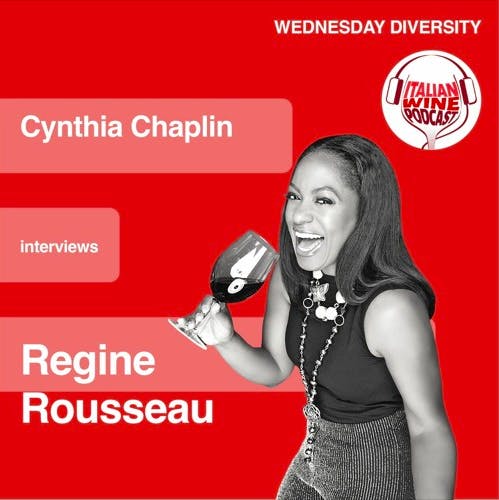
Ep. 852 Regine Rousseau | Voices With Cynthia Chaplin
Voices
Episode Summary
Content Analysis Key Themes and Main Ideas 1. Regina Russo's personal journey into the wine industry, overcoming perceived barriers. 2. The challenges and experiences of minority professionals, specifically Black women, in the wine industry. 3. The concept of ""belonging"" and self-belief as crucial for success in exclusive industries. 4. The need for greater diversity, equity, and anti-racism efforts in the wine sector. 5. Regina Russo's unique approach to wine education and marketing through her company, Shall We Wine. 6. The importance of humanizing wine language and making it accessible to a broader audience. 7. The intersection of personal experience, art (poetry), and wine appreciation. Summary In this episode of the Italian Wine Podcast, host Cynthia Chaplin interviews Regina Russo, founder of Shall We Wine, a Chicago-based wine and spirits marketing and event company. Regina shares her unconventional path into the wine world, from a childhood split between Chicago and Haiti, to discovering wine's magic in France, and later leaving pharmaceutical sales to pursue her passion. She discusses the persistent issues of exclusivity and lack of diversity in the wine industry, particularly for Black professionals, and emphasizes the importance of self-belief and creating one's own space. Regina advocates for active anti-racism and a more inclusive approach to wine education, moving beyond Eurocentric language. She highlights her mission to connect consumers with wine through relatable stories and experiences, even writing a book, ""Searching for Clothes and Lilies, The Wine Edition,"" which pairs poetry with wine. Looking ahead, Regina aims to expand Shall We Wine internationally and continue creating accessible wine content for consumers. Takeaways * Regina Russo's journey highlights the importance of personal passion and resilience in building a career in the wine industry. * The wine industry historically presents barriers for minorities and women, yet progress towards diversity and inclusion is being made. * Self-belief and the conviction that one ""belongs"" are vital for navigating and succeeding in fields where one might not be ""expected."
About This Episode
Speaker 1 introduces the Italian wine podcast in Pavilion six on April 10th to the 13th, while Speaker 2 describes Regina Russo's love for educating people about the joys of wine and her passion for diversity and equity in the wine industry. Speaker 2 advises Speaker 1 to see oneself in a position of success and create practices that allow them to see themselves in a position of success. They discuss the importance of building one's own image and belief in oneself, and Speaker 2 gives credit to his mentors and Speaker 1 gives a brief about the world wine guys. Speaker 2 talks about his plans to make the international company international and create content for consumers, his favorite Italian wines, and his plans to create more international content for consumers.
Transcript
Welcome to the Italian wine podcast. This episode is brought to you by Vinitally international wine and spirits exhibition, the fifty fourth edition of Vinitally will be held from the tenth to the thirteenth of April right here in verona to discover more about Vinitally and get your tickets. Visitvenitally dot com. This year, the Italian wine podcast will be live and in person in Pavilion six. Stand a seven. So come on down and say hello. Welcome to the Italian wine podcast. I'm Cynthia Chaaplin, and this is voices. Every Wednesday, I will be sharing conversations with international wine industry professionals discussing issues in diversity, equity, and inclusion through their personal experiences, working in the field of wine. If you enjoy the show, please subscribe and rate our show wherever you get your pods. Welcome to voices. This is Cynthia Chaplin. And today, I'm happy to welcome Regina Russo. She's been in love with wine for years, but she didn't think there was a business in it, and I know that feeling very well. But in two thousand and thirteen, she realized that she loved educating people about the joys of wine, and it sparked her to found shall we wine, Chicago based wine and spirits marketing, promotions, and event company. And since then, her career has take it off, and she's been nominated for wine enthusiast wine star awards, as well as becoming renowned for her wine education and writing skills. She holds a level two certification from the international Camelia Guild, and she's a very vocal advocate for diversity and equity in the wine Risa. Welcome to the show, Regina. Thank you so much for coming. Oh, thanks for having me. It's a great pleasure. So happy to talk to you today. You have such an interesting background. You split your childhood between Chicago and Haiti, which, as you know, I grew up in Ohio and now I'm in Verona. So very different worlds for sure. How did you find your way into the wine world after a childhood of Chicago and Haiti? Thank you for asking that question. It's one of my favorite, questions to answer. So I was, a student at Knox College in Galesburg, Illinois. So in a small town, I think you can relate to that. Absolutely. And, French, obviously, from, you know, my interest your your question was my first language, having grown up in Haiti. So I was able to retain, the language and speak French and creole at home with my family more creeled in French, but my senior year in college, I decided to do a study abroad program in, business in France, because I wanted to reconnect with the language, and I wanted to be fluent, and because I knew there would be value in retaining, that part of my culture. So while in, as, you know, life would have it, I was invited to one of the other students, home for for a dinner. And, you know, I love sharing this because I believe that, you know, our destinies, we just have to follow the universe, and it will lead us to our destiny. So I'm invited to this, student's home, and, it's a beautiful home. And one of the ones that I I just always remember, and I have a fantasy of living in a home like this, And, I walk into the dining room, and I remember there being maybe six, but in my imagination, there were fourteen bottles of wine on the table. Excellent. I love that dining room already. Exactly. And it so happened that the father owned a wine shop in town. And as his guest, he decided to do a wine tasting or a wine presentation for me. And, I remember being in that room and getting chills and, you know, not fully understanding everything that he was sharing, but having this distinct knowing that this was connected to my my destiny. I I really fell in love as I describe in an article that I wrote for PIX Magazine. I fell in love with this invitation to a world that I was never proving to, right, that a world that just wasn't, like, open to me. And that was it. In that moment, I knew that wine would be a part of my life. I didn't know how, but I I knew that whatever he was introducing me to, I would feel connected to for the rest of my life. That's such a warm story. So such a I think that really resonates with a lot of people in the wine industry, you know, finding something magical in that one particular first glass of wine kind of a thing. I love that it happened for you in France, which is even better. Absolutely. But it it's it's interesting about saying that, you know, the door wasn't really open to you in wine before that. And I I know that you've said from a young age, you noticed the exclusivity within the industry. You know, the wine world presents often even nowadays as white and rich and male. And I just wonder how you got your head around this obstacle to your success because you obviously fell in love with wine that day and then what happened? Well, so I wanna answer the question in two ways. I have always been an outsider in the United States because I come from I grew up. Although I was born in Chicago, I grew up in Haiti. So when I came home, I had a strong accent. I had, you know, there was just some cultural nuances that I, I couldn't connect to or didn't understand because, you know, my formative years were spent in another country. So that is a superpower, right, because knowing that I didn't quite fit in and knowing that I wasn't expected to fit in, I had to learn other ways of navigating in American culture. So when, you know, when I started my career, you know, I already knew how to make room for myself. Right? And we're talking about the wine industry, but this is fact in every industry for or most industries for people of color. You know, it's not just, you know, this it's not just wine. So I I guess to answer your question, I have to say that by the time I joined the wine world, I already learned how would I needed to do in order to succeed. What I needed to do in order to get people's attention because they didn't expect to see me. So, you know, that was true when I was in pharmaceutical sales, when I was in litigation consulting. No one expected to see me. Does that does that answer your question? It does. It's so interesting. The the concept of I didn't fit in is one thing, but the concept of I wasn't expected to fit in, I think, is very interesting that no one expected to see you that that you weren't expected to be in that space. I think that's a far more interesting conversation to look at. I mean, we all know there need to be more black and brown stakeholders and mentors in the wine sector. But I I think this is sort of starting to touch on other areas. You know, you've said there needs to be more active anti racism, and it I think that concept of I wasn't even expected to be there. It has a lot to do with that, you know, racist attitude that, unfortunately, has been part of the wine sector. You know, thank goodness. We live in an era where we're starting to see that change, and I hope it, will continue to change. But we know already that, you know, in the US, in particular, white owned small businesses are twice as likely to receive bank financing compared to black owned small businesses. Now only two percent of wine industry members identify as black, you know, How has this played out in your career? Where do you see that kind of exclusion in our wine sector? What strategies do you think you used to combat it? And and, you know, how would you advise people who want to come into the industry to, you know, manage to smash these obstacles. It's not a matter of handling them. It's a matter of getting rid of them, really, I think. Yeah. I I wish I had, I wish I had an answer because this is something that I think about. Let me say this. I I think my advice would be you have to see yourself in that position. Right? You have to understand that as you, you know, if you are a person of color and you're trying to create space for yourself, in the wine industry or any industry. Number one, you have to wrap your mind around the fact that you belong and that you can make a space for yourself. Now on a daily basis, and it's really important for me to say this is Beyond wine. This is an issue with a you know, with our country and with our world. Right? True. Absolutely. Yeah. Because if I say to someone, you know, close your eyes and describe a sommelier. And, you know, there is going to be a very specific person that is described. And it's rarely going to that person will rarely look like me. Right? So in order for me to become the professional that I want to be, to grow the business that I want to grow, It has to start with my own mindset and my own belief that I belong. And I have to on a daily basis, create practices that allow me to see myself there. Right? So that's that yeah. That is such an interesting concept that it starts with you. I I don't think a lot of people looking at it that way, Regina. I think that's really refreshing that your own image and your own mind of yourself belonging has come first. I think that's a really important way to look at it. What was your first job in in the wine sector? The fir my first job well, I was a server. So I I, you know, that is definitely a part of it. The best wine professionals start off that way. Don't we all? Exactly. Exactly. But it was with a small importer called Direct import wine company. They're no longer around, but I was so fortunate because I got to sell some beautiful wines, you know, bollinger, pine ridge, shaffer, you know, at a very young age. So, that was the first job I had. A good one. For sure. And Yes. Yes. For sure. And definite well, the great thing is that that job, I'm I'm getting the feeling that that job encouraged you to stay in the sector. And to establish your space there. Actually, it didn't, to be honest with you. I was in my early twenties, and I was in the industry for about, I'd say two and a half, three years, and then I left and went into pharmaceutical sales. Because at that time, I don't know what the salaries are to be quite honest with you. It wasn't really lucrative for me. I I know. Is is anything in the wine industry really lucrative for anyone? That's a question that I wonder about quite a lot. Exactly. Exactly. So I I didn't stay around long. I I I chased the money, but the truth is, you know, my my heart was in the wine industry, and I knew I would always come back. I didn't know how I was gonna get back, but I knew I would get back. Great. Great. Well, it's it's interesting because you went from one industry that's pretty tough on young women to another one. Pharmaceuticals is, you know, especially at the time when you were getting into it, it was is not exactly welcoming to young women either. So you had the whole double whammy of misogyny and and racism hindering you. You know, I've I've been in the wine industry for about twenty years, and definitely women were being challenged as not belonging when I started. And and even still now, sometimes, how how do you feel our industry is doing now compared to when you started out? Well, you know, I know this is not the the popular answer. I just wanna go back. You you talk about the hindrance of being African American and being woman. You know, I'm not hindered by it. I think society is hindered by it. That is such a good point. And I and I think that's important to to hear. Yeah. I mean, you know, who I am is an asset. My, you know, all of it, the good, the bad, you know, the, the hard, the easy. That's all an asset. And I've always believed that So, you know, if if the people that I'm working with don't see it, you know, shame on them because people like me, I, and people like me are here to add something. So the ones who get it, they, they benefit from it. The ones who don't get it, they lose out. That is really what I think. And I I do think that our industry to answer your question, we're getting better because there are more people who feel empowered to speak And it's coming from different sides. You know, there are male allies. There are, non people of color allies, you know, so because there are more voices, I do see change and that there's a lot of work to do, but I think we are on our way. I agree with that. And and I hope that we can take sort of the momentum and and keep it coming. I think it's so important to have these conversations. You know, you have, as you said, you didn't see it as a hindrance and nothing held you back because you've been very successful. So you left pharmaceuticals and and what came next because I wanna get to the point where I can ask you about shall we wine. I'm excited. So jumping from pharmaceuticals back to wine, what was the journey? My journey was long and, you know, I got in my own way because of fear. That's another topic for another podcast, but So I went from pharmaceuticals to, litigation consulting in twenty thirteen. So all sales and marketing was my background. Twenty thirteen, I got the biggest gift ever. I was laid off And I knew the company was going to lay me off about a year before it happened. There were just certain trends that I could see. And so what I did was I gave up my luxury apartment. I paid off all my debt. And I prepared myself to become a full time entrepreneur. So when I in twenty thirteen, I'm sitting on my couch. I have a severance package. I have very little debt, and I decided to create a business plan, and I knew for me it would be wine. I didn't honestly know what it would look like. But what I did was I said, what is it that you want to do? I wanted to be in the wine business. I wanted a business that was focused to consumers, and I wanted to do television. And I just mapped it all out. And what I came up with was creating an experiential marketing company, where we did demos And, you know, for those who don't know, you know, a distributor or an importer will hire a team to go out and do demos at festivals and stores and, you know, private event as a way to get consumers to taste their wines to try their product. It's called, you know, lip to glass. And I knew I would be strong at this because, one, I had a marketing background. Two, I had a lot of management background. So I knew how to train people. And then three, I had this this passion for wine. And that's that's how the business started. It's so interesting how, you know, you kind of had a pre COVID experience when you got laid off and, you know, you were at home, like all of us were for the past couple of years, you turned it into an opportunity, which I think is, you know, inspiring and and really shows a depth of strength and belief in yourself that is you know, not only admirable, but, you know, you turned it into action. So that's that's really pretty cool. I think you're you're you're even being very humble about what you've done because I love your mission. You know, I your mission is to work with the consumers. And you've referred to it as an art form, and I completely agree because I'm an educator, and a writer as well. And it's it's the connecting the story and not just the story about the region, but you've said everything that happens to create a bottle of wine creates a story that makes you feel something. So your sort of natural inclination to to teach that and get that message out, you know, how are you interacting with your audience? Are you going out there doing the demos or are you just on TV. Tell me about what you're actually doing. What's a day in the life of Regina look like? Oh, a day in life regime is a crazy, crazy day. How did I know that would be the answer? Yes. Well, now, you know, because of COVID, there are very few demos. But what I was doing in terms of the demos was educating my team, working with them and so that I I taught them how to speak and present to consumers so that they can connect the story of the wine to the story of the bottle when they're facing consumers. Today, what I'm doing is I'm writing a lot. I'm creating content for, for my clients. So, for example, I just finished, a project for, Pino Grigio Delven Nzier, where we, my team and I created fourteen videos, gear towards consumers, and they're all lifestyle videos. That's what was, you know, I had to write the script. I had to think of ways, to connect to consumer, to connect the product to the consumer. And and that's a lot of work because I have to take off my my own wine training, and I have to say if I was a regular person and I wanted to understand or feel or experience, pinot grigio Delvenanza, how would I do that? And what context would I put the product? And then try to create a video that really shares that story. So that's a lot of the work that I did this month. And it's the same thing with television. You know, I do a a monthly segment. And, again, I have to think about what are the tidbits that I want the consumer to walk away with But how do I put the wines or the spirits that I'm trying to present in a context that they can relate to? It's so interesting. This idea of having to step away from our own wine rich background and put ourselves in the shoes of consumers who might be new to wine or who certainly know less about it than we do. You know, it it is almost like a foreign language. You you obviously have a good affinity for languages. You've got, you know, French and creole in English. But there's a lot of discussion lately about including more cultures and more food traditions and more language, when we talk about wine than just the typical Eurocentric way, you know, that we've always looked at wine through sort of our traditional training programs. You you wrote a great article, you know, talking about, the language of wine, you said that we need to make some room for other voices and cultures. I completely agree with this. One of my favorite things to do with my clients is to pair, food from other countries with traditional wines, which doesn't get done often enough. But what did you mean about that, in terms of making room for other voices and cultures in the way we talk about why Yeah. I believe what you're referring to. I I didn't write an article by it, but I was quoted in an article. So, you know, our language so if you and I were tasting together, You know, we could because of our, you know, similar training. You know, we could talk about high acid, you know, low acid, medium body, medium plus, and have a conversation that most consumers would have no idea what we're talking about. Right? Completely true. Completely true. And so we've developed a language that you and I can understand. I believe that when we are trying to include consumers into the conversation, we should broaden our, our vocabulary. And we can use things that are accessible to us. For example, poetry, music, you know, common, shared, common experiences. So that's what I mean. And I think that when we broaden that, there you know, I I do wanna say this. There is a need for professionals to have a shared language. Right? There has to be, or else we couldn't begin the conversation. I I agree with that. Exactly. Now does a shared language have to be based only in one culture? No. Because as we diversify the industry, we are going to have a richer vocabulary because we'll be able to pull things from all of our colleagues, right, from the culture of our colleagues. Yeah. Thank goodness. Let's move away from Goosebury. Yes. Which no one knows what that means. Exactly. You know, but, you know, so the the point is that I I think that we we have to use everything that's accessible to us because that's what wine gives us. I tasted a, champagne, Lausau. It was their oh my goodness. I believe it was two thousand seven Clough. And I was completely blown away because this wine made me feel, you know, when you're right about to cry Mhmm. And the way that your body the way that you the the way that your body changes when you're you're going to cry. You know the tears are coming. That's how the wine made me feel. I think Landstone's gonna have you on the phone in about ten minutes, regimes. That's that's such a moving description, and you're you're so right. As I said, I I'm an educator, and I often work with young students in their early twenties. And I think being able to tap into, you know, something that's part of our humanity rather than a very strict and tailored language that we have to learn to talk about wine is is much more to the point. I I would write there with you in that moment because, you know, what you described physically is so human for all of us. And that's what we we need to make room for that in this industry. We need to make room, and it's okay for me to describe the wine in that way. And it's okay for me not, you know, I can still be a wine professional and talk about wine in that way. Absolutely. Absolutely. Someone else can be a professional and talk about the structure of the champagne and talk about, you know, the the terroir, and it's okay. There's there's room for all of us. And I think it does it adds layers to our ability to communicate. You know, the fact that you have the the traditional structured background, but you have connected it to your humanity. I think that that gives more of a depth to your ability to communicate that wine. So I'm I love where you're going with this, and I I know that you are also an author. You've got a book called searching for Clothes and Lilies, the wine edition. And I know it started out originally as your own book of poetry and then you paired the poems with wine. So I wanna know how on earth this came about and how you did this because I I see where you're going with, you know, your humanity and your your emotional side connecting with wine. So I wanna hear how you paired it with the poetry. I've done some wine and art pairing, but I've never tried with poetry, and that sounds so fascinating. Well, I I have to tell you this. I give all credit to my mentors the World wine guys, Jeff Jensen and Mike Desimon, because the idea of pairing wine and poetry, I I I just never even conceptualized it. I didn't either until I read about this. Yeah. I had a conversation with them and shared my ambitions, you know, very early on. That's, I think it was twenty sixteen when I met them, and I just told them, you know, this is who I what I wanna do, and I wanna be on TV, and I wanna share wine with the consumers. And, you know, they encourage me to write a book. And I said there's no way being a writer is one of the most frightening things that I have ever done. And, I told him I said, you know, I have a book and it was so emotional. It was just I I just never wanna do that again. And I they asked me about the book, and I told them that it was a book of poetry. And right away, they said, well, how about pairing poetry and wine? And it was, again, like that moment in Bison sol where I was in a space where I knew my life had changed because I knew I was going to do this. Yeah. No matter how daunting the idea was gonna stick with you. And it was daunting. It took a year. Even though the poems were written, it took a year. And I remember sending my first rewrites to them, and they said, you're on your way, but not quite. And they were so encouraging. It's the and when I sent the last one, they were like, you got something here. And, you know, I I'm they did not edit the book, but they were very encouraging and, you know, saying keep going, keep going. And it was great. So how I did it was I connected the story of the wine to the story of the poem. Just like I described, you know, the the La Song Cloe and how it had this emotional effect on me. I used the emotion from the wines or from the poetry to make a connection. I've got to ask you where does one get one's hands on this book? Can I get it on Amazon? Where do we find it? Yes. It is available on Amazon, and I've had a few friends order it for They're in Switzerland, and Amazon was able to deliver it to them. So for, you know, everyone listening, yes, please pick it up on Amazon. Fantastic. Well, I I'm going to do that, and I shall let you know how Amazon in Italy does. Well, this has been so inspirational and really eye opening. I I love where you're taking this. I I wanna ask you before I let you go, what, you know, what are your goals for twenty twenty two with shall we wine? Where are you going? What's what projects have you got coming up? Yeah. So, I I am looking to make the company international. So that has already happened with my work with Pino Griccio Delavan Nzeier. So I'm looking for a few more international clients I would like to do more television segments. And when the world opens up and allows us to again, I I do wanna get back to experiential marketing. So for me, this year, during COVID is about more international clients and creating creating content for them. I am working on my next book. It is not a wine book, but will continue to write and, you know, be be here for consumers who want to be a part of our world. Fantastic. Well, as this is the Italian wine podcast, I have got to ask what is your favorite Italian wine, and when would you crack open a bottle of that? So that's a tough question. It always is. I it's a tough one for me, so I love asking it of other people. It's it's so hard. So I'm going to say it it's gotta it's Italian White. I'm actually writing an article on Italian White because I'm just like, oh my god. People need to be drinking more Italian white wine. So Completely. I'm obsessed. Yeah. Today, I'm gonna say okay. I have to say Pinaigrisia Delevin Nzia because I drink, like, six bottles in the last two weeks. But I'm gonna say Sounds sounds good. Yes. I I'm gonna go with Swave. I'm a huge fan of Swave, and I I just want more people to understand how delicious these wines are. Well, that's made my day because I actually live in the Swave denomination. So Swaves are some of my my favorite wines at the moment. I'm enjoying having them right on my doorstep. So that's amazing. I'm so happy to hear that And I'm really happy that you came on the show today, and thank you for being so open with us, about all of the really personal stuff you're doing in your wine career. It's great to hear you, and I'm really happy to have had this time to chat with you. Thank you. Thank you. Thanks for listening to this episode of the Italian wine podcast brought to you by Vignitally international wine and spirits exhibition, the biggest drinks trade fair in the world. For more information about VINitalean tickets, visit VINitalee dot com. And remember to subscribe to Italian wine podcast and catch us on SoundCloud, Spotify, and wherever you get your pods. You can also find us at Italian wine podcast dot com. Hi, guys. I'm Joy Livingston, and I am the producer of the Italian wine podcast. Thank you for listening. We are the only wine podcast that has been doing a daily show so the pandemic began. This is a labor of love and we are committed to bringing you free content every day. Of course, this takes time and effort not to mention the cost of equipment, production, and editing. We would be great for your donations, suggestions, requests, and ideas. For more information on how to get in touch, go to Italian wine podcast dot com.
Episode Details
Keywords
Related Episodes

Ep. 2651 Diversity in the Wine Industry and Wine Tech Innovation with Jeremy McCarty | Voices with Cynthia Chaplin
Episode 2651

Ep. 2627 Regenerative Winemaking, Mentorship & LGBTQ+ Perspectives with Terah Bajjalieh | Voices with Cynthia Chaplin
Episode 2627
Ep. 2545 Building Inclusive Wine Spaces Through Storytelling with Amari Collins | Voices with Cynthia Chaplin
Episode 2545
Ep. 2531 Winemaking Journey from Mumbai to Napa with Priyanka French | Voices with Cynthia Chaplin
Episode 2531

EP. 2517 Sarah Looper | Voices with Cynthia Chaplin
Episode 2517

Ep. 2505 Ren Peir | Voices with Cynthia Chaplin
Episode 2505