
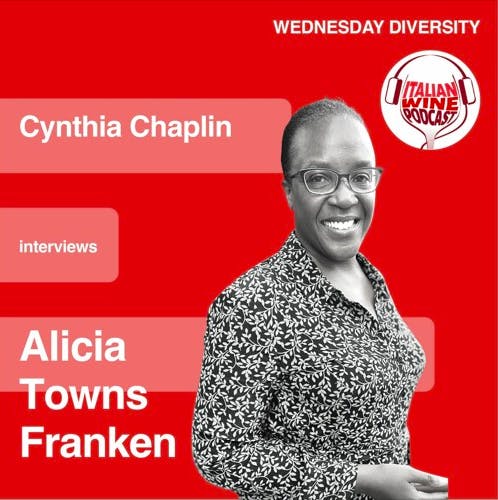
Ep. 881 Alicia Towns Franken | Voices With Cynthia Chaplin
Voices
Episode Summary
Content Analysis Key Themes and Main Ideas 1. Diversity, Equity, and Inclusion (DEI) initiatives in the wine industry. 2. The democratization of wine and making it more accessible to a broader audience. 3. Evolution of wine consumption and marketing strategies for younger generations (Millennials and Gen Z). 4. The role of education and mentorship in fostering inclusivity and career development in wine. 5. Innovation in wine packaging (canned wine) and its implications for market growth and sustainability. Summary This episode of the Italian Wine Podcast features host Cynthia Chaplin in conversation with Alicia Town Franklin, VP of Wine Portfolio at Archer Roose and Head of Mentorship for Wine Unify. Alicia shares her extensive 25-year journey in the wine industry, from her early ""lightbulb moment"" with wine to becoming a pioneering wine director who built diverse, all-female teams. She highlights her philosophy on wine education, which emphasizes personal trust and demystifying wine language. The discussion then shifts to her work at Archer Roose, a company committed to making wine more approachable through canned formats, appealing to younger consumers who value convenience, affordability, and sustainability. A significant portion of the interview focuses on Wine Unify, an organization co-founded during the pandemic to welcome, elevate, and amplify voices of color in the wine industry through comprehensive education, resources, and mentorship. Alicia describes the profound emotional and professional impact of Wine Unify, fostering a supportive community. She also reflects on how the pandemic helped her refocus on purpose-driven work and personal priorities, ultimately aiming to democratize wine and bring more people into the industry. Takeaways - The wine industry can foster inclusivity by making wine more approachable and less elitist. - Younger generations (Millennials and Gen Z) are loyal to values and experiences, making sustainability, transparency, and authentic stories crucial for wine brands. - Canned wine offers a convenient, affordable, and less ""precious"" alternative that appeals to new and existing consumers. - Organizations like Wine Unify are vital for providing education, resources, and mentorship to empower underrepresented voices in the wine industry. - The pandemic prompted a re-evaluation of priorities, leading many professionals to embrace purpose-driven roles focused on positive industry change. - Trusting one's own palate and moving away from overly complex wine language is key to inclusive wine education. Notable Quotes - ""For me, with wine, it's for everything. It's everything that I love, history, science, romance, all of the good stuff wrapped up into a glass of wine, and it spoke to me."
About This Episode
The Italian wine podcast holds its 50th edition from October 2019 until April 2022, highlighting the importance of diversity and inclusion in the wine industry and the need for people to trust themselves. Speakers emphasize the importance of learning and presenting new ideas to help people understand their wine language and the importance of trusting oneself and bringing personal experiences to learn. The success of their wine conference in Guadalajara and their own brand, The Rosy, in the market have been highlighted. The importance of sustainability and their partnership with winemakers and their own company, Wine Unify, provide education and w stay education for wine consumers. The pandemic has helped reestablish their focus on their family and community, allowing them to focus on their family and work.
Transcript
Welcome to the Italian wine podcast. This episode is brought to you by Vinitally international wine and spirits exhibition. The fifty fourth edition of Vinitally was held from ten to the thirteenth of April. If you missed it, don't worry. Go to Vineethly plus dot com for on demand recordings of all the sessions from the exhibition. And remember to save the date, the next edition of Vineethly will be held from the second to the fifth of April two thousand and twenty three. Welcome to the Italian wine podcast. I'm Cynthia Chaaplin, and this is voices. Every Wednesday I be sharing conversations with international wine industry professionals discussing issues in diversity, equity, and inclusion through their personal experiences working in the field of wine. If you enjoy the show, please subscribe and rate our show wherever you get your pods. Hello, and welcome to voices. This is Cynthia Chaplin, and today I am so happy to welcome Alicia Town Franklin to voices. We met in verona in October twenty twenty one. When Alicia came for a speaking spot at wine to wine business forum, and I'm really pleased to have the chance to talk to her today. Alicia's been in the wine industry for over twenty five years, and she started as many of us do as a waitress at the age of nineteen and worked her way up to wine director at top restaurants, And she's now the vice president of wine portfolio at Archeroo's, a company bringing wines from all over the world to the arena of cans and sustainability and inclusivity. Alicia is also the head of mentorship for wine Unifi, and I really can't wait to talk about that. So Welcome to the show today, Alicia. It's great to have you. Oh, thank you so much, Cynthia. It's a pleasure to be here. Well, I've gotta ask you. We we haven't really sort of talked about our past. We were talking so much about our future last time. I was like, what was your light bulb moment with wine? Now you've been in the sector for years and years now. What made you completely focus on wine? I was just the sure joy that you get from a ball of wine. I remember, well, I should say that I in order to pay for college, I worked in restaurants. And I remember Didn't work well. Exactly. And I remember someone handing me, a glass of of Berundy, red burgundy. And it was, like, really red burgundy. And it was amazing. And it was the first time I actually really thought about wine in a different way as opposed to just the beverage, but this was, like, how is this possible? How is what is in the this glass possible. And for me, with wine, it's for everything. It's everything that I love, history, science, romance, all of the good stuff wrapped up into a glass of wine, and it spoke to me. It's that's such a great description. Everything wrapped up in one glass of wine. That I think that's that is the magic moment that all of us, when we get addicted and seduced by wine. It's it's such a fun story to see how people go from that spot in their life. I was about the same age, all into the next things. And you you created sort of an amazing career for yourself going going on through wine, directorships, and and running wine programs, and you and managed to come up with a fascinating space that you developed and created yourself at grill twenty three bar in Boston when you were the wine director there and you had an all female team and all of you were racially diverse and you've described this term as a point of power in your career when you were trying to change perceptions and change the conversation. And you've said it was it was tough to get past stereotypes. But you clearly did it. So I'd love to hear sort of that path and how you got this team together and how the three of you together sort of smash through all these barriers. No. That's a great question. I mean, It was a very interesting position to be in. It was the nineties and the early two thousands and being in charge of a such a huge wine program. It started off as I like to see a wine list, and I created wine program. We were selling well over three million dollars worth of wine a year. I was looking for someone with just personality and a little love of wine, and there's so many things you can teach. And there's certain things you can't teach. And so one of my first hires was an amazing woman named Natalie Bachey, who's from Bordeaux, and it's currently the head of, the hospitality of Peter Michael in Napa. And Natalie was the concierge. She had worked in the wine industry back in France, but she hasn't really, while she had been in the States, and her personality could sell anything. I love people like that. Right? Don't worry. My producer will cut that out. So with Natalie, I mean, her personality was just amazing. And there were things that you could definitely teach her, but the part of that that made her her was just ingrained and was amazing for our program. My other my second hire was an amazing woman named me at the time of incontoma now Ryle to change her name for from thirteen letters to three. So it's Mark. It fits better on all the forms. We have to fill in nowadays. Exactly. And she was incredibly young so interested in wine had been working at a retail store, and and actually created a a wine program at her university, which was amazing as well. But she was just acclimated by the science and all the things, and I love the combination of the few of us. I mean, he needs originally from Ohio, but her family, comes from India. So here we were like the most diverse group, all women running a fine dining steakhouse wine program, and doing it incredibly well. And, you know, we had tons of regular customers. In fact, some of them are still friends of mine today. That there are people who didn't know me. And so I was previously assigned every job, but the one I actually had. They thought I was a hostess. They thought I was this person. It was never that I was the wine director running this program. So Did it really matter at the time? Not really. Why it was still such a new thing and having three people who were devoted to a program was somewhat unheard of. So as a point of power, absolutely. It was, I could buy whatever I wanted, which is great. I traveled a ton, but what I really wanted people to see was the the the the love of wine that we had that we wanted to share. But also that we were just three women doing our jobs. And it was not because we were female wine experts or that I was a black wine expert, but we were wine experts doing what we do did best at the time. Yeah. And what you love and and and we're, you know, totally seriously qualified to do. So that's, that's great. That's a great backstory. But, you know, eventually, I I know you've sort of found the antisocial hours of of working in a restaurant, you know, didn't really go that well with raising your family. So, you pivoted on to becoming a wine educator, which I also am. So I always I'm always interested in how that that change over from hospitality or or retail into education happens. So now you're a wine educator and a consultant, and I've heard you say that you love most, the connections and the community that people form together when they're sharing a bottle of wine, and and wine is naturally an inclusive thing, which I really agree with. Because it's all about your own individual palette. You taste what you taste and I taste what I taste. So what's your goal in teaching and presenting? What are the takeaways you wanna give people when you're sort of explaining a bottle of wine and and teaching teaching how to enjoy that. The first thing I want people to do is to trust themselves. And as you you said, palettes are so incredibly personal. My body temperature, my saliva, all not the best septy, the sexy stuff of wine tasting, but all those things that work into it are very different between me and who you are. My memories of what my grandmother's kitchen smells like is different from yours. The flavors at our dinner table might have been different than yours. So, I want people to trust themselves and to explore and to make mistakes and to use words that really make sense for them. We are working on a project at one unified called my my brioche is your biscuit or my biscuit is your brioche because it's all the same ingredients, but it comes down to a different product. But that is the memory for me. It's not a free ocean like grandmother's kitchen. It's a biscuit on a Sunday morning that we smell, but, you know, so using what you know and trusting yourself, is so incredibly important. And when I'm doing a a presentation or trying to teach something, I really want people to have information that they can connect with and actually take away. Something useful, how to discover the type of wines that you like, looking at the alcohol content that maybe give you a good idea of what the body of the wine is going to be like so that you can walk in the store and say, I usually like things that are you know, a little medium body so I'm gonna be in this alcohol range. And just useful information, I think. I am not a person who normally says, oh, this tastes like raspberries, or this tastes like root there or whatever the flavor is. There are some people who don't have those flavors in there, and their their muscle memory of of taste. And so I I think the biggest thing is just to trust yourself and to bring your own experiences to anything that you're doing. I think that's so important. I I work a lot with young students who are very, very new to wine. And, you know, while they may have, you know, a similar lexicon, they're all coming from similar sorts of universities and more or less privileged backgrounds, they they often can't get the language, you know, that sort of, you know, rarefied language that we use in, in upper echelon wine classes that really kind of locks the door against people who who don't have that language. So I like this idea of things that have the same ingredients, but you have a different word for it than I do. So we're tasting and smelling the same thing, but we're gonna call it something different. And I think that's that's something to really be exalted sharing each other's, you know, as you said, sort of muscle memory or, you know, aroma memory bank and your memories while you're drinking the wine just adds to the experience. So I I really appreciate that. And giving people the power to walk into a wine store and not be nervous to know what they want and and to give their salesperson something to go on. I think that's a great tool to give people. Absolutely. Well, you you have done all sorts of things. You know, it throughout the the hospitality industry, consulting teaching, but now you're sort of in a different arena with archer roots. You know, you you were event planning and and consulting in Boston, and what made you change tack and head to archeruth? What about that company's ethos attracted you? And what are you hoping to accomplish there? Well, I I love the idea that archeruth wanted to democratize wine because that was something I've wanted to do and have been doing since I began my career. And I wanted I joined Arturus and met the owner of Arturus short during the pandemic, actually. And we were just talking. And the more I talked to Mary and the more I thought, I love what they're doing, and it fits right into what I'm trying to do with wine unify and what I've been trying to do the rest of my life is to bring more people into the wine world to make it more approachable. Like, the fact that and I trust me, I have a nice seller, but, you know, not every day requires me to open a full bottle of wine. And the idea that you have potion control or it can have a different variety if you want bubbles and you want bread. Well, then you don't have to fight about it. But what I particularly liked was that this is a way of of inviting more people in who thought that wine was for them, that wine didn't go with their foods per se, or that, you needed a special tool in order to get the bottle open, or you needed to have certain words in order to describe the line. I thought that this is a great way not only to to bring in different groups of people who never thought they could be here, but also younger people who are looking for variety, who are looking for things that are not so precious. And, a full bottle at times can be a commitment. A full bottle on a Saturday night, absolutely a Tuesday night, a can work for me. Yeah. It's a it it's a fascinating concept. I mean, we we had the great fun of having you and Marian here in Verona in October when I first met you, for our wine to wine conference. And the discussion was so lively about the viability of cans and how they really do attract a new audience and and bring new people to the wine party in a very different way with very different expectations, I think. You know, I'm like you, I I have a relatively decent seller myself, but you know, it's not every night that you wanna open up something that's expensive and leave it open. My husband doesn't drink, which is a big tragedy. So I have to be super committed if I'm opening a bottle on a Tuesday. So so how's it going with the with can. So we we cannot get them here in Verona. So I'm very curious about the market and the marketing and where you're selling. Well, we are selling all over the US for the most part. And, well, definitely, especially because We are CPC as well. So not only do we have national distribution, we're also online. But it's going quite well. We're actually producing two new ones for our core portfolio this year. Pino Grigio from Mario Zunicello who owns IQbhi in PRuri. Oh, wow. Fantastic. And a right. It's so delicious. It's so delicious as well as, what we're calling our bubbly Rosay, which is our our sparkling wine producer, and we are creating we've created the Rosay with him as well. And the lines are his day, and and even working with Mario, he wants to help democratize wine. He's always thought that people should be able to have a delicious glass of wine at an affordable price. And that is what we're trying to do. It's not bulk wine. We partner with our our winemakers, and So we have certain standard operating procedures that they follow because, you know, it's in a can so lower sulfur. And it it's worth quite well. And it's been a joy working with so many different winemakers from around the world and we are global, so we haven't made anything domestic yet. That's hopefully that will be in the future. But I think that it It's something that people are definitely looking at a bit more. The can line industry is exploding, and we're not asking people to replace their bottles, not at all. We're saying this is in addition to your portfolio. If you're a producer or in addition to your grocery cart if if you're a consumer. And, it it seems to be working. More people are producing great wine in a can. I mean, historically, there's been some really bad ones. But that's definitely changing. That's incredible. I'm I'm really excited about this one because I happen to love Eco Levy's wines. You know, it's an interesting point. What's the price point on a on a can of pinot grigio, from your partner, equally as opposed to what we pay for a bottle of of their wine. Oh, that's a great question. So, we sell, in four packs. So it's a leader, and it's about fifteen dollars. Wow. Okay. So that's a bargain. Yeah. That's a bargain. So it's a third of the bottle for four dollars. Wow. Yeah. Okay. Well, that's that's gonna be attractive. Also to younger, younger drinkers and people new to wine who don't want to, you know, drop seventy five dollars every time they wanna open something and still get quality wine in their glass. No. Absolutely. So that's, yeah, that's so interesting. I like the fact that that what Archer is doing is is being really proactive about inclusivity. What other things do you think the industry could be doing to banish that sort of exclusive, intimidating atmosphere that the wine industry has had and bring people in rather than keeping them out. Yeah. Unfortunately, it seems to people that the industry has been a bit elitist and exclusive. And I think Absolutely. The thing that we can do is to meet people where they are at. You look at the millennials and the gen zers, and, the gen zer, and people forget about us all the time. But the millennials and gen zers are about sixty percent. By talks are about sixty percent of the those generations. Very different because bypassed in the boomers is only twenty eight percent. And Absolutely. Yep. These are our wine drinkers going forward, and we need to be able to, essentially, market to them. And, to make them feel included authentically because they can smell that like no one's business. And, also, these are kids, the gen zers who've always lived their lives online. And they have not known a space where there's not been an internet. And that's how they find out information, and it's not, a wine critic telling them they should drink certain things. It's wine influencers. It's their friends. It's a great website of a wine producer. It's a great video on TikTok. There's so many different ways of connecting with them, and the way that we've been doing it doesn't really resonate as much. And the fact that they are drinking less than their grandparents, and they're doing it for so many reasons, and one specifically is because they live their lives online, they need to be in control. They know these idiot images and and videos are forever. So they're careful. And and with the millennials as well, it's health and wellness. It's like, what am I putting in my body? Not so much as don't drink that. It's bad for you. It's like, only drink this because it's it's good for you. It's it's not it's it's it's quite interesting how they think. And just I've been reading a lot about them lately, and and I kinda wanna be them. I sorta wanna be my kids when I grow up. Well, I I have six of them. Yeah. I have six of them. My my kids are all in that realm. So my kids range between twenty one and thirty. So they cross over a couple of those annuals. But it is interesting how, you know, how much they do take from their social media input and how how critical they can be of various things. There's a particularly large, distribution company in the world that I won't name. And my children refuse to buy from them for Christmas presents because they don't like what they're doing. So in terms of your outreach over social media and things, it it sounds like you're connecting in a way that's positive. I mean, you've also got sustainability going for you, which is another big issue with with my kids. So that that whole age group, and and how are cans playing into that? So sustainability is huge trust. We are also gluten free and, you know, wine is naturally gluten free, but it depends on what you're finding things with. And vegan friendly, and and we list our ingredients on the can, which is something that is important to them. On a wine bottle, you don't know what's in there. And, on our website, you can find further what's what's in our wines. And you know, there's a a term floating around called clean wine, which we don't use. But it's, and knowing that there are certain additives that are permissible, and we don't do that. So I think that's important, but also the story, and millennials are looking for experiences, and the gen zers are looking for a cool product. And stories are That's such a good point. Stories are important And we do that quite well. And as I'm looking to partner with winemakers, I I'm thinking about their story as well. For example, there's a South African that Shannon Blong producer who if the parent company decided that they could not financially contribute in a way. So they created a company that was going to be owned by the workers only, and so they were all given shared in their business. And they put in a little bit of money every month that goes towards the their business. Now they not only own their company. They also own fifty percent of the parent company, which I think is a powerful story. You know, it's not That is huge. Right. So thinking out people like that and wine producers like that, I think it's incredibly important, diversifying our portfolio. It's it's important to me that There's a female winemaker or multiple female winemakers. There's winemakers of color. We are sourcing from around the the globe, so that definitely is helpful for us. And Yeah. So it can can do so much. And we've also partnered with Elizabeth Sykes, who's a producer, director, and actor here in the state. She's great. She's great at delivering a y, and just being sort of fun, we call it inter in how do we call it entertainment? You know? So she has a great way of of delivering information that people find engaging, which I think is awesome as well. So whatever we can do to paint the picture, that this is a wine that you want to drink and wine, I don't think that the younger generations are unnecessarily loyal to brands in a way we have been. They're loyal to their their values. And as long as you continue to to be as you said, meet them where they are. Yeah. Then I think they're loyal to you, definitely. I I like that your your company is developing its own story so well too, not just the stories of your wines, but the story of your own company is is really developing too, and you hear that coming out in your voice. So I'm I'm really excited about that. But before I let you go today, I I really do wanna take a minute to talk to you about your work at Wine Unify. You know, it's not as if you don't have ten other things to do, but you join the board of directors and you're leading the mentorship program. So what inspired you to take on this role? What is wine unifying doing? Tell us about them and and sort of the drive behind it for you. Absolutely. One UNIFY was born in twenty twenty. It was at the height of the pandemic. It was the height of Black Lives Matter movement. It was George Floyd and Brianna Taylor. And it was at a point where I'm a mother of children, like kids are a little bit younger than yours, and I was having a difficult time it's with the state of the world. And I received a call from my friend, Ylen Proctor, who's amazing, saying that we are thinking of doing this. Do you wanna join us? And, It was a it was three o'clock in the morning. I answered his text. He was in California, of course, because no one was keeping them. And I said, absolutely. So we launched, in July of of of twenty twenty, which was pretty ambitious, but everyone was at home, so we had the time. And what we decided to do was our pillars are welcome, elevate amplify. So we wanna welcome elevate and amplify voices of color in the industry. And we know that education is so incredibly important. And that for us, it's like a uniform. So we supply their w step education, levels one through a diploma, their awards. And so we give you everything you need. It's not that we just, like, send you off and go and do it. It's no we're here to scaffold your your your, your journey. And so we pay for your award. We also give you the wine that you needed to study with because wine is incredibly expensive. Also resources, Jesse Robinson, for example, has given everyone a subscription. Corabank is everyone a Corabank. So we're giving you all the tools you need to be successful. And then mentorship is a huge part of that as well. I mean, our mentors are people like Gary Ablakas Ghosn from the Alenia Group I'm Andre Mac from Newton. I'm sorry. Maison. Maison noir. Yeah. Maison noir, we don't want anyone to be sued. Or Tonya picked in San Francisco, we have vitners and and, importers. And so we have immediate people. We haven't, the breadth of mentors that are amazing. And so for our mentees to be able to speak with these industry badasses excuse my language. It's awesome. And so we do group mentoring where we talk about the business, we talk about certain specific things, but then we do one on one mentoring as well, which is so incredibly important that people feel as if they are being supported. And so life after your your your w set level is not over. We have ambassadors and alumni, alumni ambassadors that will they create parties, they have meet ups. And so people came for the education stayed for the culture and the community. And so we've given up about seventy awards now. And they've ranged from people who are twenty one years old, and we have a woman named, janice, who is seventy six, who's a social justice attorney back in the day, and has opened up a BNB and wanted to be able to offer wine tasting. So you don't have to be in the wine industry per se. Initially at some point that you go up in the levels you do, but we just want people to feel as if they belong in this world. And I'm just amazed that the jobs that have come out of our time are very short time of being around. I'm impressed with these kids. Every time I see them on the screen, I see the future of the industry. And it's been one of the most satisfying and amazing things I've ever done in my career. It it sounds absolutely joyful too. You know, so much is wrong in the wine industry. It's really great to hear when something is going right. And and, you know, wine unify is doing something proactive that's been successful in only eighteen months, you know, giving giving people a a path to success in the wine industry and actually inviting them in. I think that's just amazing. I I love the joy in your voice when you talk about it. Yeah. Absolutely. And I think I once said to you that I feel like Oprah when I call up for award recipients this day. And because there's always there's tears, there's screaming, and there's laughter. And I just remember, particularly, it was a really bad day here in Boston, and I and we had riots and it it was windows were boarded up, and it was the day that I had to call recipients, and I didn't want to do it initially. And after my first one, I'm like, I wanna call them all. I'm gonna invite them over too. It was a little love to invite them over, but I think that what we are doing is is important. For so long, so many people did not know this is this was did you call it the wine party? Yes. It is the wine party. It is the wine party. They didn't know they were invited to the party, and now they know that they are the party. So I was just out in Napa, for a wine unified board meeting and to actually and it's funny because many of us have not met before. And I live on the East Coast, everyone else is in California. There are people that I've talked to pretty much every day that I've never met in real life. And so that was a powerful moment, two weeks ago. And also a meet and greet with our, our our alumni and our current recipients and tons of tears always, and that there are tears of joy and lots of hugging and and COVID tests. But other than that, it was just it's always it's always a good time when we're with wine unified people. We call them the family. And it is yeah. Well, it is and it's it's nice to know that there are some post COVID gems. You know, I it's the same, but Italy is a very small country. It's smaller than the state of California. And I've been working with a few people during COVID online, and I still haven't been able to meet up with them. We don't even live that far apart. And when we finally do, it is that magical moment of let the party begin I think having been restrained for so long, but one of the good sides of COVID is that we really appreciate those moments now, and they're really special. I mean, we're we're all sort of coming out of the pandemic now. Thank goodness after two years that threw more obstacles in the way And I know that you're, you know, obviously the most inherently positive person. So besides being able to give away awards and cheer yourself up on a bad day, how did the pandemic affect the other work that you do? You know, are there new goals for twenty twenty two? Where are you heading? Where am I headed? Interesting question. I I would say what the pandemic did for me. I I definitely didn't want anyone to lose, you know, their livelihood, their family members. But what it did for me was that it became actually the birth of no and a and refocusing my attention. I felt a little bit of relief to have the world shut down. I shouldn't say that out loud, but I was I was spread with them, and I felt like I was going to break. And so what the pandemic did for me was allow me to take a step back to really refocus my attention, what was important, and there are things that would have been great to be able to do. And I always listened but I have to decide that I needed if the pandemic has taught me anything, the amount of time I want to spend with my family and the people I love, was so incredibly important to me that I've had to back away from the things that I would like to do, but really were not the things that were going to drive my family, closer together. And so it was a wake up call for me. I walked a ton. I walked ten miles a day just to sort of clear my head. I mean, it's it was great. And because the city was shut down, I I you could move around easily. And, it was it really was a a period that helped me refocus my world after being a mom full time and working part time to decide that, yeah, I was ready to go back to work full time, but I needed to do something different. And I needed to do something different because I wanted to to to help change the world, the wine world in a way. Even in a very small way. So that continues to be my goal is to help democratize wine to help, bring more people into the industry. And, to drink delicious wine. Those are those are some very fine goals. And, yeah, you're you are well on the way to success, my friend, between archers and wine Unifi, I think you're changing the industry in a lot bigger ways than you know. It's like dropping the pedal into the into the glass of wine maybe and seeing the ripples going out. It's it's really nice to hear how sort of positive you've been able to keep both both things, you know, your your work work and your and your work with Line Unify as well. But I I know you've gotta get going. And so do I, but before I let you off show. We we always have some laughs about various wines that we like. And I know you're a champagne girl, but I have to ask what's your favorite Italian wine? And when would you open up a bottle with me in particular? Well, I yeah. I have two bottles. I we've opened with you well, three, because we'd have to have champagne. And I will be honest, not only did I walk ten miles every day. I was drinking a glass of champagne every day because you can't be sad with bubbles in your hand. So That is so true. That is so true. For Italian. I love Italian wines, actually. I'm a huge nebula fan. But I would start in truly, actually. It was Mario Denoso. I love his wife. I even love his sparkling wine. I think his wines are absolutely delicious. But if I'm leaning red, it's our pepe. I love an alpine neviello. Those wines are absolutely delicious. And I also like to say it. It's a great name. Yeah. Who doesn't like seeing art and effect? Exactly. And drinking their wine. These are great choices. I approve. Thank you so much for coming on today. It's just a pleasure to reconnect with you and to hear what you're doing now post post wine to wine and and back at work more or less full time now as we're all coming out of this. And I hope I get to see you one of these days soon. So keep up the good work at at Arturus and at Wine Unifi and take a care. Thank you again for coming on. Thanks so much, Cynthia. Take care. Thanks for listening to this episode of the Italian wine podcast. Brought to you by Vineetri international wine and spirits exhibition, the biggest drinks trade fair in the world. Save the date. The next edition of Vineetri will be held the second through the fifth of April two thousand and twenty three. Remember to subscribe to Italian wine podcast. And catch us on SoundCloud, Spotify, and wherever you get your pods. You can also find us at Italian wine podcast dot com. Chinching. Hi, guys. I'm Joy Livingston, and I am the producer of the Italian wine podcast. Thank you for listening. We are the only wine podcast that has been doing a daily show since the pandemic began. This is a labor of love and we are committed to bringing you free content every day. Of course, this takes time and effort not to mention the cost of equipment, production, and editing. We would be grateful for your donations, suggestions, requests, and ideas. For more information on how to get in touch, go to Italian Wine cast dot com.
Episode Details
Keywords
Related Episodes

Ep. 2651 Diversity in the Wine Industry and Wine Tech Innovation with Jeremy McCarty | Voices with Cynthia Chaplin
Episode 2651

Ep. 2627 Regenerative Winemaking, Mentorship & LGBTQ+ Perspectives with Terah Bajjalieh | Voices with Cynthia Chaplin
Episode 2627
Ep. 2545 Building Inclusive Wine Spaces Through Storytelling with Amari Collins | Voices with Cynthia Chaplin
Episode 2545
Ep. 2531 Winemaking Journey from Mumbai to Napa with Priyanka French | Voices with Cynthia Chaplin
Episode 2531

EP. 2517 Sarah Looper | Voices with Cynthia Chaplin
Episode 2517

Ep. 2505 Ren Peir | Voices with Cynthia Chaplin
Episode 2505