
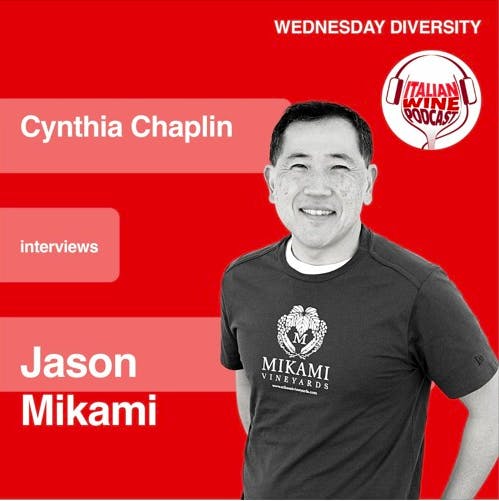
Ep. 936 Jason Mikami | Voices With Cynthia Chaplin
Voices
Episode Summary
Content Analysis Key Themes and Main Ideas 1. Jason Mikami's family history, including the internment of Japanese Americans during WWII and his mother's experience surviving the atomic bomb in Hiroshima. 2. The perseverance and return of the Mikami family to grape growing in Lodi, California, after significant hardship. 3. Jason Mikami's journey from a high-tech career at Uber to taking over the family vineyard and establishing Mikami Wines. 4. The challenges and opportunities for Japanese Americans and other minority groups in the wine industry. 5. The importance of diversity, equity, and inclusion in the wine sector, particularly concerning migrant workers and land ownership. 6. The specific wines produced by Mikami Wines (Zinfandel, Petite Sirah, Zinfandel Rosé, and upcoming Rhône blends). 7. The balance between a demanding professional career and hands-on agricultural work. 8. The philosophy of family legacy and honoring heritage in the context of a generational business. Summary In this episode of the Italian Wine Podcast's ""Voices"" series, host Cynthia Chaplin interviews Jason Mikami of Mikami Wines in Lodi, California. Jason shares his family's incredible and challenging history, tracing back to his great-grandparents' immigration from Japan in 1896. He details how his grandfather and father lost their original vineyards due to their forced internment in Arkansas during WWII, forcing them to sell everything and restart their lives and business in Lodi after 1945. He also reveals his mother's harrowing experience as an atomic bomb survivor in Hiroshima. Jason, a third-generation grape grower and a high-level tech executive at Uber, discusses his decision around 2005 to transition from selling grapes to producing wine under the Mikami Wines label, primarily to honor his family's legacy and expand the story of Japanese Americans in agriculture. He highlights the distinction of being one of the very few Asian-owned wineries in the US. Mikami Wines produces award-winning Zinfandel, Petite Sirah, and a dry Zinfandel Rosé, with Rhône blends soon to be released. The conversation also delves into the broader issues of diversity and bias in the wine industry. Jason advocates for supporting migrant workers and enabling them to become stakeholders and landowners, drawing parallels to his own family's struggles. He describes how he balances his demanding tech job with the therapeutic work of winemaking and grape growing, viewing it as a complementary pursuit. Jason concludes by expressing his hope that his daughter, Kate, will develop her own passion for the wine industry, but emphasizes her freedom to choose her path. Takeaways * The Mikami family's history is marked by significant adversity, including internment during WWII and surviving the atomic bomb, showcasing immense resilience. * Jason Mikami's transition from growing premium grapes to making wine was driven by a desire to honor his family's legacy and bring broader recognition to the Japanese American experience in agriculture. * Mikami Wines focuses on Lodi-suited varietals like Zinfandel and Petite Sirah, and has gained critical acclaim despite being a small, family-run operation. * The wine industry still faces issues of bias related to race, and there's a strong need to promote diversity and inclusion, particularly by empowering migrant farmworkers to achieve ownership and greater participation. * Balancing a high-level tech career with winemaking is possible and can be complementary, offering both intellectual challenge and hands-on, therapeutic work. * The concept of family legacy and perseverance is central to the Mikami Wines story, with hope for future generations to continue the tradition. Notable Quotes * ""It really is about honoring what my grandfather and father and mom had to deal with and had to persevere through to keep the vineyard."
About This Episode
Speaker 2 discusses their plans to release a lighter style rosette and a red blend of rhone varieties in their vineyard, while Speaker 3 talks about their grandfather's decision to return to the US after the war and their desire to become a busier city in California. They also discuss their desire to teach Japanese art and their efforts to promote disinformation and remove bias. Speaker 2 expresses excitement about their portfolio and hopes for their daughter to experience more fruit and stay true to their family. They also discuss their plans to add more wines to their portfolio and their love for their wine.
Transcript
Welcome to the Italian wine podcast. This episode is brought to you by Vinitally International Academy, announcing the twenty fourth of our Italian wine Ambassador courses to be held in London, Austria, and Hong Kong, from the twenty seventh to the twenty ninth of July. Are you up for the challenge of this demanding force? Do you wanna be the next Italian wine Ambassador? Learn more and apply now at viniti international dot com. Welcome to the Italian wine podcast. I'm Cynthia Chaplin, and this is voices. Every Wednesday, I will be sharing conversations with international wine industry professionals discussing issues in diversity, equity, and inclusion through their personal experiences working in the field of wine. If you enjoy the show, please subscribe and rate our show wherever you get your pods. Welcome to voices, everybody. This is Cynthia Chaplin. And today, I have Jason Mikami from Mikami wines in Loedi, California. The Mikami family have been growing grapes in California since eighteen ninety six when the first generation immigrated from Japan to California. And Jason is something of a modern day renaissance man. He runs his family's a hundred and twenty three year old business, but he also has, a second life as the head of efficiency and site reliability engineering for the global transportation giant Uber. So Jason holds a lot of very high-tech degrees and Asian language degrees, from very reputable schools in California. I won't name them since I am not supposed to be plugging anybody on my show. But I really wanna welcome Jason today. Thanks for giving us your time. Thank you very much for having me. I'm I'm very excited to be here. Great. Well, it's a pleasure. At it's not often I get to talk to a third generation grape grower from from lodi. Your your vineyards were bought in the nineteen forties by your grandfather. And later on, your dad added to that in the sixties, how big is the estate now? What grapes are you growing there? Yeah. So our vineyard, the one that my father purchased is only about fifteen acres But on that fifteen acres, we grow Zinfandel petite Sarah. And recently, we added, very classic grown varietals, ganache, Sarah, and Movedra. Oh, great. Today, we produce yeah. And so today, we produce you know, Zinfandel and petites are all and a dry rosette of Zinfandel, and the recently planted rhone briditals will allow us to release a very, you know, lighter style rosette of the rhone varieties and also allow us to produce a red blend that we're planning on releasing next year in two thousand twenty three. Well, that's exciting for me because Rosay is one of my areas of of really deep interest. So, we'll come back to that because I wanna hear about this road blend coming up. The the vineyards that you've you've got now aren't aren't the original ones as you said. Your your dad has purchased some of them, but I understand that the ones that were originally your grandfather's were lost because your family was forced into an internship camp in Arkansas after the bombing at Pearl Harbor. We we know, you know, in general, about the prejudice and discrimination practiced against people of Japanese cent during and after World War II, but, you know, it's certainly outside of my experience. And I'd love to hear from you, you know, how that, you know, horrendous experience changed your family's destiny Yeah. So I think, you know, just to provide a little bit of context. So, you know, in nineteen forty two, after war was declared between the US and Japan for, you know, effectively, for lack of a better term, racist reasons, you know, persons of Japanese descent were all forcibly relocated from western states to designated, what they called at the time, internment camps, which were effectively prisons holding both persons of Japanese sense, meaning immigrants, as well as even full blown Americans, those Japanese Americans who are actually born and raised in, in the states, were all forcibly relocated to these ten, internment camps and in the case of my father. So, excuse me, my father and grandfather, they were forcibly relocated from Lodiya, California all the way to Arkansas, roller, Arkansas, which you can imagine is you know, a huge, huge distance apart and you're moving to effectively a barren wasteland in in Arkansas. And, you know, the the reasoning at the time was really around, you know, the potential threats of, you know, Japanese or Japanese Americans having some sort of allegiance back towards Japan, which, you know, over the course of the war and the internment camps, you know, there was never any sort of uprising or, you know, acts of unpatriotic acts by the Japanese Americans during that time. And so for my father and grandfather, they had to effectively, you know, sell everything that they had in nineteen forty two, whether that would be land, a property, cars, etcetera, and took, you know, roughly two suitcases per person, onto these trains that eventually took them to Arkansas. And for my for my grandfather and father, you know, it wasn't until nineteen forty five when the war ended where they were released from the internment camps. And in my, family's case, they they decided to go back to Lodi and, and, and, again, restart their life in the great business. And it is around that time that my grandfather purchased, purchased about thirty acres or so in in lodi. And then subsequent to that, you know, my father bought the fifteen acres we mentioned earlier in nineteen sixty three. And that's where that's the property that I actually was born and raised on. Wow. I just I can't get to grips with that in my mind that your family who'd been in the States for fifty years was sort of forced to sell up everything they had achieved and and be shut off to Arkansas, which would have been hell of a culture shock from Lodi to Arkansas, I can't even begin to imagine and to lose their freedom as well. Your grandfather must have had quite the indomitable spirit to take the family back to Lodi after three years of being effectively in prison. In his own country. Yeah. It was, you know, it's, it speaks to a lot of the Japanese American history, I think. So, it's weird now through all this time. You know, one of the things that actually unites, brings the Japanese American community together is this sort of this historical events that affected them all, and they call it camp, basically, like everybody knows about camp, and how people had to basically recover from it and move on with their lives and actually overcome it and So, it it's funny. There's a there's a Japanese phrase. It's you can either call it Shkataganai or Shilganai. Basically means, you know, you can't do anything about it. You just have to overcome and you have to, be able to, you know, surpass that, that, that bump in the road. It's it's amazing. I I'm I'm I'm so inspired by the ability to just keep going on after something. And and calling it Camp is is quite I think that also speaks to the spirit of just wanting to move on because, of course, most people's experience with the word camp involves, you know, log cabins and sleeping bags and and bonfires and marshmallows not not prison. That's right. So, I'm so impressed. It it must have been the most herculean town ask to sort of rebuild and and not be consumed by anger. And so so your dad how old was your dad when they moved back to Lodi in nineteen forty five? He would have been twenty five at the time. So it's still a really young man. It's I mean, it's really it's quite quite the powerful family history. And for for our family, what's interesting is that, because of my mom's story, I actually sort of, have heard stories about both sides of the war in terms of the Japanese history on, regarding this, because my mom who actually is from Japan, she was in Piroshima at the time of the war. So she actually was one of the atomic bomb survivors So on on my mom's side, you know, she would tell me stories of how yeah. She heard the actual air raid sirens for the for the plane that, that eventually dropped the the a first a bomb And she was on the second story of her house. And she turned around from the window, and all of a sudden, you know, flash of lights, and then she's under, basically, on the on the ground floor, would rubble all on top of her from her house. And, you know, she's injured and burned, but then, you know, has to try and go find her parents. You know, she's seeing the massive def devastation of a, you know, nuclear bomb and seeing, you know, effectively the walking dead you know, as people are burned severely, but still able to walk for a short period of time and just the the amount of as you can imagine, crazy, the crazy scenes of death and despair after the atomic bomb. And so that's happening on, you know, the left side of the Pacific Ocean, and then on the right side of the Pacific Ocean, right, my my my father's side of the family is is in prison, basically. So it's, it's a pretty crazy, crazy family history. I can't even begin to imagine, you know, literally for your mom to have experienced that and to, you know, be able to speak to you about it. And then also, so what took your your mother to America? Because, you know, it would have been very human of her to to hate America. Can. Yeah. You know, it's interesting. The, so effectively, although not quite exactly, but she was effectively a a picture bride in the sense that it was an arranged marriage, for my father, so my father's parents, my grandfather, right, that he was from Japan, and so he wanted to find a, a Japanese bride for his son. And so the there was this arranged marriage with my mom. And and you're absolutely right. My mom had visions of, oh, this is America. It's a great country. My mom was very much into sort of Japanese arts, and so she wanted to come to the United States and actually teach Japanese arts, which she eventually did. But, she has somewhat the idea that cal oh, especially California was going to be this great, busy place, etcetera. And so she wanted that experience for herself. And but her father was just like you said. He was adamant that he she should not actually go to the States because this was the country that, you know, effectively killed one of his sons because, during the A bomb, one of, my mom's brothers was, you know, was killed. And so father was against it. Mother was okay. My mom thought that this would be a good opportunity. So she ended up coming to the states. And kinda sadly for her, she didn't realize that she was going to Lodi, which, you know, at the time, was maybe a city of, what, ten thousand people or something like that, where Hiroshima was much more of a busier city at the time, you know, post post world war two. And so she had quite the culture shock moving to the country, and moving to Lodi. But but, yeah, that was the reasoning for her to come over here was her desire to want to experience the United States and California and to teach Japanese arts? That's incredible story. And and so she she moved from from the devastation of of her hometown and and finds herself in the middle of a vineyard in lodi, not exactly a thriving metropolis at the time. It's, you know, it's incredible hat that she she hung on in there and raised a family. And your your father, I know pretty much single handedly was managing all the aspects of of the vineyard in those days, you know, field management and pruning and irrigation. What was it like for you growing up in the vineyards with with your parents? And they're, you know, very profoundly, you know, moving back story. You know, it's funny. You know, as a child, you typically hate whatever your parents are doing. Right? And so that was that's pretty much the case with me as well. I remember my dad trying to wake me up to either, you know, start pruning or, you know, walking in the ever, you know, during those days, you didn't have drip irrigation systems. You had ditches that you would, you know, make with your tractor and you have to actually walk the vineyard, you know, almost effectively every day to to see how the irrigation was going. And so, yeah, he would drag me to go check on the irrigation during the day and in the afternoons. And and so what's funny though is obviously through all of those experiences, I learned a lot, as it relates to grape growing, just through osmosis, right, just not necessarily him explicitly teaching me is more just learning as I watched my father take care of the vineyard. And so, you know, that that that proves to be really critical for me when, you know, in the late nineties, early two thousands when my father was, you know, getting pretty old and was unable to really take care of the vineyard anymore. It was my turn to figure out kind of what to do. And it and it's really around that point in time where I thought you know, once, once my dad passes on, that, you know, I would want to actually devote some of the some of the fruit from our family vineyard to our own wines. And that's really when we started to make our current wines under our family label, which is, you know, right around two thousand and five, two thousand and two thousand and five is when we replanted the vineyard, and two thousand and eight was our first vintage of our wine. That is such an Italian story, Jason. I have to say there are so many times that I've been talking to producers in Italy where the story is, I I couldn't stand my my father's vineyard. I couldn't stand the wines he made. All I wanted to do was get away and do something else. And then there's siren call back to the vineyards later on, but, you know, you're a tech guy before before this whole winery thing happened. You're a tech guy. You've got a gigantic job with Uber. You know, you've delivered all kinds of technologies, mobile video, cloud storage systems. How do you balance two extremely different jobs of your, you know, agricultural life in Lodi, where you're making wines now. But and your whole tech side of your life, do you ever see your family? Well, you know, luckily it's it's really complimentary. Some ways in the sense that, you know, the the tech side of it is really around, especially for me in terms of my, because I'm in management. A lot of meetings, a lot of working with people being in an office or nowadays, obviously, being on Zoom all the time, and and thinking about, you know, these larger technical problems. But then, you know, going back to the vineyards, you know, you're really able to enjoy and and, you know, really be in touch with nature and it's almost relaxing and and, providing a time for relaxation, if you will, right, where just being able to do things like, you know, thinning the grapes or, shoot thinning the vines, right, is really therapeutic in a lot of ways. And so For me, it's it's a good compliment to the the busy time during during the week. I will also say that, you know, part of the reason why I'm so focused on the vineyard is just like we were talking about earlier with my father and my mom, It really is about family for me, and it really is about honoring what my grandfather and father and mom had to deal with and had to persevere through to keep the vineyard. And so you know, for me, it was there was never a thought to, you know, sell or to transfer the vineyard to to anybody because, it really is for me an opportunity to honor my family. So that's why we're continuing to do this right now. That's so inspiring. I mean, it sounds like you've got sort of the the life balance worked out, but it must be a lot going on in your life between managing the vineyard and managing your other job. So it's nice that your family sees it that way as, you know, honoring your family and and having the business within the family. I think that's something that's invaluable, and and not a lot of people get to experience that. So it's it's very nice to hear somebody who really appreciates what they have. And and loves it. You know, you can hear it in your story that you really love it. And it was you who decided to make wine instead of just growing premium grapes, you decided to start producing fine wines. What sort of prompted that decision Italian wine podcast brought to you by mama jumbo shrimp. So I think part of it was, economically, you know, if you think about fifteen acres of of wine grapes, It's it's not a lot of, not a lot of revenue just from fifteen acres of grapes. And so, you know, if we were going to continue producing the producing the grapes, I I really wanted to try something different from what my father did. So, you know, going back a little bit, you know, growing up, growing up on the vineyards, you know, we're we're pretty poor. I mean, fifteen acres only produces so much, tonnage. Right? And so, you know, you don't really have the economies at scale to produce, a ton of revenue. And so excuse me, produce a lot of profits because it's such a small amount of revenue. And so in order for me to to make it a little bit more worthwhile, but also to, again, honor my family, I I wanted to to produce the wines. It was something that I thought would be a way to give people more exposure to the fact that, hey, there are, you know, Asians or Japanese Americans in this case that are are actually still in the agricultural business. And and, you know, if you look at the total number of wineries out there that are owned by Asians's today, it's it's a very, very small percentage. And if I look back on the history of, of, our vineyard, actually, my time in Lodi, the, you know, there used to be in the sixties, fifties, sixties, seventies, even. There were still a lot of Japanese American families, farming in Lodi. But if you look today, just like, you know, we were talking about me being involved in tech, you know, my generation moved on from Lodi. And, you know, we're off in, you know, San Francisco or wherever, but there's not a lot of Japanese Americans still farming back in Loda. And so I thought, you know, in terms of the wine side of the house, a, you know, it's definitely more of a moneymaker if if I can do it successfully. And and two, it expands our our exposure of the Japanese American story to a a wider audience than just selling grapes. So those are the two two main reasons. That's so interesting. We we know that sort of sadly there still exists as sort of bias related to race and age and gender and other characteristics when it comes to, you know, who who looks, quote, unquote, like a wine producer. And do you do you continue to see this sort of behavior now? You know, what do you think the industry do to promote eliminating those barriers and encouraging more Japanese American or Asian Americans into the wine sector. Yeah. In a strange way, actually, even though I'm focused on the Asian portion, I I think what the wine industry could actually do today is really focus on, in general, the migrant worker situation and to expand opportunities, whether that's through some sort of merit based thing or through, through explicit explicit grants. But You know, when I when I am on the vineyard and we are working closely with the crew that, you know, is doing the hard labor of, you know, either picking the graves or, you know, doing some of the the the pruning, etcetera. Right? These are typically folks, you know, in California today. It's it's Hispanic or Latin Americans that are doing all of that hard work. And it wasn't too long ago where all of that work was being done by folks like my dad and my grandfather. Right? And so if the wine industry can do anything about it, it was it would be to remove the the bias and sort of the the the approach towards the the migrant farm workers and to figure out how how those folks can be more, participatory in in the wine side, in the ownership side, to be able to allow them to have the opportunities that that I have. Right? And in many ways, it it starts with land ownership, right, and so figuring out how how you can provide the, opportunities for, for these immigrants, and the children of these immigrants to kind of have these opportunities would be the would be the place to start. That's such a good point. It yeah. Helping migrant workers to really have become stakeholders in the industry that that is that would go quite a long way to changing the way that people are viewed in the sector. I think that's a really, really good point. I'm I wanna get back to what lines you're making now that you you took the the vineyard from premium grape growing, and you started up wines. And I know you sort of made that decision around two thousand four or five. What's happened in the past fifteen years? What wines are you making? What grapes are you growing? Yeah. So I I we're really excited because first, you know, we started with Zinfandel and primarily because, a, the climate in Lodi is really well suited for for Zinfandel. B, Lodi itself was recognized as one of the premier, producing areas for refined Zinfandel. So we wanted to ride the coattails of of those two things to start with a Zinfandel. And that's what we first released in two thousand and eight. And, you know, I have to say we're very fortunate to have won a number of know, significant awards from, you know, say the San Francisco Chronicles. We recently won a best of class for for artists in Fandel as well as getting, you know, ninety point scores from, for magazines like, wine enthusiasts and at Sunset Magazine, but, you know, awards, aren't don't, you know, aren't the end all be all. And so I think what we're really excited about with our Zinfandel is that it's it's it's really a a excellent expression of Zinfandel. It's not, a high alcohol jamming thousand, Fidel, rather it's more balanced, l, elegant styles in that's that's still getting grades to accolades from folks. And so we're really excited about that. And our second wine then was a Katit Sarah, which, as you know, is a was very much a lieutenant to a Zinfandel. And so, yeah, the natural next step was for us to produce a petite Sarat. And again, there, we've been very fortunate, to have, you know, won a number of accolades even just this past month. We received another best of class from the San Francisco chronicle. So that was exciting for us. And then now, and I forgot I forgot that we have a dry Rosay of Zinfandel, which we talked about earlier, which is a very different style, Rosay, it's it's deeper in color, and it's actually more full bodied. My wife and I are very much, red wine lovers, and we're we're staying focused on red wines. And the farthest will go close. A white wine is with a rose. And so even with our rose, it's a more full bodied style Rosier. And so that's been a a great add on to our portfolio. And then finally, we have the Roan blends and the Roan Rosier that will start releasing this year with a Rosier and next year with the, the reds, the red blends twenty twenty three. And, for the for the Roan Rosay, that's gonna be a much lighter style, Rosay, lighter in color, still very crisp. But again, a very good compliment to the existing Rosier that we have. And so that's gonna release here in the next few months. And, and we're we're excited about adding these wines to our to our existing portfolio. That's a really exciting portfolio. I am also a big fan of more intense Rosier's I'm I'm sure you know that Zinfandel in Italy translates into Primativo in Pulia. And I've been drinking a lot of Primativo, Rosets, recently, but have that intensity. You know, I'd like to call them you know, it's a it's a red wine and a pink dress. It has it has that body and can carry a a lot of other food with it than, you know, a Provo solace style, Rosay might not be able to hold up to. That's right. I I love that you're doing that there. That's that's incredible. I just wanna ask you, so, you know, just going back to this idea of your family and honoring everything that your family from you, all the way back to your grandfather, have achieved there. I I know you're a dad. What are you hoping will come next in in the mekami family story. Yeah. It's interesting that you mentioned that. In my daughter, Kate, she's fourteen. And she's a a great daughter. And honestly, I I I don't wanna put any expectation on her. I I think I do have her work in the vineyard. She's helped out with harvests, for a number of years. She helps me shoot thin and prune out in the vineyard as well. But it it's really up to her. You know, I I I just want her to be able to experience being in the country. I think what's most fortunate about my life experience is having grown up in the country like Lodi, where, you know, again, I grew up on a vineyard in the country, and now I'm, you know, I live in the Bay Area, San Francisco Bay Area, and so I I get to experience both both lives, you know, living in the city, living in living in the country. And so My hope is that she can experience that to some degree and that she can decide for herself if she wants to carry on carry on this tradition. But it's really up to her. Well, that is that that's a very nice fatherly philosophy. And she's a very lucky girl to be able to see her dad, you know, manage so many different aspects of his life and and be happy and be successful. And she must have been, you know, a baby when you went over or, you know, or not even born probably when you went over from growing grapes to making wine. So wine must have been in her entire life. So that's a gift in itself, from a dad to a daughter. That's true. Yeah. That's lucky Kate. I'm envious. Yeah. No. It it is fun. It is fun. She, you know, I I guess the one thing I will ask her you know, we we do ask her to do this. I want her to try more fruits and, and so that she can be a, if she wanted to a sommelier later in life because it's funny when she was a baby, you're gonna laugh at this point. She was a baby maybe three years old, four years old. I would blindfold her, and, like, I would put, like, limes and lemons and other smells under her nose to have her guess what they were. And she got really good at it. So I think that she is she from a young age. She, she developed windows. So maybe that'll give her the opportunity to be a small a one day. I absolutely love that. You're probably, you know, you're you're looking at a huge amount of money when she decides she wants to go for her master of wine. It'll be all your fault. I I I've got six kids, so I know about, having kids around wine and encouraging them to smell things and taste things and talk about it. You have six kids? I do. I do indeed. They're all grown up. Wow. Oh my gosh. But they all drink wine. So, it does work and including them and making them feel like they're part of it, and part of my life and seeing how much I love it and having to carry my wine books around from wherever I hold myself up to study for something. They all appreciate it now, so I'm sure Kate will too. But watch out what you wish for because you might you might find that she she takes it all the way to the end if she's that talented at that young of an age. That's fantastic. Oh, almost, oh my gosh. You're scaring me now, but I'll keep that in mind. No. It's all to enjoy. Every bit of it is to enjoy, and don't show fear. That's that's crucial. Never sure. Well, before I let you go today, Jason, I have ask my famous final question for all my guests, especially my wine producing guests. What is your favorite Italian wine? And you can't say Primativo. Oh my goodness. Oh my god. It's goodness. You're really putting me on the spot here. I love to put people on the spot. Trying to think. So one thing that's that is memorable for me is that my wife and I went to Italy as part of our honeymoon many, many years ago. And I remember Excellent choice. And I remember our last night, one of our last nights in Italy, we I believe this is a refosco. Oh, yes. And it was served chilled. Yes. Absolutely. And that really stood out in our minds, it was really excellent with what we were eating at the time, but to have this red wine fully, chilled and served to us was really a unique, experience for us back then. And so that is what really stands out in in my memories here. Oh, well, kudos to you for coming up with an obscure grade and a great story. That's fantastic. Any anybody can say Bruno, but refasco does not come up often in this question. So if that's That's fantastic. I'm so glad you shared that with us. Thank you so much. And thank you so much for coming on today. It's been a pleasure talking to you, and I know our listeners will be really fascinated by your family this history, what you're doing now with your, with your vineyard and your new wines. Excited to keep my eye on them. I know you only produce them in really small batches, which speaks for me because I'm sure they're not going to get over here, but I will have come to California and test them out with you. Oh, that would be great. And thank you for having me. This is really a lot of fun to talk about our family history and and our wine. So thank you very much. You're welcome. You're welcome. Thanks for listening to this episode of Italian wine podcast brought to you by Vineetli Academy, home of the gold standard of Italian wine education. Do you want to be the next ambassador? Apply online at benetli international dot com For courses in London, Austria, and Hong Kong, the twenty seventh to the twenty ninth of July. Remember to subscribe and like Italian wine podcast and catch us on Sound flat, Spotify, and wherever you get your pods. You can also find our entire back catalog of episodes at Italian wine podcast dot com. Hi, guys. I'm Joy Living Denon. I am the producer of the Italian wine podcast. Thank you for listening. We are the only wine podcast that has been doing a daily show since the pandemic began. This is a labor of love and we are committed to bringing you free content every day. Of course, this takes time and effort not to mention the cost of equipment, production, and editing. We would be grateful for your donations, suggestions, requests, and ideas. For more information on how to get in touch, go to Italian wine podcast dot com.
Episode Details
Keywords
Related Episodes

Ep. 2651 Diversity in the Wine Industry and Wine Tech Innovation with Jeremy McCarty | Voices with Cynthia Chaplin
Episode 2651

Ep. 2627 Regenerative Winemaking, Mentorship & LGBTQ+ Perspectives with Terah Bajjalieh | Voices with Cynthia Chaplin
Episode 2627
Ep. 2545 Building Inclusive Wine Spaces Through Storytelling with Amari Collins | Voices with Cynthia Chaplin
Episode 2545

Ep. 2542 4th Anniversary Special | Voices with Cynthia Chaplin
Episode 2542
Ep. 2531 Winemaking Journey from Mumbai to Napa with Priyanka French | Voices with Cynthia Chaplin
Episode 2531

EP. 2517 Sarah Looper | Voices with Cynthia Chaplin
Episode 2517