
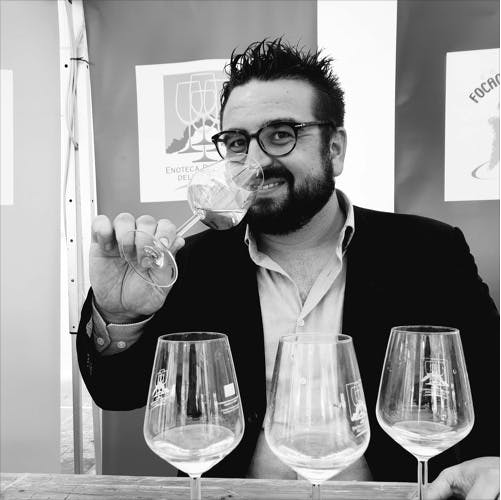
Ep. 355 Jacopo Fanciulli
Wine Enthusiast
Episode Summary
Content Analysis Key Themes and Main Ideas 1. Jacopo Fanciulli's diverse career experiences in the Italian wine industry. 2. The process and challenges of writing an accessible and comprehensive wine guide for an international audience. 3. The importance of simplifying complex wine information and regional specificities without losing accuracy. 4. Detailed discussion of specific Italian wine regions, particularly Liguria and Piedmont. 5. Personal insights and recommendations regarding Italian wine, food, and culture. Summary In this episode of the Italian Wine Podcast, host Montena interviews Jacopo Fanciulli, a seasoned professional in the Italian wine industry. Jacopo shares his varied background, from working in cellars and vineyards to public relations, and discusses the unique benefits and challenges of having such firsthand knowledge. He elaborates on his experience writing an English wine book, the ""Jumbo Shrimp Guide,"" highlighting the difficulty of simplifying complex topics, especially for regions like Piedmont, while finding Liguria relatively easier to describe. Jacopo explains his writing process, which involves extensive research followed by rigorous editing to make the content accessible to beginners without alienating experienced wine enthusiasts, using ""The Little Prince"" analogy. The conversation also touches on specific Ligurian topics, including wild boars impacting vineyards and his favorite Ligurian dish and wine pairing. Takeaways * Jacopo Fanciulli possesses a holistic understanding of the Italian wine industry, stemming from diverse roles. * Writing an accessible wine guide requires a meticulous process of simplifying complex information and removing ""geeky"" details. * Certain Italian wine regions, like Piedmont, are inherently more challenging to explain simply due to their complexity. * Liguria holds a special personal significance for Jacopo, making it easier for him to write about. * The ""Jumbo Shrimp Guide"" is designed to be valuable for both novice wine lovers and experienced students. * Personal passion for wine can sometimes make maintaining objectivity challenging in professional roles. * Wild boars are a notable issue for vineyards in certain Italian regions, such as Liguria. Notable Quotes * ""I have a knowledge of in every step of on production the cons are that I have a knowledge in every step of [wine] production. So sometimes it's too difficult to… take distances from that word."
About This Episode
A guest on a podcast spoke with an agent about their experience in the Italian wine industry and their editing and production processes. They also discussed their favorite liguria and wine, their favorite language, and their favorite language. Speaker 1 and Speaker 2 discussed their experience working with international writers and their favorite language, and Speaker 2 recommends the book as an analogy for beginners. They thank Speaker 2 for the interview and reminded them to subscribe to the Italian wine podcast.
Transcript
Italian wine podcast. Chinchin with Italian wine people. Hello. This is the Italian wine podcast. My name is Montewood. My guest today is Yacopo fanciulli. Welcome Yacopo. Hi, my Montena. Nice to talk to you. So let's get a bit of background on you. You've worked in various sectors of the, of the wine industry. Tell us a little bit about what you've done so far. Oh, basically, I've done in cellar, like, Saloran. That was my first experience in the wine world in Eligurria. Okay. Is that where you're from? I'm from the good and I started work there in wineries. Yeah. Then in public relation, sometimes, in Vineyard during the August period, but this is just a passion. I I always go to the address from somewhere in the some French winery. So Mhmm. So in terms of what you're doing now, what have what would you say the the, the benefits, the pros, and cons are of being closer to wine production, whether in the vineyard or the cellar. Okay. Yeah. The process that's you that you I have a knowledge of in every step of on production the cons are that I have a knowledge in every step of web production. So sometimes it's too difficult to take to be to take distances from that word. You know, to be more, objective and non subjective, especially if you have to present some winery or some wines that, I know, everything about it. Yeah. That is difficult with your sort of personal love and yours professional hat, so to Yes. Okay. That sometimes is difficult. It's the pros, the cons is the same. But, no, when everything is amazing, is, is the best part to know people. Okay. We're talking of people. You were working with, an international team. How was it being the only Italian member on that team of of writers and authors? Oh, it's so terrible because, to write the English that is not my mother language, but I I I write the book in English, without writing in Italian before, but was amazing. That was why I didn't actually I felt like a part of an international group. I didn't care if I was the only child. How how difficult is it, though, or how do you manage to distill all the information that you have, in a book and to filter out any extra information that you think maybe, shouldn't be in there. How difficult is the editing process, the and the and the production process, the writing process? Oh, oh, that's a good question. Basically, I started writing down everything. I I knew and everything I'd found during researches, during some researches. And after that, I read what I wrote and start cutting out. Oh, this is too geeky. It cuts out all the percentage. You know, if I was talking about soils, just mention the structure of the soil, not the percentage of glazizide or everything. Okay. So not not Just try to make it as simple as I could. Sorry. Were there any re regions that were particularly difficult to make, to edit? Oh, Piamonte was one of the difficult to make easier because Piamonte is so complicated. So many different grapes, so many different sources. History also there. So it was the most complicated to make it simple. And what was one of the easier ones? Oh, the easier one was the, for me, it was liguria. Was totally easy, right, about liguria. Okay. Just heard about oh, this is not on the list, and I'll and I'll probably get fired. But what's your favorite liguria and wine? This is tricky, but I will go with liguria and Granash. Wow. That is Granacha in Nigeria. Yeah. That's quite a left field choice. Interesting. Okay. So using the jumbo shrimp guide, if I'm an experienced wine student, Is that book still gonna be of interest to me? Would I use it differently from, say, just a a wine lover? Yeah. I think so. So the book is meant to be understandable by the beginners, the wine lover. But I think if you are, a person with background and wise, you can just read the book with another point of view. Let me I I like to explain this. This is gonna be boring. But it's like when you read the the little priest that is, book for children, you can read it more than one time in a life. And when you grow up, you understand things in that book that are not understandable by a child. That's a great analogy. Really good. Yeah. I see what you mean. Yeah. It is. It's funny how you read books, you read them once, and then you read them again, and you read them again, and you still pick stuff up. So, so, obviously, liguria, is a very special place is where you're from. You ever did you ever used to go hunting in the in the forests there? And and if you did, did you have any have have any problems with, chinguiari, the wild boar? Oh, you're not. Yeah. I'm laughing because That's the question. I'm not a hunter, but I I love doing track and nordic walking in the woods. And there are some places, with a lot of wild born now, Yes. There are a lot of them. So you can, you can do some encounter that are not so easy to to face. And then they are wild boar are probably for vineyards in a lot of places in Liberia. Yeah. And what's your final question, which is not the least, but I'm gonna stick one in there. Your favorite ligurian dish and favorite wine from ligurier to have with that dish. Oh. That's stumped. This is tricky. That's because I said that my favorite dish was, Granache, but now I'm changing everything. One of my favorite dish is Capo Madro. That is this kind of layered salad with fish and vegetables, and it's perfect with the Vermentino from Luny or Pigato from the western area. Perfect. You're making me feel hungry. Yeah, Cabo. Thanks very much for for coming in today on Italian wine book. Very much. I'm very, really looking forward to seeing you're actually reading the whole book. I've only seen a tiny extract. And the text I've seen, it makes a lot of complicated stuff finally understandable. So well done for you, Jacobo, and also to your team. Thanks for coming in. Thank you. Thank you for the interview. Bye. Take it easy. Listen to the Italian wine podcast wherever you get your pot casts. We're on SoundCloud, Apple Podcasts, HimalIFM, and more. Don't forget to subscribe and rate the show. If you enjoy listening, please consider donating through Italian wine podcast dot com. Any amount helps cover equipment, production, and publication costs. Until next time.
