
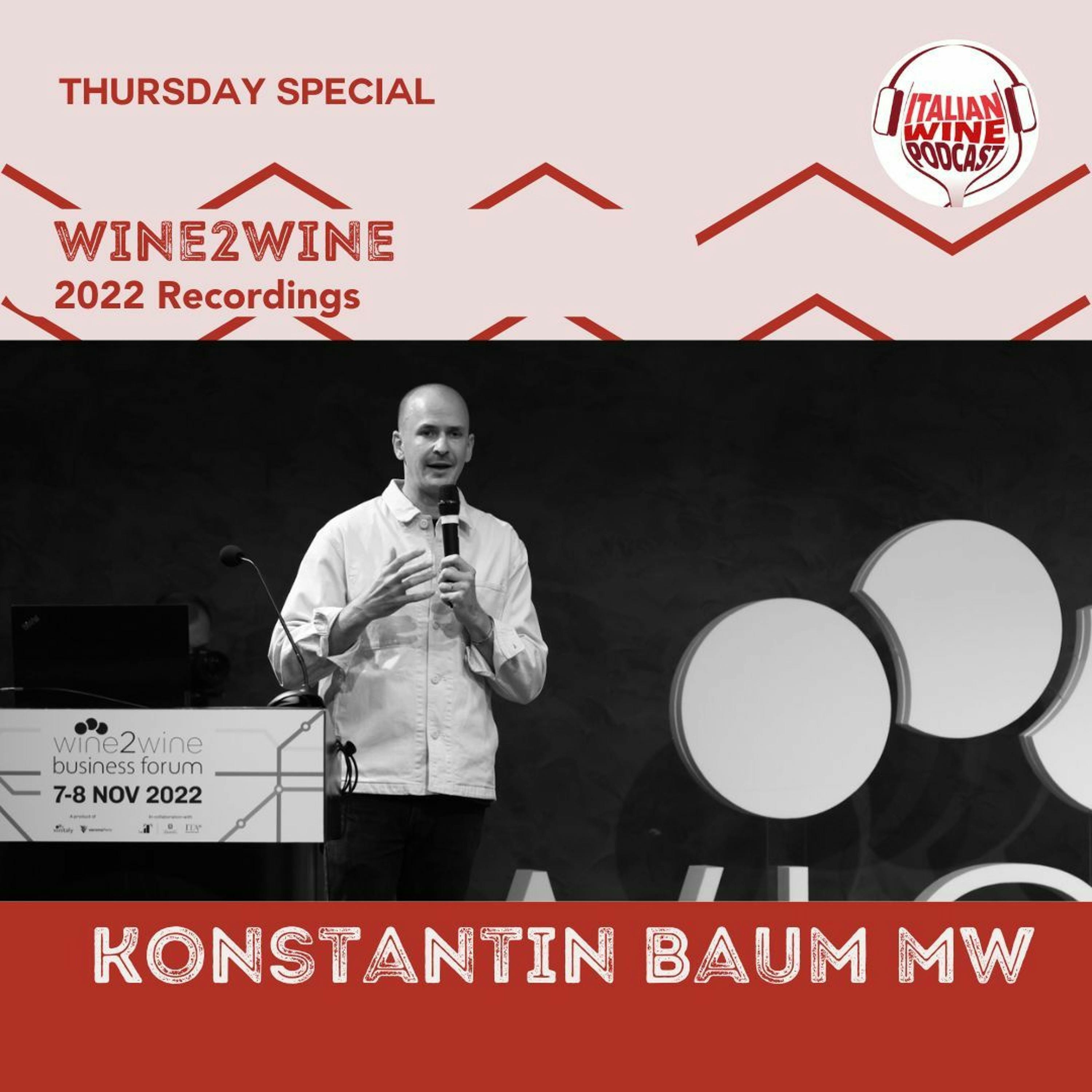
Ep. 1429 Konstantin Baum - Finding Your YouTube Audience | wine2wine Business Forum 2022
wine2wine Business Forum 2022
Episode Summary
Content Analysis Key Themes and Main Ideas 1. The power and evolution of YouTube as a platform for wine communication and education. 2. Constantine Baum's personal journey and insights as a wine content creator on YouTube. 3. The distinction between ""influencing"" and ""content creation"" on social media. 4. The business model of YouTube, including its monetization structure and audience reach. 5. Strategies for building and engaging an audience, emphasizing storytelling and long-form content. 6. The impact of viral content, illustrated by a 159-year-old wine tasting video. 7. Practical advice for wine producers and aspiring creators on balancing entertainment and education. 8. The emerging role of YouTube Shorts and cross-platform content strategies. Summary In this session from the Italian Wine Business Forum, Master of Wine and YouTube content creator Constantine Baum discusses the landscape of wine communication on YouTube. He outlines YouTube's significant growth since its founding in 2005, its massive global audience (over 2 billion monthly users), and its unique capacity for deep engagement and detailed storytelling, distinguishing it from platforms like Instagram and TikTok. Baum highlights YouTube's clear monetization structure as vital for content creators' sustainability. He shares his own experience, including a viral video tasting a 159-year-old port, to demonstrate the platform's immense reach and ability to introduce wine to diverse new audiences. He offers practical advice for wine producers and aspiring creators, emphasizing the critical balance between being entertaining and educational, finding one's niche and voice, the importance of sound quality, and the value of patience. Baum also addresses the rise of YouTube Shorts and creative collaboration as strategic tools. Takeaways * YouTube is a powerful, searchable platform for wine content, offering deep engagement and storytelling capabilities. * Its clear monetization structure provides a sustainable model for content creators, unlike many other social media platforms. * A single viral video can significantly expand reach, even attracting non-wine drinkers and new demographics to the topic. * Successful wine communication on YouTube requires balancing educational value with entertaining delivery. * Key elements for creators include finding a niche, developing a unique voice, investing in good audio, and practicing consistently. * YouTube success often follows an exponential growth curve, starting slow but accelerating over time. * For brands and organizations, collaborating with established content creators can be a cost-effective strategy to reach specific audiences. * The wine content niche on YouTube has significant untapped potential for growth as the platform's user base matures. Notable Quotes * ""I see myself when it comes to YouTube as a content creator. So I don't wanna influence anyone. That's not my primary role on the platform. It's more about creating content that is engaging and educational and entertaining for my audience."
About This Episode
The speakers discuss the success of YouTube and its impact on the creator industry, emphasizing the importance of finding the right content and finding a niche for good quality content. They stress the importance of monetization and storytelling for YouTube vlogs, as it is crucial for building audience and revenue. The success of YouTube is also discussed, including the importance of finding a niche and finding a good audience for producing good quality content. The importance of data and views in the industry is emphasized, as well as the importance of finding a strong audience and finding a creator to work with. The importance of finding a niche and finding a good audience is also emphasized. Finally, the speakers discuss their YouTube journey, including their use of shorts and the importance of soundproofing their studio. They also mention their use of Korean language transcription and their use of a t-shirt for a wine show.
Transcript
Hey, guys. Check out Italian wine unplugged two point o brought to you by Mama jumbo shrimp, a fully updated second edition, reviewed and revised by an expert panel of certified Italian wine ambassadors from across the globe. The book also includes an addition by professoria Atilushienza. Italy's leading vine geneticist. To pick up a copy today, just head to Amazon dot com or visit us at mama jumbo shrimp dot com. Italian One podcast is delighted to present a series of highlights from the twenty twenty two White wine business forum, focusing on wine communication and bringing together the most influential speak and the sectors to discuss the hottest topics facing the wine industry today. Don't forget to tune in every Thursday at two pm, Central European time, or visit the Point Wine dot net for more information. Good evening to everyone. Mira Macharelli from Macharelli winery, and I'm going to introduce you, constantinebaum, the the the youngest master wine of Germany, is important of a smaller artisanal winery from Europe, also California. Educator, journalist, contributor. You have, he has, agency or communication also. And, especially, he's one of the great the greatest, storyteller communicator in the wine industry, especially on, the YouTube world that that we are speaking before that YouTube in, comfort of, the other social media is more more intense payment and less socializing. So it's, it's quite difficult, you know, and it's a but it's a it's a target for the people they want to listen to you. So you are going to show as, some numbers and, some data and, the world of YouTube. Thank you. Thank you. Thanks a lot. Hello, everyone. I'm I'm very happy to be here flew in yesterday evening. And, well, when you're in Italy, you feel at home right away. I do at least. I'm hoping that this is going to work. We had a few technical issues, wine on keyboards, don't, don't do good things usually. So so so we'll see it, but but I hope, this is going to work. I just, briefly wanna say about this session. So so I I wanna share my own YouTube journey with you guys so that you can kinda see what I did. To be honest, I haven't quite figured out why why my YouTube channel kinda works. So so I won't be able to give you the whole recipe, but I can at least share with you, a little bit of information on YouTube and on the way I did it. The other thing I want to mention right before we start, I'm not an influencer. I do quite a lot of different things. As Maiam said early on, I see myself when it comes to YouTube as a content creator. So I don't wanna influence anyone. That's not my primary, role, on the platform. It's more about creating content that is engaging and educational and entertaining for my audience. So I wanna make sure that people get interested in wine rather than kind of, creepily try to influence them to do anything that they don't wanna do. So to begin, with just a few few few things on YouTube in general, the platform. So YouTube was founded in two thousand and five, not so long ago. So, I was in love with the platform pretty much straight away. I really liked it. I really liked the format of being able to pick and select different pieces of content and watch them and consume them. YouTube was then sold quite quickly for one point six five billion US dollars to Google today known as Alphabet. And people were kind of going, like, well, that's this is crazy. This is a crazy number for a company that is barely one year old. But today or last year, YouTube generated almost thirty billion US dollars in income. So the business has done quite well, and I think it was it was a good investment by Google to get into into, into YouTube, to jump into YouTube. What is also maybe relevant to this audience is that wine, and video content kind of worked pretty early on. So most of you probably know Gary Vaynerchuk, and he was kind of the the pioneer in this segment. He wasn't really on YouTube in the beginning at least. He was, more focused on his own website and creating video content there. But I was pretty hooked, on Gary's stuff, even though I didn't always agree with him, and sometimes we had, conversations going back and forth. Me kind of arguing that he said something that isn't right in one of his videos and he kinda going back to me telling me I'm a cherry picker, but but I really like that. And that that kind of lit the spark for me even though I never really wanted to follow exactly his path, but I I was kind of interested in doing something, a video, video content format on, on a platform on the internet. I really like that. But, just a few numbers to begin with. So YouTube has over two billion monthly locked in users. That's a quarter of the population of this planet. Quite a lot of people use YouTube tubes. So so that's that's quite quite special. And the other number that is quite interesting is that, everyday people watch over a billion hours of video on YouTube. So people watch YouTube while they work, while they brush their teeth, while they kind of bring their kids to to bed with their ear pot in their ear, or that's that's at least what I sometimes do, unfortunately. So so, yeah, it's it's it's quite an influencer influential platform. Five hundred plus hours of content are uploaded to YouTube every single minute of the day. And that's kind of crazy. I mean, for YouTube, this means they have to have a massive infrastructure in order to process so much data. For, you guys as consumers mainly, I guess. That's kinda great because you have a lot of information on that platform, but the problem is to find the really good stuff. I mean, all of those five hundred hours of content, I assume that four hundred ninety nine, hours are probably not something that I would wanna watch. So so, obviously, that kinda depends on your own preferences, but there's a lot of it. So it's kind of difficult to find the good stuff sometimes. For me as a creator, that's obviously a big challenge. Because you know that you have to compete with quite a lot of information on the platform. If you think about it, when you go to youtube dot com today, you kinda see eight tiles to begin with. Eight videos that that you kinda see in the beginning, you can scroll down, but you won't scroll down for hours and hours. So so there's very limited real estate on that platform. And the algorithm of YouTube kind of curates the information that you see, which is a good thing, but it takes some time for it to understand what your audience wants to watch, what my audience wants to watch. So really only the bigger channels that, have uploaded content for a longer time. Actually benefit from being being, kind of, pushed by YouTube. So this guy, first of all, who of you here knows who that is. Just just kinda gauge the the audience here. So not too many, I'd say. Maybe maybe less than a quarter. So so this is mister Beast, Johnny, who's, Jimmy, who's actually one of the biggest youtubers, in the world right now. His channel is one of the few that has over one hundred million subscribers. So the people who have decided that they want to subscribe to his content, he has generated that number is owned close to eighteen billion views. So eighteen billion times someone has clicked on one of his videos and he made estimated by Forbes at least fifty four million US dollars last year. So between his YouTube ad income, generated by the views. So every time you watch a v YouTube video, you see ads usually. And as a as a as a creator, you get a share of the ad revenue that YouTube generates with those videos. Most of his money is probably from paid engagements. So, he he basically does sixty second or ninety second at read and makes tens of thousands of, US dollars for those sixty seconds. So you can really, in in some cases, it's even even a million for larger corporation, larger corporations and larger collaborations. So, yeah, he's quite successful with that. And the interesting thing with Jimmy is he is twenty four now. Started when he was fourteen, so ten years ago, roughly. And in the beginning, his videos were really bad. No one watched them. He really hustled and kind of built his audience over time. So it was not like an overnight success. And that story obviously also resonates with people. This builds a pretty close relationship between the content creator, in this case, mister Beast and his audience. So, that that is, that is one of the very strong things when it comes to YouTube, building those relationships. When it comes to one YouTube, the numbers look a little bit different. So you can see the three biggest channels channels in the world right now, according to subscribers on YouTube. Interestingly, two of them are actually from South Korea. So, content creators that are based in South Korea, South Korea pre it consumes a lot of YouTube content, and, that might be the reason for it. So, I'm actually in in the third spot, right now. So, if you guys have a have a second get out your phone, subscribe to my channel in order to kind of finally get rid of Yang Gang wine TV and move past him. So so, that would be greatly appreciated. So as you can see, numbers are quite a bit smaller when it comes to wine YouTube. And the question arises if wine content has been, like, available for a long times, Gary Vaynerchuk, and so on and so forth. And, if if if, if if this this content exists for a long time, why aren't more channels breaking through? Why why is there not not more, yeah, more to Ghana for a wine wine YouTube channel? And the question might be, is the niche of wine too small and I actually disagree with that. I think it's going to happen in the future. I think as people who are using YouTube are getting older, there will also be bigger interest in YouTube on the platform. I think I one spectator at least claims that they their content is read by more than three million people worldwide. So if if there are three million people who are actually even prepared to pay for a wine content, I'm pretty sure there there are one million people who will be prepared to subscribe to a free YouTube channel. So I think it's going to happen. The other the other thing is also there's, for example, this coffee YouTuber called James Hoffman. He was a barista and then started his own YouTube channel he now has one point five million subscribers, and he makes videos that kind of where he compares different coffee machines to each other for thirty minutes going into really deep detail, and and I think if that's possible for coffee, then that should be possible for wine at some stage. Whether I I'm going to be the one who'll break the one million subscriber mark or someone else. I can tell. I know what I'm hoping for, but but but I yeah. We we'll see. But I think that the niche is certainly big enough for a really big YouTube wine channel, at least one, if not if not more than one. So why why am I interested in YouTube? Why should you maybe consider YouTube? Why should should anyone, think about creating on YouTube. First of all, like I said, there's a huge audience, but that's only one part of the story. The other part is that, this huge audience can also be monetized quite well. When you look at TikTok and, Instagram. There's actually no real infrastructure for the content creators to be paid. TikTok pays out a little bit of money. Instagram does that as well, but it's not really regulated and it's more for the really big guys. With YouTube as soon as you have more than a thousand subscribers and have generated, I think, more than forty thousand minutes of watch time, you can switch on monetat monetization and you get your share of the ad revenue that, a channel generates. So YouTube's YouTube keeps the bulk, but you get close to fifty percent, a little less than that, but so so so fair share, I would say. That is important because, if you wanna create something on the internet on a regular basis, you need to make some money from it. Otherwise, you won't be you won't sustain it. It will get too difficult to balance it with your normal job or with with your other other things that you have to do. So monetization is key for the success, of YouTube. The other thing is storytelling. Maria mentioned that earlier on. So so, you you actually don't really get to tell a story on Instagram and TikTok. There will be Instagram as in TikTok here, and I use Instagram quite a bit myself, that will argue with that point. But I I just don't think that that you can, can build a story arc in a sixty second reel or on a photo post. On YouTube, some of my videos are twenty minutes long. So so I actually get to, interact with my audience, tell them something I have time to explain something in detail. I can I can take take them out into the vineyard and talk about, the vines and then go back into my studio and finish finish it off there? So so there there are much more opportunities there. So there's real storytelling And this really builds in relationship with your audience. You you're you're, they they think they know me better than they would if I would just dance on TikTok because nobody wants to see that anyways, but but but but but you know what I mean? And and I actually get to tell them go go into detail with them. Talk about things, in in a little bit more detail than just the bullet points. The other thing is you build a library on on YouTube. You build a channel with content that will be watched in the future. On TikTok and Instagram, everything is for the moment. With Instagram, it's even in the name and TikTok kind of as well. So the clock is ticking. As soon as you post, the clock starts ticking and at some point, the the information will not really be shown anymore. With YouTube, some of my older videos, like videos that are months old or year old, they, amongst my best performing videos, for the last twenty eight days. So people keep watching the the stuff. You build a library that people get to access. YouTube is the second biggest, search engine after Google So so you can actually search for things on YouTube and find videos that are a year old or two years old. And when it comes to wine, things don't change that much. The way I open a bottle, if if you wanna show that to your audience, doesn't necessarily change. It that will be relevant for the next year. You can still, watch the video, the first video on YouTube that is seventeen years old today. So you it's still available. It might not be that interesting. But but it's still available. And with YouTube, you can actually benefit from that in the future. So how do you do it? So I would argue the first thing you really have to do is to find your niche. When it comes to me, it's obviously wine. But you can go even in even more detail. So so you don't just have to stick with wine. You can go, you you you can produce vlogs where where you travel to wine growing regions and talk about the wine growing region and and visit, winemakers, for example, you could make videos only about glasses and the way, the glasses look and the way the way they bring out certain characteristics in the wine. For me, it's tasting videos. So I do lots of different videos, but the the stuff that performs the best is when I taste wines. When I explain wines to my audience, that's obviously kind of, anyways, one of my, my strength, to be able to taste well, have a good palate, and, and that's what my audience wants to see the most. The other thing is, find your voice. So you can either say, hello. My name is contactingbaum, or you can go, a master of wine, baby. Well, that that was super silly, but but it's obviously not just about the way you talk. It's also about the way you communicate everything. So so you can pace yourself. You can speak very slowly. You can speak very fast. But it's also about the way you present your information. You you, there are youtubers who use GoPro So very, very good, but, pretty, not not great quality cameras that don't bring out everything you want to show maybe in the video. I use pretty high end stuff. So I've I've got lots of cameras, really good cameras, I got, I I want to have good sound, good lightning, lighting, that obviously also limits myself in the way what the things that I can do because I can't carry that around everywhere and produce the same quality of content. But you need to decide what you wanna do and how you wanna show it. So that's what I mean with find your voice. Find your audience is another thing. So while you are producing content, you will find an audience. In the beginning, there's no one there. You are standing alone on a stage the room is empty and you still have to talk. That's kind of what what I was scared about when I arrived here just being here all by myself. But but, but over time, people will come and they might stick around if they like what you're saying. So so, that's that's the way you build your audience. In the beginning, you really have to find people from other platforms, maybe. You're strong on Instagram. You you get them over to YouTube and try to engage them there. Or you're good on TikTok, you get them to YouTube to to, share more content with them on YouTube. Then YouTube will start understanding what kind of people watch your stuff who wants to see your videos. And the algorithm then will, play play, give your content to more people that are similar. So they will the algorithm learns, and that's why growth on YouTube is very often exponential. In the beginning, it's very slow. But at some stage, once you are one of the bigger channels, it's actually easier to add, subscribers at a much, much faster rate. In the beginning, I was happy to have one subscriber per day. Today, I'm happy when I have a few hundred subscribers per day or a thousand subscribers a day. So so so this is how how things change over time. And the other thing is be patient. So you just have to wait sometimes. Good things come to people who wait. And and YouTube is difficult. It's more difficult than kind of getting out your phone, posting a selfie and, and, I mean, that can be difficult as well. Don't get me wrong. But for YouTube, you have to understand camera equipment. You have to edit. You have to you have to do much more stuff than than you would have to do when posting photos on Instagram or TikTok or if you're making videos for those platforms. I do that as well, and I know that, like, producing a real takes far less time than producing a fifteen minute video for for YouTube. It's just it. The other opt option, obviously, and this is kind of the part where I, insert the shameless plug, is to to find the right creator to work with. I mean, if you wanna be a creator yourself, that's kind of different. You can collaborate with other creators. But, if you're an organization, a company, and you want to be successful on YouTube, it is quite quite a good idea to find someone who's already got found their voice, found their audience, and worked with them in order to promote your brand, your organization, your region, whatever. So so so that's obviously much more cost efficient in many ways. You have to spend more on that one collaboration maybe than you would on a video, but you also you also don't have to spend years and years uploading videos that no one wants to watch. And I see quite a lot of those videos, to be honest, on the YouTube channels of, produce, one producing regions, really high quality videos done by really great videographers that no one wants to when no one watches because you can't find it It's maybe not as catchy as it could be. It's not created for the platform. So sometimes having a creator working with a creator is much more efficient. Italian wine podcast. Part of the momo jumbo shrimp family. So now as a bit of a treat, and as we are, as far as I understand, are sharing business ideas. I I kinda want to share something with you that, that I've I haven't changed with shared with anyone so far. Obviously, this video I've shared with other people, but I'm going to show you some numbers. So I'm going to show you how this video became a big success. This was a big success, not only for my channel, but, it's I believe it's the most viewed, video by one channel ever on YouTube. So it it's right now at two point two million views. So so I'm kind of giving you, like, a little sneaky look into what happens when one of your pieces of content, go viral. So this the story of this basically was, I found this bottle of one hundred fifty nine year old wine in my cellar. And that's not a I I didn't make that up. I actually sometimes get bottles of friends and relatives with old wines. And oftentimes, I just go, yeah, come on, give it to me. I'll taste it. But I'm not expecting great things usually because most of my friends and relatives don't have great wines in that cellar. So so amongst those bottle bottles, there was this bottle of eighteen sixty three, Burmister port wine, a collator, and I didn't realize it at the time. When I went through my cellar, I kind of saw that bottle thought this is interesting. Send a photo to a friend of mine who's a real expert expert in port, and he actually said, yeah. Yeah. That's a one hundred fifty nine year old wine. And I was like, okay. Cool. That that's that's an interesting story. So let's make a video out of it. So So why this video went viral? I don't one hundred percent know. One thing I understood right away when I saw this title and and the thumbnails. I I created them, but but when I saw them in front of me was that this is going to do well because, the thumbnail and the title are really important on YouTube. You you basically that's all all there is for people to suck you in. You can produce a great video If they don't like the thumbnail or the title, they will not click on on the video, and that means no one will watch your video. So, here I basically try to be as simplistic as possible. You see the eighteen sixty three. So, you know, it's an old bottle, magnified by a magnifying glass that wasn't there that I edited in. My face kinda looking scary because you wanna create a little bit of suspense. In order to attract a wide audience. And then you have the port tongs there. I I'm actually not so happy about the port Toms today. I mean, the video, the the thumbnail worked, but but I would do it slightly different. It kind of looks a bit funny. You see the glowing bit. I think only people from the wine world would would have understood what that is, but anyways. And you have the title, drinking a one hundred fifty nine year old wine, poison or perfection. So it's really easy to understand, I think, for everyone. It's old. One hundred fifty nine years. I haven't I've never tasted a wine that is this old. People would have thought. And and the bit poison or perfection might seem a little bit, yeah, ridiculous because we all know that it's not going to put poison. But in my comments of that video, I saw quite a lot of people who actually just came to watch this video and see what I'm going to die. Yeah. So so they they were hoping for for the wine to be poisoned. I mean, that's the beauty of social media. It generated views. So so I'm not going to complain about it. So this is kind of, and and I I know that I'm I have to be aware of time, but I think we are mister Good. This is kind of, what happened over the first twenty four hours. So, actually, the one of the great things about YouTube is that you get lots of data. Google is really good at giving you data, graphs and all that. And this is kind of what you see in the back end. That that's what I see for my channel, for individual videos or the channel in general. So over the first twenty four hours, the video was watched two point one times as often as a normal video. My channel was quite a bit smaller back then. So so I was really pleased with eighteen point seven thousand views in twenty four twenty four hours. I was kinda like, wow, this is awesome. The watch time was obviously also high, even though the video was shorter than most of my videos, so it was just ten minutes long. But I thought, wow, four hundred fifty seven subscribers. That was a big number. I think back then, that was like the biggest number I ever had in a day. So that that was kind of giving me some some some good feelings. I was kinda going, well, this this could be really interesting. You can also see the revenue. So that's what Google was estimating. They are going to pay me for the first twenty four hours of that video. So so fifty euros, that's cool. I take it. Definitely not worth the investment when if that's all, opening a bottle of one hundred fifty nine euro wine. But then again, I didn't pay for it. So So I was I was I was pleased. But I saw I also saw this bit here, which kind of so the graph kind of moved up a little bit. So I was kind of going, well, this might go somewhere. This is hopefully not the end. So and that was the first ten days. So so you can see over the course of the first ten days, it roughly generated one point two million views, eleven point five thousand new subscribers. I think back then, I had, like, thirty eight thousand subscribers when the video was posted. So so that was a big push for my channel. And the revenue was to point, yeah, to to a half thousand euros. But what I really liked and actually, I mean, this was exciting for me, at least, at the time. I kinda woke up at night sometimes and and checked my my app, my YouTube app, and another one hundred thousand subscriber, a hundred thousand views for that video. But the the high point was basically this three hundred eighty thousand views in one day. So that was kind of, that was very special. I mean, I think Verona, is at two hundred fifty thousand inhabitants, Florence is, I think, roughly, three hundred eighty thousand people. So so, like, imagining a whole city watching your video in one day. That that was that was really cool. But, obviously, thanks. Went down again, afterwards. So the video is still watched a lot of times per day. But it's not not at that level anymore. But this kind of shows you the power of YouTube. So in in a very short amount of time, lots of people suddenly learned that wine can be aged for one hundred fifty nine years and can still be delicious. By the way, it didn't even mention that, but yeah, wine was delicious. So watch the video to find out everything, but it was just just beautiful. They also learned that wine doesn't get isn't poisonous necessarily after one hundred fifty nine years. And quite a lot of those people were actually all of a sudden more interested in wine. So it wasn't just good for me for my channel. It I think it's it was also really good for lots of people in the wine industry. I I had actually comments of people saying, I'm Muslim. I don't drink alcohol, but I still watched this video and really enjoyed it. So so so people who never really interacted with wine, all of a sudden knew a little bit more about wine, just through the power of one video. And I also kind of thought, after a while, Burmister, the the port company, that I actually gave quite a lot of promotion for free. They they didn't pay me a dime. They didn't even say thank you for the video. I'm I'm not I don't have any hard feelings there, but but how much how much might this be for them? Like, in terms of how much how much advertisement was it for the company of Burmister that I posted this video. And I calculated it using baseline numbers, for for normal cost per views. That's how you count things in the industry. And the video should have cost Bermister, forty five thousand US dollars. So they should have paid me four forty five thousand US dollars instead of me, having this opening this bottle for free. But I'm fine. I I I don't mind. I I'm I'm happy I'm happy that the video did well, and and that it did something for one in general. So the key takeaways, and then we are kind of doing a little bit of Q and A, I guess. YouTube is huge searchable and here to stay. It's it's a big platform. It's not going anywhere. I actually have I'm quite bullish that YouTube will do really well for the foreseeable future, continue to grow and, produce even better creators that make better videos than I do. It allows for really deep engagement with the audience, and I think that's really the distinguishing factor to other social media platforms. On YouTube, you can really be get into the heads of your audience, really tell them a story and really provide value more than you can on most of the other platforms. It's also the only platform with a clear payment structure. That is quite democratic. I think that's important for creators and for the quality of content on YouTube in the future. And for me, at least, it is hard work, but it's worth it. It's something, really enjoyable. For me, the best moments are not necessarily when a video goes viral, even though I like that too, But the best moments were moments like when I went to this little winery in in the files to, talk to the winemaker. And all of a sudden, I've had the feeling that something changed in the room. There was someone behind me, a younger guy, maybe twenty five, He was like, I can't believe you're here. I've been watching your videos for such a long time. I was studying chemical engineering, and I was miserable. I hated it, and your videos convinced me to change careers and get into wine. And now I'm working here, and soon I'll be, creating my own wine label. That's kind of really powerful. And I think that really shows how, how powerful this platform can be for content creators and for their audiences. So, thank you and, happy to answer some questions. Thank you, Constantine. We have some questions I have I have one. Then FedEx, I give you a mic. As a wine producers. What would you give some advice to the wine producers to about the communication, about how we have to communicate better, I think. On YouTube or that? No. In general. Actually, in general. But I I think I think if you're, like, on a social media platform, your content or what you do has to be also entertaining, entertaining. I'm I'm trying to be educational, but it always has to be entertaining. And what I see quite often is that the content either is just entertaining and not very educational. So there's not a lot of value being created for the audience. They don't learn anything, or it's very educational and not really engaging, not really entertaining for the audience. So I think the key is kind of finding the balance between being entertaining and being educational. For me, as a German, Stevie mentioned it earlier, we are not we are not very funny, in general, So I really had to practice hard. I had to go to clown university to get a little bit funny at least. But but but yeah. I mean, you don't have to be funny, but, you you have to be entertaining, I think, in order to keep the audiences in, attention on the on any platform, basically. Come on. Give me a moment, sir, Nick. Yeah. Exactly. Give him a round of applause for for the trip. No. But, I wanted to ask you how you are reacting to the shorts, to the short spectrum. Yeah. And how are you gonna change your videos with the shorts is the same strategy. Are the two strategies for it, how you're reacting to the shorts game? Yeah. I mean, YouTube introduced shorts kind of as a response to what TikTok is doing and what Instagram reels are doing. They are performing really well. YouTube kinda have the feeling they have to do something in order not for for them not to lose ground on in the video game. And I I actually don't consume all that much, short content, but I think it's it's great. For me, personally, everything that I produce has to be educational, entertaining, and excellent, as at least as excellent as as I can be with my, with my small means. And and I think I can do that in shorts as well. So so I'm going to start producing shorts pretty soon. I kind of I'm finishing the concept of it because it has to there has to be some concept. It won't be me dancing with a bottle of wine in my hand. But but but but, but but, yeah, I'm I'm going to do it because I think it's great, to have have this format to kind of get people more people interested in wine, get get them get them engaged. And I think that format works really well. And on top of that, the great thing about shorts is you can actually produce the same video, put it on on YouTube, shorts on Instagram reels and TikTok, and the audience overlap is actually not that big. So so you can produce the same content for different platforms. Obviously, the performance will depend a little bit on on on that on that platform, but but you can actually generate quite bit of reach just by using reusing the same content on on different platforms. So so, yeah, I'm going to do it, and I think, I think it's it's it's a good tool for sure. I don't know who was next, but, do we have Thank you. Great presentation. My question is is what kind of equipment should you invest in? If you wanted to start, you know, today, what kind of equipment should you invest in to to make it happen? Yeah. I mean, I I think so so I now have quite a good studio setup. I basically have have two cameras that are, worth five thousand euros or something combined. And and, a great mic and and light and all that kind of stuff. But you don't need that in the beginning. So in the beginning, you basically need a good camera, like a six hundred euro camera. You don't even have to have that. You can also use your phone, but I think at something you should invest in, have a good, good external microphone because sound is always important. Soundproof, your your studio, whatever it might be, your kitchen, or, or whatever makes sure that sounds good because the sound is super important for engagement. The video can be can drop off, every now and then. But if the sound stops for ten seconds, then then no one's going to watch anymore. So so I think, yeah, having a good camera, a good microphone, lighting is actually super cheap. Usually, good lighting is is not very expensive. So I think with, six hundred euros, you can have a pretty decent studio set up already. But, yeah, you can also just go for the iPhone version. I think that doesn't get you, all the way. But in the beginning, that might be useful. I think what you should really invest is in is practice. So making sure that your your performance, is good in front of the camera. Took me a long time, to to feel a little bit comfortable in front of a camera. And that's something you can do for free. It's just your your time, basically, that goes into it. Yeah. Can you talk a little bit about how long you were on the platform and the different formats of videos you experimented with before you were able to connect with an audience. Yeah. Sure. I mean, I I basically created my YouTube account in two thousand and fourteen. So a long time ago, I made a few videos in German back then, and don't try to find them. I I I I they are set on private, so so so no one sees them. I'm not one of the those people who wants to have their bad videos out there for the rest of their lives. So so And and then I kinda stopped. I I set up my company, and I was really busy, and I didn't really have time for YouTube, and I just maybe did one video per year maximum. And then in twenty twenty, so back then, I maybe six hundred subscribers. So so not a lot. Considering that I have quite a lot of followers on on Instagram, that that's not a lot. And then and then in twenty twenty, COVID hit, and I was kinda like, I travel quite a lot normally I always wanted to do this YouTube thing. I can't travel right now. So why not use that time and invest it into into YouTube? So my real YouTube journey journey with an English speaking channel, in that format started, two and a half years ago. And, yeah, it it grew from there. So in the beginning, in the beginning, everything on YouTube is kind of flat, and then then you start getting traction, and then it's really weights. So you get a video that does well, and it goes back but not quite as low as it was before. And then another video hits, and it goes up and then back, not quite as low as before. And, yeah, over time, you might get get get up there somewhere. You might not, it kind of depends on your content. But it's a question also of you listening to your audience and understanding what they want, in order to, build your audience. Yeah. Yeah. Really great talk, by the way. Really enjoyed it. I know that the, shorts and TikTok and Instagram love captioning. And I see the value there fully. What are your views on captioning? And have you seen it working or, you know, improving your, your, your viewership? Thanks for me. First of all, thanks a lot for your talk. That was brilliant as well. I wanted to talk to you earlier because I actually did a seminar with you in California a few years ago when I was there, with an MW trip, and that was that was so amazing. So So thanks for your your your talks. So captioning. Yeah. I think that's really important. And that's something that I'm not investing a lot of time in. So my subtitles, are auto generated by YouTube, and YouTube does a fairly good job, but when it comes to my well, like, like, wine terms, like, when I talk about Cruise in in Burgundy, the it completely butchers the names usually. And my last name, baum, sometimes comes out as bomb. So so yeah. So so so that doesn't quite work. But there's lots of potential there. And I actually I'm actually I was considering getting a Korean to translate, my, my closed captioning into Korean because I know that there are lots of people watching, videos in Korea that can't necessarily understand what I do. So so, yeah, I think there's lots of potential there, but it's, yeah, it's quite a lot of work. I speak a few languages, but I can't really sit down, spend hours and hours translating, the the closed captioning. So so but there's lots of potential. Mister Beast, the guy I mentioned earlier, he was actually he's he's now doing, he's dubbed a video. So he has a mister Beast in Espanyol channel where he does all of his normal videos just just adapt. So so someone else speaks speaks in speaks Spanish, and, it's all translated. And that works really well for him. So so, yeah, maybe something for the future, but but yeah. Not so much right now. You're welcome. That's another thing. So before we close, I do have a question. How much time are you dedicating in the production of your videos? So the production is actually, so I I I have a guy who does, does purchase the wine and, because I buy pretty much all of the wines that I I I open. I I bought myself, paid for at least. So I got a guy who buys the wines, who finds out all the information on the wines, so I don't have to do that. But I write my scripts and do quite a bit of research. I don't do the editing anymore because that was kinda destroying my Sundays and my family life. So I was kinda getting up at five o'clock on Sundays editing videos, and my wife wasn't having it anymore. So so I have someone who does that now. But but, yeah, so I still spend at least a day per week on on creating, the content that goes on to YouTube. So I'm still recorded myself. I I write the script. I obviously checked the the app excessively. So so quite a lot of time, I guess. And what about your demographics? Because Wine King his demographic is predominantly Korean. Yeah. Right? What what about are they predominantly German? No. No. No. Most of them come from the US, actually. And Germany is in in there on on the third spot, I think, UK, Germany, and then it's kind of from all over. I I actually did a few videos with with Jay, from Wind King over the course of the last weeks. I I was traveling to Korea, and we we shot some videos together. So maybe the Korean share will grow, let's see. But But, yeah, it's mainly mainly US. It's maybe it's not quite a third, but but more than a quarter, from from the US. Okay. So I think we have a lot of questions, but, I have to close-up because we have two more shows to go. So let's give it up for Constantine, the YouTuber, the MW, and, of course, Miriam. Thank you very much. And I'm sure you have questions, that you can, you know, meet with the yes. Awesome. With the thank you very much. Listen to the Italian wine podcast wherever you get your podcasts. We're on SoundCloud, Apple Podcasts, Spotify, EmailIFM, and more. Don't forget to subscribe and break the show. If you enjoy listening, please consider donating through Italian wine podcast dot com. Any amount helps cover equipment, production, and publication costs. Until next time, teaching.
Episode Details
Keywords
Related Episodes

Ep. 1670 Can A Wine Brand Sold In Grocery | wine2wine Business Forum 2022
Episode 1670
Ep. 1659 Making Social Media Work For A U.S. Audience | wine2wine Business Forum 2022
Episode 1659
Ep. 1608 E-Commerce And Trade Communication In The US | wine2wine Business Forum 2022
Episode 1608

Ep. 1598 From Serial Killer To The World's Hottest Wine Trend | wine2wine Business Forum 2022
Episode 1598

Ep. 1588 Crisis Of International Wine PR | wine2wine Business Forum 2022
Episode 1588

Ep. 1578 Segmenting The Fine Wine Consumers | wine2wine Business Forum 2022
Episode 1578