
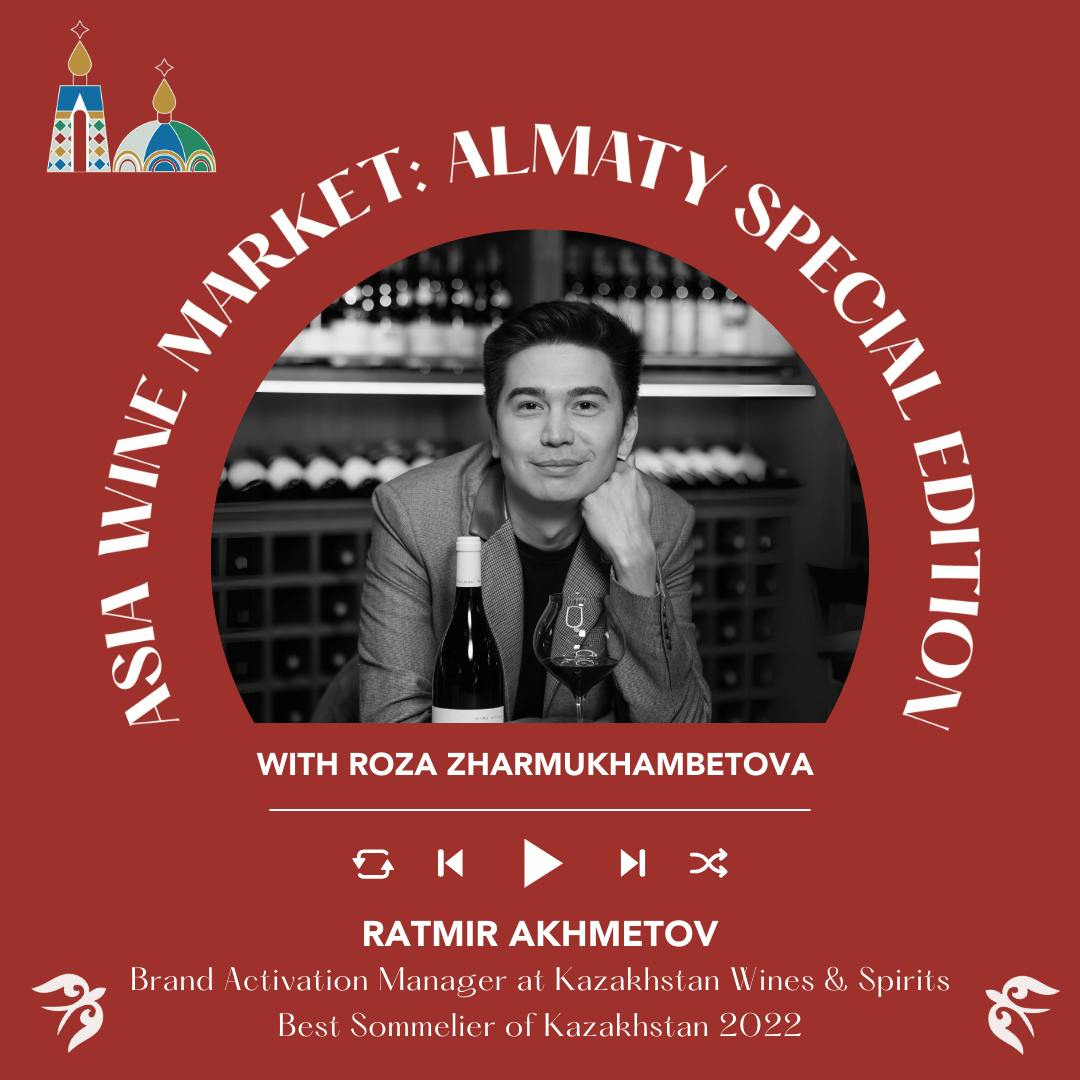
Ep. 2338 Ratmir Akhmetov of Kazakhstan Wines & Spirits | Asia Wine Market: Almaty Special Edition
Asia Wine Market: Almaty Special Edition
Episode Summary
Content Analysis Key Themes and Main Ideas 1. The professionalization and elevation of sommelier standards in Kazakhstan through education, competition, and international certification. 2. Ratmir Okhmitov's journey and contributions to the Kazakhstan wine industry as a sommelier and educator. 3. The structure, operations, and portfolio strategy of Kazakhstan Wines and Spirits, a major wine and spirits importer. 4. Current consumer trends and preferences in the Kazakhstan wine market, particularly for Italian wines. 5. Opportunities and challenges for Italian wineries seeking to enter or expand within the Kazakhstan market. 6. The role of consumer-facing wine events in fostering wine culture and market growth. Summary In this episode of the Asia Wine Market Almaty special edition, host Rosa interviews Ratmir Okhmitov, a leading sommelier and Brand Activation Manager at Kazakhstan Wines and Spirits. Ratmir shares his personal journey from a chance entry into the wine world to becoming the Best Sommelier of Kazakhstan and a gold medalist of the ASI diploma. He details the efforts to elevate sommelier standards in the country through national competitions and the critical role of international ASI certifications. Ratmir also provides an in-depth look at Kazakhstan Wines and Spirits, highlighting its market coverage, diverse portfolio balancing commercial appeal with boutique quality, and responsibilities beyond traditional marketing. The conversation delves into consumer preferences for Italian wines in Kazakhstan, noting the popularity of Prosecco, Pinot Grigio, and Primitivo, and the potential for introducing less common varietals like Vernaccia di San Gimignano. Finally, Ratmir explains how consumer events like wine dinners and tastings contribute to building wine culture and customer loyalty, while also touching on the demographic of attendees and the differing consumption habits of younger generations in Kazakhstan. Takeaways - Sommelier standards in Kazakhstan are actively being raised through rigorous training, national competitions, and the adoption of international certifications like the ASI diploma. - Kazakhstan Wines and Spirits is a significant player in the market, utilizing various channels (on-trade, off-trade, online, boutiques) and acting as a key importer. - The Kazakhstan wine market shows a strong preference for popular Italian wines such as Prosecco, Pinot Grigio, and Primitivo. - There is perceived potential for introducing more niche or high-quality Italian wines, though market adoption can be slow due to lack of originality and price sensitivity. - Consumer events, such as wine dinners and tastings, are crucial for educating the market, introducing new wines, and building customer loyalty to brands and companies. - The typical attendees at such wine events are predominantly 35+, indicating a potential gap in engaging younger generations. - Entering the Kazakhstan market requires an understanding of its relatively small size (20 million people) and regional differences in consumption habits, including the influence of religious factors and traditional preferences for beer and vodka in some areas. Notable Quotes - ""Wine industry involved me so quickly and so hard."
About This Episode
During a wine show, Almaty special edition and brand activation manager, Radmirokhmitov, discuss their experience in the wine industry and their plans to participate in the upcoming prize competition in "time. They also discuss the importance of learning about Kazakhstan wines and spirits, the role of the Somm Ace Association, and consumer trends in Kazakhstan. They emphasize the importance of learning about the average knowledge of a summer year in Kazakhstan and the importance of balancing one's day drinking with their health and learning about their generation. They also mention their involvement in organizing consumer-facing events and their experience with wine dinners and stagings. They thank their guests for their advice and suggest exploring wine wines and trends in order to build connections with other industries and individuals.
Transcript
Datnier has been a driving force in elevating Kazakhstan's family standards through competition, education, and international engagement. In his current role as Assembly and Brand activation manager at Kazakhstan Weinstein spirits, importing company, He is responsible for self training, portfolio development, and brand activation for some of the world's most esteemed wine producers. So for today, our three key learning objectives are explore how some of the training and competitions are raising the bar for wine professionals in Kazakhstan. Second, learn about Kazakhstan wines and spirits, the important company, and potential opportunities for Italian wineries. To enter the market. And third, we're gonna get a glimpse into consumer trends in Kazakhstan through wine events and different wine experiences. Okay. So let's dive in. Welcome to Asia wine market Almaty special edition with me, your host Rosa. In this special series, we're exploring the growing wine culture of Kazakhstan, with Almaty at the heart of it all. Each episode will meet with Italian wine professionals, importers, psalms, and producers who are shaping the future of wine in central Asia. Whether you are a winery looking to expand into new markets or a local expert curious about the market dynamics, you are in the right place. Welcome to a new episode of Asia wine market Almati special edition. Today, I'm thrilled to welcome Radmirokhmitov, as our guest. Ratmiro has been a driving force in elevating Kazakhstan's family standards through competition, education, and international engagement. With over a decade of experience, he has earned multiple national titles, including best summary of Kazakhstan in twenty twenty two. He is also a gold medalist of ASI diploma. In his current role as a samoye and brand activation manager at Kazakhstan Weinstein spirits, importing company, he is responsible for self training, portfolio development, and brand activation for some of the world's most esteemed wine producers. And this year, Ratmir will represent Kazakhstan on the international stage at the ASI Bestomalia of Asia and Pacific competition in Kuala Lumpur. So welcome, Ramiro. We are very happy to have you here today. Hello. Thank you. Thank you for inviting me on your podcast. It is a big pleasure for me. Pleasure is ours. As you described it yourself, you joined the world of wine by chance. And now you became best family of Kazakhstan, and you also represent our country internationally. Before we dive in into today's main discussions, Can you please briefly walk us through how it all began for you? A total. Right. It was an accident back in twenty fifteen. My classmate from the university invited me to work at the Nicola Wine Shop. It was a official French franchise of the wine shop chain where I was trainee for a first couple of months, but wine industry involved me so quickly and so hard. So I've started to educate myself really fast and I've became the head of the wine shop just less than in a year. I've had a really, really good mentor and my first teacher, Roman Poseph, really grateful that I've had this person in my life. Not also me, but Sophia who also was on your podcast. She's also was trained by Roman. After that, in twenty nineteen, I've changed my job for Cadex and Weinstein as the training manager. And this year was, really, really specific because it was my second participation in the national similar competition and I've earned the third place. It was my first final. After that, in twenty twenty, we've managed to pass our very first ASI diploma exam. And first time, we earned three gold medals and two silvers, and I was so surprised that I've earned the gold medal. It was really specific because it was our first time in Calaxon that we are can think about ourselves that we are cost something internationally. So it's really interesting part. In twenty twenty, I've also made it to the finals, but it was my silver And the next year, it was silver also because the guys, and Alexander Glantz, earned the gold medals. And only in twenty twenty two, I've managed to make it gold the next year in twenty three, I qualified for the I side best summary of the world competition, but I didn't manage to perform it at the level that I hope for. I think that lack of preparation, the limited international experience and my nerves played a role. So that's it. Since this year, told it since twenty twenty three, I mean, I have been serving at the head judge for the National Assembly competition, and I'm working also as the head of the examine education department at Kasom for the next two years. And this year will be also a very specific year because I want the national selection to represent Cadixen at the site best summary of Asian Pacific twenty twenty five, which will take the place in Kuala lumpur this September. So I'm trying to prepare myself and Also all of my colleagues are helping me, which is really good because it wasn't like that, say, in twenty twenty three. So we are hope for the best. Okay. And we're very happy for you for of all. And by the way, I wanted to add in twenty twenty two when I just came back, I went to that Samuel competition as a guest. And I remember while you were performing during the finals, you made a joke. I've been working in this restaurant, like, for three years already. Oh, yeah. It made me relax after I joked because it's always the nerves that, ruin your performing at the stage. And when you're joking, the judges, the viewers, and also yourself, you become more relaxed. And after that, you can perform better. Yeah. That's for sure. And also the audience, they were laughing a lot because most of the people in the audience, they are actually from the industry, and they knew that was your fourth final, third final, fourth competition and third final. No. It was fifth competition and force final. Okay. Okay. It was a really long way for me. Okay. You are pretty stubborn. That's a very good example for everyone not to give up after the first try. That's where true you shouldn't give up after the first try. It's almost impossible to do anything good when you're first trying the competition. Yeah. That's true. Okay. So thank you a lot for working us through your experience. And for now, we can dive in into our main topics. So for today, our three key learning objectives are explore how some of the training and competitions are raising the bar for wine professionals in Kazakhstan Second, learn about Kazakhstan wines and spirits, the important company, and potential opportunities for Italian wineries to enter the market. And third, we're gonna get a glimpse into consumer trends in Kazakhstan through wine events and different wine experiences. Okay. So let's dive in. Alright. So my first question to you is going to be about the professional preparation of somebody's as you already told us, you've got plenty of experience in that and also participating in different national and also international competitions. And now you are currently the head of the education and exam departments at our Sommelier Association. Could you tell us more about this role, the importance of international Sommelier Association certification ASI as we know it? And how this qualification helps wine professionals grow both in Kazakhstan and internationally. So, okay. As I've mentioned before, our very first exam was the hardest one. It started in twenty twenty as a diploma. And then we continued to do that in twenty twenty one, twenty twenty two, but we skipped one year in twenty three because we didn't had any candidates. And also ASI introduced us two different exams for the past several years called s I certification one and s I certification two. I'll explain you briefly what is the differences because the s I certification one is only theoretical exam, which includes very basic knowledge of the wine, spirits, tea, coffee, water, sagers, and many more things that, similar need to know as the wine producers or wine personalities. So it's only theoretical exam. It will take you only one half an hour to fill it and we charge a pretty low amount of money to do that. It's like around fifty euro per person and ASI certification two includes the theoretical exam some service and some blind testing of the wines and descriptions So it's like in the middle before the main exam and the starting. So in the terms of difficulty, I would have to say that it's like WCT level three, but with some wine service at the table and their side diploma is the hardest one. It's like to pass double c diploma with service, with economical pairing with selling task. This exam will cost you around like three hundred euro, more or less it will take you the whole day. So from the nine in the morning till the six in the evening. It's very long. It's very hot. It's like as you're participating in very difficult national competition. The thing is that when you pass in the exam, you know exactly are you worse or not because there is a bar of your level of knowledge and your skills that you need to pass that you need to jump over and only then they will give you this award of the aside diploma. When we're talking about the national competitions, the difference is you don't need to have a bar. I'm always saying when you're winning a competition, you became the best of the worst because we can imagine that we have a certain level of knowledge and skills in Cadexon, but maybe in some different central Asia countries or any different country. The level of the stimulus will be lower. So yeah. Also, we are having not only the SI certifications but also our internal certification, which is providing for free. It's almost the same level at the SI certification one we are making it only in Russian. In SS Certification one, you may choose the Russian or English. So the thing is that it will help you know what are you worth on the international level because it sees the same exams in the whole world at the same level. So when you're passing a certification one or two or diploma and when you're earning your reward, you're know exactly. Are you worth something or not? So you're really can compare yourself to different similes from different countries. I think about that and we are trying to motivate our members to take their chance to participate in these kind of events because it really make you more self aware and you can really exam yourself and see how prepared you are or not. So let's say it like that. The fact that you also provide charge free internal certification, which basically same level of difficulty. But at the same time, you don't have to pay anything. Yes. And you probably can also get the feedback from the board. Right? No. The thing is that we're not giving any feedbacks because it is a really tricky part of the exam where providing feedback are you passed or not. Okay. Our association is not like truly educational thing because we do have wine schools in Cadixen. If you want to study, you need to go to wine schools, pay them. And after that, we are more like certifying you when I'm talking that I'm head of educational department, we're not talking about the usual education, like most of the times we're inviting some specialists from different wineries producers, maybe some export managers, and we're talking about education about a certain producer or very small certain region or some wine style, so it's not like the education as you can imagine it in the wine school. So we're not providing this type of stuff. We are working as the ISI. Are you passed or not? That's it. Okay. I got it. Well, that's fair enough. So as we mentioned before, you're also a head judge at Kazakhstan's National Assembly competitions. You're probably first person to ask when it comes to the National Assembly competition because you already participated five times there. So for me, it absolutely makes sense why you're the head judge. And could you please tell me from your own experience have you seen the skill of participants evolve over the years? Or how did it evolve? The thing is that at the first similar competitions, the difference between the best and the last participants was very, very huge because we did have some, like, old school simulators who were really high skilled. And for the past few years, I have to say that our level of the simulators become more flat. So it it become harder to define the best simul year because you can make it to the semi final pretty easily, but you need to be precise and you need to be well prepared. I'd like to say that maybe the top top level of our competition participants sometimes can be lower than before, but the difference is really smaller. But I have to say that for the last competition, Romancher Bakhov showed us really high skilled performance at this stage. So I think that we are involving more members and we are showing higher skills on this competition as well. Okay. So that is to say that the average knowledge of a summer year in Kazakhstan is getting higher. Yes. And we are happy for that. And thank you for educating a new batch of summer years in our country. Okay. Now let's shift to your work with Kazakhstan Weinstein spirits. One of the country's leading wine importers. Can you tell us more about the company's structure? Which channels do you operate in and your main responsibilities there. So Cadex and wines is spirits. It's a part of big French group called Elon SAS. Our head office based in Bordeaux in France and we're performing in Cadexon, China, South Korea, Hong Kong, Japan, and this year, Australia also. So we are covering pretty huge region, but I have to say that we are not depend on each other. We have different portfolios. In Cadixin, we are performing for twenty three years already. It's a bit less than two hundred employees in our company, we are performing in Almaty, Astana, Pavodar Karagende and Akthao. We have our official offices there in different cities we are performed with our sub distributors. We are covering the on trade, the off trade, the private customers, through our wine boutiques, and we do have our online shop. So we're pretty much covering each possible channel we are having. So that's remain as one of the main and the biggest companies on the market. I am working as brand activation, but, you know, I'm doing everything. I'm making wine cars for restaurants. I'm making some study programs for our employees, especially our Kavista BRutt Gizet. So I'm making some commercial meetings with our partners trying to introduce some new products to our portfolio. So making some wine events like dinners or wine tasting. To be honest, only a single target. So I'm making everything possible to develop wine portfolio in our company. Okay. So that is to say a jack of all trades. Oh, yeah. By the way, what is the difference between brand activation manager and marketing manager or? To be honest, for the wine producers, most of the times we don't have any budget. So we need to activate it through different things like small tastings or just have a small talk with some of these. So if we have really few bottles of really good product, for example, a small producer from burgundy, we cannot allow us to open even a one bottle because when you have an allocation of thirty six bottles, it's don't make a sense. So the thing is that I'm not really working with marketing. So there is not a global strategy. So I'm trying to introduce our products to everyone despite it's a big brand or small and not to spend a lot of money on that. Let's say it like that. Oh, yeah. I think it's the same story, like, everywhere else. With money, everyone can do it. You try to do it without money. Oh, yeah. Okay. So let's talk about your portfolio. Your portfolio spans from major global brands to boutique producers. So how do you balance the commercial appeal with some innovation and quality when you curate your wine selection. And also what does Kazakhstan wines and spirits typically look for when choosing new producers to work with. So if you want to import some small decent rare producer, you need to have money to live on and that's the reason where it really depend on our big producers, like from Italy, for example, it will be which is the biggest producer of prosecco on our market, the most popular producer in our market. And I was very happy to hear from them that we are in the top ten best export markets in the world. So that means that we're doing a really good job. So we're balancing it like that for our usual customers. Let's say it will be a supermarket or some small cafe we need to introduce a very familiar, very popular wines. So the customer will easily select this wine for the evening, for the dinner, or for any Azure occasion. But when we're talking about a really top tier restaurants, high level restaurants, we need to provide them something more and that's the reason we're trying to search for very small specific producers popular only within the specialist on the market. And we're trying to provide biggest allocation that we can, but sometimes it's very funny when you're talking about that, then you have the allocation for the whole year for a hundred and twenty bottles. So we are trying to balance it like that. Of course, we're not providing these rare products to the supermarkets. Sometimes even for, wine boutiques. So yeah. And, when we are searching for something new, we're searching for the wine trends on the market or wine trends in the world. So who became the most popular which is trending, for example, by the Robert pocket in a certain country or when we're searching for a specific region. For example, Cortone Charlemagne from France, so we need some decent producing from there and we're starting to search. And that's it. As we are working for the long time, our portfolio is pretty full. So we're very picky. So we're selecting very best producers from small regions. It's almost impossible for us to have something big now. So we are pretty stable. So you're saying that with bigger names, you're pretty much stable now. And now you're choosing some brands that are less familiar to people but good quality. Right? Yeah. Yeah. The highest quality. I mean, and the highest price as well. In terms of basic one, we're pretty satisfied. Okay. The premium segment. What you're looking for now? Yep. Yeah. Okay. Got it. Focusing on Italian wines now because we're Italian wine podcast. Could you please tell us which styles or regions are performing particularly well in Kazakhstan right now and also the wines from your portfolio? And are there any Italian wine categories or regions or styles you believe have bigger potential if given more exposure. Maybe there are not many of these wines in the market, but they still have potential. There is a potential demand for them. Alright. So the Madison market is not very original. So the main thing on all market is prosaica. I think only prosaica will cover about like forty percent of the whole market for Italian wines and cattoxon. And the second one is Pinagrigia, especially from Belvinesse, Trevinesse code. And we're talking mostly about the low price for the reds It's pretty basic primitivo from APulia. That's almost it. I also want to admit that super tuscany wines are performing well, but only big names are Seshikai and Ornelai and only when we're talking about the price building because it's pretty expensive wines as well. So our market is not very original as I've mentioned before. We're talking about the greater potential. The thing is that our market not very original and very slow developing. So the wine trends need to have more time to be introduced to our customers. And for me, the latest discovery was the Vernache de San Jamignana from Tuscany because it's, let's say, the Vernache can be pretty low price or medium priced, which is pretty interesting wine style. It's very fresh. It's medium acidic and also the same, position in half, Vermont from Tuscany or Sardinia or any other region that you can mention, but the thing is that when we're talking about high prices, it's very difficult to introduce it to no market. That's the reason that and it's not really the best performing regions because it's very cute wine style but it's pretty hard to introduce it to our clients and it's the biggest sadness for me. That's the PMont wines are not performing well in Cadixin. So there is almost no Barolo Burbaresco on the market. So it's very few producers and, yeah, maybe it will change in the future. Let's see. I actually thought that in every wine boutique, I can see barrel and Barbaresco bottles. Yeah. You can, but it will be like, three, four producers. Most of the times, the big ones. For example, we would try to import some, it wasn't commercially successful. So yeah, there is some small, one important companies who are still trying to work with these producers, but it's really hard. So there is no commercial value so you cannot earn a lot of money from these contracts unfortunately. Alright. Thank you a lot for your insights. And so beyond the trade side, as far as I know, you're also involved in organizing consumer facing events, like wine dinners, wine tastings for the final consumer. So could you tell us more about these types of events that you organize and how they help you? So even last week, we organized a wine dinner with wines from Gaia. So we invited our private customers from our wine boutiques. We are invited our customers from this restaurant. It was at the wine time restaurant. So beyond that, we are making wine tastings for our final customers. So most of the times it would be a final customers, but sometimes we are providing some events for wine specialists because we are want them to know to taste some our new products to be more familiar with that. At this type of events, you can introduce some new product or new wine style or something new that you didn't have before or maybe your customer didn't try it ever. And sometimes it really works because the customer after they try and the wine, they love it and they try to order it at the same time. So one bottle or six or twelve. So the thing is that at this type of events, we're talking about the wine culture, about the wine regions, about the wine making, the terroir, or some different details about the producer or the specific wine. So it's, always interesting to educate a bit your final customers or educate a wine specialist. These type of events make our final customers become more loyal to our wine boutiques and that's a win win situation. We have our loyal customer, and we are trying to provide them very best products that we are have and very best events as well. And here it's important that you build this kind of connection and communication with the final customers to make them more loyal to your company and also to the brands that you sell. Could you tell me what is the typical age or the average age of consumers attending these kind of events? For example, wine tastings, wine dinners. Have to say it's like thirty five plus. So most of the times, it's the pretty adult people because, the young generation are not willing to participate in this kind of events. Maybe they consider it a bit boring. I don't know, actually. I think it's not probably boring, but it's probably because of the price sensitivity. Sometimes Yeah. But I've noticed that the younger generation are not willing to drink a lot of wine, actually. That's the topic we always talk about. And not only in our country and also in other countries, Yeah. They're saying like, younger generation, not drinking less wine. We're just gonna hope that they will get to this age point. When they get to middle age, when they're thirty, thirty five, forty, they will start exploring the wine world? Yeah. Probably. Yes. But now it's very popular to have a healthy way of living, you know. The generation zed is not drinking at all. So they are more self aware about their health, but, you know, they need to remember that their parents or grandparents maybe drank a plenty of wine or different things and lived a long lasting happy life. So you need just to balance and not to be pretty hard on your day drinking or something like that. But there is nothing wrong when you're trying to relax a bit at the end of the week. Yeah. Moderation is the key here. That's true. And actually for our listeners, this topic was raised a lot by my colleagues, Barbara and Juliana. Some of their recent episodes are actually focused on gen z, younger generation, what is influencing their choice when it comes to beverages, like beverages with alcohol or nolo wines or other beverages. So I think I think their guests would a little bit disagree with you So that is why for our listeners, if you want to explore more this topic, I would suggest you to listen to some of the recent episodes on Masterclass US wine market series. Alright. It's almost time for us to wrap it up. And before wrapping up the episode, I've got three rapid questions for you. And if you can answer them, in a short way. Maybe with a couple of sentences, we would be very glad. Alright. Let's go. Alright. The first question is, what's one key thing? Italian wineries producers should keep in mind when entering our market. Our market is smaller than you think. It's only twenty million people in our country and half of them are religious. So keep in mind That doesn't sound promising. I wouldn't say that half of the people in our country are religious. Okay. But we can say that's, some of them are still drinking only beer and vodka, especially in the small cities. Here it's to say I don't agree here. Alright. Saying that half of the population in our country is religious. As for me, it would be a little bit misleading. For example, my family they consider themselves as Muslims, but at the same time they drink alcohol. I mean, they're not following all of the rules strictly. I would call ourselves more traditional rather than religious even though they call themselves Muslims. Yeah. Yeah. I totally agree with you, but I've tried to say that we have a plenty of religious people and also in regions. People are not drinking wine at all. So in some cities, our sales are really, really bad because, people are focusing on more traditional drinks that they have, which is like beer and vodka. Unfortunately, we have a plenty of work to do. Could you name top three cities where you sell more? For us, the ALMacy and Astana is the best, but I think it depends. Is really good and shrimp Kent is also really, really good wine markets. Okay. I think we will continue the conversation later about Kazakhstan being religious or not. That's a good topic. So the second question If you could introduce one new wine trends or grape variety, Italian one Alright. To Kazakhstan, what would it be and why? So as I've mentioned before, my target is to bring Verneci de san gimigna. We also have producer in our mind, and I think that this year, we will manage to have it in Catexon. So I think it could be a next Pinagridger. So, yeah, we want to change the taste of our consumers from the really popular wine style to, beat more small and specific one. And later on, we will try to change it more and more and more and bring it to a really decent high quality wines. So it's a long work. Yeah. I agree with you. We still need time to change things. Alright. And the third question, which is not related to wine. If you weren't working in wine, what other profession or industry could you see yourself in? Oh, it's very tricky. Most of my friends telling me that, would be a good doctor, probably a surgeon. So I think that I'm a bit pity that I didn't make it, to the medical school, but now, as a similar, I'm totally satisfied. But now if I am lack of wine industry, I really don't know. Maybe in some entertainment, my dream is to be a voice actor for some cartoons or movies. It was one of my dreams. But I didn't made any role. Yeah. But that's more or less like that. Okay. Got it. Alright. Again, it's time to wrap it up for us. Thank you a lot for your time. Thank you a lot for your insights. For the information about your company, about your portfolio, good luck, and a good preparation for the next competition in Malaysia. Thank you a lot. Thank you for inviting me. It was a really big pleasure. To have her this nice conversation with you. And thank you for your passion to enlight the wine market and wine personalities in Cadixon. It is a big pleasure. Thank you. Likewise. Ciao. Ciao. Thanks for listening to Asia wine market Almaty special edition. Don't forget to subscribe and follow the Italian wine podcast wherever you get your parts. And if you are curious to discover more about the central Asian wine scene. Join us at the Vineet Lake Kazakhstan Roadshow on July seventh. See you in the next episode. And until then, cheers from Almaty.
Episode Details
Keywords
Related Episodes

Ep. 2772 A Surprising Partnership between Japanese Sake & Italian Wine with Monica Samuels | Masterclass US Wine Market
Episode 2772

Ep. 2770 China’s Wine Market: From Misleading Import Numbers to Today’s Consumer with Fongyee Walker MW - Part 1 | Asia Wine Market
Episode 2770
Ep. 2760 Winning the Restaurant Floor: Training, Education & Italian Wine with Sylvester Inda of Ci Siamo | Masterclass US Wine Market
Episode 2760

Ep. 2751 From Montalcino to Kazakhstan with Francesca Arquint of Collemattoni | Asia Wine Market
Episode 2751

Ep. 2748 Florida Wine Market & Vinitaly USA with VIA Italian Wine Ambassadors Stefano Campanini & Daisy Penzo | Masterclass US Wine Market
Episode 2748

Ep. 2746 From Almaty to Verona: Inside the Italian Sommelier Challenge with Leonid Kirsanov | Asia Wine Market
Episode 2746