
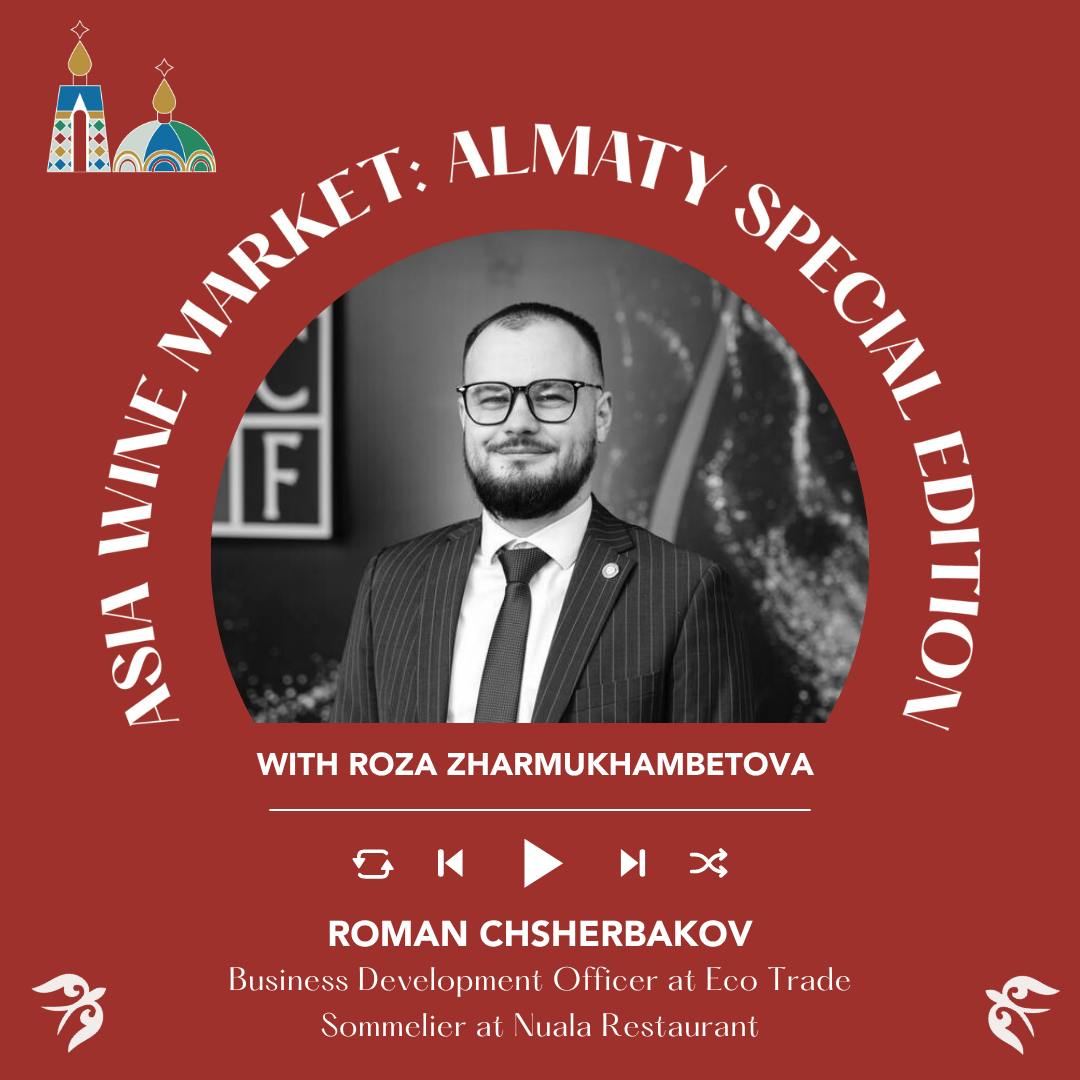
Ep. 2353 Roman Chsherbakov of Eco Trade | Asia Wine Market: Almaty Special Edition
Asia Wine Market: Almaty Special Edition
Episode Summary
Content Analysis Key Themes and Main Ideas 1. The evolving wine culture and market in Kazakhstan, particularly in Almaty. 2. The significant role of Echatrade, a leading importer and distributor, in shaping the country's premium wine landscape. 3. Roman Cherbakhov's journey as Kazakhstan's Best Sommelier and his influence on wine education and consumption trends. 4. Detailed insights into consumer preferences for Italian wines, identifying top performers and areas of growth potential. 5. Strategies and challenges for Italian wineries looking to enter or expand their presence in the Kazakhstani market. Summary In this episode of the Asia Wine Market podcast, host Rosa interviews Roman Cherbakhov, Kazakhstan's Best Sommelier of 2024 and Business Development Officer at Echatrade. Roman shares his 15-year career journey, which led him to his current deep engagement with wine over the past four years. He provides a comprehensive overview of Echatrade, a 15-year-old company that stands as one of Kazakhstan's oldest and largest wine importers and distributors. Echatrade's portfolio includes 30-35% Italian wines, focusing on artisanal, story-driven, and regionally distinctive producers rather than mass-market brands. The conversation highlights current consumer preferences, noting Prosecco and Pinot Grigio as top-performing Italian wines due to their widespread availability and ease of approach for Kazakhstan's conservative wine drinkers. Roman identifies significant potential for lesser-known styles and regions, including North Italian native grape varieties, Ramato (orange Pinot Grigio), Etna wines, and dry Lambrusco, for which he aims to revolutionize its perception. Echatrade also plans to introduce Super Tuscans and Franciacorta, recognizing the market's readiness for more sophisticated and premium offerings. Roman further discusses ""The Bottle,"" Echatrade’s innovative retail and hospitality project, which serves as a direct engagement point for consumers through various concepts, from intimate wine bars to natural wine-focused spots and discounted outlets, catering to diverse demographics and price points. He observes that while the market is still being educated on dry wines and terroir, there's a nascent interest in natural wines and surprising popularity for non-alcoholic options, though price remains a crucial factor. Roman concludes with practical advice for Italian wineries: be honest about your product, understand your audience, and maintain strong partnerships. Takeaways * Kazakhstan's wine market is maturing, with a growing appetite for quality and diverse wines, particularly in Almaty. * Echatrade is a key influencer in the Kazakhstani wine scene, focusing on premium, artisanal, and narrative-rich Italian wines. * Roman Cherbakhov, as a leading sommelier, actively shapes consumer tastes and industry standards. * Prosecco and Pinot Grigio are current bestsellers, while dry Lambrusco, Etna wines, Super Tuscans, and Franciacorta are identified as high-potential growth categories for Italian wines. * Kazakhstani wine consumers are generally conservative and price-sensitive, often preferring familiar grape varieties and wines with some residual sugar. * Direct consumer engagement through innovative retail concepts, like ""The Bottle,"" is crucial for market development and feedback. * Interest in natural and non-alcoholic wines is emerging, indicating a slow shift towards more experimental consumption habits. * For Italian wineries, key success factors in Kazakhstan include honesty, competitive pricing, and a compelling story behind the wine. Notable Quotes * ""The journey into wine start quite naturally through basically the service. I was working in a restaurant. And over time, I realized how much depth there is in the wine. Culture, geography, human stories, especially human stories."
About This Episode
Speaker 1 discusses their interest in working in the craft, their portfolio, and their desire to expand their work in South Africa. They are focusing on small and local producers, but also looking for smaller producers. They are working on a contract with some super depth craft wines and are working on a retail and hospitality project. They are open to try new things and building confidence and joy. They discuss the importance of good stories and the need for education in the industry. They also mention their approach to consumers, including their approach to the price, price, price, price, price, price, price, price, price, price, price, price, price, price, price, price, price, price, price, price, price, price, price, price, price, price, price, price, price, price, price, price, price, price, price, price, price, price, price, price, price, price, price, price, price, price,
Transcript
Roman is not only a samlier at Echestrate and Nuhala restaurant in Almaty. He's the current best samlier of Kazakhstan for twenty twenty four, but also an active voice in shaping wine culture here. Our key three learning objectives for today are explore Echatrates import strategy and its focus on premium artisanal wines. Learn about the bottle, Echatrates retail and on premise project and how it connects consumers to wine culture. And third, understand key consumer trends and identify opportunities for Italian wines in Kazakhstan's market. Okay. So let's dive in. Welcome to Asia wine market, Almati special edition with me. Your host Rosa. In this special series, we're exploring the growing wine culture of Kazakhstan, with almighty at the heart of it all. Each episode will meet with Italian wine professionals, importers, psalms, and producers who are shaping the future wine in Central Asia. Whether you are a winery looking to expand into new markets or a local expert curious about the market dynamics, you are in the right place. Hello, and welcome to Asia wine Markets, Almaty Special Edition. Today, I'm excited to welcome Ramann Cherbakhov. He's the current best samlier of Kazakhstan for twenty twenty four, a two time winner of the national blind tasting trophy, and he also holds the ASI diploma. Ramman is not only Assembly at Echestrate and not a restaurant in almaty, but also an active voice in shaping wine culture here. So welcome, Ramman. We're very happy to have you here today. Hello? Hello? Before we dive in into our main topics of discussion, can you please briefly walk us through how it all began for you? I start to work at the Horika, like, fifteen years ago. So, that was a long way for me from the beginning to the current point. The journey into wine start quite naturally through basically the service. I was working in a restaurant. And over time, I realized how much depth there is in the wine. Culture, geography, human stories, especially human stories. I start studying, tasting, then tasting more seriously, and eventually competing as a subculture, become a patient, then it, turned into a profession as simple as that So thanks to the growing familiar community because it's, start to grow massively, like, four years ago, when I start to educate myself with the new profession for myself. So in one training, that was as I remember correctly, Brankota State, New Zealand ish, Sonya, and she, like, not just me, then asked me to go to the San Jose competition, and I made it to this semifinal before I get even my basic course of seven years. That was a fast start, and then I start to educate even harder. And then you see what I've become. That is actually very impressive. So, actually, your journey in wine, a deep journey in wine started only four years ago. Yeah. I changed restaurants from the restaurant when I worked mostly with the beer, but if you're speaking about the Samelier term, first, I was working in the beer Samelier in two thousand fourteen, I guess. In Costaana. So this is, one of the northeast region and biggest northern city of the region, and I was working on some of the beer factory, which have their own restaurant, which calls Tesla should out to Tesla. And I worked as a beer samiria there, then I went to Almati and start to work in the beef eater, which is the one of the biggest wine seller in the whole country. So this is how I changed my favorite drink Okay. So you're originally from Costa. Actually, I'm originally from Durudni, which is the city in, like, forty kilometers near Costa. So it's, like, hour of road. The small city with, like, one hundred thousand people of population. Okay. Because I'm from Costa and I region as well. Yeah. I didn't know that fact about you, actually. It is good to know. Okay. So what about Echatrade? How and when did you start working there? That was, like, three years ago. I was working in the Vinole, Vineentries, a vine bar, which was, which still is my favorite place when I was working ever. That was the small bar. This is only new world style ones. There is like no old world, no Italy at all, no friends, and we were trying to push the more expressive and easygoing styles, but, we're open a little bit earlier. The market wasn't ready. So the park for now currently closed, which is very sad because it was like Liz with very beautiful people, but, unfortunately, it is what it is. So I was looking for some South African wines in my wine card, Antonina, which is for now, branch manager of Martin Hennessey. She used to work in a eco trade as a branch manager as well. She came to me to decide what kind of South African wines I'm looking for myself, and then she just, like, haunt me. This is how I became the member in the Brent ambassador of the eco trade at first. Okay. Got it. Alright. I'm very happy to know these facts about you that you're from Costa and I region as well. So let's start our today's main topics. Our key three learning objectives for today are explore Echat traits import strategy and its focus on premium artisanal wines. Learn about the bottle, Echatrates retail and on premise project and how it connects consumers to wine culture. And third, understand key consumer trends and identify opportunities for Italian wines in Kazakhstan's market. Okay. So let's dive in. Alright. So let's start with your work at Accatrade. Could you give us an overview of echo trade structure which channels and regions you cover and your main role as a brand ambassador there? Okay. Since the start of my work in the echo trade, I changed the position. Now I'm currently working as the business development officer. But for myself, it's more like the manager for different questions. So I'm pretty much working with everybody with everything. I'm trying to connect different people to work together closely and more productive. About the growth rate as a company. We started working in two thousand ten. So pretty much it's fifteen years on the market. We're one of the oldest. So it's pretty much the one important in distribution company based in the Pakistan. We worked nationwide. Our strongest city is obviously Estanayan Almaty and our clients, including the top restaurants, the boutique, the wine bars, pretty much all premium hurricane, the whole gas system, because we also a little bit working with the regions So there is a few places in the coast tonight that you can find our product, the few place in Bush, and we are looking on Paragandale pretty strongly. This is gonna be the next city for us, I guess. Also, we do have our own, the retail network. This is our wine bars that we'll talk about a little bit later. The bottle also, we do have a few restaurants for now. We have the Gogra. This is the Georgian cuisine just in front of me. So this is pretty gorgeous place to visit and with the view. And for now, and we also own the Jardino. This is the Italian cafeteria. And for my humble opinion, this is the best Italian food in the Casa stands for now. I'm one hundred percent sure. Alright. You intrigued by saying that's the best Italian food in the whole Kazakhstan. You intrigued me a lot. Okay. So let's shift to your portfolio right away. And could you tell us what is the percentage of Italian wines in your portfolio and what Italian wineries do you currently represent? And what does Ecatrade typically look for when choosing new producers to work with? Pretty much we have like thirty to thirty five percent of the Italian wines vineries like Pascal, which is my favorite in our portfolio. I like every vineer is is like the child, but this is my favorite one. Also, we do have the Fontanasa, Salvana, this small vineer is from the north part of the Italy from the PMont, the bright star, which is very close to giuseppe Quintin Terrelli. So we are very proud to have him. Fratelli Vagadori. Also, we are working with some, guys from not very popular regions in the Kazakhstan, such as Marque. We have the Santa Barbara and the Azienta Grady. Of course, we have guys from Apulia, which is the giniomorrah with their, like, very cool project called Pulia Pop and I didn't mention, we have. They're making perfect multifalca, very good. And also, Marima, of course. And what was the second part of the question? What do you usually look for when you choose new producers? To work with. This is kind of a local joke about a catrate company that we are looking for the very painful labels because we have a lot of labels with the paintings and stuff like this. But first of all, of course, this is gonna be the native varieties organic farming, strong regional identity. And, if diviner has a story, some of the USB, this is also would be great. And then, of course, of course, this is gonna be the price quality bridge without it, it's impossible to import something. For us, it's important that the wines tell a story. We are with mass market brands and look for people who care deeply about what they're doing. It shows in the bottle and it resonates with our land. Okay. Got it. So you are not into, like, very commercial, big commercial wineries. Well, you'd have some big commercial wineries for sure, but still you're also giving the chance to smaller producers if their store is resonating with you. We are focusing on the small producers, but if you're speaking about our biggest and commercial Italian producer, which is the familiar Pascal, they have site, but the main project, but it's like the sites in for them for us. Like, the project for the Soul, the My Jeremiah. So this is the Valipulichia, the classic, a superior, which got the ninety seven by Robert Parker. So I'm not quite sure that the classical commercial binaries could make something like this but they can. So they are not just the commercial binary. They're above that. And again, they have beautiful labels. Yes. Yes. Okay. Nice. Thank you for sharing that. My next question would be in general. This is a general question. Which styles or regions from Italy are performing particularly well in Kazakhstan right now in your opinion? And are there any Italian wine categories, styles or regions or maybe grape varieties, you believe could have even greater potential to become successful here. Maybe they're still not well represented or underrepresented in our market. But if given the chance, they could become successful here. Starts from beginning. The top performers, obviously, this is gonna be prosaka in Bina Gridio. It's like crush and everybody's drinking it in every Wankaj you can fight. Five, six, seven producers. So Proseca, for now, and I'm helping one of my friends to make the wine card for your place. And there is four different prosseca. All of them are, like, gorgeous, very well known, but it's seals for prosaica in the wine cart beside that the equipment and stuff like this, but the for prosaica. Because the community of wine drinkers in Pakistan, they, like, everybody loves something different. And in case of pros even if this style is quite similar, they're pretty loyal to the brand that they opened once. So we had to be, like, wider in our wine list. And the pinacresia, this is actually one of the most convenient wines Fortline specialist to give to someone who doesn't drink or didn't drink wine before because it's easygoing. It's with the medium acidity with a pretty understandable aroma. So if person try to understand the wine, like, what kind of drink is this because in the case of different categories of drinks are usually using in the, like, everyday basis. So the Phoenix region, one of the most convenient wine to start with So that's why it's very popular because the second thing that we should know about the wine lovers in Pakistan, they're very conservative. So if they love something, it's very hard to give them different style So that's why the picnic region is gonna be, I think, and it doesn't sound like for a lot of time, like, five years or something. I also see a lot of potential in the north part because there is, lots of different native grape varieties I'm looking on the Ramata style, which is gonna be a thing because the it's like the orange wine, the skin contact, but it's usually it's very gentle. And, this is gonna be like the peanut brisier, which is actually, pinacresia as well, which is gonna be the pinacresia for the orange wines. The similar usually want to work with the wines that from the gastronomic point of view, very wide. So and introduce orange to the people. It's very important. And for me, Ramathe is the one of the best styles that we can find. Also, I will tell you anything new, but Aetna is growing very well, and the vines from them are fantastic. For now, and this is my favorite region. Like, two days ago, I was opening the whole set of Aetna for the guests because they, like, we heard that the Aetna is growing. Let's try it. And I was like, yes. Today is the best day to drink Aetna because if you years later, this is gonna cost you twice. So when we drink, like, five bottles, they are pretty happy. They even try the which is extremely rare in the Kazakhstan, but I do have it in my restaurant. And also, I would mention my favorite Lambruske in the dry version because in Pakistan, the reputation of this van is absolutely awful. It's crushed by the semi sweet semi dry sweet and basically with the very bad quality of the wine, but, for now on, we're trying to start the revolution, but it's still like the one or two labels in the whole market that are like drinkable. They're great, but it's still like only one one or two So this is gonna be a thing because of the lights, Arromas, huge ACDT. And for me, this is one of the best ability for now on. Yeah. That's true. And also, it's a good way to move a little bit from prosecco to Lambrusco. Exactly. Yeah. And I think, actually, it's not only in our country that Lambrusco's reputation was destroyed many years ago. I think it's the same story in other countries to other markets. But now they're doing really great. The region does a lot of promotions. They work on it. They work on restoring the reputation and helping out the producers who make the quality wines there. And could you please tell me about Echatrade? What are you going to look for later this year or the upcoming years? What kind of styles would you like to bring? You already mentioned orange wine? What other styles you would like to bring? For now, on, we are working on a contract with some of the super tuscany's, but, it will not tell you what kind of producer it is, but we are working on the super tuscany because it's basically the liquid money in a Kazakhstan. One of the most popular style in the category of people from, like, thirty five to forty five. So which is basically the most, like, rich people from the wine lovers. So if person knows what he wants, it's probably is gonna be the Supertasking or the or rare, but still it's gonna be the Burbinski, but Supertasking is a big thing. So also, I think we end the market ready for the French quarter because for now in the Kazakhstan, there is none of Francacorta, not even the single bottle. I'm going to interrupt you. That is so true. Like, I think a couple of years ago, I tried to find Francacorta at wine bars in Asana, and I couldn't. I only found one bottle and it was super expensive. So I never drank it here. It's actually you try to find it in in Astana. In Astana, finds the good one is a little bit more tricky because I don't know, like, sixty percent of the wine drinkers of the country is currently in almaty. Astronized grow very well, but a few years ago, trying to find French Corte in astronauts, like, almost impossible. But you did well. You found, and we found the good producer of the Frenche Corta. This is gonna be huge thing, I guess, because from the last time that French recorder was on the market, the market actually pretty obviously changed. And now we have some people who could at least try from QBOC team, even if it's gonna cost, like, the bottle of shop. Pain. I was working as a waiter when French court came to the market and, when they tried to sell a bottle just to be honest, to try by myself as a sample, and then, sort of, to guess. I didn't answer the question why it cost more than the bottle of champagne, why should I buy this? And I still looking for this kind of ancillary, but for now, as I know, our producer, the price is gonna be pretty decent. So we won't compete with the, like, big houses of champagne. Then we start start to promote French Chacorta as a style and then we bring satin and styles like the more elegant, more expensive. Mhmm. I think that's a good start. So I hope French Chorta producers will listen to our conversation. And it will give them a kind of a splash of enthusiastic, optimistic view in the future. Okay. Thank you for sharing that. And you also mentioned Supertuscans you said that Supertuscan wines are pretty popular among consumers, but is it difficult for you to introduce some lesser known names from this category? Or like do consumers still look for big names, popular names, or they're also open to try some new producers from the same category. Okay. So I'll tell you two different, point of view, one of from the assembly on the floor as I work in, and the second one as I could trade Brent ambassador. So difference is if I'm working on the floor, I'm just going to the table. If person asked for some super tasking, and I was like, this is like Seshikaya, but twice cheaper. And like, I'm not even explaining anything because people usually are like looking for Seshikaya because I'm quite sure this is the most popular bottleneck in this category. And, when they hear that this is like CCaya, but cheaper deal is done. And in case if I represent the eco trade, the any of our super tuscany, now current or, future will be questionable because We have the huge standards on the market because we have all the Salayas, Cecilia, and the people love them. People recognize them. And to be a part of this niche is very hard, but it's more like very personal work in this kind of style. So you have to even go with the private service, who is the people who consume this kind of wines because this is like not everyday consuming ones. So from time to time, you're just going to private service to the people to your most available agitator. So you go to introduce the wine for themselves, and it works well. With lesser known producers, you have to do much more effort to convince your distributors, for example, or the, wine places you work with to prove to them that it's worth to order those wines? Yes. Yes. There is also a question. Why do I need them if they have cica only? Cica is a huge marker on the market? Okay. I got it. And Nuala restaurant also belongs to Echestrate or it's a separate? Okay. It's belong to Solar Group, which also have the, beefeaters. And, also, if you know, I'm pretty sure you know the Checio pops. Yeah. Mhmm. Like, I usually represent the solo group. We have the beef eater on the to stick street, which is the eldest thumb. So he's, like, left the family. He's working. He's by himself. We have the beef eater on Bramstore. Middle son, which is, actually under loved a little bit. So everybody always forget about them. He is by his own. And we have the, youngest and favorite daughter, which is Noel. So everybody loves Nuala. Nuala is one of the popular restaurant in the country on the last word to eat. Do you know what's the word to eat? Where to eat? Yeah. Just to be clear, but to eat, it's like the Oscar in Chorus segment for now. So when we got like top four in the two thousand twenty four. I also took the best summary of the year. So for us, it was like a very good day. I think you also helped the restaurant to get that trophy because you became the best summer year last year. Yes. I was quite hyped for a few months after the competition and even before because we got the Vine enthusiasts award of our wine card. We have some London Star wine list. We also got this. We also got a few different line card of words. So we were hyped for a whole summer. Then personally, I, myself, was hyping the whole autumn, and they, you know, the autumn that was the retreat. So we would quite successful day. I didn't know that no other restaurant had so many new words. That is good to know. Thank you for sharing that. Okay. Now when we've explored the import site and also no other restaurant a little bit, let's look at how Echatrade connects directly with consumers through retail and hospitality. So Echatrade, as you already mentioned, owns a chain called the bottle. Could you tell us more about it? When it was opened, how many stores you've got, and what kind of wine selection you've got there? The bottle is our retail and hospitality project, a chain of wine stores, and wine bars that we started if I remember it correctly in twenty twenty. But our main bottle not just vine boutique or vine store. This is the small restaurant, which have all of our portfolio and even more because you can find something like very rare and specific that we are not distributing anymore, but we still have it in the bottle. The bottles are not just a place to buy wine. It's where we, as you said, connect directly with customers and consumers offer tasting and take feedback. So this is usually one of our ways to understand what market wants for now. It's very important to be in touch with the final customer. For example, this is how we manage that we need the risky because if you guys from our bottles, they said could be bring the riesling because people want it so bad. So now we are looking for a riesling, but still looking. We also give advices, bring the stories behind the bottle. This also helps a lot with the marketing side because every of our workers, they know they portfolio very well. I personally taken care of it. Actually, every Wednesday, I go to one of our bottles and we are training with the guys So they're pretty compatible on every competition of Sanulier. So you'll see how many guys from the bottle you'll see in the semi final this year. This is like small spoiler on the next competition. Okay. I'm looking forward to that actually. Coming back to consumers, I visited the bottle, two of them, because one of them is just very, very close to my house, the one where you got the restaurant. I guess it's the main one as you said. And for me, they look like very modern. And also for me, the chain, the bottle looks like the place that is more open for some younger consumers. So just in case if I'm wrong, what types of consumers are frequent visitors there. And what is their average age? Since bottle vine bar opened the age dropped a little bit because David is the guy who is responsible for the vine bar he made huge work with the revolution of Nature wines, and this is, the wine for the young people, especially if they love the loud music. So they made the the concept around Nature and Biodynamic and organic, and I'm very happy that we have the wine to put in his idea. So in his place, I guess it's roughly, like, twenty one to thirty two or something like this, like the youngest that could drink legally in the case of them. Also, I didn't mention Like, two days ago, we opened one more bottle. That's why I was about to explain the difference because every bottle for now, they have less than common that they supposed to because, for example, the main bottle. So it's like the niche restaurant. It's very secluded. So you can see it. You can go for a day there. This is a little bit dark. So the atmosphere is very romantic. But from the other side, we have bottle vine bark, which is very loud with like twenty, thirty people were thinking Milaza in the whole loud. And third point, we have classic in attack in the forum, which is, one of the biggest trade malls in Ahmed. And we have the guys who just, like, working in front of the one of the biggest supermarkets in Pakistan, also the Galmar. And, like, this is absolutely basic. For now on, we are opening the bottle just opened in the run store, and this is gonna be in our minds. It's something like the bottle outlet. So we will put lots of discounts and just try to introduce fines for the people who doesn't like to pay a lot. So this is gonna be a lot of wines with lower prices. And we will see, is it gonna be successful or not? You're not afraid to make these strange steps forward? That is very good to hear. And especially because people in our country, when it comes to choosing one, they're very price sensitive. Yeah. Yes. To be honest, wines in our country, they cost a lot. And I didn't answer a question at all. So I was talking about every round, but didn't mention the answer. So our guests except the wine bar are mostly between twenty five and forty. They're curious, educated, and open to try new things. And the bottle becomes a trusted space. We keep things approachable, never intimidating. It's about building confidence and sharing joy, not lecturing anyone about divine. Okay. Thank you for sharing all those insights on the consumers continuing that conversation based on your experience, both with the bottle chain and also is a samoye on the floor at Nava restaurant. How do you think what factors seem to influence consumer choices when it comes to tailwinds? Is it the grape Is it the style? Is it the price? Is it the story? What hits most? First of all, of course, is the price then it's great price because people in Afghanistan, as I mentioned before, are very conservative. If, like, five years ago, they tried sangiovese and they liked it, they will ask for sangiovese and they don't care that sangiovese could be, like, in every possible style, the wine is made, but they just want sangiovese. So this two very important. For me as a summary on the floor, one of the things that I can use to help customer make a choice is the good story behind. It could be, of course, the, beautiful bottle or the label on it. But if we are speaking about, I don't know, Sanvediguda has a name of the wine. I always can tell the story about why this wine goes like this, and usually it sells. And, also, important thing that I didn't mention, Resideo Sugar, North Parts, lots of the cold days, and a lot of the people feel likes the not dry wines, that's why the Apulia region is one of the most popular in Pakistan. And, as they see, the Abruzzo is making a lot of right moves step by step, they becoming an next big thing in the Italian wine in the acquisition market. And it's true. And I think it wise with some residual sugar with higher levels of residual sugar that they're popular. We already talked to Zulfia We already talked to Aratmir. I already talked to Switzerland from Uzbek. And, yeah, I think all of them already mentioned that. It's very important. And all of them mentioned prosecco Pina Grijo, Primitivo. It's, yeah, it's a true story, honestly. How many of them was mentioned in dry, Lambrusco? Zula. Zulphia. Okay. Okay. And again, coming back to you already mentioned that it's one of the wine bars, the bottle, wine bars, David, who works there. He actually tries to promote the organic wines, biodynamic wines to the consumers. Could you please Tell me, do you see any growing interests in this trends in our country? Like, do you think it's becoming a thing in our country or it's still something that is it's a global trend that didn't come to our country yet? It's still a dish. Nolo wines, growing. In case of the growing religion in the Pakistan, people start to go with the non alcoholic wines more often. But for me, this trend is going to be here in Afghanistan, like, maybe in three or four years because we still educate people. For now, it's very hard to relearn people from the semi dry to dry wines. Then if we succeed with that, we start to give them the understanding of terwa and the difference between them, between the regions, between the key regions. As you hear, this is like at least twenty four bottles. And then when they have like the base of their own opinion, then we can speak about some revolutionary or natural wines because not even every summary in the case of some still understand what is natural wine. And, how it's produced and why and for what. So this is not just the why this is a philosophy behind it. So before you start drinking it, you have to be interested in it And, for that, you need to be a little bit educated. And now we're on the stage when we are still educating our customers if they're interested in that, of course. Okay. Yeah. And I agree with you, but among these friends, maybe not organic and natural, but no law wines. I think some of the producers of this kind of styles, if they have this kind of wines, I think they should pay attention to central Asian countries. Is a market for them for no low wines. Yep. Especially if the price I'm talking from the eco trade side if the price is okay. Oh, yeah. True. The biggest problem that, you should obviously make a vine, which is gonna cost something. And then the alkalizing it, which is gonna cost you more than making the wine. Yes. We now grow in in the case as soon as they see the labels. For now, we have a few. Even though in our portfolio, we have a few new labels of non alcoholic wines. And, surprisingly, we actually made a mistake because I was thinking that, I made a mistake. When we made an order, we were thinking that the sunyun Blum and this onion plant sparkling in non alcoholic will be a big thing, which is currently it is. We are very good in the selling it, but we didn't pay attention of the pin in Huawei made the smallest amount of the order on it, and it's out of stock it was out of stock, like, in a less than a month. So that's my mistake, but it shows that the non alcoholic wines are popular and people drink it well. Okay. And thank you a lot. It's a pity, but I must say that it's time for us to wrap it up. But before doing that, I've got three rapid fire questions for you. If you are ready, we can go with them. If you can answer them fasts with a couple of sentences that would be good. Okay. So the first question is, what's one key thing Italian wineries should keep in mind when entering Kazakhstan market? To be honest, be honest with yourself and your key audience. And also with your partners in the market. Yes. Right? Okay. Thank you. Next question. If you could introduce one new wine trends or grape variety to Kazakhstan, what would it be and why? One thousand nine. Okay. And I agree with you totally. And number three, the question that is not related to wine. So if you weren't working in wine, what's other profession or industry could you see yourself in? That's hard one. I would be a sport commentator. I love football. So, I I would go with that. Okay. That's a nice one. Alright, Ramon. Thank you again for your time, and thank you for sharing all this valuable insights. I think that is gonna be a very insightful conversation for Italian producers who I hope will be listening to this episode and make notes and pay attention to the names that you said, to everything that you said. And for our listeners, if they want to connect with you, what is the best way to do that? The best way it's actually just Instagram with swing the roman, you can find it under the podcast that you are hearing right now is gonna be link on my Instagram so we can always write a message and then we will find a way to contact. Okay. Thank you a lot and see you in ALmaty. Or costanay. Or costanay or Astana. Anywhere or Italy. Hopefully. Thank you so much. I appreciate that your copy here. Big thank you for every Italian vine producer that do what you do and you love what you do. Thank you so much. We very appreciate it here and train our best. To sell your wines. Okay. Thank you again. Ciao. Thanks for listening to Asia wine market Almati special edition. Don't forget to subscribe and follow the Italian wine podcast wherever you get your parts. And if you are curious to discover more about the central Asian wine scene, join us at the Venice Lake Kazakhstan Roadshow on July seventh. See you in the next episode. And until then, cheers from Almaty.
Episode Details
Keywords
Related Episodes

Ep. 2772 A Surprising Partnership between Japanese Sake & Italian Wine with Monica Samuels | Masterclass US Wine Market
Episode 2772

Ep. 2770 China’s Wine Market: From Misleading Import Numbers to Today’s Consumer with Fongyee Walker MW - Part 1 | Asia Wine Market
Episode 2770
Ep. 2760 Winning the Restaurant Floor: Training, Education & Italian Wine with Sylvester Inda of Ci Siamo | Masterclass US Wine Market
Episode 2760

Ep. 2751 From Montalcino to Kazakhstan with Francesca Arquint of Collemattoni | Asia Wine Market
Episode 2751

Ep. 2748 Florida Wine Market & Vinitaly USA with VIA Italian Wine Ambassadors Stefano Campanini & Daisy Penzo | Masterclass US Wine Market
Episode 2748

Ep. 2746 From Almaty to Verona: Inside the Italian Sommelier Challenge with Leonid Kirsanov | Asia Wine Market
Episode 2746