
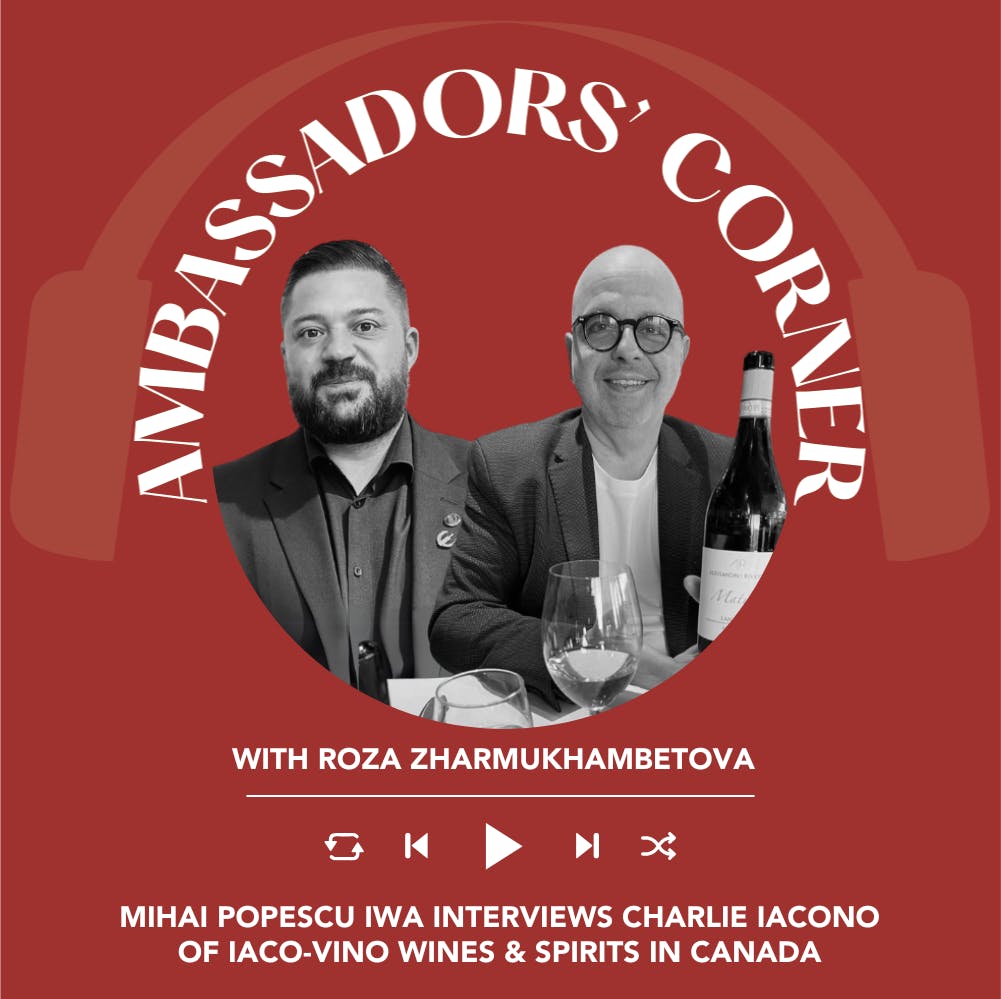
Ep. 2406 Mihai Popescu IWA interviews Charlie Iacono of Iaco-Vino Wines & Spirits in Canada | Clubhouse Ambassadors' Corner
Clubhouse Ambassadors' Corner
Episode Summary
Content Analysis Key Themes and Main Ideas 1. The landscape and opportunities for Italian wines in the Canadian market. 2. The role and vision of Charlie Yacono and Yacovino Wines as an Italian wine importer. 3. Consumer preferences and emerging trends in Canadian Italian wine consumption (e.g., organic, specific regions). 4. Challenges and strategies for Italian wine producers navigating Canada's provincial monopoly systems. 5. The impact of global trade shifts, specifically US tariffs, on Italian wine's position in Canada. Summary In this episode of the Italian Wine Podcast, hosted by Mihai Popescu and Rosa, Charlie Yacono of Yacovino Wines and Spirits discusses his journey from a Montreal restaurateur to a dedicated importer of Italian wines in Canada. Charlie emphasizes his passion for bringing unique, small-production wines with authentic stories to the Canadian market, often building personal relationships with producers. He highlights the significant presence of Italian wines in Canada, accounting for 20-23% of sales in Quebec's SAQ, making them a major import. The conversation delves into current market trends, noting increased consumer interest in organic, natural, and low-intervention wines, as well as the growing popularity of Prosecco and premium reds like Barolo and Brunello. Charlie also points out the shift from Italian wines being seen as ""special occasion"" to ""everyday drinking."" He identifies emerging regions and grapes like Sicily's Nero d'Avola, Grillo, and Catarratto, Puglia's Negroamaro, and Valpolicella wines from Veneto as gaining traction. Navigating Canada's provincial monopolies (like SAQ and LCBO) is discussed as a major challenge for producers due to complex rules and high costs, but Charlie also stresses the opportunity presented by recent US tariffs, which have created shelf space for Italian wines. He advises Italian producers to seek committed importers, prioritize authenticity, consistent quality, good value, and share their unique stories to succeed in the Canadian market. Takeaways - Charlie Yacono, owner of Yacovino Wines, transitioned from a restaurateur with a large Italian wine cellar to an importer, focusing on small, authentic producers. - Italian wines hold a substantial market share in Canada, representing approximately 20-23% of sales in Quebec's SAQ. - Canadian consumers are increasingly drawn to organic, natural, and low-intervention Italian wines. - Popular Italian wines in Canada include Prosecco, premium reds (Barolo, Brunello, Super Tuscans), and regional specialties from Sicily, Puglia, and Valpolicella. - The Canadian market has shifted from viewing Italian wines as solely for special occasions to being suitable for everyday consumption. - Provincial monopolies (SAQ, LCBO) pose significant entry barriers but dedicated importers can help producers navigate the complex system. - Recent US tariffs have created a ""win-win"" opportunity for Italian wines, opening up shelf space in the Canadian market. - For Italian producers, authenticity, quality, consistent style, good value, and a compelling story are crucial for success in Canada. - Finding the ""right agent"" or committed importer is paramount for Italian wine producers looking to enter or expand in the Canadian market. Notable Quotes - ""The idea was always to share the kind of Italian wines that I was passionate about. Like, the unique small production of wine that the real stories behind the wines that they make, actually. I wasn't interested in the big commercial stuff."
About This Episode
Speaker 1 discusses the importance of sharing Italian wines and offers a clubhouse session. They also introduce a fellow Italian wine community member, insider, and interviewer, Charlie Yacono, who is a fellow Italian wine bugger and a wine expert. Speaker 1 discusses their personal journey into the wine industry, their role in the Italian wine industry, and their desire to expand into new regions and price points. They also mention the challenges faced by small and large wine producers in the Canadian market, including taxes, markups, and import costs. Speaker 1 emphasizes the importance of quality over hype and the need for agents to understand the product and sell it on the Canadian market. They also discuss the importance of finding the right importer and partnering with them to create new products. Speaker 1 is interested in finding a good agent for a wine producer in the Canadian market and suggests reaching out to them. Speaker 3 thanks Speaker 1 for their time and offers advice on how to attract a
Transcript
What was the story or a division behind? I think you mentioned small producer and quality producer, but can give us some examples of the producers you work with, or at the regions, and the vision you have even moving forward, what's the vision with the the way you see importing Italian wines? Yeah. Absolutely. The idea was always to share the kind of Italian wines that I was passionate about. Like, the unique small production of wine that the real stories behind the wines that they make, actually. I wasn't interested in the big commercial stuff. I just wanted to find and, and felt personal with the small producers and be, like, family with them also. So that made it really, really interesting. Welcome to the special club house session of the Italian wine podcast. Listen in as members of the Italian wine community engage in fascinating conversations about contemporary wine topics. If you enjoyed the show, please consider donating through Italian wine podcast dot com, and remember to subscribe and rate the Italian wine podcast wherever you get your pods. Hello, everyone, and welcome to a new episode of our clubhouse Ambassador's Gordner. And today, we are joined by Mihai Popeescu. He's our fellow Italian wine Ambassador from Canada. And today, he's going to interview Charlie Yacono of Yacovina wines and spirits from Canada. So welcome, guys. Welcome, Mihai, and welcome Charlie. I hope you are doing well. Thank you. Yes. We're doing well. Well, thank you for having us. Thank you for having us. Yes. It's a nice opportunity to talk about Italian wines and talk about Italian wines here in Canada. Okay. And thank you guys both for finding time. Actually, this recording is happening in three different countries. So Canada, Italy, and Kazakhstan. So by the way, I didn't introduce myself. I'm Rosa. My name is Rosa. A very long Kambly name, which our colleagues in office still cannot remember. So now let's move on. First of all, I would like to introduce Mihai for those of you who don't know him yet. So Mihai Popescu, he is our fellow Italian wine Ambassador. He's based in Canada. He's a wine expert dedicated to helping producers enter and thrive in the Canadian market. He holds W said diploma, and he is also an international wine judge who supports wineries with strategic brand positioning, market access, and distribution. Mihai also organizes professional tasting events, attends major trade shows, and creates tailored marketing plans to boost visibility and sales for the wineries. He's active on Instagram and social media. And in the show notes to these episodes, we are going to share with you how you can reach him. So he also reviews and promotes wines mainly Italian to an engaged audience of wine lovers professionals blending digital influence with in market expertise. So, again, welcome me, hi, and before we start, I would like to ask you three questions. Those are our three ritual questions. First of all, how did you meet Charlie and how did it start to you both? The first time I met Charlie, I was invited to one of his, portfolio tastings. And I was really impressed with the nice selection of Italian wines he was offering and how dedicated he was to promoting the wines, to talking about wines, I think he was one of the first person to spark a lot of interest from my side on Italian lines. Okay. That's very interesting. And could you tell us why did you choose to interview Charlie for these crop House session. So I know Charlie for a few years now, maybe more than five, probably almost ten. And I think I see him often at trade shows, and I see his dedication and knowledge about Italian wise, and that's He's solely focused a lot on importing Italian wines. And also, let's not forget. He has a lot of expertise in the restaurant and import business of Italian restaurant and import business. So I think he's a great person to give us their insights And what's going on on the Canadian market with Italian wines? Okay. Got it. And I really think that is going to be a very timely conversation regarding what is going on in the global wine market. So thank you for inviting Charlie. And the last question from me to you would be, what are the learning objectives that we should expect from this interview? What we are going to learn today? I hope we can cover everything. So the main points be the role of Italian wines on the Canadian market, the trends and demands of the market, what's going on at this moment, a few strategies for Italian wine producer that wanna be on the Canadian market, especially with the monopolies. And, obviously, we're gonna talk about the USA tariffs and how it can be opportunistic for a data in producer because there is a lot of changes going on, because of these tariffs. And I think there could be some opportunities for data in wine producers. Great. And I really think that it's going to be a very insightful and practical conversation for all our listeners. So it's time for me now to mute myself, and I'm going to give the mic to me, hi. So enjoy. Thank you, Rosa. And, I hope it will be interesting for everybody because, we're gonna cover a few nice topics. Thank you, Charlie, for taking your time to answer the questions to be here. And, we'll start a bit slowly. I would like to know, tell us a bit to you about your personal journey into the wine industry and how you came to focus only on Italian wines and importing Italian wines in Canada. Yeah. Hi, me. Hi. Yes. Absolutely. Listen, I spent over thirty years running a well known Italian restaurant in Montreal, which with a wine cellar of over twenty five thousand bottles, strictly Italian wines. And over the years, I've built strong ties with these producers that used to come to my restaurant and I used to appreciate their stories and the people behind their wines. When my health made it tough to stay in the restaurant world, I knew it wasn't I wasn't done with the wine. So I launched an importing company called Yacovino, focused on Italian wines that I know and love so much. Now I get to share the passion across Quebec bringing in unique small producers that well deserve a place on their table. What was the story or a division behind? I think you mentioned small producer and quality producer, but can you give us some examples of the producers you work with or the regions? And the vision you have even moving forward, what's the decision with the the way you see importing Italian wines? Yeah. Absolutely. The idea was always to share the kind of Italian wines that I was passionate about. Like, the unique small production of wine that the real stories behind the wines that they make, actually. I wasn't interested in the big commercial stuff. I just wanted to find and, and felt personal with these small producers and be, like, family with them also. So that made it really, really interesting. Over the time, the business naturally evolved, I started with a juice, a few producers, and now I worked with wineries all over Italy. A lot of them have become friends and feel like family, actually. So we actually call each other to see how we're doing, how her things are going, and how production is doing. It's going beyond importing too also. So we go see them, they come and see us, and that's what's creating an experience through the tastings that they have And also, we have, a wine club that we make our members try their different wines that we have. So it makes it really interesting. Do you sometimes bring producer in from Italy? Do you have, any strategies to promote that are a bit different or outside the box thinking of the new gen zs, for example. I mean, you talked about the wine club, but do you have a vision where moving forward where you can approach the younger generation with that? Absolutely. I usually invite my wine producers, especially the small ones that I think that are fantastic, amazing. I invite them. We do events. We do like wine tastings, I do shows also with these wine producers also. Like, wine shows that, that people come in and they try. And and a lot of them get great, great feedbacks. I enjoy doing what I do and I enjoy telling people the story behind. And I enjoy also introducing these wine producers to my clients, my, restaurateur, my private people. So that's where where I'm at right now. Overall, where do you think the role of Italian wine? What do it what's the role of Italian wines currently play on the Canadian market, voting volume perception, market shares? We all know it's the monopolies, but, if you have an idea of it, how big is the market, how much they represent? Any movement on its to to the increase? Do they sell more compared to the last few years? Yeah. I think I think Italian wines play a major role in the Canadian market. They actually, some of the top imported wines by volume. With a strong, market of twenty percent. Like, they have a twenty percent market in Canada. And the Quebec SCQ reports that Italian wines make up twenty three percent of all their sales just behind France, which they have, like, thirty to thirty five percent that they sell. Consumers are increasingly, drawn to Italian wines for their quality variety and authenticity. Like, prosseco and organic options are especially gaining popularity, sparkling wines, particularly prosseco, lately, monthly sparkling wine drinkers have grown by, like, by year one point eight million cases on sales. As for restaurants, they're growing demand for premium Italian wines like barrolos, brunellos, Canticlassicals. Those are the the strong wines that that have really gone big. I've seen a shift in Italian wines, used to be seen as a special occasion thing to drink, but now it became part of everyday life. People enjoy it casually, whether it's dinner or get together, just relaxing. It's less than, about luxury and more about having good time with friends and enjoying a great pool of glass of wine. I think those are a very great news. I just wanted to add something for the listeners here in Quebec. It's a monopoly or also in Ontario. Each province is a monopoly. Here we have SAP. And just to give some market perspective, it's around four billion dollars of sales they do per year and seventy percent is wine of which, like, Charlie said, twenty two to almost twenty three percent of the sales are Italian wine. So I think It's a great market only in our province, for Italian wines, and I'd see it. As you said, it's increasing. And people, they love to travel to Italy. They like to discover wines. And, once they travel, they like to keep drinking the Italian wines. The next question would be, are there any for you as an important? Do you see any specific regions or variety that are gaining traction? Some, maybe your consumers or some less known regions that now are becoming popular? Yes. Of course. Sicily, that's where my parents come from. They're getting a lot of buzz, especially with their narrows, and the gorillos, and the cattaratos that are easy to enjoy. Negramato from Pulia, which I import also, which is one of my favorites really, really great. And from the north, the Ebola Jala, which was a wine that was forgotten about and now making a comeback, it is really, really a great wine. It's crisp, nice fruit flavors to it. Easy to enjoy. Fumante, of course, they have their nebulos with the Barrolos and Barbara Escos. And Tuscany, yes, Tuscany. It's Tuscany. Right? So they're San Joseese to do the campus and the Bernellos, especially that's a favorite of a lot of, people that enjoy that. And the prosecco, which is made with glare and grapes, is super popular right now. I'm not only from Vanito. That's what people giant like when they like something really bold and robust. That's a good way to enjoy also. Have you seen any shifts towards more natural, organic, or this type of approach in winemaking? And as you mentioned, some lesser known region, like, from the north, like, there is Ebola, but Anything else that you have seen going on in the market? Yes. I see here in the Quebec market, a lot of people are concerned about if it's organic because they're they read too much about having, too much pesticides being put on and doing whatever. So, yes, a lot of my importers or a lot of my producers are, actually organic, natural. They don't filter some of the wines. So they make it as as natural as possible. I'm a sufferer of migraines. So I tend to go towards those type of wines. And also, it's important for them to know how much sugar is involved and they're bottles of wine. So everybody's into this the amount of sugar per liter there is inside the wine. So last time, I tend to look at that. We're not gonna go with the number only with the number only. There's seventeen percent sugar to the bottle. Will go more like, brunello or Barolo, which is less than two grams of sugar per liter. So that's what people are looking at right now. So I guess the market is ready to discover a new regions, a new grapes, more also the organic, it's encouraged. Any price points, you know, that are doing better at this moment. You mentioned for a restaurant, and maybe it's the premium wines, but for the wholesale or, you know, the stores, like, the monopoly stores, What do you think is doing better at this moment? Yeah. I think, I think people like price per the quality that they get also. So I try to get them a good deal all the time. I'm here to not to go and not make money. Right? Everyone's here to make money, but I want them to enjoy the type of wines that I bring also. These wines are not expensive. I can import some wines that are very expensive. The most expensive wine that I have is one hundred and twenty dollars that I sell to the restaurant tours. The least expensive wine that I have is fourteen dollars, but a fourteen dollars bottle of wine is more for everyday cooking. I mean, everyday drinking. Have a glass of wine here, have a glass of wine there. I mean, and it's also not very high in sugar. It's two grams of sugar. It's not organic, but it's it's a great one. So tuscan wine. It's great to drink. Everyone enjoys that. And that's very good to hear because as we know, we need to democratize the wine drinking and have to be more accessible, especially for the younger generation with always the price rising. So it's good to hear that, importers like you try to find also products that are interesting and price point great value. And, it's leading me to the next questions. What qualities or strategies should Italian wine producer have to stand out for the buyers or reporters like you or for the so they can, get more attention on the Canadian market. Yes. I understand. For one, authenticity is key. Right? Canadian buyers love producers who stay true to their roots. Family Run Regional, they're hands on, with real sense of tradition. It makes it feel like the wine is special. To quality over hype, it's not over flashy labels. It's what is made inside the wine. Right? The what is delivered to your glass of wine. That's what I find. The practices that they have also is being open on how wine is made. They like to talk about how it's done, how it's made, traditional method, organic, low intervention. That's the way it is. And people also like a great story behind it. Right? They like to understand how they started, which ancestor went through it, how it became to beat what you're doing now. Then, of course, like you said, great value. Everyday drinking wine has gotta be a good wine. Right? It's gotta be I have Barrellas that are not too expensive. I have brunellas that are not too expensive, but I had to go out to Italy and go out and find and search these guys and meet up with them and struck a deal with these guys. Also, consistency, they have to always have their style of wines and make sure that it stays true to what they do and and stays true to how I sell it. Right? It's gotta be great. It's gotta be fantastic. People have to love the flavors of of what I'm giving them. And being a good partner with them is is awesome. Like, the producers who are easy to work with I like that. I really love it. I think I need to support them, and they need to support us also. So that's what really stands out for me in doing all this. Do you think, so you were talking and you work a lot with these small producers Do you see any challenges that they face a lot here on the to enter or to stay on the Canadian market trip? Because sometimes, you know, the wines, they show up at the monopoly, but then after a few imports, they disappear. So, I mean, for sure there's challenges that they face. Absolutely. Listen. The challenges are there. Right? There's the taxes, the markups, import costs. All the costs can push prices up. Also, they need to stand out. There's a tough competition. With many wines in the market. It's hard for smaller names to get noticed. It's complicated also. Like, the regions have a complication. Each province has its own rules, which can be a tricky to negative, especially for the producers that are unfamiliar to the system and fighting the right partner, right, defining the committed importer like I myself is key. Without one, it's nearly impossible to build an awareness connection with the right audience. As for Quebec, execute system, Quebec, is a controlled market. So all of the wine goes through the ACQ. They're, like, as we say, the mafia of the wines and and and and liquor. Right? So ACQ can be a long and complex process, especially for small producers trying to get listed. French language is required. All the labels have to meet the French criterias, right, to make sure that everything works out for them. And SQL only allows private importers to sell by the case. So I usually bring them in by cases of twelve. So if I have to sell it, let's say you are, as a private person, I wanna sell you a case, you have to buy twelve bottles. I can't sell you one bottle. I can't sell you two bottles. You have to buy twelve bottles. That that's what makes it a little bit more difficult for us, agents. I mean, those are very important challenges, but that gives a bit of opportunity for the producers to learn that it's important to have a the right agent that understands your product and knows how to sell it here on the Canadian market. And not to be discouraged by the ice security. What do you think on the role of the agent would be and to explain a bit to the Italian producers or anybody that's interested in doing business here, especially with the SECO or the LCB on Ontario? Well, honestly, all the global trade drama have helped Italian winemakers to make it an impression here throughout Canada, right, rather is, LCBO or, SCQ. With no US wind on the shelves, on the SCQLC, it's a plus plus for us. It's a win win for us, actually. So we're getting to expose more of our our products to the restaurateurs and to the people. Italian wines are two step in right now. Great quality tons of variety and no trade barriers with Canada. Like I said, it was a win win situation on that. For Italian producers, Canada's become a solid welcoming market, especially when things are more uncertain as elsewhere. I just wanted to mention to everybody that's listening since the trade tariffs in Canada, most of the provinces, the monopolies have taken out the USA wines from the shelves. So that's why Charlie was mentioning that there's opportunities because these shelves are empty and out it gives opportunity to other countries to take off that space. Also, they're encouraging Canadian wines, but I think the to replace some American wines, you would need something that's similar from Italy or sometimes what could the consumers look for. So Charlie, do you see any differences since, I think it was March that they took off the wines from USA, and did you see any differences in your market share or if you see more demand for your product? Yeah, for sure. Every sense that US imposed a tariffs with the policy, it impacts how wine moves across the borders. Right? So and, Canada, if you felt that a lot. We felt that our buyers are more interested in buying higher end wines for that reason because they were buying big cabs, big merlots from the United States. And we came about now doing big bariolos, big brunellos, or big super tuscans, that people are more interested into it. Also, that opened the door for us, the Italians, and other European countries, right, winds to gain more visibility in the Canadian consumers are responding. They're exploring new regions, trying new grapes, and have considered before and not realizing the amazing value that you get that on the usual as a suspect. Did you see any effects for the let's say for your partners from Italy, like, the producers, do you see that they're ready to be more involved on the Canadian market, to be more price competitive since they're unsure of what's going on with the USA market, and they have volumes to sell. Do you think you have more, flexibility in, pricing or, imports or budgets here to do events or to promote the lines? Well, yes. Like I said, I need to find the right partner, the right producer. I understand the provinces, by provinces, then I try to deal with these guys and make it possible to bring their stuff in to introduce new products that they have, finding the right partner is key right now. It it all starts with for with the importer, ourself, right, the high being an importer and trying to find the right producer and the right wines that they make understanding, them also is is key too. They're finding it difficult because they're not importing their wines in the States anymore. So we're helping them to try to bring more more stuff here to our country and our provinces. Making the story stand out is key right now. Customers love authenticity. Share your vineyards, to your family history, your passion. I I have a true passion for wines. Like I said, I was a restaurateur and really met a lot of these guys. And when I went back to Italy, they all recognized me and they all were impressed, and a lot of them wanted me to become their wine producers. So that that was a pretty good, feeling that I had. And that's it. And, before before I have one more question and actually two more questions, any advice you would give to the producer, but let's say I would start with, like, you mentioned, finding the right person, the importer that knows exactly the rules, the ways to go with the monopolies and to understand all the recommendation, but also to understand how they can apply for tenders or how they can sell inside the Monopoly store, which is a big market for a Italian wines. Yeah. For sure. My producers wanna get on the shelves. I find this it's I I'm not a big company. I'm I'm a company with two working, right, my wife and myself. So she does all the back end. She does, everything else, and I do all the sales, the sales, and all the ordering of, of the wines and everything. So, yeah, I think it's important that the producers wanna know about the tenders and how to do it and the way to get it. Well, they have to do. I tell them what to put out and they do the tenders. That insists of them getting their wines on the the execute shells or the LCCO shells, as they say. I would try to make it interesting for us. And besides that, doing the orders and making it simple for them, I'll take care of that. Then they just have to accept the order. When I make the order, I just tell them how to make sure that the labels are conformed, with the the Quebec laws and, the rest is history. Before you go, we had a question in the room chat, and Beth Burde was saying Canada has been a global leader in park volume of Venetos, Valpolicella and Amaroni. And did you see you personally as an importer? Any changes in the affinity of this wines in the past years? Also, because the what's happening with the tariffs, maybe Dalarone could replace some of the American wines. Yeah. For sure. Maroney is one of my favorite wines. Well, they have also, Balicellas. They do Repasos. They do white wines also. They do the Chaltos. So in that area, I have a great producer, which is called Ventura These guys are, family run. They work the fields. They get dirty. They get to see what what's going on. They have about fifty hectares of land. And they're out there picking and, drying their grapes and doing whatever they have to do. On my behalf, yes, I've seen a growth on the sales of Ameroni. I've seen a growth on the sales of Valicello, and I've seen a growth on the sales of Repaso. That El Paso has been always on the rise. I'm at only. It took a little bit of time, but it's now recognized. People are really enjoying the Amaroni, but the Val Poll each other has become the everyday drinking for the people that really enjoy wine. It's an easy drinking wine. It's smooth. It's very fruitful. It has a lot of flavors to it. And, yeah, and I see that it's really getting up there. And, we still had another question. You mentioned before, do you the question was do you import any sicilian wines? And I'm gonna add something a bit to this question, knowing the trends that are going on now with the monopoly, there are push for a lighter red and, obviously, sparkling wines and white wines are increasing. Do you have anything in mind that you're looking for in the next six months to a year, any producer, any regions, any grapes that there you you're eyying or trying to bring new on the market? Yes. I do have, a wine that I import from Sicily. This is called the Pocente. These guys are natural organic unfiltered wines. Their wines are fabulous. Their grapes are amazing. The Grillo is a unique grape from Sicily, the Kataratos, a unique grape from Sicily, and the Nero Dao has a unique grape from Sicily also. The Nero Dao has a red wine. It's a full body type of wine because the sun there is too powerful. Qatar is a nice apricot flavor, peach, crisp wine, easy to drink. Grillo is a complex full body wine as a white wine. It's really, really great. Really enjoy their wines. And I also started with their orange wine that they they started doing, which is called Chinkue in Verne, which is five winters These wines are are amazing. It's made with Qatar. So it's, really full body, also really nice. And they always they give it out after this they sell it after five years that it's been in in barrels. That's great to know. And, anything more like light threads from Sicily or any other regions from, from Italy that you have in the portfolio or you think of bringing to answer to this new trends, the marketing the market demands? Yes. Actually, I'm actually looking for a a producer that's from Sabania. I wouldn't mind trying, the Canal wines. They're usually lighter, easier to drink wines. It's It's got a lot of character, but, I enjoyed those style of wines. So my next step is to go out there and try to find the right little vineyard that I could import and impress the Quebec market and give them a story on their behalf. So, yeah, Sardenya is my next my next stop to go do that, right, right there. I know you're a busy person, and I'm gonna leave you with one request before, we say goodbye. I would just like to have one last, maybe a suggestion for any wine producer from Italy that likes to step into the Canadian market or any young people, sommeliers that would like to get into the import business. We had a question in the group. So any advice you would give, first, an Italian wine maker that would like to come to the Canadian market, and then maybe for young people that would like to start their import business. Absolutely. For a wine producer that would like to branch out to the Canadian market, it'd be great to find the right agent, the one that's gonna push a product the one that's gonna make you believe your product is the one that's supposed to be there. So, yeah, the agent is is the key for the Canadian producers. Four young people that wanna become an agent it's a tough world out there. You have to hustle. You gotta work every day. You gotta know your your stuff. You gotta know people. You gotta go out and make the restaurants, make the people show the people what you have and That's the way it is. I mean, it's a great career. It's fun, but it's also costly. So you gotta make sure that you get there. You gotta make sure that you have your move. You have your energy to go out and actually sell these wines and show them what you have and make people taste what you have. Thank you so much for, for all the insides. And thanks for taking your time to explain a lot of the stuff that's going on. Maybe didn't cover most of it because it's a very complex market, but it gives an idea on what's going on and the interest for the Canadian wines and for the Canadian market. Sorry. And, to understand that the canada's here to stay as a market and it has a free trade with, Europe. And I think there is a lot of opportunities at this moment. Absolutely. I think there is a lot of opportunities in the Yeah. The free trade that helps helps a lot. So it works with that. Thank you. Okay. Thank you, Rosa, for a for the supply to meeting. Okay. First of all, thank you a lot. I think this is not gonna be just insightful to the listeners and also to the wineries, but I think also to the wine professionals, for me, it was super exciting to listen to that conversation. Because I didn't know, for example, that Canada was, monopoly. And now I'm kinda searching for the information how it is in different provinces, how the system works. That was really interesting conversation, and we really hope that Italian wineries will use this opportunity to learn about Canadian markets a little bit more. And also, especially some producers from Sabania will listen to this conversation too. That's great. Okay. It's time for us to wrap it up. Thank you again both for your time, and we're going to see our listeners in another club house episode next week. So thank you, Mahay. Thank you, Charlie. Thank you, Rosa. Thank you, Rosa. Thank you. Goodbye. Bye. Goodbye. Listen to the Italian wine podcast, wherever you get your podcast. We're on SoundCloud, Apple Podcasts, Spotify, email ifm, and more. Don't forget to subscribe and rate the show. If you enjoy listening, please consider donating through Italian Wine podcast dot com. Any amount helps cover equipment, and publication costs. Until next time. Cheaching.
Episode Details
Keywords
Related Episodes
Ep. 2786 A Journey into Italian Biodynamic Wine with Stefania Pepe and Artem Lebedev IWA | Clubhouse Ambassadors' Corner
Episode 2786

Ep. 2780 The Bridge between the Past and the Future of Wine with Serena Costanzo from Palmento Costanzo on Etna | Clubhouse Ambassadors' Corner
Episode 2780

Ep. 2769 The Younger Wines from the Volcano with Giulia Monteleone & Darya Nagornyak IWA | Clubhouse Ambassadors' Corner
Episode 2769
Ep. 2762 The Fashion in Wine with Mariano Buglioni & Ekaterina Vislinskaya IWA | Clubhouse Ambassadors' Corner
Episode 2762

Ep. 2750 Planeta Winery: Discovering Sicily’s Marine Wines with Patricia Toth & Stephanie Johnson IWE | Clubhouse Ambassadors' Corner
Episode 2750

Ep. 2745 Discovering the "Rive" of Conegliano Valdobbiadene with Lucia Fragoso IWA & Alessandro Favaro of Rivaluce Winery | Clubhouse Ambassadors' Corner
Episode 2745