
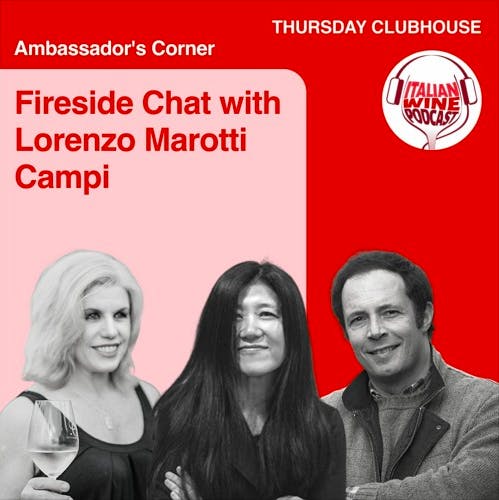
Ep. 790 Marcia Hamm Interviews Lorenzo Marotti Campi | Clubhouse Ambassador's Corner
Clubhouse Ambassadors’ Corner
Episode Summary
Content Analysis Key Themes and Main Ideas 1. The structure and purpose of the Italian Wine Podcast's ""Ambassador Corner"" Clubhouse sessions. 2. Lorenzo Marani Campi's personal journey and family winery in the Marche region. 3. The unique history, characteristics, and diverse expressions of the Lacrima grape. 4. Winemaking philosophies and practices for both Lacrima and Verdicchio at Marani Campi. 5. The importance of being an ""estate grower"" and the ethos of independent wine producers. 6. The challenges and rewards of running a family winery, including market distribution and personal passions. Summary This Italian Wine Podcast episode broadcasts a Clubhouse session from the ""Ambassador Corner,"" hosted by David Kim and moderated by Marcia Hamm. The focus is on Lorenzo Marani Campi, a winemaker from the Marche region, and his family's pioneering work with the indigenous Lacrima grape. Lorenzo recounts his unexpected entry into the wine business, his winery's significant role in preserving Lacrima from near extinction, and the grape's distinctive characteristics, notably its ""tearing"" skin. He details how Lacrima is crafted into various styles, from fresh, aromatic young reds (Rubico) to age-worthy, complex expressions (Origiolo), and even sparkling and sweet wines. The discussion also touches on the winery's Verdicchio production, its global distribution, and Lorenzo's strong belief in the ""estate grower"" model, where wine is produced solely from one's own grapes. He candidly shares insights into the practicalities of managing a family business and his passion for travel photography, which complements his winemaking career. Takeaways * The Italian Wine Podcast's ""Ambassador Corner"" provides a platform for in-depth discussions with Italian wine producers. * Lorenzo Marani Campi's winery in Marche played a crucial role in preventing the extinction of the Lacrima grape. * Lacrima is named for the ""tears"" (juice) it sheds due to its delicate, yet thick, skin cracking as it ripens. * Despite its aromatic nature, Lacrima wines, particularly the Origiolo expression, can age exceptionally well, developing complex spicy and balsamic notes. * A true Lacrima wine should be completely dry; any sweetness indicates added sugar. * Lacrima is a versatile red grape that pares surprisingly well with a wide range of foods, including white meats, fish, and certain cheeses. * Marani Campi is an ""estate grower,"" meaning they produce wine exclusively from their own vineyards, aligning with the independent wine growers' philosophy. * The winery produces various styles of Verdicchio, including a unique ""macerated wine"" that is not considered an orange wine. * Lorenzo Marani Campi balances his winemaking responsibilities with a passion for travel photography, using his business as an opportunity to explore the world. Notable Quotes * ""Teardrop, it's because the skin of the grape, it's thick, but fragile. And, when it gets towards the maturation, since the cluster tend to be very compact and tight, the the skin breaks and leaks black tears on the ground."
About This Episode
The Italian wine club is hosting virtual clubhouse sessions for their twenty eighth edition, introducing their twentieth edition, their Italian wine expert Marco, and their Italian wine expert Marco. They discuss their success in the Italian wine club and their plans to expand their store in Edmonton. They also discuss their success in the Italian wine industry and their plans to expand their store in Edmonton. They also discuss their experience with Italian wines and their plans to expand their store in Edmonton.
Transcript
This episode is brought to you by the Italy International Academy, the toughest Italian wine program. One thousand candidates have produced two hundred and sixty two Italian wine ambassadors to date. Next courses in Hong Kong Russia, New York, and verona. Thank you, make the cut. Apply now at viniti international dot com. Welcome to this special Italian wine podcast broadcast. This app is episode is a recording off club house, the popular drop in audio chat. This clubhouse session was taken from the wine business club and Italian wine club. Listen in as wine lovers and expert alike engagements in great conversation on a range of topics in wine. If you enjoy listening, please consider donating through Italian wine podcast dot com. Any amount helps cover equipment, production, and publication cost and remember to subscribe and rate our show wherever you tune in. So hello everybody. My name is David Kim, and this is the Italian wine club. I believe, like, is this the twenty eighth edition? I can't remember. Yes. This is the twenty eighth edition. Okay. Great. This is I don't know. It's it's pretty hard to believe. It's the twenty eighth edition. Of Ambassador Corner at the Italian wine club on Clubhouse. Of course, you guys know that we do replay this on Italian wine podcast at some point, and it has been absolutely fabulous. We published the top ten list from two thousand twenty one, by the way. Thank you all so much for supporting us. We've hit million listens just last year alone. It really means a lot to us. So and And the Ambassador Kona has been very successful. And I would I would love to thank all of our ambassadors for that as well. So today is our twentieth edition. And we are here with Lorenzo who, Marcia will introduce. But let me just tell you what this is about. Most of you, I see in the audience, you know what this is all about. The ambassadors corner is so that we can kinda bridge the gap between week. They tie in ambassadors at large and with with the producers. So and they get to choose their favorite Italian wine producers. And this is where we have a small chat for one hour. I tried to, mine everybody's time, so we try to cap it off at one hour. Mog. So today's, moderator is Marcia Ham. Did I say it correctly? I never know, like, how to pronounce your first name. No. You totally got it right. Steve. Okay. Thank you. Okay. So it's Moxie Ham, and she's our Italian wine expert, one of the very few, which means she's the top level of the VINita International Academy. Ambassadorship. She is based in, and still at Edmonton. Is that correct? Yep. That's right. Okay. And and specifically in Iverta with your friend, Gervender. Do you get to seek Gervender much? No. I think he's, he's off traveling again. He's been, he's been in other parts of the world doing some wine judging. So, hopefully, you'll be coming back to Verona and you'll get to see your neighbor in Verona in April. Isn't that? How how, yeah, how interesting is that? So right now, tell us a little bit about what you're doing right now, Latia. I remember when I when I came to you, you were running a wine shop. In your area, specialized, of course, in Italian wine. But what are you doing now? I am in a different wine shop. I'm in a very large, what some people would call a big box store. However, we sort of bridge the gap in our store between a boutique and a large store because we do have a a very niche selection of wines, and and we do specialize in Italian wines here as well, since my arrival, the Italian section has certainly expanded. And so I run the vintage room here, which is the collectible, seller worthy wine room, as well as, I'm the floor manager. I make sure things are kind of running smoothly here on the floor and do a lot of do a lot of sales. Great. Fantastic. And the shop is called every everything one and more. Is that correct? That is right. Yeah. Okay. So, first of all, congratulations. I don't know when you got your diploma, but you're also a diploma holder. And you also did the Italian mind scholar program. So you're also an Italian mind scholar. You're also do an educator for Vineita International Academy. You did one course. Right? You had a groupage of group of one class, or did you do more than that? No. I just had the one class. That was in December of twenty nineteen, and then we all know what happened after that. Right. Right. So you how what is the COVID situation then right now? Well, it's, you know, we're certainly not locked down, but it's, it's masks everywhere you go. And, you know, hospital, admissions are still up. And we're just who are I think like everybody else just trying to run its course and and get through and move on. Yeah. I I can't remember the last time I saw you, so I'm really looking forward to seeing you very, very soon. Mancha, listen, we always get to ask, our ambassadors Why did you select Lorenzo Marconbi as your favorite producers? Because you know tons of Italian wine producers. Why did you choose him for today's call? I I I do know a lot of producers. I I've been very lucky and blessed to have met a lot of really great producers, but, I I've always had a a very good relationship with Lorenzo. I've done several calls with him before. We met here in market in Alberta, I've been to the Marque a couple of times and have been able to sit down to dinner with him, not just, on a professional level, but just a personal level. I was invited to his estate, but I wasn't able to go unfortunately. But it's important I think for everybody to know that his estate produces LaACrama, which is one of the few, aromatic red grapes that, Italy has. And His particular state produces, a table wine from it, a sparkling Pecito, Frisante. It's a very interesting grape and very interesting thing that he's doing. So that's that's why I chose him. Oh, great. Oh, let me just give a shout out to Dino. Dino, listen. I'm going to reach out to you because one of our, podcasters want to interview you. I see Denobody in the audience. Okay. And then, how did you how did you meet Lorenzo? I met him through Ashley through the importer, his importer here in Alberta, who is a friend of mine. So her partner broke. What is the name of the importer in, Alberto? It's a wine quest to spirit brokers. Okay. Yeah. So really small company that represents a Lorenzo's wine here in market. And I was able to walk around tasting where I tasted his wine specifically the Orgiolo la crema, and that has been a wine that has really, really stayed with me as far as it's, I will never forget the first time I had it. And it's one of those wines that I will always recommend to people and that I think is just absolutely fantastic just for the qualities and the aromas and So, Marcia, what after this call, you see a lot of your colleagues and co ambassadors here, Erin, shout out to Erin, and Oh, Tushar from Dubai And, of course, Melissa, I see Amelia Kevin. I hope you can come, Andrea, Fanny, Eric, and so on. So what do you, what do we expect from you after this call? What can we learn? What are the learning objectives? We are going to learn all about lacrima. Really, it's it's about how how it operates in the vineyard, how it behaves, what wines it makes, why we should drink it. Okay. Fantastic. So you won't believe this, but this is the part where I get to shut up. It's it rarely happens. So, you know, and you can just take it away to you, Marcia. Alright. I'll come back later when, you know, like, if there's some questions and answer if there's time. Okay? And to close-up the room later. Okay. Bye. Bye. See you later. So, yeah, as I said, we're gonna be, Lorenzo, and I will be chatting today. This is not the first time we've done this. We've we've had quite a few lengthy chats about lacrima, but just to give you a little bit of an introduction on Lorenzo. He can expand on this as well. He, he and his family currently live in Rome. He was born there. And has an economics degree from from Rome. And he literally only spent the summer holidays in in the Marquay with his family. It's three generations. You don't think he ever thought that he would be running a winery, but here he is, twenty three some years later, and he's still in the wine path in the wine business. It's a family run business, of course, focused on, Veradicchio and La Croma. And Lorenzo supervises the wine production and manages the sales and many other tasks. And, of course, we see him at Vin Italy and in market and other places like that. So, Chow Lorenzo, it's really nice to be chatting with you again. Chow. How everybody? So I moved in the in in the market since twenty three years ago. But it was not planned. It was my father who after he retired from a career in the spirits, decided to build a winery in the property to vinify the grapes that we already had because we had over fifty actors, of grapes back then, and I told him, okay, I can help you out at the beginning, then I will choose my my road. And now after twenty three years, I think, this is the this was my road. So here I am. So, so we know that you are living the countryside of of La Marque to tell us exactly, you know, specifically where you're located. And and what you Okay. First of all, Lamar, I I don't know if everyone is familiar with La Marque. La Marque is a is an essentialist cause to Italy on the adriatic see. It is a a a beautiful region with a a widespread beauty with gentle rolling heel, descending from the Upperino mountains, to the coast. There is almost no flat land in La Marque. We are in the center of La Marque in the Ancona province, halfway between the medieval city of Yeezy in Lander, located in Lander, and the coast, just ten kilometers from the coast on the small town of Cinegalia. Both of them are, very old, medieval towns, the steel preserve, their medieval walls. So the market is It's a the unspoiled, real Italian countryside, rich of medieval villages, with this culture, heritage, and, still untouched by the, mass tourism. For those of you that are listening that have not been to La Marque, you absolutely need to go because it's it's in it's stunning. It's absolutely gorgeous. So Alba is a is the center of two operations, which are verdicchio de Castel de Yeezy. We produce also Verdicchio is not the second son for us. We love Verdicchio. It's just today. It's more about LaKrima, but, Anna is a center of the, also, the Appalachian Latrima de Mordalba, which we are the largest growers of. Yes. So, you know, as as I've mentioned, we've talked about, LaKrumah before, and you said you are the largest growers. How many hectares do you have, underline of LaKrumah? Well, maybe, we should, consider the Latima wasn't disappearing, a grape. And back in nineteen eighty five, there were only seven actors left. When we started the winery in nineteen ninety nine, There were only fifty hectares, and we own it at twenty five. Today, we have, about thirty five actors, of LaKrima, out of a total of two hundred. So we are the single largest growers. There are other growers, of course, not all of them make wine. Many of them, they, just sell the grape, but there's a total of, almost I think it's twenty two today, twenty two producers of La Quintimodinor of Alba. So, you know, you mentioned you have thirty five hectares and you are the single largest grower. We've had a conversation about, the fact that you actually make wine for other other wineries. Why do you why do you do this and why you choose to do this as opposed to just producing it all of Well, to campaign. Two two main reasons. First, we started the winery when we ordered a total of seventy heck of grapes between Laquima and Virdicchio. And as you know, unfortunately, it's not so easy to, go on the market with, overall, a million bottles, and, in in in a short amount, of time, at least in a generation. It takes time to develop a market. And we didn't want to rush to the market with too many bottles. So, producing LaKima for others, it means for us that, we can keep really be very selective on, on the grapes, because we vinify everything, and we keep the very best, for us. And, especially when you work on the lacrima, this is very helpful in, being consistent in quality. The because if, let's say, out of one hundred, we take thirty percent for us and the rest, we produce, for a good bottle for other producers. This means that despise the the harvest and the the condition of the the single vintage, we manage to be, a bit more consistent, in the quality. And, again, with the lacrima, it is a very critical aspect because lacrima tend to, vary from vintage to vintage a lot in terms of both yields, protector, and in terms of, quality. Yeah. Yeah. Okay. So the grape itself, let's let's chat about that for my fellow ambassadors in the room. This we all know how important this information is to us in our learning and into sharing information with others. So many Italian grapes, of course, are given their names based on their color, their shape, where they're grown, characteristics, and, of course, lacrima means tier. So can you tell us about that, why this particular grape is named LaKroma. And and how how they ripen. I mean, I know the answer, but let's let's, let's hear what you have to say and tell everybody else about it. Yes. LaKrima de Morodalba is a longer name, not so easy to pronunciate, but is I think it's a beautiful name for an appalachian because in its name, it has both the name of the varietal and, and the name of the of the location where the Latrimus producer, which is the village of Motorola. Teardrop, it's because the skin of the grape, it's thick, but fragile. And, when it gets towards the maturation, since the cluster tend to be very compact and tight, the the skin breaks and leaks black tears on the ground. And, it is very critical that you harvest, right before, this happens, because being very tied, the cluster, it tends to develop modes, and other problem that you don't wanna bring in the in the winery. So that's why we call it lacrima, which I'm imply implies also the fact that the the harvest time on the lacrima differently from Vedicchio, is not very flexible. When it's time, it's time. You don't have, a large room, large, large window of time that you to pick the grape. So, literally, you're you're saying that as soon as you pick the grape, you gotta get it to the winery because it might start fermenting right away. No. No. Not really that. Yeah. I'm I'm not saying that, when the grapes gets to words and maturation, since the cluster is very tight, and the skins tend to break, and you don't wanna, leave the grape on the vineyards, leaking juice, because, being the classic, very tight and compact, it can create problems. So, the the the wine that is very close. So as soon as we pick the grape, we bring to the wine that it doesn't have time to ferment, but you you need to do, with the right timings. Yes. Right. So, once it gets into the winery, are you using, native native yeast natural fermentation? We don't wanna gamble with the seventy hectares of grapes. So we you select the Easter because, it's totally untruth that the only indigenous grape, make typical wine. That's that's not, we do not believe in this. We do believe in, research. We do believe in the fact that, after twenty three years, we've been experimenting several, selected East, which are not characterizing yeast, just select good fermenters, which on the lack of a are critical. And, for several aspect. And we came out with a with a specific one, which is very good in, linking, with the, sulfur, the lucky my struct after the fermentation, so it develops after the fermentation. So we don't need to, to intervene, to to clean the, the, the lack of a too much. So, I think that that's why we use a selected list. Okay. Yep. Well, that totally makes sense to me. As you said, you you don't wanna be, playing Russian roulette with your with your seventy hectares that you're, you know, making the best for yourself and and making for other producers as well. Because at the end, I mean, the the the the yeast must just take ferment the sugar into alcohol or in the proper way without leaving, the open door for bacteria or other problem, which in the lacrima, being an aromatic grape, would result amplified. After the process is finished. So that's why. Yeah. Okay. So, let's let's talk about the, the the still wines right now, the Rubico and the So can you explain to us, Lorenzo, the differences in the winemaking of those two? Yes. When I started making La Crema, there was only one version of, La Crema. It was the young La Grima, Vineified in stainless steel only that expresses, at this highest level, the primary aromas of the grape, which are roses, violet, lavender, the floral, primary aromas, which LaKrima is known for. Just, it was, believer that that was the only way of making, when we started making LaKrima, we decided that we needed to experiment a bit more to see the true potential of this grape to see if it was possible to age La Chima and have different expression than just the younger, Bojolaine, vaux style, kind of, red wine. So along with the a young version of LaKima, which is the rubico. We have been fighting stainless steel, to give the, fresh expression of the grape. We started making another version of LaKima, which is the who comes, out in the market after one year of, aging in, use it, oak barrels. We say almost neutral oak after several passages. This is because lacrima, it's extremely reaching onto science, which are very powerful antioxidant. And, in the early stage, it tends to be a bit close. With the aging in the wood, we help the lacrima to evolve a bit faster and open up, to, different aromas, which are spices, more complex bouquet. Maybe a bit less intense, but more, more complex and a bit more elegant. So with your chalo, we have a a version of Lachima, which is a bit, slightly less, or rustic than the young, Lachryma, more elegant, and made for long aging, because Lachryma are differently from what people chose, can age extremely well. So Ojolo is a vilified stainless steel but just age it in a neutral oak. Yeah. So I I I remember, you know, the first time I I tasted the orgiolo, you literally could have heard a pin drop in the room with my, with my tasting group because I had never in my life experienced anything like that before. And this was before I started studying Italian grapes. And but I just remember thinking this is this is one of the coolest wines I have ever smelled. And as you said, it's very, very dark in color, and the the floral aromas, the lavender came through, the rose. But I I just wanna challenge, my fellow ambassadors in the room too. If you get a chance to taste, Lorenzo or Jojo, look for green cardamom. It's it it's just an interesting scent that has never I've never been able to get that out of my head. Every time I have a glass of of a la Croma de Marolda from, Lorenzo Origiulo. I always get that green cardamom note. So I I challenge you. I dare you when you try to to find that note in there as well. Yeah. A lot of people can be a bit polarizing because it is extremely different red wine with a lot of personality. And, of course, like, everything with a lot of personality, I think you fight people who love it and people who just don't like that kind of wine, but, it's okay. We don't we don't make for wine for everybody. Yeah. Yeah. I agree. And I, and I like your comment about, the ageability of it because it's certainly not something that you think of, especially in an aromatic grape variety that you can that you can age it. So what's the oldest bottle that you have in your library right now for Lacruma? Lorenzo. Well, I have the first VIN. I've, or with the lab cream, especially with your jaw, we take, apart to several bottles because we can do vertical testing. And I can say I have, the latest, the the last twenty vintages dating back to the two thousand vintages, and they are all in a, very good shape. We've we've done several, library tastings, with all the vintages, and, really, there is not one that has, that has fallen. And this in virtue of, this those Antosiah, Antoscience, and a and a good ACET which keeps, the freshness, of the fruit and the freshness of the color. The lucky mask is very, a red, and violet, color that it preserves even after, several years. And this was, unexpected because, Latrima originally was done only in carbonic maceration, like, So that kind of unification is perfect to emphasize the, fresh aromas, the primary aromas of the wine, but then they fade, early, and they leave you with a wine, which is not suitable for long aging. But if done in a different way, Latrima, really ages, very well. Well, I can't wait to, try some of your older vintages sometime. Okay. Why so why I know for you, you make several styles of wine with lacrima. So why is, you know, lacrima such a great, great for making, you know, pacito and sparkling not just for still wines? But why I make a different one is because, I only I only have two grapes, Verdicchio and Lacima. I wanna be, recognized as as a, a producer of these two grapes. So, we experiment a lot, in every form and shape, these two grapes. So the reason we make a lot in in different style, the main reason is that one. Is it lacrima, so versatile? Not as much as Vildicchio, I must say. But, again, we make a Rosay wine. We make a sparkling Rosay. We make we don't make a passy to the lacrima, though. We make a, partially fermented the, must of LaKrima, which is the series, same procedure as a Moscato Dasty or, Lambrusco. I don't know, which is only six alcohol and the rest is natural residual sugars. So we we play with the grape, but that, of course, the the main wine we make is a red steel wine, which can be called lacrima because It can be called lacrima, only in the, steel red wine version and in the pacito version. All the other, forms of lacrima, rosé, sparkling rosé, partially fermented, they cannot be called a Laquima. So you won't find the Laquima word on the label, anywhere. Yeah. That's so the the sparkling is just called Pemonte Rosato brute. Made in the Sharmat method, which I have I've had, and I typically carry in the store here. And, of course, we were just talking about the Ziris, which is a very interesting style, I think. So on on the label, it says, and as you said, there's no lacrim lacrima on there anywhere on the label. So you know, you stated that it was similar to Moscanto as far as the alcohol content, but explain this whole process of this partially fermented must. For the zetas? Yes. Well, you, it's the first fermentation. We we we produce the mask, and we keep it, a very cold temperature. So it doesn't start the fermentation. Then we put into a autoclave, which keeps the, carbonics during the fermentation. We start the fermentation, and we stop it with the cold temperature and filter. We stop the fermentation when it reaches about six six one five alco. So a bit higher than a Moscato, and the rest is just a natural residual sugar. Let's say about one hundred and thirty grams. The nice thing is that it's just natural residual sugar. It's non added sugar, or concentrated grade mask which very often is added to this kind of wine or also to steal wine, unfortunately. So, it's not sticky on the palate. It's not tiring. It's not, the kind of sugar that saturates you very, quickly. You can drink it. Of course, it's a sweet wine meant for the sare, but it leaves you, a very fresh and clean palette. So that's, character of the wine. And you see a and it's a version of Lachimab where you really, taste the the fruity flou floral, aromas of the grape, the violets, the roses, sir, you have it on the nose and especially on the palate. Yeah. It's, it it is a fantastic little wine, this the ziras, it's it's great with any sort of, cherry fruit, compote, or any a little bit of chocolate in there. Just let me reset the room for a moment. I am speaking to Lorenzo Marati Campi from the, Marati Campi state in La Marque. And today we're talking about La Crima. So for those of you that missed it, I I, introduced Lorenzo earlier, and I gave a little bit of his background, and he expounded on that. But if you're just joining us, this is who we're speaking to today. And we're talking all about, of course, which is an aromatic, great variety, a red aromatic, great variety, that he produces on his But it's it's not it's not classified as aromatic variety that's strange enough, but, it's not classified as a aromatic variety. Even though it's clearly an aromatic grape. Or, semi aromatic? Yeah. Let's say semi aromatic. Yeah. Okay. So, you know, we've we've talked about all of these different styles of of lacrima. Now if we we're gonna put this on our table with some food, what, you know, what are we gonna pair the Swiss, Lorenzo? Well, it's funny because, when, when, when people taste Lachima for the first time, especially chef, they say, oh, my god, what what are they gonna pair this wine with? Because, it's too aromatic. It's too it's too different. But lapim is extremely versatile in the food pairing. In fact, in the local cuisine, the lapimized parrot, both with white meat, we have a lot of, turkey, rabbit, duck, pork, but also with fish, in the, the market cuisine is, pretty much divided between coastal cuisine and inland cuisine. Inland is all about farms and animals of the farm. So again, duck, rabbit, pork, cooked in a very typical way with fennel seeds, wild fennel seeds, in the oven, very tasty, and, and, and, no'ili, on the on the coast, is all about fish, especially we in in the Encona area, there is a a typical dish, which is called Brudetto, Alankonitana, which is a, let's say, Filipino style, soup with a with a oily fish, fat fish, tomato sauce, black in my loaves, preparing with tomato. So even though all the pasta dishes with some tomato, sausages, I'd say, Lachima goes with any everything, anything, just not the plain beef steak. It's not the optimal pairing for the Lachima, but depending on the young and older version, Lachima, it's a red wine that emphasizes the aroma of the dish. Even if you think of the a green, kind of green meat, like the liver, the duck, there was slightly herbal green finish, the lacrima mixed in a bit more elegant and floral in the in the finish. So it's a very fun red wine to pair with food. It's complimentary to many other reds. That's that's good to hear because it's always been one of those where I I'm like, I have no idea what to serve with this. So that was a very comprehensive list. Oh, what about cheese's Lorenzo? Yes. That's the young cheese, especially, in my opinion. But when I was in Edmonton, we had with Bison, which was very good. So, again, it's a it's really versatile. These these aromas, they tend to play a lot with the dish, especially if it's a dish, a bit fat. Lachima loves, the pairing with something oily because it it it is dry. One very important thing to say is that the real Lachima is totally dry. I've met so many people on the market who told me, oh, no. I don't like Lachima because it's sweet because they had their first encounter with LaKrima, there there are sweets. So they are they have been sugar added. But the true nature of LaKrima is being totally dry. This is very important to to notes? Yes. Yes. Absolutely. And, of course, here in Alberta, we love our we love our red meats, and and I'm glad you got to have it with some vice vice and very interesting. I I don't have any more questions for you Lorenzo. Is there anything that you wanted to add before, I give the room back to Stevie and we open it up to the floor for questions? Well, the the only thing that I'll I like to stress, because is that that the wine communication is the, floated with rhetoric, and the only true concept that I wanna that is dear to me is that we are estate growers. We make wine from our own grapes, which is, the, the, the, the most characterizing aspect, of my winery. We are part of, Phoebe, which is the independent wine growers, of Italy. And we really support this kind of communication because I think it's the most important aspect, in a winery. Before all the rhetoric that evolves around the the the nature, the love of nature, the sustainability, and everything else. But, the first question you should always ask to a producer is that is, do you make one from your own grapes, or are you a wine merchant, or are you something else? So just this, and then I will leave the room to the question and answer, Okay. Thank you very much, Lorenzo and Martia. So, this is a good time. We ran through those questions. If anybody in the audience has any questions, this is a good time for you to raise your hand, and we will bring you on to the stage. In the meantime, I have a question for you, Lorraine. So, can you just give me an overview of your wines? Like how many labels? What is the production? Kind of with the business side and the economics. Where do you, where are your wines represented? Of course, in addition to Canada, which are your main markets and why? Sure. We produce about, three hundred thousand bottles, and they are divided half analysis between Verdicchio and LaCRima. We produce four labels of Vedicchio. So we we we cover the full range of Vedicchio. We have a entry level Vedicchio, the Vedicchio superiore. We have a verdice area, which is aged, partially aged in wood. And now we have a new verdice, which is a a macerated. It's a six months, five, six months maceration on the skin. It's not an orange line, though. It's a, not oxide. What color is it? No. It's totally yellow, not orange, no oxidation. And, so we we we never wanted to make an orange wine. It's just a a macerated wine, which is two slightly different things. So it's a new experiment. We are we are doing, this regards, Verdicchio, regarding Lacima, we make two Lacima, the or Joel in the Rubica, the young, and the aged wine, and with the Latima grape, we make, a still Rosay, sparkling Rosay, and the sweet. And then we also planted twenty five years ago, three actors of international varietal because back then, if you did not have a cabernet and Merlo or something else, you were, no one. So we had three actors of, mixed with cabernet, Petiverdo, and Monte Puciano. We never wanted to mix with the lacrima because we, we, we, we, we, we, we, we, we, we, we, we, we, we, we, we, we, we, we, we, we, we, we, we, we, verify a lack of a hundred percent, a hundred percent, a hundred percent, a hundred percent, a hundred percent, a hundred percent, a hundred percent, So we made, a red steel wine out of those, grapes, which is the dundere, which is also available in, in, in, in Alberta. So Gavinder, Gavinder was one of the first, who brought the dundere. In in Alberta. So but it's the only, we only make few bottles of that. The the the real focus is, on our two verdicues and two lacima, which are the main labels. And we are distributed here and there, it's a very, it's a very, why why why spread distribution from, Australia, to US, to New Zealand, and Europe. And Italy, I think, is still our main market because, we have a good Salesforce in Italy, and, And they are really niche wine, especially the Lachima. So, it's not a kind of one where you expect a huge rotation. Even if prices are not Who's who's your importer in America state side? No. We don't have a state side importer. We work with about ten importers Mhmm. In different states. So we we tend to favor smaller, distribution because we are not a huge winery, and I like to travel a lot because I'm also an office to advance at photographers. So, I I am Also, you're a photographer. Yeah. I Tell us tell us about that. Do you have I make photography better than wine. Basically, wine, wine making is basically an excuse to travel the world. It's a really a good excuse. So you can find them on Instagram. Unfortunately, the past two years, there is not much about my travis. It's only about my grapes and and vineyards that we tend to be a bit boring. But, if you scroll my Instagram, in the father than two years ago, you have a a good So is it the, is it Lorenzo Maria de Camilla? Yes. Yeah. Yeah. Okay. So it's mostly landscape. Is that Is that for us to say? People, depending on where I go. Of course, if I go to Cambodia, I I go for people. If I I I love US, especially US and Canada, especially the the West the west of them, I also made a v made a video, which is on my YouTube, of pictures of US and Canada, because of the landscape over there, are majestic. And so And are you doing your own social media? Yeah. I'm I'm one man band. This is this is not a a winery. But I we we are two person. I've I want one very good person, who does it. Yeah. Counting, the, in the banks, which is the most boringest part of the business. Important for survival. It's the most important and the most boring, and I do everything else, which goes from the sales, to the internet, to media, to traveling, to everything else. And, of course, the production, and I I have I must say I'm very lucky. I have people with me in the production department, which are extremely capable. The head of my workers, is with me since regeneration, and now his son is, is is with us too. And and we have a a team of young kids working with us, and we take care of them. And they they really work as if it was, their own company. So we are very lucky in that department. So, I usually also like to know, like, how was the harvest? The last harvest? Last harvest was very interesting because as you know, especially in the central, south of Italy, it was a record drought and a hit. So when it was towards July, we were afraid that we would not harvest because we have never seen such, drought and hot temperature with the wings. But we are lucky that we are in Santamiko, which is, where is that? Santamiko is the, hill of Morudalba. Which is considered a crew for LaKrima. It was selected. My my grandfather's, my grandfather, the founder of the, of the farm, hired, an agronomist of the, of the time, to find the land, which was, the most suitable for agriculture. And, the soil here is very fresh. It's a mixed soil, clay, sand, but with a good certification that really keeps the, the the the water. So, whilst five miles from here or less, let's say, three miles from here, they did not pick the gravest here. We had an excellent harvest, and you could see the a huge difference between, the next hill and our hill, just because of how the composition of the soil is. So we were lucky, good harvest, good quality, and also we had the quantities, and it was really unexpected. So this year, I think it was the the proof that our Grand Grand, parents, had a good eye for the for the soil and for the land. Excellent. So, Lorenzo, which is your signature one? Is it definitely la Crema, or is it also Velcchino? Well, the wine that I get most of the awards is our ridiculous Erva. The San Mariano, along with the Latima Superiore though, I mean, the the both equally awarded the, and, to me, it's really impossible to say, I'd prefer one or the other because It's like they're your children. It's like asking a parenthesis every child. I have I'm making more white wine than red wine in general. Sure. And as a as a I think as a complexity that is second to no other white wine in Italy. La Crema, it's a slightly simpler wine in some way, because it's not, in in a biolo, but, it it has such a strong personality, so it comes out for from another, another door. So it's, they're they're really two to two sons, two sons of mine. So Okay. So Sorry. Go ahead. Yeah. Do you have, like, are you currently, have a tasting room on-site? Is it open? Are you able to do that? We do tasting room. Yes. We do testing room. Taking consideration, the market is not, asking your opinion where you have, a huge amount of tourists, all year round. So the tourist season is mainly in summertime, and we are always open. We've always been opened, and people can come in and, get a taste of the wine at the Banconi on the on the table, of the, of a counter of the shop. But we do have we do we have, several room for tasting. We have a a it's a large villa. So we enter outside or inside. We host tasting. We've been doing more in the past. In the in the past two years, have been more difficult, but we never closed them. So Okay. I just bought up, andrey from, Lavera. He's also Italian wine Ambassador, from this class of two thousand twenty one, Chandrey. Hi. Wanna Sarah. Have you got a question for Lorenzo Omasya? Yes. I have a question about the la crema, and I understand that you told us that, this might have a edge and potential or may I say longevity for ten, fifteen, twenty years. Right? Correct. Correct. Absolutely. You know, at least they are made in a truthful way. Yeah. Of course. Could you please describe the muttering phases of this, wine? Let's say, dude, does it has, rooted face, and, finally, what the aromas after fifteen, twenty years? This wine has. Yes. Definitely. Lackima changes a lot because, it's almost aromatic. So, like, every aromatic wine, and, and, in the in the Rome, the primary roma, roma of the lacima, are roses and violet, which are floral notes. And the floral notes, they don't stay in the wine forever. They evolve, after a few years into something else. Usually, it's not fruit. It's more spices. So even after a couple of years, you start to pick up, Juniper, sage, lavender, dried, pull free, flowers, but the further you go with the aging, the more it develops, clove, pepper notes, and even more, it turns into balsamic notes. So really, the, twenty years old Laquima is a very balsamics, and it it really, it tastes like, pine forest, so this is the evolution. In terms of, tannines and fruit, the wines stay tends to stay young, because it it is extremely rich of antioxidant in terms of, unto science. And, even the color is surprisingly young, after many years, that if you vintages, turns to more, orangey red color, but most of them that stay red violet. So, it it's very difficult to oxidate the lacrima. You can try it by opening a bottle, and leaving several days. And, it it actually grows. It doesn't fade. It grows. It really needs oxygen to open up. So that's that's the evolution of the lacrima. And it becomes more elegant because lacrima, when it's extremely young, it there's a slightly green, green tenants tend to have the slightly green tangent. So we'll put some aging, this mouton a bit, and, it becomes more elegant and vevoci. Andrea, are you are you satisfied with his answer? Yes. Yes. Thank you very much because I don't think that a lot of of people are among among even the Italian wine and butter has possibility to taste, fifteen or twenty years old luck him. You can do all in my winery. We we we we have we also Several wine ambassadors in the past with the many, many, old vintages. Some last time, we had a a library testing was, with Iandagata, back at the time, but, there are yep. I I I've done several. I I I still do a lot of, vertical testing, but Not many winery actually. I'm I think I'm the only one who who are keeping all the, vintages of LaKrima to do those kind of laboratory testing. It's not really to sell them, but just to, to show that it'll acclimate is not only, a beaujola in a row? Well, Lorenzo, it sounds like an invitation to me. Definitely. When you want. Okay. When you want. Okay. So I think, lot, you'll be getting a lot of calls very soon. And, certainly, next time we organize Ajitas Galasica, we will be, tapping you for that, availability. So, I know, like, our clubhouse manager, has a question for you. This is really out of curiosity because, yeah, I agree. Actually, I was looking through your website and, the the roti company website and the photos are really astonishing. It's amazing. So now Well, we discovered he's a photographer. So Yeah. Amazing. Right? So, this is out of curiosity because I was also helping you out earlier on the biography. You mentioned that your, your background is not really related to wine. Right? I mean, you were you either, you you didn't when you when you started, you weren't really into the wine world, and then you didn't grow up to the vineyards. But then I'm really curious, like, what keeps you staying in your wine road? Why? Why are you stay still staying? So that's it. Well, I I I had to never be planned, unfortunately. So no. I'm la I I consider myself lucky, to be in this world, because, first of all, first of all, I work for myself. And this is, another value. Second, it's a kind of job, which is very various. It's monotony is not for me, and, When you work in the wine, you do really a bit of, everything. Most of all, you have the chance of traveling the world, seeing people, seeing the world, which I would not be able to do if I work at somewhere else. Of course, with the joy comes the pain. When you have a winery, especially when you have a winery in central south of Italy, when the value of the land and the value of the grapes is not so high. You must be brave to, to produce wine from your own vineyards. So, not everything is as bucolic or poetic as it may sound, but I think it's a good life, and, that's why I'm still here. Alright. Thank you so much for that answer. I think, I think Lorenzo Stevv made a good point that, hopefully, the, Jita Schulastica where we've typically gone to, Bulgaria or Sicily that, things can move over to the east side and and Forget Volgari, Lamar, and my place is much more beautiful than Bolgari. I cannot. I cannot think about the wine, because, my the area is for sure more beautiful. And, my state also is beautiful, especially in May where we, we have a lot of roses flowerings, and, we have also an agritourism. So we can host you, in the agritourism. So, there is no excuse and not to to not to come. Well, it definitely sounds very sexy for many of us. Lorenzo, I have one last question. It's a little bit cheeky. And I always like to ask this question, which is you, Virdicchio, because I love Verdicchio. I'm not, I'm not very familiar. I've not had a lot of exposure to lacrima, but verdicchio. In let's say, let's pretend we're in a blind tasting. Okay. How would you be able to, recognize your verdicchio, with others. Let's say you have, like, three verdicas or five even. Right? Amongst them, there's your verdicchio. How or would you be able to recognize your verdicchio and how would you be able do that. If yes. Probably not. No. Maybe maybe yes, it depends, because of But that's an honest answer. Okay. There is there is not one If in my estate, from the same vineyards, in the same winery, I managed to make four ridiculous that are all extremely different from one another. You can imagine how versatile and how many expressions of edicchio. You can have. So it is not really the Vedicchio, Vedicchio, for sure, as a sum, common characteristic, Vedician Maia, which is more Mediterranean, and because Muradalba is one of the hills of Viez closer to the coast, we really see the sea. The we we are we have the influence of the sea breeze. The verdiceo tends to be a bit more mature, a bit less aromatic, a bit more austere in the early stage of life, but they become, they open up, and they become very elegant and powerful, with some aging. So minerality, salinity, those, sea sea breeze notes, on the nose, not too flowery. And, most of all, I would recognize for the salinity of the wine for the Sabid finish, the the ridiculous in this area tend to ever. That said, I challenge every producer to find his own wine in a horizontal tasting, but because it's not so easy. But sometimes I manage to recognize when we do testing of any vatic use. That's fantastic, Lorraine. So thank you so much. We have come to the end, and so I'm going to close the room. Thank you so much, Martia, for hosting. And hope to see you really soon in verona at Viniti. I just want to remind everyone that next week, we are back to our Thursday slot bought at eight pm. So thank you. Everyone being sort of for being flexible about this. Next week, we have Stefan Medsna, our Italian one Ambassador, interviewing Clement, and then the week after that we have Julian Faraker interviewing Amanda Courtney. The week after that twenty fourth of February, which is my birthday, Ashley Howell with Pierluca Priietti of Abia Nubia. That's it for now, and I'm going to sign off. Thank you all very much. Thank you very much. Thank you everyone. Thank you much. You're doing a great job at Clubhouse. Thank you. And Chada Gazi. Chala Rental, thank you. Chao. Listen to the Italian wine podcast, wherever you get your podcasts. We're on SoundCloud, Apple Podcasts, Spotify, EmLIFM, and more. Don't forget to subscribe and rate the show. If you enjoy listening, please consider donating through Italian wine podcast dot com. Any amount helps cover equipment, production, and publication costs. Until next time. Chichi. Hi guys. I'm Joy Lamingston, and I am the producer of the Italian wine podcast. Thank you for listening. We are the only wine podcast that has been doing a daily show since the pandemic began. This is a labor of love and we are committed to bringing you free content every day. Of course, this takes time and effort not to mention the cost of equipment, production, and editing. We would be grateful for your donations, suggestions, requests, and ideas. For more information on how to get in touch, go to Italianwine podcast dot com.
Episode Details
Keywords
Related Episodes

Ep. 2769 The Younger Wines from the Volcano with Giulia Monteleone & Darya Nagornyak IWA | Clubhouse Ambassadors' Corner
Episode 2769

Ep. 2745 Discovering the "Rive" of Conegliano Valdobbiadene with Lucia Fragoso IWA & Alessandro Favaro of Rivaluce Winery | Clubhouse Ambassadors' Corner
Episode 2745

Ep. 2683 Alberto Rivera IWA interviews Andi Punter of Franz Haas winery in Alto Adige | Clubhouse Ambassadors' Corner
Episode 2683

Ep. 2660 Elena Barattini IWA interviews Ondine de La Feld of Tenuta di Tavignano in Marche | Clubhouse Ambassadors' Corner
Episode 2660

Ep. 2645 From Cheese to Wine: A Food Scientist’s Role in the Wine Industry — with Rebecca Siefring | Next Generation
Episode 2645
Ep. 2638 Ekaterina Vislinskaya IWA interviews Andrea Pieropan of Pieropan Winery in Soave, Part 2 | Clubhouse Ambassadors' Corner
Episode 2638