
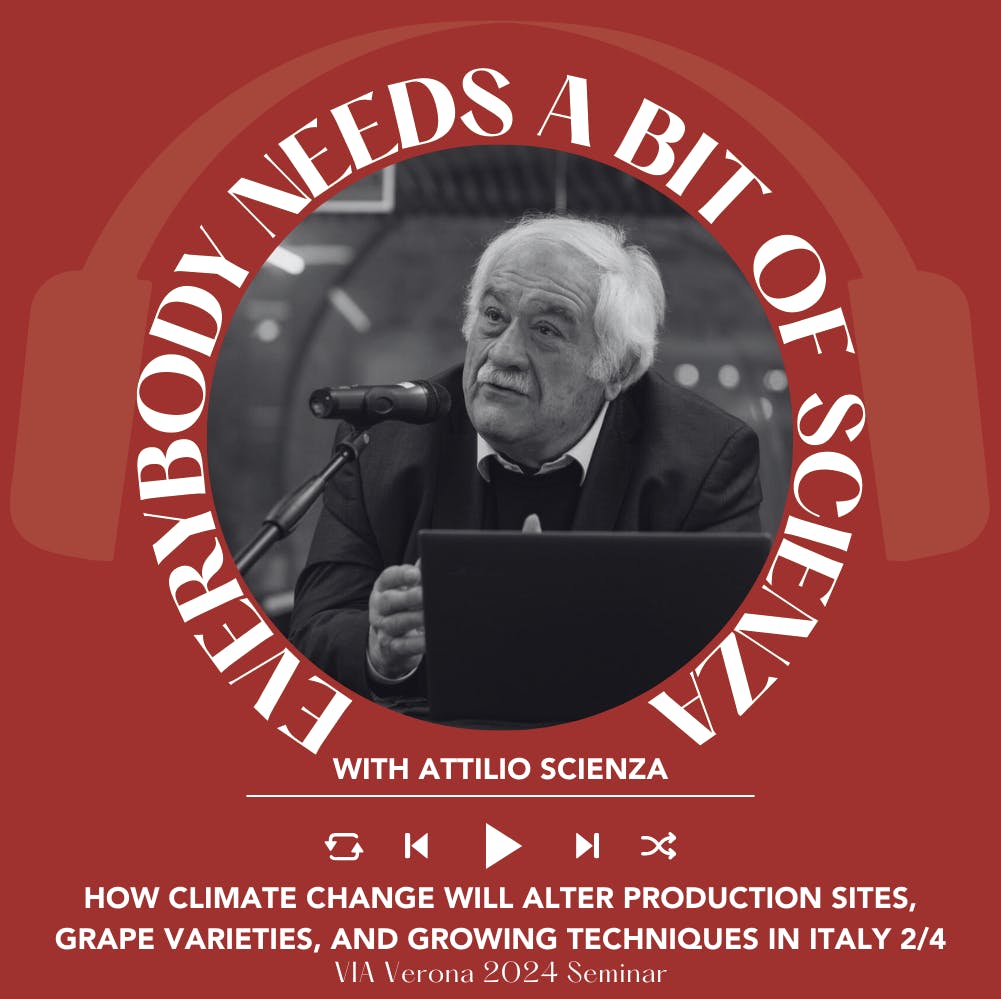
Ep. 2007 VIA 2024 - Climate Change pt 2 of 3 | Everybody Needs A Bit Of Scienza
Everybody Needs A Bit Of Scienza
Episode Summary
Content Analysis Key Themes and Main Ideas 1. The profound and multifaceted impact of climate change on Italian viticulture. 2. The urgent need for adaptation strategies in vineyard management, genetics, and location. 3. Challenges to traditional wine regions and appellation laws due to shifting climate zones. 4. The dual nature of climate change's effects on wine composition, including both negative and surprising positive aspects. 5. The evolving concept of ""vocation of territory"" in wine production and the importance of moderate stress for vines. Summary This episode of the Italian Wine Podcast features Professor Scienza discussing the critical implications of climate change for viticulture. He highlights how rising temperatures, increased CO2, and UVB rays are altering traditional growing conditions, leading to issues like early grape ripening, water deficit, and soil salinity. The ""Winkler scale"" for defining optimal grape-growing zones is now obsolete, and traditional Italian wine regions, like those in Sicily, Puglia, and Sardinia, face potential disappearance of viticulture. Professor Scienza emphasizes that current appellation laws, which tie wine names to specific locations, pose a significant challenge to adapting to new climates. He proposes a multi-pronged approach to adaptation, including developing new genetically resilient grape varieties, implementing innovative pruning and canopy management systems, and strategically relocating vineyards to higher, cooler grounds. While acknowledging negative impacts like ""jammy"" wines and altered aromas, he also points out surprising positive effects such as reduced disease and enhanced specific compounds (like TDN in Riesling) in certain varietals. The professor stresses the importance of understanding the ""vocation"" of a territory, which is now rapidly changing, and finding optimal ""moderate stress"" conditions for healthy vine growth. Takeaways - Climate change is fundamentally altering Italian viticulture, necessitating radical shifts in practices. - Key immediate challenges include increased temperatures, higher radiation, water scarcity, and extreme weather. - Traditional viticultural zones and appellation laws are under threat due to climate-induced changes in suitable growing areas. - Adaptation strategies must include genetic research for new, resilient grape varieties and advanced vineyard management techniques. - Climate change can manifest both negative (e.g., high alcohol, jammy flavors) and, surprisingly, positive (e.g., less disease, enhanced specific compounds) effects on wine composition depending on the varietal. - The concept of a region's ""vocation"" for specific grapes is dynamic and must be reevaluated in light of changing climates. - Vines thrive under ""moderate stress,"" and viticulturists must seek out locations that can provide this equilibrium. - Long-term and short-term strategies are crucial, potentially drawing lessons from historical climate shifts like the medieval glaciation. Notable Quotes - ""The negative effect of radiation on vines is the biggest problem we have."
About This Episode
The speakers discuss the challenges of increasing temperature and the need for new strategies to adapt to the changing climate. They emphasize the importance of pruning vines and creating new varieties to prevent risks such as radiation and heat waves, and address issues with violent tropical rainstorms and salt increases causing vines to collapse. They also discuss the importance of communicating the positive aspects of climate change to consumers and managing the impact on wine quality. The critical environment for vines needs a balance between stress and excessive stress to prevent them from struggling, and the company is developing new methods to manage vines and improve sustainability.
Transcript
The Italian wine podcast is the community driven platform for Italian winegeeks around the world. Support the show by donating at italian wine podcast dot com. Donate five or more Euros, and we'll send you a copy of our latest book, my Italian Great Geek journal. Absolutely free. To get your free copy of my Italian GreatGeek journal, click support us at italian wine podcast dot com, or wherever you get your pods. Language. This podcast contains information in Italian, chinch in. Welcome to this special. Everybody needs a bit of and the addition of the Italian wine podcast. Here's the premise. Fin Italy International Academy Community members send us their questions for Via Chief Scientific Professor. We record his answers, and stay be Kim tries to keep him in line. Sometimes it works. Thank you for listening. So what might happen due to this increasing temperature that seems to be going up and up with no relief? One of the main problems is that we're going to have an increase of carbon dioxide and increase of UVB rays. So the negative effect of radiation on vines is the biggest problem we have. So vines are thought to have been boring in very hot places, but it's not true. They actually were born in cooler places. Vines live best in the shade, and too much light is our biggest fear. So too much sunlight interrupts the photosynthesis. It interrupts the ability of the leaves to form properly. We are at risk of having our grapes exposed to too much sunlight, not enough canopy cover. So the leaves and the canopy are crucial. So we have to have a new strategy. We have to move our Viticulture to areas where we will be able to create shade, where we will be able to manage the canopy. We have to explain to our consumers that the problems of temperature and climate change are are not something that we that we can't get around. We have to explain that we're going to be able to create new wines as long as we adapt new strategies. We need new pruning systems. We need new canopy management systems. We need new training systems. We need to take a look at our soils where we're planting, and we need to work specifically with genetics of the vines. We will need to create new varieties that will be able to withstand the problems of extra radiation and less water, higher temperature, less shade. So the positive aspects are that our innovation will swing scientifically into the genetics and also into the techniques that we use in our vineyards for pruning for canopy management for vineyard location, soils, and how we create shade and protect our vines from increased radiation. This is the stress. So in the next few years, these are the issues that we need to really take a look at. Not only the variation of temperature and and weather patterns and climate across several years, but the unpredictable variation within one year, we're looking at the possibility of violent tropical style rainstorms that you can see on the slide that increase erosion. They don't actually bring water because the water runs off too fast. So instead of having consistent light rain, a tropical style, very violent rainstorm doesn't bring water to our vines. When we have extreme heat and early ripening of the grapes on the vine, we run a lot of other risks, frost disease. This past summer, we had a lot of Ferrine Oscar in in Veneta. We have extreme stress on the vine in general, water deficit, heat waves, all of these things are happening not only across a series of years, but within one year on its own. This was a big project conducted to take a look at drought risk across Italy. And, specifically, if you look at the purple zones on the map, we see that by two thousand and thirty, Vidiculture will essentially disappear in the purple zones. So in parts of Sicily, Pulia, and Sardinia, just an increase of half a degree Celsius per year will cause this. And When we're looking at a lack of water, we're looking at an increase in salt that attacks the roots of the vines. When we don't have enough water, the salinity is left in the soil, and this will attack the vines causing another problem. So we need to confront this quickly, or we're going to lose Viticulture in these areas of Sicily, Pulia, and Sardinia. We're looking at the Winkler scale here. Winkler was a professor at the University of Yucal Davis in California, and He worked with the wine producers in California to define where to grow various varieties such as Chardonnay and Granache, Cabernet sauvignon Sierra, he worked out a bioclimactic scale looking at temperatures over the course of several years from April to October. And using this scale, he was able to delineate the zones where it was appropriate to grow certain types of grapes. So cooler zones and warmer zones versus hot zones. And this scale has been used in Europe and all around the world for many, many years. The problem is that now the map of these zones has completely changed. So we don't have as much of these cooler areas or even temperate areas. Many of the places that were sort of designed for growing the grapes as winkler put in the index. Are inappropriate now. They're too hot. So this is the biggest problem that we have to deal with. We're going to have to change the growing location of many of these varieties, and this is not easy to do specifically because many grapes and many wines now are named by their location. So such as Brunoo, Brunoo grows in Montalcino, Barolo, is the location where we grow Naviolo to make Barolo wine. We can't just pick up those vineyards and move them somewhere else and still call them by those names. The laws don't allow that. The laws don't allow us to grow Naviola for Barolo outside of the Barolo zone. So this is a huge problem that has to be confronted How are we going to change the location of where we grow our grapes due to climate change and still be able to use the names that they've traditionally been called? Okay. So because we're in Venetocl, we're using Amaroni as an example of what's happening, We can see on the left hand side, on the winkler scale, the green bar represents the norm, the median temperatures that we would expect, and the red bars are showing the extreme increase in temperature, over the past several years. On the right hand side, we're looking at a precipitation scale. And, again, the green represents the norm or the median rainfall we can anticipate, and the blue is showing how the rain is dropping off extremely. So we have the problem of increased temperature, decreased rain. The solution is for amarone producers to move to higher ground. The problem is right now, higher ground in Balicella is covered in woods and forest So the Amaroni producers have to confront how are they going to move their vineyards effectively into a location that's going to be more advantageous for them with temperatures that are lower and the ability to hold water in the soil or have slightly more precipitation. Are you enjoying this podcast? There is so much more high quality wine content available for mama jumbo shrimp. Check out our new wine study maps or books on Italian wine, including Italian wine unplugged, and much much more. Just visit our website, mama jumbo shrimp dot com. Now back to the show. Not sure. We are seeing huge changes in wine composition. And the general thought is that climate change can't be good for wine. It's too hot. Grapes are maturing too quickly. We have very jammy, very cooked flavors, but the actual matter of fact is that there are very positive effects that are taking place in vineyard management. So we are having grapes that don't have as much disease, other good things that are happening other positive effects. And our job is to communicate to our consumers that climate change is not a negative necessarily for wine production, not a negative for wine quality, but we have to be able to communicate to the consumers effectively the positive aspects of climate change in wine composition for the future. So no, more to measure the twenty twenty five. Looking at the changes in wine styles, you can see exactly what professor I, was talking about the higher alcohol wines, the less colored wines, lower varieties with aromas, a little less complexity, as I mentioned before, the overwrite characteristics that jammy characteristic, but we see the popularity of white wines increasing. People want to drink wines served cold. They want lower alcohol. They want less tannin. Sparkling wines are a little bit less elegant due to the temperature change. But despite all of this, we're seeing, and and we've been tasting in the past few days with Sarah and our master classes that in recent years, particularly since two thousand and fifteen, some of these fine wines, our premium wines, Barrolo, and Marronello have actually improved. So we're we're looking at positives and negatives that are coming forward due to the temperature increase and the water decrease. The paper. The the reason. We're looking at bio mechanisms within our grapes here. And the effect of the temperature going up. The point of this slide is that there are positive effects and negative effects. So depending on what grape we're growing, such as if we're growing riesling, the TDN likes hot weather. It likes to have a lot of light. So during ripening, TDN will increase giving us that minerality and that those notes of resin that we want in our wines such as a riesling style. So that's a positive effect. When we look at, which gives us the coconut or fig notes, which can be unpleasant or undesirable. Those also go up in heat So that's a negative effect. We're looking at synthesis of pyrazines going down, losing some green pepper notes. If we're talking about sauvignon blanc, that's a bad effect, but terpenes go up in this type of weather, which is a positive effect. So The point here is that not everything is bad with temperature increase. There are a lot of things that are very positive that will happen depending on the varietal that you're growing. And if you're having increased light and increased heat, for certain varietals, it's going to bring out good characteristics for other varietals. The biomechanism within the grape will be affected in a more negative way. Stress. The the the the confronted that I'm on cancer distress. So looking at stress on the vines, professor says the best conditions is moderate stress. If we are growing vines in a location or in a climate where there's very little stress, we've got a lot of water, the plant doesn't have to struggle at all. It's not good. It has negative effects on the wine, the longevity of the wine goes down. The acidity of the astringency stringency can go up. If we have excessive stress, Obviously, that's also a negative. Too much heat, not enough water is going to cause a lot of problems for our vines. So what we're looking to find is a location and a climate where we can provide our vines with a moderate amount of stress. So good heat, a little bit of water enough to cause them to struggle, but not be stressed too much. So we're looking to find an equilibrium between no stress and excessive stress. Want to find locations and climates that will give our vines moderate stress. So we're looking at what can we expect in the future how we're going to have to make the correct selections of varietals, of vineyard management, and of analogical practices. The the to the question of it, the condition standard. They've been a quest of a line for turo. He explained the problem. The in italian in borgonia. You know, okay. The consequences of climate change for what we have to do, how we can anticipate the future, we need to choose the correct varieties, first of all. And we have to take a look at what Professorient refers to as a vocation. So the vocation of the territory. So, for example, a a person who sings very well has a vocation for music. A person who writes very well has a vocation for literature. It's the same for wine. So vines need an atmosphere that has a vocation for quality. And over time, human beings have come to understand the vocation of our territory. We know where to grow grain We know where to grow vines. But what we have known up until now has got to be modified due to climate change. We're going to have to take another look at the vocation of our territory, which is totally changing due to the increase in temperature. The response of of plants to climate change particularly invines the the leaves die off, the grapes over ripen. We have to deal with soils. Soils are very, very complicated. They need moisture. They need a constant temperature without those things. We have all a whole world of problems, as professor. I called it. We develop fungus. We develop bacteria. We have to learn how to manage our soils in a biological way, not using chemicals, maintaining the vocation, maintaining the vines in the soil. Is gonna be very, very important to the life of the vine. So the life of the vine is changing as well. Vines can live a very long time. Vines are a very interesting plant, but they rely on the reserves from last year. So the reserve in the vine is stored in the wood. We see it, you know, when we're pruning our vines. You see the wooden part of the vine that's left. And what accumulates in the wood from last year is what starts off the vigor of the vine when springtime comes. So if we have a vine that hasn't accumulated enough resources last year, we're going to have vines that can't be vigorous. In the coming year. Back in the nineteen sixties, nineteen seventies, we were looking at bordeaux style management, we were looking at clones, we were looking at a completely different style of agriculture, Viticulture, vine selection, All the things we were doing then have virtually disappeared. So we need to go back to a Mediterranean style of Viticulture. Rutes need more room. Canopy has to be managed. We have to manage our soils. We have to choose clones that will produce big grapes. So if there is a loss of water and the size of the grape decreases as the water evaporates during the maturing period, we will still have some sugar, some pulp left. If we choose clones that produce grapes that are too small. By the end of the maturation process, all we'll have left is a seed. There'll be no pulp and no sugar. So we're going to be looking at techniques and choices, choices of location and climate that are vocational for quality, choices of clones that will produce the types of grapes that can sustain themselves, and choices of management that will allow our vines to accumulate resources during the year previous to support the growth and vigor of the year coming. For in the country in Northley. So we've got long term and short term strategies for how to deal with the problems that we're confronting, but we need to look back to things that we did during the small, medieval glaciation. If you remember from the very beginning of the presentation, there were genetic materials, genetic varieties that were developed that supported the very cold weather. So we need to look at things that will support very hot weather. We have the technology to do this, and selecting genetic material carefully for clones that we'll be using in the future is going to make them more resilient to the problems that we're confronting with climate change. This is the this slide basically shows the decision tree that we're facing, professor. So as we've we've talked about all of these things, but essentially, the point is that climate change is going to have an effect and change all of our decisions of location of atmosphere of climate where we're growing our vines. Listen to the Italian wine podcast wherever you get your podcasts. We're on SoundCloud, Apple Podcasts, Spotify, email ifm, and more. Don't forget to subscribe and rate the show. If you enjoy listening, please consider donating through Italian wine podcast dot com. Any amount helps cover equipment, production, and publication costs. Until next time. Cheaching.
Episode Details
Keywords
Related Episodes

Ep. 2586 Richard Hough Part 2 | Everybody Needs A Bit Of Scienza
Episode 2586

Ep. 2574 Richard Hough Part 1 | Everybody Needs A Bit Of Scienza
Episode 2574

Ep. 2569 Anselmo Acquah Part 2 | Everybody Needs A Bit Of Scienza
Episode 2569

Ep. 2552 Anselmo Acquah | Everybody Needs A Bit Of Scienza
Episode 2552

Ep. 2511 Beatrice Motterle Part 1 | Everybody Needs A Bit Of Scienza
Episode 2511

Ep. 2497 Noah Carrenca Part 2 | Everybody Needs A Bit Of Scienza
Episode 2497