
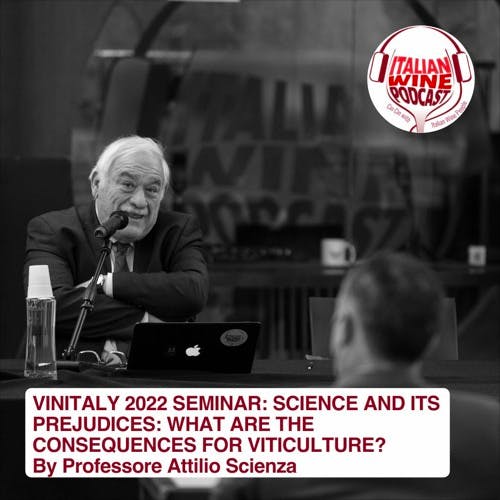
Ep. 884 Science & Its Prejudices Seminar Day 1 Part 1 | Everybody Needs A Bit Of Scienza
Everybody Needs A Bit Of Scienza
Episode Summary
Content Analysis Key Themes and Main Ideas 1. The evolution and genetic relationships of grape species, particularly *Vitis vinifera* and various American *Vitis* species. 2. The importance of fossil records and genetic studies (clades) in understanding grape evolution. 3. The concept of disease resistance in American grape species and its potential viticultural applications. 4. A critique of ""scientific prejudices"" in viticulture, drawing parallels to historical human racism and eugenics. 5. The need to challenge preconceived notions and biases in scientific thought and practice. Summary This episode of the Italian Wine Podcast features a seminar by Professor Attilio Scienza, titled ""Science and its prejudices: What are the consequences for Viticulture,"" originally presented at Vinitaly 2022 and translated by Richard Huff. Scienza delves into the evolutionary history of grape species, emphasizing the significance of fossil discoveries, like *Vitis Chutonica*, and genetic studies in deciphering the lineage of grapevines. He highlights the distinct characteristics of European *Vitis vinifera* and various American *Vitis* species, noting the latter's valuable resistance to diseases and stress, making them important for potential hybridization. A central part of the seminar critiques historical and ongoing ""prejudices"" within viticultural science. Scienza draws a provocative parallel between the past preference for *Vitis vinifera* (labeled as ""area r"") over American species (labeled as ""area b"") and the pseudo-scientific ideas of human classification, citing Francis Galton, physiognomy, and the concept of eliminating individuals deemed ""abnormal."" The seminar ultimately calls for a critical examination of biases within scientific paradigms and their consequences for viticulture. Takeaways * The evolution of grape species, including *Vitis vinifera* and American *Vitis*, is understood through fossil records and genetic analysis. * American *Vitis* species offer valuable disease and stress resistance, which can be crucial for future viticulture. * Professor Scienza argues that historical scientific biases in viticulture, favoring *Vitis vinifera* over other species, mirror broader societal prejudices. * Concepts like physiognomy and eugenics are used to illustrate how scientific prejudice can manifest and lead to exclusion. * The seminar prompts a critical re-evaluation of established scientific norms and the potential for new, more resilient grape varieties. Notable Quotes * ""Science and its prejudices. What are the consequences for Viticulture."" (Seminar Title) * ""the importance of fossils of the tertiary era and the how how crucial they are to our understanding of the evolution of the the the grape species"
About This Episode
The Italian wine podcast discusses the importance of fossils and the relationship between VITis Chutonica and the American species. They also mention the limitations of free media and the importance of the VITis Tyl pilots for understanding the evolution of species. The podcast also discusses the potential of the VITis Tyl pilots for reducing racism and the importance of the Italian wine trade fair for bringing free content.
Transcript
Welcome to the Italian wine podcast. This episode is brought to you by Vinitally international wine and spirits exhibition. The fifty fourth edition of Vinitally was held from ten to the thirteenth of April. If you missed it, don't worry. Go to Vineethly plus dot com for on demand recordings of all the sessions from the exhibition. And remember to save the date, the next edition of Vineethly will be held from the second to the fifth of April two thousand and twenty three. Today, on the Italian wine podcast, we welcome you to this special seminar led by officore Atilio Shenza entitled Science and its prejudices. What are the consequences for Viticulture, which took place during Vin Italy twenty twenty two, held in Italian and translated into English by Richard Huff. Tuning each week to be a part of this special event and remember for more great Shinsa related content, check out our sister channel, mama jumbo shrimp on YouTube. Because it's only tissues. Krishna. So the question So, this slide, you can see the, importance of fossils of the tertiary era and the how how crucial they are to our understanding of the evolution of the the the grape species, to identify just just a few of the the species mentioned here that the VITis Chutonica, which they found in the remains they found in Germany fifty to sixty million years ago. And these these kind of imprints are crucial to our understanding of the evolution of the species. To do a phenomenal. To the So I'm not concentito la Continuita, the, the general, proticament, separate will continue with the interlump. So the the the the difference of the the the the ability to differentiate between the American species and the the European species, is important for understanding to significant, phenomenon. First of all, the the American species provides a degree of continuity, as a species evolved. And also the the second important event is the, the emergence of the very, or the the the disappearance, if you like, of the Baringa channel between Europe, and America, which, meant that the the two species evolved in in completely isolated ways. The the general beat is the raperanto Rosier. The, it's the So, yes, on on this slide, we, can see that it's a a cleared from a a two thousand and thirteen study, which and that again is is important for understanding how the species evolve, but also the limitations of free as a means of, understanding the the evolution of the species. In cluster, in Chicago, in Branca, only Branca. Diversity. The the America. The most of the slide. Yeah. So this is, a clade, which is a group of organisms all believed to comprise the evolutionary descendants of a common ancestor, and you'll notice from the slide the the proximity of VITis Vinifera, and the American species VITis Tylifolia and VITis rotundifolia. And that suggests that these species began from the same place. They have a calling a common ancestor. Hey, Co. Crystal, Gella viola. From to teguante, specific, labitez Renifera, a multispeppericana, the the the the the, So in this diagram, you can see the relationship in particular between, seizures and and VITos. But as you as you can see from the slide, there are four In fact, five, groups of species in different colors. And once again, this shows the very close proximity between the European species and the American species and and fundamental to our understanding of, the the relationship or the evolution of these species as the, caesar species. So, okay. The Yeah. So again just to to summarize the the slide, the, the this species is very important particularly because it offers a degree of resistance. In relation to illness or disease and stress. So that that could, potentially, and in practical terms make an important contribution as a as a hybrid, but the VIT is only for a species. The on the end of the end of the year. Christo Grande Progetto, pociano, war many a chimpanzee, because they are a grande project of the Yeah. So now we're going to confront the this idea of a a, parallel in terms of racism, a parallel between vines and and mankind and this notion that there is a area r and a area b, with Vitifinifera being in the area r and the American species being in a and a area b. And, the English statistician Francis Galton was was behind this idea, really, that, there were these two classifications or or two types of men. And there are there are two events really that demonstrate the the the prejudice of science to use the title of the presentation. The first is physiognomy, which which is face reading used to identify delinquents based on their their appearance and their their facial characteristics. And the the second important idea or manifestation of this city was the elimination of those individuals who don't comply with the ideas of normality or preconceived, ideas of what is, what is the correct kind of appearance. Thanks for listening to this episode of the Italian wine podcast, brought to you by the Italy international wine and spirits exhibition, the biggest drinks trade fair in the world. Save the date, the next edition of Vineet Lee will be held the second through the fifth of April two thousand and twenty three. Remember to subscribe to Italian wine podcast and catch us on SoundCloud, Spotify, and wherever you get your pods. You can also find us at Italian wine podcast dot com. Hi, guys. I'm Joy Livingston, and I am the producer of the Italian wine podcast. Thank you for listening. We are the only wine podcast that has been doing a daily show since the pandemic began. This is a labor of love and we are committed to bringing you free content every day. Of course, this takes time and effort not to mention the cost of equipment, production, and editing. We would be grateful for your donations, suggestions, requests, and ideas. For more information on how to get in touch, go to Italian wine podcast dot com.
Episode Details
Keywords
Related Episodes

Ep. 2586 Richard Hough Part 2 | Everybody Needs A Bit Of Scienza
Episode 2586

Ep. 2574 Richard Hough Part 1 | Everybody Needs A Bit Of Scienza
Episode 2574

Ep. 2569 Anselmo Acquah Part 2 | Everybody Needs A Bit Of Scienza
Episode 2569

Ep. 2552 Anselmo Acquah | Everybody Needs A Bit Of Scienza
Episode 2552

Ep. 2511 Beatrice Motterle Part 1 | Everybody Needs A Bit Of Scienza
Episode 2511

Ep. 2497 Noah Carrenca Part 2 | Everybody Needs A Bit Of Scienza
Episode 2497