
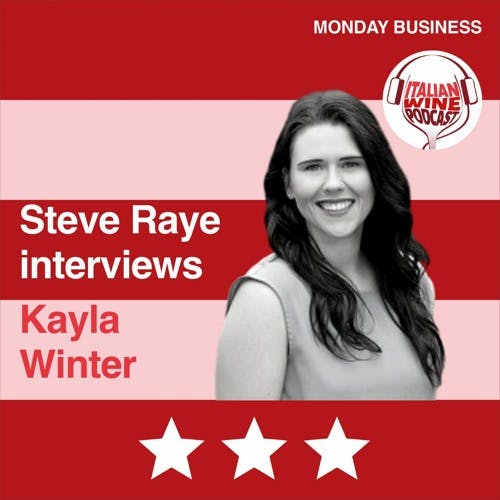
Ep. 1150 Kayla Winter | Get Us Market Ready With Italian Wine People
Get Us Market Ready With Italian Wine People
Episode Summary
Content Analysis Key Themes and Main Ideas 1. The burgeoning growth and market potential of the low and no alcohol (LNA) wine segment in the US. 2. The scientific and technological methods, particularly spinning cone columns, used for producing high-quality de-alcoholized wines. 3. The distinct and often confusing regulatory frameworks (TTB vs. FDA) governing LNA beverages in the United States. 4. The unique consumer demographics, purchasing behaviors, and marketing strategies required for the LNA category. 5. The challenges and opportunities for Italian wine producers to enter and compete in the global LNA market. 6. The broader societal shift towards health, wellness, and mindful consumption as a driving force behind the LNA trend. Summary This episode of ""Get US Market Ready with Italian Wine People,"" hosted by Steve Ray, features Kayla Winter, Director of Sales at BevZero. The discussion focuses extensively on the rapidly expanding low and no alcohol (LNA) wine market in the US. Kayla explains BevZero's core technology, spinning cone columns, which gently remove alcohol from wine while largely preserving its original flavor. She traces the recent surge in LNA popularity to global health and wellness trends and evolving consumer preferences, particularly among younger generations. A significant portion of the interview is dedicated to the complex US regulatory landscape, differentiating between TTB and FDA oversight based on alcohol content, which dictates labeling, distribution, and sales channels. Kayla also highlights the difficulties Italian producers face due to their own restrictive regulations on LNA products and discusses the unique marketing and distribution approaches (e.g., dominant online sales, non-traditional packaging) required for success in this category. Both speakers emphasize that LNA is a lasting societal trend, not a fad, offering traditional wineries a valuable opportunity to attract new consumers and increase overall sales by diversifying their product offerings. Takeaways * The low and no alcohol wine sector is a significant and growing market, driven by changing consumer preferences towards health and mindfulness. * Advanced technologies like spinning cone columns allow for the production of LNA wines that retain much of their original flavor profile. * The US regulatory environment for LNA beverages is complex, with TTB regulating wines over 7% ABV and FDA taking primary control below 0.5% ABV, impacting distribution (e.g., bypassing the three-tier system for fully FDA-regulated products). * Italian winemakers face specific domestic regulatory hurdles that can hinder their entry into the LNA production and export market. * Marketing and sales strategies for LNA wines differ significantly from traditional wines, with a strong emphasis on online retail and innovative packaging. * Offering LNA options provides a compelling strategy for traditional wineries to attract new demographic groups (Millennials, Gen Z) and expand their market reach, potentially increasing overall sales and margins. * The growth of LNA is considered a long-term societal trend reflecting a shift in consumer values rather than a temporary fad. Notable Quotes * ""We pivoted from just standard de alkalization, alcohol adjustment into this role, really taking charge into the low and no segment of wine."
About This Episode
The hosts of the Italian Wine podcast discuss their interest in the low and no alcohol industry, with a focus on the TTB and the importance of legal compliance. They emphasize the need for compliance and the need for labeling and decommissioning products. The conversation also touches on the Italian wine industry and the potential of promoting the "naught and no alcohol" wine category. They suggest educating consumers and promoting the "naught and no alcohol" wine category.
Transcript
The Italian Wine podcast is introducing a new donation drive this month. It's called y m I f on. We are encouraging anyone who tunes in on a regular basis to send us your ten second video on why you are a fan of our podcast network or a specific show. We will then share your thoughts with the world with the goal of garnering support for our donation drives. Italian wine podcast is a publicly funded sponsored driven enterprise that needs you in order to continue to receive awesome free wine edutainment. Seven days a week, we are asking our listeners to donate to the Italian wine podcast. By clicking either the go fund me link or the Patreon link found on Italian wine podcast dot com. Remember, if you sign up as a monthly donor on our Patreon, we will send you a free IWP t shirt and a copy of the wine democracy book, the newest mama jumbo shrimp publication. Thanks for tuning in to Get US Market Ready with Italian wine people on the Italian wine podcast. I'm Steve Ray, your host, and this podcast features interviews with the people actually making a difference in the Italian wine market in America. Their experiences, challenges, and personal stories. And I'll be adding a practical focus to the conversation based on my thirty years in the business. So if you're interested in not just learning how, but also how else, then this pod is for you. Hello, and welcome to this week's edition of Get US Market Ready with Italian wine people on the Italian wine podcast. I'm your host, Steve Ray, And my guest this week is Kayla Winter of Bev zero. Kayla, welcome to the show. Thanks so much, Steve. Tell us a little bit about Bev zero, and then we'll get back and explore a little bit more about you, but but you're kind of a lab rat. So this is gonna be somewhat chemistry focused conversation. Hopefully, not too complicated, but tell us a little bit what Bev zero is and does. Sure. So Bev zero, originally, the company name was ConTech. And we utilize spinning cone columns to de alkalize wine in, the US, Spain and South Africa are three facilities. In, twenty twenty one, we actually rebranded globally to Bev zero to account for our innovation and thought leadership role in the low and no alcohol space, which actually came about after a lot of the tax regulations have changed allowing, winemakers to produce wine below sixteen percent in the US, which is actually a lot easier to do than below fourteen. Which was the tax bracket in twenty eighteen. So, we pivoted from just standard de alkalization, alcohol adjustment into this role, really taking charge into the low and no segment of wine. And also beer insider. Okay. So we're starting on the the technology and the chemistry mode. Give us a little background about you and, kind of work that you do in your preparation for it. I grew up in Sonoma County, California. Don't I don't come from a wine family background, but it's hard to not have wine in your life when it's when it's all around you here. Started popping around wine raised when I was sixteen, fell in love with the industry. Traveled to New York, went to school at Cornell and got a degree in medical terminology, came back to the u sorry, to the US. Came back to California. Sorry. I have to laugh at that one. That's so you're you're saying ethic in New York is not part of the United States. That was a slip of the tongue. I get it. When I was eighteen, it certainly felt like I was in another world, upstate New York first, California. But, yes, so I I came back to California and worked, at at traditional wineries, kind of more on the premium end, for a few years. And then found my way into the No and Low Alcohol segment here at Bet Zero. Okay. So let's kind of explore that a little bit. Can you give us a little history on low and no alcohol? It it it's kind of always been there. There are a couple of brands in the US that kinda defined the category. But it was of relatively little interest or significance in the industry. And and now all of a sudden, everything's changed. Can you tell give us a kind of a timeline of of that? Sure. So No and Low has been a lot more prolific in other countries than the US. US has always lasted to, I think, we fall behind a little bit. So in in Germany and other parts of the EU, Noah and Low got a lot bigger, a lot quicker. Here in the US, it wasn't until twenty nineteen ish that, people really started paying attention to it. Previously, there were products on the market that had been there for ten, fifteen years. I wouldn't say they were the best. They were kind of designed for, hey, if if someone isn't drinking wine, we'll give them kind of our leftover stuff that, you know, there's no other option, so they're gonna drink it. I think with the health and wellness movement that really has started booming in kind of the coming of age of gen zers, which are very much into mindfulness, and taking control over your your health, your consciousness, your experiences. Nonalcoholic, and the idea of drinking less or not drinking at all has really, started kind of booming, and and is really on top of conversation in the US, and that that has played a huge role in why people are interested in these kinds of products. So, dramatic growth or certainly interest. I I guess if you did a keyword search, you'd find it really ramped up in the last couple of years. But given some definitions, then, low alcohol, no alcohol, and then the seven percent kind of magic number, as it relates to regulation. We'll get into TTB versus FDA in a moment. Let's start with definitions of low and no. Well, no alcohol depending on where you are in the world, safely, it's less than point five percent, and it can also be less than, zero point zero five percent. Is that nonalcoholic or alcohol free terminology, which does it does vary, country to country. For low alcohol, that's a great question. What it what is low alcohol? What's the definition? We don't really have one. I've seen people show me their twelve percent wine and say, look, this is low alcohol. And then I've also seen nine percent, seven percent, five percent wines. And they're all kind of in this category. And within that, we're not really defining them in a distinct manner. So low alcohol is is kind of difficult to to figure out. But it's, I guess, it's it's a personal, definition, and then, of course, the TGP and the way they're looking at Alright. So we'll get into that in a moment. But if if somebody came to me and said, you know, I'm I'm wanting to drink lower alcohol, my recommendation would be riesling, because it tends to be, lower alcohol for a whole variety of reasons. But, you know, in the eight nine, sometimes ten percent range. So it's a pretty safe bet. I won't guarantee every riesling is below ten percent alcohol, but there's a tend tendency there. On its own riesling is not that popular. A varietal. Well, at the same time, it is a noble grape varietal, like, Cabernet sauvignon chardonnay and, you know, noir. Just really hasn't caught on in the US. So there really has been, you know, naturally low alcohol products, if that's your interest. As a to, produced to be lower than some other standard. So when you say twelve percent could be considered low, that would be off of a sixteen percent Cabernet sauvignon produced by somebody like in the Napa Valley floor or something like that. I think that's what you're referring to. I mean, I I think the the point here is that it could what you're what you're talking about could be low alcohol to someone. And in a conversation that you were gonna say, as as you said. Someone says, I wanna drink less or I want, you know, to drink more and feel less. What should I be drinking? You can say a naturally low varietal and mind like riesling or from a, kinda cooler climate. Or you can say, hey, I know a napa cab that has been adjusted down to a nine percent and is only ninety calories. And those are both low alcohol. So it really just depends on the conversation. Right. But nobody's talking so nobody's talking about unadjusted or adjusted wine. So we'll just live with the the categories as they are low and no. Now I think one of the most important things that affects no and low is something that's probably not well understood by producers in Italy, and that has to do with who the regulator, the federal regulator is, in the category. So there there's a big softball. Okay. Can you give us lecture on, TTP versus FDA and low alcohol. Yeah. So this is all sometimes the most difficult part of this industry is is figuring out how to legally navigate it mostly because the industry and the innovation that the producers are are coming up with is going faster than regulation is. And so the laws as they're previously written and designed don't always apply perfectly to situations we're in today. So, just from a general overview, we have the TTB in the US, which regulates anything alcohol related. They legally define wine as being above seven percent. Below seven percent is this, flavored wine category in which They do regulate it, but there's it also becomes half TTP, half FDA regulated. So you you can do nutritional panels and you you can kind of, the ingredients list that you can add is actually a lot greater than with standard winemaking. And then so there's that below seven percent all the way down to below point five percent. Once you go below point five, it is completely FDA regulated. The TTB is no longer involved there are a few carry over laws like you can't call it a chardonnay if it's a sauvignon blanc or say napa, if it's not. However, besides that, it's all FDA. So your ingredients, you can add anything that's food grade. You can sell it through food channels. You don't need the three tier distribution setup that you do in the alcohol industry. It could be sold in grocery stores and and online, and you don't need to find for it. Yeah. Absolutely. So And even in New York, where where mine can only be sold in wine and spirits shops and not in supermarkets. And so this kinda changes that that game a little bit. So just to be clear, FDA is, food and drug administration, TTB is the tax and trade bureau. They're in separate entities and they also fall under different departments in the federal government. And one is under agriculture FDA, I believe. And TTB is under the treasury department. So the idea here is a lot of producers come to me and say, I really object to or don't wanna have to be to go through the three tier system. And and my response is if you're a wine as we traditionally define it, in this case, would be over seven percent, by federal regulations. You are by definition within the three tier system. And the only way around that is, as a domestic producer, you're allowed to sell directly to consumers, domestic wine producer, you're allowed to sell directly to consumers, but that option is not open for imported wines because the importer functions as tier one, and the importers cannot sell directly to consumers. So while there is a solution to bypassing, if you will, the three tier system in that way, but for farm producers, this is one way to do it. Now it's not actually selling the products that you probably currently make them and maybe not the kind of products that you wanna sell. But like everything else in the US, it may not be what you want, but it's what you can do. And you have to adapt to those rules and constraints. So the big impact from what I heard from you is where it can be sold and, impact on terms of packaging and labeling and what information not only is mandatory, but the flip side of that is what information can be added. And we're having a big, discussion in the US public discussion on, ingredients, labels online as they are on other food groups. People are really interested in that kind of thing, but it hasn't been required now. So talk about a little bit more about why the idea of adding more information as opposed to, you know, under FDA guidelines as opposed to adhering to the basic requirements of, CTB? I think the the regulation that non alcoholic products must have all of the ingredients and and nutritional labeling. It can be a blessing and a curse for producers. It's great because the by default, unless you are putting a ton of sugar into these products, they are going to be much lower calorie, than an actual alcoholic wine. So you could have ten calories per serving in a non alcoholic wine versus your hundred twenty or whatever, it is you're comparing it to. So that is a huge win for the category. And being able to put that on label as low calorie and, you know, low sugar and all of that, does help a lot with with sales and marketing. However, there is a lot of things that people can add to wine that if you were to have to declare that onto a label, consumers would put up a red flag. And so Like fish glass. Yeah. Like hiding glass and and, you know, I'm I'm sure if you had to label you know, finding agents like PVPP consumers would freak out because they don't know what it is. It sounds scary, you know. And so there's a lot of ingredients that we can add to our products that will make it taste better. It'll improve the mouth feel. It'll find out something you don't want. However, if you have to declare it on the label, then a lot of brand producers don't wanna do it because it's scary to them, you know, and they don't want the consumers to reject it. So You can either add these things if they're wine making ingredients. You can add them before the wines de alkalized, and then they don't have to be on a label because it's it's encompassed in that term de alkalized wine. Or you add it after it's been de alkzed and then depending on the type of ingredient you do have to declare. Okay. So let's talk about Italy specifically. You guys, aren't really doing much of anything with Italian producers. Why is that I mean, I think there are a few factors here. So so our European facility is in Spain, and Spain is one of the largest consumers of nonalcoholic products. And so we're certainly quite busy with our brands and and and consumers that we're working with out there. But Italy has been a little harder to get into the category. Mostly because the the regulations, and and excuse me, I'm not a hundred percent expert in Italian regulation. But from what I understand, it's difficult to define de alkalized wine under the regulations. You can't put an adjective in front of the word wine, so you can't say alcohol removed wine or de alkalized wine on the label. I think it's difficult to even be able to say the word wine if it's less than, nine percent, I think. And there's all these other factors there. But so it's it's discouraging to producers because they think, well, if I can't call it wine, then how does anyone know what these products are. You know, like, how do I sell the product? So you're limited not only in what the the Italian government will let out and then also what the American government will let in. Yes. Yeah. Exactly. But there are a few Italian products, Italian produced non alcoholic products that are in the US. And and there are a few Italian non alcoholic products that are sold in Italy. There's just certainly nowhere near as many as we're seeing in these other markets. Sure. So can you give us the names of the ones that are sold in the US? Yes. So prima Pave, probably the worst pronunciation of that word, but, that is one that I actually really enjoy. They're sparkling, the miss Pumante, and then a sparkling Rosay, that the really nice. I know that's an Italian produced product. Bonafide zero zero is also another one that I've seen here in the US. And as far as I know, both of those are also available in in Italy and other parts of the EU. Okay. So one of the things you talked about was low calorie and the fact that, you know, because alcohol contributes a lot of calories. And, obviously, so does sugar. The American palette for domestic wines favors sweeter wines. We've seen Naomi and Josh and some of these other brands do extremely well. I know personally working with new consumers to the US, they find dry wines hard to appreciate initially in the system. We all grew up on Coca Cola. And maybe that's the reason why. I guess it really doesn't matter. But is the market more oriented towards sweet wines? And we're and we're talking about the market, meaning the domestic producers, what types of wines are they producing that consumers seem to be would that seem to resonate with consumers? That answer is definitely regionally dependent. I think there's a lot more sweeter wines being produced and consumed in Spain versus a US here. Which is actually very interesting because I think the US probably contains more sugar than any other country on earth. But for whatever reason, the wines that are doing better here domestically are the ones that are much lower in sugar and the more dry, acidic and kind of restrained styles. Okay. And this may be out of your area of expertise, but I haven't heard the the the subject of low no in my converse very much in my conversations with importers. Now that may be because they're not coming to me for any information on that. That's certainly possible. But I haven't heard it as part of the conversation, you know, when I've attended trade shows and, things like that. Do you see based on contacts you have coming into bev zero? Interest coming more from importers, from producers, from export brands, from existing major wineries in the US versus boutique smaller or newer producers? From a producer standpoint, everything started here in the US with startups. All of the big wine companies were talking to us, were keeping their ears open, but the majority of the products that were first produced were these startups that said, you know, no one's doing this. At least, no one's doing it well in our opinion, and we're gonna, you know, take a crack at it. In terms of the way it's been evolving now that these startups paved the way, there are a lot more larger producers getting into the game. But you brought up an interesting, you know, point that you in in talking to the traditional wine importers and retailers, They might not be talking about know and lo. And I think, part of the reason is because they don't know what to do with it. It's not a product that is regulated the same way as all of these other products they're familiar with. And so not only do they not know how to handle it and how to record it in their books and all that. Once they get it, you know, for a retailer, where do they put it? Does it go into the soda section? Does it go into the wine section? Does it need its own section? It it it's just very confusing to them. And so I think a large part of what producers and and and, you know, myself with Bev zero, something that we're really focusing on is education to these distributors and importers and retailers about what these products are, what you can do with them, and the fact that there is a demand if they just figure out, you know, the way in which they want to work into the category. Italian wine podcast. Part of the Mona jumbo shrimp family. So let me just interject here that we're talking with Kayla Winter, who works for Bev zero. And if somebody did wanna contact you guys to learn more about No Low, can you give us your email and your phone number? Yes. You can email, me personally Kayla, k a y l a, at bev zero dot com And then our office phone number is seven zero seven five seven seven seven five zero zero. Okay. Let's get back to what we were talking about on the retail side because I find that really interesting in my store visits, I've only recently begun to look at this kind of stuff. And in a way, it's akin to the problem New Zealand's avignon blanc faces. Where does it go? Some stores are organized regionally, you know, or by country. Some stores are organized by bridal. Some are organized by both in a couple of different ways. And I was in one store in a particular Sommio Blanc that I work with. Was in four different places in the store. Retailers, I guess, do that on purpose because it enables them to sell more. It was also not the best use of space, and I think it probably confuses to a degree some consumers who are shopping. So what do we know? What do you know? What does Bev zero know about who the people are who are buying this? How they shop where they shop? This, like, tends to be more online rather than retail Can you give us a little perspective on that? Sure. As far as who's buying everyone, but there's there are definite a lot of different types of people are going for non alcoholic. But in general, we see the trends mostly with younger generations, millennials, and gen z, as well as females in, in general. And the demographic also that kind of middle aged soccer mom tends to gravitate towards these nonalcoholic wines. It's interesting the idea, you know, of where where to put them. And because one, because retailers brick and mortar retailers don't know didn't know the answer. And and also because of COVID, it really paved the way for online retail to take a hold of the category and and garner most of that. That's what I thought, and that's easier to do online because you can re re program your shelves very, very simply, unlike trying to do it in a retail store. Correct. So we have online retailers like Better Roads, Nanobar, Wazon, and and Wazon now having brick and mortar shops as well who have had a ton of success with creating these online retailers. Before they got on board, if you wanted non alcoholic wine that wasn't for your Ariel, which is in grocery stores everywhere, you had to go find that producer's website in order from them directly. And that was a huge hurdle for consumers. Once we saw these online retailers show up, then there was a place where consumers can go and they can peruse, and they can try different things, and they can order different things, and then, you know, save on shipping. And so kind of the buy in, the initial buy in is is lower. And that, I think, has really created a a better space for the consumer to approach non alcoholic products. Well, okay. But what about, and then what about sites like wine searcher or tools like wine searcher, VIVino, and and other online wine sales and wine information type sites like wine pair? Are they findable on those? I I haven't done an audit, so I don't know. But if I went to to wine searcher and look for low no alcohol, do you know what I would find? No. And now I wanna go do that. Again, me too. You know, let's do that. Okay? We'll do we'll do that live. I'm going there right now and you can follow along. I'm going to wine searcher. Okay. So, I just typed in wine searcher. I have the pro version which allows me to get a little bit more information, and I do recommend anybody in the industry. If you sign up for wine searcher, it's like sixty nine dollars, get the pro version, get a lot more information. The first three products that I see on screen surprised the heck out of me. One is Golden Green Alcohol, and, the other one is Everclear. We all know about Everclear. And then Ariel, nonalcohol at Cabernet sauvignon. So that's because I typed in low alcohol with no quotes around it. So it was giving me alcohol as well as low. Now I'm going to type in low with quotes around it and alcohol. It brings me to the same three things. And then there's some Freshinae alcohol removed premium sparkling. Obviously, that's from Spain. That makes sense. There's a French sparkling cider, and then a couple more grain alcohols and then free and cordonu zero. No secco and and some others. So my guess is there's not a lot of shopping. There's not a lot of searching going on for low alcohol, certainly not in wine searcher, which leads me to believe that the people who are looking for it are not people from the traditional wine industry. That maybe they're non winos, if I can use that term who are coming in looking for low alcohol as an alternative to, not another version of wine. I'm guessing on this. I really don't know. What do you I've definitely seen both. I think there is a lot of people who don't like wine or who don't drink alcohol in general who aren't used to going through standard wine channels. But I also know a lot of people and a lot of the the customers we work with and and conversations we have with different, retailers. They are wine drinkers who are also looking from this space. But here in the US, I think these online retailers that I mentioned previously have done such a good job of creating a presence in this space that that's usually the go to of where what you find. So if I if you were to Google non alcoholic wine, likely these online retailers would come up first before any kind of, Vivino or or wine searcher website. So even marketing these that, I mean, the the logical follow-up to that is marketing them can't you can't use an existing rule book. Those of us in the in the line marketing business, I think, have to throw with the playbook away and rethink about that. I think it behooves the industry to do some research to get some clarity syndicated studies or whatever on who these shoppers are, what they're looking for, how they shop, what are the queues, and, where do things like calories, sweetness level, alcohol level and accessibility. And also packaging fit in with the the the growth in canned wines and RTDs, the metal beer bottles, if you will, there's been such an explosion and innovation in in these things. I would imagine the packaging is going to be different for low no alcohol wines than traditional seven fifty ml glass bottles. Yeah. Have you have you heard much about that? Do you have a comment on the the packaging piece? I do. In general, and it relates to packaging as well, I agree that standard, standard wine, marketers should throw away their rule book because the types of consumers that are approaching non alkaline are very open minded. They are not looking for tradition. They're they're looking for something new, something exciting. So when it's a really fun space to play in, because the the limits have been pushed, you know, the line is much further out. We can do cool strange packaging. You know, I I I have some clients looking at putting non alcoholic wine in basically like adult juice boxes. Wow. Yeah. And it's it's it's not something that, you know, everyone goes, oh, wow. Why would we ever do that? Because we're not in that traditional world anymore. And so you can be a little bit more creative with packaging, with marketing, with ingredients, with with everything. And so that's been really enjoyable, you know, from my standpoint too, being able to open that up to these brands coming to me and saying, you know, what can I do? And I say, what do you wanna do? Let's do it. Wow. Yeah. I mean, talk about, a blank slate. I think this is pretty exciting. And then we're gonna I'm I'm guessing probably see it at varying levels within the concept of no low from zero to seven and then from seven to ten or something like that. It's gonna be an interesting thing to watch. Had mentioned earlier in the broadcast that we're gonna talk a little bit about chemistry. I've avoided it successfully, so I'm just gonna ask one question. Can you explain what a spinning cone is? So spinning cone column is a really large column with a diameter of thirty or forty, and I, for whatever reason, can never remember, cones that are inverted, and they alternate spinning and stationary. And so what happens is In order to remove alcohol, you know, if you're distilling something, you increase the temperature to the boiling point of alcohol and you remove it. If you were to do that with non alcoholic wine, the wine that would be coming out would not taste very good. It would be, you know, spent boiled. The wine that was left. Yeah. The Why no one's left? Yes. So, you know, in order to extract alcohol more gently, we have to play around with that boiling point, to allow us to extract alcohol at lower temperatures. So what we do is in this in this column with these cones that are spinning, we put it under a vacuum, which first lowers the boiling point of alcohol. The cones that are spinning create kind of a centrifugeal force to spread the wine out and increase the surface area of the wine, which also allows us to extract it more easily. And the temperature's warm. I mean, you can touch the column. You wouldn't be able to touch it to just still and and not have some some pain. But, you know, you can touch the column, and it's totally fine. It's it can be, like, maybe thirty seven degrees Celsius. But it also, has this vapor. So we take a small portion of the wine, and we heat it up, and we vaporize it, and then we inject that from the bottom of the cone. So this vapor is going up while the wine's going down, and the vapor basically, attaches on to the alcohol and and helps extract it along the way. So we're doing four different things to extract the alcohol as opposed to just heat. And that makes it so that way the wine that comes off Actually, it's pretty good. It's it's out of balance. We just took a lot of alcohol and water out. So there's some work that needs to be done, but it doesn't taste like we're just trying to cook it into a pie or something like that. And so part of it is you're extracting, I don't know what the term is that you use the the wine part that you reinject in at some point in the process? Yes. Yes. So when we process wine, for non alcoholic wine, the first pass through the spinning comb column is what we call an essence strip. So we extract the top one percent volatile compounds, set that aside. Then we put the wine through a second pass. We remove the alcohol down to whatever the desired level is, and then we put that essence back into the wine. So you can retain a lot of the volatile compounds that were in the original line. And my experience and I last worked on this about thirty years ago, the dealkylization process basically strip flavor along with alcohol. And now here here's a way of preserving somewhat the integrity, of the wine. Good. So for all my listeners, the next time we talk, there will be a test on this. I'm gonna ask you about spinning cones. Wanna give a big thank you to, Kayla Winter for for joining us. But but I have one question I wanna ask. I I like to end my interviews with. And that is, what is the big takeaway? So we've we've touched on really just touched on a bunch of the issues surrounding the concept of low and no alcohol wines. If someone were to walk away from listening to this podcast and actually be able to do something tomorrow, what kind of practical piece of advice would you give that has come out of what we just talked about? I would say in general, non alcoholic wine is possible. It has a ton of potential. The quality has improved greatly over the last ten years. And if it's something that you're interested in that you wanna do or you are hearing, you know, if you're a retail and you're hearing people talk about it, let us know. Get into the space. Call us, you know, if you're a retailer, we can direct you to brands that you can, work with, or we also have white label programs if you want your own. If you're, you know, an entrepreneur, like, now's the time to get into the space before The really big guys do. Right. So, like, now is not the time to get into the RPD space. No. No. The same thing happened, but that only took like a year and a half or two years before all of a sudden the big guys came in and overwhelmed the, the initial players in the game. Correct. And this is a slower I mean, like, the seltzer boom, that that was overnight, but it was also a boom and then kind of a gut. Right? So that's not what we're seeing here. This is not a trend that is, you know, that we expect to kind of fall off anytime soon. There's not a fad. It's a trend. It is it is a overall societal and global, you know, human choice to have more accountability for your health, for your your social interactions, your your, you know, consciousness and the way you're interacting with the world. I think this is not something that is just because it's something that's cool to do. I mean, honestly, it's kind of depending on what group you're in, not cool to not drink alcohol, but still we're seeing this trend grow. And so It is it's here to stay. We're continuing to improve on quality and kind of infrastructure, within the industry. But, again, yeah, now's the time to get into it, because it's only gonna get bigger and pretty soon it'll be too late. I I would add one other thing, and I've been seeing a lot of conversation and challenges about the wine industry as flat. We're not, being relevant to these new generations of consumers gen z and millennials. This is one way to do that. Now it's not selling what we already are making, but it certainly is a way to expose and entice and bring new consumers into the industry and allow them to kinda educate their taste. And they might stop at low, no alcohol, and that's fine. I think it is one very, very compelling strategy for the industry to look at to bring new consumers into, the wine industry. Imagine, you know, your products are on the shelf and someone says, tonight with dinner, I have a big meeting tomorrow, and I don't wanna drink wine. So they skip your products and they go grab, your filter water or something. But what if next to your alcoholic product, you had a non alcoholic option. And that person in that moment says, oh, I love this brand. I don't wanna drink alcohol tonight. I'm gonna grab their non alcoholic version. Oh, but then I'm gonna grab an alcoholic one too for the weekend. Great. Great cause. Right? So you've just doubled your sales. And I think that's something that traditional wineries are wary of. They think this is competition. This is disrupting the industry. I would say it's adding to the industry. It's it's disrupting the idea that the wine industry is only this big. I also see it as a way for everybody along the chain to increase margin because the the perceived value of it of a glass seven fifty ml bottle of alcohol free cabernet sauvignon next to a bottle of regular cabernet sauvignon. They're gonna be there's a relationship between the pricing there, but the margins are gonna be a lot higher because you don't have the FET taxes. And state taxes for alcohol. So once again, it's a way a better way for the industry to attract a new, group of client clientele offer lower prices without and and, basically, it's premiumization, but a hard left turn. If you will. Yeah. Exactly. Interesting way of looking at him. Okay. We've been talking today with Kayla Winter of, Bev zero. Kayla, what's your, title and position and function at the company? I'm director of sales, US services right now, but I'm also kind of the director of winemaking and it's a small company. Right? So I have a million hats. But, basically, what I do here is I am the liaison between brands and and clients that wanna get into the space and I help them figure out how. Utilizing our services. So if you're out there and you're listening, you're and you're curious of the low no alcohol category, give Kayla a call. I'm I'm not shilling for her, but I think this is maybe one of the best things that can happen to the category. To grow the thing overall for all of us. My name is Steve Ray. I've been the host of the podcast today, and I look forward to having you visit us next Monday where we'll have another interesting conversation on the US wine market on get US market ready. With Italian wine people. Thanks again for listening. This is Steve Ray with Get US Market Ready with Italian wine people on the Italian wine podcast.
Episode Details
Keywords
Related Episodes

Ep. 2772 A Surprising Partnership between Japanese Sake & Italian Wine with Monica Samuels | Masterclass US Wine Market
Episode 2772

Ep. 2770 China’s Wine Market: From Misleading Import Numbers to Today’s Consumer with Fongyee Walker MW - Part 1 | Asia Wine Market
Episode 2770
Ep. 2760 Winning the Restaurant Floor: Training, Education & Italian Wine with Sylvester Inda of Ci Siamo | Masterclass US Wine Market
Episode 2760

Ep. 2751 From Montalcino to Kazakhstan with Francesca Arquint of Collemattoni | Asia Wine Market
Episode 2751

Ep. 2748 Florida Wine Market & Vinitaly USA with VIA Italian Wine Ambassadors Stefano Campanini & Daisy Penzo | Masterclass US Wine Market
Episode 2748

Ep. 2746 From Almaty to Verona: Inside the Italian Sommelier Challenge with Leonid Kirsanov | Asia Wine Market
Episode 2746