
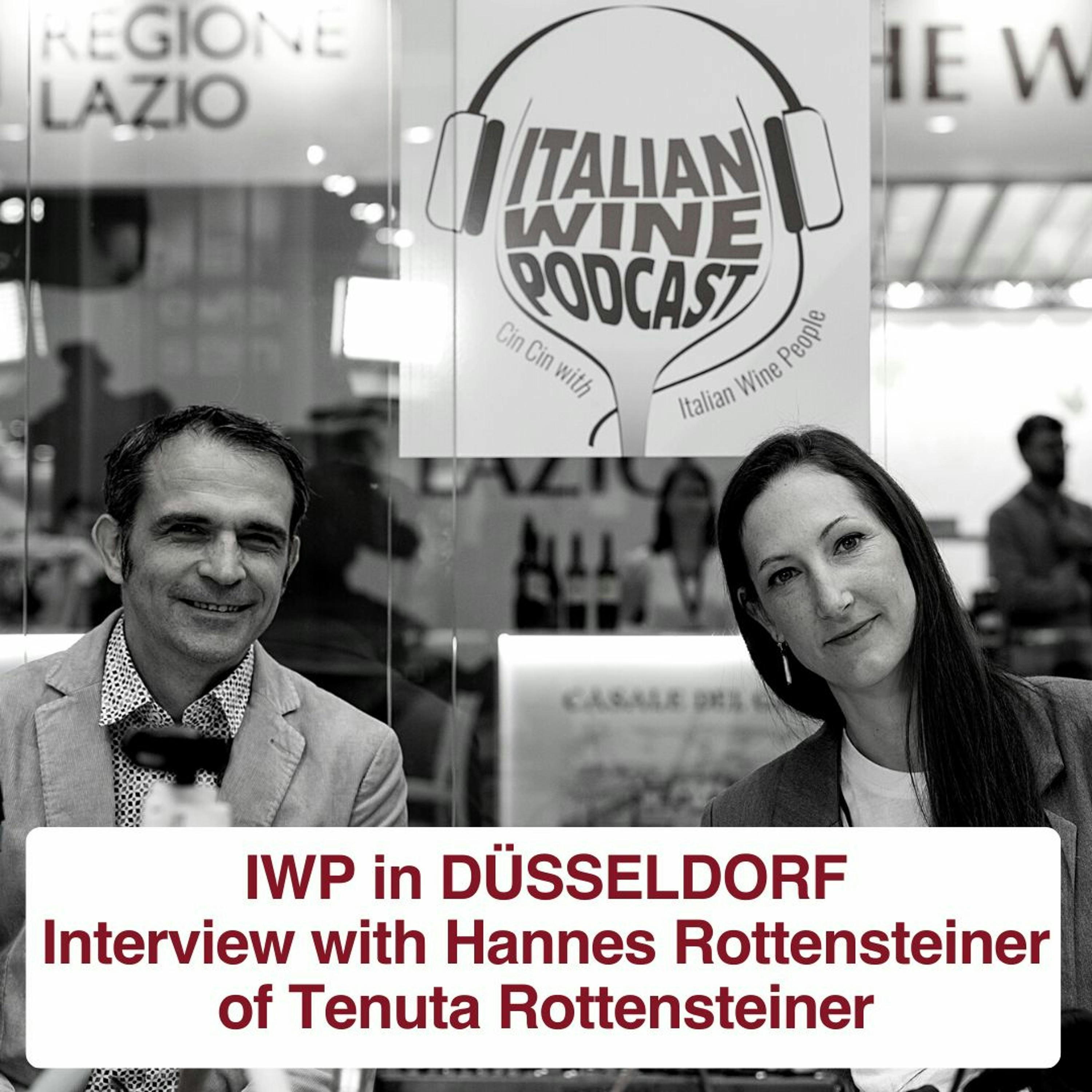
Ep. 1391 Hannes Rottensteiner | Italian Trade Agency Masterclasses In Germany
Italian Trade Agency Masterclasses In Germany
Episode Summary
Content Analysis Key Themes and Main Ideas 1. The unique and centuries-long history of the Rottensteiner family in winemaking. 2. The ""Manzo Cuso"" family tradition in South Tyrol and its impact on land ownership and new winery establishment. 3. Detailed insights into specific Rottensteiner wines, including their blended Sauvignon and signature varietals like Santa Maddalena and Lagrein. 4. The winery's key export markets and areas of significant growth. 5. Personal food pairing recommendations for their wines, reflecting regional influences. Summary In this episode, the host interviews Hannes Rottensteiner of Cantina Rottensteiner at a wine event in Düsseldorf, Germany. Hannes shares the remarkable history of his family, which has been involved in agriculture since 1528. He explains the ""Manzo Cuso"" tradition, a unique South Tyrolean custom where the entire farm passes to the firstborn, compelling other siblings to seek opportunities elsewhere and often establish new ventures. Hannes reveals that his grandfather founded the current Cantina Rottensteiner in 1956 after having to leave his original family farm due to this tradition. He discusses their Sauvignon wine, featured in the masterclass, detailing how it's blended from two distinct vineyards (Abiano and Buzano) to achieve a complex profile. Hannes identifies Santa Maddalena and Lagrein as their signature wines, noting Lagrein's current prominence. Regarding markets, he highlights Germany's historic connection and the significant growth observed in the USA and the domestic Italian market. The interview concludes with Hannes sharing his favorite food pairing: Wienerschnitzel with his Santa Maddalena, and richer game dishes with the Lagrein. Takeaways - The Rottensteiner family has a deep-rooted history in winemaking, dating back to 1528. - The ""Manzo Cuso"" tradition in South Tyrol dictates that the farm passes to the firstborn, leading to the establishment of multiple Rottensteiner wineries. - Cantina Rottensteiner, as it exists today, was founded in 1956 by Hannes's grandfather. - Their featured Sauvignon wine is a blend from two distinct terroirs, contributing to its complex profile. - Santa Maddalena and Lagrein are considered signature wines for Cantina Rottensteiner. - The USA market has shown the most significant growth for their exports, alongside a robust domestic Italian market. - Hannes Rottensteiner enjoys pairing his Santa Maddalena with Wienerschnitzel, reflecting his Austrian heritage. Notable Quotes - ""It's a very old family, and it's, doing well since, fifteen, twenty eight."
About This Episode
Speaker 1 and Speaker 2 discuss the history and importance of Italian wines and the manzo cuso concept. They also discuss the success of their Rottensteiner brand and the importance of competition in wine making. They talk about the wine industry in Germany, including famous names and historic trade of wine. Speaker 2 explains their history of exporting wine and recommends a combination of Schnitzil and Saint Macelena, with a emphasis on traditional Italian foods. They thank Speaker 2 for their time and ask about their favorite food, which is a combination of Schnitzil and Saint Macelena.
Transcript
Hey, guys. Check out Italian wine unplugged two point o brought to you by Mama jumbo shrimp, a fully updated second edition, reviewed and revised by an expert panel of certified Italian wine ambassadors from across the globe. The book also includes an addition by professoria Atilushienza. Italy's leading vine geneticist. To pick up a copy today, just head to Amazon dot com or visit us at mama jumbo shrimp dot com. Welcome to this new mini series on Italian wine podcast. Join Stevie and her just do the work team as they travel to Dusseldorf German to interview some great Italian wine Each producer had submitted one of their wines towards the special Italian trade agency's master classes. Each were run by master Sommelier, Eroz Theboni. Join us to get the inside scoop on these fantastic of wineries. So I am here once again with another fantastic producer here at the Italian trade agency area at this fantastic wine event in Düsseldorf, Germany. And, your wine is part of the, mountain wines from Italy. So Welcome, Hanes Rottensteiner. And you are from the Rottensteiner, Kantida Rottensteiner. Okay. I'm I'm on a roll here. Okay. So tell me tell me who you are, and tell me the history of your winery. Right. History of my winery. So my name is Hange Swautner, as you already said. And, well, let's see. Let's say I want to begin with not the history of the company, but with the history of the family. It's a little bit more interesting as it's a very old family, and it's, doing well since, fifteen, twenty eight. Wow. That is fault. Yeah. But, however, it's not a very linear history. As an adviser, we have this concept of, the manzo cuso. So the whole, farm always goes to the firstborn son. Or now also firstborn daughter, and all the other children have to leave the farm. You're kidding. Yeah. So it's it's like this. It's just over two different things. It seems brutal, but at the other side, you have the guarantee to always have enough land so that, family can live from this land. So tell me something because this is the first time I've heard this. Now if Have you had a lot of very, like, generous people in your in your family that have, like, owned it? And then said, okay, sisters and brothers. I love you all. Here, I will help you in your life. Actually, actually not. No. Actually, it has been, let's say, my my parents were first ones to divide them. Really? Vignettes. Yeah. And so, for example, my grandpa had to had to move away, from his farm. That farm's still producing its wines, still selling the swine, and found them, the other one. Wow. And started in nineteen fifty six with the company as we have it now. Okay. Okay. And, so it's in my family, there are four wineries of Apologia. Italian wine podcast brought to you by mama jumbo shrimp. Okay. No. Actually, that's genius because that means that everybody wants to go into wine So you just start another Rottenstein. It's like this. That's genius, and you have competition with yourself. That's Friday. I love it. Okay. Sorry. Totally off track, but I find that fascinating. So, tell me, which wine is featured in the master class? The sauvignon. Sauvignon. Tell me about the sauvignon. Sauvignon, but there's, not that marshutal. It grows on two different vineyards, two different soils. For me, it's, rather important if you produce sovignon to have, more, facets of the, so first one is Samantha Carriers. Soil in the Abiano community, and that gives a quite smooth, quite fruity, quite creamy, sauvignon. The other one is in the Buzano community on a porphyry soil, and that's a much for, green in the in the nose, more minerality, more, freshness, and it's, always quite nice to put them together at the end. Okay. Okay. And and so that's is that your signature one? Or is it a different one? No. It's just a wine. Exactly. They choose they choose it, for tasting over here. What's your signature wine? Signature wine where I am from Muzano. So it's the typical wines of the secret of Muzano Santa Marlena, and, and La Grange. Maybe the company's best known for La Grange at the moment, but we were also working quite much on, Santelena. Okay. Okay. Awesome. And, so we in Germany. Do you guys export to Germany? Or we do. That's I I assume so. But I just I gotta ask. Actually, it's a very, very, historic market for I plotted your wines, especially the southern part of, of, Germany. So in medieval times, actually, the monasteries of, Vaya Mhmm. Were the most important vineyard owners in Natalie So so it's a very, very long, tradition to export wine. Gosh. Those monks, they really like their wine. Yeah. I know. I that's great. No. And but okay. Where do you export everywhere, or is there a market in the world where you would like to see your wine break in and do really well? I'm quite pragmatic on this one. So, it doesn't matter, actually, where I saw the wine important thing is that at the end of the year, when it's sold, the however, the market with biggest growth in, last years has been USA. Mhmm. And also Italy's growing very rough. Yeah. So we have a domestic market. That's no. That's fantastic. Yeah? Well, I guess that's that's that's all my questions. I I would probably ask you what's your favorite food? My family food. You cancelled the day. Who else? You know? Maybe, with a traditional food, it's the Viena Schnitz. Yeah. Oh, I see I'm Austrian. So I'm a big fan of Viena Schnitzil. Okay. So you would pair that with your signature wine? With the something about with the Saint Macelena, I would pair it. Yes. Not with the Brayan. No. Okay. No. No. It's okay. So with the Brayan, maybe, game or something. Maybe ravioli stuffed with, some chingale Yeah. The quite heavy sauce. I'm hungry. That's good. Okay. Alright. So that's it. Well, that's thank you, Haines, for your time. And I hope you enjoy the rest of this pair. It is huge. So many people and enjoy the master class. Okay. Thank you so much. Alright. Bye. Listen to the Italian wine podcast wherever you get your podcast. We're on SoundCloud, Apple Podcasts, Spotify, HimalIFM, and more. Don't forget to subscribe and rate the show. If you enjoy listening, please consider donating through Italianline podcast dot com. Any amount helps cover equipment, and publication costs. Until next time.
Episode Details
Keywords
Related Episodes

Ep. 2502 Matteo Zoppas of the Italian Trade Agency | On the Road with Stevie Kim
Episode 2502

Ep. 1409 Daniel Pfitscher | Italian Trade Agency Masterclasses In Germany
Episode 1409
Ep. 1438 Alberto Zenato | Italian Trade Agency Masterclasses In Germany
Episode 1438

Ep. 1428 Elisa Semino | Italian Trade Agency Masterclasses In Germany
Episode 1428
Ep. 1418 Giulio Bruni | Italian Trade Agency Masterclasses In Germany
Episode 1418