
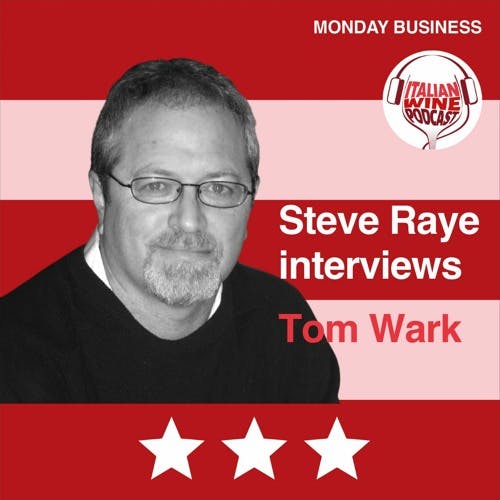
Ep. 1074 Tom Wark | Get US Market Ready With Italian Wine People
Masterclass US Wine Market
Episode Summary
Content Analysis Key Themes and Main Ideas 1. The historical context and current state of the three-tier alcohol distribution system in the US. 2. The evolution and challenges of direct-to-consumer (DTC) wine shipping for wineries, retailers, and importers. 3. The disparity in direct shipping rights between domestic wineries/retailers and imported brands/importers. 4. The role and limitations of wholesalers in the US wine market. 5. The importance of digital presence and information transparency for wine brands, especially imported ones. 6. The economic and regulatory barriers faced by international wine brands seeking to enter the US market. Summary In this episode of the Italian Wine Podcast, host Steve Ray interviews Tom Work of Work Communications, a PR consultant, and executive director of the National Association of Wine Retailers (NAWR). The discussion centers on the complexities of the US alcohol distribution system, particularly the three-tier system and direct-to-consumer (DTC) shipping. Work explains his background in wine PR and how he became involved in advocating for direct shipping rights, especially for retailers. He details the history of DTC shipping, from its early illegality in the 80s/90s to the 2005 Granholm v. Heald Supreme Court decision, which allowed wineries to ship interstate. A key point of the conversation is the ""dereliction of duty"" by importers who, unlike domestic wineries, have not lobbied for direct shipping rights, largely due to their reliance on the traditional three-tier system and the influence of large brands. Work highlights that retailers are the primary drivers of interstate DTC shipping for imported wines, as they are often the only legal channel. The discussion also touches on the economic realities of shipping, noting that DTC primarily serves consumers of higher-priced, rarer wines. They lament the lack of digital transparency and complete product information online, attributing it to a lack of collaboration between producers, importers, and retailers. Work critiques the outdated nature of the three-tier system, arguing it retards industry growth by maintaining a quasi-monopoly for wholesalers, a system designed to prevent ""tied houses"" from the 1910s, which is irrelevant today. He concludes by emphasizing that NAWR is actively litigating to expand retailer DTC shipping rights, which indirectly benefits imported brands. Takeaways - The US three-tier system (producer/importer -> wholesaler -> retailer) is largely a post-Prohibition construct aimed at preventing ""tied houses"" of the early 20th century. - Domestic wineries have largely secured direct-to-consumer (DTC) shipping rights across states following the 2005 Granholm v. Heald Supreme Court decision. - Retailers in the US have significantly fewer interstate DTC shipping rights compared to wineries. - US importers have historically not pursued direct shipping rights, limiting direct access for imported brands to consumers. - DTC shipping primarily serves higher-priced, niche wines, as the economics do not favor shipping inexpensive bottles. - A major challenge for imported brands in the US market is the lack of comprehensive, easily accessible digital product information (labels, scores, stories, etc.). - The National Association of Wine Retailers (NAWR) is actively challenging state laws banning retailer interstate shipping, which could benefit consumers seeking imported wines. - The current distribution system is seen as stifling competition and innovation in the US wine market. Notable Quotes - ""Everybody in the world need to know what I thought about things. So I started a blog... I spoke a lot about regulations, direct shipping, etcetera."
About This Episode
The Italian wine to wine business forum is hosting an in-person edition on the seventh and eighth of November, with the hosts introducing guest Tom Work who will host an in-person edition on the seventh and eighth. The challenges of the wine industry and the importance of direct-to-consumer shipping are discussed, along with the need for consumers to obtain direct-to-consumer shipping rights and privacy laws. The speakers emphasize the importance of preparing brands for e-commerce and creating awareness for wine in the US, as well as the need for importer to navigate the e-commerce system and promote the use of electronic commerce to facilitate sales. The speakers emphasize the importance of high resolution images and dual different ratios for wine tasting and emphasize the need for a trust state from retailers to prevent overconsumption. They also discuss the importance of sharing information and creating a unique story of the brand.
Transcript
Welcome to the Italian wine podcast. This episode has been brought to you by the wine to wine business forum twenty twenty two. This year, we'll mark the ninth edition of the forum to be held on November seventh and eighth of twenty twenty two in Verona Italy. This year will be an explosively in person addition. The main theme of the event will be all around wine communication. And tickets are on sale now. The second early bird discount will be available until September eighteenth. For more information, please visit us at wine to wine dot net. Thanks for tuning in to Get US Market Ready with Italian wine people. On the Italian wine podcast. I'm Steve Ray, your host, and this podcast features interviews with the people actually making a difference in the Italian wine market in America. Their experiences, challenges, and personal stories. And I'll be adding a practical focus to the conversation based on my thirty years in the business. So if you're interested in not just learning how, but also how else, then this pod is for you. Hello, and welcome to this week's edition of Get US Market Ready with Italian Wine People. I'm Steve Ray, your host, and this week, my guest is Tom Work of Work Communications, the fermentation blog. And also the National Association of wine retailers, n a w r. Thanks. And it's good to be here. I've, I've listened to the podcast quite a bit, so I'm excited to be on. Oh, cool. Thanks. We first met I don't know if you remember. I do, at an event called Vino two thousand nine in New York City on a panel discussion, and I didn't know you from Adam at the time. And it was talking about three tier system issues and distribution And all of a sudden, this guy next to me started talking and it was like a hurricane next to me. Whoa. Where did he come from? He certainly has opinions. I was kind of not a newbie to the industry, but certainly to that conversation. This was the panel where it was you and me and a member of the wine and spirit wholesalers of America. Right? Yeah. And it was a a panel about the three tier system, if I'm not mistaken. And the other person that was there was Bill Earl of, National Association of Beverage importers. Yes. Exactly. That's right. Yeah. I I remember that very, very clearly. This is not an unusual thing for me, Steve, where I'm on a panel, and I appear to be the odd man out, and I appear to be the person with all these opinions. And the reason that is is my opinions tend to be a little bit different those people who were dependent on the three tier system to make a living? Just a little bit different. Well, speaking about, take, making a living, why don't you give us a short bio of, Tom Work, the PR guy, Tom Work, the, three tier system guy, and any of the other things that that you're doing related to the business. Sure. So I got into the wine industry in nineteen ninety after I graduated from San Francisco State University. I immediately went to work for a wine public relations firm in Santa Rosa, California. And we handled usually wineries and maybe, some associations or events. But after, it took me three years to do the math and to look at how much I was being paid, how much my salary was versus how much the clients that I was servicing, we're paying the firm. And I saw the imbalance. And so I decided to start my own firm, took a few clients with me. And so since nineteen ninety three, I've worked as an independent public and media, relations consultant to the wine industry. And so That went all fine. And then in two thousand and four, I decided that everybody in the world need to know what I thought about things. So I started a blog, and it was focused primarily on the wine industry and the wine business. And I spoke a lot about or wrote a lot about regulations, direct shipping, etcetera, the three tier system, then there was the Grand Home V Healed Supreme Court decision, and a lot of people, including retailers, thought that they would finally get their direct shipping rights. Turns out retailers didn't, and they started an association called the National Association of Wine Retail. They sought me out to be the executive director, and I was happy, to do that. So since two thousand and seven, I've acted as the executive director of NAWR as well as kept my consult PR consultancy. And of course, I've been writing my my blog, which is now a a sub stack newsletter since two thousand and four. And so I worked with a lot of different facets of the industry. A lot of it had to do with regulatory issues. And of course, a lot of it having to do simply with marketing public relations and media relations issues. Well, congratulations for being one of the early ones to do blogs and to maintain it for eighteen years. I know the challenge of doing anything for eighteen years, but but right writing, a blog for eighteen years is is significant. You're one of the few that, can claim that title. I don't know. Aldaryaro is a is another one that comes to mind, and there's a few others. I think Alder and I were one of the first you know, four or five people who started blogging regularly. I try to keep to a schedule of, every other day publishing. Wow. God bless you. Okay. So let's, move away from the, your commercial venture of public relations and and focus on the whole direct to consumer issue. And and remember if you will, just as a guideline that most of the people who are listening to this are listening from the perspective of dealing with international brands or export brands being imported into the United States. So kinda give that not as you're talking about things, but I'll ask a broad question first. Can you put the whole DTC controversy into perspective for us? I I think I can many, many, many years ago. There was very little direct to consumer shipping, and we're talking now in the in the eighties and and early nineties. It was generally illegal in most states for, American wineries to ship direct to consumers, but it was in the nineteen nineties when the number of producers in the United States really started to expand significantly. At the same time, this expansion, the people behind the expansion of wineries in the United States realized that the three tier distribution system, whereby you have to a winery sells directly to a wholesaler. Wholesaler must sell to retailers when retailers sell to us, didn't weren't able to handle the expansion of all these different brands. And so these brands started to rely on their own tasting rooms. And after that, they started to rely on direct to consumer shipping. And they realized that the, the state laws that prevented winery shipping really was hampering their their business. And so they went about trying to change these laws. That culminated with a Supreme Court decision in two thousand five called Grand Home Be Healed, which basically said that if a state allows its own wineries to ship direct to residents in those states. They have to allow other wineries in other states to also ship into that state. There was nothing in that decision, that Supreme Court decision that suggested this concept of of fairness, nondiscrimination didn't also apply to retailers. And yet after the decision, retailers simply weren't included in the updating of the state laws and in a lot of the judicial decisions that came after that. So over the course of the next fifteen years, wineries largely got their direct shipping rights into most states, while retailers did not. The impact of direct to consumer shipping is is massive. Today, the winery to consumer shipping channel is probably worth somewhere in the neighborhood of four billion dollars. We don't have an exact figure for retailer consumer shipping, but, my best guess having been involved in this part of the industry for so long is somewhere in the neighborhood of three to four billion also. That's a lot of wine being shipped by both wineries and retailers. Retailers, if they were allowed to ship into most states, would clearly eclipse the amount of wine that's being shipped by wineries. Retailers may only strictly legally ship into fifteen states currently. Whereas wineries can ship into, I think it's forty six or forty seven. Okay. And effectively, most of what you just discussed described in terms of the winery direct shipping to consumers really is the only way around, and I it's not really a way around or a complimentary way of, selling wine, within the three tier system. That route is not open to imported brands who function well, the imported brand is the supplier, but they're selling to an importer and the importer of an imported brand is more similar to a supplier of a domestic brand where they sit in the three tier system. That's right. One thing that happened recently over the last four years was, called the CBMA, the Crap beverage modernization and beverage act. And, it dramatically lowered federal excise taxes. And for the first time, included imported producers in the tax. I looked at that and so did Bill Earl for that matter, and saw maybe a chink in the armor that maybe that was the beginning of legislation that would put imported brands from our perspective into the same category as domestic brands. I think that was a a big, you know, bridge too far maybe a long lead. Can you comment on that? Sure. Particularly where direct shipping is concerned. All direct shipping legislation is done at the state level, not at the federal level. So the extent to which importers who are, in fact, similarly situated to domestic wineries in the supply chain, the extent to which importers will be able to ship their portfolio direct to consumers depends on states passing laws that allow that to happen I believe I'm correct in saying that absolutely no states allow importers to ship directly to consumers in different states. And I think there's a good reason for that, Steve. I think the reason is importers simply haven't asked for the privilege. Talk more about that. That clearly was one of the touch points of our initial conversation in preparing for this interview. And it's not one that I've heard espoused by very many people. So you you opened the door. Can you walk us through that and explain the significance of it? Sure. So to reiterate, the domestic producer and the American importer are similarly situated in the product chain. Both these entities, the winery and the importers sell to wholesalers, wholesalers, then sell to retailers and retails. Retailers and sell it to us. Wineries have been very aggressive in pursuing direct to consumer shipping rights in different states. Importorters have not said boo once ever. I've never seen any while I've never seen the National Association of Beverage importers ever ask or lobby for the right to ship direct into a state. I don't know why that is. I presume it's because, the most important members of Navi are very large importers controlled by very large brands, or importing very large brands who are themselves dedicated to the three tier system of alcohol distribution imported to wholesaler to retailer. And that's a mistake because by not pursuing direct consumer shipping rights from the importer to the To the consumer, they've essentially set aside a very important channel, for distribution, and it'll become it would become more and more important as the marketplace becomes more and more crowded with import brands. At this point, a consumer who wants to obtain an imported wine that's not distributed in their state or that's sold out in their state, they have to go to a retailer in another state who will ship it to them. However, it would be nice for the consumer if they could go directly to the importer. In addition to that, the importer, if they were able to ship direct to consumers, could really put together some compelling consumer facing websites, consumer websites, commercial websites that highlight a variety of different brands. You've got a number of importers who focus, for example, on Italian ones, or South African wines or Chilean wines, and it's easy to do to imagine how some of these importers could become a really key source for information and wines from specific regions, as well as a source for wines from a number of different regions, but they've simply never made the effort to convince state legislators that they should be allowed to ship also. And so as a result, the degree to which importers are involved in the direct to consumer shipping channel depends on the degree to which retailers will sell their wines online. Okay. So now we're in a world post COVID world. We'd like to think it's, well, whatever the post COVID it's not post COVID. It's post the beginning of COVID because it's always gonna be with us. But there's this always has been in there continues to be and it's growing. There's tremendous interest in the part of export brands of both spirits and wines for that matter. To wanna come to the US, coupled with a lack of understanding of how the three tier system works and and how to effectively enter the three tier system. It's still a patchwork of fifty two different regulatory entities. As you said, it state regulated the fifty states plus Washington DC in Montgomery County, Maryland. And the net net is there has been no call it progression on the side on the part of importers to try and expand their access to the market that they've pretty much been comfortable in the, role that they play within the three tier system. Now with the growth of internet. And the expectations of consumers that Amazon and others set the standard for shipping terms and timeliness and responsiveness and web access and information and so on and so forth add to that the concept of label identification or label recognition technology where you can hold your phone up in wine search or in Vivino will actually take you to a page or information directly on that wine. Even if you don't remember the name of it. All of those things have progressed in the world that we live in, and yet the wine industry hasn't moved much at all, into that modern age. The the question is, I guess maybe you already talked about it, that they haven't done it, but the the question I'd ask, I guess, is why? Why have importers not taking any steps? Well, importers have a certain responsibility because of the expansion of ecommerce, wine e commerce in the United States. They need to help prepare the brands that they work with to, to navigate internet commerce. And that goes back to exactly what you were talking about. That is preparing their materials, preparing their labels, preparing information about the brands to be disseminated efficiently across electronic channels, as well as across the three tier system. So that's that's an important thing that import brands and importers have to do together. They have to gather up the materials that can be efficiently distributed and used to educate wholesale sales teams, retailers, as well as consumers. That's about the most, I think, that the import brand can do in terms of facilitating their sales in the United States through electronic commerce. Again, the degree to which I say an Italian wine brand is going to be sold to consumers direct consumer or via e commerce depends almost exclusively on the retailers that their importer is working with. So I can see how an importer, might be interested in targeting sales to those retailers who are actively working. In the DTC marketplace because the fact of the matter is it's only really a small minority of retailers in the United States that are actively working on the internet, achieving internet sales and shipping interstate, but it would seem to me particularly an importer in the northeast. It would seem to me that it would behoove the importer to try to work as closely as they possibly can with those retailers, to get their brands into those retail outlets where consumers from across the country can access them. Italian wine podcast. If you think you love wine as much as we do, then give us a like and a follow anywhere you get your pods. Well, that makes perfect sense, but let's let's back up to a consumer. They taste the wine when they're maybe not at home. It could be in their home state or could be in some other state. Where they read about it and they look it up, and then they go online and wanna buy it. And it may be available, in their state, you know, registered in their state, but not necessarily available at their local store or available to be purchased. That is is like diametrically opposed with the way we shop for every other consumer item in the world from books to shoes to sneakers to food, grocery now. It's all done, directly. So people are exposed to wines, that they would like to have and then find out, you know, they're blocked from being able to buy it. Why haven't consumers made a bigger stink, if you will, about this, about not being able to get access to the products that they want just because they happen to live in Pennsylvania, for example. Yeah. That's because the vast majority of wine consumers are buying fairly inexpensive wines that that don't require direct shipping. The vast majority of consumers are buying but we might call grocery store wines, wines that cost between, say, seven and fifteen dollars a bottle. Shipping a seven dollar bottle of wine, interstate doesn't make much sense economically right. And if you're buying a seven dollar bottle of wine, and if you can't find you know, the the cheap import that you want, there's another brand that you can substitute for. Ten percent of the population might be interested in buying something more exclusive, something a little bit more rare, something in smaller apply something more interesting. Those are the folks who are buying on the internet. Those are the folks who are paying more for a bottle of wine. It's interesting to note that the average bottle of wine shipped in the United States is somewhere in the neighborhood of forty three to forty five dollars a bottle. That is not the average price of what a bottle of wine, bottle of wine purchased, at a retailer cost. I'm not exactly sure what that is now, but I my guess would be somewhere in the neighborhood of eight to ten dollars a bottle. I looked at ten dollars as what what Nelson says. Roughly. Okay. So Oh, it's an entirely e commerce. Wine e commerce is an entirely different marketplace with different rules and different different types of consumers. So for a lot of the wineries that I talked to work with and and speak to when I'm traveling, that's the world that they live in. They're not trying to compete in in grocery store wines, although they may not understand the retail environment in the US. They do know that they're trying to sell more expensive wines that have a a deeper, story to tell to people. So what can producers do in preparation for finding import solutions? One of the biggest issues, we talked about and and I wrestle with every day is is the issue of margin And oftentimes a winery will say, well, I'm I'm selling my exporting brand for call it four dollars, not four euros, four dollars, and it'll end up at retail in the US at sixteen dollars. And if you look at everybody else's margins or markups, and they are different. Everybody's making more money on their wine than I am as the producer, and I have to own the land, grow the grapes, live with the weather, procure all the things and process it and so on and so forth. That that seems to be a real disconnect. But this is the nature of the wine industry. I mean, look at a domestic producer, right? The domestic producer who, just take a round number, for example, who sells a bottle of wine out of there, tasting them for a hundred dollars. If they put that into the system, they have to sell that to a wholesaler for fifty dollars a bottle. Right? Then the wholesaler will mark it up, and the retailer will buy it for roughly seventy five dollars a bottle, and then they'll sell it to the public for roughly a hundred dollars a bottle. This is the nature of the alcohol distribution system in the United States. Now, part of the nature of that system is the fact that we have a state mandated wholesaler in the middle. It would be interesting. Wouldn't it, for everyone involved from the producers, whether they be in the United States, or outside the United States, it would be interesting. If the importer or the winery domestic winery could sell direct to the retailer. And go around the wholesaler and not use the wholesaler. That's an entire tier of profit that be split up between the producer slash importer and the retailer, or even the consumer. Right? But the vast majority of states don't allow what I'm talking about, which is self distribution. Self distribution, allowing self distribution, allowing producers and importers to sell directly to retailers without going to a wholesaler. This is the, this is the key. To reforming the alcohol beverage marketplace to making it more fair for everybody, including the importing producer. And again, it should be the importers who are fighting for this change in the law, but they simply aren't. And again, I can't speak to why they aren't. All I know is it's a dereliction of duty. So let's be clear though. There are, you know, when I talk to, export producers that we're talking about direct to consumer inter state between states as opposed to intrastate within a state. Mhmm. And there's a lot more freedom and flexibility for retailers to do that. Florida is an example. New York is an example of where they can retailers can ship to consumers in their own state. So that's an opportunity if your local retailer doesn't have that one wine that you just tasted that you're interested in, but it is registered in the state that you could in fact order it. So it's not as grim of a vision of the industry as it might be because obviously there's in in trust state options. But a lot of times people ask me, you know, well, you know, what are my options? And I go through a list of, you know, their options to be selling in the United States, and the the summary of it is you've got a lot of options, and they all suck. I mean, it's not what anybody wants to hear. And I I sometimes feel like I'm the, you know, the doomsayer. Right? Well, you can't do this and you can't do that and you can't do this. But we've found a whole lot of people being very creative within the confines of the regulations that we all acknowledge recognize and deal with that kind of makes that happen. And I'm talking about things like naked wines or some other things that that are different spins on the way, in this case, mostly domestic wines are purchased. But those are really just scratching the outside surface. Do you see any anything on the horizon where this might be changing. Is there any lawsuits? Are there any things going on that you think might be I go back to a chink in the armor where this might be expandable? There's nothing right now happening that would allow importer producers to more easily sell direct to the consumer either interstate or interstate. Okay. Nobody's working on this issue at all. The there's no association of importing producers who are putting any pressure on state legislators. There's no association of American importers that are putting pressure on state legislators to to change any laws that would make it easier for consumers to access the imported ones. Nothing is happening. The most that is happening actually is what the National Association of Wine Retail is doing. And that's what we're lobbying from more retailer to consumer shipping interstate. We're, we're involved in seven different lawsuits in seven different states challenging bans on retailer shipping right now. And and by the way, our message to look legislators, and our message to consumers, and our message in our lawsuits, centers on imported wine. And the way it centers on imported wines is that sure consumer in most states can get their hands on domestic wines. But If a consumer can't find an Italian or a French or a German or a Spanish or a Lane or an Australian wine in their state, either because it's sold out or it's not, or it's not sold by a wholesaler there, then that consumer can't get it unless the law allows them to have it shipped to them. So there's very little going on right now that will help importing producers, really, with the exception of what an AWR is doing. So alongside the whole issue of direct to consumer shipping, there's a whole B2B business in the wine and spirits industry. That's still very nascent and developing. And one of the the things that changed the game a lot was a company called seven fifty, which basically was an online electronic ordering vehicle and information vehicle for retailers who are ordering from distributors. There's a suit now with a company called Provee. Provee has, I guess, is merging or acquiring. I don't know what the the term is seven fifty, and it's still in process. So nothing's finalized. But I think it's almost a proxy for some of the things that we've been talking about on the consumer side, on the b to b side. Do you have any comment on that? Well, I've read the complaint that Provi's filed against RNDC and Southern. And essentially what they allege is that the two have conspired together to stop retailers from using their platform. What the probate platform does is it allows retailers to buy inventory across whole different wholesalers using one platform, the probate platform. It turns out that according to the lawsuit, the, r n d c and Southern don't like that. They prefer retailers to use their own in house platforms, electronic platforms to purchase inventory. So it's an antitrust lawsuit. It's, who knows where it's going to go? I can tell you that the discovery process of this lawsuit is going to be absolutely fascinating if the wholesalers allow that to go forward. I would not be shocked to see it settled, although wholesaler is notorious for not settling. Nevertheless, if it if it is not settled, then they go through the discovery process. We're going to learn awful luck about the inner workings of RNDC and Southern wine and spirits. Flipping us from the other side and talking about the importance of things like the WSWA meeting for export brands who are trying to come to the US. I've been going for, I don't know, thirty years. It's evolved dramatically. It's changing dramatically this coming year. We don't know exactly what it's gonna be like because, they didn't have it the last two years. But what they're talking about is is making it more friendly for brands who are looking for importation and distribution and making it easier or more an incentive perhaps for distributors and importers to be open to pitches or, exposed to some new brands. Know one of the big challenges I face in my clients often face is they can't get anybody on the phone to listen to their pitch. Just know I'm not looking at any new brands now. We all know that new brands are the, the blood and guts of the industry and everything from tequila, vodka, Jae hermeister, examples of products and categories that have tequila now, especially. I mean, back then, it was Jose Cuervo. Now it's it's absolutely huge. So WSWA plays a very important role in this changing. Do you have any comments on that? I mean, They're on the other side when it comes to this argument about, direct to consumer shipping. But on the other side, they play a very significant role in facilitating sales of beverage alcohol products in the US. Well, let's be clear, the only reason they play a significant role is because the law requires they play a significant enroll. I go back to self distribution. If importers and producers were allowed to sell direct to retailers, then wholesalers, the members of WSWA would be much more willing to pick up new brands because they'd have to actually compete for, for business, as it is now, in most states, brands must go through a wholesaler to get to the retailer. It's a quasi monopoly situation. That said, as quasi monopolists, the wholesalers are in the best position to help importers and importing brands find a marketplace. There's no question about that. I'd argue that I'd argue that the market allows them to cheat in that regard. When you don't have competition, when you don't have to convince an importer to use the wholesaler when they're required to use a wholesaler that allows you to offer terms that are not advantageous to the wholesaler, but more advantageous to you. And it comes back to the fact that the system that we're using right now to distribute wine in the United States is it's broken entirely, and it's based on situations that existed over a hundred years ago. I was just about to to ask you that. I didn't talk about tight house laws and that. So take us back to give us some, history and perspective on it. When Prohibition ended nineteen thirty, three, the primary concern of the people who were gonna write the laws concerning alcohol distribution was that we not return to the situation that existed in nineteen ten when you had retailers, particularly taverns and saloons, essentially tied to producers. And by that, I mean, a brewer in a certain area would give money to a saloon and essentially control the saloon and allow them to open up, but saloon would be required to sell a certain amount. In order to sell that amount, there were some terrible sales tactics that were used And so the saloon became a place where people went and and really overconsumed in in terrible, terrible ways. But now we're talking about nineteen ten, right? And again, nineteen thirty three, the regulators wanted to avoid that situation from happening. But you have to think about nineteen ten. We were in the midst of a huge wave of immigrants into the United States. And in nineteen ten, most dwellings had no electricity. Most dwellings had no air conditioning. People, there was no cross country air travel. There was very little auto travel. There were very few affordable sporting events. There was no television. There was no internet. There was no training services. However, there were the saloons and there were the taverns. And the saloons and the taverns were if folks went to get the news of the day. It's where they went to find out what jobs were available. It's where they went to organize political and organize political parties. It's where they went to commune with their people. And it's also where they went to to drink and to eat. And as a result, we had lots and lots and lots of drinking. That went on, and it helped form the reasons for provision coming about in the first place. But in nineteen thirty three, that was the big deal. Let's prevent these saloons from being tied to these producers so we don't have this overconsumption. Twenty twenty two, we've all got electricity. We've all got air conditioning. We've got affordable. It used to be affordable cross country air travel. Everyone's got a car, streaming services, the internet, television, radio. All these things that didn't exist, the point is, We don't go to the saloon, to find out what jobs are available. We don't go to the bars and restaurants to, to get the news of the day. We don't go there to organize politically. We don't go there to commune with our people. Still, In twenty twenty two, we have this three tier system that was built to prevent tide houses, and the problems that existed in nineteen ten. And it's a bit like the US army coming out and making an announcement that Our new policy is we're going to figure out how to dig deeper trenches faster. You can't have an alcohol regulatory system built on the problems of nineteen ten when those problems could never emerge today and yet we do. And as a result, we do. And The, the alcohol beverage industry has been retarded, in its growth. So as we think about, imported brands, where I've been focusing my resources is to help them leverage what they can do, which is in trust state from retailers who do have inventory of the brand. Using many of the tools that are out there, whether it's Vivino, whether it's information sites like VinePA, whether it's, or or wine searcher, where people the information about products is more available and exposed. It's kind of like the difference of buying a car. It used to be only the dealer knew all the facts and figures. Now it's transparent for everybody. Well, that that level of not just transparency, but knowledge about wine or accessibility of knowledge about wine is pretty widely available to challenges getting the products themselves. So within a given state, you do have an opportunity. And I I I think that's where retailers are really doing a good job. Those that are expanding into into e commerce, because they recognize Not only can they sell to a wider audience. They can provide greater value to that audience as well as their local geographic audience. That's absolutely right. But the retailers are the retailers rely a lot on importers and wholesalers to get the information that they that they need. To put up on their website. There's nothing. There's nothing worse than browsing a retailer's website and coming to a wine that's interesting to see that there's no label there, and no information essentially about the wine except perhaps the the appalachian and the price that's partly the, the retailer's fault for sure, but it might also be the importer's fault. And for that matter, it might partly be the producers. I I I think that's where it is. Actually, you hit on one of my, not pet peeve. Something that I'm really adamant about is that And I've said this in some other interviews. And if you wanna call me at, or email me at steve at pathology inc dot com, I'm happy to have a conversation with anyone who's listening. But the idea is brands are in control of how they're they appear online that you can There's a whole suite of things that, supply or, sites like wine search and VIVino need high resolution images in certain formats and so forth. And in my book, I detail a list that I put together with the wine searcher on the information that they need to optimize brands. This is something that doesn't cost a winery much money. Doesn't require a lot of time, requires a little bit of technical expertise, but you know, your your your children or your grandchildren, I'm I'm sure are more than capable of doing it. And it it puts you on an even keel with all the major brands that are out there in the world where we will be competing in the future, and that's online. As opposed to just in the store. So that's something everybody can do, but I think the burden falls on the producers to do that. And it's it has to be recognized. This is block and tackle work. I mean, this this work has to be done as a matter of road. Yet, here's a quote. Mike Osborne was quoted as saying only five percent of the wines that are listed on wine dot com have, complete documentation, if you will, or the the information you people want on the wine, current ratings, reviews, wine pairings, winemaker notes, vintage things, and all that. Only five percent. And, when I was interviewing Borkard, Nesen, who write who was the analyst for Rabbobank, he was railing on on on the same issue. Come on, guys. This is relatively easy for everybody to do. So if we all got together and made sure it got done, everybody would be in much better shape, and it would minimize, I think, the the the DTC issue because you're maximizing your presence of brands online. And that's just And you had a wine dot com is still willing to put up those wines, for sale without having that information. Right? So it's not as though they're not willing to go forward without the information in the data that they need it to make it complete. So if probably the retailer's fault too. The retailers could put a stop to this if they wanted to immediately by saying, we'd love to sell your wine and we'd love to, promote your wine. But until you get to see information that we need, we are not going to do that. So everyone's to blame at this. In the end, you're right. I mean, the information has to come from the producer. It's gonna go to the to the importer after that. Maybe it's gonna go to the wholesaler after that. And finally, it's gonna get to the retailer, but there ought to be a an efficient way. Yeah. And Frank, it's been one of the things that I've been working on and the ideas collaborate between and amongst all of them or amongst everybody to kind of spread the burden. It doesn't cost a lot of money. It's relatively easy to do, and the assets are accessible because they already exist within an organization. The challenge is just to gather them and communicate them. So What is the main information you think needs to be provided besides a high res image? Well, high res image logos, and dual different aspect ratios, vertical and horizontal. Logo on a black background. They'll go on a white background. And if Rachel wanted to do any things or or any of the distributors wanted to make up some things. Most current scores for the currently sold vintage, winemaker notes for the things that are being sold now. And whatever, the background story is the story of the winery, because every winery has a unique story. Because they didn't have a unique story. They'd be the exact same as the one next to them, and we know that Chateau dauryak is very different from Chateau Muutan. Right? So I think that is a tremendous way of presenting your brand in a way that resonates with this new audience of millennials. They want to know the story behind the brand. They don't wanna know necessarily about sauteed gooseberries and other flavor notes and things that that they don't know anything about. But they do wanna know is it sustainably produced or pesticides used in it? How is it harvested? How are the workers treated? Those kinds of things? Is there some history that about the land that that makes it, particularly interesting? Those are stories that go beyond scores and winemaker notes and all the rote wine geeky stuff that we all talk about. And I think, what I find is everybody's got a story, but not everybody is capable of our particularly. And, That's my job. And my yes. There you go. The the collection of things that, that you say are needed. Yes indeed, they are needed, but it's also it's also certainly a collaboration in order to create those things. Part of that information has to come directly from the producer, but where the, the scores are concerned, right, that's gonna be the importer's job to gather up those because it's there. Yep. Yeah. It's it's absolutely collaboration. And I that's what I would like to say. Okay. Not pointing the finger at who's responsible for doing this, but ask the question, how do we get this done together? And that's something that I try and facilitate, with my clients, because as I said, it's relatively easy to do. It doesn't cost a lot of money, and has significant impact immediately and and is evergreen long term. So why would why would you not just jump on this? Anyway, I don't have the answer to that question. It just it just one of those conundrums of life. My guest this week has been Tom Work of, National Association Wine retailers of Tom Work Communications. He's a PR guy in his spare time. I think that's how he actually makes money. And he's also the author of the fermentation blog, which I was pleased to find out in this conversation. He's been writing regularly every other day or so for eighteen years. Tell me how people can access your My blog. Recently, my blog has been turned into a newsletter, and it can be found at Tom work dot substack dot com. And, again, we publish every, about every other day there. It's a, a paid and a free publication. So, I urge everyone to check it out. I tend to write about the issues that Steven and I talking about right now. And he's very forthright in the things that he says. That's what makes it so much fun. Tom, if people wanna, reach out to you directly, can you give us your email and, phone number if you're interested? The email is tom at Work Communications. That's w a r k communications plural dot com. And the phone number is area code nine seven one three three two five zero five seven. And you're calling Salem Oregon. Cool. Alright. Thank you, Tom, for a very interesting conversation. I I I look forward to having another one where we we see how far the industry has come since the last time we spoke, but I hope we speak soon. I need to. Thanks, Steve. We hope you enjoy today's episode brought to you by the wine to wine business for twenty twenty two. This year, we'll mark the ninth edition of the forum to be held on November seventh and eighth twenty twenty two in verona Italy. Remember, the second early bird discount on tickets will be available until September eighteenth. For more information, please visit us at white to wine dot net. Hi, guys. I'm Joy Livingston, and I am the producer of the Italian wine podcast. Thank you for listening. We are the only wine podcast that has been doing a daily show since the pandemic began. This is a labor of love and we are committed to bringing you free content every day. Of course, this takes time and effort not to mention the cost of equipment, production, and editing. We would be grateful for your donations, suggestions, requests, and ideas. For more information on how to get in touch, go to Italian wine podcast dot com.
Episode Details
Keywords
Related Episodes
Ep. 2790 Italian Wine in the US: Building a Narrative and Reaching Asian American Consumers with Susan R. Lin MW | Masterclass US Wine Market
Episode 2790
Ep. 2783 The Suburban Gold Mine: Insights into New Jersey’s Wine Market with Brittney Abell | Masterclass US Wine Market
Episode 2783

Ep. 2772 A Surprising Partnership between Japanese Sake & Italian Wine with Monica Samuels | Masterclass US Wine Market
Episode 2772

Ep. 2770 China’s Wine Market: From Misleading Import Numbers to Today’s Consumer with Fongyee Walker MW - Part 1 | Asia Wine Market
Episode 2770
Ep. 2760 Winning the Restaurant Floor: Training, Education & Italian Wine with Sylvester Inda of Ci Siamo | Masterclass US Wine Market
Episode 2760

Ep. 2751 From Montalcino to Kazakhstan with Francesca Arquint of Collemattoni | Asia Wine Market
Episode 2751