
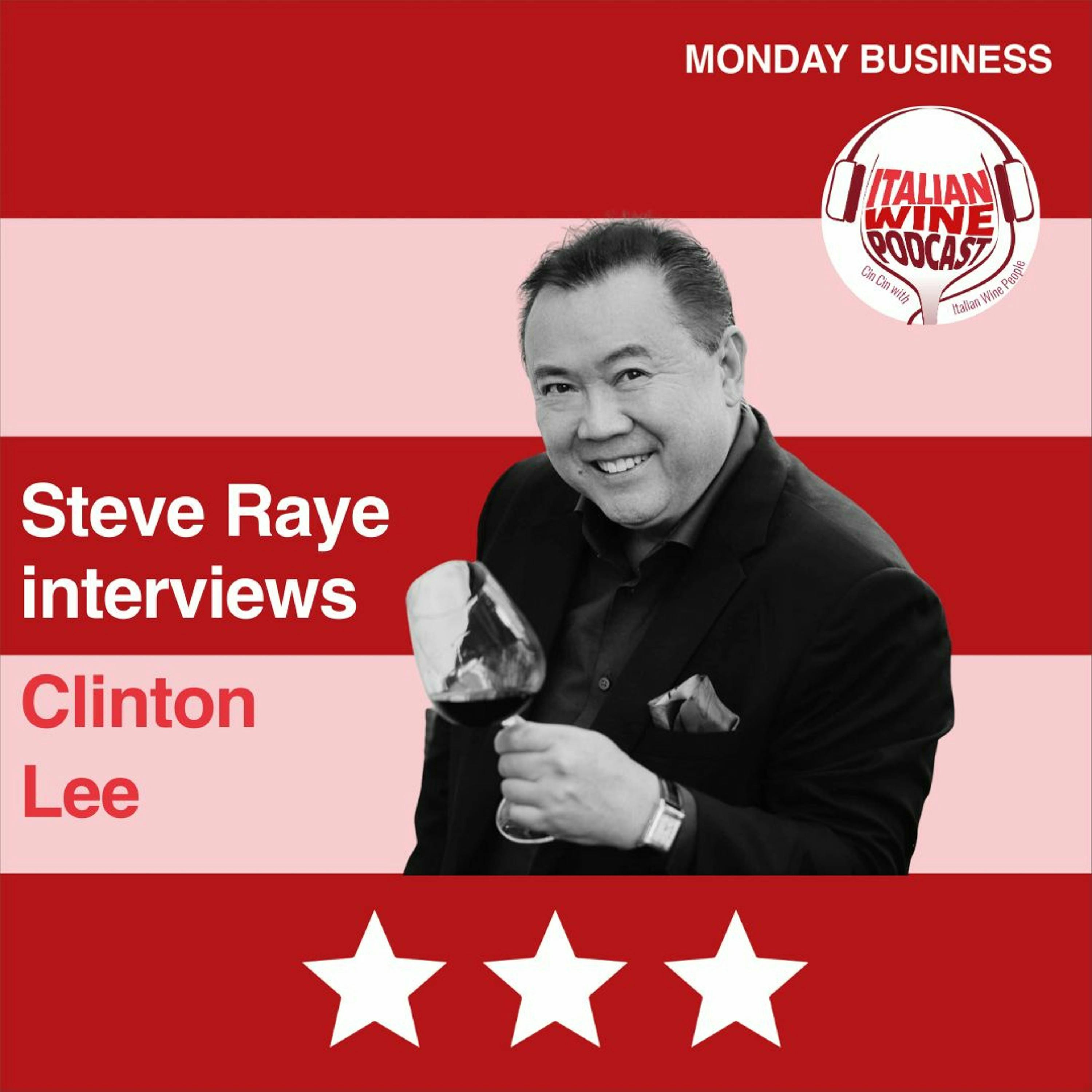
Ep. 1211 Clinton Lee | Get US Market Ready With Italian Wine People
Masterclass US Wine Market
Episode Summary
Content Analysis Key Themes and Main Ideas 1. The mission and offerings of the Asia Pacific Wine Spirit Institute (APWASI), focusing on wine, spirits, etiquette, and cultural understanding. 2. The evolving role and format of storytelling in marketing, particularly for Gen Z and Millennials. 3. The impact and strategy behind social media influencing in specialized niches, using Dr. Lee's Instagram as an example. 4. Cultural nuances and business etiquette essential for engaging with Italian and Chinese markets. 5. Unexpected aspects of Italian agriculture and industry, such as caviar production and the role of Punjabi immigrants in Parmigiano Reggiano. 6. The importance of respecting local customs and environments when traveling and conducting international business. Summary In this episode of ""Get US Market Ready with Italian Wine People,"" host Steve Ray interviews Dr. Clinton Lee, the Executive Director of the Asia Pacific Wine Spirit Institute (APWASI). Dr. Lee introduces APWASI's three main pillars: online courses in wines and spirits (including luxury items like caviar and truffles), etiquette masterclasses for cultural understanding, and international wine and etiquette cultural tours, with a significant focus on Italy. He discusses the timeless nature of storytelling but highlights how its format and speed have drastically changed for younger generations. As a prominent social media influencer, Dr. Lee explains that APWASI's video content is primarily driven by follower requests, emphasizing audience engagement. The conversation delves into crucial cultural considerations for Italian wine, covering topics from proper Italian dining etiquette (e.g., no cappuccino after noon) to the often-overlooked fact of Italy's significant caviar production. Dr. Lee then shifts to China, illustrating differences in business culture, such as the emphasis on patience, group decisions, and gifting. He draws a fascinating parallel between the generational business relationships in Italy and China. A surprising revelation is the vital role of Punjabi immigrants in Italy's Parmigiano Reggiano cheese industry due to historical labor shortages. Dr. Lee concludes by offering universal advice for travelers: always respect local customs and environments, echoing the adage, ""When in Rome, do as the Romans,"" and attributes perceived ""boorish"" traveler behavior more to travel volume than specific nationalities. Takeaways * APWASI offers a holistic approach to wine education, integrating cultural etiquette and understanding. * While storytelling is timeless, its delivery and consumption have accelerated and diversified to cater to modern audiences like Gen Z. * Successful social media engagement for specialized content relies heavily on audience interaction and tailoring content to their requests. * Cultural nuances, from hand gestures to dining customs, are critical for effective communication and business relations in Italy. * Italy is a significant, albeit lesser-known, global producer of farm-raised caviar. * Chinese business culture prioritizes patience, group decision-making, and relationship-building, often across generations. * Punjabi immigrants have played a crucial and unexpected role in the labor force of Italy's renowned Parmigiano Reggiano industry. * Adapting to local customs (""When in Rome, do as the Romans"") is the most fundamental advice for all international travelers and business professionals. Notable Quotes * ""As an institute, we are focused on promoting culture, understanding of other people, etiquette, through wine and spirits."
About This Episode
The Italian wine podcast is a hub for promoting culture and understanding different cultures, with storytelling being a fundamental part of their growth. The podcast is a result of many requests and interactions with their audience, and they use Facebook and Instagram to produce videos and cover a range of topics. The course is a combination of learning about Italian classifications and the food aspect, and communication is a group decision within the hierarchy of the company. Visitors can avoid problems and irritation during visits to Italian countries, and can visit their website for more information.
Transcript
Some of you have asked how you can help us while most of us would say we want wine. Italian wine podcast is a publicly funded sponsor driven enterprise that needs the Moola. You can donate through Patreon or go fund me by heading to Italian wine podcast dot com. We would appreciate it Oh, yeah. Thanks for tuning in to Get US Market Ready with Italian wine people. On the Italian wine podcast. I'm Steve Ray, your host, and this podcast features interviews with the people actually making a difference in the Italian wine market in America. Their experiences, challenges, and personal stories. And I'll be adding a practical focus to the conversation based on my thirty years in the business. So if you're interested in not just learning how, but also how else, then this pod is for you. Hello. Welcome to this week's edition of Get US Market Ready with Italian wine people. I'm your host Steve Ray. And my guest this week is doctor Clinton Lee. Doctor Lee, welcome to the show. Thank you very much, Steve, for having me on your show. Why don't you give us a a brief bio? And, I'm, you know, you're obviously involved in things Asian. You can talk about that. And then we'll get into, some parallels to things that I think are relevant to the Italian wine industry. But Give us a little bio background on you and what you're doing. Well, certainly, perhaps if I could just clarify, you know, you mentioned, into something Asian. I'm the executive director of the Asia Pacific Wine Spirit Institute. And we're located here in Vancouver, Canada. And the reason why it is named Asia Pacific is because we are actually an Asia Pacific country and hence, hence, the name. As an institute, we are focused on promoting culture, understanding of other people, etiquette, through wine and spirits. So the organization, we have, what we call three tiers. One tier is online classes. And those are classes relating to wines and spirits. Obviously, one must have Italy being one of the power houses of the, wine world, but we also have luxury courses, which, include, caviar, and, truffles, which is very close to the Italian heart. Mhmm. And, we have, the spirits of Brandy's and Conjaks So that's one tier, all the online. The second tier is what we call our etiquette master classes. And those are involved in understanding different cultures, what works for them, if you're traveling to that country, if you're traveling to Italy, what do certain gestures mean, what you shouldn't choose and what you should. And the third tier that we have is we hold and conduct with strategic partners international wine and etiquette cultural tours, of which Italy features quite prominently. As for myself, I've been involved in the wine, spirit, edicate industry for over twenty years. I've lectured at universities here in Canada. I've given consultancies and have gone through work and travel to over five continents and over a hundred countries. And, just yesterday, Steve, I, completed my manuscript for my New York publisher, and I sent it off with great glee. Muzzle tough. Yeah. Muzzle tough. Yeah. So, yeah, so that that will be my book, which will be coming up in January, February. That'll be starting to market that. What's the title? We have yet to decide on that. Okay. So we we we wanted the manuscript ready, and then, we get the design cover. And then we will move on to naming, the project. Congratulations. I know I know what a challenge that is. So, one of the things we talked about early on when we were kind of preparing for this is the importance of storytelling. And, you know, in my perception, that's always been true. But now it's become kind of a buzzword for marketing to millennials and gen z The question I'd ask is, has the need or the role of storytelling changed in the era of the internet and smartphone? I think storytelling is fundamental to the way in which we grow up. You know, we're doesn't matter whether you come from a different continent or a different culture. There's always stories that you are shared with, and it's those very tender moments where it's either your mother or your father sharing a story with you at bedtime or around the dinner table about what life was like for them and for your family. So storytelling will always be with us. It's never going to change in my opinion. What has changed is with the millennials and, the gen z, the format and the speed has changed. We're no longer having to wait for eight o'clock before we hear the story. Young generations now are having those stories related to them in all sorts of manners, in all sorts of ways with totally different perspectives, and the speed at which we are sending those stories out and receiving them is alarmingly high. So Alarmingly high. Alarmingly high. Because I think it doesn't allow you that time to sit back and appreciate the type of effort that's gone into, you know, when you talk about the marketing, right now, because of the huge impact and the volume, one has to go for this shock and awe, I sometimes like to call it. And the Italians are known for their patience, resilience, steadfast, tradition. And I think sometimes one would lose the vital essence of what is Italian esque, which is tradition. Interesting. To your point about, being in another country. One of the things I learned I'm I'm just back from a trip to Corona and Sicily was, the different meanings that when we have two fingers up, if I say I'm going to talk about two things in Italy, but that's like an insult to hold your fingers up like that. Well, yes. You so what you're doing is you're holding your index and you're holding your middle finger up And, if your palm is facing outward, that is acceptable in, you know, in the sort of early sixties Peace in love. The sort of, hippie movement that was peace. It was actually, to contrast what the then president of the United States, president Nixon, with his two hands, correct, facing up, towards the sky. And they changed the connotation to mean love and peace. Against the the war that was running at the time. Now if you were to hold those same two fingers, but hold the palm facing you, well, that's quite a rude remark. Yeah. Not only in Italy, but in many other countries. It it actually is one of the featured scenarios in the book. Oh, okay. Great. I mean, I I learned I learned it the hard way, but I was with some friends. So, and they said, you shouldn't do that. Okay. Well, let's you were talking about social media. Let's let's jump into that. One of the things that you do is these features or videos, whatever you wanna call it on on, particularly on Instagram. You have two hundred and forty five thousand followers. You're an influencer. You're like a major player. Because of that. Why do you do these? Why do you do that format? What's what's the reason behind it? What's the value? How does that fit with your mission or or, what you're trying to do? Well, thank you very much. I mean, we're very pleased because we have now equaled the same number as the Canta. Oh, great. In term, in terms of their, Instagram followers. And, we've seen a huge rise consistent rise, and we're very pleased with that. And we thank that to our supporters and our followers. And you asked a very pertinent question as to why do we produce the type of videos that we do. Well, that's because of the inundation of requests that we receive from our followers, from different generations, requesting Could you explain? Could you describe? Could you show? Could you compare and contrast? How one should behave in a certain way? What wine should we be drinking? So We work very closely and are associated, very proudly with our followers, and we hear what they want. So for us, it's a matter of not just us producing material, but it's what does the market want to hear from us? And of course, if we have some very strong views, we will, air those out. So that's that's really how how, it comes at comes about, Steve. Okay. So if somebody, wanted to watch your videos on on Instagram, what's your handle? Appwazi Wine, a p w a s I, wine. Afwazi stands for Asia Pacific Wine and Spirit Institute. One of the challenges I find in doing this podcast is we don't have very good, metrics. I mean, we have, we know how many listens there are. And we're kind of in a hockey stick mode. Meaning, it's going along at a a kind of a flat rate and then all of a sudden dramatically goes goes up like like the end of a of a hockey stick, which is great, very rewarding. But that's it. We don't get much feedback other than anecdotal stuff. So when you say you're getting this kind of feedback, is that the dialogue or the conversation that's happening on Instagram? Is that what you're referring to? You mean the feedback that we get back from our supporters? Yes. Yeah. We get a healthy number of requests. We get a healthy number of interaction, from our supporters. And, from that, our team gets together, and we obviously would love to do more videos, but there's only a certain amount that anyone can produce. As you know, you have this podcast, and there's I'm sure there's so many people you have every week. How many you you you can actually speak to, and and we're very privileged to be on your show. So, yes. You know, it really depends. And sometimes they also do reach out to us directly, which is happening increasingly now. K. Can you give us some specific examples of how you're training programs that you can say are relevant to the Italian wine business in America? No. No. I mean, I think, you know, Italy is a fascinating historical, richly rewarding in all aspects of culture from the arts to the sculptures to the food, to the way they dressed, to the way they walked. It could be before or after dinner. You know, you and I have been to the main thoroughfare near the arena. In verona, you know, beautiful marble floors. And when you see the passes by immaculately dressed up, you tend to wonder why don't other people do this? But this is something quite unique to the Italians, and they do it with such style, panache, and flare. Ain't that true? It is. It is. It is. As much as I try and, and dress up. They they carry themselves so much better. The tailoring is always so wonderful. Right? Italian wine podcast, part of the mama jumbo shrimp family. Certainly. So when students come to us and they learn about courses. Ours is not a mere regurgitation of, montepulciano, quixante. You know, you want to learn about, the different levels of, Italian classifications, you know, you know, you have your d o d o c than d o c g. That, of course, we cover, but we cover so much more because when we talk about Italian wine, there's also the food aspect. That you must and cannot avoid if you truly enjoy life itself. And Italians are there to show you, and they share so generously when you are with them. So it's all learning The wine course, it's about wine, but it's about their culture. It's about learning. And that's what we also include in our Italian wine course, which I'm very pleased as, popularly reviewed taken by many students. And what we are finding now is an uptake on caveat because unknown to many viewers I I would suspect. Italy is, quite a major producer in in, in, caviar. Really? Yep. I had no idea. Yeah. I didn't think they had a lake big enough to have sturgeon. It is sturgeon. Most of the caviar in the world is now all farm raised. And Italy is one of the, players in the world that produces good quality caviar. And and whenever I'm giving presentations on caviar, which I will be doing in about two weeks time, these are where I am getting a number of requests by institutions, by companies to say, look, we'd like to know more about Italy. And then I always share with them. Well, if we're going to do some, something with Italian wines, then Perhaps it's, improper and impolite not to include Italian caviar. We'll get back to that in a minute, but you mentioned wine. You mentioned caviar. What do you recommend as a pairing? With, the caviar? I, I like, cardinal Bosco. Which is from, pressure. Mhmm. Of course, any sparkling wine you could. Once again, it depends. The prosecco itself is very lively and very bubbly. So you want it to be able to match well with the different caveats that you have. You know, we have, seruga, etcetera, beluga. So if you're going to have a prosecco, it would be with a certain style of, caviar and the manner in which you are going to serve that to your guests. Give me an example. So when you are actually enjoying caviar for the first time, there is a procedure, and that procedure is taking a small amount, in a spoon, not metallic, it should be mother of pearl, and, putting it into the middle of your tongue and then pushing it up to the to the roof of of your, of the insulate of your mouth. And slowly, you will you will hear. You will feel those eggs open up the flavors that will then consume your your palate, miraculously, and just transport you into a different, atmosphere. Now certain parts of the world, you will actually hear a pop, but there are countries that don't allow borax into the addition of caviar. And that's when you won't hear the pop. Borax is used as, as an element to increase the longevity. Yep. Reservation of it. Yeah. It makes sense. You talked to we were just addressing that that you do, training for corporations. So this, I'm guessing, would be multinational type ones who are, prep preparing their people who are gonna be dealing internationally to, function in the international business world. Yes. Yes. And and thankfully, because of of the internet and the zoom, and other particular software that's available out there, we can reach out both online and, in person. And with those two avenues open to us, we do deal with multinational companies who are wanting to have there, I would say, middle to upper management who deal with clients that they conduct themselves and are very okay with, the types of wines and cuisine and how they should behave with other clients. And, obviously, Italian is going to rank very, very highly on that criteria. So they want to know how should they behave when they are interacting with Italian business people what should and they shouldn't do when they're ordering. Should they order a cappuccino after twelve o'clock noon? Right. That's not done. That's absolutely not done. Yes. And, you know I'm ashamed to say I do. I like cappuccino in the afternoons, but but I'm an American. So Well, yes. Yeah. And, you know, when when when people sort of say, oh, you know, I'd like, pasta, Alfredo. Well, you don't add milk, you know, as they do in North America. You know, it's it's it's in Italy. It actually comes from the wheel of the parmigiana. That's how they mix it all up. So there's these aspects, the finer aspects, which they expect their staff to know, and then which wines would you pair it with? So the learning with Atwazi is not just about wine. It encompasses everything that's with Italy. Yeah. And, you talked about the range of things that kinda define Italy. Well, let's turn that around a little bit. And, as you're aware, China has been a huge target for Italian wine exports. We're going through a period now where some challenging times in in China about, COVID lockdown and so forth. But put put that those things aside. Given the things that are happening in in the world, talk us through some of the differences between and we'll use China as, for oriental. And versus occidental. And we can talk about other countries as well, but let let's focus on China. And I'm thinking there in terms of flavors, and I've heard about things like, you know, leaching that flavored popcorn and all all these different things. How how how do Italian producers? Do they adapt their product to the Chinese taste or do they just find ways to pair with the things that the Chinese people eat? That's I'm we're oversimplifying this. I mean, China is a huge country. It's like saying, you know, Alabama is the same as New York. It's not what we know. But, I understand, the message you're trying to, put across there, Steve. China has four very distinct areas in a north of the Yang Sea south. That's how they break north and south. They have the cuisines of the west east, north and south, quite different. But there are eight major cuisines, in China. Now equally, Italy is is quite different. If you were to go into the northeast, as you are very familiar, an eye with verona, and I recall having a wonderful trip driving all the way out to, Riva delgado up in the north. Everyone literally speaks German there. And the cuisine is very much more in terms of the sort of Italian Germanic style, whereas if you go to Malano, Torino, you know, where you have to move across into into France, you have more of a French style, you know, and and with, Piermont, you know, have the slow style of cooking. So the wines that are made in those particular parts of Italy, well, they are there to match the types of foods that is made so superbly well. And central is quite different as is Cecilia. Their food is different. So if you're talking about should the Italians change, the way they they make their wine, should they consider different flavors? Well, if they want to consider different flavors, they would have to consider changing the types of yeast because that's where your majority of flavors come from. I mean, you can add your oak and you can you know, change it in terms of your filtering and finding. But in essence, a lot of it is derived from the yeast. In in my perspective, I would say, in Italy, in the northwest, your barrolos, your barbaresco's, they go well with the heavy meats, the wild boar. If that is the situation, then you need to aim for parts of China that have a similar cuisine, which would mean northeast. Of Italy. Right? The liaoning province, the Sheyans, these are big, huge cities, the Dalyans. While the palette is quite similar, whereas if you were going to take a barolo down to the southern part of China, I think you'd be extremely challenged. Yeah. A burrola with Sichuan food. I'd, you know, for not Well, Sichuan would would would would, just explode in anybody's mouth, but it's a wonderful flavor. So I think the Italians in my perspective would be best aiming for those regions that would pair with their wines as opposed to them having to change specifically for the market. Okay. So for people who are doing business there, What are some tips, top line tips about communicating, I know giving your card as a whole process. You hold it with two hands and bend forward and so forth. Can you give us some other examples of, say things not to do in China? Well, I would say aspects of number one, my rule would be patience, patience, and more patience. It is not a country where decisions are rushed. It is also a country where decisions are not made on a singular basis. Whereas in Western countries, Italy to a degree, you would a way to decision to be made by the head of marketing or the CEO, whereas in China, many of the decisions are made as a group. So it would always be a group decision within the hierarchy of that particular company that you're dealing with. So patience, decision making, and gifts. Let's let's talk about gifts because that is changing. And we know by Joe has has been very popular, but the, the government has has tried a couple of times to to crack down on gift giving, but it's part of the culture. So where does that stand now? Well, I think in terms of, by Joe, you know, the mao tie being a crackdown is I wouldn't say it's necessarily only China that has a The crackdown on that, I think all countries do, but it was more specific because of the symbolic air that Martai has. If you're going to give gifts, they should be moderate. And once again, you know, not excessively, grandiose, but one that is in line and that the intention is to create a friendship. With with, Italians, as you know, they find great value in holding relationships, and they do that for generations. You just need to look at carrara marble. You know, you have the one family that does the the the the blasting of of of the marble. And then They only work with one particular family that will will will do all the works and installation. And it's the same thing when you're dealing with wines, obviously. They are all generational. Same thing with the Chinese. It's all generational. That's why I think there's so much of a symbiotic relationship in many ways between Italians and the Chinese. Okay. Let's let's change geography a little bit. One of the things you were talking about fascinated me was, in regard to apartment and the cheese business and the punjabis from India who are Yes. A big part of that. I I I'm totally oblivious of that. Tell us about that. Well, well, the punjabi they come from the province of Punja, which is in the northwest of Italy, and Punja means five rivers. So it is a very fertile part of India and is often referred to as the bread basket of India. It's, not unsimilar to Amelia Romania, which is the bread basket of Italy. Now as we all know, we we enjoy, having a parmigiano reggiano with, al pastor, perhaps a piece just on its own. It's just that lovely crunchiness texture and flavor that that that it gives you. And in the late seventies, early eighties, there was a exodus of young Italians, leaving the country, and that resulted in, a labor shortage which the entire world is now starting to reel from. And at the time, there was a increased immigration of Punjabis going into Amelia Roman. And with that, thorough bread background of farming for them to get involved in the cheese making industry was a very natural progression. And as a result, many of the major, Parmigiano, Regiano, cheese producers up on Jabi today in Italy. Fascinating. So whenever I'm asked, I always share that with my students to say that wine captures all types. Of, individuals from all around the world. And, I think we will see more and more of that because the level of immigration that we are seeing in our lifetime is quite a story. And you're seeing changes. I mean, I would say every single major city in the world has so many different cultures living in those cities. It's not very difficult for visitors. To to find a community that they belong from or originate. One of my, feel like this. It's a Canadian story. I used to do some work up there and friend edwin said, do you know what the differences between American and Americans and Canadians I said, no. What? He said, well, in America, you call people from other countries, foreigners. In Canada, we call them Canadians. And it's that the the the thought of its Canada, speaking, Toronto, particularly, I mentioned Vancouver is too. It's a mosaic as opposed to a melting pot. Can you comment down that? Yeah. I I I believe, you actually call them aliens. Right. Americans, all non immigrant aliens. And, whereas in in Canada, There there is the word mosaic that is used very frequently, but it's not just a word. It's the aspect where you can see communities getting together where entire cities, celebrate the different celebrations. You know, you you have your Chinese New Year. You have the the Jewish Russia Shana. You have, the, Iranians and the New Year. Every single different, the punjabis, you know, the Hindus, with, Davali, everyone celebrates it. So, yes, it is quite different. Okay. I usually end each interview with the question out of all the things that we talked about, and we only touched on a whole lot of things. Is there something somebody listening to this show can take away and put to use immediately? Yes. We've spoken a lot about Italy, and I would like to share this advice with you, but not only does it pertain to Italy, but to anywhere else in the world. When we visit a country, we need to respect the way they live, the way they eat, and the way they think because we are visitors. It's not for us to walk into a country and say, oh, this is what we do back home and why aren't you doing it? Because if we were to take an example of that, if someone was a guest and came into your home, Steve, and said, well, I'm not taking my shoes off. That's not what I do at home. I don't care if that's what you do. That's not what I do. I don't think you would find that very welcoming, and nor would you be welcoming to that guest And when you're in Italy, there's a very famous saying. It goes back centuries. When in Rome, do as the Romans. And all I'm saying is to the listener, think about the situation you're in, and considered the environment and which is a main theme of my book. Always consider situation and environment. And if you do that, I think you will not be creating unnecessary problems and irritations during your time there. Speaking of that, do you think it's true that Americans have this reputation of being kind of boorish travelers? I think it doesn't just relate to Americans. I think there's always those type of travelers that you will find in many different parts of the world. I think why perhaps we think more of Americans is because Americans tend to travel more as opposed to other countries, citizens. You know, we have eight billion, and there's only twenty percent of that population in the world travels. And you need to be fairly affluent. So if out of that twenty percent, you know, you could say North Americans and Europeans would probably make up about fifteen percent. So if you're going to say who is boorish, then you need to look at the numbers who are traveling. But that doesn't mean that the others that if they had the chance, they wouldn't be that way. It's just a matter of understanding. I think that's what where where your focus is. So if people were interested in watching some of the videos and finding more about it or courses and so forth, What's the best way for them to get in touch with you? They could go to our website. It's a p w a s I dot com appwazi dot com. And appwazi y is the name that we identified on Instagram, TikTok, Facebook, and also on YouTube. Cool. So we're talking this week with, doctor Clinton Lee, from Vancouver. Who's, has carved out an an an interesting niche in, understanding other cultures. Thank you very much for sharing your time with us. It's been my pleasure. And thank you very much, Steve. I hope we have the opportunity to enjoy a superb glass of wine in Italy. Piazza Brat. That's that's what I've got in mind. I'll be there for Vin Italy, so perhaps then. Okay. This is Steve Ray signing off for this week, tune in next week for another exciting edition of Get US Market Ready with Italian wine people. Thanks again for listening. This is Steve Ray with Get US Market Reddy with Italian wine people on the Italian wine podcast.
Episode Details
Keywords
Related Episodes
Ep. 2790 Italian Wine in the US: Building a Narrative and Reaching Asian American Consumers with Susan R. Lin MW | Masterclass US Wine Market
Episode 2790
Ep. 2783 The Suburban Gold Mine: Insights into New Jersey’s Wine Market with Brittney Abell | Masterclass US Wine Market
Episode 2783

Ep. 2772 A Surprising Partnership between Japanese Sake & Italian Wine with Monica Samuels | Masterclass US Wine Market
Episode 2772

Ep. 2770 China’s Wine Market: From Misleading Import Numbers to Today’s Consumer with Fongyee Walker MW - Part 1 | Asia Wine Market
Episode 2770
Ep. 2760 Winning the Restaurant Floor: Training, Education & Italian Wine with Sylvester Inda of Ci Siamo | Masterclass US Wine Market
Episode 2760

Ep. 2751 From Montalcino to Kazakhstan with Francesca Arquint of Collemattoni | Asia Wine Market
Episode 2751