
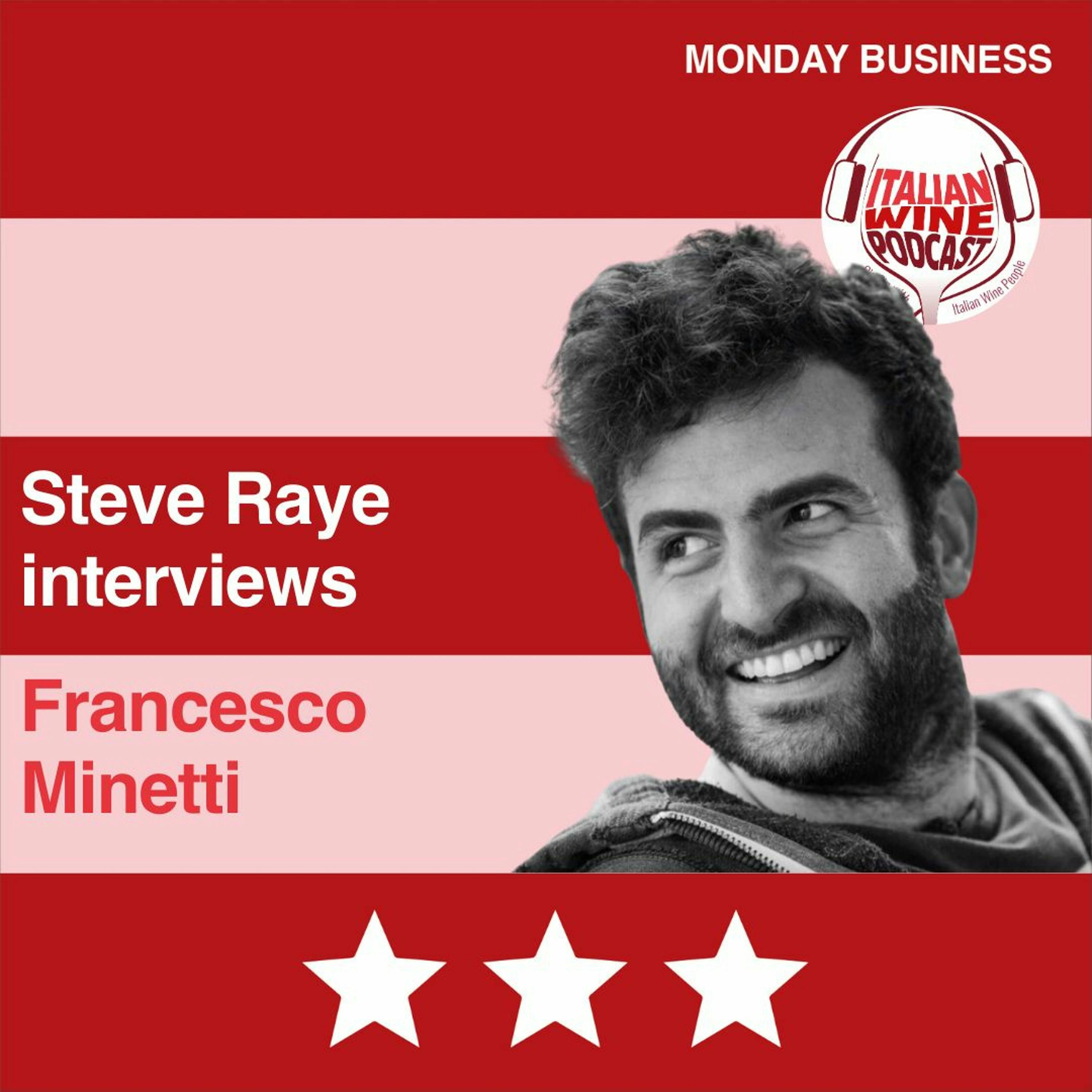
Ep. 1227 Francesco Minetti | Get US Market Ready With Italian Wine People
Masterclass US Wine Market
Episode Summary
Content Analysis Key Themes and Main Ideas 1. The evolution and current state of Public Relations (PR) in the Italian wine industry, particularly for the American market. 2. The role and history of Welcome Communications, a PR agency specializing in Italian wine, led by Francesco Minetti. 3. The critical distinction and differing strategies for communicating with trade versus consumer audiences in the wine market. 4. The importance of brand differentiation (""three pillars"") and relationship building over simply producing content in modern PR. 5. The relevance and limitations of wine ratings and scores in market entry and consolidation. Summary In this episode of the Italian Wine Podcast, host Steve Ray interviews Francesco Minetti, CEO of Welcome Communications, a multi-generational PR agency focused on Italian wine. Francesco discusses how his mother founded the agency in 1989 as a pioneer in wine PR and how he joined a decade ago. He explains how PR has evolved, especially with the consolidation of media and the rise of digital influencers. Welcome Communications works with Italian wine brands to build their international presence, particularly in North America, by helping them define their unique ""three pillars"" of differentiation. The conversation highlights the challenge of tailoring messages for distinct audiences (trade versus consumer), the significance of direct relationships with key wine professionals (sommeliers, buyers), and the role of ratings. While acknowledging the importance of scores in the US market, Francesco emphasizes that they are a tool for consolidation, not market entry, and that genuine relationships and clear brand identity are paramount. He concludes by stressing that effective communication starts with introspection and identifying key differentiators. Takeaways * PR for Italian wine has significantly evolved, moving beyond traditional media to include digital influencers and direct trade engagement. * Welcome Communications, founded in 1989, specializes in helping Italian wine brands build international presence, particularly in the US. * Effective PR requires differentiating a brand through unique, non-replicable ""three pillars."
About This Episode
The podcast, created by the Italian wine podcast, is a strategy to help the media industry understand the three pillars of their peer strategy, which is a combination of dealers, target countries, and distribution. The podcast's success depends on the success of the wine in the US and the success of the wine in the country. The importance of data ratings and personal development is emphasized, and the use of digital tools and personal development is emphasized as key to reaching out to guests. The podcast's success in reaching out to guests is also discussed, and personal development is emphasized as a way to build a structured relationship with consumers.
Transcript
Some of you have asked how you can help us while most of us would say we want wine. Italian wine podcast is a publicly funded sponsor driven enterprise that needs the Moola. You can donate through Patreon or go fund me by heading to Italian wine podcast dot com. We would appreciate it Oh, yeah. Thanks for tuning in to Get US Market Ready with Italian wine people. On the Italian wine podcast. I'm Steve Ray, your host, and this podcast features interviews with the people actually making a difference in the Italian wine market in America. Their experiences, challenges, and personal stories. And I'll be adding a practical focus to the conversation based on my thirty years in the business. So if you're interested in not just learning how, but also how else, then this pod is for you. I'm Steve Gray. I guess this week is Francesco Minetti from the welcome agency Francesco. Thank you very much for joining us. Tell us a little bit about your background. Interesting that, you've got an agency and you're the second generation. We talked to a lot of producers. We're multi generation, but I've rarely talked to someone in the Airbnb business with us. It's actually not so usual. You're right. Actually, my my mom, started the business in nineteen eighty nine. She was quite a pioneer in the industry, because, you know, at that time, was something not so common to have a PR strategy. And, she decided to to start this business because she met, a very important journalist in Italy that was called the luigi Veronelli that was probably one of the main, journalist that actually created culture in terms of, you know, gastronomy. And so after this meeting, she decided to embark on this adventure. And, ten years ago, I decided to join the company, and then, she's now retired. You're the CEO. It just drives a pretty good game. So tell us about the company where it's located. So he's the kind of client that you have. Yeah. Actually, we are, let's say, we were. Based Nava, and now we shifted our operations remotely. So we are now able to to work from wherever we want. We are twenty five people, and we work mainly with Italian brands, only one brands, I would say about seventy per year just to give you an idea. Yeah. And, we help them build their brand intonation wheels globally. We work actively in seventeen countries. Of course, most important ones from North America, so United States and Canada, then UK, then continental, Europe, standing out. Yeah. And a little bit of Asia, Japan and Hong Kong. Okay. So PR has gone through radical evolution as has every business, I think, in in the world. How has PR changed for a company based in Italy where your working with American journalists, American media, social media, influencers, all that kind of stuff, but you're an ocean away. Yeah. This is a good question. You know, we had, the chance to meet American journalists because I in the late nineties, we were the first to organize unfamiliar tasting for, nebbiolo based wines, you know, and this was something we somehow, I mean, let's say it was inspired by Bordeaux faceings. And so the second, but at that point, we got to know the main media guys, the industry. Still made media gains after twenty years. And this was, let's say, our this way, our competitive advantage, but then a lot of things happened. And I would say on the both sides, because on one hand, we have now in Italy definitely more brands, or I call it, I mean, one of the brands. So a lot of wineries that decide maybe not to sell bulk wines anymore, but they started to have their own bottles, their own brands on the bottles, and they want attention from the media. On the outside, we have data, all the media industry has been consolidated and concentrated a lot. So we have less people to talk to. And this is somehow creates, I would say, an accept amount of visibility and reputation. And this is quite difficult to manage. I would say. Yeah. I could see that. So what do you do? First of all, we try to, strategize. So I know that everyone does strategy and no one has it. But we try to, help one race to set their objectives in terms of target countries in terms of target city, is it possible? Because if we don't, work yet, we have fifty different markets. So, yeah. So first of all, that, then then, the the I mean, for us, the most important thing is to help them understand why they are different. So, we elaborated some visual models to help this process of the same introspection because for us, it's important to understand the three. Let's say three things that are very characterizing, distinctive of your breath. Without this, you're just wasting your mind because you don't have actually a distinctive message But you'd always say the same things. Oh, yeah. We are traditional, but also a little bit innovative. Oh, yeah. We are family owned, and this is the fourth. That the thing that everyone say right now is, yeah, we are sustainable. Great. So this is actually something that is pretty common of all the thousands of, of Wannabe brands in Italy. So the first step is to help them understand the three pillars, we call it dealers, and, these to us are the foundations of a peer strategy. Then which is the target. And the target could be not only because of the of the, of the thing that I was saying before. So we also expand our PR work beyond to what? Half yet. I was wondering. Actually, we, consider also other important spaces and other important audiences. Of course, we need to, be aware that, this excess demand actually created an opportunity for other people to fill the gap. And these are the people are, okay, influencers. Digital influencers, content creators. And for some brands, this can be a very effective strategy. In particular, if the brand is very well distributed, for example, I would say, mainly So you have a lot of distribution and you need to get very fast and very effectively and with a lot of control of your message to the final consumers. So this is, of course, more measurable than social media. Faster, and I would say also more secure in terms of the control of the message. So this is, of course, one one choice. But the other choice, and I think if the most promising one is trade. So if you are a boutique inquiry, you want to premiumize your portfolio. Maybe not all the influencers are, let's say, suitable for your strategy. And so we are starting talking to master of wines, master sommelier, and buyers consultants for wireless restaurants directly. And this, I think, it's quite effective because at the end of the day, apart from the reputation you get from ratings, from articles, there's a bit of reputation that you get directly from distribution. If you are in the main one way, that's validation your commercial. It's it's the yeah. I mean, to me, it's a wonderful social proof as well. Because if you are, you know, wireless with other great guys, that means that you are doing a great job far from the meetings. So this is our, let's say, approach. So one of the challenges let's let's be polite about it is many wineries and sorts of URLs. Don't distinguish messaging between training for consumer. And so it's why in American trade magazine, you'll see consumer ads. Those people are still doing advertising for those magazines to still exist. And that just turns off that audience because the trade is not interested in your grandfather or your sustainability. They wanna know what's the margin on this thing. What kind of promotion materials are you gonna put into the market? What kind of distribution we're going to to break. It's an entirely different set of, rules or needs. And you have most of the producers I work, especially when we're talking about farmer producers. Don't recognize that, that the trade has very specific needs and interests and different ways that you reach them. How do you educate your clients being able to do that? It's it's in a way, it's harder than teaching them how to talk to consumers. Yeah. But probably more effective, I would say. So we we spend some time, in the initial part. I mean, to us, the most important part of the relation, whether with clients is the first one because it's the one where you set your targets and you set your expectations. Okay. So it's really important that in this initial phase, we do also some kind of educational work, same data. Actually, you need to have, for example, a well structured portfolio. This is something maybe that someone considers not really relevant for PR strategy, but at the end of the day, for trade is super relevant, right, that your portfolio is well conceived. And you have too, hey, you don't have too many products on the same second, same price of wine or same type of wine and all that kind of stuff, because it's I I see this all the time, and, you know, you get, people come dance, twenty SKUs or something, and they want to get off twenty SKUs in marketplaces. They're not bad on this one that's gonna be a cherry pick. Just a few. That makes the challenging because we only have one where if you face into the store, how are you gonna get notice of time and attention. So it's a it came first, the chicken or the egg. Yeah. That's true, man. But we also try to have them to understand and to identify one icon line. So the one that is perfectly suited for media for technical journalists, the ones who needs to get the ratings. It must be limited quantity. It must be, you know, it's the, I I always do this, this kind of example, with automotive, you your Audi that the German manufacturer, and they present to the Geneva, fair, the a eight hybrid. They don't say probably not even one. Maybe it's just a product. But what's the point? The point is, this is the most representative wine that actually shows our philosophy. It's our best. And then, identify the best. Okay. So which is the entry for for you, you know? And this actually is very important also to target different, for example, samplings to different kind of soils or you know, store customers, whether it's a door junk chain grocery store. It's not gonna be interested in your icon. Yeah. They're never gonna sell. Their customers are never gonna pay that. Absolutely spot on from my perspective. And whenever I explain this to people, they they wanna tell me about all their other lines. I'd rather have you have one line that got a ninety three from somebody rather than twenty ones, they've got eighty nine. Eighty nine is not a bad score, but it's not anything you wanna, get the business on because if it's below a ninety in the US, it basically says it's not of quality. It's just the reality of the business. So we've become licensed, if you will, to score, subordinate to scores. And the first question, you know, will wineries get what when they're talking to the trade in Americans, you got scores. And if the answer is, yes, I got Tracy Gary from Denver or Russell. No. No. Do you have scores that matter in the US? Not to diminish or demean Deborah Russell. And at a certain level, that becomes very important to certain importers and distributors. But for the general public Yeah. And then if if if we want to talk about ratings, I have a lot to say. I I think data ratings are crucial in the in a certain period of the brand evolution. What what I want to say, that first of all, you are maybe, going to a new market. Okay? Maybe going to the US. Maybe you don't have strong distribution yet. Maybe you don't have distribution at all. Okay. You cannot use scores or ratings to get a distribution. Right? Because one spectator won't trade you because you are not important. Full stop. I mean, and one of those is sometimes and, but, I mean, this is not the task. So first of all, you need to understand very clearly why you're different. And we try the wines that actually cannot, you can use as a, let's say, to to to break the ice. I would say enough with the trade. Then if you want to consolidate, then, okay, This is very helpful. And if you have ratings, can help. Sonova can help us out, yeah, for sure. And then you should need also to, at a certain point, to premiumize your portfolio. Waiting are super, efficient, effective, but I can quote a lot of wineries immediately that became, like, superstars we know the rating. Yeah. The the reason I brought it up is that is the first question people ask because they're trying trying to identify, do you understand the US market? And if your answer to the question of, do you have scores? Is no? Then you clearly don't understand the US market because you have to have it. The second question here would be is it from a US recognized source. What they're trying to do, these are proxies for answering your real question, which is, how do I know the wine is going to sell? Right. Yeah. It's true, but I think that it must change somehow because now we have in Italy, I would say almost one hundred thousand one is. And we have let's be generous five relevant magazines, you know. Right? How are they supposed to rate them all? Well, what's happened is there's been this explosive growth in secondary rating entities, which a lot of people in the trade will dismiss as well. I don't give some deep credence to that one over this one. But I can tell you this is, a major retail chain in the US. And it provides lists. These are the entities that matter in operating cities. Okay. So if you're gonna be marketing a wine in the US, wanna sell through that store, get ratings from those. Twenty entities. One alone isn't it, but it's it's kind of like the default question that people have. For most Americans, there's not enough information on a line labeled. So the score is where proxy again is proxy for equality state. And that's all we have to do. And it's even more so when it's on point because you don't have somebody standing next to you to explain to you how long is it for this one? Italian wine podcast. Part of the mono jumbo shrimp family. This is for sure true for, full of trade. Yes. But if we're talking about own trade, things are a little bit more complicated or more easier if you want. Because at that point, what is the key aspect? Is the relation you have with Sony or the or the one on the floor? Right? Because at the end of the day, no one is gonna be at the at the wine list and checking, oh, let's see. This is a ninety five, this is a ninety six. But probably, this is okay. I'm gonna what it is, can you suggest me a good pairing? Okay? And maybe I want to try something new. For example, we can we can also think about, the success, for example, from Scottish or Jura or call y'all. They are not treated. I mean, this is not the main subject. That's a different audience. Right? Yeah. So it depends. I I really like you. And to get on your options, not only ratings, because ratings is something that actually can confer. It's the reason why it's a brand patented, but it's not a brand deal. Because at the end of the day, if, for example, Aspectator, okay, does it change, maybe it wouldn't change. With different tastes. Yeah. What happens? You were rated very highly. And then from one day to another, you are not trading so high anymore. Yeah. It's not something that you can actually control, like, the relation with ten top summary in the US that we are able to influence. So are you working with the same level? Do you have that kind of, engagement interaction with people who are on the, let's call it the front lines, and if so now. Yeah. We are we are trying to address them, as if they were journalists. We are trying to invite them in Italy to educate them to make them leave meetings with relevant experiences. And, let's say, have, a flame of the war of the territory, if we work, for example, with consortia, and we do it with master lines and master summaries that are not probably the top line, but I would say the ones more to the top line. And we are doing with top line that has maybe some, like, restaurant chains, not just for Western because otherwise, it's the cost. Right. Right. Absolutely. How do you do that from across the notion? I mean, in the US, agencies have people. We attend the conferences. You know, we go to W SW and some of the, you know, industry events, you know, everybody gets to know what everybody is. Here you have Italy and some other shows, wine to wine, which is where we're talking in right now. How do you do that from here with people who are not even in an office? Yeah. Actually, we we don't work in an office more. So I think, for example, that's it. I think that in in this this area, the digital, the digital tools actually had a lot. In particular for scouting. Okay? Scouting is really easy. It's probably also quite effective from, from the from your desk. Let's do it this way. Then there's something that must be in person, and this is the relation building. So we travel to US, and we might not wait for the purse. Yeah. It's it's not something that that's one of the best ways to get paid, but it's it's expensive. We went to a period of, COVID where nobody could travel, which was horrible, from my personal perspective, because that's what I like to do. You get a sense of You can get a sense about, what would be the winery and a wine and a winemaker and a winery owner in a way that you cannot get some taste in your wines that could be carried in New York or something like that. It isn't so much as, you know, seeing the seller and walking the blinds and all that kind of stuff. I remember one, why I worked with him so much in the name, but he was trying to explain to me about about an evidence, right? And she took me out into the field, and she put her hand into the dirt. Her hand went all the way up to her bottom. And if I she said if you went across the street, it wouldn't even penetrate the dirt because it's all compacted. That show it in such a real or more real way that allowed me and us to communicate to people because that's the kind of story that resonates with people. It's supposed to just say we're biodynamic. Here's a perfect example. You can just put your hand into this. That I can relate to everybody to the trade can relate to that, consumers can relate to that. So we know we're in a world where stories Everybody consume stories. Your job is to tell stories, architectless stories. How do you teach a new generation of, PR people Maybe they're from journalism schools, even have journalism schools sitting around. Those skills when they're remote. Actually, I think the stories and content in general in this precise moment are a little bit overrated. Really? Tell me what, because that's you're the first person to say that, we were like, I would say, there there was this continental and there was this emphasis after the digital revolution. But this was this there was this fancy of producing art because at the certain point, it was so easy and so cheap. To have your own platform. Everyone, brands, trade, everyone, and produce produce, produce, and so all the marketing will content first, content is king. That's awesome. Okay. Great. But at the end of the day, if you don't have the relation, the content doesn't get to the papers. Yeah. So my point is build the relation first. Identify which is your presides targeting. But I this is not something like blurred. I want names. Mhmm. Name, serums, places. Okay. This is a list. And then, look, the stories. Three blocks. Okay. Your three pillars. That's all, which are. That's all. So summarized with three pillars. You want me to define them? Yes, please. These are the three, main differentiating, hassle for you. These are not replicable. And if you read the three of them, you can clearly understand it must be you. Yes. You're making this package. You mean that the pillars will differ with each producer and their own individuals, but don't they fall into a certain category. Now, how do you explain to your clients holding their producers. Well, let me resend a question. Do you work differently with consortcy than you do with producing ones? Yeah. Of course, in terms of approach. And in terms of activities. So the approach, first, you need, of course, to communicate, not just one brand, but I would say a solo brand. That is relationships. Usually, all these escalations. So, of course, when we are talking about the strip pillars, they cannot be, too much, let's say, focusing on, personal aspects, but they somehow need to be a little bit, more collective. So we can talk about plate varieties, we can talk about the, like, general, we can talk about soils, and this is like, I mean, we can dig and find specific aspects. So this is a first difference approach. Then in terms of approach, we have a lot of emphasis on two things. One is internal communication. Because for us, it's really important that the best of the consortium understand what we're doing and why. That's her job. That's why. But we believe that it's the only way because at the end of the day, to peer strategy is also an opportunity to grow your organizational business culture because you are somehow facing new people in different markets and these help I think this helps you grow Mhmm. Has an interpreter Mhmm. Because it expands your your Verizon. So this can be just a systematic newsletter. Or workshops or education and disease in the manner. As per we are focusing a lot of that. And because we take for granted that, a winery is able to talk with somebody or to talk with the journalists from the other side of the world, but, this is really and in most cases, it's not true. Yeah. Interesting. And so this is, I think in terms of approach. These are the main the main differences. In terms of activities, we, with consortium, we are focusing a lot more on the press store, blocked or mediator, somebody at all, we want to make people live to territory. Yeah. And also in that with with different kind of angles, not just with the angle of okay. Now taste the wines. But leave the to what in the sense that you can have also a visual understanding of what's going on in terms of the astronomy, outdoor, in terms of the arts, in terms of biodiversity. In terms of, at the end of the day, not just people who grow vines, but all people that makes actually terribly. Yeah. Cool. Okay. We're coming to the end of our time. One of the things that you think I do is ask our my guests for a big takeaway. What is the one thing of all the things that we talked about here? But if, why why we were listening to this or, someone on the trade in the US side was to put to use immediately, to take from what we talked about and and the practical outcome. Usually, I I was told that communication is really expensive. And, that, all the the issue is, Okay. My perspective is that eighty percent of your communication is introspective. So you go home and ask yourself. What are the main aspects of differentiation? This is my key question. And which are the ten people I'm really genuinely interested in building a relationship with. This is at zero cost PR strategy, and it takes some time. We're in these guidance too. It's not something anybody can do on their own. Yeah. We we usually have the the winners of the discussion to get their promoters with interviews. But I mean We're talking this week with Franchesco Menetti, who's the CEO of Welcome Communications. Thank you for being on the show. We appreciate you sharing your time with us. So if somebody wanted to reach out to you, what would be the best way to get a hold of you? Our website is welcome online dot com, w e, double l. Com online dot com. Here, you can find all contact details. Okay. Great. Thank you. Thank you again for sharing your time, and it was great to meet you here. Thank you, sir. My pleasure. Thanks again for listening. This is Steve Ray with Get US Market Ready with Italian wine people on the Italian wine podcast.
Episode Details
Keywords
Related Episodes
Ep. 2790 Italian Wine in the US: Building a Narrative and Reaching Asian American Consumers with Susan R. Lin MW | Masterclass US Wine Market
Episode 2790
Ep. 2783 The Suburban Gold Mine: Insights into New Jersey’s Wine Market with Brittney Abell | Masterclass US Wine Market
Episode 2783

Ep. 2772 A Surprising Partnership between Japanese Sake & Italian Wine with Monica Samuels | Masterclass US Wine Market
Episode 2772

Ep. 2770 China’s Wine Market: From Misleading Import Numbers to Today’s Consumer with Fongyee Walker MW - Part 1 | Asia Wine Market
Episode 2770
Ep. 2760 Winning the Restaurant Floor: Training, Education & Italian Wine with Sylvester Inda of Ci Siamo | Masterclass US Wine Market
Episode 2760

Ep. 2751 From Montalcino to Kazakhstan with Francesca Arquint of Collemattoni | Asia Wine Market
Episode 2751