
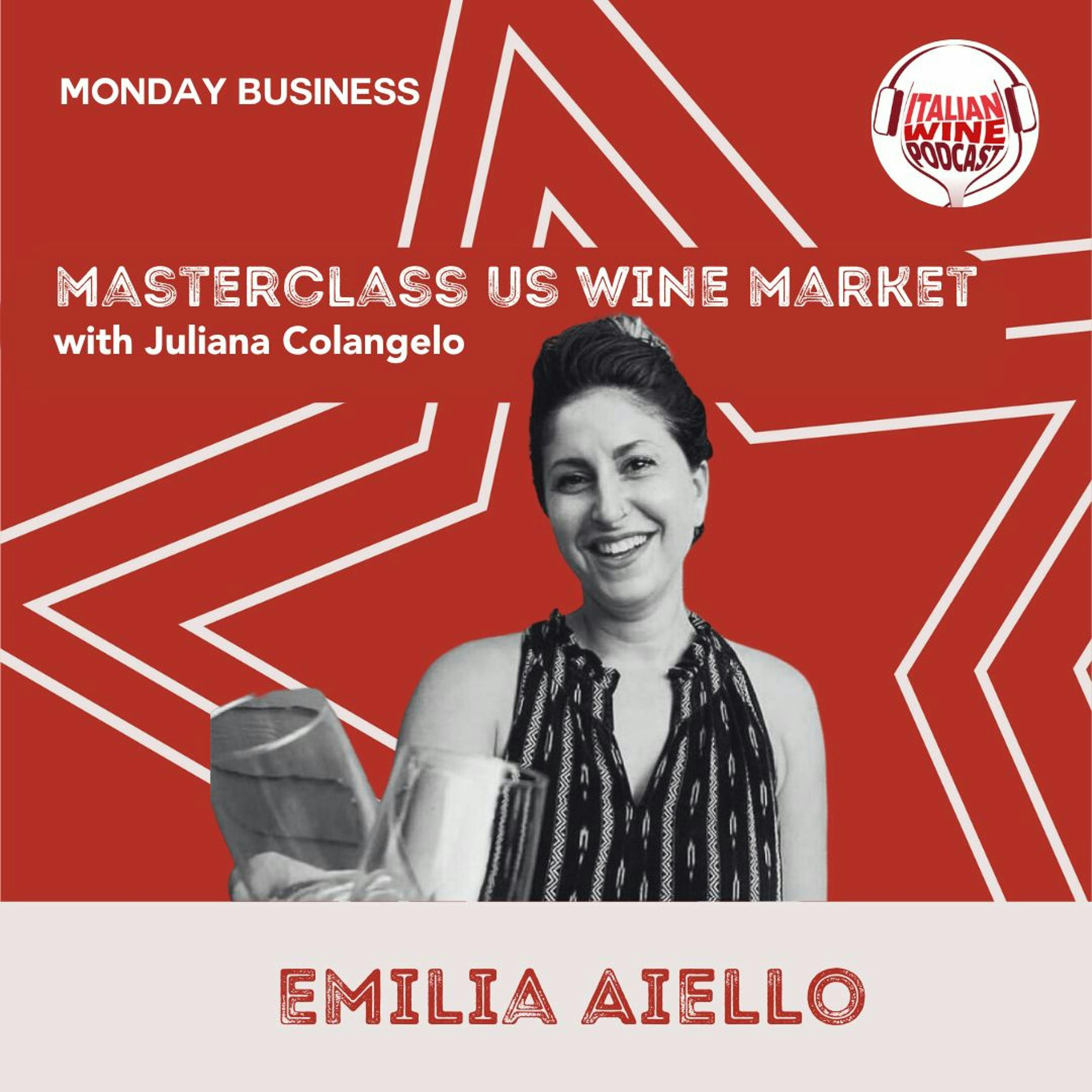
Ep. 1444 Emilia Aiello | Masterclass US Wine Market With Juliana Colangelo
Masterclass US Wine Market
Episode Summary
Content Analysis Key Themes and Main Ideas 1. Demystifying the US Wine Market for Italian Wineries: The core purpose of the podcast ""Master Class US Market"" is to provide insights and strategies for Italian wineries targeting the American market. 2. Introducing Lesser-Known Italian Wines to US Consumers: The central topic of the episode revolves around the challenges and opportunities in promoting Italian wines beyond popular regions like Tuscany and Piedmont. 3. Amelia Aiello's Journey and Chitavino's Mission: Exploration of Amelia's deep connection to Italian culture and wine, stemming from her immigrant background, and how it shaped her career and the unique, story-driven approach of her wine retail platform, Chitavino. 4. Historical and Socio-Economic Factors Influencing Southern Italian Wine Perception: A detailed discussion on the historical North-South divide in Italy, its impact on wine promotion, and why Southern Italian wines have struggled to gain market penetration in the US. 5. Strategies for Engaging Consumers with New Wines: Highlighting methods such as focusing on context, history, regionality, and food pairings rather than just tasting notes, and creating immersive, trust-building experiences for consumers. Summary In this episode of ""Master Class US Market,"" host Juliana Colangelo interviews Amelia Aiello, founder of Chitavino, a California-based online wine retailer. Amelia shares her personal journey into Italian wine, rooted in her Italian-American immigrant background and her extensive career in New York's hospitality and wine scene. The main discussion centers on the challenges and opportunities of introducing lesser-known Italian wines, particularly from the South, to the US market. Amelia delves into the historical and socio-economic reasons for the North-South divide in Italy, explaining how it impacted wine promotion and contributed to Southern wines being undervalued or overlooked. She emphasizes Chitavino's unique concierge-like approach, which focuses on telling the stories of small producers, connecting wine to food and travel, and empowering consumers through context and trust rather than just tasting notes. The conversation concludes with practical strategies for engaging consumers and the importance of on-site visits to truly understand and convey the value of these unique Italian wines. Takeaways * The US market presents both challenges and opportunities for lesser-known Italian wines, especially from Southern Italy. * Historical socio-economic factors, particularly the North-South divide, have significantly impacted the perception and promotion of Southern Italian wines. * Chitavino, founded by Amelia Aiello, employs a unique online retail model focused on curating and storytelling about smaller, lesser-known Italian producers. * Effective strategies for introducing new wines to consumers include emphasizing historical context, regionality, food pairings, and the producers' stories. * Building trust with consumers by lowering their perceived risk and providing immersive experiences (e.g., relating wine to travel) is crucial for expanding their palates. * The concept of ""wine as food"" and an agricultural product is key to understanding and valuing Italian wines, particularly those from smaller, family-run operations. Notable Quotes * ""This show has been designed to demystify the US market for Italian wineries through interviews of experts in sales and distribution, social media, communications, and so much much more."
About This Episode
The Mastercross US Market discusses their love for learning about Italian wine and contemporary wine, their desire to become an American American in a place where they feel comfortable, their love for introducing consumers to new wines and regions, and their journey to learn about Italian wine and understanding the difference between Tuscany and Piamonte. They also discuss the challenges and opportunities for esoteric Italian wines in the US market, the importance of history and regionality in the experience of consumers, and the need for travel and touring wines to enhance their understanding of the region. They also offer to connect with listeners through social media and a podcast on the Italian Wine market.
Transcript
Hey, guys. Check out Italian wine unplugged two point o brought to you by Mama jumbo shrimp, a fully updated second edition, reviewed and revised by an expert panel of certified Italian wine ambassadors from across the globe. The book also includes an addition by professoria Atilushienza. Italy's leading vine geneticist. To pick up a copy today, just head to Amazon dot com or visit us at mama jumbo shrimp dot com. Welcome to Mastercross US Market with me, Juliana Colangelo. This show has been designed to demystify the US market for Italian wineries through interviews of experts in sales and distribution, social media, communications, and so much much more. We will quiz each of our esteemed guests at the end of each episode to solidify the lessons that we've learned. To sharpen your pencils, get out your notebooks, and join us each week to learn more about the US market. Hello. Welcome to master class US wine market. Today, I'm thrilled to welcome to the podcast Amelia Aiello. Amelia is the founder of Chita Vino, California based online wine retail with a rotating selection of curated Italian wines. The site is fueled by curiosity for wine, the people that make it, and the places it comes from. Prior to starting Chitavino, Amelia worked in wine for over a decade in New York City, starting her career at Lupa in Greenwich Village, in two thousand six, she passed the Italy international wine bachelors exam. So we have a fellow via here today, which is very exciting. Moon and I also worked together over a decade ago at Italy and have reconnected here in the Bay area over all things wine and Italian wine, so I'm super excited to have her on the podcast today. Thanks for being here today, Amelia. Welcome to the show. Thank you so so much for having me. It's such an honor. Absolutely. So before we dive into today's discussion, and our topic around introducing consumers to lesser known Italian wines and varietals. Tell us a little bit about how you became so interested in all things Italian wine and a little bit more about your career in New York City and your journey to Chita Vino. Gosh, it's a journey that's kind of come full circle, and I've just been in these last months even realized just how much. But I come from an Italian background, immigrant Italian family, So born into the culture, I guess, you could say I'm already third generation. So that's been a really interesting point to reflect on for myself as well, like how that immigrant experience has last it and changed and become what it is now in my generation. So, yeah, I'm immigrant Italian family. My great grandparents immigrated from Italy on my dad's side, from Sicily, and then on my mom's side, LaGuria and Piamante. And my parents, yeah, Both Italian found each other in, I guess, their little Python community, at least for us here in Temescal in Oakland, and then also for my father's side in Antioch, California, they stayed pretty insular. So, yeah, like finding your community and your people that just kinda get you. It was a safe place. And please read, they could people kinda share their cultural experience and also coming from that immigrant background. And I think my parents really connected over that. Right. And even coming north in the south, we know that's a contentious issue sometimes for millions. Totally. I think for them too, that was, like, already break the cycle. Somebody from the north interacting with somebody from the south. With my great grandparents generation that probably didn't happen. My mom even tells kind of some stories about her side, her great grandparents, and the myths that they'd have in house about Southern Italians. But it means you guys grew up with so many rich traditions and varied culinary traditions, I'm sure, coming from those three regions, Piedmont, Nagoria, and Sicily. Yes. Absolutely. Which for me, you know, growing up was just like a blanket Italian as, especially as I started working at restaurants and with wine understanding, you know, kind of where each influence was coming from. My mother made it a really big point that we knew we were Italian, and she's the one who kinda maintained the tradition a lot, not just for my some, my, my, my sister's and myself, but, her family as well. And she really wanted to make sure to document recipes from my dad's side as well. And she really actually huge effort to introduce a sicilian culture into our kind of everyday life as you know, in addition to her own. Yeah. Hatch off to her. And so for me, it's just like, it's my identity. Again, now that I'm older, I can pick it apart a little bit, but younger, it just kind of is was. And I bring up the immigrant part because that really did influence being Italian American and that kind of intersectionality of culture and and people trying to find their way here and which ends up being like you bringing a piece of your life from your homeland and trying to initially, this is how it starts and trying to cultivate it here in a new place. So my grandparents bought a homes with land surrounding it. I mean, I'm in Oakland. But, you know, it has a little bit of property so they could grow vegetables. And we're still on that, and that's something I still love doing. I grow vegetables. For me, it's incredibly fulfilling, but it's just who I am, who we are. I still grow, these bean seeds that make great grandfather brought over from Italy. My aunt has been saving them for years. Yeah. How about any grace? So that your grandparents have enough room to plant any great Oakland? Yeah. So, yeah. Right. I mean, not I don't they grew them. I I think they bought them, but we still have week of Papa Joe's wine press in the garage. It's just sitting there. I I'm stare at it thinking, like, I'm fantasizing about how I'm gonna refurbish it. But, yeah, yeah. Absolutely. So did you go to New York always with the intention to work in Italian wine or tell us a little bit more about how you had landed at Lupa and at in these great, you know, Italian restaurant and wine institutions? So after I graduated college, I moved back home in Oakland and was working at my cousin's restaurant in Oakland. I not take a Molinari, just to have, you know, a job. I wasn't finding work. I'd studied art history and anthropology, and I wasn't finding work like, a direct translation from those majors. I was looking at museum work and, you know, getting rejected for competitive unpaid internships, and it was kind of a discouraging time. And so I was working at the restaurant just more as, you know, again, to make some money. And I thought it was an interim thing, and then, you know, it's an Italian restaurant, Italian wines. He was just kind of discovering that scene for himself too. So it was a somewhere for me to divert a lot of my energy. Yeah. I fixated on wine. You know, I started looking at wine labels like I would, you know, a piece of artwork wondering what the producer was thinking when they made a label or, you know, what they were trying to say to me through that label and, you know, trying to understand more about the great variety because, of course, as we know, Italy has insane amount of different grape varieties. And so at the time, I thought I was just kind of, like, actively engaging with my time as best I could before I figured it out. I ended up moving to New York actually for dance, think that was, you know, I was like, our history is not working out. I'm gonna dance. And, again, and so I moved to New York, and that's a, you know, longer story, and then continued supporting myself in restaurants. But restaurant work was came pretty naturally to me. And I'll, you know, I was thinking about why. And, obviously, like, the Italian hospitality clearly. It's in our blood. I have our DNA growing up, setting a table, clearing a table, hosting. Yes. It is totally and finding just enjoyment in that. And I would say too, like, also coming from the immigrant background too, it was, like, being hyper aware of your space and sensitive to other people's needs and making sure everybody around you good and picking up on signals when they weren't. And, you know, you're always trying to ameliorate or keep a situation kinda cohesive and going. And, you know, again, so restaurant work felt it was it's incredibly demanding, but conceptually, I found it pretty natural for me. And, again, to keep things interesting, continued kind of self studying the wine and interacting with people over it. And at some point, I'd made the decision to stop dancing And I that pretty much came around the time when I accepted. I was at Lupa, you know, worked my way up the ladder, essentially. And that kind of came at the time. I was already they'd offered me the wine director position before and said no. And then, you know, they offered it again. And I was like, okay. Let's just try this. Let's go for it. And what a place to be to take a wine director position in New York City? A place that I feel like embodies a lot of the things you're talking about around hospitality, Italian wine, culture. So I feel like it must have been a natural fit for you in a lot of weight. It was. I spent a year hopping around, like, the New York and not really finding my fit and lupa absolutely was, and I know a lot of people feel this way about particular restaurant. I found out my community there, and I think that's something that I am always looking to bring to whatever I do. That sense of being tight with your coworkers and supportive and creating a family is really important to me. And I definitely got my first taste of that at Lupa and have made some lifelong friends there. And so, and, of course, Lupa also focusing in one particular region. So it was also a deep dive, at least food wise, and that's also where I got to explore and understand again for myself and even my own background, the regionality of Italian cuisine, culture, and of course wine. Italian wine podcast. Part of the mama jumbo shrimp family. Yeah. Absolutely. And that's what we're gonna focus on in today's episode and talking about How do we get US consumers engaged with some of those lesser known Italian wine regions, especially in the south. You know, we we see the excitement and the popularity among wines from Tuscany and Piedmont, but do we draw more attention to the wines of Calabria and Compania and those areas? So our three key takeaways for today's master class are number one, the biggest challenges and opportunities for esoteric Italian wines in the US market. Number two, the best ways to introduce consumers to new wines and regions that they might not be familiar with. And number three, how to explain the concept of regionality and terroir and place in Italian wine, which, you know, you were just talking about. So lots of interesting topics to cover, and I'm sure Amelia, we could do this for hours over some wine, but we'll condense this to twenty five minutes. But let's start first and talking a little bit more about your Chita Vino and the launch of Chita Vino and why you chose to focus on selling these smaller producers lesser known regions and varietals through your company. Initially, it all started with my own personal exploration of the southern side of my family. Don't know much about my father's side and really can only hang on to the bits and pieces he can give us, but also, you know, kind of that culture my mom cultivated at home, as best she could. And I ventured into Sicily pretty early. I think it was twenty one, but this was before my wine adventures. And just had a pretty immediate fascination. And again, I think absolutely stemmed from wanting to learn more about Sicily because not knowing how much of a con like my own context. For myself. So it's always been something that I've sought to understand more. When I took over the program at Lupa, before I took the Van Italy Ambassador exam, we had our our list organized kind of haphazardly, like, You had mentioned Barolo Tuscany, and we had this really, like, really beautiful fleshed out sections and how Barolo was organized according to crew, etcetera, etcetera. And then we just had, like, a Southern Italian section and everything was lumped together. Yeah. I was like, and everything else. And I was like, well, okay. I'm spending a lot of time studying the differences between these borley and, you know, their respective areas. I wanna be able to bring this heat to the guest when I bring a bottle of Tarousie, like, why I am in equipped to explain why this Tarousie is different from this one other than just like my own tasting notes. When I attempted to explore that more for myself, I found it really difficult, like, the resources available, which just weren't readily available. They weren't there. We were so, had the luxury of going to these incredible seminars and tastings, but, yes, always centered on Tuscany and Piamonte. So I being infinitely curious and then also with that Southern Italian background, you know, I wanted to learn more. And at the time too, my career in wine kinda started when Aetna became anytime I try to describe Aetna's popularity, I can't refrain from using, like, volcano puns. I don't intend to. But it's like, you know, and this wine, like, exploded onto the market and really hot item. And I was also fascinated with it, but these wines were becoming popular and but I was in equipped to say much about them. So I traveled at not to do a harvest. It took some time off work. And and then again, after taking the Ven Italy exam, really understanding, okay, before great variety, I need to look at place. And went to Aetna so I could, you know, better study that place and work to harvest with Steph and Chudo Biondi. It got to spend just, yeah, which was incredible, obviously. And just got to spend a lot of time talking, not just them, but other producers and other actually Americans that were trying doing the same or had the same interests that I did and learned so much. And so when I came back to New York and was super pumped on sharing all this information or trying to converse about with my colleagues. And what year was that? That was twenty eighteen to try to converse with my colleagues about it. And I was pulling out, like, a map that I found and things that they had never seen before. And that kind of was a light bulb of like, oh, okay. I'm I'm bringing something really valuable here just from that on-site experience. And So that was the first adventure and understood too just how important it was to be there in actually doing the work and having the immersive experience. Especially since there was a lack of information in your New York, right, at the time where there's gonna be information about Italian wine category in any city in the US, it's gonna be New York. So the fact that it's up there probably meant, you know, like here in California, even less so outside of maybe what, you know, Shelley is doing currently at age sixteen and what she's been doing for so many years. So talk to us a little bit about, you know, what do you think and, you know, in your experience working with some of these producers? Are there reasons why it's taking longer for wines from Southern Italy to really penetrate the market here in the US. To me, in in my view, pretty complicated from spending a lot of time there, my own studies and research, and then talking with a lot of producers in places like Calabria, which is kind of the south of the south even though it's it's less, you know, Sicily is more southern than Calabrio, Sicily is having such a renaissance right now. But there's a lot of socio economic reasons. I would say in kind of we alluded to that already about this North South divide, and that is something centuries long to unpack and just a brief brief kind of unpacking of that is that the North Italy is was such a desirable location for people in the Mediterranean and It's just smack in the middle of it. It's just a prime spot. And so it was constantly intruded and attempted takeovers by other people's. So a ton of cultural interactions from different people from different places happening on that peninsula. And I would say too, even then as far as back as nine hundred, the north and the south had pretty different trajectories. And so, whereas the North Navy started developing concentrations of power, the south was still experiencing this influx of different peoples and arab occupation and then lombardy occupation. It maybe had a period of cohesiveness under the kingdom of Spain. But that's still a that's like an entity that's not really on-site. So it's a ruling power that's abroad. So culturally, already different things are happening. Let me backtrack a little bit when Italy was unified in the eighteen sixties, you know, the unifying power came from the north. It was the house of savoy. And, actually, the house of savoy has a lot to do with Barolo. And so you can already see two where, like, this wine and, cultural crossovers happening, but the House of Savoy is technically the House and the Kingdom leader that unified Italy. And so even with wine, these promotional efforts are happening, like, really far back, and the House of Savoy was the champion of Nebula and Barolo. And the South still at that time, you know, experiencing fluctuations and didn't have that kind of concentration of power of people kind of championing, in this case, wine. And we even see two on Aetna, there was actually a lot of activity and effort around this time too. And I would argue that's also why Aetna wines are on the forefront of our minds as well. All that promotional effort happening, you know, back in the eighteen fifties. And so the south, you know, and then you have the World War, so it happened that long after unification, Filoxera, and the South actually became something for the North and other Northern European countries to lean on. Phylloxera didn't hit the south until later. When Northern Italy and other northern European countries were devastated, they look to the south to supply the wine, and that wine's already being shipped now to Northern Italy France. And even today, that kind of tradition has persisted with the south being producing more bulk wine than wine of origin. Even though there's some really rad wines that come from there, and you might know of them on paper, they produce more bulk wine, than not in the northern regions don't really their per those percentages are different. They're producing more wine with origin. So even even, you know, that far back, so those historical precursors are still playing out today. History lesson too. I mean, that you've covered centuries of information there pretty succinctly. So thanks. And the south is still trying to recover from all of this, you know, in in terms of being they a lot of people feel themselves be kind of the forgotten areas of Italy. And you get it, you know, when you visit there and the money right now is concentrated in the north. The south is still largely agricultural. And this is something I would say we're experiencing in America as well. Agriculture work isn't valued as much as it used to be, and making a living off of farming is kind of impossible. And these producers are finding some kind of reprieve and able to maintain their family's territory now with Greek farming. That makes a lot of sense. Well, talk to us a little bit about, you know, now you're you obviously dealt with a consumer in New York, but now you're dealing with Sumers in a different way and introducing them to wines through experiences, through content, through so many platforms with Chitavino. So tell us a little bit about some of your biggest wins most recently in introducing your audience to some of these lesser known wines and and Ryals talked to us a little bit about how you're introducing them and what's really resonating with them as well. Yeah. I'm, you know, I'm finding the consumer, the school, which is like kind of the last point of contact. Right? We have we have wine professionals in psalms and they are consumers themselves, but more, let's say, influencers to the consumer. Consumers are pretty o at least here in Oakland. It are pretty open to trying new things. They are and this could be a post COVID thing, but people want an experience. And I think what drew me to wine initially was, you know, I got to learn so much about it. I created my own kind of internal experience, learning about a place, learning about people. There's so much history that's involved too. And when I present wine to consumers with that context, certainly within context of tasting notes kind of. I actually do tasting notes last. I find I my goal is to really empower the consumer and make them feel comfortable to speak about what they like or what they might pick up on the line because I want them to walk away having been kind of I'm helping, but they are the manifestors of their own experience. And I find things stick better that way with people. It's more more memorable when they are more in control that way. So I'm just kinda setting the stage. When I talk about wines, I, of course, will mention the great variety, but I'm actually more likely to mention the territory and maybe some historical information and and create the experience or give them tools to create an experience before they might even taste the wine. Very cool. Yeah. That makes a lot of sense. Like, leading with history, leading with regionality before diving into what does it taste like? And now that tourism is so back, like, up again in Italy, and I'm definitely seeing more people go to the south. I just recently encountered a lot of people who have visited Bulia, which was shocking to me. I think Bulia is one of the most beautiful regions of Italy. And to to kind of casually meet people that have been there is cool. Like, people are discovering Southern Italy and discovering that they have that experience now that they can themselves bring to the table or maybe a wine that's gonna help them remember that experience and relive it. So kind of creating on a way to, like, the travel using that travel language too has been full and integrating travel tips or, like, winery connect people are really interested in visiting these smaller production, small producer wineries because they get a little more of an intimate experience with them. Yeah. I bet. And I think that travel is one of the ways that we reach consumers and introduce them to new wines from new regions. So it is exciting to see regions like Kulia. Sicily, of course, and the white lotus explosion to use one of your volcano phrases there, but being those avenues in which Southern Italian wines can reach more consumers. So maybe we need a Calabrio travel brush. I hear that the the beaches of tropea are pretty spectacular. That's definitely on my way. But it sounds like you're becoming somewhat of a concierge for your members as well in terms of introducing them to regional cuisine and recipes, relationships to wineries. I mean, that's not something that you're gonna get when you walk into, you know, a major retailer and pull a wine off a shelf. So It seems like a really unique proposition that Chief Avino is bringing to its audience. Thank you for saying that. I like that term concierge, to use it more. And, yeah, that is the idea. To me, again, working with small producers and course, this is happening throughout the world. It's not just Southern Italy, but in spending more time there, I, myself, fully, and after working harvests, and, you know, winemakers that are also the farmers, fully understood wine is food. My mom used to always say that to me, and I still didn't quite get it. And I was like, sure, sure. We're supposed to drink Italian wine with food. I get it. But it it actually kind of I didn't fully understand until I worked those harvests. No. No. No. It is food. It's an agricultural product. Growing by people who are investing their physical labor in the land and producing this. And that's the same thing, you know, of of any other food product. And I want people to start viewing wine in that capacity. And I think, like, you know, you said, bringing together the history and the travel and also the actual, the, well, it's all food, but bring in the recipes and the regionality, that way, I think ties it all together. It was impossible for me not to. Right? Just try to sell Italian wine without talking about the food. I was like, this is not gonna work. And we're lucky too that, you know, Americans love Italian food, and it's pretty much everywhere in the US. You'll find a pizza joint and also just great regional Italian food as well. So talk to us a little bit about how wineries can work with you yeah. I so I I try to get to Italy often. And so part of my platform, I mean, what I've had really valuable is that contact with winery. So visiting them, and it's not just sitting down and tasting the wine with them, actually, because, again, for me now that I absolutely see wine as food and as an agricultural product. I wanna walk vineyards. I wanna talk to them about what they do in the vineyards. I would love to even get some vineyard action myself. Hence, I like to do harvests. I spend more time with producers there. And because that's the message that I wanna relay to the consumer, and I want consumers to feel, again, empowered to ask questions and not feel like a question is stupid, and really with me as a wine professional pull apart these lesser known terms and understand really what it means to be organic versus natural versus whatever. Like, I want the consumers to be in that dialogue with me. So with producers visiting and on-site visits are absolutely key to what I can do to promote a region, not just a singular producer. And I've been working with some Calabrio producers in now Aetna to find some representation in the states. And, again, also, for me, coming from helping the small Vignaolo, you know, make it. But it's also about the larger message and within the framework of the zone and what they're contributing to the area. But really getting to know their story firsthand so that you can translate it correctly and really introduce it in an in-depth story driven way to your audience. It sounds like. Yeah. I mean, I want when I go talk about a wine, I want a consumer to be there with me. Like, I wanna, again, I to the best we can. Right? Like, the closest we can get to an immersive experience outside of being in the experience is to me, in with the context that we're talking about is through the food and wine. So Well, Amelia, I know we're running up on time. So I do wanna make sure we get a chance to do our rapid fire quiz, which we do at the end of every episode to review our key takeaways and lessons and learnings. So if you can do your best to answer these questions in one sentence or less, please. Question number one, what are some of the biggest challenges for lesser known Italian wines in the US market? So on the wine professional end, seem to have been the biggest challenge is convincing people of these wines worth and value because people aren't used to them being expensive products. And I'm trying again by looking at the work behind it, be, say, wait a second. The same amount of work is going into this wine as it is into this wine. The quality is excellent. Why why don't you find the value in that? For the consumer, it's trying to get them to see the wine as food and be interested in how their wine is made and where it comes from as much as they're interested in that final product. Question number two, what are some of the best ways to introduce consumers to new wines that they might not be familiar with? Again, creating that experience for them. So when I was working as a Sam at at Lupa, it was actually kind of fail proof surprisingly. I just was experimenting, but I started doing this thing where, of course, listening and engaging with the guests, like, you actually I have to understand what it is they're looking for. But just taking a baby step out side of what you think their comfort zone might be and asking them to trust you. And I would always say, okay, I'm gonna open this bottle. You're gonna taste it. If you don't like it, I'll take it back. And I never had somebody send a wine back because I didn't like it. Amazing. So making them feel like they're lowering their risk of ordering something new. Yes. Because then also, you've lowered that risk. You've created trust with somebody, and you've also created opportunity for them to try something new. Like, you've expanded their horizon and that they might be interested in trying even more after that. And finally, number three, how do you explain the concept of regionality in place in Italian wine to consumers? Yeah. Lately, I've been I've been working on hosting tastings. And kind of actually centering it around that. I'll try to do it on the theme, location or just did volcanic wines of Southern Italy. And people are interested. People want I'm finding again people are are desiring to understand the context of wine. I also am a student of everything in of wine and infinitely curious. So for me, I consider myself learning along side the consumers. So when I do tastings or we taste wines, I really encourage people to come up with their own tasting notes. I do my best to give what I think is, okay, this wine was grown in this terroir, and here's the basics of how that translates to this wine. But then, you know, the rest is for them to create their experience around it. Very cool. Alright. Well, thank you, Amelia so much for being on the Italian Wine podcast with me today. It was so great to have you here. How can our listeners connect with you? Yes. Of course. I would love that. I'm on Instagram. As is the need, they can connect with me at Chitavino underscore co, but also the website, w w w dot Chitavino Pumtoko, if somebody wants to just go down rabbit holes. There's a ton of information and maps on the website. Yes. And, they can always email me as well. I'm Chow at Chitavino Puntoco. Alright. Fantastic. Well, thank you again, Amelia, for being here today. It was great to have you on the show. Thank you for having me. This was awesome. Thank you for joining me today. Stay tuned each week for new episodes of Master Class US wine market with me, Juliana Colangelo. I remember if you enjoyed today's show, hit the like and follow buttons wherever you get your podcasts.
Episode Details
Keywords
Related Episodes
Ep. 2790 Italian Wine in the US: Building a Narrative and Reaching Asian American Consumers with Susan R. Lin MW | Masterclass US Wine Market
Episode 2790
Ep. 2783 The Suburban Gold Mine: Insights into New Jersey’s Wine Market with Brittney Abell | Masterclass US Wine Market
Episode 2783

Ep. 2772 A Surprising Partnership between Japanese Sake & Italian Wine with Monica Samuels | Masterclass US Wine Market
Episode 2772

Ep. 2770 China’s Wine Market: From Misleading Import Numbers to Today’s Consumer with Fongyee Walker MW - Part 1 | Asia Wine Market
Episode 2770
Ep. 2760 Winning the Restaurant Floor: Training, Education & Italian Wine with Sylvester Inda of Ci Siamo | Masterclass US Wine Market
Episode 2760

Ep. 2751 From Montalcino to Kazakhstan with Francesca Arquint of Collemattoni | Asia Wine Market
Episode 2751