
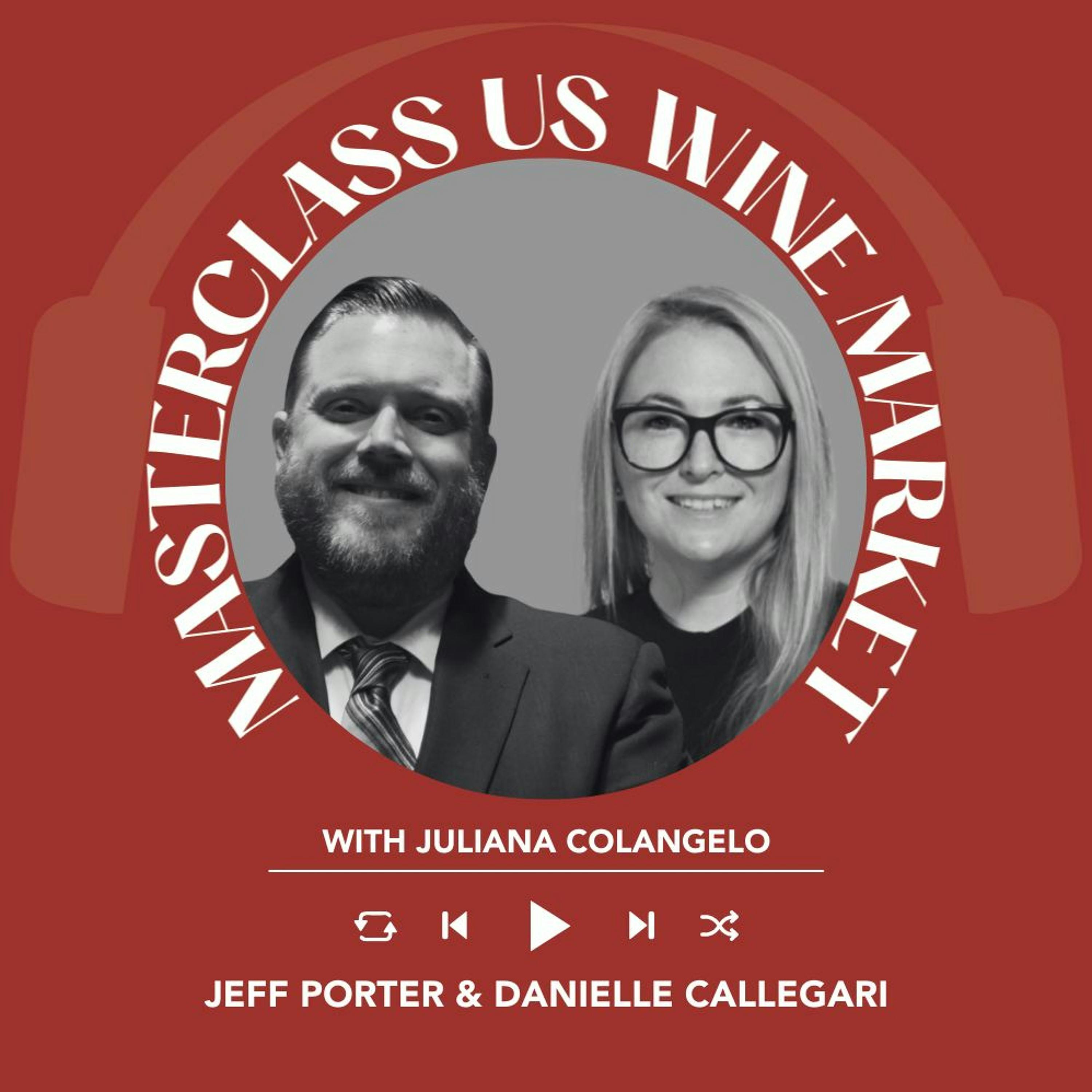
Ep. 1564 Jeff Porter & Danielle Callegari | Masterclass US Wine Market With Juliana Colangelo
Masterclass US Wine Market
Episode Summary
Content Analysis Key Themes and Main Ideas 1. The role and methodology of *Wine Enthusiast* critics in rating Italian wines for the US market. 2. The unique backgrounds and collaborative dynamic of *Wine Enthusiast*'s Italian wine critics, Danielle Callegari and Jeff Porter. 3. The process of blind wine tasting and scoring at *Wine Enthusiast*, emphasizing parameters, expectations, and class-based evaluation. 4. The current excitement and dynamic evolution within Italian wine regions, from classic areas to undiscovered gems. 5. The significance of wine scores for consumers and the importance of reading accompanying reviews. 6. The evolving landscape of US distribution and market access for diverse Italian wines, including smaller producers. Summary In this episode of *Masterclass US Market*, host Juliana Colangelo interviews *Wine Enthusiast*'s Italian wine critics, Danielle Callegari (covering Tuscany and the South) and Jeff Porter (covering Umbria and the North). They discuss their unconventional journeys into wine criticism, highlighting Danielle's academic background (PhD in medieval Italian literature) and Jeff's extensive sommelier and restaurant experience. The core of the conversation revolves around *Wine Enthusiast*'s rigorous blind tasting process, where they evaluate between 2,500 and 3,000 Italian wines annually. They emphasize that wines are scored within their class and price point, making an 88-point wine potentially excellent value, and encourage readers to look beyond the numerical score to the detailed review. Both critics express immense excitement for the current state of Italian wine, noting the renaissance in classic regions and the emerging potential of lesser-known areas. They also touch upon the growing decentralization of the US wine market, with demand for diverse Italian wines expanding beyond traditional major cities. Takeaways * *Wine Enthusiast* critics taste all wines blind at their Valhalla, New York offices, never on-site at wineries. * The Italian wine critics for *Wine Enthusiast* review between 2,500 and 3,000 wines annually. * Wine scores should be interpreted in context, considering the wine's class, price point, and the detailed review. * Italy is experiencing a ""renaissance"" in its wine industry, with excitement across both classic and emerging regions. * US demand for Italian wines is expanding beyond major metropolitan areas to new markets like Nashville, Atlanta, and Denver. * There's an ""infinite"" amount to discover in Italian wine, fueled by evolving producers and consumer interest in diverse varietals. * Italian wines often offer excellent quality-to-price ratios compared to peers from other regions. Notable Quotes * ""We represent the largest dedicated national area of wines that the magazine covers."" - Danielle Callegari on Italian wine coverage at *Wine Enthusiast*. * ""We review blind... you take out certain prejudices."" - Jeff Porter on *Wine Enthusiast*'s tasting process. * ""Something that's an eighty-eight might be an incredibly good wine at its price point, and that's [a] great value."" - Danielle Callegari on interpreting scores. * ""It's the newest, oldest wine producing region in the world because so much is happening."" - Jeff Porter on Italy's current wine landscape. * ""The thread that ties [wine lovers] together is that they love the infinite possibility for learning new things."" - Danielle Callegari on wine discovery in Italy. * ""You're seeing some of the most interesting wine lists not in New York and not in LA and not in San Francisco."" - Jeff Porter on emerging US wine markets. Related Topics or Follow-up Questions 1. How do *Wine Enthusiast* critics calibrate their palates and scoring consistency, especially with diverse regions and varietals? 2. What are specific examples of ""undiscovered"" or emerging Italian wine regions that offer exceptional value or unique experiences? 3. How does *Wine Enthusiast* adapt its scoring rubric for natural wines, organic wines, or wines made with less common techniques? 4. Beyond the editorial content, how does *Wine Enthusiast* leverage digital platforms or events to further educate US consumers about Italian wine regions and trends? 5. What are the biggest challenges smaller Italian producers face in breaking into the expanding, but still complex, US distribution network without traditional importer relationships?
About This Episode
The hosts of the Italian wine podcast discuss the importance of tasting wine at the One enthusiasts and the process of scoring wines at Wy enthusiasts. They emphasize the importance of being a member of the wine community and being a part of the industry, and discuss the importance of tasting wine on-site with blind testing to remove bias. The speakers emphasize the importance of differentiation and being a good wine for both younger and older consumers, and express enthusiasm for the possibilities of learning new things and finding new ideas. They also discuss the excitement and intr luck of the Italian wine industry, as consumers want to see pictures and comments of its creative and direct connection to the industry. They end with a quiz to review key takeaways from the episode and ask the audience to describe the most exciting things to them.
Transcript
Since two thousand and seventeen, the Italian wine podcast has exploded. Recently hitting six million listens support us by buying a copy of Italian wine unplugged two point o or making a small donation. In return, we'll give you the chance to nominate a guest and even win lunch with Steve Kim and Professor Atilio Shenza. Find out more at Italian One podcast dot com. Welcome to Mastercost US Market with me, Juliana Colangelo. This show has been designed to demystify the US market for Italian wineries through interviews of experts in sales and distribution, social media, communications, and so much more. We will quiz each of our esteemed guests at the end of each episode to solidify the lessons that we've learned. To sharpen your pencils, get out your notebooks, and join us each week to learn more about the US market. Hello. Welcome to Masterclass US wine market. Today, I'm thrilled to welcome Danielle Callegari and Jeff Porter to the Italian wine podcast. They both joined the wine enthusiast tasting team for Italy last year. Danielle reviews wines from Tuscany and South and Jeff reviews wines from Uber and North. Thank you both for being on the show today. It's great to have you both here. Thank you for having us. Pleasure to be here. This is the first time I have two people on on the podcast with me, so it's very exciting. We're really just one unit. It was great to have you both here. We're gonna talk all things wide enthusiasts about your roles, about Italian wine and the category at at wide enthusiasts specifically. But before we dive into today's discussion, let's just start with some general intros and tell us a little bit about your journeys and how you ended up being Italian wine critics with wine enthusiasts. So, Danielle, let's start with you. Sure. Thank you. Yeah. I began my journey in the least obvious way, I think, for this kind of industry, which is with a PhD in medieval Italian literature. I took a an academic route straight through and expected to work in the university, which I now do at Dartmouth College. I teach, I teach Italian literature, but I also studied betty Capout and beverage studies, and got serious about wine along the way, and eventually, got contacted by wine enthusiasts to take over some Italian regions. And I asked to for the south because of my love of the south and Tuscany because of my years spent living there in Florence, and here I am. Amazing. Yeah. That is definitely a less expected route, but very interesting nonetheless. And, Jeff, how about you? I have a little more wine wine centered route because I got involved in wine, super early on in my life, when I was nineteen years old, working at a restaurant, as a dishwasher and then cook. And, it blossomed from there. I I It it was a a big hobby of mine. And then as I got older and and started working in wine retail, it just turned into something that was tangible and and financially stable. And I became a sommelier and then traveled the United States being a sum at different restaurants. And I got involved in a restaurant in Napa Valley called Trevenia, which was, like, you know, Cali Tao. And we had a lot of a strong, obviously, Napa Valley list, but a also a strong Italian list, and that's when I really became in love with Italian wine. And, I I just felt so akin to it and kind of went from there and hopped around from restaurant to restaurant and ended up here in New York. And then running a restaurant called El Paso, and and then, just being so deep into Italian wine culture and and history and passion. And, it evolved into one day getting a call from, wine enthusiasts being like, hey, would you like to write about Northern Italy? And I was, like, a hundred absolute percent. And here we are today. Amazing. And I think you both bring really different backgrounds, right, that I imagine balanced each other out quite nicely between the academic and then the restaurant that, you know, on premise. So it seems like it it's a good mix. Am I right? It's like the doctor and the beast, you know, Danielle's the smart one, and I'm just like the the the hammer. As much as restraint is required when it comes to wine tasting, I would say that Jeff brings a lifetime of expertise that we would probably miss if you are in around. Absolutely. Alright. So Danielle and Jeff today, we're gonna talk about the process for scoring Italian wines at One enthusiasts. And, you know, you're both of your experiences at the publications since you joined just about a year ago. So our three key takeaways for today's master class and what we're really excited to talk to you both about. Our number one, the process of how wines are rated at Wy enthusiasts. I know that might sound basic, but for our listeners, we like to give real clear tangible lessons from each episode, and I think It's a really important one as we know scores and and ratings in the US are are so critical. Number two, trends in Italian wine among wine enthusiasts readers. And number three, how wine enthusiasts is bringing the Italian wine category to life for US consumers. So, let's dive right in. You know, why did this just just rating over twenty five thousand wines every year? Danielle, can you tell us how many of those wines rated are from Italy? I we would have to check the database to date, but I'm pretty sure that Jeff and I get through somewhere between twenty five hundred and three thousand bottles a year. So we represent the largest dedicated national area of wines that the magazine covers, probably California and France have the other, kind of comparable areas, in terms of coverage. And I think we're both actually always adding more so the number will only go up in the coming year. Wow. That's incredible. And, Jeff, and and Danielle, as well, just walk us through a little bit the process of how those twenty five hundred wines plus are are rated for wine enthusiasts by both of you. I think this is a a a good time because actually, we're working on twenty twenty four right now. So the editorial team, sends us, you know, hey, these these are the stories we're we're looking to pursue, and then we create, a calendar for twenty twenty four that we then send out to the world and being like, hey, this is when we wanna taste certain wines, and sometimes they align, with editorial. And sometimes it's just we we know that the wines are released at a certain date and we wanna make sure the the readers get that access to information when the wines drop, so they can act before the the wines get all gobbled up. And so then people send wines to the office And then Danielle and I know nothing, because the the one thing that I think separates wine enthusiasts from a lot of other review, sites and print publications is we review blind And I it's for me, I I call it a single blind versus double blind because we'll set up a tasting day, and we have a whole team, and these are, like, the heroes, the unsung heroes of wine enthusiasts is this crew of people that receive all this wine, put it in the database, catalog it all, and then we just, you know, flow in like dilettantes. You know, they line up the wines for us, and then we just sit down and we we start tasting. And, what what they do is they organize it into into flights that are that are like. So, like, the the this past week, I've been tasting only Sacramento to multifalco. And so when I sit down, I know I know that it's segmentino del Muldo Falco, and I know it's from this vintage. And that's all I know. And then I write my notes, I do my scores. And then, I'm told what the wines are. And I'm like, wow, that's really exciting. And sometimes there's, like, big surprises, big chockers, and that's the exciting thing of tasting line because we take out certain prejudices. We have to know the grape because we wanna score on a kind of in my head. I have a rubric and a pedological idea of what a certain varietal or region kind of has a range of. And and that's, I think, where where the the subjectivity of the the reviewer themselves comes into play, obviously. Mhmm. But the the cool thing is by having it blind, we really take out, you know, that any preconceived notion. And which is exciting. Again, you you get surprises. And the beauty of it is, as for for me, for being in the wine business for over twenty years, is to see the evolution of producers and producers that maybe fifteen years ago, I was like, ho, man, And then all of a sudden, I taste these wines blind, and I'm, like, writing, like, a an eight hundred word essay about the wine, which is only supposed to be forty five words. Okay. And, giving it, like, ninety eight points and being being super impressed. And then I call them and be like, hey, let's talk about what's the change. And that that leads to editorial ideas that I then pitched to the magazine. So hopefully that wasn't Got it. Decent up at cancer. No. That that was great. And I think really helpful to understand the blind process. So all the wines are tasted at the wine enthusiast offices in, New York and Westchester just outside New York City. Correct? Correct. You're never tasting anything on-site with a producer because I think that's sometimes a misconception. Right? Like, oh, I want the critic to come here and taste my wine and score it, but are you ever scoring anything in Italy or with a producer? We only score at the office. I think, I mean, I can speak for myself. And I I know Danielle, but it's we go visit the producers so we can know what they're doing. We talk to them with great story ideas. You know, I earlier in the year, I wrote kind of a a vintage report And nothing was scored per se, but I give my impression. And that's that's kind of what we we use from those interactions, but the hardcore scoring of it happens, you know, in this chilly room that I have to, like, even the that of summer, I'm wearing, like, a it says cellar temperature. I wear, like, a jumper or sweater, and, we taste the lines blind. And, it's an exciting process. Yeah. I bet. And it sounds like, you know, there's you you wanna know the the ride off for TIPOC City and and that part of it. But, Danielle, talk to us a little bit about when you both started, is there a way in which your palettes are calibrated for the Wy enthusiasts reading system? Talk to us a little bit about that. Yeah. Absolutely. As Jeff was mentioning, when it comes to our day to day tasting, we're tasting in categories. So you have to have some kind of parameters and expectations. And that's why you can have something that's maybe, crafted in a very different way with a very different price point and market share in mind as scoring similarly to, you know, something in a different lineup because, they're we're we're thinking about how it's performing according to expectation. Is it expressing that grief in the right way? Is it doing something exciting with the tools that it has at its disposal? And so that's what we're trying to align, between ourselves all the time. You know, do we agree in terms of, broad strokes that this is what we're looking for in this class of wines or this region right now or this style of production. And, there are some, ways that we do that that you would expect. So we, trade wines and tastes and give our impressions to each other. We taste together in other settings, just stringing wine together and talking more about it. We keep each other updated on what we're both seeing when we're in Italy. As Jeff mentioned, He and I both, visit Italy very, very frequently. I think both of us go. It seems like on average about once a month, if not more often. And we are on the ground. Proking to producers, talking to people in the industry, and just informing ourselves so that when we get to our wines, we're both working with a lot of context, even if we're, facing the wines, the individual wines flying. Right. Right. That makes a lot of sense. Once a month to Italy, it doesn't sound too bad. I know, Jeff, you'd mentioned you're just you're heading over there today. Correct? Today. Correct. Yeah. I'm I'm flying over. But this is this is exciting. It's it's purely vacation. Okay. My wife daughter and I No. I mean, I'll okay. I say I I still say it's I I have three appointments set up. Only three. That that's that's that is a vacation. Normally, if I do, like, a, like, a week in a region, I'll do, like, five visits a day. Yeah. And that's that's a lot. It pushes it. But, yeah, I I love going to Italy. Amazing. Well, vacation sounds great. I'm the right time here for it, of course. So, question for both of you, you know, ratings, scores, been a lot of conversation in recent years. Like, what do these numbers mean for the, you know, younger consumer, especially, but for the American wine consumer, how much are scores used, how much do consumers care about scores. So for both of you, what do you think wine scores mean for for wine enthusiasts? And and what do you think the wine enthusiasts readers should take away from these the numerical score, but also your review. And, Danielle, let's start with you. Well, I think scores are a shorthand, and it makes sense for the average consumer to have a point of reference that's legible and accessible. And so I like the the fact that everybody can understand a score in that kind of immediate, abstract way. It, you know, it functions in in any context. We all we we all know how to use that measure in. But I think that and I I have a feeling that Jeff would agree for us, you know, we see a lot of wines that maybe don't have as, the highest scores that we can give out, but that are performing really well within class. And I think that our the the language in our reviews is something that both of us take a lot of care and time for because we want people to understand that something that's an eighty eight might be an incredibly good wine at its price point, and that's the, a great value, and that is a great introduction to that wine that might then be an opportunity for someone to, become familiar with that style. And then later on, maybe invest a little bit more for a wine that would naturally be scoring higher. But that they can then appreciate and feel more confident about your purchase. Okay. Jeff, how about you? I mean, that's why we have a PhD on staff. I mean, that difference and an explanation is is perfect. I mean, that's exactly what it's for. And it's it's just like I mean, I think people need to look at ratings, you know, kind of like how how I look at, let's say, like, restaurant reviews. You you you may see a two star, but you they'll say, I, I mean, coming from the restaurant industry, it'll be like, Oh, it's a two star review, but it reads like a three star. Right? Right. And and it's important to to read the review because let's say you're doing, we'll take, like, bulgory, for instance. And and if a wine, that retails for, like, fifteen dollars has, like, an eighty nine or an eighty eight in that category. That's an awesome bottle of wine because you have to you have to look at, like, the the the wine that's, what, like, you know, like, ninety eight points of, like, a super high end wine that that has a lot of pedigree. And I I think what I'm hoping readers get from it is that, you know, we're also since we do things in their class, like, I recently did a bunch of Lambrisco, and I gave a I gave a few Lambriscoes ninety points because they blew me away. And they're it's not apples to it's not, you know, apples to oranges. I'm not comparing Mbrusco to Barolla or Lambrusco to Ambrusco. Right? So, like, within that that category, these wines are the top of their class and and and people need to kind of maybe associate, like, why we taste that way because, you know, there's there's a there's a difference, between winemaking styles, varietals, obviously, Yeah. That that's really important to distinguish. And I think over the years, we've seen Italy become so much more regionalized, right, in the way that Americans are drinking. It's not just Kianti anymore. There's obviously so many regions that have emerged, and there's so much more need for education now to explain these various regions and wines to the consumer. So, I like that approach that you're taking about It's not about comparing within regions to one another, but rather really treating each region or category specifically and intentionally. So it makes a lot of sense to me. And, Danielle, I agree with you. I think the cues of the scores are are vital. I always talk about, like, I walk into Sephora and freak out because I don't know what to do and that must feel like what a consumer might feel like going into a total of wine. Like, it's just the number of choices can be overwhelming and a score or a rating is an indicator, right, of of quality, something that can help you decipher the thousands of options that are in front of you. Wine to Wine Business Forum. Everything you need to get ahead in the world of wine. Supercise your business network. Share business ideas with the biggest voices in the industry. Join us in Verona on November thirteen to fourteen twenty twenty three. Tickets available now at point wine dot net. So, speaking of regions, it sounds like we have a little of that classic, you know, north south divide between your respective tasting beats. But would love to hear a little bit more from each of you about what you're really excited about. These days from your respective feat. So, Jeff, let's start with you. You're about to visit the north and talk to us a little bit about what's exciting you there these days. Oh, man. I don't think we have enough time. I, like, you know, and I I'll speak for Danielle on this because we we recently wrote, an intro to the buying guide of the Italian wine issue about why Italy as a whole is one of the most interesting wine regions or wine countries in the world. And and I always like to say it's the the newest, oldest wine producing region in the world because so much is happening. It's every region is is exciting. Every every producer is pushing themselves. There's there's this renaissance. I'm seeing, across the board, across regions that is making the the most classic wines take Yani classical, for example, example or Valpolicella or or within within Barolo to be extremely exciting and interesting. And then you look at, I'm going to Valdo OSa's, the last region in my my my journey through Italy. I've never been, and I'm going on this trip and we're going to try, you know, a bunch of pre a blanc, in in Margier and the the Alpine wines. I don't know. I mean, everything is exciting. I I think Italy is where it's at, and I think everybody should just you know, just be so excited. Like, I think Danielle and I are for for what's what's happening. And and there's more stories to tell, and that's, I think both of us are searching, because it's happening again, again, in the classic wine regions, and these unsung regions that are just getting noticed today. But the the the interest from the consumer and the excitement that I'm seeing versus, like, even just ten years ago the the the youthful generation and the younger younger wine drinkers want story, want connection to a place, and want to feel, you know, like a, an explorer they wanna discover. And so they're not afraid of grapes that are hard to say whereas, like, ten years ago, you know, for me trying to sell, you know, a Falangina or Catacante was was a challenge. Right. Right. That's super interesting. Well, that's exciting. You sound very excited, Jeff. So that can feel the enthusiasm through the headphones. And, Danielle, how about you in the south? What's been super interesting or exciting for you recently? Yeah. As Jeff said, I think I'd pick up one piece of of what he was pointing to in particular for the south, which is that, and and for Tuscany, which I I have a little bit of an unbalanced sheet there because Tuscany. Obviously, not competing in this same way as some as places like Maurizio or or right. But, I think, the thing that maybe stands out to me the most is that areas that have long been appreciated are making changes to improve quality and to be more exciting and to deliver more quality and to make the most of their Kra and the expression of their grapes. And while also areas that have not been greatly appreciated are beginning to excel and to find traction and visibility, And so that means that, you know, Jeff's enthusiasm is fueled by the fact that it isn't everywhere you turn. So if I think most people who are passionate about wine, the thread that ties them together is that they love the infinite possibility for learning new things. Like, there's no there's no conquering all line. You'll never know everything about it. That's impossible. Right? And and Italy, In Italian, there's a great, term called, a terra's terminata, which is, a a way of saying an infinite landscape that you can explore forever to come up with a, you know, a new and exciting thing to see every single day. And that's what it feels like. It really does. The south is just so undiscovered yet. That it's incredible that, you, you know, the amount of time that I've dedicated doing graduate work on this, you know, to this country and this culture. And I still, every single time I'm there, learn something that completely blindsides me. Not just that I didn't really know about, but that is truly stunning information to me. And it's just, you know, it really it keeps you going. It gives you energy. That's amazing. Can you mention anything specific or one of those recent discoveries that was so astonishing to you? I would say, on my recent trip to Sicily. I spent time in the dead center of the island, Hirgali, which is a a big, well known, historic property. And I had actually already been there, but I still went driving around in a jeep with Colorado and visited some of their, further reaching vineyards and harder to access pieces of land. And saw one one particular memory I have is a space where the soil changes immediately next to each other is visible sand, like surface sand against clay. And it was the hardest line in the at the in the middle of a of a vineyard that I've ever seen of just complete transformation of the terroir. And it was it was something that just, you know, changed the way that I thought about how a vineyard could perform. Amazing. And, you know, Jeff, question for you just coming from the the restaurant side of things. How do you think distribution and access to these wines is keeping up with the level of discovery that you're both so passionate about. I mean, there's there's so many great wines coming from smaller producers, lesser known regions. Do you think distribution, United States, is is keeping up and and bringing these wines to the market for consumers to to find. I, you know, it's it's changed rapidly and fast, specifically post COVID, more there are more small importers popping up across the United States. I was recently in Nashville. And, you know, Nashville is a market that a lot of people, you know, they know it's it's popular. It's become a place to let go and and and party and stuff. But the restaurant scene's taken off there, and they want the same wines that are found in New York City or San Francisco, and the importers are obliging. Like, I'm seeing really cool lists in places that you wouldn't think Atlanta, Charleston, North Carolina, Denver, Minneapolis, and and the consumer wants that. So, I mean, this is one thing I always talk talk about to producers themselves is don't just rely on New York, San Francisco, Los Angeles, you know, and, Chicago is those aren't the only markets in the United States, and the consumers are diverse and spread out across the US and want the the wines, and people are starting to live to deliver on that. And that I think that's again a a boon for the the consumer here in the US is is is more of these small itty bitty producers. And also larger producers, who may have originally been with, you know, kind of legacy importers or legacy, distributors are reanalyzing their strategy and working with the their historic importers or producers or making a change to to kind of create a better, you know, better diffusion of their wine throughout the US market, which I think is also important because you know, there's there's this there's this big mass migration kind of all the time here in the States of people from different cities across pollinating and and creating new new restaurants and new retail stores. And I think it's just gonna be so much better. And that that helps us. I think it's wine enthusiasts because we're seeking out wines across the spectrum from itty bitty one hectare to five hundred hectares and and showing the consumer what's available to them and why they should drink it. That's exciting. And it sounds like as much as there is to explore in Italy, there's some exploration for these Italian producers to do when when they come to the US and finding these you know, itty bitty towns, maybe in Kansas or Oklahoma or I don't know. The world between California and New York is is vague for me, but I know there's a lot in between. I mean, I think you're seeing some of the most interesting wine lists not in New York and not in LA and not in San Francisco. My that's my hot take is that there's there's really cool things happening, throughout the country. That's exciting. That that aren't in our current backyard. I mean, I think there's super cool things, obviously, in all these cities, but the the the price quality ratio specifically in, like, places like Texas or Charles that Mhmm. For Nashville is super high because the the cost of doing business there is so much less. Right. We might have to dive into this in another episode, Jeff. I'll I'll follow-up with you. So July was the Italy issue for wine enthusiasts. Danielle talked to us a little bit about that issue, the overall approach and some of the things that you and Jeff covered and and wrote about for that that issue. Yeah, Jeff and I, I think, we've already expressed, got a chance in this issue to just tell everyone the things that we've been telling you in the course of this podcast, which is that there is no limit to the amount of excitement and intrigue you can find in Italian wine right now. And the deals are just absolutely screaming still because at the end of the day, even the really high end and ultra conscientiously crafted wines are still coming in at price points that are more affordable than their peers in, in other, in other regions. So we were really excited to have a a platform to, to to say all that to our readers and to put that against the, specific bottles that we've been scoring and show them here are the wines that are doing exactly what we're saying. And please look out for them and enjoy them and take advantage while you still can. And Jeff, how about for you? What was particularly exciting for you in this issue? I had a a a piece, you know, and and I'm new to writing. Right? Like, I, you know, you know, Danielle has been writing for her entire professional career. And it it's exciting to to finally have this this place versus a wine list where it's it's obscure where you you get to have some sort of, influence in the direction of what people are drinking, but to to really highlight something like Lambrusco that I love and this this idea of going back in time to this this process called Rifermanntato, and and seeing more producers and interviewing them and and having this direct connection in these, like, these these beautiful exchanges and then convincing that all down into an article, I think is it was so exciting and and to see it in print and see the pictures and what the editorial team does and how Lambrusco and, you know, what we're all what what we're writing about in general, reaches the readers. It's just it it really it's it's like a pinch me moment. To see that finally, like, after years of doing this, there's maybe someone that might listen. Lots of people that might listen. I mean, all the all the wind of these used readers, of course. So, yeah, I I thought it was a great issue. I think it was a nice balance between a lot of the lifestyle and the pizza pairings and great recipes, but, you know, the whole feature story on pre a block and, you know, diving into some navy lesser known regions and wines and more in-depth stories was exciting to see. It was a great issue. Absolutely. So finally, we're coming to a close for today's episode. So we have to do our little rapid fire quiz where we will review the key takeaways from today's episode. So if you can both do your best to answer these questions in just a couple of sentences, that would be great. Jeff, we'll start with you. How do our listeners and producers get their wines raided by wine enthusiasts? They send them to our office. We taste them blind, and then Danielle and I go ham and taste a lot of wine and spend a lot of time thinking and and writing about about the wines. Danielle, are wines ever scored in person or what the producer at their wineries or States. No. We taste all of our wine blind on-site at our offices in Balhalla, New York. I think that's a really important one. That's why I asked that again because I think there's some confusion there. So I wanted to hammer that point home. And finally, for both of you, one word to describe what is the most exciting thing to you right now in Italian wine. One word for both of us. Oh my god. I had to record all there. But No. No. One word for either of us. For each of you can pick a word, Jeff, we'll start with you. Is, it's pretty challenging. Danielle, you go first. Either one of us uses one word when a hundred would do. One word in Italian wine, energy. Oh, damn it. Okay. I mean, you know, to be honest, like, when you said it, the word Italy came into my head. Okay. That works. Perfect. I think it's one of those just whatever pops in first. So love energy in Italy. Together, you know, they work perfectly just like both of you as compliments and and critics for one enthusiast. So thank you so much for doing this with me today, and being on the podcast. How can our listeners connect with each of you? They can find me on Instagram at doctor Calagari's cabinet, and then on my wine enthusiast email address, d caligari at wine enthusiasts dot net for information pertaining to our day to day testing and other work at the office. For me, it's on Instagram at Jeff Porter wine on TikTok at Jeff Porter wine. And then for wine enthusiasts, it's j porter at wine enthusiasts dot net. Fantastic. Thank you both so much again. Thank you. Thanks for having us. Thank you for joining me today. Stay tuned each week for new episodes of Master Class US wine market with me, Juliana Colangelo. I remember if you enjoyed today's show, hit the like and follow buttons wherever you get your podcasts.
Episode Details
Keywords
Related Episodes
Ep. 2790 Italian Wine in the US: Building a Narrative and Reaching Asian American Consumers with Susan R. Lin MW | Masterclass US Wine Market
Episode 2790
Ep. 2783 The Suburban Gold Mine: Insights into New Jersey’s Wine Market with Brittney Abell | Masterclass US Wine Market
Episode 2783

Ep. 2772 A Surprising Partnership between Japanese Sake & Italian Wine with Monica Samuels | Masterclass US Wine Market
Episode 2772

Ep. 2770 China’s Wine Market: From Misleading Import Numbers to Today’s Consumer with Fongyee Walker MW - Part 1 | Asia Wine Market
Episode 2770
Ep. 2760 Winning the Restaurant Floor: Training, Education & Italian Wine with Sylvester Inda of Ci Siamo | Masterclass US Wine Market
Episode 2760

Ep. 2751 From Montalcino to Kazakhstan with Francesca Arquint of Collemattoni | Asia Wine Market
Episode 2751