
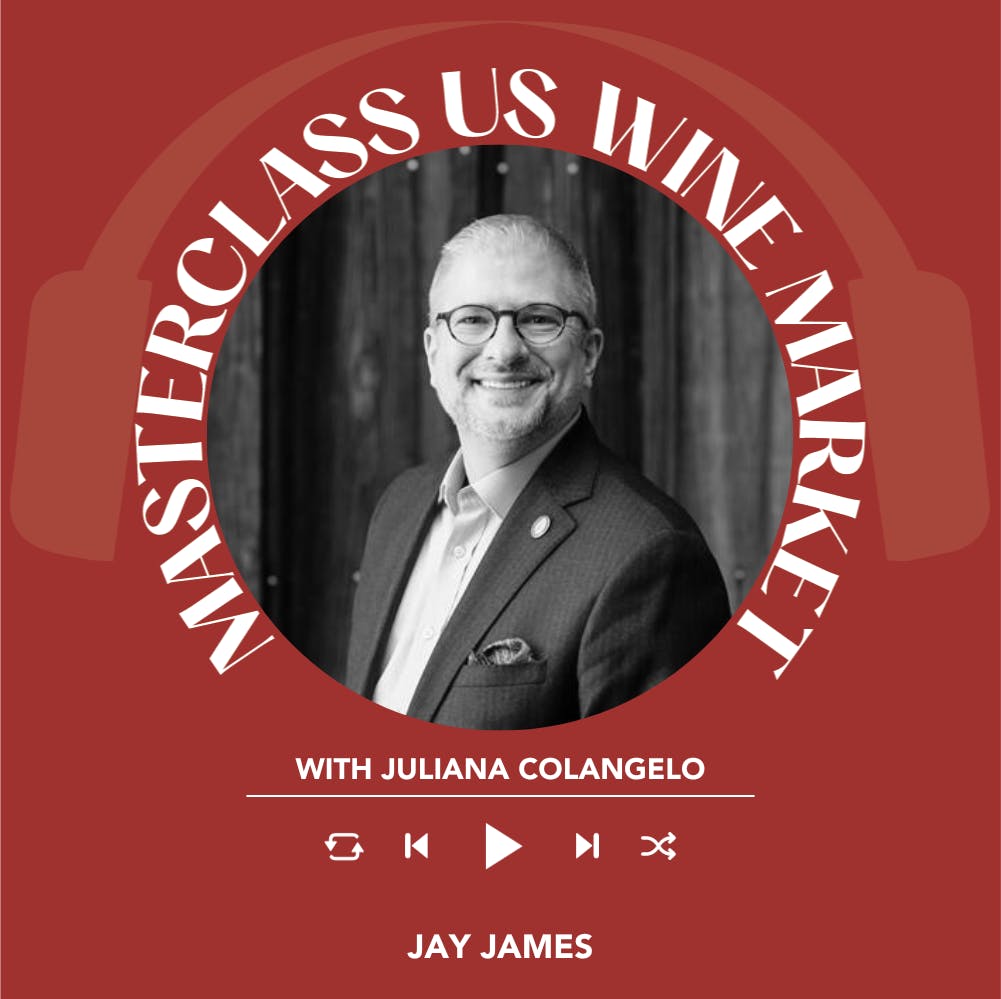
Ep. 1710 Jay James | Masterclass US Wine Market With Juliana Colangelo
Masterclass US Wine Market
Episode Summary
Content Analysis Key Themes and Main Ideas 1. Current state and trends of the US fine and rare wine retail market. 2. Impact of global economic conditions on high-end wine sales, especially during the holiday season. 3. Performance of Italian wine categories (Piedmont, Tuscany, Etna Rosso, white wines, sparkling wines) in the US market. 4. Challenges and strategies for engaging new generations of wine collectors. 5. The career journey and insights of a Master Sommelier in the wine industry. Summary In this episode of Masterclass US Market, host Juliana Colangelo interviews Jay James, Master Sommelier and President of Benchmark Wine Group, a leading retailer of rare and back vintage wines. James describes the current US fine and rare wine market as ""cagey and cautious,"" noting a slight softening of prices and a reduction in sales for the most elite categories (e.g., Bordeaux, Grand Cru Burgundy) compared to the ""go-go market"" of 2021. Uniquely, the Italian wine category has shown slight price growth, with Piedmont (specifically Nebbiolo) being the primary driver, while Tuscany remains flat despite a string of excellent vintages. James highlights emerging interest in Etna Rosso (likening it to Italian Burgundy), Italian white wines (especially from Friuli), and the potential for Italian sparkling wines like Franciacorta and Trentodoc, buoyed by Prosecco's market penetration and Ferrari Trento's Formula 1 sponsorship. He discusses the challenge of attracting younger collectors, emphasizing reliance on word-of-mouth and non-traditional marketing avenues. The discussion also covers the consistently strong performance of Champagne sales and James's career transition from music to wine, offering advice on utilizing experts and the importance of storytelling in wine sales. Takeaways - The US fine and rare wine market is currently cautious, experiencing a slight softening of prices and demand for ultra-elite categories. - Italian wine is an outlier, showing modest price growth, primarily driven by Piedmontese wines (Nebbiolo). - Tuscany's fine wine market has remained flat despite recent strong vintages. - Emerging trends in Italian wine include increasing interest in Etna Rosso, high-quality Italian white wines (e.g., Friuli), and Italian sparkling wines (Trentodoc, Franciacorta). - Word-of-mouth and non-traditional marketing (like sports sponsorships) are crucial for engaging new generations of fine wine collectors. - Champagne sales remain robust and are a dominant segment in the fine wine market. - Utilizing experts (retailers, sommeliers) and effective storytelling are key to success in the wine industry. Notable Quotes - ""I got into it by accident just like almost everyone else."
About This Episode
The speakers discuss the impact of the pandemic on the wine industry, with Speaker 1 noting that the market is currently cautious and cautious, but seeing a shift towards affordable price points and a slight softening of prices in the auction market. They also discuss the challenges of the Italian wine industry, including declining categories and a shift towards consumers behaving differently, and the challenges of reaching younger consumers in the crafting and rare retail spaces. They also discuss the success of the sparkling wine industry in Italy, particularly in relation to the drive to survive show on Netflix, and the importance of learning to sell wine in the US market. They also give advice on enhancing the guest experience in the wine industry, including finding a relationship with a retailer and being mindful of the price of wine.
Transcript
The Italian wine podcast is the community driven platform for Italian wine Geeks around the world. Support the show by donating at Italian wine podcast dot com. Donate five or more Euros, and we'll send you a copy of our latest book, my Italian GrapeGeek journal. Absolutely free. To get your free copy of my Italian GreatGeek journal, click support us at italian wine podcast dot com, or wherever you get your pods. Welcome to Masterclass US Market with me, Juliana Colangelo. This show has been designed to demystify the US market for Italian wineries through interviews of experts in sales and distribution, social media, communications, and so much more. We will quiz each of our esteemed guests at the end of each episode to solidify the lessons that we've learned. To sharpen your pencils, get out your notebooks, and join us each week to learn more about the US market. Hello. Welcome to master class US wine market. Today, I'm thrilled to welcome Jay James to the Italian wine podcast. Jay is a master sommelier and the president of Benchmark wine group, a licensed imported distributor and retailer in California, and the leading source of rare and back vintage wine for wine retailers, restaurants, and collectors around the world. Jay brings nearly four decades of expertise across the fine and rare wine spectrum to his position at Benchmark Wine Group. Welcome to the show, Jay. It's so great to have you here. Thank you, Juliana. It is a pleasure to be here today. Before we dive into today's discussion, and, you know, we're sitting here in, on December first. So we're gonna talk all about OND and holidays and shopping trends. Before that, Jay, tell us a little bit more about yourself and and how you got into this crazy wine world that we work in. Sure. Thank you. So, you know, I have a saying about the wine business that, I got into it by accident just like almost everyone else. You know, if your if your last name isn't, you know, I mean, Davi or ancillary, you know, you're not necessarily destined for the wine business. So we kind of most of us fall into it by accident. And I did certainly. Born, raised and educated in Atlanta, Georgia, attended Georgia tech. And, this is gonna seem like a completely weird detour, but while I was there, actually, almost as soon as I started school, I started playing guitar in a rock band, and I've been a guitar player since I was a little kid. And that's how I got into wine business. Okay. So how did how did that happen? I I did that for I did that for a couple of years. This was in the eighties during the the REM. Years when Athens Georgia was, like, the hottest place in the American Music scene. So I was right in the middle of that. And Mhmm. I dropped out of college for a couple of years to do that, and I decided to go back to school, study jazz guitar, which had been a long, long passionate, long held passion of mine. And as I did that, I I needed to so I was supporting myself. I needed a job and through, I'm just a couple of weird coincidences. I met someone who had just gone to work for the Ritz Carlton. Atlanta, downtown Atlanta, and, I, long story short, I was hired as a room service waiter while I was in music school. And that's how I started learning about wine. I I began studying there, and I just immediately gravitated towards it. And so and then I loved the restaurant business, and I wasn't expecting that. So I I kinda stuck with it, and I stuck with studies, even though I stopped music school, went back to to Georgia Tech, and as I was wrapping that up, That was when I got my first wine director job and started preparing for the master following exam. Oh, wow. You're busy. Yeah. I was a I was a busy guy. I did that. You know, I just kept my nose at the grindstone on the MS exam, past that in nineteen ninety seven soon after, got the opportunity to move to the west to open a small hotel in Las Vegas called Bellagio. As the wine director, which was life changing. And that was really where I got immersed in the fine and rare side of the business. At that point, Bellagio was one of, if not the largest buyer of back vintage finding rear wines on the planet. Oh, interesting. And even back then, it wasn't right away because I don't think a benchmark was founded in two thousand and two, but I recall actually buying wine from benchmark while it was a bellagio. Interesting. It all comes to one circle. Right? Yeah. It's all for all full circle full circle, excuse me. And I I I remember them from back then. Did some some years in distribution in Nevada when I I was suddenly one in spirits for a while. I left that. And I handled Bine and Ray during that time. And then Okay. Reading that, I I moved to Napa. I have a a thirteen year old daughter. She was three at this time, and I decided I wanna to put her in school in California instead of the badass. So I made the move to the wine country and kind of joined the winery side of the business for a little while. So I was VP of sales for Joseph Phelps, prior to that Chapelay. During those posts, I actually used the benchmark as a resource to find library bottles. We didn't ever wire them to sell them, we use them for, you know, trade events and, you know, and different things like that where we were gonna be entertaining and we wanted to show some older wines, but not necessarily tap the seller of the winery and, you know, here's a little secret that many of you may or may not know. Most wine or most American wineries have no library at all. Right. They didn't plan so well for for the future. Yeah. Well, it it's it's a combination, I think, of that as well as, you know, when you when you've got to hit winery, you've got sales velocity to meet. And it's it's awfully hard to say no, sometimes to protect, you know, to protect a, a library entry for the future. Definitely. So benchmark came in handy for that. And, and so I've, you know, over the years, I've been involved with Benchmark and acquiring lines like that. And it was, a real great closure to the circle for me to join Benchmark, in a leadership capacity. Right. So it's a You've touched really every aspect of of the industry in the US and also different regions from the East Coast and down in Atlanta. You know, on the on premise side and hotels and and some a and beverage director to distribution and Evada and then wineries and Napa, and now it get back to to retail. So it sounds like you really have that full picture perspective of what's happening in the US market. I've never made wine, and I've never really wanted to. I've always I like I like to talk about it and sell it and making it as fascinating, but that's about the only thing in the business I haven't done. Yeah. Well, there's plenty of people out there making it. Right? We that we gotta sell it here. Exactly. Let them let them do it. I'm happy to I'm happy to be their voice if I can. Totally. So, Jay, we wanna talk specifically today about trends in the rare and fine wine retail space in the US market, but really also what's happening right now in OND and a holiday season. It's been a a weird year. Lots of external things happening with wars and, economic challenges in the US, political, appeal and up and down. And we wanna understand how that's all actually impacting the market and and how that's translating into sales at benchmark, especially finding such a niche market. We really wanna dive into a little bit more of of what's going on. So our three key takeaways for today's master class. We're really excited to learn from you are. Number one, how is this year different from yours prior in terms of fine and rear wine retail? Number two, what categories in Italian wine specifically are trending? And which are not, which are declining. And then finally number three, how are consumers behaving differently in terms of consumption of finding real wines this holiday season specifically? And and perhaps looking towards next year, what are some predictions? So, you know, just for starters, you know, we're halfway through the holiday season. What are you seeing right now at Benchmark? Well, you know, as you point out, the market, the the world economic conditions and market conditions we're seeing this year are, I mean, they're always unique, but they're there's really some outlier things happening right now in the world. And so this is a super strange year. I kind of term. I term the market right now is cagey and kind of cautious. You know, it's like Okay. It's, you know, there's been all of this talk about recession. And yet, we're not according to the the people that make the call on this were not in one yet, we're seeing not just in the wine business, but in, you know, all so many segments of the the US market, there are, you know, there's there's just a mood that's, like, reserved. They can be cool or not. You know, they just don't wanna wanna reach out. They, you know, just they're just keeping their powder dry. I guess is a is a great way to say it. So it's it's a cagey cautious strange market, and twenty three versus twenty two, you know, looking at numbers, they're, you know, we're they're they're not that different in terms of sales velocity. They're about the same for us. We did see a reduction this year in contribution from the most elite categories of the one. Interesting. You know, the, the things like, you know, ordo, DRC, Lawa, first growth burgundy, or Grand Prairie, excuse me, those kinds of things, they shrank this year versus what we did last year. And yet, and at the same time, we saw some growth in the two hundred to four hundred dollar price range. You know, which was interesting. And that's something that, you know, that's kind of unique to this year. Now one of the things I wanna point out about our specific situation is we're fine in rare retailers. So what that means is we purchase a great deal of the wine we we sell from collectors. And Right. When we sell it to other collectors. So, you know, we're sort of a sort of a mercantile in in a way in respect to that. So we have wine incoming from people who are collectors buying going out to them. And that makes this a little bit different than than than your traditional retailer that's buying wines directly from wineries or from distribution, which, you know, we do that as well. It's just not the only part of our business. Got it. So that puts us in a unique situation to sort of see what's going on at the different levels. And we collect data on all of that in, as well as the auction market in general, which, you know, gives us an understanding of sort of what's going on with with prices. And that brings me to, I guess, my last point on this, which is we're seeing slightly softer demand for collectors to sell wine. And I believe that that's probably related to back that over twenty two and twenty three, we've seen a very small, but notable softening of price points in all of those different price categories and, and wine categories we were just talking about. Interesting. So, Jay, you mentioned that you're seeing less supply if some of them is really fine river wines. It's called first growth and grand cruise, etcetera. Where do what do you think is happening there? What is causing that? Lower supplies? I so I think that, you know, we're seeing a slight, very slight softening of prices in the auction market. And I think that that is that has a direct effect on collectors that regularly trade in these things. They see the prices go down there. It's sort of incentivized to hold on to it for just a little bit longer to see if the price comes back up to where it was. We certainly saw some price peaks during the Gogo market of twenty twenty one. Right. Which, like, the whole Wind industry talks about how insane the last half of twenty twenty and most of twenty one was, and it certainly was. We see that in our numbers as well. So since then, there's been a softening of prices. And in the case of collectors, that that draws down the supply a little bit. That makes sense. Yeah. Because in in economics, you know, we know that deflation, and price lowering is dangerous for the market. Right? So it makes sense that these suppliers that hold on to inventory as opposed to sell it at a at a lower price and wait until the market picks back up. Indeed. And we don't think it's something that's permanent. You know, certainly we're in, you know, we're we're an active buyer all the time. So we're we're always talking collectors about, you know, just about, you know, what the the state of the market is, what their moods are. And that's a that's a a fair sort of distillation of what we're hearing from everybody. Absolutely. So, Jay, let's talk a little bit about Italian wine specifically. We're we're on the Italian wine podcast after all. But what have you seen trending categorically at benchmark year over year in this year versus last year? In Italian wine specifically? So when it comes to to data, you know, we track all of the data on these things. Italian wine basically boils down to Piedmont and Tuscany, and then everything else that's kind of that's kind of what can be, you know, what you could track and sort of keep up with. And what we're seeing is for twenty twenty three, the average retail prices of, of Italian wine have have gone up slightly. And out of all of the different different categories that we track, it's the only one that's gone up. Wow. That's exciting. All all it is slight. It's tiny. It's less than a percent. Okay. But it's it's still it's it's improved, and all of the other major categories, Grand Crew Redundy, Premier Creek, Redburgundy, Bordeaux, California Colts, they've all declined in the somewhere in the single digit percentage just for most of those those categories. Interesting. And then splitting it splitting it down even further, it's actually Piedmont that's driving the success that Italy is seeing. Tuscany is basically flat which I'll talk about that in a in a minute. It's a little hard for me to understand why that's happening, but it's Piedmont that's actually showing some, some measurable price growth Right. In in a in what everybody has to describe as a down market. So, you know, kudos to Piedmont. Way to go way to go Navio. Yeah. That's that's very exciting. Do you have any predictions or idea, you know, inclinations about why we're seeing the Italian wine category in the finer rare retail space specifically trend up when a lot of other categories are are declining? I I think that it's a, I I think there's a little bit of a value proposition there. I I think as the whether whether there's volatility in the rest of the categories, I think that that broad based collectors are looking at at Italy and going, okay. Well, well, this is stable. So now's the time to be involved in it. Okay. And, I think that there's a lot of uncertainty about both the economy and the economic situation as well as all of those other wine categories with uncertainty and confusion in in the economic mood set and then that paired with the prices getting a little softer and going down a little bit on the other the other segments. I think everybody's just holding and kind of watching. I I believe that this is going to spell at some point the beginning of a new bull market on this sort of stuff. People are gonna suddenly realize, oh, hey. Wow. The economy's not as bad as I thought it was. And there's certainly a lot of people that are out there saying that now. And these prices are depressed. So let's grab them. And I think that that's coming. And so when when that happens, Italy might not look so good by comparison because it may, you know, if it if it continues doing what it's doing, then it's just gonna do whatever thing else is doing. Right. The one piece of this is really hard for me to understand is why Piedmont is eclipsing Tuscany right now as a as a subcategory of Italian wine because Tuscany just is in the this window of a string of phenomenal vintages. Right. It's sixteen, maybe, you know, it's one of those kind of gears which people would call vintage of the century. Followed by seventeen and eighteen, both of which were, you know, outstanding to classic ratings by all of the pundits. Right. And so so it's it's a little hard to look at at, especially Bernelo, and understand why it took a a dip from what happened to it in twenty one, which I can clearly associate with the release of the twenty sixteen. Right. Yeah. That's interesting. I wonder if it has anything to do with consumer preference around stylistically, wines that are a little bit lighter in style, you know, in terms of what we're seeing trend wise in just people's palace? It's possible. And and I actually just gonna touch on that and, you know, kind of moving out of the the Piedmont Tuscany paradigm here and talk about, okay, well, what about the rest of it? There's, you know, certainly a whole bunch of of Italy that's not Piedmont and Tuscany. And the the superstars that are in Italy outside of Tuscany and Piedmont are, like, the level drops off dramatically when you when you get outside of those two zones, you know, you have You have the superstars in the Zenito, like Contarelli in Delfourno. And, you know, those have the kind of price points that you see with Gaia and Soldera, and all these super collectible p button tuscan wines, But then once you get past there, like, there's still really remarkable, rarities to be found, but for the most part, the prices just they they're they become a fraction of what those other sell for. Mhmm. So that said, One of the superstar areas that I see coming on board, and I there was some there was some press on this just yesterday. It was Aetna Rosa. So lighter style red, Norello Maskalesi, Norella Capuccio, you know, is the the key grape varieties there and high altitude volcanic soils. This, I think, of that Nuroso, like Italy's burden. You know, this is this this is these are the these are the crisp, you know, red fruited sort of high acid wines of than the the greatest ones of the Italian range. Right. And yesterday yesterday, I saw some some press saying that, the consortium there voted to go all in to attain DOCG. For Aetna. Exciting. Yeah. And I think Which I both thought is very exciting. And I and I think it's also telling that there's a lot of serious attention around those wines now, and that's that's a very lovely thing. Totally. And I think, you know, actually at Automino Gourmet, in Sicily this past fall. I know they did a comparative blind tasting of Aetna rosso in Burgundy. So that comparison you drew. Really? Yeah. I think they're they're noticing it as well there, and they're also going into from what I hear more of a a rating by site and location. So really looking at, you know, the cruise system in Burgundy in terms of how to further classify and distinguish the wine. So, I think that's a really apt you know, comparison and prediction and and I expect we'll see that Russo continue to become more prevalent in this fine wine and collectible space, which is exciting for me. I love those wines. And it'll be fun to drink more back vintages and and kinda geek out on them more. I'm deeply looking forward to that, and it as you point out, it's a it's a very fun thing to talk about with producers. And and this is, you know, at this point in time, and kind of the the the global level of wine knowledge about Mount Edna is it really resides with the producers right now because, you know, when you talk with them, they'll be able to tell you this vineyard sits on a lava flow that started in nineteen sixty one, and it's black lava. And this This wine comes from one that was from nineteen forty eight that's red lot of, or, you know, or other distinctions. And it's it has the same level of insane detail that you have in the vineyards of burgundy we just don't know it yet. We don't know where, you know, we're not accustomed to it outside of that, that set of producers and them sharing their knowledge is is lovely. So I couldn't be more enthusiastic about what's going on there. Yeah. That's great. I see interestingly more attention on Italian white wines than ever before. Okay. Which, you know, there's that old saying in in Italy that, you know, what, the first job of a wine is to be red, which I think is hilarious. It only produces spectacular white wines Definitely. In, especially in certain places. I'm a, I'm a giant free leaf fan, and Me too. You know, so it's really lovely to see the wines of of of Italy, the white wines of Italy from those special regions begin to gain more and more traction. Mhmm. And, you know, and a third thing that I'm kind of watching in in this Italian wine is I'm waiting on prosecco to draw attention to other Italian sparkling wines. To have, like, that, that kind of halo effect of getting people interested in more of Franco Corta and Franco doc or some of the more method of classical wines. Both of those things. Yeah. Both of those places, especially. I I've I've long been a fan of French quarter. It's always baffled me as to why it didn't have a slightly more more prominent role in the world stage. And so, you know, I'm I and I think that I did to have this realization right away, but after, you know, we're we're, what, a good now, six or eight years into this this evolution that Prosecco has made into States market, you know, I'm kind of hoping that that that now that it's become a staple for people that it's gonna draw attention to. Okay. Well, what, well, what else is great in bubbles in Italy? Right. Then then that discovery begins to happen. So I've I've got my I don't know that that's a trend yet, but I've really got my fingers crossed for it to become one. Yeah. Me too. Me too. So just to set up, Jay, I mean, we're we're looking at in the fine and and rare retail space and Italian line at Noroso, whites, and especially for Julie, it sounds like, and Piedmont. And, and Nevios seem to do three things that we really wanna keep our eye on and see how they evolve in in the coming in the coming years. But That's that's exciting for Italian White overall to hear that in benchmarks business, at least. You're seeing the category trend up while others gonna remain flat or even trend down. So good news for us and our listeners here on the Italian One podcast. Yes. We think so. Yes. Definitely. You know, we love to talk about love and hate to talk about the next generation wine consumer. And, you know, I think it's worth talking to you, Jay, about this specifically because, you know, you're dealing with a really niche consumer and what we probably expect to be typically an older consumer in the fine and rare retail space. So how is benchmark approaching that challenge the entire industry is facing of reaching new consumers, younger consumers, specifically, let's say, millennials, older gen z, into this fine and and rare retail space? Well, marketing two collectors is probably the weirdest or one of the weirdest parts of the wine business. It it's it's there's There's not like somewhere you can go where collectors just are. Right. You know, you can't you can't just pick a spot and go, okay. Well, that's where all the wine collectors hang out. So, or or what they read. And so this is this is where we're gonna put our attention to. A lot of a a lot of the attention we get from collectors comes from other collectors. It's it's word-of-mouth, it's reputation. Mhmm. And and so we have a slightly different entree into into the the world of marketing and the consideration of demographics than a more traditional retailer would have. That said, we are beginning to see some younger collectors start to surface. Now our our metrics and our demographic metrics are dominated by the boomer and and less so the gen x cohort. Mhmm. But that's that's mo that's where most of our businesses. And so it's it's notable for us that we're now starting to see you know, collectors in their late thirties and early forties beginning to emerge, which is sort of the center of the the next demographic cohort, the millennial generation. Mhmm. And So and so that begins to raise the question. But, okay. What will what's going on that, you know, or how can we access more people that are interested in that? And, you know, certainly all of the standard things that everybody is doing know, different social media avenues, but just we're we're just trying to keep the name of Benchmark present in the serious collector space and knowing that that word-of-mouth action that happens with collectors is going to lead us to the next generation of collectors. Right. With that said, I'll I'll tag back to sparkling wine I was talking about just a second ago. It was one of the things that that occurs to me is that there, you know, you're seeing new media attention on new things. And so let's talk about Formula One for a sec. I I'm a I'm a veteran Formula One fan. I've been I started watching Formula One in nineteen ninety nine, and I don't think I've missed a race. Oh, wow. I can't say the same, Jay, but but that's why we're here to talk to us about it. Well, so so I bring that up because I think there's something really interesting that that loops back to what we were just talking about. You know, one of the classic things that happens at the end of an f one race there's podium celebration. And if there when you're not in a Middle Eastern country that doesn't permit it, there's always been some kind of a showering of of champagne that goes on at the after and present the trophies. Well, right now, that's not champagne. Did did you were you aware of that? I am aware of that because I've all the work we do in Italian, I believe it's French of Corta or it's Trinto doc. It's That's Trenta Docs. It is. It's Ferrari. That's right. It's it's been Ferrari since twenty twenty one or two, and they're in the middle of, I think a five year agreement. That's amazing. So I, you know, I think that's a really interesting thing. And it's it's sort of a it's quizzical that the name of this wine is Ferrari because that Ferrari family has nothing or very little do with the the automotive variety. Right. Right. They're not they're not related. But you could trick people into thinking they're connected, right, and it works for the the promotion. It's an easy misconclusion to make. That's for sure. But Ferrari, Cantini Ferrari is, you know, one of the most celebrated sparkling wine method traditional sparkling wine producers in Italy hailing from Trentedoc. And getting that kind of attention, especially with what's going on with the drive to succeed, a drive to survive show that's happening on Netflix, which is designed to market f one to a whole new generation of of people And at the same time, it's marketing a great Italian sparkling wine to a whole new generation of people. Right. And so I watch little things like that around around the world that aren't necessarily They're not ingrained in the wine business, so to speak. But they certainly are little threads that move out to begin to expand the awareness of of wine in a way that is novel and is new and has not really happened before. So you know, my fingers are crossed that we're gonna see some effect from that. Yeah. And then we'll start to see more of that too of seeing wine in other spaces, whether it's it's sports, its entertainment, and, and of the likes. And I think the sparkling wine does lend itself maybe in some ways to those occasions more than other styles. But hopefully, like you said, that's a gateway and opening to seeing some other advances as well. So that's certainly exciting. And speaking of sparkling wine, just, you know, one last question because it's the holidays. I love champagne. I'm sure most of us do. Talk to us a little bit more about sparkling wine sales right now at benchmark. I just read today that drizzly, which clearly services a different type of consumer, but nearly a quarter of their entire platform is sparkling wine sales. At least right now during this time. So we know that that category is huge this time of year. So tell us a little bit more about what's happening and sparkling white at benchmark right now. So so from a from a categorical standpoint, another segment that is actually performing above the rest of the segments is is champagne, especially, Grandmark champagne. Like, we have we have very little little challenges with that. Actually, our challenge is finding enough of it. Good challenge to have. And it's it's across all different segments of of champagne. So it's, you know, it's not just Tetikube. It's it's vintage. It's it that's, you know, broader champagnes, all of them have, you know, outstanding velocity. And we've certainly seen it be good this fall, in spite of, you know, what we all think is just a sort of weird walking market which has various ups and downs. That that's remained solid. Okay. So we're we're enthusiastic about that and and hoping that continues throughout December. We're doing everything we can to enhance it. And, you know, it like, I sort of alluded to, champagne is is still dominant in the category, and we've not seen yet in the collector world, a move towards French Acorda or Trented Doc. From a collecting standpoint. But, you know, when we when we do see those wines come into our hands, you know, they don't necessarily remain long because people recognize them as in almost every case in in Branch Acorda is typically less expensive than an equivalent quality model for champagne. So, you know, it it makes a it it makes a a great glass of bubbles that you don't have to shell out quite so dearly for it. Definitely. Definitely. Well, maybe when we talk next year, Jay, we'll we'll see some French records and Trento Docs starting to trend up more. That's that's our hope. I'll I'll be keeping my eye out. Yes. Exactly. Well, Jay, as we wrap things up, we'll do our rapid fire quiz. We ask our guests a few questions just to capture their thoughts in the US market. The number one, what is your number one tip for mastering the US wine market? And this has long been my number one piece of advice for anybody that asks a question even close to that. Know and utilize your experts. It's the most important thing. You know, I I've long advised people to have a relationship with a retailer. Right. Get to know them and let them get to know you and what you like and don't like so that it it makes them better able to make recommendations Mhmm. For you. And it's, you know, it's just like working with the Sommelier restaurant. The Sommelier knows what what's best from the kitchen, that night, and how all the wines in their cellar are working. They know that in a way that you most people can't possibly know. Totally. So rely on that and don't be afraid of it. You know, embrace it and it will enhance your experience almost every time. Yeah. Look at them as partners. That's that's great advice. Question number two, what is something you might have told your younger professional self about selling wine in the US? Oh, I would I would have told myself in nineteen ninety five, which was the year I left the floor of, the restaurant and moved into distribution as a sales rep. The first time, I would have told myself that at the top of the wine business, no wine is sold without a story. We're all storytellers and boil it down to what we do. We're here to tell stories about this stuff in the bottle that we love. And the better the better you are at that, the more success you have, and the better relationships you develop with people that are relying on you to deliver something. That's a really good reminder. I love that one. And finally, question number three, we all travel a ton in this industry. What is your favorite travel hack? Oh, well, so, you know, it's it's I kinda reflect back onto the time that I was and the winery side of the business and, you know, traveling to different markets to work with distributors for that. I don't know. There's so many. Well, my favorite one for New York City was get a metrocard as soon as you get to town. You know, not just for your own personal convenience, but all the best reps in New York City, they never get in a car. They're on the subway with a wine bag, and they were running like crazy. So I made some great sales and some great relationships by being willing to get in the trenches with them and go as hard as they were. So wear comfortable shoes also. Comfortable shoes, you know, same as so in in a outside of New York City, in a very similar thing. When I first started working with distributor sales reps in a car, I found myself getting carsick a lot, and it took and that never happened before. And I couldn't figure it out for a couple of months until I realized what I was doing is I was reading my email on my phone while we were riding around, and I was looking down at the floor. And so I learned to hold my phone up at eye level and keep the horizon in my eye. That's a good time. While I was reading my email, and the the car sickness the car sickness stopped immediately, when I started doing that. And and then, and I'll add one more. I've always made this my habit. I used the plane as downtime. I was, you know, like, like, all of we're all busy. I was always tempted to pop out the laptop and start working when I was on the the plane. And what I came to realize over the years was that I was way fresher if I used the plane as downtime Yeah. Lots of rest and and some relaxation. Watch a trashy movie or something. Watch it, you know, watch a, watch a guilty pleasure kind of movie, and then come back at it hard the next day. And I was better the next day. And if I tried to work on the plane, I was it usually took me two or three days to kind of get back in my rhythm. And so I started becoming, you know, very serious and consistent about doing that and it really paid off. I like that one. That's a great tip as well. Well, Jay, thank you so much for joining us during this very busy time of year on mass or class US wine market, how can our listeners connect with you in Benchmark? So, benchmark wine dot com is where you will find us, and you will find, you know, one of the greatest selections of fine and real wine available anywhere on the planet. At that website, and there's links to get to me and the owner, Dave Parker, and, you know, all of the people here who handle all of the business. So we'd love to hear from you and love to see you. Great. Thank you so much, Jay. Thanks for joining us today. Thanks, Juliana. It's a great pleasure. And let me know when you need me again. I'll be here for you. I will. Thank you for joining me today. Stay tuned each week for new episodes of Master class US wine market with me, Juliana Angelangelo. I remember if you enjoyed today's show, hit the like and follow buttons wherever you get your podcasts.
Episode Details
Keywords
Related Episodes
Ep. 2790 Italian Wine in the US: Building a Narrative and Reaching Asian American Consumers with Susan R. Lin MW | Masterclass US Wine Market
Episode 2790
Ep. 2783 The Suburban Gold Mine: Insights into New Jersey’s Wine Market with Brittney Abell | Masterclass US Wine Market
Episode 2783

Ep. 2772 A Surprising Partnership between Japanese Sake & Italian Wine with Monica Samuels | Masterclass US Wine Market
Episode 2772

Ep. 2770 China’s Wine Market: From Misleading Import Numbers to Today’s Consumer with Fongyee Walker MW - Part 1 | Asia Wine Market
Episode 2770
Ep. 2760 Winning the Restaurant Floor: Training, Education & Italian Wine with Sylvester Inda of Ci Siamo | Masterclass US Wine Market
Episode 2760

Ep. 2751 From Montalcino to Kazakhstan with Francesca Arquint of Collemattoni | Asia Wine Market
Episode 2751