
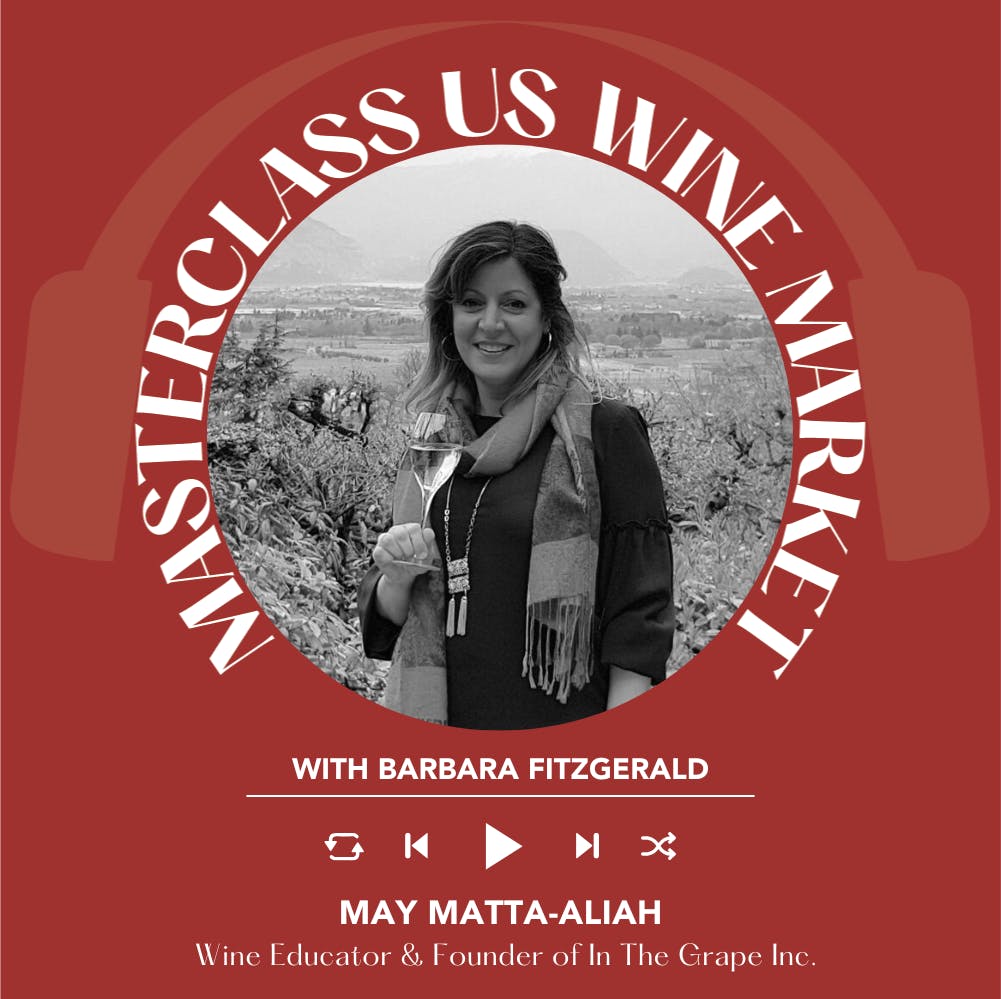
Ep. 2370 Barbara Fitzgerald interviews May Matta-Aliah of In The Grape Inc | Masterclass US Wine Market
Masterclass US Wine Market
Episode Summary
Content Analysis Key Themes and Main Ideas 1. The challenge of maintaining relevance for Italian wines with rich heritage in the dynamic US market. 2. Adapting marketing and communication strategies to a changing US consumer landscape, particularly younger drinkers and shifting consumption habits. 3. The multifaceted and strategic role of a brand ambassador in the US wine market, extending beyond storytelling to include cultural translation, trade partnership, and market strategy. 4. The importance of innovative, experiential approaches to wine education and marketing beyond traditional seminars. 5. The critical need for international wine brands to have dedicated in-market partners in the US to navigate market complexities and support distribution channels. Summary In this episode of ""Masterclass US Wine Market,"" host Barbara Fitzgerald interviews May Mata Aliyah, a highly experienced wine educator and brand ambassador. May, who describes herself as a ""wine nerd"" with two decades of experience, discusses the intricacies of positioning Italian wines in the fast-evolving US market. The conversation focuses on three core themes: bridging the traditional heritage of Italian wine with contemporary relevance, adapting to new consumer behaviors (such as the ""sober curious"" trend and younger demographics seeking experiences), and the comprehensive strategy behind her role as an ambassador. May elaborates on how her work for clients like Franciacorta and Lebanese wineries involves not just education but also acting as a cultural translator, trade partner, and market strategist. She emphasizes the necessity of tailoring approaches to specific US regions rather than adopting a ""one-size-fits-all"" model and highlights the invaluable role of in-market partners in supporting distributors and ensuring brand visibility and success in a highly competitive and consolidating market. Takeaways - Italian wine brands must proactively bridge their historical heritage with current consumer trends and preferences in the US. - The US wine market is evolving, with younger consumers seeking experiences and showing interest in alternative beverages; brands need to adapt. - A brand ambassador's role is complex and dynamic, encompassing education, market strategy, trade relations, and cultural translation. - Innovative and engaging experiential marketing (e.g., themed lounges, pop-up events) can be more effective than traditional seminars for consumers. - Marketing strategies must be tailored to specific US markets, as consumer preferences and industry dynamics vary significantly by region. - Dedicated in-market representation is crucial for international wine brands to gain traction, support distributors, and avoid being overlooked in the competitive US landscape. - Effective communication and training for sales teams and distributors are vital for a brand's success, as they are key to pushing products. Notable Quotes - ""bridging tradition and relevance because Italian wine has such a rich heritage, but it needs to stay relevant in today's very fast moving US market."
About This Episode
Speaker 1 discusses their experience with Italian wine, including their work with a new winery and their desire to reposition their work with the region. They also talk about their new role as an ambassador for their region, which focuses on Micheliniterics, and their use of events and events to bring attention to the region. They emphasize the tension between tradition and relevance, and how they use their experience to create messaging and storytelling experiences for their message. They also discuss their experience with French wine, including their success with events and experiences, and their use of in-person events to bring people into the room. They also emphasize the importance of finding partnerships with industry partners and being educated and supportive of their clients. They recommend hiring a partner who can manage shifts and be creative, and emphasize the importance of training and investing in partners.
Transcript
Today, I'm thrilled to welcome May Mata Aliyah to the show. May is Lebanese by birth, New Yorker by heart, and a true wine nerd. In this episode are three key takeaways and what we're excited to learn from May are first bridging tradition and relevance because Italian wine has such a rich heritage, but it needs to stay relevant in today's very fast moving US market. Second, adapting to a changing consumer landscape. And then third, really the strategy behind the ambassador role. So it's not just a storyteller. Right? It's kind of a cultural translator, a trade partner, a market strategist. So we're here about the ways that she kind of develops that for her brands. Yes. Fantastic. Well, let's dive in. Welcome to Masterclass US wine market with me Barbara Fitzgerald. In this show, we'll break down the complexities of selling wine in the US. By discussing the relevant issues of today with experts from around the globe. Each episode serves up three key insights to help elevate your wineries presence in the US market. So grab a pen and paper, and let's pave the way for your success. In the US. Hi, everyone. Welcome back to Masterclass US wine market. Today, I'm thrilled to welcome May Mata Aliyah to the show. May is Lebanese by birth, New Yorker, by heart, and a true wine nerd. With two decades of wine education under her belt. May is happiest when swirling, sipping, and sharing her love of all things wine. She's racked up an impressive list of wine certifications and has represented numerous wine regions and wineries as an educational or brand ambassador through her company in the grape. She's also a fellow Italian wine ambassador, so it always feels extra special to have someone in in that family on the show. So welcome, Mae. Thank you so much for joining us. Thanks for having me, Barbara. To be on the show, I'm excited. Yeah. Absolutely. Well, before we dive into today's discussion, May, can you tell us a little bit more about your background and how you came to work in the wine business? Well, my background as a Lebanese born, every end of the summer vacation, my family would go up to the Bicat Valley, and we would buy wine, and they would get their, you know, case of red, case of rose, case of white. So ever since I was a kid, I've been fascinated by wine, and know, fast forward many years later. I studied graphic design, worked as a graphic designer, and then in my job was assigned as some wine importers as clients and went off to some wine classes to learn about my clients and decided pretty promptly that I'd much rather stop being a designer and, become a wine educator. So that's kind of the shortcut to the journey. But, yeah, that went from an interest in a passion, passion award that everybody in the wine industry seems to use. To me deciding to actually pursue it as a career and then going through my WS certifications started with just taking a class because I thought it was fun. And then went to level three, did my diploma and here I was with my diploma and, you know, looking for something to do with that diploma and somewhat accidentally stumbled upon education. Very happily stumbled upon education. Fantastic. Yeah. So can you share some of the brands and regions that you're currently working with? Yeah. So I've been working with one of our fabulous Italian wine regions, which Francha Corta. They are a current client of mine that I started working with in twenty sixteen. And, I am currently also working with a winery from Lebanon called Chateaux Sarah, which is the oldest and the largest winery from Lebanon. And those are my kind of ongoing clients today. Prior to that, I also represented Alto Adi Jay for many years. I've worked with Champagne. I've worked with Port I do a lot of work with, Chevli and the wines of bourgana. And from Lebanon, this is the third winery that I've represented. So I'd like to shepherd Lebanese wineries into the market and then help Yeah. Help them some traction. So I've worked with two previous wineries and now I'm working with the biggest one. So I think I've I've tried to reach the max there. Well, that's so great to hear about all of this experience that you have, as you said, kind of shepherding, definitely international brands, but especially for this We focus on Italian brands, wineries, and regions into the US market. So that's what we're gonna talk to May about today. So in this episode, our three key takeaways and what we're excited to learn from May are first bridging tradition and relevance because Italian wine has such a rich heritage, but it needs to stay relevant in today's very fast moving US market. So we'll talk to her about some ways that she does that. Second adapting to a changing consumer landscape. So as we know, we hear a time and again, sober curious trends, growing competition with alternative beverages. So how does she's keeping Italian wine relevant amidst those changes. And then third, really the strategy behind the ambassador role. So it's not just a storyteller. Right? It's kind of a cultural translator, a trade partner, a market strategist. So we're here about the ways that she kind of develops that for her brands. Yes. Fantastic. Well, let's dive in. We're gonna kind of, like I said, start exploring how heritage, quote, unquote, can be reimagined for today's US consumer because we can't just sell wine with tradition anymore. About kind of translating legacy into maybe more emotionally resonant stories that connect with today's consumer values. So how do you make that tradition, you know, from Italian wine feel fresh and relevant to an American audience? You know, it's an interesting question because I think that in wine communication in general, there has not been a whole lot of innovation. There are some brands that are innovating, but I think for the most part, we've pretty much state sort of at the tried and true. I think I'm not gonna be able to answer your question directly primarily because for the various regions that I work with, there are and this is kind of a way of tacking into your last question, which is that when you're in an Ambassador There's it's not a one size fits all. So, and oftentimes when you're working with a region and I know that you've done your fair share with working with Italian. And so when you're working with consortiums, the bigger picture is coming from them. So as the ambassador, it I I wish I was in a role where I can actually direct the conversation, but I'm more on the end where I'm just presenting what they've already decided. So this is kind of the role that I play with Franca Corta now. So in that sense, what I'm doing is an extension of their strategy. So, you know, within that, I'll give you a, you know, direct example of Franca Corta last few years in Italy, they've been the partner to Michelin. And this in twenty twenty four, they signed a three year contract with Michelin US USA. So the message comes from the region in that everything that we do now in the US. For the next three years will be focused on Michelin Restaurants. So then it's really, you know, it's up to us saying, okay, well Michelin just did an event in the Southeast. What city are we going to go to? But when we're going there, it's pretty classical, you know, seminar presentation, and really just targeting those regions where Michelin has already been, and it's kind of a follow-up to what they're doing. So it's not very innovative in that sense because that's more the direction that's coming from them. Prior to that, I'll say, for example, where I had a different role because I was also in an ambassador robot in a different capacity. I worked with Armeniac. Armeniac being an old brandy from France. That was actually the first ambassador role I ever had, and I started with them in two thousand and nine. So they were really my first baby and how I kind of figured out my way in this ambassador role. What was interesting about them is that when they brought me on, they'd never had a PR arm in the US. They never had a PR person. So I was wearing many hats and I was wearing everything from, you know, going and having a drink at a bar and talking to bartenders and going in and training them and trying to get placements. And then, you know, doing consumer events, doing industry training, going the tails of the cocktails, going to, you know, spirit seminars and conferences, but then also doing events. And I did effectively everything you can think of doing for this one account, but then come pandemic you know, as we know the world kinda shut down. Coming back from that, I really wanted to reposition what I was doing for them and do something that was a lot more interactive. I felt that, you know, community was where people wanted to be. We wanted something a little bit different. It was also a very new generation of people that came in. So I kind of shifted from just doing, you know, let's all sit in a room and do a classic PowerPoint presentation to doing events. And so I kind of took the category and segmented it into different topics and then did lounges. And the lounge would be you come in and, you know, one was like on a Sunday afternoon and I had a foosball table and we had music and we had, you know, snacks and you were just kind of self guided and I was there. I had informational cards about the categories, and I was there to kind of interact with people. Then we did another event that was on another category. And this was more sort of more premium categories, and I did it as a lunch and paired it with tacos. Tacos and Armeniac. And then we did another one that was for vintage armagnac and I brought on a you know caviar purveyor and we did caviar bumps and and armagnac. So, you know, it was different because and we really opened it up. We had a lot of industry come and I would just stand on a chair and kind of do this, you know, big kind of tough presentation. And I drew a lot of people and I really tried to get a very different group of people into the room. And they were really successful. And by all metrics, I think, you know, I had such positive feedback, but then what happens? The region comes and says, we've decided this was great, but for next year, we wanna go back to doing seminars. So that's all you can do now. And then that's all you do. Yeah. So the reality is that you could be very creative and at the end of the day, if the clients are the strategy because, you know, they're all coming from consortiums that have communication. Right. Right. Right. You know, committees, and they decide what they decide, and then it's up to you to implement. But, you know, what you were saying about these events sounds like such great examples of ways to make messaging storytelling really land with a US audience. You know, I really think so. And I will say, you know, my last one was going to be, which I was very excited about because I think that's, you know, how do we bring them? So I would love to get, you know, forty people on a plane and take them all to gascony because there's nothing like experiencing that. Like, nothing like experiencing Italy. Right? But I couldn't. So there is a place in New York that's actually a farm owned and run by a lady who is from Gascony and it feels very much like a Gascony farm. And I was going to do a day trip just get everybody on a bus have an army headquarters on the bus take everybody up to the farm, spend the day on the farm, and really bring that experience of being in Gascony, but in upstate New York. And everybody was, you know, very excited about it. We're gonna you know, a duck dish and we were gonna really try to make it feel like we were there. And then again, with the change of direction, they pulled the plug on it. But to my mind, I think really kind of creating experiences that are engaging where you can see yourself. It doesn't have to be fussy. It doesn't have to be precious. Education can take many, many, many different faces and many different directions, and it can be done in a conversation. It doesn't have to be, you know, like, show death by PowerPoint as we say. Yes. Yes. So what you're saying is, though, that that tension between kind of bridging the tradition and the relevance is still very much there. So there's still work to be done and still ways, you know, to find more innovative opportunities. Maybe. Yeah. I think so. I think so. Yeah. And can can we go back to a moment? As you were mentioning, Runchikorff does work with Michelin, what are those seminars like? Are they, you know, talking about the terroir and, you know, the unique attributes of French Chacorta? Is it more experiential? Is it both of those things? So that's a great question. So what we do with French Chacorta is we've really not every market is a mature market. Right? So in some markets like New York, I'm based in New York. We have done several events already in New York. If we had done, I think three different festivals that were predating this contract with Michelin, but they were, you know, we would offer different seminars, and some of them were panel discussions. And so they would take a, you know, sort of a, the seminars in the morning, then there was a big walk around tasting, that was a trade tasting, and then in the evening, it was a consumer event, and they were great. And, we did a few of those. But so we've been in New York. We've done a lot of different seminars in New York. So this year, for example, we decided to just do a lunch, and we chose a restaurant, we did it at Armani, So, our restaurant Armani is beautiful. It's very they have a lot of French a quarter on the list. It's also it's very Italian, right? And and French a quarter for both the Milan, and it's all about fashion. And so it really felt right. The food was wonderful. We spoke to the chef. And so when our guests game, there was no PowerPoint. There was no, you know, it was really just a lovely lunch. For that, what we did is a we had a magnum bar. So guests came in, they chit chat, they network, they're enjoying some wine. We had a a little blind tasting competition, with the person who did the best on it would get a trip. So there was an incentive to engage the brand. And then we had a lunch, a three course lunch each course paired with three different wines. So really kind of showing the versatility because a big part of our talking focus for French Corta is it's a wine for food. It's, you know, it's like we're sort of really walking away from just, you know, pop open a bottle of wine and just celebrate and then move on. Was really kind of highlighting how food friendly those wines are. And so it was a really nice experience and three different courses, you know, three different wines. They were able to taste nine wines and pair them, and it was a really wonderful group of people, all professionals, So they were all, you know, engaging with the wines in a way that you would normally would, right, at a table with people with food. So we did that for New York because we've been in New York a bunch of times. Miami, we've been to several times. And so Miami, the first time we went down there, we did a, you know, more of a food and wine focused seminar. We went down again. Did a discussion. We had winemakers, and I moderated discussion with different winemakers. We touched on different topics. We went there again and, you know, for that third visit, we decided to just do what we called an industry appreciation party. And so we did it in November, and we did it at a beautiful rooftop, and we just had stations. So we had the station of the, you know, the We had a satan station, a Rosay station, food and wine pairing, but it really was just a party. And for that one, a mingling, and, you know, we kind of do a pause and I I'll always have a component of education. But I can give it to be more of a chat. So I get, you know, ten, fifteen minutes. I kinda lay the groundwork for what it is and then go around and just talk to people and engage with them sort of on more one to one. And I think, you know, visiting I think pinpointing key markets for your brands and then building that loyalty incrementally, keep coming back and keep doing different new things in that market. Don't just come in and do the same seminar over and over and over, but find ways to engage with your loyal, you know, clients in a way that feels a little bit more organic and more genuine. I think is a good thing to do. So, I mean, we've we've heard from a lot of suppliers in Miami now that the market has really shifted. That's great. Yeah. So that's, you know, that's really great. So those are some of the conversations that I'm involved in with the person who handles the PR for them and with the consortium, you know, where is each market at and what is appropriate? If we're going into a new market, first time we're there, we do what I call my friend Chacotta one zero one. So, yes, then to answer your question, it's here's where it is. Here's how it is. Here's the soil. Here's the climate. Here are the grapes. Here's how it's made. Let's taste the wine. So it really it really depends, and this is part of what is very enjoyable working with the consolstery directly, is that we work as a team. Yeah. There's Constance, Chamberlain, who's running she does the PR. I do the education, but we're on Zoom's with the consortium, and we're all hammering these things out together. And honestly, I think that's the most effective when everybody's on the same page and says, okay. You know, we did Chicago. We're in Chicago again. What makes sense for a follow-up seminar? Yeah. And what it sounds like is you are really their kind of person on the ground. You're this in market perspective that they wouldn't have otherwise. Right? And you can't develop programming for a market. You don't know the market well. Otherwise, you're just it's a little bit of a guessing game. I think one of the biggest challenges that I find is that the best programs are when either the client comes and spends time in this market and really understands this market or puts their faith in you that you really understand your market. I think the worst case scenario and I say this having done, you know, pretty much been doing this for a while and I've seen a lot of different things. When everybody thinks that there's a one size fits all, I truly, truly do not believe there's a one size fits all scenario and even in the US. You live in California. I live in New York. Yeah. We're very different. Jersey's a different market near. It's not the US market. Yes. It's the US market. Right? Yeah. And so you have to tailor. You really have to beat. Yeah. And this is where you have to believe in the people that you're working with. And, you know, I value I mean, my career when I studied in college before I became a Hawaiian educator was graphic design, and graphic design is all about visual communication. I see this as just a different way of communication, but I always think you have to communicate for your client. It's not, you know, I'm not, it's not about me, when I'm in a room, and I have a lot of, you know, students that I mentor. And I say, you know, It's not about me. When I'm in that room, it is not about me. I'm not in here to tell you about my I call it my Me, my fabulous life. It's not that's not what we're in this room for. I'm here to service you and my client and try to bring that client because every region is unique. Every region has a story to tell. Right? And so how do you bring that? And how do you connect the people in that room to that? And and genuine appreciation is really important. I will not work with a client if I don't believe in them. I mean, that's the privilege that I have also, but I really can't, you know, at the end of the day, I work for myself. And if I can't genuinely and enthusiastically speak about something, it will come across. I've had many people tell me I could never be a poker player because I just don't have much space. So if, you know, so I'm excited about something it comes from the heart, but I also, you know, I want to be a partner and I want to work with people that believe that I value them and I want their best interest. That's great. But I mean, what I'm hearing is, you know, the the kind of, like, the line of the day in marketing is just meet the customer where they are, but you're somebody that can actually bridge that gap for the customer and the producer or the region, you know, whoever they are. And that's so beautiful that you do it with such passion. I know we said passion that gets thrown around a lot, but I know. I know. But it's yeah. It is it's it's true, but I think, it's true. You're saying that though, because I every podcast I listen to, it's, you know, meet the clients where they're at. And I think it's a It is easier said than done. Right? But I've been really kind of fascinated by that concept, and I think it's, you know, there are lots of opportunities. And that, you know, I mean, anyway. So let me ask a couple questions a little bit more about kind of that changing consumer landscape. For example, you know, we're talking about we see less lower overall wine consumption, definitely among younger drinkers. And, specifically, with those younger drinkers, there really is a rising demand for experiences. So are you is that playing out in I know you're offering, like, especially with Prunchikorff to such a premium level of experience. Maybe it's a younger consumer might be price sensitive to that. But are you seeing that in any offerings that you have that it's really engaging younger consumers? You know, I think, again, with best recorded, it's a little hard for me to say that just because I don't have as much give in what we're doing. And that customer is a customer that is interested in things that are a little bit more premium, interested in fashion, interested in a particular lifestyle, and I think they're still buying. You know, it's it's like I would say that the friends are called the customers maybe a little bit more mature customer and they are still, you know, they're still buying those ones and they're still seeking those experiences. When it comes to something like the Lebanese one that I work with, for example, you know, that's where I'm working with a brand, which is a little bit easier because you just have one person to convince instead of a consortium of people to convince. But with that, for example, I'm trying to do a lot of things where I'm, you know, I'm in events. I'm in places where young Lebanese people are to get them to drink those wines. And so, you know, I've connected with a lot of people that are doing, you know, festivals and things here. And then I'll be there and I'm pouring the wines there and I'm getting those wines in front of people. I'm taking a drink that is the very traditional which is called Arak and it's our, you know, very traditional Lebanese spirit and I'm gonna make a punch with it and I'm gonna put it on ice, you know, to kind of like get people to try to see it in a different light. But I think, you know, to go back to, you know, meet them where they're at. You know, we can't I mean, doing in store tastings works, right? Doing all of these things works. You push, you sell bottles, people taste they buy the bottles, but we need to do more. And I think just kind of finding the partnerships with people that are out there that are doing fun things, where I'm like doing pop up dinners, where I'm going and doing these festivals. That's, you know, that's what I'm doing with that brand because that's where I'm you know, I can get to the younger people. You kinda said it a little bit earlier, you know, that it can be tempting to put on one event, see that it worked well, and then that's what you want, you know, you wanna make that the format going forward, but you have to offer something fresh. Every time to keep people engaged and excited and to really build that loyalty within a market. I think you have to keep I mean, you have to keep innovating a little bit, you know. And I've been very interested, and I'm I'm not I don't have an answer for that yet, Barbara, but I'll tell you. But I really have been trying to see what events people are doing that are a little bit different, that are a little bit more kind of exciting. And how are they working? Cause I have also been to events where people have tried to do something different. And, you know, the wine industry is a funny beast. Because we have to really differentiate between industry people and consumers. For the vast majority of wine industry people that I know in the city, they want things to be pretty straight up. They want a tasting. They want a seminar. They want to sit down and take their notes and taste their wines and that's it. Events that I've gone to that have been innovative have had mixed results by people that are used to things being a certain way. Consumers, I think it's a, you know, it's an open field. I mean, you can I think consumers are seeking something very different? And the decision some wine regions are just really focused on communicating only to the industry. Yeah. Others are brands that are really communicating to consumers. And I think that's going to be a big part of how you address that business. Most of what I'm doing, most of what I do is reaching industry people. Okay. Interesting. Yeah. Just gonna. Yeah. It's a rare opportunity that I get to do more consumer facings. So I just think they're actually fun. So that was I actually kind of in talking about, you know, the ambassador as a as a strategic operator. You know, how much do you I mean, you kinda just said most mostly trade, but how much would you say you touch, you know, your role touches trade versus consumers versus media even? Media, again, very I would say very little mostly because for the majority of, like, regions, there's somebody else doing the media outreach. So if somebody wants to interview me, then they're usually connected through the PR per if the area has a PR, if the region has a PR person here. Armenia did not when I worked with them, they didn't. So I was getting all of it. I was doing all the consumer, you know, media everything for them. So it really, again, it really it really depends. On, again, it depends on the client. It depends on how mature or how, you know, what what kind of backup does that region have here. Right. And then for some people, I know have worked as ambassadors for regions where it's a full time job. For me, none of these have been the full time job. You know, they tend to be more event driven. I'll have some months where, you know, I'll maybe doing a bunch of different seminars and then maybe I don't do anything for fun Chacorta for months. Right? So it's So, you know, it's a little bit of, like, being able to manage that shifting schedule. Yeah. So it sounds like, though, kind of, you know, the key takeaway from that is for a brand that is not based here, to be successful here, it's really important for them to have in market partners that they work with. And I'm sure that that can sound daunting for a small winery, but it's not necessarily cost prohibitive. Right? Like, you can an ambassador can be hired on a contract basis I guess this is more of a question. I shouldn't just say this. I mean, right? They can be hired on a contract basis or, you know, per event or something like that. But to give yourself, you know, give yourself a partner that can help you really under, it's like having a translator. You're gonna come here and you don't feel very comfortable with the language. You probably want somebody that can translate things for you, and this is like a market translator. You know, I would say I remember I was working with a brand years ago, and I remember going talking to the supplier. I was like, what can I do? What can I do? He said, you know what? It's not sexy, but just walking around and knocking on doors does actually make a difference. To your point, I think it is a hugely important factor. And I think if I were to give one suggestion to a lot of brands that are trying to get more traction in the US market. It is really worth your while to hire somebody whose main focus is your brand because the more the market is changing here today. Consolidation is crazy. And unless you're a really, really big brand and you're really making big numbers, you do get lost in the shuffle. And unless you have somebody who is actively looking out for you, you will hurt. Your brand will hurt. And I can say this direct experience because one of the brands, you know, their distributor has gone through several consolidation rounds. And I had a key account. I was trying to place an order, and they always copied me. Thank god, but, like, that order was going nowhere. Nobody was answering, you know, and I'm like, you're, you know, and if I wasn't here to address that right away Right. That probably would have lost the spot on the shelf, right? It was by the glass placement at an important restaurant for us, and nobody was answering that. So those are the kinds of things that you know, like just being here or if you have a portfolio tasting, it's a difference between having somebody who doesn't know the brand at all behind the table or somebody who knows the brand and cares. Right? Yeah. Yeah. So there are many, many reasons why I think having. And to your point, it doesn't have to be a retainer. It can be a small retainer. It can be an on project. It can be a commission based. I mean, there are many different ways, and a lot of people can do it in a part time capacity, but I really think for where it is, you know, an opportunity for brands to have someone, I think it's very valuable to have someone to represent them. That's so great. And may I ask, do you ever find yourself for any of your brands supporting wholesalers in any way? Like, are you kind of do you work with the distributors to help the winery or the region gain more prominence even in their portfolio? Or Yeah. So, I mean, with this, for a variety of clients. I've done things where you just go and you do a distributor. And I think again, it's one of the not so sexy, but really important parts of the business. If the salesperson doesn't know what they're selling, they're not gonna sell it. Know, I keep saying this to brands. I mean, you know, at the end of the day, salespeople live on commission, and they're putting those bottles in their bag and they're going on the street. They want to make placements because they want to make money. So if they don't understand your brand and they have no idea what to say about it, they're going to be a lot less client to actually want to sell it. So my first step is find partners. You know, their distributors have to be your partners, and they have to really care, and you have to train them, you have to invest in them, and you have to come and spend time in the market with them and go knock on doors and give them the support they need so they can be successful. You can be successful. So, yes, that is something I have done a lot of as well. And I did a program with the wines of Shibley where all I did was, you know, I think I did six friend training sessions. They were all for suppliers. Mhmm. So they're a category education, but they were intended only for suppliers. And I think the answer is very valuable. This is really what you're saying then as an ambassador can be this very dynamic role that is bridging, not just, you know, bringing education to consumer, bringing what the consumer wants back to the supplier, but also just kind of this holistic, like, supplier distributor consumer touch point. Yeah. You've got your, you know, fingers in all of those different areas in a way that brings so much value to the brands that you're working with. Yeah. And anchoring it all. Background is, you know, being educated and being and being supportive of your various clients. Right? So, I mean, when I'm going to distributors, I'm teaching them if I'm doing things for consumers, I'm trying to teach them and get them excited, get them to care. I mean, at the end of the day, just like everything has a story to tell you just have to get that story to the right people and get them here. Yeah. Well, may this has been so fantastic. This is such, I think, really kind of just juicy practical advice for somebody looking to further develop their brand in the US and some good tidbits for how they can do that. But as we start to wind down, we like to ask our guests three questions to help our listeners better understand the US wine market and specifically this episode. So it's just kinda rapid fire style if you can answer in just a couple sentences. First, What's your number one insight for mastering the US wine market? Number one insight for mastering. Oh, Lord. I don't know. Go to a retail store and spend a couple hours on the floor. I think that is great practical advice. Like, yeah. That's what somebody told me to do when I was starting and I worked in retail, and I think it's the best learning environment. Amazing. Great advice. What is something you would have told your younger professional self? About selling wine in the US? Just enjoy it. I mean, just just explore just explore and and enjoy it. I don't know. No. Great. Nice. I mean, it's such a big, fascinating, beautiful world. Right? There's don't forget to have fun. Lastly. And our last question, we all move around a lot in this industry. The last time I saw you was in Montalcino, for example. So what is your favorite travel hack, when you're doing market work? Favorite travel hack. Oh my god. Those are good questions. I should have asked you. My favorite travel hack, does it have to be wine specific? No. Not at all. Just, you know, some people say, like, only pack a carry on or bring herbal tea, you know, like, something really practical. For being on the road. Always bring a carry on and bring your own steamer because I'm always going to do seminars and I always have my dress that needs to be steamed. So I pack my entire outfit down to the jewelry and the shoes, everything gets back together in a thing with the steamer. And that's, you know, I'm always on to holding on to that. It's the first day I make sure everything is set up before I do anything. So that's, you know, I'm usually traveling for work. So I try to look, you know, presentable. Yeah. That is great. Yes. That is great advice. You know what? I don't think anyone's given that advice yet too. So that's a really good one. Yeah. The small great one that just stays in my bag. Actually, my bag is right next because I'm packing to travel again tomorrow, but yes. Well, Nate, thank you so so much for being so generous with your time and your expertise. How can our listeners connect with you? Well, they can find me on LinkedIn. It's in the grape is my company. My website is in the grape. My Instagram is may is in the grape. My email is may at in the grape. They can find me through any of those. They can DM me. They can email me. They can WhatsApp me. Any other problems. I am not too shocked. Oh, mate. Thank you so much again for joining us on Master Class US White Market. I hope We get to see each other again very soon. Me too. I hope so. Alright. Until are you, Kjell. And that's a wrap for this episode of Master Class US wine market. Thank you so much for joining us. If you enjoyed this episode and want to stay up to date with the latest industry trends, remember to like, follow and share our podcast. And if you find value in our conversations, please leave us a review to help others discover the show and grow our community Stay tuned for new episodes every Monday. Until then.
Episode Details
Keywords
Related Episodes
Ep. 2790 Italian Wine in the US: Building a Narrative and Reaching Asian American Consumers with Susan R. Lin MW | Masterclass US Wine Market
Episode 2790
Ep. 2783 The Suburban Gold Mine: Insights into New Jersey’s Wine Market with Brittney Abell | Masterclass US Wine Market
Episode 2783

Ep. 2772 A Surprising Partnership between Japanese Sake & Italian Wine with Monica Samuels | Masterclass US Wine Market
Episode 2772

Ep. 2770 China’s Wine Market: From Misleading Import Numbers to Today’s Consumer with Fongyee Walker MW - Part 1 | Asia Wine Market
Episode 2770
Ep. 2760 Winning the Restaurant Floor: Training, Education & Italian Wine with Sylvester Inda of Ci Siamo | Masterclass US Wine Market
Episode 2760

Ep. 2751 From Montalcino to Kazakhstan with Francesca Arquint of Collemattoni | Asia Wine Market
Episode 2751