
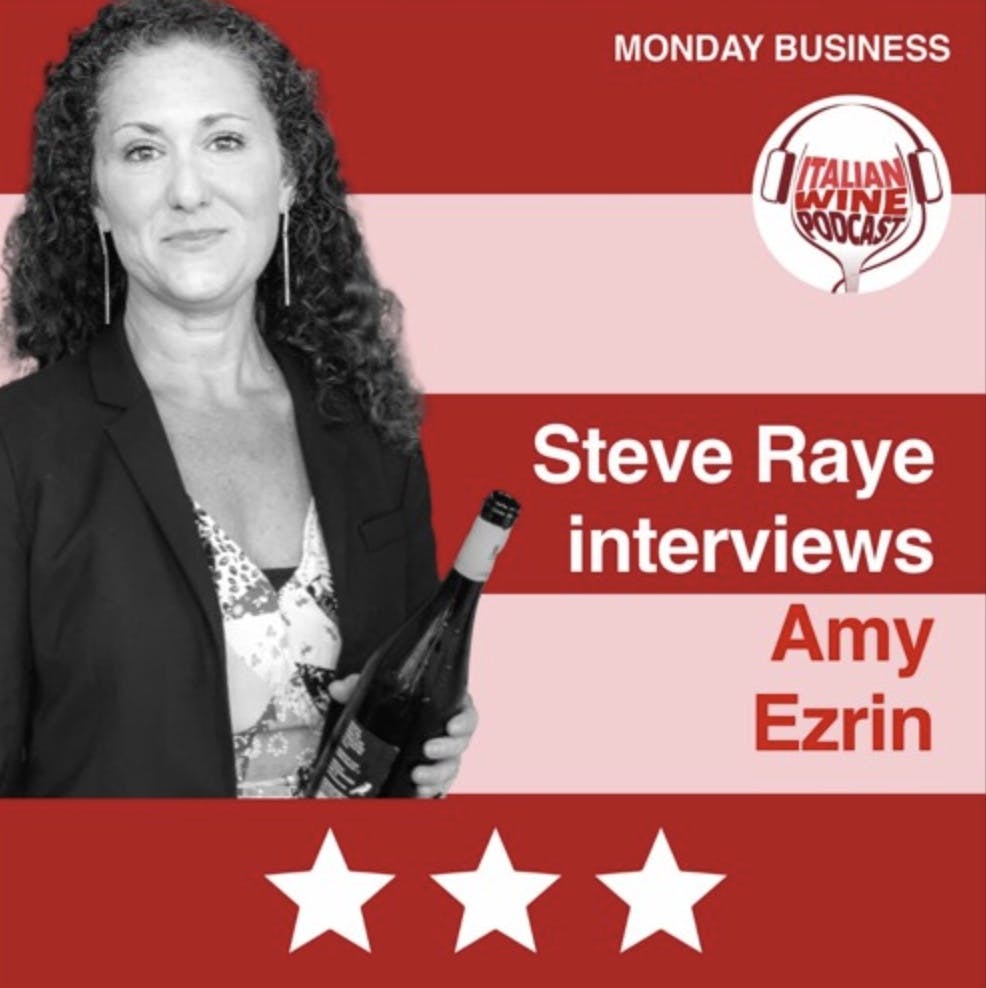
Ep. 654 Amy Ezrin | Get US Market Ready With Italian Wine People
Masterclass US Wine Market
Episode Summary
Content Analysis Key Themes and Main Ideas 1. The evolving landscape of Italian wine import and distribution in the U.S. 2. Amy Esrin's extensive career journey within the Italian wine industry and her role at The Piedmont Guy. 3. Innovative business models and logistical solutions for wine importers, including the use of service importers. 4. The impact of COVID-19 on wine sales strategies and market trends, leading to a hybrid approach. 5. Sustainability in wine: a critical discussion moving beyond organic certifications to holistic B Corp standards and packaging. 6. The growing importance and environmental benefits of alternative wine packaging, such as liter bottles and bag-in-box. 7. The strategy of developing proprietary brands and ""gateway natural wines"" to meet diverse market demands and expand reach. Summary This episode of the Italian Wine Podcast features host Steve Ray interviewing Amy Esrin, a veteran in the Italian wine industry and partner at The Piedmont Guy. Amy recounts her extensive career, which spans living in Italy, working for various U.S. importers, leading marketing campaigns for the Italian Trade Agency, and co-founding The Piedmont Guy, an importer specializing in Piedmontese wines. She details The Piedmont Guy's traditional import model, made feasible for a small company by outsourcing complex logistics to a service importer. The discussion then shifts to the changes in sales strategies post-COVID, where a hybrid approach combining virtual tastings with essential in-person relationships has emerged. Amy elaborates on The Piedmont Guy's portfolio, emphasizing small, family-owned wineries and their successful strategy of developing proprietary ""gateway natural wines"" like unfiltered Arneis and Bracchetto to cater to a broader market and boost volume. A significant segment covers sustainability, where Amy argues that while organic farming is crucial, packaging choices (liter bottles, bag-in-box) offer a more substantial environmental impact reduction than certifications alone. She introduces B Corp certification as a comprehensive, 360-degree approach to sustainability, encompassing environmental, social, and governance practices, which her new personal brand, Sandy Jovese (a 3-liter bag-in-box Sangiovese), is pursuing. Amy passionately refutes the ""clean wine"" trend, advocating instead for ""farmers market wine"" – small-production, artisanal wines. Her main takeaway for producers is to embrace creativity in product selection and packaging to navigate current market demands and logistical challenges effectively. Takeaways - The U.S. wine import business is highly complex and costly, making the use of service importers a crucial enabler for smaller companies. - Post-COVID sales strategies require a flexible hybrid approach, blending efficient virtual tools with the foundational importance of human relationships and trust. - Importers can diversify their portfolios and capture wider market segments by developing proprietary ""gateway"" wines that respond to current trends like ""natural"" wine characteristics, even if not fully certified. - True sustainability in the wine industry extends significantly beyond organic farming to include packaging choices, with formats like bag-in-box dramatically reducing carbon footprints. - B Corp certification offers a more holistic and robust measure of a company's commitment to environmental, social, and governance sustainability compared to singular organic certifications. - Alternative packaging formats (liter bottles, bag-in-box) are increasingly popular, offering benefits in terms of eco-friendliness, convenience, and logistics for consumers and producers. - The term ""clean wine"" is often a marketing buzzword; consumers seeking high-quality, ethically produced wine should look for ""farmers market wine"" – artisanal, small-production wines from dedicated growers. - Producers looking to succeed in the U.S. market should be open-minded about diversifying products and formats, as this can enhance market presence and logistical efficiency. Notable Quotes - ""The long and winding road that usually brings most of us misfits to this business..."
About This Episode
The speakers discuss the Italian wine podcast and its success in the wine industry, including the importance of logistics and maintaining a staff. They also discuss their success in the wine industry, including their partnership with a winery and their ability to manage their business. They emphasize the importance of organic and sustainable wines, packaging, and creating a brand in a box for independent retailers. They also discuss the benefits of box wine, including the potential for expansion in independent retailers and consumers.
Transcript
Thanks for tuning into my new show. Get US Market Ready with Italian wine people. I'm Steve Ray, author of the book how to get US Market Ready. And in my previous podcast, I shared some of the lessons I've learned from thirty years in wine and spirits business helping brands enter and grow in the US market. This series will be dedicated to the personalities who have been working in the Italian wine sector in the US, their experiences, challenges, and personal stories. I'll uncover the roads that they walked shedding light on current trends, business strategies, and their unique brands. So thanks for listening in, and let's get to the interview. Hi, guys. I'm Joy Livingston, and I am the producer of the Italian wine podcast. Thank you for listening. We are the only wine podcast that has been due a daily show since the pandemic began. This is a labor of love and we are committed to bringing you free content every day. Of course, this takes time and effort not to mention the cost of equipment, production, and editing. We would be grateful for your donations, suggestions quests and ideas. For more information on how to get in touch, go to Italian wine podcast dot com. Now back to the show. Hello, and welcome to this week's episode. This is Steve Ray for the Italian wine podcast. This week, I'm pleased to have as a guest Amy Esrin, who's a longtime friend in the industry, and, well connected in the Italian wine business. Amy, welcome to the show. Hi, Steve. Good morning. Good morning. And, tell us a little bit about your background in connection with Italian wines? Well, the long and winding road that usually brings most of us misfits to this business, started, I would say, in restaurants, working in restaurants, both in New York City, and then ultimately I moved to Italy and lived there for about eight years, while I stayed connected to that community. I sort of transferred what was a burgeoning love for French wine onto Italian wine so that when I left Italy and moved back to the United States in two thousand and five. I, knew at that point that I wanted to be in the wine and spirits industry and more specifically, in the world of importing wine to the US. At that point, I was very fortunate, to get a job sort of fresh off the boat as they say, with Scernic wines, which was at the time Michael Scernic wines, and that is of course, has been a school for many, a wine industry professional. If I can give myself that word. I worked a bit for Polana selections in New York as well, and then I moved to Massanoi imports where, we sort of grew, a license into a real company, and I curated that portfolio for about nine years. Then I took a position at the Italian trade agency where I ran a national marketing campaign for Italian wine on behalf of the Italian government. And that, I guess, jettisoned me to where we are today, where I am, a partner in, a small boutique importer called the Piedmont guy. We, as you can imagine, import wines exclusively from the region of Piedmont in Italy, I also do a little bit of consulting with a few wineries, directly, basically helping them get imported into the US. This is a smaller part of my business. And more importantly, I recently launched my own wine brand, which is a three liter bag in box wine, named Sandy Jovese, affectionately after the grape of Central Italy, San Jose. And that is getting out into stores now. Great. We'll get into that a little bit later in, in the interview. So speaking of your work at the at the Piedmont guy, describe the model. A lot of people one of the issues people have is, you know, I'm I'm looking for an importer, and they're not really they're looking for an import solution. Maybe it isn't, you know, there isn't just one model, the old agency brand. So talk about the model that you follow with Piedmont guy. Okay. So, yeah. So the Piedmont guy, our model is actually very old school in many ways. In the sense that we, really are that sort of traditional company that buys wine, selects wine, and buys wine in Italy. Specifically in Piedmont, in this case, we import it to the US, and then we sell it to distributors, wholesale distributors around the country who then in turn sell it to, retailers and restaurants. So our role is both in those relationships with the Italian companies from whom we purchased and also in supporting our distributors in their sales of those products to their customers who then in turn sell their wines to the good private folk of this country that drink wine on a regular basis. And so talk about logistics because you're unusual, somewhat unusual in that regard. While you're using a service importer, it wasn't like you started with the service importer as the solution. You started with your import company and chose the well, tell us. Right, Steve. Well, you know, I don't know. There's a there's a sort of a chicken and the egg question buried in that, which is that we, as the Piedmont guy, as a small company, I don't know how easy or feasible it would have been for this company to have gotten to where it is today. Have we not been able to actually outsource our logistics six to another company, which in this case would be Ellingtoni imports, based in New York City, also in California. The existence of companies like this, they're not the first. I would argue they might be the best, but a plug for also who are my dear friends, I suppose I should point out. But this is a, a structural kind of company that's existed, for some time. And, Elantania, I think, is, you know, kinda brought it to the next level, but really opened up a lot of opportunities to small importers and small distributors even who are trying to sell on a boutique level. The logistics behind importing and reselling, and also even if it's domestic, of course, but reselling alcoholic products, in this country is a labyrinthine process It is incredibly nuanced and it is very expensive. And the cost of maintaining essentially a staff to do that work for you or this or really, the cost of, let's say I'm just a one man show or in this case, we are a four man show. The cost of us us to be able to outsource that and focus on what we do on a daily basis, which is, buying and selling means, and it gives us an incredible opportunity. So once upon a time, the role that we play, I think, might have only lane with with larger companies, with companies with a larger structure that could be national importers. Now that these kind of services and this kind of structure exists, you see that there are plenty of other companies structure just like ours that are operating in this space, thanks to Lisha's six provider. Okay. So let's move on to sales. You know, you've been in the business for a long time. We've had a couple of changes recently with COVID, but let's talk more broadly about how the sales function has changed and how communications happen between you as a importer person. So, you know, everything has changed and nothing has changed. Right? Yeah. We have I think collectively, I'll learn, a lot of virtual communication skills, that we hadn't really developed before just the other week. I did a tasting via Zoom. I sent ahead a series of samples to a buyer, in Washington, DC of a prominent Italian restaurant. And we tasted on Zoom. We had the meeting that we would have had in person via Zoom. And I believe I walked away with three glass bores and, like, ten new list placements and a huge order for some library wines. So awesome. I didn't have to go to Washington, DC. I didn't have to travel there. And have to haul my bottles, etcetera, etcetera. And it really worked out great. On the flip side of that, none of that would have been possible if I didn't already have something of an in person human relationship with this buyer. And if I didn't have their confidence, and their attention, which I'm extremely thankful for. So, you know, again, this proverbial chicken and egg thing, you know, there's no I I find like there's no replacement really for that human interaction. And in fact, despite restrictions and COVID and travel and all of that, both my myself and my two colleagues. We have really kind of somehow continued our sales efforts in person. And we have traveled throughout this time cautiously and to certain markets and maybe skipped others. But we found, I'd say, a very interesting hybrid between the two. I think that, you know, sales today, we are in a very crowded field. There are a lot of more creative ways that we can approach it. But I think at the same time, there's really no replacement for a, you know, this in person relationship, that actual, you know, sort of the the human touch in a way. And also there's never gonna be replacement for simply being prepared and knowing how to do your job and knowing, you know, what your customers need and offering a service. And, you know, that's a segue into what I regularly harp on is just follow-up and organization, and, you know, we can all always do it better. But I think ultimately in sales are the biggest thing we are selling might be beyond just our our actual product. Might be our ability to manage up and our ability to do the jobs of our customers for them. And I think, you know, we can complain about this and say, well, everybody should be doing their job, but the fact is that in sales, your job is to do everybody's job. Because that's the one way you can guarantee that it's gonna get done, and that's the best way you can effectively move your product. Okay. So tell us a little bit about the portfolio briefly. How many brands are there, what are some of the more notable ones and how the change that COVID has wrought has impacted your business? The portfolio currently, we have ten estates and one proprietary brand. The, I think our most prominent name in our book is probably pottery Oderro, the great barolo, historic barolo producer. We do not represent them in every market, but we represent them in a large, in the majority of the United States and also a little bit in British Columbia. Amazing. We, otherwise, we typically, represent small to medium sized family owned wineries. All of them are, you know, farming, subs sustainably really all organically not necessarily certified. They're all working with indigenous varieties. They're all making wines in a fairly traditional fashion with the exception of a couple of more creative products that we've developed along with them. I think the biggest problem for us with COVID outside of, you know, that real quick pivot that you did, at the beginning of the pandemic to really shore up your retail contacts and get in touch with your retail customers and make sure that you were investing in those relationships, which was, I think, you know, could a big change for all of us who had worked significantly with restaurants up until that time. But for us, one of the biggest, handicaps has really been not being able to travel to Italy and not being able to go not only visit our producers, but meet new ones. And that I think, you know, we're do we're actually going in a couple of weeks. All of us are literally chaffing at the bit to get over there, anxiously watching, you know, new restrictions and changes go into place because we're determined to get over there and meet some new folks and, you know, taste and stuff that we've already tasted before and and expand because, at this point, we are extremely fortunate to have done very well throughout what has been a very difficult period, and we need to expand in order to grow. So one of the areas that you were talking about, I think I found really interesting was working with you used a really fabulous term gateway natural wines, Arnese and Brocado. But can you talk a little bit about that and also in the context of B corp and organic? Sure. Okay. So first of all, you know, there's always that logic to when you're selling small production esoteric, possibly more expensive wines that you still need to fill palettes. Right? So everybody still wants to fill that palette to the top, right, from us out of our wineries to our distributors out of our warehouse in the US. So to that end, it becomes real handy to have some wines that sell in volume that are less expensive. And that maybe respond to market trends, right, all of course under the umbrella of utter authenticity, which we, of course, adhere to. So one of the things that made us very successful were brands that we had had a hand in developing as opposed to the, you know, wines that are made by our estates and that are their flagship wines. We already had, for example, a line of leaders that we had developed made from Barbara a Bianco, which was Cortese and a Rosato. We added a Mosquatrade in a seven fifty to that, and this is our aircole line. We had only sold this DI and then during COVID figured out how to make them canix behind it and the pricing essentially work so that we could sell it stateside. And that was instrumental in our, ability to grow throughout the pandemic. Absolutely. A hundred percent. So that's a proprietary brand that we make in Piedmont. We have done something similar with one of our partners in Piedmont, which is the winery Angelo Negro in Roero, where we have they we've long worked with their estate wines, which include, of course, our niece, because they're in the row arrow. They make absolutely divine nebbiolo. They make lovely sparkling sweet, Bracchetto. At one point, the Piedmont guy himself, who is, Western Ward with in Minneapolis who started this company. He was in the winery, tasting tanks of brand new, you know, finishing Arnais of the newest vintage and said, and it was cloudy and had sort of a different flavor to it unfiltered. And he said, could you bottle it like this? And they looked at him like he was maybe a little bit crazy. And then said, sure. And so thus was born our unfiltered RNace. So what basically happened here is we took a classic and traditional product and tweaked it with the winery a little bit so that it would have, let's say, the appearance or many of which have many of the qualities of what people are looking for when they are looking for quote unquote natural wine. So, I call it gateway natural wine because it it's not an extremely funky wine. Right? Like, it doesn't have doesn't have barnyard notes or anything like that, but it does have that unfiltered quality. So it has sort of like a yeasty profile. It it would it's a wine that actually could really appeal to beer drinkers, right, or sour beer drinkers. It's just a little alternative. And, you know, In fact, it is not cannot bottle it as Roera RNace because it is unfiltered because it is considered untraditional by the rules of the a doc, or docG. So, you know, it's bottled as a Vino Bianco, but, products like this, we we then added, during the pandemic, actually launched its red sibling, which is made from dry, Breketo, also unfiltered, and that has also been a resounding success. So you know, it was like a creative move and certainly responding to some of the preferences of today's wine drinker. Those have been wildly successful wines, and they have really helped us also grow. They have helped all of our distributors grow. They have been instrumental really for them just in accessing certain types of accounts and in making sure that Piedmont guy wines are sold very regularly. And you know, that's always an investment in also selling some of the more esoteric stuff that we really love to sell like our, you know, that's Paulina from the Alto pi Monte or, you know, Erbaluce from also from the from the Canvaso up in the or for timorasso from the cholletortonese. You know, all of these wines really benefit, from the fact that we have these other wines that are a little more shall we say mass market, mass appeal. It just keeps the wheel turning. Interesting. So leaders, talk about leaders for a bit, and then we'll move on to the p corp thing. Leaders are, you know, a really an increasingly popular package right now. You know, it it goes without saying that, you know, you're still talking about a glass bottle. Right? You're still talking about a resource. Still talking about something that's not actually gonna get used again and may get recycled to a certain extent, but possibly not entirely, or at all. So that, you know, a liter bottle of wine when you're drinking it every day or when you're having a party, puts six glasses of wine at your disposal as opposed to four and a half. Right? So that right there is a benefit. It's great in a more casual restaurant when you're pouring by the glass. You know, it's a screw cap. Leaders are you know, increasingly loved, and you see a lot more a lot more types of wine coming out in that format. It's funny. Some producers are a little hesitant to work with leaders because they see them as being, you know, less important or, you know, cheaper, maybe. You know, I would argue that for your entry level wine, like, why not? It's modern, it's fresh, it's hip, and it's, you know, eco friendly, more so than that seven fifty. And, you know, they really make sense in a lot of settings. Retailers love them. So, you know, we have these wines and leaders. I have a hilarious, well, there's a hilarious picture on our Piedmont guy, the Piedmont guy Instagram right now, which was taken from a recycling bin in Mansita, Oregon, at, like, the town recycling center. It was literally folded the top of our air quality leader white. Right? These blue labels with a bunch of bottles of fireball thrown in there. And was, like, clearly somebody had a great time with Ercole, Bianco, which was awesome. We love that. We support that, you know, a round of applause, but, you know, they got a lot of bang for their buck. There's fewer bottles ultimately in that recycling bin right now because those folks were drinking out leaders. Right? If your bottles more wine, drink more. Okay. I get that. And, you know, I've it's a great project. I see more people developing them. I've helped other people develop them from other regions of Italy. It's a cool it's a cool format. Yeah. We when I was working with Austria, we saw a bunch of producers doing that, and they used the beer cap thing too. And I think those were wines that were still throwing off sediments, some groomers and so forth. Right. And Austria kinda at the bar for that. Like, that it's really Austrian Grooner. That I mean, to almost to the detriment of Grooner Belt leaner from Austria, serious Grooner Belt leaner because then everybody just thought of it as something that came in a leader. So that's what I think is Garrett, the Italians, but I think the Italian should be scared. They should be doing leaders, you know. I think it's a great option. Okay. So let's move on to clean wine, natural wine, organic, sustainable, and now this b corp thing that I had never heard of that you were filling in. Okay. So the leader, I think, is a good segue possibly to other formats, which would be a box of wine. Right? And that's where that b corp conversation comes up. So you know, dot going back, taking a step back, first of all, if, you know, we wanna talk about organic wine, you know, that's that's one topic. If we wanna talk about, eco friendly wine from the perspective of how packaging, that's another topic altogether. I I honestly think we can tackle organic first because I think this this is a a a topic that is both tired and also super current, right, like, essential. The consumer, I think, we know, doesn't really distinguish necessarily, is certainly, you know, confused a little bit about organic biodynamic, sustainable. You know, when we talk about wine, I I think, you know, it's the whole organic thing is a little is a little just, extreme. We need we are we're we're a little we've jumped the shark a little bit in other words. All of my small wineries that I represent in Italy, are all farming organically. They're not using chemicals in their vineyards. They're using copper, and sulfur, dilu diluted. Right? To fight off certain diseases throughout the growing season, and they're using them as sparingly as possible. And, you know, that's kind of the the end of the story. Right? Like, what more do we want other than grapes grown without a lot of fertilizers and pesticides and herbicides and all sorts of other crap being sprayed on them. Okay? After that, certified organic, you know, these become very huge costs, significant costs for a small farm to bear. And often, you know, these folks come in and cause more disruption to a small winery than they help. I won't even, you know, I love the concept of biodynamic and I love a lot of wines that have been grown biodynamically, which is, of course, like, a more, let's say, you know, organic on steroids in a way. Right? It's like, it's very, it's very, dogmatic. Right? It's a there's a very, for a certain prescribed set of rules. The results can be very, very interesting. But do I agree that I as an importer should have to pay for my own subscription to the certifying entity that oversees biodynamics when My winery has already paid for it and I'm not farming anything because of my because it's a marketing tool. You know, this we start we I think we've gone a little too far at this point. What I would say is that we all need to, you know, it cuts back to the import in a way. Right? Like, my name is synonymous with what I say about my wineries. If you are concerned that my wine is organic, you as the buyer, right, should believe what I say. And if you don't believe me, then you're probably maybe you're working with another importer. Right? Like, it's kind of credibility in a way that we represent, that we represent these small farms. To the average consumer out there, you know, that's a question of we gotta we have to know our audience. Right? Like, the person who wants my wines, is somebody who I think is already pretty educated about wine, pretty interested in wine. They're already relying on a retailer most likely to help them find new stuff. And if they're concerned about a wine being organic, I would expect that they would believe that retailer as much as that retailer would believe me. And it's kind of this chain of like, you know, what are we investing in here? Right? This speaks to the B corp thing in the end because just organic doesn't, you know, necessarily mean that you're getting, the product you desire. And just because it says organic in some way on the label, it doesn't mean that that's a better product than another. Again, I think we need to look at our sources. What I think is a more interesting topic for all of us in the wine industry and for the consumer, quite frankly, is the packaging. Right? Like, when you are talking about a fantastic barolo, yes, I still want that in a bottle that is a seven fifty milliliter bottle. I still want it in glass. I still want it with a cork. I want all those things because I want that inert material of that glass. I want that more or less that quantity of wine, you know, all of those things stay the same. But when it comes to the wines that we drink on a regular basis, I think we really need to look around at how we are serving ourselves and what we are doing and how that impacts the environment. So liter bottles are great. You just got a whole quarter more, right, of a wine, and you use less glass to transport it. When. Right? You are drinking a wine there's a wine that you drink all the time on a regular basis on a, you know, that you just keep around. Why not buy a three liter bag in box? Right? That has four bottles of wine inside of it. And that box is one tenth the carbon footprint has one tenth, the carbon footprint of that single glass bottle of wine. That's a win for everybody. That's a pretty significant win. Right? You mentioned B Corp, which I would say is beyond organic. And then if we know, start talking about the product that I've developed in a bag in box, Sandy Jovese, that producer, the producer who makes that wine for me is pursuing their B corp certification. And b as in the letter B corp as incorporation. There are multinational companies that have already signed up for this that are not necessarily agricultural companies or winemakers or any of those things. That just happens to be the case of who I work with. It is an overarching certification for sustainability. So if you are an agricultural company, of course, you should be practicing, you know, farming methods that are absolutely sustainable that do not contain chemicals that enhance, that encourage biodiversity, etcetera, etcetera, etcetera. But beyond that, organic's not enough. Right? At after that, what's your packaging like? What's your what's your packaging to import impact on the environment? How do you transport? What kind of, vehicles are you using? What are your employment practices? Do you practice fair employment? Do you support your employees? Do you have you employ a good balance of men and women? People of color, etcetera, etcetera. All of these questions. This is a three hundred and sixty degree approach to sustainability. And I think that's actually more interesting. Like, let's ask our wineries if they're doing that. Kinda thing. Let's not just focus on organic as as this, you know, word that fixes everything. And beyond that, you know, you mentioned clean wine. This is a cute little tag line that we see these days on wines and a nice little sound bite that people are using to sell wine. I mean, what the heck does it mean, right, clean? Do they, you know, is is there a little a dash of clorox in there that's gonna, cure your COVID as well? I mean, clean wine, what what we're all talking about here and what every single wine drinking individual could have done was go to a great retailer and just, you know, say I want a wine that is a little lower in alcohol. I want a wine that doesn't have a lot of sulfites. I want a wine that's artisanally made. I want something that's small production. Ultimately, what do we want? We want farmers' market wine as opposed to supermarket wine. Right? Clean has no meaning at all. Right? Cause clean meaning what? There's nothing. There's no extracts in that wine. There's no, you know, minerals in that wine. I mean, no. You want wine as a living, breathing thing, right, made from real fruit that we have figured out very, very careful ways of preserving and moving around the world so that we can all enjoy it. I think that we should be talking more about how do I get farmers market wine? Meaning small production wine made by small farmers people that live in their vineyards and that breathe the air that rises off of them in the dust on a hot summer days. Like, that's clean wine because those people are living in the middle of it. Right? That's what everybody should be looking for. Just like you're looking for a tomato that actually tastes like a tomato so you go to the farmer's market. Okay. Let's shift gears to a more commercial subject. And tell me about the idea behind Sandy. You talked a little bit about Sandy Jiovese with the eye idea of the packaging and better for the environment and all that kind of stuff. But it's more than that. Well, it's a big jump you made to create a new product. So this was really borne of those moments those early days of the pandemic when I was, you know, locked in my house in Brooklyn, and I hadn't, you know, been out the door for three weeks. I start I I actually have a very good friend who owns the company communal brands, Melissa Monte Sanders, and she is a queen of wine boxes. She's developed a bunch of wine boxes over time, particularly in France. She has one from Austria speaking of Grooner. And, she, I knew she was doing her master of wine thesis at the time on retail impression, buyer impressions of sustainable packaging. And I I, you know, listened to her a lot about the topic. I helped to read her paper, etcetera, etcetera. And it kind of inspired me to think about building, you know, creating my own brand in a box. I really I love the concept. I love the utility of it. I love, you know, the opportunity that it really does present to a consumer to be more eco conscious in their purchasing habits. And I also at the same time was thinking, well, what do people really wanna drink right now? And so I looked at, you know, what was available in the market before box wine, and what is selling, when I look at, you know, my independent retail customers. What are they what are they selling a lot of? What are people drinking a lot of? So I kind of merged all of that together by coming up with an Italian red that would be chillable, you know, drunk cold. A lot of the retailers in Brooklyn and Oakland and, you know, Cambridge, etcetera. They're all featuring chillable red sections on their websites. Right? And or in their stores. And I think that's great. I think, you know, we're finally, coming to the point where the consumer understands that, you know, the, abuse of wine by temperature is no longer acceptable. And, we all really like to drink bread a little cooler. So I just saw an opportunity. I saw a wine, a type of wine that didn't exist in a box. And I also see a huge opportunity among people who already drink quality wine, people who like, you know, to explore wine, who are somewhat knowledgeable who live in, you know, possibly in places where they have access to retailers with great programs who are selling really cool stuff. You know, and these people maybe don't always wanna open a bottle of wine. Right? Like, they don't always want. A whole bottle of wine, or maybe they, you know, maybe they won't drink that night because all they want is one glass, or maybe they just want something really, really simple, you know, to have a glass with dinner. And then, you know, they're gonna hit the vet early because they have a big day tomorrow. What's around for those people? Not a lot. Right? All that that was really out there in that space, in that independent retail fine wine environment were a lot of Southern French reds, a a lot of, of course, you know, there's all the massive inexpensive stuff, but there just wasn't a big choice. So I thought, okay, here's a space that is ripe for expansion, and I think that I'm not alone. I I am confident in fact I've already seen that there are a number of new box wine brands coming out that are aiming at that same space. I haven't necessarily seen one that's a chillable Italian red. So I figure I'm a little bit ahead of a trend here. This is in fact, sangiovese blended with Trebiano. I was also inspired by a wine in our Piedmont guy portfolio. Nabilulo. So I think we're gonna see a lot more in that space. And I I really think that the education has started. I think there are tons of articles being written about Fox Wine all of a sudden. In fact, I just heard over the weekend that Andre Mac who you may be familiar with, who his brand is Mouton noir, and he has a bunch of restaurants in Brooklyn that he did a piece on Fox wines, for Bon appetit, and there's going to be a little video about him reviewing a few Box wine brands. And apparently, Sandy was his favorite. So that's pretty cool. You know, I'm I'm trying to make a box wine. That is for people who like good wine. Right? People who won't drink Francia or Boto box or black box, which, by the way, are three of the top ten wine brands in the United States today. So of the ten top wine brands in the US, two day, three of them are bagging boxes. Right? Like, that says something to me. That says that the American public is aware of boxes. And that there must be a whole series of people who are like, okay. Cool. Where's a box that I'm willing to drink? Because they're not gonna drink that stuff. They want farmers market wine in a box. Okay. We're running over long on time. Okay. We're come to the end of our, session. One of the things I like to end my interviews with is what's the big takeaway from all the things that we talked about here today, the advice or the thing that would would be of value to someone listening? You know, obviously, we're people listening are distributors importers, retailers, consumer I mean, all agencies, all that kind of stuff. Other things you talked about, what's a big takeaway? Well, gosh, Steve. Let let's for the sake of this conversation, assume that we have a lot of folks that are either producers or folks on sort of that exporting side of things. I I would say that one of the messages to take away from this is really creativity in your product selection. Right? Like, don't first of all, open mindedness to all types of formats. I think at this point needs to be had. I think smart wineries are looking at diversifying their products, so you still, you know, make your flagship wine in a glass bottle. Great. But what else can you develop a that is a product that is a shorter lead time, right, that is a quicker return on investment, but that is, you know, really suited to the market you're approaching today. Right? Like, that is something that is that is different. That is ahead of a trend. Don't necessarily be so concerned that it's going to hurt your image. I think more than anything. If you can get your labels and you can get your wine out there in any way, you can get your name out there. That in and of itself is more valuable. And also just the, you know, from a logistics perspective, having something that will fill palettes makes it so much easier for your importer and, you know, in turn your distributor to to keep the orders flowing, especially at a time when it's just extremely expensive to get wine on containers and out of Europe and into the US. That's a whole topic we didn't even cover. And difficult. Yeah. Yeah. We we won't go there. Okay. So, big thank you to Amy Esrin of the Petemont guy for being our guest this week. Amy, thank you very much. Some really interesting comments there. I sure appreciate your time. My pleasure, Steve anytime. This is Steve Ray. Thanks again for listening. On behalf of the Italian wine podcast,
Episode Details
Keywords
Related Episodes
Ep. 2790 Italian Wine in the US: Building a Narrative and Reaching Asian American Consumers with Susan R. Lin MW | Masterclass US Wine Market
Episode 2790
Ep. 2783 The Suburban Gold Mine: Insights into New Jersey’s Wine Market with Brittney Abell | Masterclass US Wine Market
Episode 2783

Ep. 2772 A Surprising Partnership between Japanese Sake & Italian Wine with Monica Samuels | Masterclass US Wine Market
Episode 2772

Ep. 2770 China’s Wine Market: From Misleading Import Numbers to Today’s Consumer with Fongyee Walker MW - Part 1 | Asia Wine Market
Episode 2770
Ep. 2760 Winning the Restaurant Floor: Training, Education & Italian Wine with Sylvester Inda of Ci Siamo | Masterclass US Wine Market
Episode 2760

Ep. 2751 From Montalcino to Kazakhstan with Francesca Arquint of Collemattoni | Asia Wine Market
Episode 2751