
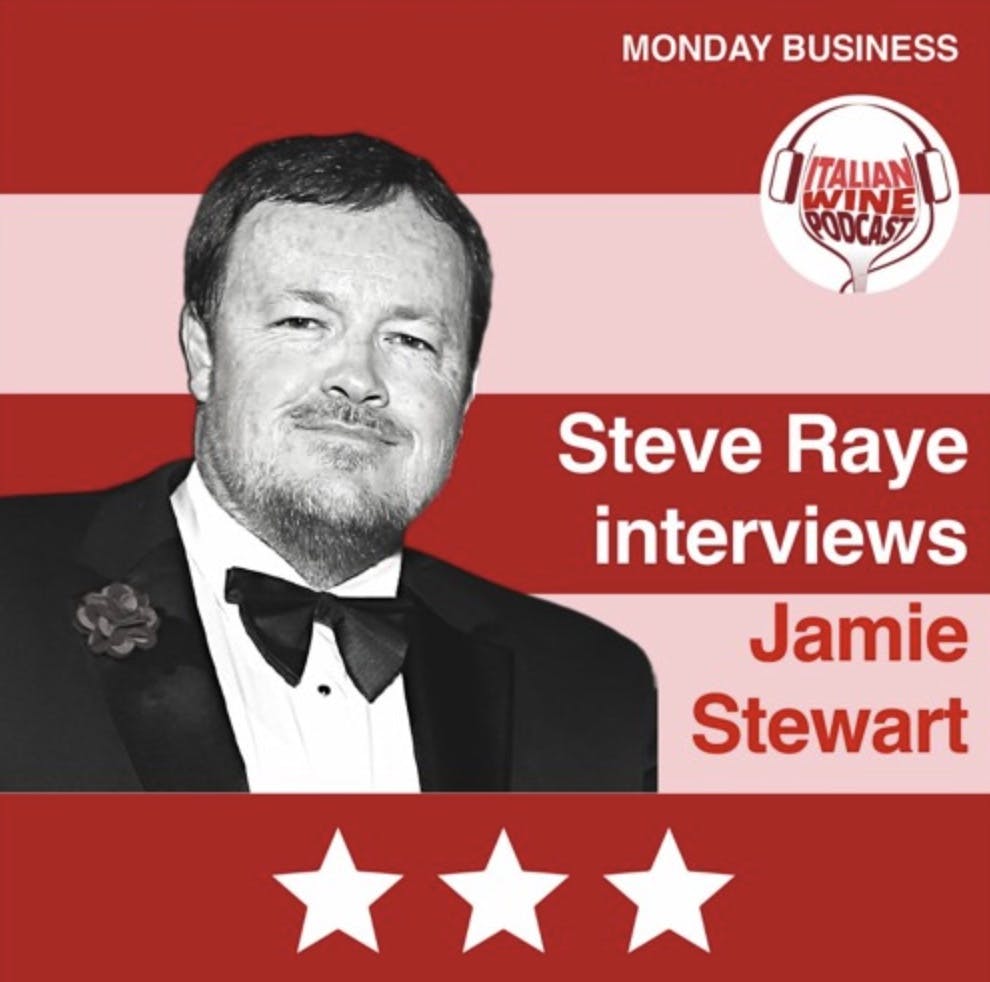
Ep. 694 Jamie Stewart | Get US Market Ready With Italian Wine People
Masterclass US Wine Market
Episode Summary
Content Analysis Key Themes and Main Ideas 1. Distinguishing Ferrari Trento (wine) from Ferrari (automobiles) and other sparkling wines like Prosecco. 2. Strategic brand building and market penetration through high-profile sponsorships, exemplified by the Formula 1 partnership. 3. The competitive landscape for Italian sparkling wines against established players like Champagne. 4. The evolving and multifaceted role of a modern wine brand ambassador. 5. Challenges and practical advice for smaller Italian wine producers seeking to enter or grow in the US market. 6. The intrinsic cultural connection between Italian wine and food. Summary In this episode of ""Get US Market Ready with Italian Wine People,"" host Steve Ray interviews Jamie Stewart, a brand ambassador for Ferrari Trento. The discussion kicks off by clarifying the common misconception about Ferrari Trento's relation to the Ferrari car company, and also distinguishing it from Prosecco. Jamie elaborates on Ferrari Trento's strategic decision to sponsor Formula 1, highlighting its significant impact on global brand recognition and sales, and asserting its position as a leading luxury sparkling wine. He discusses the uphill battle non-Champagne sparkling wines face in the market and the need to challenge established perceptions of quality. Jamie also shares his extensive background in the wine industry and explains how the brand ambassador role has evolved from merely sales-focused to encompassing comprehensive brand management, public relations, and relationship building. The conversation concludes with advice for smaller producers, emphasizing quality, building genuine connections with consumers, and the unique, food-centric nature of Italian wine culture. Takeaways * Ferrari Trento is an independent, century-old sparkling wine producer from Trentino, distinct from the Ferrari car company and Prosecco. * High-profile sponsorships, like the Formula 1 partnership, can be highly effective in elevating a wine brand's global luxury status and driving sales, even for producers not considered ""large."
About This Episode
The speakers discuss the success of Ferrari's sponsorship of Formula One wines and the importance of global brand recognition for their brand. They emphasize the value of case generating ability and the success of their own brand in the market. They also discuss their role as a brand ambassador and the challenges of being affordable. They stress the importance of being ahead of expectations for consumers to understand their wine tasting and discuss the use of back labels in Italian wine culture. They thank their audience for listening to the podcast and mention their involvement in the Italian wine podcast.
Transcript
Thanks for tuning into my new show. Get US Market Ready with Italian wine people. I'm Steve Ray, author of the book how to get US Market Ready. And in my previous podcast, I shared some of the lessons I've learned from thirty years in the wine and spirits business helping brands enter and grow in the US market. This series will be dedicated to the personalities who have been working in the Italian wine sector in the US, their experiences, challenges, and personal stories. I'll uncover the roads that they walked shedding light on current trends, business strategies, and their unique brands. This episode is proudly sponsored by Vivino, the world's largest online wine marketplace. The Vivino app makes it easy to choose wine. Enjoy expert team support door to door delivery and honest time reviews to help you choose the perfect wine for every occasion. Vivino, download the app on Apple or Android and discover an easier way to choose wine. Hi. This is Steve Ray, and welcome to this week's show. Today, I'm particularly pleased to have as a guest, Jamie Stewart, who works with, Ferrari, and we'll explain the difference between Ferrari wine and the Ferrari race cars in a moment. But Jamie, welcome to the show. Thank you, Steve. It's a absolute pleasure to be here. So let's ask the first question that always gets asked. And, actually, I think it's the question that all of you people who work for Ferrari do. I remember, when I was at Ferrari and Mass Miliano was given a presentation. That's the way he started it. We're not Ferrari, the race car company. So why don't you dispel that myth for me? Sure. Well, actually, we have to dispel two myths ordinarily when people you encounter people with regard the brand because we have to explain first and foremost, we're not Presecco. And then, moreover we're not connected to the car company. So Ferrari Trento or Trento from is from Trento Dockets in a, DOC in Northern Italy. We were first established in nineteen o two as a producer and a purveyor of, excellent quality sparkling wines made in the tradition of the Champ and Wab. The car company came subsequently about half a century after us. We've always had a very unique kinship with their organization. In fact, the The two companies have a unique parallel in Italy in terms of their reputation. They're both seen as a a paragon of luxury brand, and luxury production of goods, obviously, in two different bandwidth. You know, in Italy, I dare say that if you stopped a hundred people in the street and you said Ferrari to them, the vast majority would think of the winery before the car company, just because of a general contact is a tactile contact that the average Italian citizen has with Ferrari Trentadoc, which is, superior to that of the automotive group. Literally, every household in Italy drinks at least a bottle of Ferrari once per year, and we're forty percent of market share for the entire sparkling wine category. So as far as brand recognition in Italy goes, we are very, very strong. I did not know that. That that's fascinating. Yeah. Outside of Italy, however, the the, the, the role is reversed. Maranello Ferrari commands a, a very strong presence. In terms of brand recognition. They hand make seven thousand vehicles a year, and with meticulous intensity to detail and luxury. And I think it's the finest manufacturing, firm on earth for automotive engineering. So we are very fortunate though that we both represent the same values that are intrinsic to Italian luxury culture. And, you know, the the the irony is is that, you know, Ferrari, the the roots of the name, derive from the same roots as the name Smith here in the United States, and in fact, There are so many people in Italy furnished with the, the surname Ferrari that, it's almost as common as Smith. Give us a little background on yourself. How did you get here? My story is quite simple. I was raised by a single alcoholic mother. Who always enjoyed wine at the dinner table. Ordinarily, it came out of a big cardboard box in a mylar bag made by Stanley Leasingham. My mom realizing her own deficiencies, was adamant about me not becoming like her in that regard. So allowed me to taste wine at the dinner table. We talked about it from a cultural perspective. I actually didn't develop a deep love for the industry early on in academic career. I, graduated from high school in Australia. I'd worked extensively in the hospitality industry there. I then went to Japan and studied economic at the Tokyo National University. I built a couple of restaurant wine lists there, Maxines and Sabatinis whilst working for the American government. I then went to study in Paris, under Gisavoit. I worked there as well as the Sommelier. I went to Russia and studied comparative political science, the polytechnic and students in Petersburg, worked in a beautiful Michelin starred restaurant there, came to the United States for love of a woman and worked at a number of, fine dining established in New York City while I was going to school at Columbia University. I got three degrees at Columbia. And after the at the fruition of all of my academic pursuits, I had accumulated five degrees and no real love for any of them in terms of a vocational pursuit. And realized that surreptitiously the way I've been paying from educational along had crept up on me and I'd fallen in love with wine in a very, appreciable sense. So I went to work for a a very famous brand from my home country actually penfolds as a, global brand director, and then eventually took a a very strong interest in the wines of the Tao family selections portfolio, which was Palm Bay back then, and applied for a joint position covering Planeta and Ferrari. And I've been doing, working on behalf of Ferrari now. For over a decade. Let me shift the conversation now back to race cars. And, but instead of, the street cars that, Ferrari Automotive makes, Ferrari, the wine company is sponsoring, Formula One, and I understand there's a big event taking place in Austin? Has it happened or is it just about to happen? It happened. This just this past weekend. I just returned home from it yesterday. Give us a little summary of what that was all about and how the the winery was involved. You know, the the difficulty of being a non French producer of sparkling wine and the champagne method is that you know, you're always given very short shrift in terms of people's credit the the credibility they extend to you in terms of quality, you know, and and and a sense of history or or prestige. And the the, the French of really beautifully marketed the idea that they have a copyright on quality. When in a sense, all they have a copyright on actually is nomenclature on the language of their region, that the generally people in the wine consuming population have an understanding that French champagne is the pinnacle of excellence, and the the finest expression of sparkly wine, and it just simply isn't true. But it's an uphill battle for any producer that lives outside of the AOC, in Champagne. And for us, establishing credibility isn't just axiomatically linked to the quality in the bottle, but it's also how we're perceived as a brand by the consumer public. So it's important for us to develop investments and opportunities to showcase our brand in a setting that is conducive to the idea of of global luxury, the global understanding of luxury We achieved the first real, effort in this by becoming the official, sparkling wine sponsor for the Emmy Awards, the first in, seventy years that wasn't a, champagne producer. And during the pandemic, when a lot of the big champagne houses were pulling away from their global investments and sponsorships, the opportunity came up with carbons withdrawal from Formula One. And at a time, that was quite, anxious for us in terms of, you know, major investments, we stepped up to the plate and told Formula One that we would be their sponsor. And, of course, you know, Formula One is a brand unto itself, and it's a very strong brand. Half a billion people watch each race. The economy and just over this last weekend generated almost a billion dollars in revenue as a direct result of the Formula One. So, you know, it's not enough to just offer them a sponsorship fee and hope for the best. You have to have a brand that can carry the weight of expectation that the people associated with the brand you're you're aligning yourself with already have. And, we did it exceptionally well. We really have been received in a very positive sense. And Ferrari not just fits. There's a feeling is that we've always belonged to that environment because of the way that how stylized our branding is, the quality of our product, and the aptitude people are displaying in in consuming it. We served, fully more than ten thousand bottles over a three day race weekend just at the track alone. So it was a tremendous success So you've served a lot of wine, and that's great. But, I'm I'm gonna play the devil's advocate here. What what's the value of a sponsorship to a brand? I mean, to a degree, it's similar in some respects to a celebrity brand that, you know, you are using the rub off of the event or the celebrity to benefit the brand. But how does the brand benefit from your f one sponsorship? There's there's two ways. Okay. I and I've I've always said this with regards to developing my brand And it's very, very simple. You know, anything that you do where you invest money, any activity you undertake, there's two measurements. The first is case generating ability. If it can generate the ability to sell cases of wine, that is first and foremost the primary role of any investment. Anything beyond that is just bullshit. Okay? Ultimately, that's what it comes down to. Everything needs to be done to further the brand because none of us live in a charity bubble. We're not a five zero one c three. We have to be successful in creating a return on these investments. And from that perspective, it was very, very healthy for us. We had the largest response in terms of general sales associated with the special packaging that we did that we've ever seen with any investment in the United States from a communications perspective you know, with half a billion people watching, you know, the race, the the the, really, the money shot in the race is when those drivers step onto the podium at the end of two hours, and they receive a trophy and a large bottle of sparkling wine, which they crack open and spray with just adamant enthusiasm upon their fellow drivers. And that's Ferrari. So half a billion people get to Sierra wine being held aloft as the spoils of victory by the some of the finest automotive athletes in the world, drinking it from the neck of the bottle and spraying down, you know, their colleagues with it. Some from a communications perspective, it's absolutely priceless, but we also have managed to convey it into a very successful commercial, platform. We really we sold out of everything that we made with, specific notation to this event, quite early. I've got people clamoring right now for additional product that is has connective tissue two formula one. So are in a very good position as with regards to that. Well, let's bring it around from global and half a billion people watching the event to Austin and Texas as, as a, a market for you guys. You had a couple of, promotional partners on this, obviously, we all know in the industry that we're we need to talk about three or two other accounts. So we're gonna mention a couple of account names other than these, but H EB, the, supermarket chain in Texas was involved in the program, and Darden was as well. Can you, explain how you tied them in? Sure. So, and actually, I'll tell you of one or two others too that are that are, right there in in Austin. But, you know, the, first and foremost, our wholesaler in Austin, Southern Glazors absolutely embrace this with a with a vigor unparalleled in my opinion. You know, I mentioned that half a billion people watch the race on television, but also half a million showed up in person. It's the largest grand prix formula one ever in the history of of, racing. So It was very enthusiastic patronage. H EB definitely stepped up to the plate and, have done amazing things with the brand. They've they've taken out merchandising standards and creating massive end caps display features across the bandwidth of the different products that we were featuring with Formula One logoing. We had the, the president of our company go in and do bottle signings at, a number of the different store locations. But universally, not just in Austin, but around the state, H EB, stepped up to the plate, darden under the leadership of, of, a very dear friend and an incredible woman, Helen Macky, have, have put us into play with, the ADVs group So more than two dozen restaurants have started to feature the furry brute Rosay non vintage by the glass again for a twelve month period, which is incredibly rewarding for us to have an association with her organization. The, the fairmont, in Austin, a signature property. We did some work with the fairmont in Monaco during the race there, but, they rebranded their lobby on our behalf. They put, an amazing retail display in the, the concession that's there in the lobby, and then asked us to join them at the lounge at the track They did, beautiful branded bar, and they served Ferrari as the first, you know, gift or offering to their their top guests as they walked into the Fairmont lounge activation. Sports illustrated bought us in as a partner for their lounge at the track where people spend ten thousand dollars a day just to watch the race. We headlined the, the sports illustrated booty bellows VIP party with chain smokers and, you know, Travis Barker, etcetera. You know, it's the way that that people, you know, and organizations rallied around the brand because of, you know, how well they know their customer base, and how beloved formula one is in that particular market was incredibly rewarding. There wasn't any, trepidation whatsoever because we weren't we're not a champagne house. Ferrari is well known there. Formula One is well known there, and it was an absolute Kismet for us on a local business level dozens and dozens of the top restaurants in the city. You know, she read Ash, you name it, stepped up and and really supported us in a very organic way. You know, there wasn't any expectation on their part other than an enthusiasm to get behind the brand in CSP successful. And we've just extended the contract from three years to five. So this is gonna be a long term development for us. We're gonna continue to work with these partners. And I I will say this quite genuinely as well. For us, it's not an opportunity to take advantage of vendors and and and to serve our own needs. Our brand needs to be successful for that vendor to be successful. And we have a deep concern whenever we sell wine that we're doing everything we can humanly possible to support the success of that client. And and all of that also has a halo effect on Italian wine in general. But let me ask you a question from the perspective of some smaller producers who are here saying, oh, wow, you know, the big company they can afford a formula one sponsorship, hundreds of thousands of dollars or more and all of these, you know, activation type things around it. What lessons did you learn from participate in this that may be applicable to some of the smaller producers. I mean, as an example, I'm talking with a co op from north from the Trento area. And, you know, what can I tell then from having talked to you? Well, let me first address Ferrari and and and the gamut of size because there's this perception, this, you know, popular perception that we are much larger as a brand than we actually are. We only produce about four and a half million bottles of wine per year that might seem a lot But then when you look that don't bring on a six million nine liter cases and champagne is half a billion bottles, we're really like a mode of dust in god's eye by comparison. And when just a mild irritants to the French in terms of scope, we definitely are a dominant producer within our DOC, and with that comes the responsibility of leadership. And these activities, when we undertake them, it's never just to benefit Ferrari. It's also to benefit the other forty odd producers that do struggle for recognition and market share. Know, this is one of the reasons we don't just talk about Ferrari. We're Ferrari Trental Doc. We talk about Trental Doc, the doc, and the other members of it, you know, vociferously. And I would say that, you know, we we necessarily, if you were to look at it just on paper, because we've we've had an appalling attrition during the pandemic. I mean, we went into the pandemic with about seventy percent of our business model being on premise, just independent brick and mortar. You know? And, you know, our retail presence was independent retailers. We've been very steadfast in supporting local family owned and operated businesses. And they've been crushed by the pandemic, and the on premise arena continues to be crushed by mandates and and, you know, you're just nonsensical regulatory things and the lack of people coming back to work. It's it's actually quite a hazardous time to be investing on a large scale, but it was, you know, the courage to step forward and lead from the front leadership is an action. It's not a title. If there was ever time for us to take advantage of the weakness of French producers and supply chain battles, it's now And we bring those other producers with us from the the smallest to the largest in the doc. And we also act in accordance with with strengthening not just the reputation of the doc, but the reputation of the producers from a qualitative perspective We are constantly as a company, and the Lenelli family take a leadership role in investing in the other producers and making sure that qualitatively everybody from the DOC is beyond reproach. So, you know, it's it's important for us to do this so that one day, A Cesarini Sforza or another producer from the region can step into that leadership role, and we'll happily bequeath it to them. You know? We live or die by the same sword. We're a small doc in the north of Italy. We stand in the shadow of Frontier Quarter because of how they marketed, you know, their wines, We've definitely stand in the in the shadow of the Juggernaut of Champagne, but we're coming for them. Boots and all, we're coming for them. I'm telling you. And I'm gonna say it. I'm gonna say it upfront. I I I find it an absolute affront to dignity that the majority of Americans drink a wine from champagne that smells of stale vomit and tastes even worse, and they think it's the absolute standard of quality. We are here to stay, and we are gonna punish them until they're either gone or they get back to the the business of making better wine and not spending so much money on marketing and putting celebrities faces on their bottles. So we are we're in a fight for for our our pedigree and our prestige. We're winning the battle qualitatively. But we've got to win the hearts and minds of American consumers and convince them that, a word on the front of a label is just an epillette of, designation of geography. It's not a guarantee of anything other than their wine came from a particular place. And our wines drink in a way that is wholesome and satisfying and and vigorous and viral, in a way that that the the abundance of success in Champagne hasn't led them to. Okay. So I'm gonna come back and re ask the question you didn't give me an answer to a little bit later. Alright. Let let's come back to a little bit more of practicality. Your importer you had mentioned is TFS, TOW Family selection's part of, Palm Bay, and the president of TFS was just named wine person of the year by wine enthusiasts in their wine stars program. Tell me how what what that means to Ferrari is one of the brands of that importer and how you guys can leverage that. Again, benefiting, you know, we're all talking about selling bottles. At the end of the day, that's where the business were in. I I had the the great pleasure of working for a couple of years alongside of David Taub, and that man was just a gentleman and a scholar. He probably had forgotten more about the wine industry than most of us will ever know. His son has inherited the mantle of of not just ownership, but also leadership of that con that company in a way that is staggeringly eloquent Mark Talv is a very smart man and a very generous man with his time in this consideration, and he has a large portfolio, you know, of which Ferrari is one of the smallest brands. And you, you know, you know, there's a pecking order of attention that you would think that the smaller brands, you know, are suffer under the duress of the larger, but that's just not the the reality. You know, Mark Taub is a great man because he genuinely makes every brand and the stewards of those brands feel as if they're the most important to his portfolio and his people, and he himself personally, spend a great deal of time and attention more time than there is in a day, actually, measuring out so that there's equity and equality amongst all of his brands. Mark Tab came to formula one. He celebrated with us his whole team rallied behind this initiative and this effort in a way that I've never seen, an importer do on behalf of a supplier, before. And we couldn't be more satisfied and more pleased And in turn, we do everything humanly possible to support his other brands and the the overall success of his company. Our success in this country lies in lockstep with his and his and his other brands, and We are a part of a brand family, and we are we are managed by an incredible family, and not just Mark, but his son as he's emerging in a leadership role in the company shows the same values, ethics, and capabilities as his dad. So the the lineage there of leadership That's Jake Tao. Yeah. They're they're an amazing family and good people. And that's my first, you know, word I would I could ever say about them. If someone asked me about Mark Tao, I would say first and foremost, he's a good man. That's the most important thing in any relationship. You know, you know, the measure of the people that you you work with and that you dedicate your life to supporting. So Let's shift direction a little bit too. You are your, as you were referred to me, a brand ambassador. Now that term has been bastardized a lot in the industry over the last fifteen or twenty years has a lot of meanings, most of them, I think, bad these days. But explain to me what your perception is of your role as a brand ambassador and compare that. This is where I really want you to focus on to the industry's perception of brand ambassador being just a, sales guy working for the supplier alongside of a distributor salesperson in a given market. Well, my original dream was to pour Bacardi through an ice luge That was my dream job, originally. I I've but unfortunately I've seen those things with with some vodka, never Bacardi, but it sounds pretty good. Well, I've just I don't look good enough in a in a in a speedo to, to carry that role, unfortunately. But you know, look, the that there there is no real nomenclature that describes brand ambassador. There's no job description actually that captures the intensity of it. A lot of people think that we just run around drinking wine and talking about it for a living, but it's a lot more complex than that The the industry as a whole has become a quagmire of inefficiencies of the distributor level at the import level, supply chain level. And a lot of the time, it feels like you're just trying to, you know, heard cats to be successful. It's putting out fires. It's it's no longer the the good old days where you really could just trace around America with a suitcase and a smile and be successful. You're at this job now is is heavily involved and engaged with managing people to their success and their potential. A lot of our distributor partners have moved away from people that have been born into this industry through a love of wine It's now more of a mercantile pursuit where people are going out each day selling wines that they're told they need to sell or they're incentivized against without giving any real thought, or wisdom to the needs of the account they're going into aside from that of their own, you know. So it's Isn't that demonizing distributors? I mean, they do play a very, very vital, important role. But, yeah, go ahead. It they know they they're they're our first customer The reality is is that if you're a small supplier within a small importer and you're coming up against a constellation, you know, or a, or a massive, import partner, you know, for us, for instance, okay? We we come head to head against champagne, suppliers in any wholesale that we're with. And just the amount of money that the champagne suppliers have to wield in terms of incentivizing choice for wholesale managers when they go into the field to sell is is just enormous. And then there's the incentive dollars that go towards the at the account level to be successful. A lot of the choices these days, whether it's what wine to put in the bag to go out with tomorrow, and which wines going to wine list is is all predicated on how much money you've got to spend. And as I said, we're not a large producer. We we bankroll excellence in quality and the love of Italian made things in the United States that's how we are our fortunes funded. Well, let's get back to the the question that I asked, which was, and I appreciate it. It's an issue that I run up against a lot. The expectation by distributors and articulated by them right up front is if you're gonna put feet on the street, boots on the ground, people in the market, brand ambassadors. My point of view is that is not necessarily effective. It is certainly not it it is challenging to be affordable, and it's not anything that's scalable from my perception. So while everybody likes the idea of having more feet on the ground, the reality is the role, my opinion is the role of a brand ambassador has dramatically changed from augmenting what's already happening to substituting for distributor sales attention. Yeah. No. And that's exactly where we've gone. I mean, the my role involves communicating about the brand to people that work in public relations as a field, to consumers, to wholesalers, to definitely trade members across both retail, and on premise bandwidth, doing specialized events, developing investment potentials for the brand, developing a brand partnerships in terms of synergies with other brands. These are all roles that ordinarily, it's like a restaurant situation. You know, you know, post COVID or even post nine eleven, a lot of summary, a rolls disappeared. And then all of a sudden, tradie had become the general manager and the closing shift, and then maybe it was a captain in the restaurant in one night, and there's a diversification of the role. It was in the past just to be an academic, resource to distribute our salespeople. But now the the amount of skills that you need to be a successful brand ambassador on behalf of a brand is is, you know, you're constantly representing them on on a in a number of different diaspora of different settings and expectations. I mean, just last week, I was tasked by my importer to do a presentation for Ferrari to the hard rock hotel group and, hard or cafe group. And the questions that the hardware cafe asks you to explain about your wine is Joseph Wine Rock and is this wine edgy? And I did it by doing, extensive tasting notes on our wine, set to music. You know, I'm, I I'm comparing the Ferrari Brute Rosay to the, you know, immortal duet between cher and meat loaf, dead ringer for love, you know? And it's, like, there's very there's a bit, but it but it worked. And in the end, in the end, you you have to have a dexterity to your skill set where you can do that and sit down in front of Brinker or Darden and make a compelling case. You can help design a private label for Disney, and then you can just stand in a store. Next to a a a retail display and talk to consumers that are coming in that are very price conscious about how they're spending their money. That's what a brand ambassador does. There's no there's no It's knowing your audience. And when you have the comfort and creativity, to adapt to what you're saying, not to the company line so much as your personal passion in this. I found at least in my experience in the wine industry. That's what people really relate to. The wine industry is not about wine at all. I it I've never felt that the wine industry is about wine. Wine is just the amalgam that brings all of us together. The industry is about people. We share a common love, and that that common love is typified by subjective understanding of wine. There's no there's it's not an objectivity about wine that draws wine people together. And being able to convey convincingly and with the requisite comfort zone. The way you talk to a buyer for a national account, whether it's a, you know, a, a Michelin restaurant or a, a global rest a hotel chain or just a buyer and a standalone independent retail store, you use a different language, you use a different tenor, but you convey the same values. And that person needs to trust you that you, as the face of the brand, are compelling and that you're going to be there for them when they need you. It's not enough anymore to just sell a product into an account and then come back twelve months later and say, how are you doing? You need to follow-up religiously. You need to follow the person that you've made a relationship with You follow them on social media. You see when they're when they they've gotten a new dog or they've, you know, they've had a baby or an anniversary. You become invested in the lives of the other people that help us keep this whole shit show together that is the wine industry in the United States of America. But it's a happy shit show. I think. It is. I wow. Anybody who has too much blood in their alcohol system shouldn't be in it for a living. So Well, it wasn't going there, but I was just I'm just back from Italy at TV Kim's wine to wine event, which was just exhilarating to be around people and the conversations about new stuff that's happening, new technologies that are happening, which leads me back to the question earlier that I said you didn't answer. So what have you learned or what can you share from your experiences with the Ferrari F one partnership as well as your regular career that that happened before that that a smaller producer might be able to benefit from that doesn't have the prestige, the money, the apparent size or the legacy or story of a Trento Doc sparkling wine. How how can, a little guy from, Pulia selling Primativo? What can he use from what you had done? Look, my best advice to any producer especially in, in a, in a, in a small production capacity as this, and that is just stay the course. You know, this wine at the end of the day, especially with small producers, just like poetry and romance in a liquid form. There's there's a very unique altruistic virtue involved in building a small brand and costing it out and costing it to the wolves of the larger competitors in our set. We everyone is struggling right now. It may seem that are struggling less than others, but that's not necessarily true. I think the larger companies can hide the, the chagrin that they feel the way things are right now. At the end of the day, what wins is quality and that that sense of romance that that compels people to buy things. You know, you be you become a brand not because you've thrown money at the idea of building brand presence or penetration. You become a brand because enough people love you that just naturally want to support you. The idea for any small brand stakeholders should be this is to create, at first, like a temple night organization of people who are true believers, who really love, and give them things to talk about, give them experiences to talk about. And eventually things will grow organically from there. If you focus too much on what others are doing, especially the larger competitors in your class or your market share, it's easy to be daunted, and it's easy to let them bully you. You've just gotta put your head down, focused on what you're best at, and be be true. Be honest and forthright and courageous and be true. At the end of the day, this industry is a transitory thing. It's small brands becoming larger brands, becoming successful brands. We're all in the process of of brand development. And that's what I do for a living. I'm, you know, I'm a brand builder. Ferrari is established for a lot of people, but the the vast majority are unfamiliar. You said it yourself, the confusion between the car company. How many people at Formula One mistook us for being for the automotive group. How many people at Formula One mistook us for being a Presecco? These are things that even a successful brand like Ferrari still has to overcome. And you can't get caught up in the minutiae of those things or the frustration of of being misidentified or or mischaracterized. You've just gotta keep doing what you're good at and not losing faith that, you know, if you shoot your heart out of your chest like a cannon for something, then in the end, you'll win. Okay. Well, a little practical perspective here too. When I am working with brands and we're talking to prospective importers or distributors or retailers or even consumers, there's a tendency for everyone to start talking about quality. And I use this as a test. I ask people tell me about your brand to see whether they understand what's going what's needed in the US market. And invariably, it's always I make a really great, whatever. And my grandfather, you know, bought the the business after or bought the farm after World War two or it was inherited from Frederick Barberosa eight hundred years ago or a thousand years ago. And that's really not relevant at that point in time in the conversation. And a lot of people, when we do that, say, look, okay, I'll stipulate your wine is wonderful. I don't even need to taste it. I think in this day and age, the ability to technically create wines that are commercially, just call it acceptable. It may be spectacular too, but the point is there's no no flaws. In them with the exception of Cork and TCA and all that, but but back to the issue. The quality is not a relevant subject in the beginning. What what most of the people that we deal with is how are you going to help me sell it? That's what they really wanna know. They don't articulate the question, but that's what they really wanna know. Do you agree with that? I do in a sense. I think that there's a struggle for a lot of small producers to move their wines to a more ubiquitous not not qualitative level, but a style, a style that's more comfortable. I'll tell you as a producer of wines alongside of within our brands that we have wines that we make in inumbria. And you talk about wines that are made with Sagrentino as a as a grape, either full throttle or as a large percentage, you know, when you approach somebody whose understanding of Tannan comes from drinking silver oak or came a special select and you present them with Segrentino, they're in a corner and a Yeah. They're in a they're in a corner and a fetal position sucking on their own thumb and humility. You know, it it's inculcating. Unless they unless they've had to knot from uruguay. Yeah. That's right. But the thing is is that, you know, you know, I hate when things become so ubiquitous that there's no distinction amongst of style. You're right. The the the majority of wines, the gamut of wines today are good quality for sure. I mean, the technical still skill, to create good quality wines is easily accessible and and affordable. And and language isn't really anything. You can say all you you want about the poetic virtues of wine. It's really in the end. It's how it tastes to a consumer. But our job is we've gotta be talking to people before they have that experience of tasting. Obviously, in store tastings and all those kinds of promotion tools are important, you know, like with the ellipses, everybody says. You've gotta front load their expectations for what they're going to to receive. Exactly. And to me, that's the biggest challenge because we kind of default to this wine spectator or wine advocate model of it. It tastes like, you know, red fruits, with, a structure of something here and then a hint of something. I mean, that's kind of the the structure of a wine review. From my perspective, it's all bullshit. Right? I I I don't know what a gooseberry is, much less a sauteed gooseberry. Right? But I've seen that in in in descriptions. And I find that just not only foolish, not only, not working. It's intimidating and off putting to consumers because they think that maybe there is truth in that. You wanna comment on that? No. It I mean, it's a look, honestly, a lot of the people that that form the intelligentsia of the wine industry are at best. And I I hate to say this, but it's true. When it comes to conveying things to consumers, they're intellectual masturbators, you know, they're in love with the sound of their own voice. It's true. What's the difference between a lingonberry and a and a gooseberry? That's like saying what's the difference between a ninety six and a ninety five point wine? You know, it's it's like, you know, we've I think we've all drifted away from the fact that loving wine is subjective. It's not objective. Of it all. You can be the font of all wit and wisdom about wine. You can think that you live in an ivory tower and breathe a rarefied air. But at the end of the day, consumers that are struggling to have courage in their choices need real sense three information about what the wine's going to taste like, and you have to bring it back to a baseline. If you're talking, for instance, if we're talking about Trentadoc and and Trentino Auto Aderge and the dolomite mountains, and etcetera, and the vistas of our vineyards It all has to be rooted in what those things mean to the way the wine tastes. You know, the the level of sugar in the wines, the the the aromas of fruit, you know, and when you talk about apples, you know, granny smith, you know, golden delicious, anjou perre, you know, these things people that are, are familiar with. In a setting when you're just, you know, talking to all master sums, you know, you may use a different, a different verbiage, but, you know, the idea is to to make a compelling and honest statement about your wine in the simplest terms because you also don't wanna set somebody up for a disappointment or intimidate a person and drive them away from your wine because you're talking about it in in a from a perspective that they can't possibly grapple with. You know, personally, Personally, sometimes I like to describe our tic duvet wine, or some of our vintage wines as being like a grand cru white burgundy with bubbles made by la lubise lua, but how many people understand what that actually means other other than the enameled pin set, you know? So I don't use that terminology ever, you know, when, when talking to consumers. And I prefer to talk to consumers, actually, because they are the people that are buying my wine and not asking for free samples of it for their seminars and everything else. So I love getting down rolling up my sleeves and actually finding a way to talk about how wonderful it is to drink my wines to people who actually drink them. And they do it, because, you know, maybe a thirty dollar choice for a sparkling wine isn't an everyday consideration for them. You know, and sparkling wine tends to fall into that category of special occasions. You damn well better make a wine that's equitable with that. Cause if someone's ringing it at their wedding or their birthday or their son's christening or whatever else it is, it's got to seal the deal in their memory as something beautiful and evocative of what the the emotional context is is presenting. So for us, it's even more difficult than if we were making a cabernet or a chardonnay, you know? Interesting. Back to what you were saying before, I'm a big believer in back labels. Now I've seen a lot of research that said nobody looks at the back label, and yet I've stood in stores and watched people and they look at a a, you know, the first thing they say is the label, and there's generally not a lot of information on the label. Even while there is like on German wines and some Italian wines for that matter, they're still not getting the question answered. What is it tastes like in words that I understand. And, the answer to the question, will it go with what I'm having for dinner tonight? That that's what I think people want, and that's really the function of a back label. So as one's working with a, a Spanish wine, and we came up eight words that I think were were really brilliant. They didn't use anything like terroir or hints of or any of that. It was, tastes great with tapas, try it with tacos. And I think in those eight words, it kinda captured what the wine was all about. It made it like, oh, this is an everyday wine. That you can appreciate. It goes with spicy food and all that kind of stuff. And I've always We do the same thing with Rose. Excellent with pizza. Yeah. That's it. Al Rose is literally, and it's an epiphany for a neapolitan style pizza. Excellent with pizza. What's wrong with that? Absolutely nothing whatsoever. The beauty of Italian food and wine culture, it it's it's great wine, great food, and the memories that are forged in the company of those two things. There's this there's this duality between food and wine in Italy that forms its own group. And I think that's the difference between Italian wine and French wine. You know, French wine is very intellectually driven. It's not rooted necessarily in serving the traditions of of French food in a sense. It's it's send it stands separate. They run parallel, but there's no event horizon where they meet and become one, whereas Italian wine is a direct offspring of food culture. You know, it's an identification of of of what this food needs to make it exponentially magnificent. Beyond its own natural properties. If it grows together, it goes together con concept. Yeah. That's right. And the whole idea for telling culture is the dinner table. That's where people should gather. This whole idea about you know, cocktail parties, stale canapes, you know, and and tired conversation. And, you know, I prefer environments where people don't actually talk about wine at all. They ingest it. And there's those beautiful moments of silence when you're rolling it around in your mouth and the the swell of it in your throat, where it's contemplative in the in within the group, but individually. And Italians have really got that down in in spades, you know, and and you're right. I mean, we are we have access to the kind of wines. I always tell my friends this when they ask me about why like working in the wine industry. It's just like this. You never become wealthy in the wine industry, but you live every day as if you were. That was absolutely brilliant stuff. A big thank you to Jamie Stewart of Ferrari. What what's formal name of the company? It's it's group Olineli, but Ferrari Trento is the specific sparkling wine division. It's been an absolute delight to talk with you. It's been a really enlightening, conversation, and I really enjoyed it. The the pleasure was in Charlie Mine. I really do admire, wholeheartedly, what you're doing. You are definitely an an an an agent of love and change and appreciation for the Italian wine community. You play an invaluable role and for those of you that are listening I wish everybody godspeed. I hope that everyone remains safe and healthy and adamant about getting back to a normal life where we can gather together and celebrate and drink the things, that we love. This is Steve Ray. Thanks again for listening on behalf of the Italian wine podcast. Hi, everybody. Italian wine podcast celebrates its fourth anniversary this year, and we all love the great content they put out every day. Chinching with Italian wine people has become a big part of our day. And the team in verona needs to feel our love. Producing the show is not easy folks, hurting all those hosts, getting the interviews, dropping the clubhouse recordings, not to mention editing all the material. Let's give them a tangible fan hug with a country fusion to all their costs, head to Italian wine podcast dot com, and click donate to show your love.
Episode Details
Keywords
Related Episodes
Ep. 2790 Italian Wine in the US: Building a Narrative and Reaching Asian American Consumers with Susan R. Lin MW | Masterclass US Wine Market
Episode 2790
Ep. 2783 The Suburban Gold Mine: Insights into New Jersey’s Wine Market with Brittney Abell | Masterclass US Wine Market
Episode 2783

Ep. 2772 A Surprising Partnership between Japanese Sake & Italian Wine with Monica Samuels | Masterclass US Wine Market
Episode 2772

Ep. 2770 China’s Wine Market: From Misleading Import Numbers to Today’s Consumer with Fongyee Walker MW - Part 1 | Asia Wine Market
Episode 2770
Ep. 2760 Winning the Restaurant Floor: Training, Education & Italian Wine with Sylvester Inda of Ci Siamo | Masterclass US Wine Market
Episode 2760

Ep. 2751 From Montalcino to Kazakhstan with Francesca Arquint of Collemattoni | Asia Wine Market
Episode 2751