
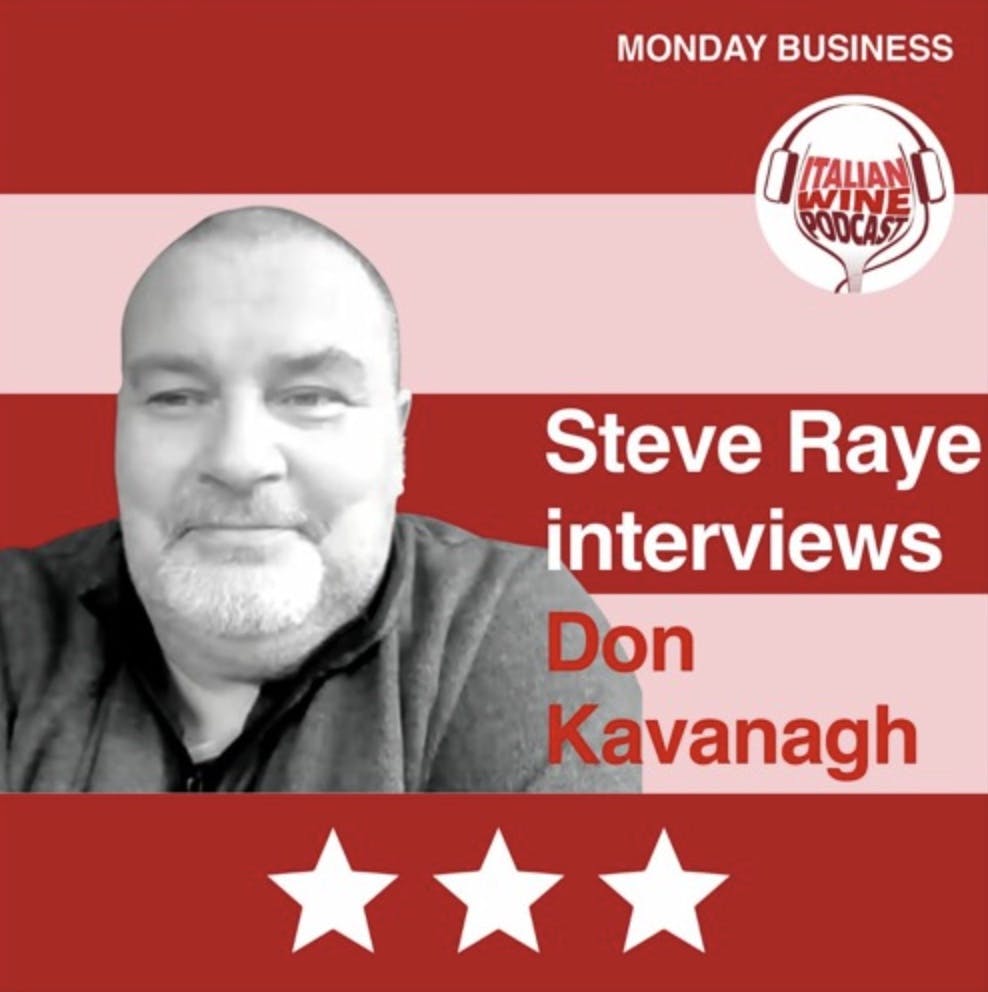
Ep. 823 Don Kavanagh | Get US Market Ready With Italian Wine People
Masterclass US Wine Market
Episode Summary
Content Analysis Key Themes and Main Ideas 1. Introduction to Wine-Searcher: The core function of Wine-Searcher as a global search engine for wine, beer, and spirits, primarily focused on price comparison. 2. Evolution and Business Model: How Wine-Searcher began as a trade tool in 1996 and evolved to serve consumers, monetizing through referral fees and advertising. 3. Transparency vs. MSRP: The platform's commitment to pricing transparency and the challenges it creates for producers concerned about undermining manufacturer suggested retail prices. 4. Information Beyond Pricing: Wine-Searcher's extensive and human-curated encyclopedia covering regions, grape varieties, producers, and technical data, often underestimated by users. 5. Editorial Content and Philosophy: The role of daily news stories, weekly newsletters, and the ""cheeky"" journalistic approach of its writers like Don Kavanaugh and Blake Gray. 6. Technology and Data Insights: The use of label recognition technology and how search data provides unique insights into consumer demand, even for aspirational wines. 7. Future Prospects and Value: Wine-Searcher's ongoing efforts to expand its information offerings, become a comprehensive tool for the entire wine transaction, and the benefits of its ""Pro"" membership. Summary In this episode of ""Get US Market Ready with Italian Wine People,"" host Steve Ray interviews Don Kavanaugh, editor at Wine-Searcher. Don details his personal journey into the wine industry and explains Wine-Searcher's core function as a global search engine that aggregates prices from thousands of retailers. He clarifies its evolution from a trade tool in 1996 to a resource for both trade and consumers, monetizing through referral fees and advertising rather than sales commissions. A significant portion of the conversation addresses the inherent tension between Wine-Searcher’s commitment to price transparency and producers' concerns about price undermining, with Don asserting transparency as a fundamental principle. Beyond pricing, Don highlights Wine-Searcher's extensive, human-curated encyclopedia, which offers deep information on regions, grape varieties, and producers—a resource he believes is ""horrifically underused."" He also discusses their editorial content, label recognition technology, and the unique insights derived from user search data, which indicates actual demand. Don emphasizes that Wine-Searcher aims to be a complete information hub, providing everything from technical specifications to critics' scores, and promotes the ""Pro"" version for enhanced features. He concludes by reiterating that Wine-Searcher is far more than just a search engine, serving as a comprehensive, continuously expanding resource for the wine industry and consumers. Takeaways * Wine-Searcher is a comprehensive global search engine for wines, spirits, and beers, not just a price comparison tool. * It operates on a referral fee and advertising model, rather than taking a percentage of sales. * Transparency in pricing is a core tenet, even if it sometimes conflicts with producers' desired pricing strategies. * The platform boasts a vast, human-curated encyclopedia of wine information, including regions, grape varieties, and producer profiles. * Wine-Searcher's editorial content offers unique journalistic perspectives and insights into the wine world. * Their search data is a unique indicator of global wine demand, including for highly aspirational wines. * The ""Pro"" membership provides valuable additional features like extended price history, cellar management, and customizable alerts. * Wine-Searcher continuously expands its data, aiming to provide detailed technical specifications for all listed products. * The company prides itself on its ""duck analogy"" – appearing seamless on the surface while extensive human effort works behind the scenes. Notable Quotes * ""We're a wine search engine in our basic, most basic form. What we do is we gather prices from thousands of retailers around the world, and we display them so people can make better buying decisions, basically."
About This Episode
The speakers discuss the use of a wine searcher as a referral fee for retailers to generate revenue. They emphasize the importance of transparency in pricing and advertising, as well as the use of label recognition technology for wines and spirits. The company provides information on wine search through proprietary technology and uses a contact wine searcher to optimize pricing and provide technical information. They also discuss the use of search results for wine searches and the importance of the industry as a source of entertainment. The speakers emphasize the benefits of using Pro for better pricing and longer back information, as well as the use of Pro to access information and create a list of wines. They also mention the use of technology to rank wines and offer personalized feedback and a pro level of pro wine searcher.
Transcript
Thanks for tuning into my new show. Get US Market Ready with Italian wine people. I'm Steve Ray, author of the book how to get US Market Ready. And in my previous podcast, I shared some of the lessons I've learned from thirty years in the wine and spirits business helping brands enter and grow in the US market. This series will be dedicated to the personalities who have been working in the Italian wine sector in the US, their experiences, challenges, and personal stories. I'll uncover the roads that they walked shedding light on current trends, business strategies, and their unique brands. So thanks for listening in, and let's get to the interview. Hello, and welcome to this week's edition of Get US Market Ready with Italian wine people. I'm Steve Ray, the host, and Joining me today is Don Kavanaugh of wine searcher. Don, welcome to the show. Thank you very much for having me. Give us a little background on you and your experience in the in the wine industry, and then we'll get into wine searcher, which I think is gonna be a fascinating conversation and the role it's playing and, the impact it's having on the industry, but talk about yourself. Well, I I came into wine reason well, reasonably late, I didn't grow up in a wine drinking family. Not many people in Ireland did, really, but I'm guessing beer and poutine. Right? You know, beer and whiskey. Yep. Yep. My mother used to rub whiskey on our gums when we were teething, and then she wonders why I drink. But, yeah, it was really when I moved to London that it started for me. I got a part time job in a wine store, and it just went on from there, really. The wine company were very good. They put me through various levels of WSET training, and they sent me to Europe to visit lots of wonderful places, drink lots of wonderful wines, and I just fell in love with it, really. It was, much more interesting than beer I thought, so much more variety for a start. There was just the sheer sort of breath and depth of what was available was. It was slightly mystifying and bewildering, but also, you know, just magnificent. I just couldn't believe there was so much wine to drink and And has grown exponentially since. I mean, it used to be. You only needed to know France Italy and Spain. Right? And there wasn't Chile and Argentina. Indeed. Maybe a little bit of maybe a little bit of Germany. And well, Germany too. Yeah. But recently, it's a whole another story. But anyway, okay. Well, what you're doing now is is working for wine searcher. You're doing the newsletter for them, and you do a bunch of other things. So Tell us a little bit about what wine searcher is, what your functions are for, and we'll we'll dig a little deeper. Sure. Well, basically, wine searcher, we're a we're a wine search engine in our basic, most basic form. What we do is we gather prices from thousands of retailers around the world, and we display them so people can make better buying decisions, basically. No more, payless. Your target audience, is it the trade or consumers, or what did it start out with and what has it morphed into? It started out as a trade tool. It started out way back in nineteen ninety six, I believe. Wow. Really? Yep. When our CEO Martin Brown, he got the idea when he was working for Berry Brothers and Rod the great old venerable merchants in London. He was part of their IT team, and rather than having people manually checking prices, that their competitors were charging for various wines, he came up with a way of doing it. Automatically. And wine searcher was born. Couple of years later, he moved back to New Zealand, and we've been based here ever since, pretty much. And, the monetization of that is my understanding is the retailer's pay to have their products, checked and listed? Yes. They will they don't have to. Many of them do. Many of them choose to. They become sponsors, which means just means they get, you know, the the they get a little bit more promotion, they're more obvious, you know, so their their entries will be in bold rather than in, you know, standard type. And what happens is if somebody clicks through to a merchant website, then, you know, we clip that part of the ticket, and that's it. We don't take any money from sales. We don't we don't clip the ticket on sales as it were. You know, we don't take a slice of everybody's sale, but we take a tiny a tiny amount for a referral. Referral. So it's like a referral fee of And then, of course, we we sell advertising as well. And and my guess is if it if it goes back to the nineteen nineties, it's not nearly as much as some of these new delivery services and so forth, which are having such an an an impact on the on premise. Basically what they paid for the delivery service is their margin. And that that's become a challenge. How how can you work with them and how can you work without them? Yeah. Well, exactly. This is the problem. They become so they become ubiquitous that, you kinda have to work with them, really. Okay. So transparency of pricing is, I think, one of the the fundamental principles that you guys are working with, but I know working on the side of the business that I am for a lot of, especially higher end wineries that we work with. They they have this, they're less enthralled with wine searcher than maybe other people have because they feel that it can undermine the MSRP manufacturer suggested retail price of their product. Either because of the way it's displayed in wine searcher, the way you can rank it, you know, depending on night alone and those kinds of things. Can you talk about that challenge of how you guys have accuracy in prices and, this whole issue. A lot of people will say that, gee, the the stuff on wine searcher people are faking prices just to manipulate the system. Well, if people are faking prices to manipulate the system to to to manipulate the ranking, in our results. People tend to let us know. And if that happens, then we deal with that merchant, and we explain the rules to them that prices must be for unless otherwise stated, the prices displayed must be for in stock wine. Like, so basically they have to have the wine on hand and available at that price for them to be able to put that price on on a wine. So does that apply to on order? Like No. If it says in advance, this is the pre release price or this is, you know, the on premura price or if this is an in bond price or if it says, you know, may take up to twelve weeks for delivery or so forth then that's fine as long as that's made clear. Mhmm. But to be honest, I mean, yeah, I'm sure some producers probably don't particularly want to have their have their, recommended retail price undermined. But the problem is it happens. I mean, it's up to the retailer what they sell the wine for. Right. May have may be not having it showing on wine searcher might be a goal, but the reality is if a consumer wants to find that information out, they will. Yeah. Of course they will. I I think the analogy that I use is is, at least in the US to the way dealers priced cars. It used to be that all the knowledge of the price of the car was in the hands of the dealer. And so the consumer was, at was not in control of the situation. Now all that information is available to everybody. You get to see the sticker price, you know, what the the markups and all that kind of stuff are. So it's changed the way you buy a car, and that's a negotiated item in in the US still, but that's not the case with wine. Can you comment on that? It has changed. It's it's given a little bit more power to the consumer who's the person who ultimately we like to kind of think we're on their side. Well, well, we don't really take sides in a in a commercial transaction, but we do like to make sure that as many people as possible are aware of the, you know, kind of the well, yeah, about about the pricing, really. I mean, it's it's a different analogy, really, with wine, though, isn't it rather than with cars? Because I just say cars are a negotiable item. However, you know, a person can say, well, look, I can buy it here because I'm here, and it's this price. But if I was willing to put in the effort in, you know, beat feet, you know, ten blocks down the road. I could probably get it for two bucks cheaper, ten bucks cheaper, a hundred bucks cheaper, whatever, depending on what they're buying. And we give them that opportunity effectively. And not just the physical option, but then then they can buy e commerce too because many of the stores that are listing. Yeah. Exactly. Of course. They can they they they can buy online as well. I mean, it's, in fact, we'd like them to, after all, that's that is partly where we get her income from. But, you know, so it's a it is at, It's all about transparency. I mean, that's what it is. We're just trying to put as much information into the hands of the buyer of the of the ultimate buyer as possible. That I think that's a really interesting point because a lot of the people I talk to, they they impugn wine searcher as having some negative or evil motivation when it's not. And I've I've met Martin. I enjoyed dinner with him in Auckland a couple of years ago. I was very impressed by this is what we do. This is how we do it. And it's very transparent what we do and how we do what we do and that's why we do what we do. And if people wanna manipulate that, then that's up to to them, but what we're doing is providing the information. But beyond pricing, you guys do, or provide a lot more information now and and certainly in recent years. Ratings, reviews, regional profiles, etcetera. Talk about the the rest of the non pricing information that's available on wine searcher and what role that plays? Well, the this is the thing about wine searcher. The wine searcher is this kind of great undiscovered treasure trove of information. And it's not just pricing. I mean, I know a lot of people just use it for pricing, but our encyclopedia is huge. It's, like, it's genuinely, I think, and I'm not just seeing this because I'm the editor, but I I think it's one of the best wine resources available online. Deepest and extensive. Oh, absolutely. I mean, we go from the very basics of France as a wine region down through to Ludets in burgundy. You know, we we literally got every AVA that's ever been made. We've got every appellation in France. We've got every tiny little sub region of Italy of of anywhere where we make wine. We've got entries on Tahiti. We have entries on, you know, we have entries on Nigeria not places that you'd automatically think of for wine. So how do you get that information? How does that get populated into the database? Gets populated by an awful lot of hard work, by an awful lot of dedicated people. We have a we currently have a team of two, one, two, three, four, five. There's six of us, and we basically look after the encyclopedia. We and then there are the there's another wine specialist team that looks after things like the scores, the awards, the critics, and so forth as well. So we've got in total between the wine matching team, the wine matching team out of people who make sure that the wine somebody is listing is the actual wine they mean. And then because as you can imagine with, not twenty, thirty, forty thousand merchants they'll all have slightly different descriptions of the same wine. So they're they're, you know, they're going they're doing an awful lot of work. Or or and the way it's spelled with the chateau, is it c h period or, you know, that kind of stuff. Yeah. Exactly. And so so what we do is we refine all that so that eventually any combination of that name that you put in will be will eventually arrive at the destination of the wine you're looking for. So, so there's that with the wine searching, with the wine specialist team, and then with us, the content team, we do all the writing, basically. So we've written, and not just us, the current team, but, down the years, there have been, stalwart people just typing away writing all that stuff. And we, you know, we we write a lot of it. We get a lot of information, the information from the appalachians themselves, so forth from, existing wine encyclopedias and so forth. And from our knowledge, I mean, we're we're quite knowledgeable bunch So if somebody if you're from a consort CEO in Italy or a winery in Chile or whatever and they see, information that are lacking or information that's incorrect or needs to be updated, how can individuals who are in the business optimize, correct, provide updated information and assets including visuals and so forth to you guys? Oh, simple. They can just email us. Is that that's it? Just email you? We've got we've got a contact contact wine searcher, but, section, just hit the automatic email. Tell us what the issue is, and we'll be back to you pretty much straight away. How do you do that with six people? I mean, you just I I I know that I have, you know, a library of of wine books that I've collected over the years. I know how thick they are and I know how much information there is and how much is changing and expanding you know, every day. How do you do that with six people? Is is is it any of it, you know, like, automated so that con content is scraped or is somebody always, human looking at it? There's always a human looking at it. Wow. I I don't think people recognize that about wine searcher. No. No. I I I don't think they do either. It's just it's the it's the old duck analogy. You know, we're we're sailing along beautifully on top of the water and paddling furiously underneath. Where nobody can see. And, you know, and I'm, I'm incredibly proud of what we've got, our, our, like I say, our encyclopedia, the regions, the grape varieties, the producer profiles that we're constantly writing new ones off. You know, we've got sort of four thousand producer profiles on there already, and we just and we're still, you know, we're we're pumping out more each month. And of course, the job is getting bigger as well. This is the this is the thing. It's, crucially because what we're doing is we're improving the amount the amount of information associated with Hyn as well. We're getting technical materials from, technical sheets and so forth from the producers themselves. So eventually, we'll be we'll what what we're moving towards us being able to provide full technical information down to grams per liter of residual sugar, harvest dates for each wine, whether they're vegan, wines, well, you know, and so forth. And eventually people will be able to search by that. People were able to search by, you know, white wine, racing less than seven grams residual sugar. And and then for, you know, by country or by producer or whatever if they want to. So we'll just Yeah. We've got a lot of work on. We've got we're making it broader and deeper, and it's it's a spectacular resource just horrifically underused, I I believe. Yeah. I I I I agree, and I I find that when I use it. And then I I we're gonna shift over to talking about the editorial stuff, which we will address after this next question, which is, you guys are one of the pioneers in label recognition technology. Can you talk about how that came about how you have integrated it, it, and why it's important and how it works in the industry. And this is for wines and spirits, by the way, not just wines. Right? Yeah. Oh, no. Yes. Absolutely. Wine spirits, beers. We we cover everything. I mean, we we're called wine searcher, but we we literally cover anything pretty much drinkable. We've got, I mean, because we've even got soft drinks and, you know, coffees and teas at some stages listed on our No. I'm just not aware of that. On our on our prices on the database as well. I mean, there's not a lot of them, but you will you will come across them every now and again. The label recognition was, well, when in the early days of of using pictures as information, we got onto it as quickly as we could. And, really, we've just been constantly updating it ever since. And, you know, trying to constantly improving it. I mean, a lot of a lot of the criticism we get about our site will be that under the label recognition tool isn't as good as Vavena. Well, you know, that's that's fine. That's, you know, that's their opinion. But we're just literally constantly improving on, and we're working on it all the time. And we do get better about it. We're just not quite so good at boasting about it as other people. But, yeah, it's a we we've got a sp we've got a specific team that works on that. They just be for a way. I mean, to be honest, I I I mean, I'm I'm not really sure what more to say about the label recognition except as the technology gets better, our label recognition gets better. And we've been working to create the technology ourselves as well. I and I think the my point on all this is that, the automated piece of it, and that's that is an automated piece of it is kinda mission critical for for the whole thing to address all of the wines that are sold all over the world, you know, everything from private labels to the brands that that are real. Tell me a little bit of how you guys handle newsletters. Who's doing the writing And what is the timetable for generating content? Okay. For so for news content on our site, so this is features and general news stories, interviews, opinion pieces and so forth. We run one each day. We run a a new, exclusive to us, new story each and every day of the week. Usually Sunday is a roundup of bits and pieces that haven't really, you know, wouldn't have been a story, but they're interesting in their own. Right? So we we have a guy who puts together a little kind of an aggregation of smaller stories for Sunday, but, other than that, yeah, so we've got a we've got a big meaty story every day, and we put out a newsletter then once a week every Wednesday. So that's what I'm I'm referring to is, So the stories appear on the site itself, but the things that end up in my mailbox are the newsletters. So Yeah. Yeah. That'll be the that'll be the four top stories of the week. I've enjoyed them, and I would, say that I find them to be somewhat cheeky occasionally, and and I'm gonna We're we're fine with that. We we don't we don't wanna send, like, we don't wanna send, like, you know, the New York Post or the New York Times all the time. You know, we don't we don't wanna send Drian authoritarian. Speaking of New York and the US. So your, compatriot, who's writing from the US is, Blake Gray who I've, I know a little bit was on a a couple of trips with him, and he can be quite cheeky. Oh, yes. He yes. He's he's definitely gotta. And, opinionated. I think, a very different from you. So when did Blake join and what is his role? Visadi, you Well, Blake's been there. Blake's been basically writing for us and keeping an eye on America for us for actually, since before I started, so it would be about he's probably there about twelve years now, eleven, twelve years. I've been there eight. So, and he he predated me. Blake is now he's our US editor. So, basically, he's kind of our go to person for US news. Well, I mean, we do have other writers over the other contributors who who write for us freelancers as well, but, Blake's our kind of main man for American for the American scene. And, yes, he is quite he can be quite shaky. He's, he can be quite a polarizing figure as well. I mean, a lot of people either like him or hate. And, but that's okay. I mean, if you're a journalist, that's, you know, that's Pat for the course. And there's a lot to work with, with with all the regulations and things going on, certainly in the US market. Oh, lord. Yes. I don't know how you guys can operate over there, to be honest, with the the laws you've got. Yeah. But but with, with the cheekiness, I mean, I think a lot of that has to do with the fact that both certainly both Blake and I come from news backgrounds. We were both news journalists before becoming wine journalists. And So it it gives you a great grounding in the fact that wine is very much it's a very important part of my life, certainly. Very important part of a lot of people's lives, and the wine industry is a very, very important industry globally, not just in the states, but It's rarely life and death. Right. And, you know, and a lot of the pretension around wine just begs to be laughed at. Yeah. We can go down that road and and tie I I use the phrase, you know, sauteed gooseberries and my philosophy is people wanna know two things about a wine. Most normal people, people outside of the industry is what does it taste like in words that I understand? And is it going to go with, whatever it is that I'm making for dinner tonight? And anything beyond that is we're talking to ourselves. And maybe that's a negative. We've seen a lot of conversation, lately about, Rob McMillan's Silicon Valley Bank report commenting that we're doing the industry is doing a lot the job of in engaging with and inviting millennials into this whatever it is that this world, it's it's more like a club that people feel excluded from as opposed to included in. An example of that is A lot of the data you publish is based on searches. K. You're a search engine. I get that. And a lot of it, the searches are about things that no one some of the articles that you do is based on searches, and the searches are based on wines that most people are never gonna have a chance to drink. DRC, Roman Conte, first gross and all that kind of stuff. So while it's of esoteric interest, I think, to people in the wine industry, why do you guys do those kinds of roundups as opposed to focusing on the wines that people can buy? Know that's putting you on the spot, but there you go. I'm a journalist too. So No. No. No. No. I mean, we can do that. We can do we could do, most search for wines under thirty bucks. But it would be entirely arbitrary, of course, because your cutoff price point would be just whatever you feel is, you know, the maximum people will pay for bottle of wine. The reason we do the ones that we do is that's that's a bit of fun, really. These are aspirational searches in ninety percent of the cases. Although at times, actual wines that people are looking for that are not necessarily the esoteric. They they're not the, they're not, shadow of feet. They're not screaming eagle, sauvignon blanc. Sometimes wines will break through into it, and suddenly wines and indeed Whiskies will break through Blanton's bourbon, for example, was in the top ten for over a year, who's in our most searched for products for more than a year at one stage. Which wasn't bad for like a fifty dollar bottle of bourbon. So but with the stories themselves, yeah, they're they're a bit of fun, really, but because they these genuinely out what people are using our website to search for, whether or not they have any value to the trade. I would doubt. They make for a pleasant four or five minutes of somebody reading something on their phone while they're on the subway or, you know. And it's Well, it's fun, and they're, incredibly popular. We get a lot of readers. That's I think the the point that you made when we we spoke earlier that, it's an indication of what people actually are searching for. It's just funny that you just don't seem to see that in coming up in any of the other wine sites or even, general search things like Google and so forth. Whatever. Okay. It is what it is. Give us a sense of scale and scope in terms of number, total number of searches per month the number of varieties, that you cover countries. Can you give us some examples of numbers that give us a sense of scale? We could well, we cover every every every country in the world, two hundred and something million searches a year. So, you know, twenty million searches a month, maybe. Something along those lines. That's the most recent figures I can gather. We've got about four or five active users each month. So we get, yeah, it's we're we're looking at, I don't know, maybe three hundred million searches a year. The majority of the stores that are on on the system, I think, are US. Right? Can you give us a sense of, Yeah. Well, pretty much all in our in our total traffic, I mean, regardless of and this is reflected in the number of, merchants and so forth as well. It is a little over fifty percent American. So fifty a little over fifty percent of our audience is from the States and around fifty percent of our merchants are based in the states as well. So, it's kind of become I've I remember the days of when I would go travel out in the country and one of our our jobs when we're doing work with or or going to stores is is capturing competitive prices, and it would all get fed into whatever was our proprietary database. But nobody really had a good idea of of what prices were actually being charged. You guys so now all of a sudden that we made that information available, along with the qualitative information that supports that on the regions, the wineries, the histories, the people who make it, and all that kind of stuff. What's coming down the pike in terms of, services and capabilities for wine searcher? We're gonna well, basically, it's more and better. We're gonna offer more information. Basically, what we wanna do is we want to we want to be a tool that informs the user all the way through the transaction. So from the decision making process at the start of which wine I want to buy and why I want to buy it through to the where do I buy it? How can I get it delivered to me? How, you know, and so forth? That's that's coming. Well, I mean, we do, we do a lot of it already, but, you know, the idea is to present more information. So we've got more as I was talking about earlier about tech sheets from producers and so forth. So we'll be able to offer we like we're we're going to be able to offer full technical specifications for every single wine on the site. Well, talk that's happening in the US through a site called seven fifty that has, subsumed the beverage media group and has become kind of the the go to or de facto point of reference for online ordering within the trade retailers from distributors and so forth. Where does wine searcher fit vis a vis seven fifty where you can download a tech sheet because it's pulling from a whole bunch of different fields that have been populated in the in the database. Is that the way your program works too? Or, our program will sort of have it tailored so that you you don't go searching for tech sheets as such. When you search for wine, the information will be there on the results page. And organize with information on regions, awards, critics, reviews, and all that kind of stuff. When we're talking about critics' reviews, are there any critics that you don't include? Or Oh, there's lots. We we've really only got kind of the top forty. Top forty. Well, the the ones that we feel are authoritative enough and credible and credible enough. I mean, it's a and we do guess, we often will get irate emails from some producer somewhere. It says, excuse me, my nineteen, ninety eight vintage of my Malbec was, you know, scored ninety nine at the, I don't know. Something else. Right. Yeah. Out of outer Mongolia, you know, regional wine show. So why have I only got a an an aggregated score of eighty eight, for, for, for that wine. But, but really it's because we, we look for authoritative credible critics. So, you know, the Genesis Robinson, the wine advocates of the world, the spectators of the world, the wine enthusiasts of the world, seller tracker, people like that. And, some very specific ones too, so for Italy, for, in Germany, and Spain, and so forth. So for Italy, is it, you know, using like Luca Maroney or Gamero Russell or who who would Gamero Russell. But but we're changing. I mean, we're including more all the time there as well. We're we're growing that field as well. And, obviously, there is some who don't want to be on our site, and some who actively tell us that they don't want us to use their scores. And so we don't because, you know, that's their gig. That's where they're making their money is by charging people to see those scores on their web sites. You know, the interesting thing I've noted in in talking with you and getting to know you and, and Martin, when I met with him, there's there's a very New Zealand quality to kind of your gestalt or or ethic. You guys are transparent. This is what we do. Like us or hate us. This is it. We're not here to be judged. We're just providing all this information. You can use it how you want, and you can get all huffy about it if you want to too, but it's not gonna make a difference because That's not our mission. It's the way it's the way we're doing it. It's kinda like Canadians are nice, right, than polite. And in New Zealand, just kinda the same. This is what we do. Don't yell at me. Just, you know, use it or if you don't like it, don't use it. Not necessarily here to please, people. So, but back to the point about scores, it's a very polarizing subject in the US. You know, the old joke was if if you got a a ninety or above from Parker, you couldn't buy it because it would have been on allocation. And if you got below a ninety, you couldn't sell it because nobody wanted it. And that that obviously is overgeneralizing Now there's this plethora of scores. And, yeah, the whole idea of the hundred point system is really more like a eighty six to ninety four, you know, maybe an a ten point system at at best, which really doesn't discriminate as much as a hundred. What is the role of of scores from the perspective of your trade users. Can you interpolate that for me? Or can you give some insight into that? Well, I think the thing about it is because we aggregate the scores from forty odd people. We do. It weeds out the kind of more extreme ones. So it's, you know, occasionally somebody'll give something a ninety nine, somebody'll give it a eighty eight. It's, like, well, fairly rarely these days, to be honest. It's, you know, as the quality of wine has increased and the quality winemaking. Everybody's kind of given the same scores for things these days. But so we kind of round things down for them. They can say this is a ninety five point ninety five point wine, or this is a ninety three point wine without having to say this is a ninety five point one from, say, the wine advocate, for example, or having to buy little stickers to put on the bottles to say that this is a and and we just, you know, because we're aggregating a lot of scores. It's it's fair and it's it's pretty independent, really. I mean, the thing is we don't even we don't taste the wines ourselves. So, I mean, it's not like we're giving them the score. But it what it works out to is it works out to a nice handy shorthand, which is kind of what the hundred point scores are these days. They're kind of a shorthand. Somebody looks at it goes, oh, look, it's a ninety four. It'll be a good wine. Yeah. The flip side of that is people It'll be the kind of wine of that type that I enjoy. Right. Well, I mean, that that's the whole thing. Who who decides what is is a good wine? And if if you're drinking an eight dollar wine, you're not gonna get a ninety point score, but there might be an eight dollar wine that is a fabulous QPR quality price ratio kind of a thing. Absolutely. You you have a a level of pro wine searcher, which is I think it's only like sixty five dollars. I've been a subscriber for years. I don't know what the difference is anymore. What do you get with the pro level that you don't get with just using it as a normal person? Well, you there there are a few things you get. You get more information about everything. You can kind of create your own seller, you know, so you can with this, you can list the wines that you've got in your cellar, their respective scores, so forth, perspective drinking windows and so forth. So you've got all this on your device, on your phone, or on your laptop, or whatever. Also Pro gives you longer back information, like it goes farther back. So instead of two years of price history, you get five years of price history. And there's, you know, there's there's other little stuff on there as well. It's, so there's, you know, a bit of everything on there, but it's it it really is worth it because it I think it's the best the best deal in the industry in terms of getting access to the information where you guys have done all the hard work digging it out. Yeah. Well, that's and that's pretty much what we're here for, you know, we're here to make it easier for people. And this is what it does. Pro is just that step up. It's a little bit more personalized. You can you can create your own lists. You can give, give yourself alerts when certain wines become available in certain areas. At a certain price point. You know, it's a there's there's a lot of there's a lot to be gained from it. And as you say, you know, it's not silly money. It's it's not silly money by any manner of means. Oh, no. It's it's It's a deal. Okay. So one of the things I like to do is to close each interview with a a question of we've we've covered a lot of ground here. I appreciate your time. What is a big takeaway? Someone who is listening to this, and most of my listeners are in the trade and predominantly in the US UK and Italy that somebody could put to use immediately, from your perspective of what we just discussed. Well, there's the big thing is there's more to us than you think. We're not just a search engine. We offer everything from vintage charts going back to you know, early nineteen hundreds, with, with descriptions of the vintages of each in everywhere, in every little region in the world. We've got that. We're like where we put all that together in one place for people. We've got all the information you could possibly need to to educate your consumers and to educate your staff even about about the wines they're selling. And we as we get go along. We get bigger. We end up with more information all the time. And, you know, if it's information you want, we've got it. We're the only people who can measure demand for wine. Interesting. So, yeah, I would would add to that that I use it pretty much every day in my work because it answers it allows me to get the answers to a lot of questions that I used to have to do digging and searching and You know, I I I have probably a couple hundred books in my library that are outdated by the time they they're printed and land on my desk, and this is more updated stuff. I also wanna do a a a thank you to Don. He was very helpful to me when I was writing my book and really dove in with edits and criticism and suggestions. And I wanted to give a public thank you for taking the time and energy to to do that. I really appreciate it. No problem at all. So this is Steve Ray, get US market ready with Italian wine people talking with Don Kavanaugh, who's the editor at wine searcher. And whether or not you love wine searcher? Did you hate wine searcher or you're not even gonna evaluate wine searcher or not? It's a great tool, and I highly recommend that if you're gonna use it by the pro version, and then you don't have to call me to ask for all that proprietary information you can get it yourself. So, Don, thank you very much for sharing your time with me. I appreciate it. And, I do look forward to seeing you somewhere else in the world sometime soon. Seems like maybe we're coming out of this thing. Soon as the borders start opening up again, I've I've I can't wait to get open. Well, you know, Australia just did. Right? So, you know, maybe? Yeah. Well, we're we're we're removing the, incoming barriers in a staged process starting next week. Yay. I could almost go on a holiday. Yeah. Maybe in New Zealand. Okay. There you go. Great. Don Kavanaugh, wine searcher. Thank you very much. This is Steve Ray, and we'll see you next week with another interesting conversation with somebody from the international wine industry. Thank you very much. This is Steve Ray. Thanks again for listening. On behalf of the Italian wine podcast. Hi, guys. I'm Joy Livingston, and I am the producer of the Italian wine podcast. Thank you for listening. We are the only wine podcast that has been doing a daily show since the pandemic began. This is a labor of love and we are committed to bringing you free content every day. Of course, this takes time and effort not to mention the cost of equipment, production, and editing. We would be grateful for your donations, suggestions, requests, and ideas. For more information on how to get in touch, go to Italian wine podcast dot com.
Episode Details
Keywords
Related Episodes
Ep. 2790 Italian Wine in the US: Building a Narrative and Reaching Asian American Consumers with Susan R. Lin MW | Masterclass US Wine Market
Episode 2790
Ep. 2783 The Suburban Gold Mine: Insights into New Jersey’s Wine Market with Brittney Abell | Masterclass US Wine Market
Episode 2783

Ep. 2772 A Surprising Partnership between Japanese Sake & Italian Wine with Monica Samuels | Masterclass US Wine Market
Episode 2772

Ep. 2770 China’s Wine Market: From Misleading Import Numbers to Today’s Consumer with Fongyee Walker MW - Part 1 | Asia Wine Market
Episode 2770
Ep. 2760 Winning the Restaurant Floor: Training, Education & Italian Wine with Sylvester Inda of Ci Siamo | Masterclass US Wine Market
Episode 2760

Ep. 2751 From Montalcino to Kazakhstan with Francesca Arquint of Collemattoni | Asia Wine Market
Episode 2751