
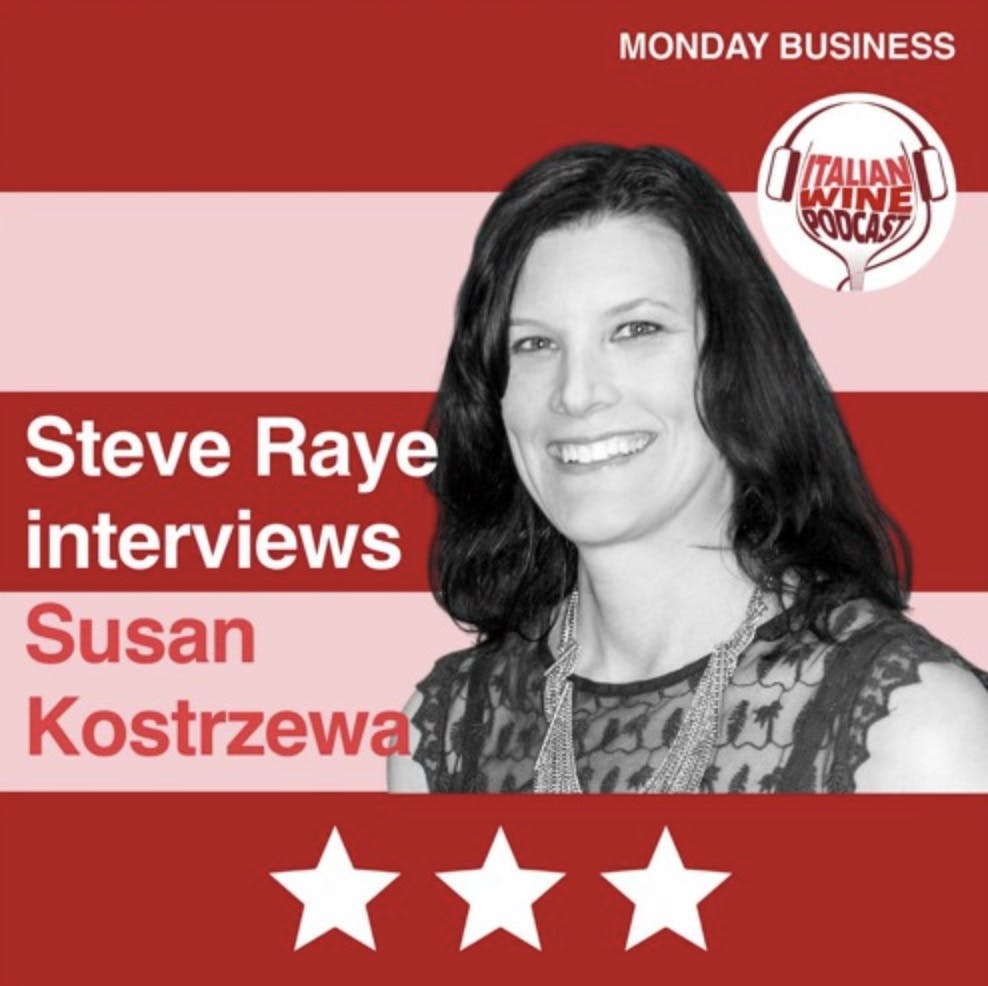
Ep. 889 Susan Kostrzewa | Get US Market Ready Withe Italian Wine People
Masterclass US Wine Market
Episode Summary
Content Analysis Key Themes and Main Ideas 1. The evolution of content creation and communication in the wine industry, shifting from traditional print to diverse digital platforms. 2. The changing roles and influence of traditional experts versus new peer-driven content creators (influencers). 3. Challenges and strategies for wine brands, particularly export brands, in navigating the complex and fragmented US market. 4. The importance of comprehensive storytelling that extends beyond the product itself to encompass brand values, people, and culture. 5. The debate surrounding the relevance and future of wine scores in consumer decision-making. 6. The impact and progress of Diversity, Equity, and Inclusion (DEI) initiatives within the wine industry. Summary In this episode of the Italian Wine Podcast, host Steve Ray interviews Susan Castrava, former editor at Wine Enthusiast and founder of Resplendent Inc., a content creation company. Castrava discusses her transition from traditional wine media to digital content, emphasizing the industry's need to adapt to a fragmented communication landscape. She highlights that print is not ""dead"" but rather one of many platforms where diverse storytelling is required, including podcasts, social media, and e-commerce. The conversation covers the evolving influence of wine experts versus peer recommendations, noting that while experts still provide value, consumers are increasingly savvier and seek broader context. Castrava shares insights on the challenges for export brands entering the US market, stressing the importance of understanding regional differences and utilizing digital tools like virtual events for outreach. She also addresses the persistent debate around wine scores, suggesting their primary value is now in trade rather than consumer-driven decisions, and touches on the positive but slow progress of DEAI in the wine industry. Ultimately, Castrava advises brands to prioritize clear audience identification, holistic storytelling, and fostering a dialogue with their consumers. Takeaways * The wine industry's media landscape has diversified significantly, requiring brands to engage across multiple platforms (print, online articles, social media, podcasts, virtual events). * COVID-19 substantially accelerated the shift towards digital communication and e-commerce in the wine sector. * Effective brand communication requires storytelling that goes beyond the wine itself, encompassing the company's beliefs, people, and cultural context. * The US wine market is highly complex and diverse across states and regions, necessitating a tailored approach for export brands rather than a ""one-size-fits-all"" strategy. * While traditional wine experts remain relevant, the influence of peer-to-peer recommendations and influencers has grown considerably, reflecting a shift towards community-driven information. * Wine scores, though still valued by the trade, are becoming less dominant for consumer purchasing decisions, who now seek broader context and lifestyle connections. * Compensation models for content creators have evolved, with less reliance on traditional fixed fees and more integration with advertising and brand promotion. * The wine industry is slowly but positively addressing Diversity, Equity, and Inclusion (DEI), bringing new and diverse voices to the forefront. * Brands should focus on doing a few communication channels well, maintaining quality and clarity, rather than superficially attempting to be everywhere. * Modern communication in the digital age is about fostering a dialogue and collaborative feeling with the audience, rather than simply dictating information. Notable Quotes * ""I think I think that what's happened in media is there, I wouldn't say that any one aspect is dead necessarily including print, I think we're just expected to be quite diverse now."
About This Episode
The hosts of the wine podcast discuss the shift towards digital communication, including the rise of digital media platforms and the need for consistent messaging. They emphasize the importance of prioritizing one's brand and the importance of word-of-mouth in the industry. They also discuss the challenges of creating a culture of wine and the availability of information in various markets, as well as the importance of engagement in various areas, including virtual events and podcasts. They stress the need for clear communication and engagement, and mention a future edition of the show.
Transcript
Welcome to the Italian wine podcast. This episode is brought to you by Vinitally international wine and spirits exhibition. The fifty fourth edition of Vinitally was held from ten to the thirteenth of April. If you missed it, don't worry. Go to Vineethly plus dot com for on demand recordings of all the sessions from the exhibition. And remember to save the date, the next edition of Vineethly will be held from the second to the fifth of April two thousand and twenty three. Thanks for tuning into my new show. Get US Market Ready with Italian wine people. I'm Steve Ray, author of the book how to get US Market Ready. And in my previous podcast, I shared some of the lessons I've learned from thirty years in wine and spirits business helping brands enter and grow in the US market. This series will be dedicated to the personalities who have been working in the Italian wine sector in the US, their experiences, challenges, and personal stories. I'll uncover the roads that they walk shedding light on current trends, business strategies, and their unique brands. So thanks for listening in, and let's get to the interview. Hi. This is Steve Ray, and welcome to this week's edition of Get US Market Ready with Italian wine people on the Italian wine podcast. My guest this week is Susan Castrava, who was most recently editor at wine enthusiasts. She's an award winning journalist and content specialist with more than twenty years of experience in luxury lifestyle, culture, wine, food, and drinks publishing. She's also president of Resplendent Inc, a content creator. Susan, welcome to the show. Thank you for having me. So the the big question I had is you had one of the best jobs in wine. A lot of people think. And now you're going into something that's kind of unknown. Why did you do that? And how do you feel about that? Why did I do that? Well, so I was with one enthusiast for fifteen years. In various positions, editorial positions. And, obviously, I left, once I sort of was in that role of editor in chief. I loved my time there. I learned so much, what a great run, but it was time for me to do something new. And so in my role at enthusiasts and then just generally in my, you know, sort of involvement in the wine industry, I recognized a real need for someone with my skill set, not only for editorial brands, but for wine brands who really needed help with their content strategy, their brand communication, their messaging. And I always call it the storytelling of of the wines. And something I I find really interesting. There's a strategy involved. There's creativity involved. Obviously, have some great relationships with people and know know them and know what they're trying to do. So, you know, that's kind of why I created what I did. It wasn't a grand plan, to be honest. It just kind of organically happen based on needs in the market. Yeah. I'm seeing what's going on. I mean, that everything's kind of evolving. And so if if somebody isn't filling that niche, it's a great opportunity for you. There's a phrase out there people have used that print is dead. It's not. I agree with you on that principle. I still read the New York Times and the Wall Street Journal every day and a whole bunch of other publications. But the traditional role of magazines has been usurped by all kinds of things digital from social media to e commerce, which I think is a form of social media. In fact, so this whole print digital divide and the concept of storytelling as you defined it seems to be kind of the the the thread that runs through communications that works. Can you expand on that? Yeah. I mean, I think, you know, you were just referencing print. I think I think that what's happened in media is there. I wouldn't say that any one aspect is dead necessarily including print, I think we're just expected to be quite diverse now. We need to be telling, you know, stories where, where the audiences are, and that is all over the place. That's in the podcast space. That's in, the virtual event space that's in, regular sort of online, article space, and then, of course, podcasting. So, you know, I think I think that that is part of what's happening. And I feel that that's true brands and companies and products as well. They're expected to be in all those places telling you a great story, an interesting story. And and a story that is crafted to the audience, you know, who is following the the specific platform. So It it has evolved. And, you know, I think to just the whole idea of the digital space for wine has evolved a lot and has become so sort of front center. I think it was happening before COVID. We were going in that direction. And I think COVID definitely pushed, pushed the market and pushed, you know, really honestly the media space communication space fully in that direction. I don't think that's a bad thing. I actually think it's wonderful because the idea is we want more people drinking wine. And wherever we can be that they are without barriers that we've had in the past, either physical or or other, you know, other barriers. This is allowing us speak to a bigger audience and for them to know more about the wines that that we love. So I think it's positive, but it has changed a lot. Yeah. The rules and standards, if they applied, no longer apply. I think it a lot of this hang hangs on where you're from. I I I deal with a lot of international brands. In many cases, they're farmers, and they they won't have the capability of being able to do digital no more nor less and they were able to do print in terms of PR Outreach. Add to that, all the stuff that's happening with e commerce, and, I'm gonna be interviewing BoreCard NASA actually later this afternoon talking about how e commerce has changed too. But it's also how things are monetized and how they're paid. So in the old days of print magazines, you would buy an ad, and it won't be seen for, you know, three months after you placed the insertion order, articles appear. You got plenty of time to think about that, and there was one outlet. Maybe. There was a a website that was associated with it. Now the need is to be consistent in communications across the board. And that means from what you say on the label whether or not you have a QR code and where that leads to and what kind of information to what others are saying about you, The concept there is optimizing your brand presence online, meaning what does wine searcher say about you? What does Vivino say about you and all of that kind of stuff? So stuff that's in your control and stuff that's not necessarily in your control. It's kind of exploding. How do you get a handle on all this? I mean, how do you get a handle on it? I think that you can't possibly get a handle on everything, but you have to prioritize what it is that, you know, you think will be most important and impactful to your brand. Again, whether it's a media brand, whether it's a, you know, a product or a wine brand. I think that it's important to be active in the space and seeing what others are doing. And I know that sometimes that can be very difficult with the schedules people have, but I I think, you know, just being aware of what your peers are doing, what your peer companies are doing, and, you know, you, you can learn a lot from that as well. But it's prioritizing. And I think you have to decide what your focus as are and really, really go for those. And and we'll talk about this in a minute, but I think you have to do it right. You know, I I you can't be all things to all people. It's better. I think to focus in a few areas that you know you can really drill down into and do well. Because the market and the audience knows when something's done lazily or on or isn't clear or is not, of quality. So, you know, there's a lot of pressure now. Yeah. And, I think that the potential negative impact of doing a poor job may be even more significant than the positive impact of doing a good job because as you pointed out, doing a good job is expected. I mean, the standards are set by companies like Amazon and and Facebook and Instagram who have all those resource and we're dealing in the wine industry now, which doesn't have those resources. So one one area I did wanna dig in a little bit more, and then we can move on. But the idea is is compensation for content producers. There's been a lot of discussion lately about influencers, the role that they play, and how they get compensated, the, you know, the separation of church and state, the role of paid advertising, even to the point of Google and Facebook ads where they're doing it by an ad auction method, their ads. Okay. Somebody's paying for the content to be there. As opposed to the equivalent of PR, which is like third party reinforcement, if you will. Somebody else is generating the content, but you're trying to influence that. How do you see that evolving from the the simple world if I can use that term of print that we all came from to this new world of, electronic communications. Well, there's no question that those worlds are more integrated than they used to be. And, you know, we used to talk a lot about that enthusiast, where, you know, we really, of course, not only journalistically, but because of the tasting program that we had, we had to be extremely careful about how we proceeded with those, you know, those types of relationships and and how things were portrayed. And I used to hear from people in in media. Well, you know, it's changing and the consumer doesn't care. The consumer's used to seeing this, etcetera, etcetera. I always took sort of that meal. It's like, it's good enough. Yeah. It's, you know, they don't care as much as you do. You you mentioned earlier. Again, I'm not this is not me throwing anyone under a bus that, you know, it was just if industry people that I talked to, some believed in it, something as a journalist, and, you know, I think you have a journalistic background as well. It's it's it's a hard thing to see, but I also recognize that there are changes. The world as we knew it are, you know, have changed. The new generations are very used to this extremely integrated sort of, you know, advertising model that we're seeing now. I mean, obviously, with native advertising, but, you know, there's so many other things and you mentioned influencers. You know, I fake influencers as much as I I will be totally honest in the very beginning of of brands using influencers. I sort of rolled my eyes a bit. I thought really, you know, is this really going to resonate with audiences? Is this what they care about? In most cases, it did resonate and it did move the needle. And if they were chosen properly, it could make a huge difference. And I had to change my tune because I saw that a lot of what was happening on social media that was really getting engagement. It was it was these this group of people who are doing an amazing job of getting new audiences, you know, interested. Do I think there needs still needs to be a clear delineation or it's some delineation, to indicate, you know, editorial content versus advertising content. Yes, they do. And I think the brands who are smart know to do that. And, you know, they're again, that's a transparency that that it shouldn't shouldn't work against you. It should actually work for your brand if you do it properly. Okay. One of the issues has been that we've moved from an era where the experts, quote, unquote, determine the successor failure of a given brand in the marketplace, Robert Parker, and the magazine's wine enthusiast and wine spectator. Now it's a function of peers, not pundits that are, kind of running the conversation. Can you comment on that? I still, and again, not to sound too egalitarian on everything that I say, but I believe there's a place for everyone. I I do think it is natural and it makes sense that the model has moved towards a peer model because again, that is the at its best. Let's put it that way. Word-of-mouth. I mean, that's kinda where it all began. Well, it's word-of-mouth, but at its best social media is supposed to be in community. Obviously, it can become very divisive and but it's supposed to be a place where people share information and, you know, they're they're they're, they are listening to their peers. So and I I think even before that took off in wine, I mean, that was a lot of the times the way that even my friends who weren't in the industry. It was word-of-mouth. Oh, my friend told me about this great, you know, Presecco, or my friend, you know, told me I should be trying wines from that or whatever. And it was a lot a lot of that. So I feel like that's a natural and an okay direction for things to go in. Do I think there's no place though for these the expert? I think there is still a place because at the end of the day, there's a lot of information out there, even among peers, and people who are learning about wine still still want that at least that feedback. They may choose. I think they're savvier now. They don't take it for gospel anymore. So they but I think they still want it. And then they can make their own decisions. Someone is vetted through these tastings. They've done the work. They've done all that heavy lifting, and they're offering their opinions to you. There's value in that. The question is what do you do with it? Do you take it again as gospel? Or do you say, okay, I know this person's palette. I like some of it. I'm not gonna try some of it. I'm fine with that. I think there's a place for it. Yeah. I think one of the fundamental issues, compensation for that used to be, you know, you would pay somebody for writing and there was a fixed fee per word. That's no longer the way you get paid. And a lot of it is you don't get paid at all. So let's move to a specific example. I as we were originally talking, you had said that you were involved with Greek wines. I've had some experience with Greek wines as well, so that kind of intrigued me. Can you talk about your experience with wines from Greece and how some of what we just talked about applies? Yeah. I think, well, I have been extremely privileged to cover wines, you know, I was covering. I think for almost seven years, maybe even longer, maybe even ten. At enthusiasts, I was the the critic of Greek wine and was always intrigued by that category because of the history, of course, an incredible place, and just the uniqueness of the variety. So One of the things that struck me right away when I first came in was, you know, as as often happens, they were grappling with how do we get into the US market? How do what do we hang or hat on? Because this was, you know, again, this is ten years ago. At least, do we do we, believe in support, believe in and support our indigenous varieties, or do we talk about the international varieties that we make well here? And I think, you know, I think as far as marketing goes, there was some confusion as to what the clear message was going to be in the market. What are the wines? What do they stand for? And how do you even pronounce them? I was gonna say that that's the first thing right there. Are you ready to go? Does not look like that? And I have a name that's difficult. And even I was like, wow, these Greek words are quite so I think I think, you know, what what was hard for that particular, and and I think they worked it out to some extent, and and I'm thrilled to see this. But I think in the beginning, it was like, okay, how do we make this culture of wine, the words, the these unknown varieties, these regions no one's ever necessarily heard of, you know, in the US. How do we make this easy and palatable for an American audience? And I think there was the possibility of of homogenizing it. And thankfully, I don't believe that was the route that they took. They recognized over time. You know, these are varieties that really are made nowhere else in the world. They're extremely unique. They had the growing conditions are incredible. Like, there's a story here. Absolutely. I mean, I got stories, busting. They got myths. They've got myths. I mean, it's four thousand years of I mean, who has that? I it's built in storytelling. It's a built in great story, but I think, you know, they had to, as a as a as a category, really believe in that and and lean into that. And and and in doing that, I believe, have done a great job of breaking into the market. I mean, do I think that, you know, the same person who is drinking you know, maybe, you know, a very ubiquitous chardonnay if your California is loving is going to go and try an air at your Gizzo, maybe not, but a curious wine drinker and probably somebody, especially with this you know, the emerging generations that are coming into wine. Are they interested in these wines? Absolutely. But let's talk about what you did for them. I mean, the the same that same conversation we just had could apply to Armenia, Georgia, and any, you know, unfamiliar turkey. Region, on the planet. But what did you do for them and how did, your new role in digital, what role did did you play in that? Well, first of all, I was I I showed up. I I actually physically went to the wine region. I mean, I I know that sounds like a very basic thing, but, I don't think the Greece have been prioritized by a lot of people in the industry as far as on, you know, in tasting programs and and larger media. It was sort of an afterthought. And I was in a Actually, I was in a great position because of my, you know, my rank and my role at the magazine. I was able to say, no, I'd like to prioritize this category a bit. You know, I think we should be covering it. And I I wanna go, and I would like to spend some time there. And so I did some pretty extensive traveling through Greece. And multiple times was there. And, you know, really from tiny little sort of organic producers to the big boys, I I mean, I met with everyone. I tasted with everyone. I had, you know, incredible partners in wines of Greece, just amazing. Sophia Prepera there is, you know, still a friend and just was an amazing amazing, sort of guide through through that space for me. But, what I did was I tasted the wines extensively and I wrote about them. And I gave them, you know, obviously I was covering them online. So the enthusiast audience was exposed to an, a, a region and or a category that probably wasn't getting enough exposure. Let's change change direction here a little bit. Thinking about, the the the difference between export brands and domestic brands. One of the fundamental differences is that, the only time a wine can bypass the three tier system is a direct domestic wine selling direct to the consumer. That avenue, that route to market is not available to export brands. So can you can you compare and contrast from the perspective of export brands the challenges of export brands and maybe some what are the common mistakes and successes that you've seen people have, taking Italian brands and some of them are Greek for idols. Right? Like Adiana. I I think one of the difficulties, of course, the system can be extremely complicated. Every single state has its own sort of, you know, parameters which can be confusing. I think I think it's not recognizing the uniqueness of of each of the markets in the US, and that can be overwhelming. So beyond the system itself, it's also, you know, either doing the work of of extensively traveling throughout the US and really visiting the regions, Chicago versus New York market versus, Charlotte, you know, they're very different. And I think sometimes, you know, expert brands, they just sort of see it as even if they know in their heart of hearts, look, there is clearly, like, a very faceted situation of culture and wine drinking in the US. They kind of try to do one size fits all regardless of market. And, as far as their their messaging and their education and and honestly even just the way in which they they engage, themselves in the market. I think it's just knowing the and and and spending the time to learn how different the markets are and what they're looking for. I think that, and I I think you and I talked about this at one point or it's somehow there was an exchange about virtual events and how that, you know, the virtual space has made some of this a little easier potentially. Because, you know, that sort of hand sell and boots on the ground approach, which is very important, but very expensive and time consuming and tiring for, you know, depending on the size of the brand. That can be that can take up a lot of of energy and time, which, you know, it can be tough when you're trying to run it, also run a winery. I think virtual events and tastings can really help. And I think that can be one way that you can expose your brand, to people in the market, you know, whether it's retailers or educators or whatever you're looking for. That's one direction that, you know, again, virtual is sort of helping us. So, yeah, I I think I think it's knowing your market and doing the homework and really understanding the uniqueness between each of the markets as an as expert brand. That and that's a big challenge for a lot of people whose primary job is making wine. Let me let me talk about it or or ask about it this way. So you've had a job as, for a long time as editor, watching observing, commenting, synthesizing, interpreting. Right? Now you're a lot closer to the boots on the feet, on the straight boots on the ground that you're talking about because you're responsible in in many cases for actual brand performance and sales and those kinds of things, if not directly, certainly indirectly. And you talked about the role of brand ambassador, and I've seen that come and change and have some thoughts on it, but I'd, be interested in yours, is it still a reasonable strategy because it's so expensive and not scalable? I kinda led the question there. Sorry about that. You're leading the witness. Yes. No. I think it is a difficult strategy. I think that, you know, again, even even a larger larger brand. I mean, the the the cost of doing that work be, again, doing the sort of boots on the ground sort of constant interface type situation is very hard. And again, I think that's where possibly digital can come in if you can, you know, create some type of outreach and education and interaction, in those markets through virtual events. Again, I'm not saying that's the end all be all, but it's it is part of it is part of the of the the picture for the future, I think. Yeah. Well, the the direct communication between the winery, we we no longer need the intermediaries. So one of the other big changes today, a lot of what we've been talking about, but manifest itself and is the availability, the overwhelming availability of information in such a broad range of places. You've got label, identificate, or label recognition technology. So you essentially have a a encyclopedia open in front of you you're looking at a bottle of wine and taking a taking a picture of it. There's so much information available to consumers where it used to be much more limited. Now with wine search or PIVino and everything else, you can find out more information than you wanna know about many, many things. How has that changing? How consumers shop do you think? Well, I I think, again, from my perspective, as a content person, I've just been it's been interesting to see how much diversification has happened with with education. I mean, I think I think what we're seeing is more information, more education, more content in more places. And I think as far as, you know, that can influence, obviously, how somebody shops. And then we talked about storytelling earlier. I think, you know, the the not only do the the brands, but also the VIVinos, etcetera. They're starting to get into the content game a little bit more. They're recognizing that This is it's not just about price or score. People wanna understand what's behind the brand. They wanna know what the, you know, the stories are, etcetera. So you're just you're just seeing more information out there than ever. That can be overwhelming. I mean, there are two couple ways of looking at that. One is great. The more information is better and more perspectives, the better. And, that's all good. The question is, is that overwhelming to the consumer? How do they know where they're supposed to go? I think that's still remaining to be seen. And I think I think that the future consumer of wine is a lot more comfortable with that sort of richness of of information than even maybe somebody from my generation was. You know, it's it's it's more natural to them. Okay. So lots of information available to a lot of people to the point that you can get a, graduate level, education and something as obscure as Greek or Turkish wines or wines from Epinia. For example. And then the flip side of that is when somebody shopping in a store, and there's a sign above a bottle of wine that says ninety two. Can you talk about scores? Okay. So we were we talked about x expertise earlier and and has the role of the expert become obsolete? Is it really more about peers? Is it, you know, where are people going for this information? I feel similarly about scores. I don't think they should drive everything that happens in wine. I think score can only tell you so much of of what a wine is. But do I think that most consumers appreciate that guidance? I do. I think most people are busy. And it's easy for them to generally to see a score and understand it. It's something that we were raised with, you know, and in school. There's a there's a there's a familiarity to a score that can, make the, you know, make it easy for a consumer. I don't think they place as much weight in it as they used to. Now the industry still loves it. You know, the trade loves to have their scores, and I understand that. The consumer, I think, is a little less driven by scores maybe than they used to be. I also think, you know, maybe in future scoring, maybe it's not the hundred point scale. Maybe it's stars or it's, you know, indicators or something else that's a little more little more, friendly to a consumer, but I do think they appreciate that. And I do think there's a place for it. So One of the things I tell, my clients is, I I don't really care what your thoughts on scores are, and you don't really care about my thoughts on scores are. Just get them. So the first question you're gonna be asked by somebody in the US trade is do you have scores? And if the answer's no, the conversation stops right there. So go out and get scores, and you can argue how many angels can fit on the head of a pin when you're sitting there with a bunch of ninety pluses. And if you don't have ninety plus, then don't talk about them. Yeah. Don't talk about them or find a way of of you know, messaging that and saying this is a really affordable, delicious wine, you know, put it into a context that that makes sense. It doesn't have to be ninety five points if it's a great food wine that you're gonna sit on a patio within the summer. I mean, there are ways I always it always sort of, you know, discouraged me to see brands getting so upset about a wine that might be an eighty eight point wine, which I, again, for a ten or twelve dollar wise, like, this is a great score. Don't immediately assume that you know, this is going to turn somebody off. Now I understand there are a lot of nuances to who's interpreting that. But but I do think I do think that, you know, you're right. I think just, you know, you need this. You do need the scores in our environment in the US sure. People are used to seeing it. I believe it doesn't tell the full story. Yeah. For sure. And I but I I think the point you made that is more important in the trade than it is to consumers is absolutely true because of the ubiquity of information out there. One of changing direction here. You were on the board for women of the vine, and I I did an interview with, Deborah, and I thought it was really fascinating and interesting to me being an old person who doesn't Maybe it isn't so much so relevant to me. Or it is relevant to me now, but I don't know that much about it. Talk about what you were doing on the board then and what your, role is now. Deborah Brenner. Yes. She I met Deborah, years ago when she first was putting her book together, which I believe is called women of the vine. It was the sort of, you know, the the impetus for this entire events and, you know, this platform she created. So I've known her over the years. And, I think I attended the second event in Napa and just was so impressed and recognized no no question that there was such a need for a space for women in the industry. There just really wasn't even when I came into the industry, it was it was still largely male, an older an older group, and definitely no real diversity. So I wanted to get involved from the early stages. And thankfully, she and I always sort of got along. And I was asked to speak at the event and moderate a few panels. And then over time, she asked me to be on the board. And I was on the advisory board for a couple of years. She changed the model of that board, and then sort of started to apply people to specific areas that made sense for them. So what I transitioned into, was helping create the program for the event, the content for the event, you know, helping to, direct some of those, those sessions. And I did that for several years. Now I'm, you know, the the event has changed. It's kind of went digital. I believe that it's I'm not sure if she's actually doing it in person again this year, and I'll have to check that. But I'm a little less involved now. Still in certainly in touch with Deborah and, you know, I'm still very involved in space. And I've got some different appointments and and groups that I'm gonna be getting involved with that I can't really talk about quite yet. But I'm working on that right now. But back to the DEAI thing, though, do you think change is happening? And, you know, I'll leave it at that. Do you think change is happening in the industry? From being a bunch of old white guys. Yeah. It's changing. I think, is it changing fast enough? And in all the ways that we would like to know it's gonna take time. There's there definitely since successes, and there there are definitely some setbacks. It's a traditional environment. What I think is exciting is I just love seeing these new perspectives and new voices coming out, especially in social media, again, an incredible platform for the change that's happening. I I just love to see that. And it's just making the industry so much more interesting and so much again richer because there's just, you know, why would you want only the perspective that you know? It's it's great to have new voices in this space. I think it's still very tough. I think there's still a lot of tradition and, you know, there's a long way to go, but at least we're moving in the right direction right now. Yeah. Okay. Well, that's something. Okay. So we're coming to the end of of the interview. I like to end them asking my guests. What's the big takeaway? Of all the things that we talked about here, is there a simple practical idea or practice that someone could put to use immediately? To, have an impact on their business. Well, you know, I think a couple of the takeaways would be just in in the in the work that I have done and am now doing with, with these brands. Again, both editorial and, commercials, be really being clear on who your audience is and who you want it to be. Be very clear from the start. It all trickles down from there. The other thing I talk a lot to people about is your stories, not just about what's in the bottle. As much as it may seem like a cliche. You know, it's it's the generation now, and I don't even mean the emerging generation. I also mean wine drinkers of all ages now. Really wanna understand what you're about. What do you believe in as a company? Who are the people who work for you and what are what how do they, you know, what are their perspectives? There's there's a multifaceted story that needs to be told. Of course what's in the bottle has to be good. That's expected. But there's a lot more to your story than just that. We talked earlier about recognizing that, messaging is no longer just the written word. You really need to be thinking about audio, video, virtual events. As as a form of engagement. And, doesn't mean you have to do them all. It doesn't mean you have to do them all well, but you need to make sure that you're engaging in some ways in in at least a few of those areas. And and really, as we said, trying to spend some time with it. Don't rush to do it. Don't don't put something off that will as you said damage you, but know that you need to be looking in that direction. You know, and I think I think that, one of the other things that I'm sort of alluded to earlier regarding scores and know, if you don't get a ninety point or ninety five points, maybe you get an eighty eight point, but you can put that wine into context. I think that's really important for wine consumers. Now, certainly American wine consumers, they like that context. You know, maybe that's an environment. It's where to drink them. It's pairings. It's a lifestyle element that, really does resonate with with the US audience. And I think like specifically the the Italian wine market does a great job of this. I think because it's so much a part of the culture of Italy. It's just an understanding that you are going to be drinking wine with food in in this environment, etcetera. So I think the Italians have got this down, and are doing it well. They recognize it's just not about, you know, putting a bottle in front of someone. There's more to the environment. And I I think that is, of course, if that's not your forte, that's that's the kind of thing that I help to do with some of the people I work with is come in and say, I can help you to create that environment and at least talk about it. So I think I think those are some of the things. The last thing I would say is that the world that we're in now, that certainly the virtual digital world is about a dialogue, whether it's a real dialogue or perceived dialogue, you know, you want your messaging and your relationship with your audience to feel collaborative and not not to be dictating to them. You try to create a conversation. That allowed that has to do with the tone of of language that you use. And, you know, just your overall, sort of outreach to them and always thinking about how can we create this feeling that we're in this together? I think that that's a value. Brilliant. I I agree a hundred percent challenges how and how to pay for it. So, big shout out to Susan Castro and I'm thrilled to learn that I've been mispronouncing it all these years. I'm sure that's normal. It's so me Susan k. It's fine. For for joining us today on, get US market ready with Italian wine people. We didn't spend so much time today talking about Italian wine as we did about the wine industry and, coming from your, previous position, I think your, very eloquent voice. So thank you for joining us today. I appreciate it. It was really, really great to talk to you. Thanks for listening to this episode of the Italian wine podcast. Brought to you by Vinitally International Wine and spirits exhibition, the biggest drinks trade fair in the world. Save the date. The next edition of Vinitally will be held the second through the fifth of April two thousand and twenty three. Remember to subscribe to Italian wine podcast. And catch us on SoundCloud, Spotify, and wherever you get your pods. You can also find us at Italian wine podcast dot com. Hi, guys. I'm Joy Livingston, and I am the producer of the Italian wine podcast. Thank you for listening. We are the only wine podcast that has been doing a daily show since the pandemic began. This is a labor of love and we are committed to bring you free content every day. Of course, this takes time and effort not to mention the cost of equipment, production, and editing. We would be grateful for your donations, suggestions, requests, and ideas. For more information on how to get in touch, go to Italianwine podcast dot com.
Episode Details
Keywords
Related Episodes
Ep. 2790 Italian Wine in the US: Building a Narrative and Reaching Asian American Consumers with Susan R. Lin MW | Masterclass US Wine Market
Episode 2790
Ep. 2783 The Suburban Gold Mine: Insights into New Jersey’s Wine Market with Brittney Abell | Masterclass US Wine Market
Episode 2783

Ep. 2772 A Surprising Partnership between Japanese Sake & Italian Wine with Monica Samuels | Masterclass US Wine Market
Episode 2772

Ep. 2770 China’s Wine Market: From Misleading Import Numbers to Today’s Consumer with Fongyee Walker MW - Part 1 | Asia Wine Market
Episode 2770
Ep. 2760 Winning the Restaurant Floor: Training, Education & Italian Wine with Sylvester Inda of Ci Siamo | Masterclass US Wine Market
Episode 2760

Ep. 2751 From Montalcino to Kazakhstan with Francesca Arquint of Collemattoni | Asia Wine Market
Episode 2751