
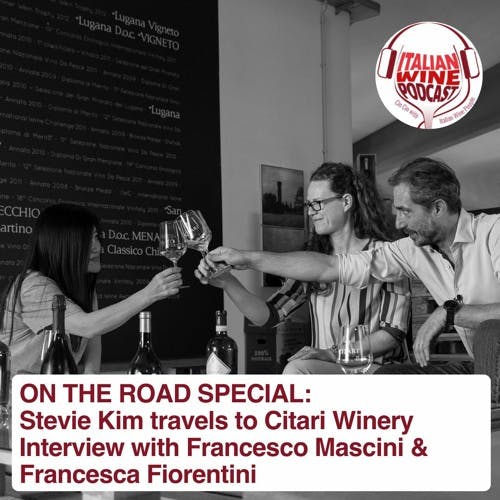
Ep. 1061 Francesco Mascini & Francesca Fiorentini | On The Road Edition With Stevie Kim
On the Road with Stevie Kim
Episode Summary
Content Analysis Key Themes and Main Ideas 1. The unique characteristics and versatility of Lugana wine. 2. The history and family-driven evolution of Chitari winery. 3. The distinction between the indigenous Turbiana grape (used in Lugana) and Trebbiano. 4. Challenges faced by Lugana producers in balancing increasing demand with limited regional production. 5. The importance of appellation clarity for Italian wines with indigenous grapes. Summary The Italian Wine Podcast's ""On the Road Edition"" features host Stevie Kim visiting Chitari winery in Lugana, Italy, where she interviews Francesca and Francesca, representatives of the third-generation family-owned winery. Founded in 1975, Chitari has grown from 4 to 35 hectares, now producing 350,000 bottles annually with a small team. They highlight their signature Lugana ""Conquilla,"" which received 95 points, and discuss how Lugana is made from the indigenous ""Turbiana"" grape, which DNA analysis has proven distinct from Trebbiano, despite past mislabeling. The winery also produces a limited-edition Metodo Classico sparkling wine and a red/rose blend called Riviera del Garda Classico (formerly Carreto), made from four indigenous grapes. A significant challenge for Chitari, and the Lugana region, is managing the increasing global demand for their wines given the limited production area and strict quality rules. They describe Lugana as fresh, mineral-driven, easy to drink, and versatile, suitable for various occasions. Takeaways * Chitari is a third-generation, family-owned winery in Lugana, Italy, established in 1975, producing 350,000 bottles annually from 35 hectares. * Lugana wine is made from the indigenous ""Turbiana"" grape, which has been scientifically confirmed as a unique variety, distinct from Trebbiano. * Lugana wines are characterized by freshness, minerality, and versatility, and they possess significant aging potential. * Chitari produces a range of wines, including three expressions of Lugana, a limited-production Metodo Classico sparkling Turbiana, and a red/rose blend (Riviera del Garda Classico) from a blend of four indigenous grapes. * A major challenge for Lugana producers is meeting the growing international demand for their wine due to the limited viticultural area and consortium quality regulations. * The Lugana region is actively working to clarify grape and wine names (e.g., Turbiana, Vino Rosa) to reduce consumer confusion and better reflect their unique identity. Notable Quotes * ""So Chitari is a a family driven in own company. Francesco is the third generation now. So is the real boss."
About This Episode
The speakers discuss the differences between their own and traditional Italian wine production. They note that their own vines are fresh and long-lasting, and that their wines are made from grapes that are called Gropello indigenous and Maritz-Go. They are working on a new wine study and experiencing the use of grapes for their wines. The production is limited to a small quantity and being done in a small area, with the wines being offered in a three-well price.
Transcript
Welcome to the Italian wine podcast. This episode has been brought to you by the wine to wine business forum twenty twenty two. This year, we'll mark the ninth edition of the forum to be held on November seventh and eighth of twenty twenty two in Verona Italy. This year will be an explosively in person edition The main theme of the event will be all around wine communication. And tickets are on sale now. The second early bird discount will be available until September eighteenth. For more information, please visit us at wine to wine dot net. Welcome to another episode of On the Road Edition hosted by Stevie Kim. Each week, she travels to incredible wine destinations interviewing some of the Italian wine scene's most interesting personalities, talking about wines, the Foods, as well as the incredible travel destinations. Hello, everybody. We're back. This is our last stop in Uganda today. As you know, we're doing kind of a small exploratory episode about this area. Consortium of Lugana was one of our supporters for Vineito International Academy. It's a little bit hot for my taste, to be quite honest. But we thought we'd give you a little snapshot of the Luvana area. So we are here with Is it chitari or chitari? Chitari is right. Chitari. Okay. It's a smaller winery. This is kinda what you see is what you get kind of winery. But they, with this wine, lugana, Conquilla, they've won ninety five points for five star wines, this year, in the selection of the guide. So Chow. Chow. So they're very original. He's Franchesca. Nice to meet you. And this is Franchesca. Okay. You can't get it wrong. Franchesca and Franchesca. So tell me a little bit about who you are and what you do in Chittari. So Chittari is a a family driven in own company. Francesco is the third generation now. So is the real boss? And there are three of us, here, me and my colleague Simone that deals with vines and the seller. Basically, the winery was founded in nineteen seventy five from his grandfather and, it started with four actors. And nowadays, we have thirty five for a production of about three hundred fifty thousand bottles. Jets, so there's three of you making a lot of many bottles of wine. Yeah. We live fun. So, basically, a hundred thousand, a hundred thousand, a hundred and fifty thousand bottles each. Right? Almost of. Yeah. So tell us a little bit about, the different types of labels. So we have, a different lugana, but we also produce other, operation like, San Martinez that you see here, or sparkling, lugana based. We also have a rose and red river del garda classico, but, of course, our typical production is, lugana. So we have three different, lugana, that are the three different expression of the soil, of the terrarium of our vines. Okay. So before we start tasting the wines, Francesca. In mixed So is this your signature wine? It's basically our first wine that we bottle when we decided to have a a line of bottled wines because at the very start, we only produced wine, but not bottle in it at the very beginning. And it's called concilla or the the fossil muscle because, we have year round a lot of, fossils Oh, really. Because of the origin of the area itself. We have three lugana, so the water source, conchelia, the muscle, and, Torre the tower because we are very close to the Torre, San Martinez. Yeah. The later harvest is torre. This is the middle one. Correct. Yes. Sergeant is the first one. Okay. So concrete is kind of your middle ground. Yeah. Okay. And I I do have a question. You have another wine. Right? Busy. There is also a functional reason because, for example, the, green. So the, the dark green glass helps the the wine to protect itself from light, for example, so it's better if you consider that the lugana can also age very well. Okay. So let's taste the wine. Are you enjoying this podcast? There is so much more high quality wine content available for mama jumbo shrimp. Check out our new wine study maps or books on Italian wine including Italian wine unplugged and much much more. Just visit our website, mama jumbo shrimp dot com. Now, back to the show. There are many lugana producers. Right? They're I think there are ninety five producers in the consortium. More than a hundred fifty. Yeah. The consortium, more than more than a hundred twenty under third you know. Okay. And in total, I think about two hundred producers. So everybody produces Lugana. So how can you tell in applying tasting, how do you know it's your one? Can you tell the difference? Let's be honest. It's difficult. Specific. So, basically, concilia is, very fresh. Wine, you you notice the great minerality. It has Of course, the traditional lugana notes are the citrus notes, the white flower, notes. And, it depends from the from the vintage. Sometimes you can find, more apple or pure or heparagus. And it also depends from the maturation of the wine. So when you drink it so that it's freshly bottled, it's, more on the citrus note. Then if you let it age a little bit, you can notice, yellow, wild fruit or, mature, or dried fruit. But the typical, the typical aroma's typical taste of lugana is very recognizable because of this minerality. There's a freshness that comes out. And it's also very long lasting in the mouth. But, if you were to compare Lughana with, Dolbyana with a an international grape variety, what would it be? It doesn't anything, in common, basically. So, actually, we did a mistake as a consortium in the past years because we called it, Trebiano Delugana. Right, ma'am. But basically it's false. So it's wrong because, now, for example, we call it Turbiana. Because of that. Because Turbiano has nothing in common. So they did, analysis, DNA, exams, and so on. And they discovered that Turbiana is a a a totally different grape. Indigenous and local And, so we have And it has nothing to do with Trebana this one. Yes. A little bit. It's sort of a cousin. Yeah. Our cousin. Yeah. They're similar in a way. Can it be aged this one? Can it be it can be age? Of course. Ligana is very good. Age if you ask me how long, I don't have a a answer now because we are experimenting, wines that are also twenty years old. So do you have a reserve of library one guys? A very small one, but, just for the events, for the awards, for example, the guides, unfortunately, not enough to enjoy, with customers and so on. Do you wanna tell me a little bit about your sparkling wine? Yes. Sparkling wine is a sort of an experience. We decided to, experiment a little bit to enjoy also the potential of the of the grape itself. And so we started years ago, and we don't produce it every year. So only in the in the best vintages. For example, this one is a two thousand sixteen. This is a fresh one. And this is also a very limited quantity. How many bought was about three thousand. Oh, you can drink it at home. You and your wife. And three of you, one thousand each. Is it made from a hundred percent tourbillon. A hundred percent tourbillona, me to the classico, so like champagne was mitted? Just to understand. And do you have to do it here? Everything is done here. Yes. Yes. Okay. And, is this officially Carreto? Is the regular del garba classico, the old name? Oh my goodness. How do you expect other people to understand that. We are working on it. Yeah. That's it's too difficult. We are trying now with consortium, Valentinazi, Rivardo, to call it, Vino Rosa, to distinguish it from, Kirito, from other parts of Italy because, it creates a lot of, confusion. Yes. Exactly. Because we have, at the moment, the same name, but we use a totally different, grapes. But in terms of taste, is it similar? It's totally different. It's the richer. It's a a rounder. I said the alcohol. The alcohol is also high. Exactly. So for this wine, we work with four, grapes that are called Gropello indigenous and, Marzemino, San Jose, and Barbara. So it's mandatory to use these four good grapes to have the appalachian. When did you start doing the? You start producing it about, fifteen years ago with a small batch generally sold in Europe and Northern Italy. The biggest market for us is Germany, but we sell now in ten different countries and in Italy. And, US is also a market that is, growing slowly but so continuously. Is it distributed nationally in America or just regional? No. Reginally. So we had an importer, for example, in Texas and Florida, some, maybe in New York because, you know, everybody looks at New York and San Francisco go are the big city is where all are. And what are the, the greatest challenges that you are facing today as a producer in Lagana? Basically, the increasing of demand of this wine because it's becoming more and more popular. But, people have to understand that, this is a limited area. And, with limited hectares and so on. So we cannot produce also to follow the rules of consortia to guarantee the quality of the wine. We cannot produce more than what we have in the vine. How many hectares do you have? We have a thirty five, all close to the winery, and it sells also to preserve the freshness of the grape when you when you collect it. So, you know, for for our audience who've never tried Lugana before, what would you how would you tell them that this is you should really try this wine. What are the characteristics that, that you can entice them to try the wine? Freshness, minerality, very easy to drink, very easy to pair, taste of summer, taste of la garda, holiday, in in a city. Every day wine, why not? We have these three wines, for our appetitivo or just, for lunch. Kunquilla is something more elegant, so you can enjoy it, in the evening after work, just relaxing and chilling out after a long day. Totally something more special for special occasion. Or weekends or when you're with with friends and partners and so on. So you you can also, pair on occasion with the wines, but it's very easy to enjoy. Okay. Very good. Well, I hope you can all come and visit Lugana, soon. We'll certainly will be back in November, with our Jeep dot Scolastica before wine to wine. That it's around. We hope you enjoy today's episode brought to you by the wine to wine business for twenty twenty two. This year, we'll mark the ninth edition of the forum to be held on November seventh and eighth twenty twenty two in verona Italy. Remember, the second early bird discount on tickets will be available until September eighteenth. For more information, please visit us at white to wine dot net. Hi, guys. I'm Joy Livingston, and I am the producer of the Italian wine podcast. Thank you for listening. We are the only wine podcast that has been doing a daily show since the pandemic began. This is a labor of love and we are committed to bringing you free content every day. Of course, this takes time and effort not to mention the cost of equipment, production, and editing. We will be grateful for your donations, suggestions, requests, and ideas. For more information on how to get in touch, go to Italian wine podcast dot com.
Episode Details
Keywords
Related Episodes

Ep. 2772 A Surprising Partnership between Japanese Sake & Italian Wine with Monica Samuels | Masterclass US Wine Market
Episode 2772

Ep. 2770 China’s Wine Market: From Misleading Import Numbers to Today’s Consumer with Fongyee Walker MW - Part 1 | Asia Wine Market
Episode 2770
Ep. 2760 Winning the Restaurant Floor: Training, Education & Italian Wine with Sylvester Inda of Ci Siamo | Masterclass US Wine Market
Episode 2760

Ep. 2751 From Montalcino to Kazakhstan with Francesca Arquint of Collemattoni | Asia Wine Market
Episode 2751

Ep. 2748 Florida Wine Market & Vinitaly USA with VIA Italian Wine Ambassadors Stefano Campanini & Daisy Penzo | Masterclass US Wine Market
Episode 2748

Ep. 2746 From Almaty to Verona: Inside the Italian Sommelier Challenge with Leonid Kirsanov | Asia Wine Market
Episode 2746