
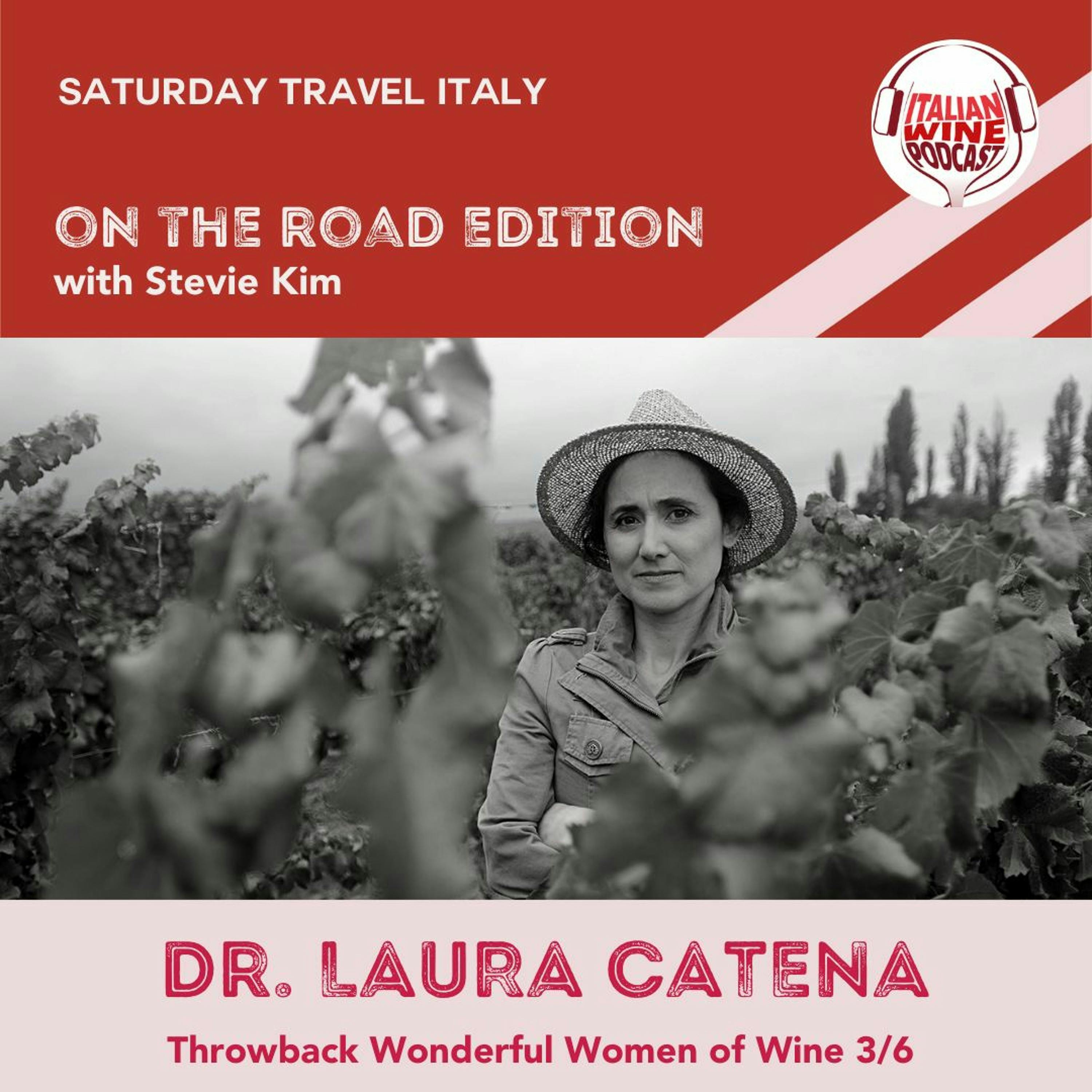
Ep. 1531 Dr. Laura Catena | On The Road With Stevie Kim Throwback Instalive
On the Road with Stevie Kim
Episode Summary
Content Analysis Key Themes and Main Ideas 1. The unique characteristics and advantages of viticulture in Argentina, particularly Mendoza's high-altitude regions. 2. The Catena family's pioneering role in high-altitude winemaking, clonal selection, and sustainable practices. 3. The impact of climate change on winemaking, with a specific focus on water management and adaptive viticultural strategies. 4. The specific qualities and tasting notes of Malbec from different Mendoza sub-regions and why it performs exceptionally well in Argentina. 5. Laura Catena's personal reflections on family, life lessons from the pandemic, and the practicalities of a travel-heavy career. Summary This ""On The Road Edition"" episode of the Italian Wine Podcast features host Stevie Kim interviewing Laura Catena of Catena Zapata. The discussion begins with the podcast's success and Laura's practical choice of wearing a beret, before delving into serious wine topics. Laura elaborates on the Catena family's long history in Argentina, their Italian roots, and the significance of naming vineyards after family members. A key focus is on the unique terroir of Mendoza, especially the high-altitude vineyards that allow for diverse microclimates and the creation of complex ""altitude blends"" like the Catena Malbec. Laura addresses a WSET student's question about phylloxera in Argentina, explaining it exists but doesn't propagate widely due to factors like dry air and soil composition. The conversation then shifts to climate change, with Laura emphasizing that water management, rather than temperature shifts, is Mendoza's primary challenge, highlighting the transition from flood to drip irrigation. She also discusses her father's foresight in planting in cooler, higher-altitude regions two decades ago, a strategy now increasingly adopted globally to adapt to warmer climates (e.g., Bordeaux allowing new varietals). The interview includes a tasting of Catena Malbec and La Consulta Malbec, with Laura describing the wines' characteristics, such as the natural vanillin and umami in Malbec, and the influence of limestone soils in La Consulta. She concludes by sharing personal anecdotes about life during the pandemic, including spending more time with her husband and taking up tennis. Takeaways * Argentina's high-altitude vineyards offer unique advantages for winemaking, enabling diverse microclimates within close proximity for innovative blending. * The Catena family played a pioneering role by planting in cooler, higher-altitude regions of Mendoza to achieve superior wine quality, aromatics, and natural acidity. * While phylloxera is present in Argentina, it is not a widespread threat due to specific environmental factors and the natural resistance of Malbec's deep root system. * For Mendoza, water scarcity and efficient water management (like drip irrigation) are more pressing climate change concerns than rising temperatures. * Malbec in Argentina is characterized by smoothness, vibrant fruit, floral aromatics, and natural presence of vanillin and umami, making it highly versatile for food pairing. * Global wine regions, including Bordeaux, are adapting to climate change by exploring and implementing new grape varieties and innovative viticultural practices. * Sustainability efforts at wineries extend beyond viticulture to include energy efficiency and reducing their carbon footprint. Notable Quotes * ""In Argentina, because of the altitude, in forty five minutes, you can go from a place as warm as the southern Rome to a place as cold as champagne."
About This Episode
The hosts of On The Road Edition discuss their recent trip to Argentina and their upcoming wines. They also discuss their shared backgrounds and discuss the importance of water management and cooler climate conditions for better wine yields. They talk about the use of Filoxer and the importance of understanding water needs for better yields. They also discuss the impact of climate change on the wine industry, including planting in cooler climates and reducing energy usage. They also touch on the unique stone in La Cons authorization and its salty and sweet tendon. They remind viewers to subscribe to the podcast and donate through Italianwine podcast dot com.
Transcript
Since twenty seventeen, the Italian One podcast has exploded and expects to hit six million listens by the end of July twenty twenty three. We're celebrating this success by recognizing those who have shared the journey with us and giving them the opportunity to contribute to the on success of the shows. By buying a paper copy of the Italian wine unplugged two point o or making a donation to help the ongoing running costs, members of the international Italian wine community will be given the chance to nominate future guests and even enter a price draw to have lunch with Stevie Kim and Professor Atigioshenza. To find out more, visit us at Italian wine podcast dot com. Welcome to another episode of On The Road Edition, hosted by Stevie Kim. Each week, she travels to incredible wine destinations interviewing some of the Italian wine scene's most interesting personalities talking about wines, the foods, as well as the incredible travel destinations. Okay. We're now live. We're waiting for Noda Catana. Okay. So we're oh, here she is. Hey, y'all. Hey, Luna. Can we start? Go ahead. Alright. So we have a surprise for you. Are you ready? I'm ready. One, two, three, Sounds good. Jam eating. Listen. We have you noticed something different? We're all wearing stuff like that. Yeah. We know we're all wearing, like, stuff on our head because in your honor, we can find bread. Oh, no. You didn't ask. For me, for me, it was so normal that you were wearing some hats that I thought Why not? No. Listen. So what is the story with the barat? Hey. Do you want the the true story? Yeah. The true story. Yeah. So, well, first of all, the barat is a gaucho hat. So in Argentina, the the cowboys were a beret because it's from the best country. You know, we have Spanish Italian Native American. So the gaucho hats, this is the gaucho hat you can buy it in Argentina and the gaucho stores. And I always used to dress like a gaucho when I was a little girl, so I've always worn it, not as much as I wear it now. But the main reason, Stevie, is that you don't have to go to the hairdresser. It's instant That's good. I like it. You're so practical. You're so smart. I knew I liked you for so much. But think about it, Steven, when I when you're traveling every day, you're going to a new country, I mean, how do you actually, you know, dry your hair and make it look good? You put a a hat. Listen, so loud. Thank you so much for doing this. We're doing this mostly for our w set students. And also, like, I used to see you at least once a year, at least. Yes. Especially in New York. When was the last time you've taken a plane? Actually, the last time was when I went to Argentina in February, of it's it will be a year since I last took a break. Oh my goodness. Yes. Yeah. It's been a long time for me as well. It's crazy. We were always flying all the time right in the past. Yes. Yeah. How our lives have changed. So, listen, we're going to this is the following I try to keep it kind of skinny. We'll do everything in half an hour. We have two wines today. You know which wines were they sent to the wines. We have the Consulta Malbec. Okay. And then we have the Katena Malbec. Oh, perfect. Perfect. The high mountain vise. I do you want me to think you did? I think I I I think you you did, but it do I know those wines very, very well. So I Are you sure? I mean, This is nice. Are you sure? The the bread and butter. The Cadinos are back if if listen, Stevie, if I don't make a minimum back, I don't send my kids to college. Yeah. It's good. Good job. So listen, what we're going to do is, first of all, mean, this has been a really, really difficult year. As we are, I mean, reading your bio is, like, you know, the Marcus, you know, the hundred years of solitude. Right? There was, like, Nicole. By the way, cola is italian. It's Machigiano, your grandma. See. And I also have genovese from my mother's side. Oh, my god. The worst of two kinds, like the Machigiano genovesey. I think so. And then it was your dad. Also, Nicole. So, actually, it's my great grandfather. He's the Martigiano. Right. He was married to another Italian woman, Anna Mosqueta. And then there was my grandfather. His name was domingo said that, you know, in Argentina, they didn't allow people to keep their Italian names. So they had to Spanishize them. So he was domingo. He said that, but he would have been domenico vincenzo because those were, you know, the the ground the the whatever the Italian rules are for naming that Everybody in my family used to call her. Is Adriana Katayna someone you're related to? Yes. And she's my sister. Oh, honey. Chow, Adriana. She's one thing. She's like, she's there. I didn't see her. Yeah. She thinks it's funny. Okay. That's good. So for a second, and you're entertain me your sister. Okay. And then and then it's my father, who is Nicolas Catena, and he sometimes uses the Zapata, which is his mother's side, which is the Spanish side because we are Italian and Spanish, but really, we are Argentinian. And then there's me and my two siblings. One of them is Adriana, who just waved, and our most famous vineyard is named after her. And honestly, you know, people always ask, why is there a vineyard named after your sister or not you? And she was there when my father was planting this vineyard. And honestly, what it was planted is it's a fifteen hundred meter celebration. It's just the most glorious place. My father didn't know it was going to be so great. Right. And so I think it just happens to be that way. And if you leave my sister, she's quite beautiful and amazing. So I told my sister, I said, if you're going to go and water my Instagrams, go on this one because this one will be fun. Yeah. Okay. That's good. Good good job, Lauda. I I will make you my be awesome when if you don't have a job. Actually, one question I did have as a student, because, you know, I've started my diploma program. It's just because I had nothing else to do. Yeah. Well, no, but you you know what, CD, you are the right person because you know how to make things fun. And I think the major problem with wine, why more people don't, you know, get interested in wine is because so many people teaching wine are so boring. And if you can infuse the wine world with you. Well, I'm definitely an alcoholic, so I will make it successful. That's for sure. Okay. So having said that, I have a w said diploma question. Yes. Yes. How come there's no Philoxer in Argentina? So, actually, there is a little bit of Filoxo in Argentina, and there it has been described over a hundred years. So a hundred years ago, they identified the first Filoxera. However, it doesn't propagate. Well, actually, we did some research because I have this theory that maybe the strains of the locks that we had were less aggressive. Actually, we have some very bad locks in Argentina, but it doesn't propagate. And some of it is related to the soil composition. And some of this is related to the very dry air. The flying phylloxera doesn't like the dry air. Yakapo is suggesting altitude because also the altitude. It might also be the sunlight intensity because the thing about altitude is it's cooler but cool shouldn't be an issue because in burgundy is quite cool, and champagne, they got phylloxera too. So I think it might could be the sunlight is so strong that the little insects don't like it, but the bottom line is that phylloxera just stays in one place and it doesn't spread. So we have the lobster, but it's not a problem. Minitoads are a bigger problem. Alright. Okay. Listen, does anybody have a question for yeah. Hold on. Let me can you pass it on to Yacobhan? I have again a question about Tara. Actually, climate changes now are a big issue in all one, well, only in all the world for wine. But since New York Mendoza is a big critical area, especially for water management, How do you face this situation in your vineyards? Yeah. So, Jacob, this is such an important question for every producer in the world. Do we have an issue with water? Because, we have the glacier water, so I our vineyards drink mineral water, but these these glaciers are smaller now than they were twenty years ago. What we have done with water is we're studying every possible way to save water, to capture water, and also drip irrigation is very So in Argentina, when I was a child or even twenty years ago, most of the vineyards were flood irrigated. And now most vineyards are drip irrigated. It's not only better for quality, but it's also better for the environment because we say border. And actually, I'd like when Europeans asked me the question about irrigation. I like to answer it because, generally, in Europe, it's considered, oh, if you irrigate your vineyard, you're just some producer trying to get a ton of grapes and and keep white. Delicious is the lack of water. I should No. But but, actually, in Argentina, we need water and we irrigate. It's like an art. So people, it takes about ten years to learn how to irrigate, and you don't irrigate Monday, Wednesday, Friday. You look at the vine and you give a little water when the vine needs it for the vine balance. So it's actually a very it's part of the art of wine growing and making is understanding, the vine well enough. And each so in every place, And even in parcels within a vineyard, you need to understand the water needs. But I agree with you that the key issue really is about climate. But if there is no water in Mendosa, we have no vines. But the other question about temperature, So, we actually did what the rest of the world is going to have to do, but twenty five years ago, when my father decided to plant in the cooler climate areas where nobody had planted, like the at the end of the vineyard I was telling you about, there were no vineyards there in Cortaceli. And he traveled around France and actually what he realized was that he needed cooler climate to make, you know, more age worthy complex wine with better aromatics and natural acidity. You know, in the old days in Argentina, most wines were acidified. And my father wanted to make wines that were just coming out of the vineyard to be made into wine that you didn't need to add anything. So he discovered this whole region, not not the whole regions. There were some vineyards in the Uko Valley, but not many. And so that is now the main, you know, quality production region, the Uko Valley, but it was a tiny region, you know, twenty five years ago. So in Argentina, we made a move to cooler climate through altitude. And I think this is something that's going to have to happen in the rest of the world where people will either have to move to cooler areas or plant to different varieties in current areas, which, you know, Gallaud announced, I think, two weeks ago, that they're allowing new varieties like, Marcelaan. They're actually the Marcelaan. They're allowing Marcelaan, and then they're also allowing Turiya Nacional also. Look Google it. I think that? Maybe one of the students can look it up. I don't think they allowed Alvarino. No. No. There's this is what tincta, her name the person's name is tincta Ifina, and she wrote Albanino. Ah, no. No. I don't think they're allowing Arbanino in Bordeaux. So now the Bordeaux blend can have up to, I think, it's ten percent from these other grapes that they think are better adapted to a warmer climate. Actually, we're working on w set diploma book. I think it was still written ten years ago, so I'm sure we don't have this. It won't be in the exam. That's all I care about. Listen, we don't have that much more time. Yes. Moment. Yes. We have two little lines. Okay. Very good. Okay. So what are we drinking first? Okay. Let's have first the Katina Malbec. And, which which is the vintage? Two thousand eighteen. And they consista is two seventeen. That's actually very fun because it's just a very classic year from Mendoza. You know, it wasn't too cold, it wasn't too warm. There was enough water, there was snow in the Amez, no frost. It was just one of those years that growers liked because they they produce good quality, but in decent quantities. So it wasn't a small vintage, and seventeen is a much smaller vintage. But again, La Consula comes from one place, and the Cadena Malbec is a high altitude blend. So this is a very good tasting to do together. In fact, I would recommend that everybody be tasting both together so they can compare a little bit. Right. Can you just point out, like, the main differences? So to me, the Cadena Malbec is what I call our channel number five. Why? Because it's a Oh, wait. Let me try. Yeah. Please try it. Please try it. I'm sure you smell better now. Well, so the Katina Vivek is a blend of five different locations. Let's say that in France, you wanted to go and blend from the Ron and Berg and Deambardo and Champagne. This would be bad. I have to interrupt you because somebody's experimental border grapes are adding now my Spanish is so great. Castets, Marcelon and Turagon at Sunala for reds, Alvarino, and for whites. Oh, so our guest was correct. And I I said no. I I am so sorry. Okay. I'm sorry. So let's go back to one take it to the difference between two us. Yeah. But, actually, very sorry to that person, mister Arvigno, and I was wrong. Thank you for participating. Okay. So the catena is a blend of different altitudes. And now if in France, you wanted to mix all these different climates, it would be crazy. You'd be driving the grapes seven hours. Right? But in Argentina because of the altitude, in forty five minutes, you can go from a place as warm as the southern Rome to a place as cold as champagne. And Marbec does well in all those places, but with different flavors. So both all these vineyards for both these wines are drinking, but let's talk about Catina first. Are planted with the Katina masala selection. So we have a selection of a hundred and thirty five cuttings that come from us. How long did that take? It's a hundred year old vineyard. It was about, I don't know, seventy something years old when we made the selection. And then we preserved that selection in all our vineyards. So you're talking about the same missile selection planted at different altitudes. And so it's like the same person and it's different expressions, and then you put all that together. So you get the ripeness from the the warmer climate, and then you get the concentration and the really beautiful acidity from the cooler climate. And so what I call this is an altitude blend, and really Argentina is the only country you can do this because you have these different altitudes so close to each other. Are you enjoying this podcast? Don't forget to visit our YouTube channel, mama jumbo shrimp. For fascinating videos covering Stevie Kim and her travels across Italy and beyond. Meeting winemakers, eating local foods, and taking in the scenery. Now back to the show. And so what I love about this wine is that it's a very a wine that's very. Complato. I don't know how you say that in in Italian or English. Complato. Complete. Oh, you say completo? Okay. Okay. Because it's not even yeah. That's it. So because it's got everything. You know, it it's delicious. It's smooth. Malbec, so if you're in a blind tasting, remember, Malbec should be very smooth. It should have floral aromatics, very bright floral and fruits. Lots of color, very deep color, but it should be smooth. If you find some greenness or bitterness, it's not Malbec. And this is why Malbec was surprised in the middle, you know, in the in the eighteenth and nineteenth century because they had the carbonate that was a little green because they were harvesting earlier, and they needed the Malbec to soften it. So what's key about the Katina Malbec is that it's an altitude blend, and these are all ungrafted vines also because most of the Malbec planted in Argentina as a grafted at least ninety percent of it. We sometimes will we usually plant chardonnay and pinot noir. For example, with graft, with the American rootstock. Many people don't know this. Most masters of wine, master Somier, WCT four five. I don't know what's the highest. They don't know this. So Malbec has very deep root system. It goes down to to up to two meters. So it can withstand, you know, problems with dry nematodes, the little relaxer we have. So, okay, so this is Yeah. I have a question. Yes. I want to know. I was the the current vintagja. The one that that two thousand and twenty one or two thousand and twenty. Yeah. Twenty one. Okay. So twenty one, we did have a frost. So it will not be, like, eighteen. That was just, like, quite big. But so far it's starting now. It's going really well. And we've actually, you know, we've kind of escaped the frost and the hail So usually the only bad thing that could happen is maybe it becomes very rainy at some point. We did have some bad rain about a week ago, but it was early enough that it's not a problem. In fact, we like a little rain, you know, about a month before harvesting because Usually, the the vines are very stressed. And so so far, it's looking very, very good. Yeah. Great. Thank you. Okay. So Sean has a question for you too. You're Sean. Yes. Hi, Laura. Hello. So follow-up the climate change topic. I want to ask, like, what do you do differently in the January to, counterpart like the climate change? What do you do? Now, a different sense. Yeah. Well, I think that the the main change we made was planting in cooler climates, but that was not for climate change. We were doing it to get better quality and better. Today, the main issue, I think it was the a couple that that was saying that is water. That is the main issue of Mendoza. We have less, warming in the southern hemisphere than in the northern hemisphere. So just by, you know, good cover crops and, you know, you you can leave a few more leaves on the vine. Like, there's things you can do if there's a little bit of warming. So so far, warming is not a big issue. We've actually had some of the coldest years in the century recently. So but water is a bigger issue. And, you know, and and to me, the the other big issue is, you know, the impact of people because, you know, the the water scarcity also affects people communities all over the world, and and it affects disease pressure on the vines on people. So, you know, that's that's a much bigger conversation. But at the winery itself, you know, we make wine with the grapes that come in. And I wouldn't say that the climate change is is is any big impact. We are doing a lot of work on sustainability in terms of, for example, being much more judicious about measuring, you know, how much electricity we use, you know, trying to we we we are reducing a lot, you know, the the gasoline, the energy that we use. And and in fact that there's a recent statistic that I looked up that, for example, in Argentina, people in Argentina, the per capita, carbon emissions are a a fifth of what they are, let's say, in the USA, Australia, and Canada. And actually in Italy, they're higher than in Argentina, but not as as high as the United States. So it it I was having a really interesting discussion about this, you know, which is that everybody's talking about climate change and reducing carbon emissions, yet there's some countries that just because of the lifestyle, you know, in Argentina, many people don't have a car. Whereas, you know, in other countries, families will have two or three cars. In Argentina, no family has more than one car, you know, and people carpool. It's normal to carpool. People take their bike. So I think that's another issue for climate change. I think we all need to work on it, but some countries harder than others. Thank you so much. Thank you. You're back too. Oh, okay. We have some questions from them that I can't read it. So this is climate change ranging food troubles and Oh, hail. The problem is with the hail relating to climate change. Yeah. I I think hail has been I mean, when I was a kid, hail was the problem. You know, I think hail is Hale. I wouldn't say that we're seeing more hail. We are seeing, actually, in some places, worst frost, which sort of doesn't make any sense because it's it's cooler. But it it might be related to to to less water. Usually humidity protects you from frost. So That's not what I was expecting. Yeah. Me neither. But I I would say, like, if I look at my memory, we've had some big issues with frost. I think it's very hard to talk about climate change, you know, when you think of the last five years. It's more of the last fifty years, you know. So, you know, since the human memory usually I can't remember more that the last year You know, it's it's hard to, you know, you you actually need to sit down and quantify to have a good assessment. Oh, yeah. You know, the audience they're asking if we can save this lot, they love you. It's never happened before. So, yes. No. For you guys. Listen, we have Stevie. Okay. No. We have four more minutes. We need to talk about Consulta. Yes. Okay. So La Consulta is this district in the Southern Uko Valley. And what's very particular, I'm gonna show you. So look at this stone. So it's it's covered in limestone. See, calcium carbonate. So the soils were formed when the oceans covered and then the undist grows up. And so we have a lot of marine deposits, and we have all this calcium carbonate from the rivers drying. And this, you know, I used to think that this was a French thing to always talk about limestone and calcium carbonate, but we do find that it the places that have more calcium carbonate do give us, like, some what more elegant wines. So there must be correlation. I don't know what it is, but we find that, you know, with our experience. So in La Casota, you have, like, that stone I showed you, but bigger. Because it's at the beginning of a cone, of an alluvial cone. So these big stones make drainage very easy. And so you can't get high yields, which is a problem if you're trying to make a ton of cheap wine, but if you're trying to make quality wine, is very good because it keeps the vine a little bit of stressed and yields are always low. So it has a lot of power but also almost sweet tenants. So it's a very rich wine with very smooth and slightly sweet tendons that come from this particular place. It's not sugar. It's polysaccharides. But what do you think? Do you feel that as well? I don't. I've been just drinking it. I didn't really feel What about you guys? Listen, there's a question from the audience. Can you define consulita salty because of the carbonate calcium? And also, I love the fact that your prop is a a piece of rock. My prop is like potato chips and, you know, peanuts. Well, I could eat some potato chips now. I I'm never tired of potato chips. So, somebody's asking about salty. So You know, in Mendoza, we do have some salt in the soils. Like, not so much that it's bad for the vines, but we do have a little bit of saltiness, to the wines. It's actually been measured. I don't think it's from the car carbonate calcium. I think it's from, you know, regular sodium that, you know, infiltrates the soils and the water, but I do agree, actually, with the common that has a nice saltiness. But I I don't face some of calcium carbonate. Yeah. He says more savory than salty. Yeah. Yeah. But I but but but it but also a little salty. Momami as well. Umami. Oh, yeah. Oh, this is big. Umami. Umami. Oh, my god. So my bank has umami. We've measured it. It has natural umami material to show me. Yes. Coffee. So, so, my bank has natural, manila, even if you make my bank without oak, you smell vanillin. We we actually discovered this. And That's interesting. And it's not from the Oak. No. No. Well, if you add Okeydoke, you have more, but it it has natural vanillin. And, we actually even had this study that UC Davis. Like, it's triple confirmed. And so I think Malbec, that is why it goes so well with steak and with mushrooms. And I think it goes really well with Asian food that has a lot of umami. So listen, Laura. You can do two things. I'll give you the last question. You can do one of two things. One, you can tell me kind of the three important things that you remember about two thousand twenty last year during pandemic, life lessons, if you will, or you can do your famous Karaoke, despacito, like the one that we did to our New Year's Eve karaoke, which I discovered, it was hilarious because no one can follow you. It was completely in Spanish. Well, for for first of all, you make it easy choice because I can only do this passita if you hear the song in the background. Right. That's a good time. That's terrible. That's why I will tell you about but let's do, I gotta okay again because I had so much fun. Thank you for inviting me. Okay. So, I think the main thing is I got a dog before COVID. You know, I think going for walks with or without a dog is something that I discovered, and I think that it's something that everybody should be doing, like, remembering that My husband has complained a lot about me over the last You have a husband? I have a husband. Oh, I can know that. We're twenty five years this year. He's American, but he speaks Spanish very well, and Italian. He loves Italy. And so my husband was always complaining that I traveled too much, and I always used to think that he was How many husbands do you have? Currently, one. Okay. That's good. So and and he stopped complaining. And, actually, it's been nice to be able to you know, spend a little more time with him. And I don't know. I think that for many people, maybe I was neglecting him. I denied it before, but now that I'm seeing that it's nice to spend more time with him, and I I'd like to continue to spend more time with him. And then also, I have picked up tennis, and having quite a bit of fun with that. Yes. Are you any good? No. I'm terrible, but I love playing. Okay. On my knees busted, but when it gets repaired, then we can hit the ball. Let's great, Dennis. Absolutely. Alright. Listen loud. I'm gonna let you go. I like to kinda keep it. You know, I'm kind of a nazi in terms of being a control freak. So let you go. Thank you so much. And one last time. Listen to the Italian wine podcast wherever you get your podcasts. We're on out Apple podcasts, Spotify, email ifm, and more. Don't forget to subscribe and rate the show. If you enjoy listening, please consider donating through Italianwine podcast dot com. Any amount helps cover equipment, production, and publication until next time. Cheaching.
Episode Details
Keywords
Related Episodes

Ep. 2769 The Younger Wines from the Volcano with Giulia Monteleone & Darya Nagornyak IWA | Clubhouse Ambassadors' Corner
Episode 2769

Ep. 2745 Discovering the "Rive" of Conegliano Valdobbiadene with Lucia Fragoso IWA & Alessandro Favaro of Rivaluce Winery | Clubhouse Ambassadors' Corner
Episode 2745

Ep. 2683 Alberto Rivera IWA interviews Andi Punter of Franz Haas winery in Alto Adige | Clubhouse Ambassadors' Corner
Episode 2683

Ep. 2660 Elena Barattini IWA interviews Ondine de La Feld of Tenuta di Tavignano in Marche | Clubhouse Ambassadors' Corner
Episode 2660

Ep. 2645 From Cheese to Wine: A Food Scientist’s Role in the Wine Industry — with Rebecca Siefring | Next Generation
Episode 2645
Ep. 2638 Ekaterina Vislinskaya IWA interviews Andrea Pieropan of Pieropan Winery in Soave, Part 2 | Clubhouse Ambassadors' Corner
Episode 2638