
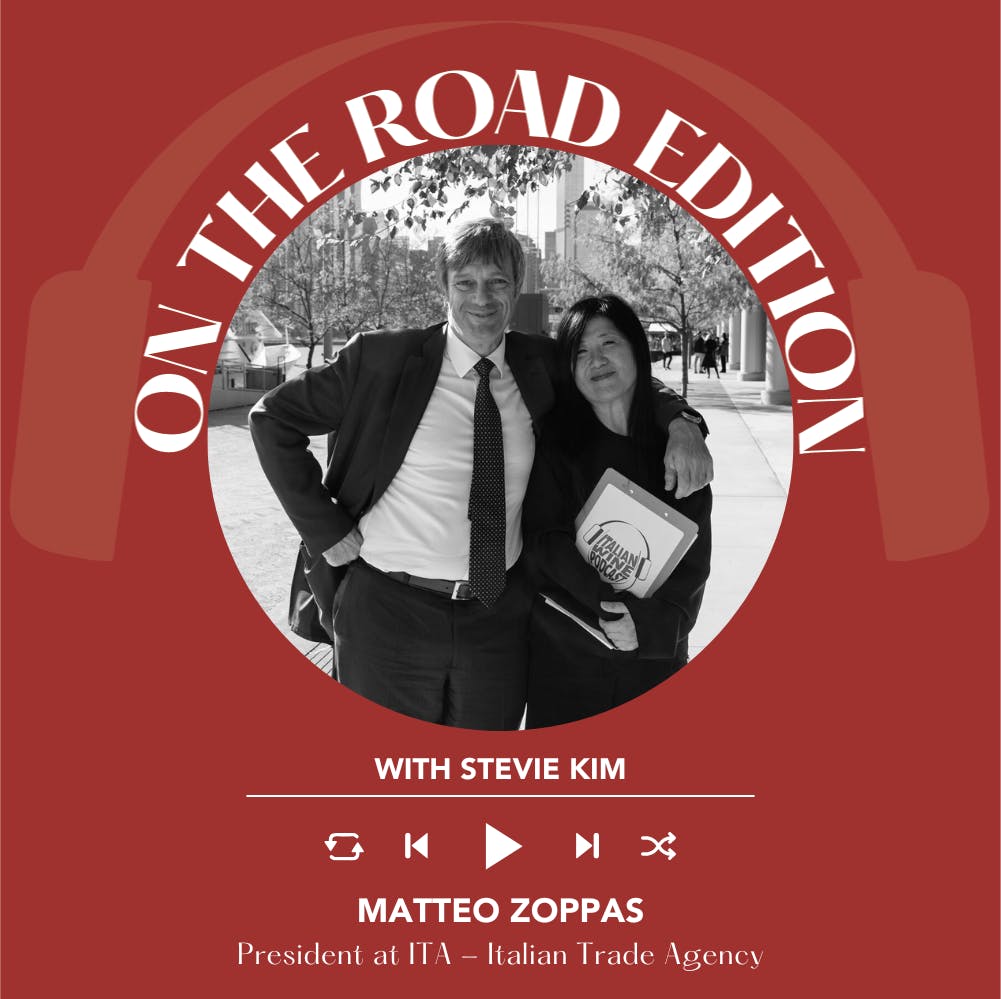
Ep. 2160 Vinitaly USA with Matteo Zoppas | On The Road With Stevie Kim
On the Road with Stevie Kim
Episode Summary
Content Analysis Key Themes and Main Ideas 1. The strategic importance and successful execution of Vinitly USA in Chicago to promote Italian wine. 2. The critical role of the Italian Trade Agency (ICE) and its President, Matteo Zoppas, in fostering ""Made in Italy"" exports. 3. The goal of increasing Italian exports, with a significant focus on the agri-food and wine sectors in the US market. 4. The value and ongoing UNESCO nomination for Italian cuisine's ""immaterial value."
About This Episode
The speakers discuss the success of the Italian wine podcast, the challenges and opportunities of the president of Italian trade agency, and the importance of producing and operators in the industry. They emphasize the importance of people and their ideas to address their industrial choices and strategies for their future. The importance of the Minnesota USA market and the Italian cuisine industry is discussed, as well as the need for instruments to help grow the Italian cuisine business and increase the number of influencers. The importance of talented people and building up projects is emphasized, along with a successful experience in Chicago. The Italian cuisine industry is seen as a government agency and needs to move within the guidelines of the government.
Transcript
Many, many producers and one year told us, thank you because, we may we already made some business, which is the real goal. That's the most important thing. Right? That we they can make the connection and, hopefully, to share business ideas, but also to build business for them. Like everything. Welcome to another episode of On The Road Edition, hosted by Stevie Kim. Each week, Stevie travels to incredible wine destinations interviewing some of the Italian wine scene's most interesting personalities, talking about wines, the foods, as well as the incredible travel destinations. Welcome to Italian wine podcast. This is a very special edition. My name is Stevie Kim. As you can see from the backdrop, yes, and the horn, this is Chicago, Vineictly USA. First edition in Chicago, and I'm here with the president of Italian trade agency. Mato Zophas. So, Mato, you know, we've met for the first time. We did this. This is a deja vu. We did this, in in Provine about a year and a half ago when you had just started as the president of EACH. So how has your life changed since then? Well, as I had not seen my family You don't see your family anymore. Most at all, but I am, trying to, to give, to this job, the maximum maximum effort, and my life has changed because I'm always traveling, much more compared, like, before. But also I'm, knowing getting to know different realities, three hundred and eighty eight degrees, thirty sixty degrees, the mini Italy products, and, and categories. And let's say it's an dysastic, path and journey that I'm that I'm doing, that it's building up pretty much my, my knowledge, I would say. So, you know, I mean, of course, there's the highs and lows the challenges and opportunities as the president of each and Yes. Sometimes it's tough, right? You can win all your battles. And you are dealing with all the entire spectrum of industry tries. But of course, what I'm interested is just wine. I only want to talk about wine always. So, of course, Italian trade agency has been an unwavering partner for Vinitally, Vineitulating International Academy. And today, of course, in Vineitally USA, in Chicago, they have been involved in doing a little mini VINitli, if you will, as a sampling of VINitli in Verona. So they've been involved in inviting all the different buyers and wine personalities. And here, we organized a mini wine business form of three panels. Tell us a little bit about that. Even more than that, I would like to tell you why we did this. Okay. So tell us why we did this. We we contribute to and organize this, in Italy, USA in Chicago because we wanted to fulfill, lack of space, that was evident in the United States market of, There was not a real show, one show. So with Verona Fierra, and in Italy, we spoke with the Camerico Mercro in, the chamber of commerce in Chicago. They had a little boutique of show about wines. And, we decided to take this format and and to grow it to make it, international, to make it first national, but also international. And to do this, what you need to have is to have a good, producers and, good operators and buyers that comes. And most of all, the success of, of a show You have it when, the producer really are selling and doing business, either at the show, either with the relation that build up and the tokens that build up during during the show. And our challenge was to build up in a short time a really important, show. We took the risk. We took the challenge. And, today, which is the second day of the show. Let me say that I'm, very happy. And I feel that, the target has been reached. So it's like mission accomplished, more even someone is saying here and on me, but someone on producers and on producer's side and also on the buyer's side the comment is, even more than expectation, which is a very important sign. And, again, to do this, we we started to put together good producer, good operators and buyers. And we created, a brand of the Vinita USA. To do this, we wanted to have also, something responding, to the real question of the people, either producer and, and buyers, on the future of the Italian wine in the United States. So we took the, most influencing people in, in the country, which is, Steve Kim, of force to moderate this this panel to help us build up the panel. Of course, your auto authoritativeness together with the the Navy President, Robert to BSN, also authoritativeness was, certifying the importance of the of the conduction of the panel. But, more of all, we had very important people of the panel. We had, Matteo Lonelli. We had, also, and also, from, Franca Corta. And, let's say, listening Also, the other side, the the the the important and distributed side. Some of the most important people, one of one for for everyone is, is built a lot from the a lot of wine group, talking about what are the expectation for the next year. Is something that, that people wanted to know and to understand to address their, their industrial choices as well and strategies for their, the company in the next future toward the United States market. If I have to take a sum right now of for what we did, which is important. First of all, many, many producers and seniors told us, thank you because, we may we already made some business. Which is the real goal. That's the most simple thing. Right? That we they can make the connection and, hopefully, to share business ideas, but also to build business around. Like everything, if you are building up an instruments, to give to people. You know if this instrument is good if, they're gonna continue to use it. So this is the, the first real ear of, Minnesota USA, and I'm, I'm confident that after this thirstier and with the reaction, the comments and the feelings that the people are having about what's happened yesterday. And today, I think that for the importance of people that were present, and the results that that, they are saying that what they got, I'm pretty sure that next year could be I I never say will be, but could be, I'm confident it could be, even much more important, addition. I think that, the people will talk about this and make some contamination on their category within those people. And more of all, there was an important institutional presence, which doesn't mean only the parents, but there was a content because there are two side two important sites for sure that were present here. One was the diplomatic site. You know, we are working with, it's called the Farnesina, the Maheche, which is the ministry of, foreign affairs. That, was, involved through each, state, to commercial, enter or Italian trade commission, in, in the show. And, diplomacy, so the diplomacy to be used to grow the business, the the Midin Italy business abroad is very is very important and consistent. And and so we had this, important representation also by the general secretary of the, for the feminist ministry, which is, the ambassador Ricardo, and also last but not least, we had a stronger presence of the ministry of agriculture Francesco Dorobrigida that came to testify that, this, show is important for all the, the producers. We had, Caldoretti. We had Philadelphia. We had, I mean, all the representative in this was present because I feel like this is a deja vu of the inauguration when you have to thank all of the, stakeholders. But, I mean, I I I make fun of it, but it is important. Right? You make a fun of it and understand because you always, if you have to repeat anytime all the greetings, but think on on the opposite side. If you don't don't have to to say thank you to anybody, mister. Right. Anybody's nobody's here. Nobody's here. Nobody's here. Nobody's recognizing the importance of the event. So the event was important. The reason we're recognized, the people, was, was happy. We are happy if the the business is developed as the ministry of, of foreign affairs who's who gave the guidelines, said we have a goal. We have to grow up six hundred twenty five billions of mid in Italy export, in the year. And, as you know, sixty four is about, agrally Mantara. So, seven point eight, between, more or less eight is about wine. And, more or less to, a little bit more than two is about the wine, Italian wine in the United States. So, I think this number tells that there is a lot of room to grow. And the instruments that you need to, to use to help them grow it because the entrepreneurs are always working day by day, of course, to reach new targets. But we are giving them an instruments to meet a lot of, potential clients imported distributors, but don't only, you know, here there's the three tiers. So you have the imported distributor and then the clients, and we are adding also some layers. We are adding influencers. We are adding all the the k, people that can make the difference to this to this, category. So I think we did, personally, I'm happy for the job we did until now. Let's see if we can continue. We will try to continue pushing very hard. We put it within also the coordinates of, the Italian cuisine, Condidation to the immaterial, UNESCO. When is this going to happen? Two thousand twenty five. Two thousand. So next year. Yeah. It's, like, one year from now, we should have a response of this. But, I mean, if you ask me, I think that, this price is something that, the Italian cuisine has already should have already. I know. I'm surprised that it was in part of the UNESCO heritage already. Well, you have the French cuisine. I think Marroquine, cuisine and, some others. I think Japanese. Maybe Japanese. Yeah. But I think that Italian cuisine, it's it it deserve it. When I say this, I'm very worried that it doesn't go through, but if it doesn't go through, doesn't mean it doesn't deserve it. I think that some bureaucracy can, can create some, some differences. But it's very nice to understand. And open up also my mind, what does it really mean immaterial, immaterial value of the talle cuisine, which is, not what you eat, is not what, not not, recipes in itself, is not, the tastiest. But, the value of, of the Italian cuisine, within the society. So it means the tradition, it means the ability and the power of the Italian cuisine to put people together, families, friendship, business, you know, that, anytime that people in Italy wants to fix some problems, they say I invite you to to have dinner or lunch so we can talk and fix things. So it's a it's a very important value that it it has, within this world, it's telling Yeah. I mean, in wine, we talk about a sense of place. Right? And I think that's that's quite important also with, of course, a Italian cuisine. I think that's a good place to wrap the this up. Is there anything else you'd like to say? I feel like sometimes your job is incredibly challenging because you're like a director, a movie director, and you have to coordinate all of the different stakeholders. Vote institutionally, politically, from the commercial side, and of course, you know, the the professionals. Well, I I I thank you, but I think you're giving me too much importance. No. I think you should go into the movie business. That's what I'm trying to say when you're done. No. I'm not coordinating. I am, I'm following. I think that we have direction from the government. We are a government agency. So we need to move within the guidelines that we receive from, the government, and we, and we have to, let's say, understand how to maximize the results with this instruments that the government is giving to us, putting them together with, all the setups and, and opportunities that the business is giving. So we are trying to assimilate, the best things that, Italy have, business wise, which is entrepreneurs. So the entrepreneurs are all entrepreneurs has their own characters. They know how to express themselves. And our job is to help them to bring abroad what they're doing. It's an easy job in a certain way because compared to other countries, our entrepreneurs know how to do things better than than others. I don't want other countries to be, against this world, but, of course, I'm proud of what Italian entrepreneurs, how to do, the inventiveness, you say, and their capability to innovate and and really to put an identity on what they're doing. I'm not doing this alone. I'm just how do you say trying to understand, with the with the people of, the talent re commission that are the best, let's say, solution we can utilize, but the results I'm not doing, and I'm not done by by my ourselves, what we have done here has been done from, a very important, staff of people that they know how to realize things. They know how to get to positive results. So I'm I'm happy that I'm working with, very, very talented people. One last question. I always say that. Why Chicago? Why are we in Chicago? As I said before, Bishan's I was listening to Federico Breicolo, the president of in Italy and Mauricio, the CEO talking about this, show that was already in Chicago, done by the chamber of commerce, Mr. Mozette, mister, Calchinardi. And I said, at least, and I have some connection there. Why don't we go together? Because I understand there's a lack of, moment of, of shows, platforms in, in United States. And so we came here, we talked with somebody. We defined some strategies. And from there, we started to, to build up. I called it the brand, but the project. And, and, as I said, to build up the project, we needed to have good producers and good, good buyers and operators committed to the project. And, this was a good starting point because there was already someone committed and convicted to the, to the project. As you know, things are happening because of the people, not because anything else. And the people was motivated, challenged, and everybody were believing on this project. So we just amplified what was already running. Yeah. I've been to Chicago many times. This is the first time, which is actually beautiful in terms of weather. I don't know if that's a sign. So please watch this space for more, and that's it. I'm signing off. My name's Stevie Kim, and with Matteo Zophas from Italian trade agency. Thank you for joining us on another episode of On the Road Edition, hosted by Stevie Kim. Join her again next week for more interesting content on the Italian wine scene. You can also find us at Italian wine podcast dot com or wherever you get your pods. You can check out our YouTube channel, Mama jumbo shrimp to watch these interviews and the footage captured at each location. Changing.
Episode Details
Keywords
Related Episodes

Ep. 2769 The Younger Wines from the Volcano with Giulia Monteleone & Darya Nagornyak IWA | Clubhouse Ambassadors' Corner
Episode 2769

Ep. 2745 Discovering the "Rive" of Conegliano Valdobbiadene with Lucia Fragoso IWA & Alessandro Favaro of Rivaluce Winery | Clubhouse Ambassadors' Corner
Episode 2745

Ep. 2683 Alberto Rivera IWA interviews Andi Punter of Franz Haas winery in Alto Adige | Clubhouse Ambassadors' Corner
Episode 2683

Ep. 2660 Elena Barattini IWA interviews Ondine de La Feld of Tenuta di Tavignano in Marche | Clubhouse Ambassadors' Corner
Episode 2660

Ep. 2645 From Cheese to Wine: A Food Scientist’s Role in the Wine Industry — with Rebecca Siefring | Next Generation
Episode 2645
Ep. 2638 Ekaterina Vislinskaya IWA interviews Andrea Pieropan of Pieropan Winery in Soave, Part 2 | Clubhouse Ambassadors' Corner
Episode 2638