
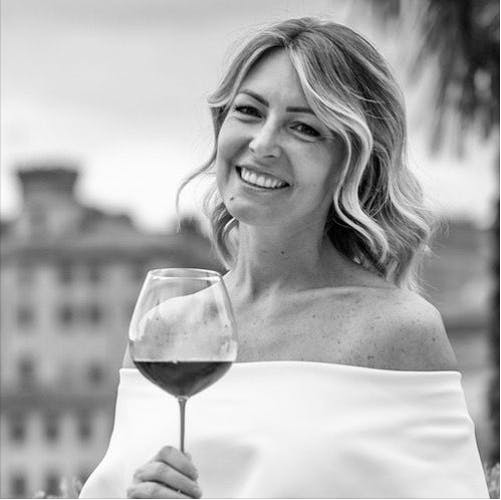
Ep. 381 Valentina Abbona
Storytelling
Episode Summary
Content Analysis Key Themes and Main Ideas 1. The history and legacy of Marchesi di Barolo winery in Piedmont, Italy. 2. The unique terroir and challenges of the Sarmasa single vineyard in Barolo. 3. The traditional winemaking philosophy of Marchesi di Barolo. 4. The winery's sales, distribution, and marketing strategies, with a strong focus on the domestic Italian market. 5. The adaptation of marketing efforts, particularly during the COVID-19 pandemic. Summary In this episode of the Italian Wine Podcast, host Monte Walden interviews Valentina Abbona of Marchesi di Barolo, a historic winery located directly in the town of Barolo, Piedmont. Valentina shares the winery's rich history, tracing its origins back to the 1800s and its acquisition by her family in 1929. She discusses their extensive vineyard holdings across Lange, Monterato, and Roero, highlighting the specific characteristics of their award-winning Sarmasa vineyard. Valentina details the ""hard work"" involved in cultivating Sarmasa due to its steep, rocky, and low-grip terrain, which forces vines to struggle and produce highly concentrated grapes. She explains Marchesi di Barolo's traditional winemaking approach, favoring large barrels, though Sarmasa benefits from a brief period in smaller barriques due to its inherent power. The conversation also covers their sales strategy, revealing that nearly 50% of their turnover comes from within Italy, with the remainder exported to over 60 countries. Valentina concludes by discussing how the winery adapted its marketing during the lockdown, leveraging social media to maintain personal connections with consumers, and extends an invitation for listeners to visit their Barolo estate. Takeaways * Marchesi di Barolo is a historic winery established in the 1800s, located in the heart of the town of Barolo, Piedmont. * The Sarmasa vineyard is a very steep, rocky, and challenging site that produces highly concentrated Nebbiolo grapes, leading to a powerful Barolo often referred to as ""the fighter."
About This Episode
An Italian wine winery called Marbok is famous for its success and success in Italy. The winery is full of small vines and uses small barrels and aging. The family uses their philosophy of linear winemaking and smaller barrels for success. They use social media to promote their wines and plan to visit their family and friends in the future.
Transcript
Italian wine podcast. Chinchin with Italian wine people. Hello. This is the Italian wine podcast. My name is Monte Walden. My guest today is Valentina Abona. Valentina's family winery is called Marchez di Barolo. Whose Dorolo DOCG Salmaster two thousand and fifteen, was awarded ninety eight points at five star wines the book twenty twenty, which, of course, includes wine without walls. The Marchez di Barolo docG Sarmesa two thousand and fifteen was awarded the best Italian wine or the Milure Vino Italiano Banco BPM two thousand and twenty. Many congratulations. Welcome, Valentina. Thank you. I'm happy to be here. Okay. So before we get into the wine itself, just tell us a little bit about the, the history of the winery and exactly where you are in Piamonte and specifically in the Marolo region. Well, that's easy. We are right in the town of Barolo. This tiny village of that counts only seven hundred people but famous all over the world because of the great wine that we're able to make here. Indawa winery sits right in front of the castle, which, used to belong to the Marquisis of the town of Barolo, who are the same people that established the winery back in the eighteen hundreds. So we are right in the center of this little town, and now my family lives on the States since nineteen twenty nine when we bought it. From the church organization to which the Marquis of Barallo, Julia Cobert, left all of her belongings, including the winery that she founded in the beginning, in the first half of the teen hundreds. Mhmm. Well, that's an impressive bit of history. I didn't know that. That was interesting. Okay. So and in terms so, obviously, you're in the, you're in the, community of, which is very handy. So how big is the vineyard and how many bottles do you make a year of wines all stripes? And then how much of that is, barolo? Well, in general, our family now controls around two hundred hectares of vineyards, half of which more than half of which are actually a state. To our family, in the area of, Lange, Monterato, and Roero. So over the years, we had grown a little bit outside the borders of the town of Barall itself. Which is, however, the town in which we own most, of our, vineyards, a full barolo, we own eleven venues, eleven single vineyards, just so within the little town for a total of around fifteen actors. So is, small quantity but very precious given the beautiful, situation in which these vineyards are. And, Sarmas is just one of these beautiful hills right in the town of Barado. And and usually the one that entertains us the most, because of the hard work that we have to do there, because of the work that we have to do in the cellar with the grapes coming from Sarmasa and then the grapes satisfaction that we find in the glass once the wine is made. Okay. Just tell us a little. Give us a bit of detail on on the hard work that you have to get through for the Salmaster. Well, Salmaster is this very steep vineyard in the commune of Verallo already going a little bit towards La Marra. Very steep. It's quite rocky. There is very little percentage of sand on Saramasa, but it's mainly clay and limestone with some bigger rocks in it. So it's not easy to walk there. As especially when it rains a little bit like it did in these last days, it becomes a super slippery. So it's quite dangerous. But in general, there is very little grip in the in the vineyard. So as we have to fatigue her to work under, even the grapes, the the vines that grow there, are actually struggling. So the roots have to go very much into deep to get, to the bottom of the hill where more easily they can find some water and mineral salt to grow beautiful grape. So there is a very big concentration in the few grapes that grow on that vineyard. So, the grapes itself, the berries are a little smaller, which means bigger, concentration and bigger power once, looking at the tiny grape itself. So down in the cellar, we have to work at our best in order to extract the extract, I'm sorry, this great power and, and translate it into the powerful wine with Sarmase. We usually refer to that Barolo as our with fighter in the family. My family today produces a number of different but all according to the different situations in which the venues are positioned. Just, three of them are our single venue that come as stand alone in And among all, Sarmas is definitely the one that has to fight the most in order to be in that class. So that's why the name. Okay. What about the winemaking? Are you using lots of new oak? Small barrels? How do you how does the aging proceed? Well, I would say that our family's philosophy has always been very, linear. Our, our winery, as we said earlier, it's quite a older. It dates more than two hundred years. And we, of course, in these many years, it took, advantage of the different situations, that the timing allowed us, to benefit from. So we did experiment techniques over the years, but our, winemaking salad always been very traditional. So, of course, big barrels are the most used one. In, in the cellar. We have our barrel range goes from one hundred eighty five hectoliters barrels to smaller barraca, which are however used in smaller percentage. Especially on our single vineyard wine like Sarmasa. And, Sarmasa, among them is surely the one that benefits the most from a little bit of use of smaller barrels. Because of this great concentration that is found in the grapes coming from Sarma Sabignet. Do I making a correction Sarma specifically is for the first year to use a little bit of smaller barrel of Barrique and for the majority, thirty, thirty five hectoliters barrels for, the total of the wine for the second year, then all the wine is moved into even bigger barrels in which your rec until is bottled. Okay. And in terms of, sales, who buys the wine? Which, which are your best clients in terms of countries or regions? Well, we're very proud to say that we are very much focused on our country, Italy in which we do almost fifty percent of our turnover and where we are distributed from the very north to the very south, lens included. So it's, there is actually a great opportunity within Italy to taste the, the biggest range of our wines. And then the other, fifty percent is export spread into over sixty different countries. So even by traveling, there is a chance to to to taste our wines and specifically Saramasa, which we are seeing, mostly in the late this year, to be one of the most appreciated baroloza from our family's production. Probably because of this great character, there's a, very strong personality, magnetic taste that that Armasa shows. We feel like the trend, the the taste, in general, of Barolo drink, because it's slightly changing. Going most of the two words, this style of Barolo, very powerful yet super elegant. So sort of traditional well made traditional style. Okay. And in terms of, distribution and sort of marketing, how what do you do to publicize the wines, and especially interesting to hear what you say when you say that the majority of your sales are in, in Italy? Well, this is also probably due to our history. We are from Barado, and we've been always been, very present in, Barado and surrounding our area. So just stayed over the years. Our, marketing approach, I would say that has changed, a little bit over time and especially now after this lockdown, which has impacted, of course, in, in in the opportunities that we had to promote our wines. We always been very present on the market. Myself, I was used to travel more than two hundred days a year to talk about our wines to introduce them, to, show the different personalities that they had. Of course, this was no longer possible. So, I used to do this abroad, but also in Italy, In Italy, I had started again, outside the borders of our country is a little bit more difficult. So we lately took advantage of, different tools like, socials, for example, which have been very powerful. Especially during the months of lockdown to still be able to bring a personal touch outside of our home, even if staying at home. Valentina, I just wanna say thanks to you for coming on the Italian wine podcast. So congratulations for doing so well. This year's, five star competition. And we hope as everybody does, everything gets back to normal soon. And, it's nice to hear that you have a strong market presence in your local area, which I think is an even more an encouragement for anybody wanting to learn about Virolla, to come and see you and your family in person to try the to try your lovely wines. Thanks very much for coming in Valentina, and, we wish you and your family every, continued success. Thank you. We would be very happy to have you here in Barolo now that it's possible to move again. When we say home, we're really being home. We would like to see you here. Okay. Well, I can get I'll get in my old goal from Drive Monta, Chino, and come and see you. I promise. Okay? Is not too far away and is a beautiful live. Chavan and Tina. Thank you very much. Thank you. Bye bye. Listen to the Italian wine podcast wherever you get your podcasts. We're on SoundCloud Apple Podcast casts, Himalaya FM, and more. Don't forget to subscribe and rate the show. If you enjoy listening, please consider donating through Italian wine podcast dot com. Any amount helps cover equipment, production, and publication costs. Until next time,
Episode Details
Keywords
Related Episodes

Ep. 1868 Livin' The Dolce Vita with Jeff Porter Pt. 5 | On The Road With Stevie Kim
Episode 1868

Ep. 1793 Corinne Keddie | Everybody Needs A Bit Of Scienza
Episode 1793
Ep. 1785 McKenna Cassidy Interviews Diletta Tonello | The Next Generation
Episode 1785
Ep. 1287 Lisa Saverino | The Next Generation
Episode 1287

Ep. 651 Victoria Cece | Voices
Episode 651
Ep. 650 Valentina Cubi | Biodynamic & Organic
Episode 650