
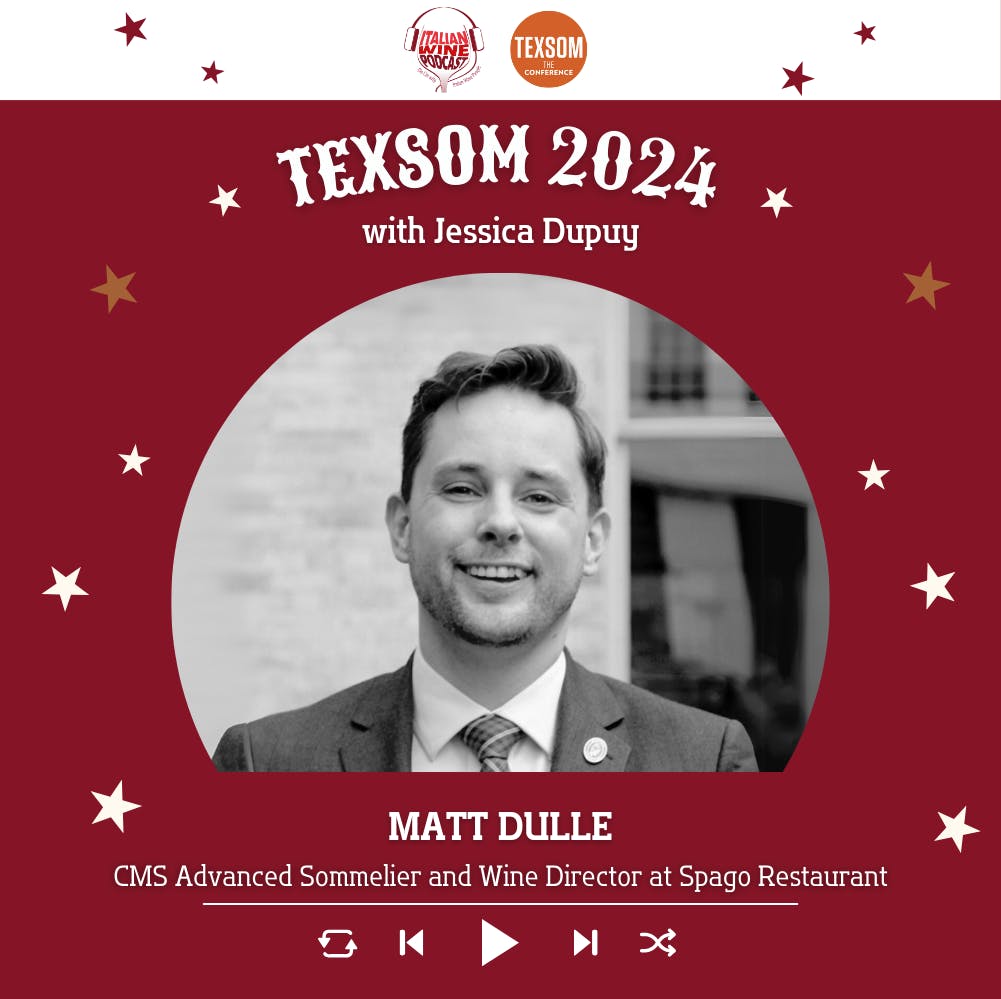
Ep. 2212 Jessica Dupuy interviews Matt Dulle | TexSom 2024
TexSom 2024
Episode Summary
Content Analysis Key Themes and Main Ideas 1. The crucial role of mentorship and community building in the wine industry, highlighted by the Saint Louis sommelier group's success. 2. The comprehensive and transformative impact of the Texsom Wine Conference, particularly its volunteer-driven model, on professional development. 3. Matt Lee's distinguished career trajectory, from his beginnings in Saint Louis to his current role as Wine Director at Spago Beverly Hills. 4. The philosophy behind curating a world-class wine program and delivering holistic hospitality. 5. The importance of integrity, education, and continuous learning within the sommelier profession. Summary This segment of the Italian Wine Podcast features an insightful interview with Matt Lee, the Wine Director at Spago Beverly Hills, primarily focusing on his career journey and the profound influence of the Texsom Wine Conference. Lee recounts his early days in Saint Louis, where a tight-knit sommelier community fostered mutual mentorship and leveraged Texsom for essential exposure and growth. He shares his professional progression through acclaimed establishments like SingleThread and Lazy Bear, culminating in his current role at Spago. A significant portion of the discussion is dedicated to Texsom's unique volunteer program, which offers hands-on experience in managing a vast and diverse wine inventory, fostering camaraderie, and shaping participants' management skills. Lee emphasizes how Texsom has been the single greatest influence on his career and personal life, highlighting the conference's integrity in wine selection and its commitment to providing a memorable experience for its volunteers. He also touches upon his vision for the wine program at Spago, stressing the importance of making ""every bottle a story"" and integrating wine service seamlessly into overall hospitality, drawing parallels with Wolfgang Puck's pioneering approach to featuring farmers. Takeaways - Mentorship and a supportive community are vital for sommeliers, especially in markets with fewer opportunities. - The Texsom Wine Conference offers an unparalleled, hands-on learning experience for volunteers, shaping their professional skills and fostering lasting connections. - Volunteering at industry conferences, even unpaid, can significantly accelerate career growth and provide unique exposure to diverse wines and management challenges. - A successful wine program prioritizes offering a wide range of quality selections, aiming to provide a unique ""story"" with every bottle. - Effective management in high-pressure hospitality environments requires a blend of efficiency, professionalism, and diplomacy. - Integrity in wine education, such as selecting wines for seminars based on editorial merit rather than sponsorship, is crucial for maintaining credibility. Notable Quotes - ""I don't think there's anything that has had a greater impact, not only my career, but also just my lifestyle and, you know, group of lifelong friends and all that stuff."
About This Episode
The conversation between Speaker 1 and Speaker 2 discusses their mentorship and career, including their desire to return to their hometown and their desire to return to their hometown. They also discuss their experiences with remote work and the benefits of managing workforce, including the importance of respect for people and being productive. They emphasize the importance of working with distributors and creating a more casual feel, while also expressing their desire to work with their own teams and create a more casual feel. They thank their audience for their time and encourage them to subscribe to their podcast.
Transcript
We desperately wanted exposure and mentorship and all that. And I think once, you know, once a couple of us found us at Texamba, it was just like holding the back door open and letting them all in, and that was kinda like part of your your education. You know, we had to make it work for ourselves, and we always appreciated it. Realized that a lot of people took us under their wing at some point. So we like to do that too. And Yeah. Yeah. Well, and if you think about it, two of you guys are our master sommeliers and the rest of y'all are all at the advanced level. So it's worked out. Tally y'all, I'm Jessica Du. Guest host for a special Texom series covering the twenty twenty four Texom wine Conference from Dallas, Texas. Join me in the heart of the Lone Star State as we delve into the experiences and insights of key speakers and attendees. Exploring career paths, challenges, and the latest trends in the wine industry. If you enjoy the show, please subscribe and rate our show wherever you get your podcasts. Alright. Well, welcome Matt LE. I am excited to have you here on the Italian wine podcast. Glad to be here. Thanks for sitting with me yet again. It's been a number of years that we found ourselves at Texon together. Yes. Yeah. It's becoming a theme here. It's becoming a theme. Exactly. Tell me a little bit about who you are, where you're from, and kind of your wine journey. How did you get into the industry? Sure. Well, currently, I'm the, wine director at Spago Beverly Hills. I live in LA, which is still weird to say. From Saint Louis originally. I spent time in Chicago, DC, San Francisco, Sonoma, and have been in restaurants for over a quarter of a century now. Yes. I started when I was young, and, always kinda loved it. You know, all my love of wine kinda grew out of for hospitality, and it was just a way to kinda give further hospitality. And then I just kinda got got hooked in where I am. Yeah. Well, I have to mention, you know, we were talking about you earlier in a different episode of the podcast. I spoke to Alicia Blackwell, And, she's also from Saint Louis. And I think it's worth mentioning, you know, you there's kind of a contingent of Saint Louis Somleges. Mhmm. So kind of talk about that. You guys have all kind of mentored each other and everyone's in different places now. Yeah. I mean, it it was Brandon Kern, Andre Avanov, Patrick Gold, Alicia, Patricia Wamehart, myself, you know, just people all over, and it's been cool to see when everyone's done. Yeah. I'm not sure what the magic sauce was, but other than I think we genuinely cared about each other succeeding, you know? Yeah. And I think there was a a good blend of being competitive with each other, but also cheering for each other's victories. Yeah. Yeah. And I think that's also holding people accountable. You know, when we would do chasing groups, it wasn't you know, we I think we got rid of a lot of ego. And just, like, break break it down for me, tell me what I need to do to get better, not, you know, that instead of saying, oh, that's not a classic wine or, you know, complaining about the the rules of the game or whatever. So Right. Yeah. So I think it was just a lot of that. Just earnest ambition. Yeah. And I think we all kind of helped each other and yeah. It came through. Well, I mean, the reason I asked is because, you know, I've been involved with Texom for a long time. And one of the things that I was helping to do early on is mentor people through the editing and writing process, when they were part of summer camp. So, like, you know, working Psalms coming through and getting education and working to as a volunteer behind the scenes for Texom. So at one point, you were one of those summer campers. And I feel like it was not far after that, where it was just one after the other coming through from Saint Louis. It was Andre. It was patched Patrick Gold. And so this is not all about Saint Louis, but what it is about is that you guys found a way to you were like, something about Texom is helping us achieve these goals. Mhmm. And so you would encourage each other to apply and come and be part of that group. I think it does have to do with St. Louis is size as a market. Right. You know, like, we didn't necessarily have all the opportunities. I mean You're not New York. We didn't have a we didn't have any masters. In fact, we had to drive we did day trips to and from Kansas City to a taste with that frost. Really? And so, like, we desperately wanted exposure, mentorship, and all that. And, I think once, you know, once a couple of us found us at Texamba, it was just like holding the back door open and letting them all in, and that was kinda like that was part of your for education. You know, we had to make it work for ourselves, and we always appreciated it. Realized that a lot of people took us under their wing at some point. So we like to do that too. And, yeah. Yeah. Well, and if you think about it, two of you guys are our master sommeliers, and the rest of y'all are all at the advance level. So it's worked out pretty well. Absolutely. And so I don't want you to be too bashful about some of your career because it's been pretty impressive on some of the restaurants that you've been able to work at. And also on the winery side. So maybe give us a little brushing before you got to Spago, where were you? So after I moved from Saint Louis, I did spend a little time early early on in Chicago, working for lettuce entertaining, which I think was a fantastic. Great experience just because I think that's some of the best training you'll ever find. When I moved out to California, that's when I think things started to kinda kick into higher gear. I wound up helping open single thread, which is now, you know, top hundred, top fifty restaurant in the world, three Michelin Star, And just there's so much exposure to think. It's a wines in California, especially when you're deep in wine country. Yeah. And then, frankly, that was kind of a dream job. And it there's only one job in the country that I probably would have taken that that could have lured me away, and it just so happened that I got that, which was running the beverage program at Lazy Bear Yeah. Which was In San Francisco. In San Francisco. Also, it's top top restaurant. Yeah. Two Michelin Star, dinner party style. And, it kind of let me build the dream program. It was, like, a little over a hundred selections when I started. And kinda made a case for why I think we need to go for it. And, we did. I think in my first year, we were at, like, fourteen or fifteen hundred selections, and it's only grown from there. And now it just got the grand award for the first year. Yeah. Yeah. So which to in a year before that single threat got one too? Yeah. And now I'm at one that spot, but which has had one for a while, you know, for it just got our fifteenth. Okay. We gotta hold on to it. So, I mean, you're still, yeah, you're still in the game. But I think, you know, the lazy bear exam is also a good one because it's an every single one of the sant will not maybe not every single, but a lot of the Psalm team that you ended up working with were kind of like recruits also from Texom. You brought some Texans out there like Chris Mcfall and Jacob Brown. Jacob from a fresh faced little punk. I know. Now he's, like Now he's running with a little bit of stuff. Yeah. Exactly. Yeah. We gotta talk about that. Yeah. Yeah. So, yeah, two micheals start grand award. It's pretty amazing. Yeah. In fact, we used there's sort of a talk at the beginning of every tech sound where we say, you know, yeah, well, it's actually part of the welcome speech. Just, you know, you never know who's watching you. So, like, this is it's not necessarily that's, like, an audition or anything, but, like, people do notice when you work hard. And, like, if you wanna, you know, move to a new city or you were looking for a job, like, these connections are are great. I mean, I probably hired forty percent of the Psalms that I've had from TexOM or have had some connection and and frankly having bounced around the country as much as I have. I was only able to do that without taking steps back because of my connection to TexOM. I mean, I don't think there's anything that has had a greater impact, not only my career, but also just my lifestyle and, you know, group of lifelong friends and all that stuff. I mean, it it really is, like, we we jokingly call it sommer camp just because it fits the punwell, but it's kinda like that. Like, some people, you only see once a year, but they're your best friends right away, and, like, they'll do anything for you. And it's a unique feel. If any anyone who went to summer camp as a kid, a sleep away camp knows this feel, and it's apps and I was that too. Yeah. Yeah. It's exactly that. Yeah. No. I think that's it's so funny because we used to joke, like, you know, that Christmas song, like, it's the most wonderful time. Yeah. Yeah. I feel like that's that's a tough song, you know, because you have that feeling of seeing people. The reason I really wanted to talk to you though is because something you told me a long time ago was, you know, you're now an adult in your career in terms of you've really made it, man. But I think one of the things I don't think I told you that, so I hope No. I'm I'm officially letting you know, anyway. I don't know if your parents have told you, but it's you're doing good. So we're proud of you, man. But I love that at one point you said to me, you know, TexM is all about giving back. You know, it's not about just promoting people through and helping them get to where they wanna go one day or don't even know that they wanna go there. But it's also about what are you putting back in? And that's something you've done for a long time now. So you were a somer camper, but in the past few years, you've turned around and you're helping to run the volunteer program for somer cam. So kinda tell me how that happen? What do you do now other than just stay up really late? Yeah, geez. Polish a bunch of glasses. Well, first of all, I will say it's been a little bit different this year because I I wasn't here for the full week like I was. So there's been other people who it kind of mean to That's right. People come, like, five days before the actual conference starts. Eight days for me. Yeah. And, like, it's just it's a lot. And it's the hardest week of my year, but I would say it's it's not relaxing, but it's refreshing for others as we talk about. Yeah. Yeah. But I do go wind up. Yeah. Just going home. Absolutely spent. So but this year, I could only make, you know, Sunday through Wednesday work. But we've had so many great people. I mean, how the new version of the St. Louis contingent is the Mississippi delegation. Yeah. Mississippi's going strong. Yeah. And they're and they're they're killing it. You know, it's like I knew that chuck knicks and Tippy bobs and all that. We're gonna come in and, you know, be able to rock it, Caitlyn. Yeah. You know, Caitlyn Ball is doing really well with it. Yeah. So, yeah. It just kind of so happened that, you know, the people who were kind of running it when I was getting into it, had lives, you know, scheduling competition in the area. And, yeah, it was basically, like, June Road, Dylan, David Keck, and then they had they were done. And, like, well, and then Kat and I kinda took over those two roles. Yes. You know, we always joked that, I managed the people and she managed everything else Totally. Which is great, especially as much as what she wanted and frankly what I wanted anyway. Yeah. Yeah. It was actually a really great team. I longed for the chance to work with her again in in some form of capacity. Maybe that isn't just so draining, but, yeah, I mean, it's just it was kind of amazing to be able to do that because you if you think about it, you know, we've had as many we've had, at some point, over two hundred volunteers. And these are all, you know, very sharp, Tom's restaurant professionals, wine directors. Frankly, people who do what you do. So that to me, like, that was always a very strong motivation to really do well because one, I know if I'm looking at how people are working, I know if people are doing the same with me, and I'm sure there were a lot of people who thought, like, oh, I can do it better than that, you know, because I don't know if we're all that way. We're all a little type a in some way shape or form. Exactly. So, yeah, I mean, it was it was intimidating, but also, like, a great challenge. You know? Yeah. Break it down. Like, what what are volunteers doing? Let's start at five AM or six AM. When are people probably getting up and what are they doing when they make it to the conference center? I think we've normalized it a little more just with some systems. But I mean, I think now, you know, lead teams probably get into breakfast either at seven or a little before. Mhmm. Doing announcements getting ready for, like, the welcome toast, things like that, making sure that everything we need to that wasn't done the night before it gets done and and set so we're not scrambling and pulling volunteers because that just has a domino effect. So there's a few different roles you can get into. There's managing the rooms, which is where I started and I love because it was kinda like service. Yeah. But also you get to try a bunch of great things. I mean Yes. First time I was in, we did, you know, was the vertical of Chapel back the mid seventies and, like Are you kidding? And Braun crew nine Braun Cooper here from the nineties. Like, I just happen to look into the great Which means for that, you're, like, opening the wines, making sure they're sound. Yes. And also creating systems because when you have a lot of hands and a lot of people, like, You've never worked with these people before. So it's, you know, there's a lot of things like, okay. Well, we're opening these five to six bottles of this. One person needs to stay sooner so they can know, where there's variation in that. Yeah. Like, we did it with George and Wines. I'm like, you have to they're all kinda wacky. Yeah. Yeah. You're like, what's the standard here? Yeah. Exactly. And just, like, getting a system. After we I remember one year, we missed. We missed a few seats. And I said never again on a few lines. So now we snake through, we get, like, line up with Wines, one, two, three, four, five, and we walk through and we just snake through the, I would say the dining room because it feels that much like service. Yeah. Yeah. Yeah. And, like, just hit everything and the first person sets the poor level. And that's how we don't run out because we run pretty lean sometimes in some moments. No. Yeah. There's that. You know, like behind the scenes stuff polishing just a ton, a ton of glasses, emptying spit buckets, you know, just all that stuff. And then there is the setting up the wine room, which is probably one of the most beneficial things that I've done because it is What's the wine room? So the wine room is basically where we keep the inventory. Basically, gigantic ballrooms Yes. With tables full of wines. Full of wine, very specific. And some of them very, you know, very specific battleings for this, or maybe they need, you know, for several different things. They're they're sending in, you know, suppliers are, like, Southern lasers or RNDC. They're sending in a bunch of mixed cases, and we have to make sense of it. The way I I always put it, I know maybe I got this from James is we are essentially intaking, processing, and, storing and then serving the equivalent of a grand award list in a matter of, like, four days. I'm just gonna I'm sync letting that sink in because I hadn't thought about it that way. Yeah. Yeah. It's it's it's the world's tops top wines coming through here. Yes. And some back finish, like serious library wines, all of that. Yeah. I mean, we'll get, like I haven't really yeah. That's a lot. That's crazy. Yeah. And it also made, like, made me really comfortable to jump into some of these larger programs that I was able to work with Yes. Because that's that's a big undertaking. Exactly. And, like, I think one of the best things you can learn is sort of the how the dominoes fall and see things if you lose ahead. And sometimes when you're putting together your own program, you don't start to see the effect of some errors or missteps until months out, things like that. But this all happens within four days. So, like, you know right away. It's like, oh, I didn't do that right. And now this is happening. And, like, you just, it's you just learn very, very quickly. What not to what to do and what not to do and sort of the impact of every little action and how I can speed up a step here or, you know, shave off a few seconds here. You know, it's Yeah. Honestly, I I don't know if I can even express fully all the impacts it has. There are times, and I just noticed that I was like, oh, that's where I learned that text. I didn't text them. Yeah. And I'm still having that happen. Yeah. Absolutely. Crazy. But that's it's a lot of wind intake. And there are a lot of things that you don't see all over the world or, you know, Back then, it was Greek wines, which was, you know, very a little more rare at the time. Now it's, you know, we're getting George and wines. We're we're getting stuff from all over the world's sake, things like that. That's one of the ways I got in the sake. A lot of things. Yeah. It's pretty great. I I'm curious if you could tell me a little bit about, you know, once you guys are finished, like, the end of the day, you've set the tables, you've kind of gone through these seminars, like, how does it end? Sorry. I've been talking healthy too. Yeah. No. Please drink. How does it end? I mean, we end with a starter where everyone comes together as like a poli it's a polishing party. I mean, you've never polished more glasses in your life. I mean, it's it's been, you know, tens of thousands of glasses But it's fun because, like, once you get the mechanics down, you're just hanging out. Like, we're listening to music. We're talking, meet new people. I always describe it as side work with people you like. Yeah. Yeah. Yeah. And it's it's funny because, like, a lot of not a lot of places have multiple summaries and stuff. So where else are you gonna be able to work with other soleiers and share ideas or learn new things or hear new perspectives or, like, hear someone else's take on it. Like, it just doesn't happen, at least not in a way where you're actually working with these people in practical ways. But this is also just the camaraderie, you know. Exactly. Yeah. Like, it's just a good What else do you think it's helped you with in terms of straight education, you know, whether it's service or management of people? Absolutely management of people. I feel like this is such a quick period that there's sometimes anyone, like, you need to be hard on people at in your normal job. And Right. But, like, there's time for them to figure out that you care, you know, like, but that doesn't happen here. So it's It's a mix of diplomacy. It's also free labor, by the way. Like, these are all volunteers. That's true. So, like, there's has to be a lot of respect for that. I mean, I am too as well. I get it. But just to have their respect to do that well, also trying to be productive and say, like, we've gotta get going. You know, it's like, it's taught me that there is a way to be professional, efficient spur things to get things done without hurting people's feelings. That comes into play all the time now. I mean, it's just To me, it's the you have to be black and white. Mhmm. Like, this is this is what we have to do. I'm so black and white that, like, there's no emotion involved and it's nothing personal. So, like, this is what has to happen. It has to happen now. It kinda leads to that, yeah, chef mentality. Yes. You know, which I think is increasingly harder in our industry now Yeah. To have. I think everyone just has their own way to, you know, way of doing things, or there's always, you know, there's always a response of some way. Like, oh, how about we do it this way? It's like, how about we we're in the middle service, and we're not we do it the way. I just asking you to talk later. Yeah. It later. Exactly. Yeah. Yeah. And what we will yeah. Next Yeah. Maybe don't do this one because I don't want my my staff to hear this thousand. Exactly. Yeah. Well, and You can hear me going there. Right? Yeah. Exactly. Way back in LA. But it's an interesting. I I don't wanna forget the part that you mentioned here, which is that we are all volunteers. And by that, yeah, you're not being paid for this. So when you're a volunteer for Texam and manager of the volunteers, you're a volunteer. And so that means people are taking anywhere from eight five, three, however many days they choose to come, but usually at least five. Right? Usually, if if they're, salarated, say, expensive vacation days, or if they're not, it's a just that's cutting in the days they can be working. Yeah. So time off work time usually not paid. And yet every year, this the volunteer pool fills up with applicants, and there's usually a waiting list. Yeah. And the only reason I like to say that is because it it really does show the weight of what someone takes away from the experience, you know, that you're willing to kind of you're giving up a lot, you know, a paycheck, if you will. You know? And so I think that that's pretty profound in terms of the impact that the conference has had. Yeah. And I think one of the things that's I I think the volunteers actually get the best experience because you just you kinda get all the cool stuff. I mean, not only do you get education and camaraderie, but, like, we do toast in the morning and, like, we've done some really cool stuff. I remember Bernie Sun, what, with Ttinger, one year we were the first people in the country to taste the o seven Kump to Champagne. And if they're, like, little things like that, they're just, like, little perks to appreciate that. I mean, it's not just, like, you're here. We're getting this experience. You're gonna meet people. It's, like, There's a very strong effort to make this not only a worthwhile, but a very exciting memorable, unique experience. And I think that's huge. It almost the part where we don't talk about it anymore because it's just like what's gonna happen. And here we are. Yeah. And, we do the polishing parties, and I always tell people that if you can get it, if you can get that sponsor slot, it's the best money you'll spend. Yeah. Because you're basically talking to people who are on floor on the floor, the restaurant buying the wines. I mean, like, it's your greatest impact to fact, I was with Reese, I was angling so hard to try to get one of those slots. Yeah. And there's a waiting list. There's people who are are not letting go of that at because it's just so good. It's so good. And I think that's a really good point. Like, it is great when your wine gets poured at a seminar, but those wines are selected more on an editorial basis. They can't be paid for or bought to be poured Yeah. At a seminar. I wanna actually, like, I think I just explain to these people all the time. Yes, there are sponsors, but the fact that there is no way for some big company to put their products in maintains all the integrity. And the byproduct that actually is what led to this Mhmm. Because you had to find other sponsors sponsorship opportunities. So doing a sound lounge. Yeah. Doing the publishing party, those would have never happened if they were just getting dollars like every other conference. Exactly. So it's I mean, I don't know if it was intentional, but that's the byproduct, and that is what's weirdly led to this becoming such a great experience. Yeah. Well, and it becomes that whole, like, oh, is so and so gonna sponsor the midnight DJ session with, you know, what, like you said, Saturday or whatever it's gonna be. And I think that that's, you know, the integrity of the actual seminars though gets maintained because you're hearing from speakers who don't work for any of the wineries or things like that. Like, it's it's very separate, which I think, you know, gives you the right information, gives you the good information. Let's kind of transition a little bit away from Texon because, again, so much of the conference has been able to influence your career. You've been at Spago now for a little over a year? Yeah. About fifteen months. I mean, yeah. Okay. And after having worked at some pretty dynamic wine programs prior to that, what is kind of your goal when you come into an established very well regarded restaurant like that restaurant group, really, because it's very large. What's your job now? Well, there was a lot of, you know, I think when a plate I mean, Spivey's been around for forty two years now. So there's a lot of, you know, it's such a fast paced restaurant. It's such a high volume that inevitably, there's gonna be things that just need sprucing up. It's not an easy thing to do because there's more exciting things to do all the time. So, I mean, my first year was, you know, running through some, maybe, old inventory that didn't need to be there, or, I've literally tore down and rebuilt by hand every single storage rack. I'm not redesigning the menu, which, like, I did at Lazy Bear. Yeah. So it's just all that stuff, building a great team. So it's always something. I mean, I I also with my background having been in service before it was in wine, I I can't not ever be a part of that. You know, I I just need to it's, to me, wine service is part of all of service, and it has to be holistic. Like, my songs are I try to get them to be able to do any job on the floor and also, like, know when to help out and read a table. And not just, I think it happens a lot. And, like, in restaurants that have songs, there are some that just kinda just do the wine thing. That's all it's their own little world. I will never let that happen. Yeah. You know? Yeah. And now it's building I hate to say, like, putting my stamp on the program or making it mine. It's more just getting to what my vision is, which it's kind of always been the same. And I I'll use a line that I think came up in Lazy Bear's Grand Award, and which was wound up being what I set out to do then. And, of course, Jacob is, I'm doing Jacob have taken and run with to spectacular degrees, which is every bottle's a story. You know, a a great wine list it's cool to have, but when I go in for dinner, I don't really care about how many wines you have, how many verticals, because at the end of the day, I'm gonna have one, maybe, two bottles, and each of those needs to be their own story and experience. So and I don't think that's always it's always seen that way. Yeah. Because, like, we have this program and, oh, well, we gotta fill this, you know, hundred dollar bottle of napa CAB or whatever it is. Like, there's a good version of everything. Yeah. You know, and if you're not finding it, you're not, I don't think you're doing your job. Yeah. You know? Yeah. Exactly. And it's easy to find things in and say, well, okay. I just need that and that's it. Or, you know, wheel and deal and let your fire do one a favor, which don't get me wrong. We need to work with our distributors. And, like, they are absolutely partners, but there's a way to take care of them without compromising. I'm just curious in terms of the size, like, sir, so for Spago Beverly Hills, what is the bottle count? How many wines are you working with? And is there a particular lean. I mean, you're in LA, so it's diverse in terms of what the food scene is like and things like that. But is do y'all lean more towards a certain area in terms of the regions of wine that you're serving and because you're not, like, a an Italian restaurant. You're not a steak restaurant, you know? Yeah. Yeah. I mean, at the end of the day, like, the cuisine at Spago would describe as things that make people happy. And I will say I don't think I've seen a restaurant that pulls off doing so many different style. Stiles of cuisine all in one. And it it's not like, you know, they're not reaching or they're not dumbing one down. I mean Which is a tribute to wolfing puck, like, having kind of that vision. Absolutely. Yeah. And, so I I think makes it exciting because there's There aren't flavors. They're just as like a set of flavors have to match with. There's always gonna be a new flavor somewhere. Yeah. So I think there are strengths for sure, like, you know, burgundy, Pordeaux, Italy, California Mhmm. Which I think used to be more California cabin as you know, as I've done in the past, like, I like fleshing that out quite a bit. But I also think that there's there should be a way to represent every region in the in the world in an exciting way. Yeah. And, frankly, if I'm not able to do that, then I make myself do that, and I wind up falling in love with something. And, you know, that winds up getting all of that. You know? So I'd like to not have a focus. I'd like it to be good in certain areas. I'd like for somebody who just likes Bordeaux or just like Berorney, if they just took those pages out of the menu, that they would have a spectacular experience. And also, like, maybe they like Greek wines. Maybe they like Hungarian, maybe it's New World, something on Blanc, or New World Chardonay. And, like, I want everyone should be able to find any version of anything they want. Yeah. So they can. They can discover or they can go for what they love. Yeah. So they can be happy. Exactly. It can be happy. It's it really is that simple. And I mean, that's I mean, it it builds an empire. You know, like, I was always a Danny Meyer fan being from Saint Louis. And when I was kind of getting to Spago and reading around, I realized Oh, man. Like, Wolfgain kinda started this, and Danny got it from him. Exactly. Yeah. In fact, I heard a really cool there was a really cool thing that happened the other day. Dan Barber Yes. Blue Hill. Yeah. Out of New York. Yeah. Exactly. Came in, you know, one of the great chefs of the world. Came in to just do a video of making the famous salmon pizza that we have. And I was kinda confused because, like, it was never worked there. And after he filmed it, he popped into our pre shift meeting, it just kinda, like, I gotta talk to you guys for a minute. You know, he never worked here, but thirty years ago, he had come in and sat at a table, had, some of the classic dishes and watched the kitchen go. And he said, that's the day I decided to become a chef. No. Never worked for wolfgang once, but he's like, that watching it, having that feel, having the just like that happy food, and also he kinda hammered home to the point that, Wolf King was really the first to feature farmers. Ah, which is a huge definite credit for. Yes. Yeah. Like, he was always featuring farmers, and it wasn't like he was, like, making a stance about it. He just did it. And because it felt natural to be, like, you guys need to appreciate this because I literally just had dinner here one night. And decided to become one of the greatest chefs in the world. Oh my gosh. It's kinda crazy. Right? That's pretty impressive. Yeah. Yeah. Thanks for sharing that story. That I kinda wanna go back to spock it. Yeah. I want you to come back to five. Yeah. I know. I'm coming. I'm coming. I'm coming to see you. Well, Matt, thank you so much for sitting down with us for a little while and telling us, you know, a little bit of your background with techsom and also what you're doing in the real world beyond texting. Yeah. This is not real world. You could make a case that most of our wine programs are not with the world either, but yeah. Yeah. Yeah. Beverly knows definitely the rules. Yeah. Such as the life. Right? But thanks for joining me, and it's always great to have a good chat with you. Likewise. Listen to the Italian wine podcast wherever you get your podcasts. We're on SoundCloud, Apple Podcasts, Spotify, email ifm, and more. Don't forget to subscribe and rate the show. If you enjoy listening, please consider donating through Italian wine podcast dot com. Any amount helps cover equipment, production, and publication costs. Until next time. Chichi.
Episode Details
Keywords
Related Episodes

Ep. 2772 A Surprising Partnership between Japanese Sake & Italian Wine with Monica Samuels | Masterclass US Wine Market
Episode 2772

Ep. 2770 China’s Wine Market: From Misleading Import Numbers to Today’s Consumer with Fongyee Walker MW - Part 1 | Asia Wine Market
Episode 2770
Ep. 2760 Winning the Restaurant Floor: Training, Education & Italian Wine with Sylvester Inda of Ci Siamo | Masterclass US Wine Market
Episode 2760

Ep. 2751 From Montalcino to Kazakhstan with Francesca Arquint of Collemattoni | Asia Wine Market
Episode 2751

Ep. 2748 Florida Wine Market & Vinitaly USA with VIA Italian Wine Ambassadors Stefano Campanini & Daisy Penzo | Masterclass US Wine Market
Episode 2748

Ep. 2746 From Almaty to Verona: Inside the Italian Sommelier Challenge with Leonid Kirsanov | Asia Wine Market
Episode 2746