
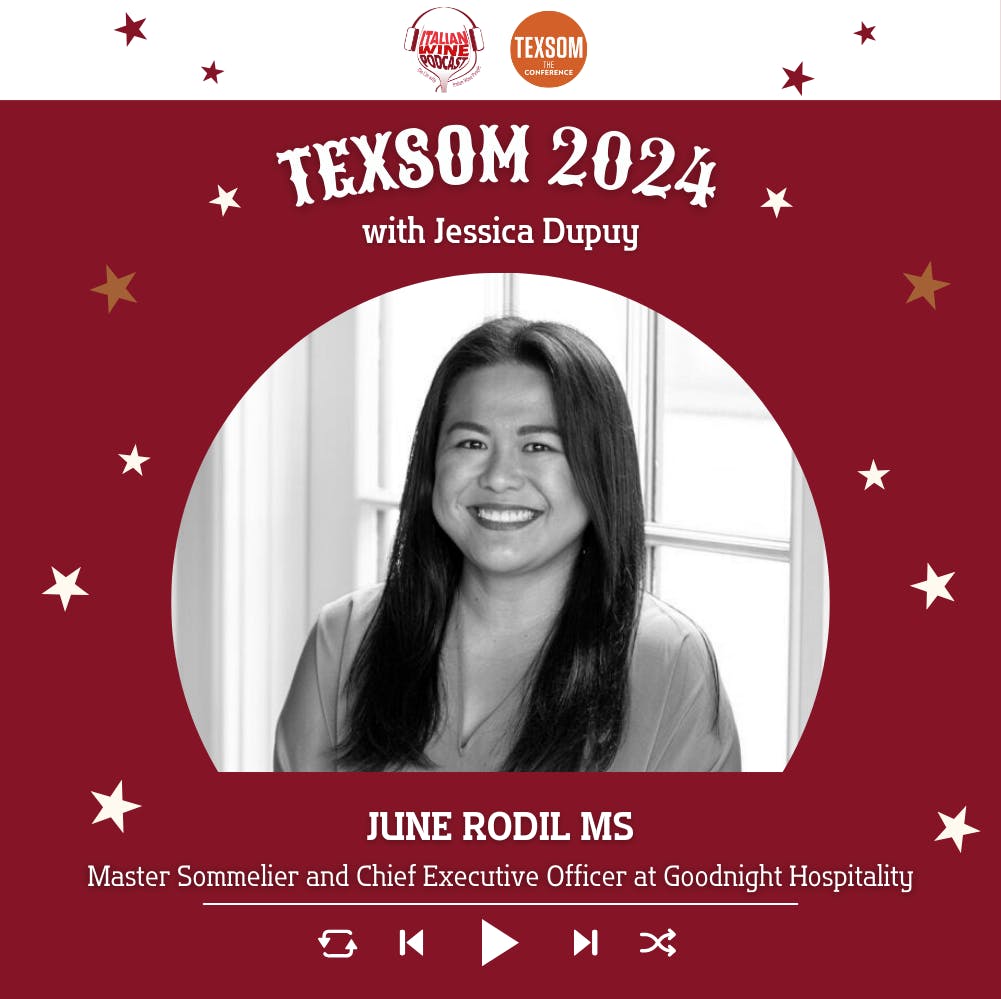
Ep. 2226 Jessica Dupuy Interviews June Rodil | TexSom 2024
TexSom 2024
Episode Summary
Content Analysis Key Themes and Main Ideas 1. June Rodil's unconventional career path from restaurant server to CEO in the hospitality and wine industry. 2. The importance of passion, observation, and strategic career moves in professional growth. 3. The business realities of the wine and restaurant industries, including financial models and industry trends. 4. The evolution of the sommelier role in America and its practical considerations beyond passion. 5. The value and impact of networking and volunteering, particularly through events like Texsom, for career development and recruitment. Summary This segment of the Italian Wine Podcast features an interview with June Rodil, a prominent figure in the hospitality and wine industry. Rodil shares her unique career journey, starting as a server at Olive Garden and progressing through various restaurant roles, ultimately becoming the CEO of a Houston-based restaurant group with over twenty openings under her belt. She discusses the challenges and joys of building a career in an industry not traditionally seen as vocational, emphasizing the significance of observation, problem-solving, and building strong relationships. Rodil, a Master Sommelier, delves into the practical and financial aspects of the wine business, highlighting the importance of understanding compensation models, distribution channels, and direct-to-consumer (DTC) sales. She reflects on how her role has evolved, balancing her passion for wine with the realities of running a large operation. The conversation also touches on her long-standing involvement with Texsom, from competing in its sommelier competition to her crucial role in organizing its volunteers and events, illustrating how the conference fosters networking, mentorship, and career growth within the wine community. Takeaways * June Rodil's career highlights the potential for significant growth and leadership in the hospitality industry, even without a traditional vocational background. * Passion for wine needs to be balanced with an understanding of the business and financial realities of the industry. * Volunteering and networking at events like Texsom can be crucial for career advancement, skill development, and professional recruitment. * The sommelier role in America is evolving, requiring a broader understanding of business operations and not just wine knowledge. * Transparency about financial models (e.g., DTC pricing, distribution costs) is vital for industry professionals. * Building strong relationships and trusting one's team are critical for success in restaurant operations and wine program management. * Flexibility and organization are key in managing the ""brain teaser"" of restaurant openings and problem-solving. Notable Quotes * ""I loved the challenge. And more importantly, it's about the people."
About This Episode
Speaker 0 talks about their past experiences with various restaurants and their desire to become a professional in the wine industry. They express their passion for the industry and their desire to become a therapist. They discuss their past experiences with mistakes and working in different businesses, including their love for the industry and the importance of being open-minded and not just trying to avoid mistakes. They also mention their experience with the Texon industry and the importance of respect and understanding the dynamics of the market. They thank their team and remind them to subscribe to the podcast and donate to Italian wine podcast dot com.
Transcript
Definitely, I feel like you were an early, early part of helping the behind the scenes thing get it stacked together. Not that it was out of that, but I mean, like, it was an exponential growth. Yes. That was, like, very, I mean, very difficult to get through, but Again, like I loved the challenge. And more importantly, it's about the people. Right? Yeah. And selfishly, I will say that it was a great way for me to recruit as well. Yeah. Right? So you have a whole team that has Texom in their background. Absolutely. Yeah. Yeah. A billion percent. I love it because you see people's motivations Yeah. Whenever they're volunteering. Those are thinking about Texom, everybody's watching. I'm Jessica Duppuis, guest host for a special Texom series covering the twenty twenty four Texom wine conference from Dallas, Texas. Join me in the heart of the lone star state as we delve into the experiences and insights of key speakers and attendees, exploring career paths, challenges, and the latest trends in the wine industry. If you enjoy the show, please subscribe and rate our show wherever you get your podcasts. June Rodeal, thank you so much for joining me on the Italian wide podcast. I can't tell you how excited I am to have you here mainly because it's been so long that we've been friends. I'm so grateful. Oh, thank you for having me. I'm super excited. Yeah. Well, if you could just kinda help everybody out, I know you well. Most of the people in Texas and Texas online world know you well and beyond, but give us kind of a little background of who you are, your name, of course, but then also kind of your journey into wine in a short amount of time. Sure. So Jean Rodill, I'm based in Houston. I was actually an awesome forty years. And, you know, basically, very common story. Didn't know what I wanted to do. Was at University of Texas, had a restaurant job as a server at an olive garden. Fantastic. I didn't know that. Yeah. That was my first industry job, unless bread sticks. Yeah. Honestly, poor college kid in it was red sticks. Yeah. Perfetch gold. Yeah. And that's how I fell in love with the hospitality industry. Okay. And so I fell in love with restaurants first. And then after I finished with grad school, I was like, okay. I really, really do love restaurants, and I have a literature degree. So I did not wanna go into higher education. Yeah. And that's when I told myself I'm gonna really go for it. Yeah. And I really had an affinity for wine. Like, as I was in restaurants, I really found this, like, affinity for pairings. Mostly, that was, like, the magic moment when food and wine get better because the pairing was so wonderful. It was, like, really works together, and that's how I started kind of studying and figuring out how to really become, like, part of the industry, because there's not a lot of it's not a vocational driven country, so you don't just think, like, I'm gonna be a chef or I'm gonna be a Salmoye. Those things are really thought of. And it's also a country where you're not technically supposed to drink until you're twenty one. So the Psalm world doesn't really come to you when you're dreaming about who you wanna be when you grow up. That's a really good point. Right. So it's not something in your youth that you're a like. I'm gonna do this unless it's generational. Correct. Winery. Your family does. That's what your father did. Your mother did, etcetera. So I had to really convince myself, like, this is a viable industry for me because it wasn't anything that was on my radar. Yeah. And I am, you know, a product of, like, an Asian household. Like, you've gotta be studious, a lawyer, a lawyer doctor. So my parents were very confused. So through that, it was really important for me to find, like, the guilds or the certifications because it gave me confidence that I was really making the right choice. So I found the Court of Mass Rosemaryes through just really taking that leap into the industry and then started studying for my MS diploma and what became a master's solier in twenty fifteen. Amazing. And now I honestly am in the restaurateur portion of my career where very operationally oriented. I'm the CEO of a Houston based restaurant grew and have opened, like, twenty restaurants in my life now. That's crazy. And so good night hospitality, how many are under that and for the current one? Okay. Mhmm. Which are all sensational Oh, thank you. Restaurants. It's not just like, oh, yeah, we got four restaurants. It's like, if you're gonna go anywhere in Houston, you'd have to have all of those on the list. Oh, I haven't been to Mary Gold Club. So maybe we just opened. We just opened. Yeah. Maybe not. Maybe not that one, but three of them at least are good. No kidding. So I really love that we're getting to sit down together. Because first of all, I get to gush about you, but, like, second of all, this is the thing. This is what it to me, what Texam is all about. Like, when you start maybe as a volunteer that's in the background behind the scenes, and you're early on in your career, and you're maybe just at a certified small a level with the court, or maybe you're doing WSTT, there's that baby. What am I gonna do with my life mentality? Absolutely. But I know I'm hooked on wine in a way, not, hopefully, but in a I I have a passion for this. I'm impassioned by it. Yes. Yes. So what I love is the trajectory that some of, you know, now we're all old adults. I know. We're old ladies. Yeah. Old ladies. And now, like, we get to say that. Like, you've gone from Yay serving endless breadbaskets, to, you know, you're you're the CEO of a company. And this is what's fascinating to me is, like, I think it definitely takes a certain personality, but also someone who understand so much about the industry. You don't just know theory and how to blind taste. You've learned about the business not only of wine, but of restaurants and how to move about. And so I wonder if you could just talk about that a little bit. Like, how And when did you see opportunities almost as if you're giving advice to people that are trying to figure out how to get to that point? For sure. I mean, I would say the biggest thing that I did was just observe so much because I was so reticent to really just dive into the industry. I didn't even realize, like, I was a server for seven years, you know, during higher education. And it took me seven years to be like, actually really think I can do this because I was, you know, just growing up, you don't think that you have a career in restaurants, right? It's almost like a secondary career. Right. It's what you do when you're going into acting. Yeah. Or when you're in college, or whatever. It's the thing that pays the bills, and there is almost I hate to say the word shame, but reticence to just be like, this is what I love to do. So I observed everything and I really observed through the operation side because I loved really successful restaurants where you felt like very joyous and had those great occasions. And then I honestly, it wasn't until probably my thirties that I linked that my parents work all the time. My mom worked as a nurse. A nurse. Yeah. And so, you know, she would have sixteen hour days. So we would never actually eat together. And when we did, the last thing she wanted to do was cook. So we would go whether it be like the waffle house or a nice steak house, like those are the most joyous moments with my mom. And so I realized, wow, this is probably why I love this industry because it has such a meaning for me in my personal life as well. So I did a lot of observing in restaurants that I really admired, and I'd stopped working at restaurants just to pay the bills. I worked at restaurants that I wanted to eat at. Yeah. There you go. Yeah. So my favorite restaurant in, like, two thousand and seven was Gucci, which is now a very successful restaurant group in the nation. And I remember being like, I'm gonna go and apply for a job there. Mhmm. And that was like the first restaurant job that I had knowing that I just wanted to be in restaurants. And I applied as a server. Okay. And I had served the chef owner, Tyson, on his wedding anniversary, and he remembered me. And he was like, Hey, girl. Okay. I like you. You should come work for me. I was gonna just, like, left my application there, and he called me on the way home from my house. And he was like, where did you go? And I was like, oh, I thought I was just gonna read my application. Like, y'all are super popular. And he's like, come right back. And I was like, cool. Okay. Came back. And I could tell that the GM was kind of like, who is this girl? I'm like, why does my boss want me to hire her? So I went through three interviews Okay. For a waitressing job. Wow. Yeah. I've seen their training book early on. Yeah. I I honestly, I I helped write that. Oh my god. It's fantastic, but it's it's nothing to laugh at. Yeah. It's real. And I really fell in love with how they ran businesses and became a manager there, became a wine buyer there. That I was their first beverage director. So they took a leap on me. Yeah. When I took a leap on them, and I still have such a great relationship with that company, and I think so highly of them because I learned a lot of my operational skills there. Like, it was, like, consistency is everything so that you can manage time to be more creative. I love that. Oh my gosh. You you really put that in a nutshell for them because I still wanna be top restaurants in the city of Austin. Mhmm. I mean, obviously, has grown to multiple other branches and selfishly, like, I should disclose, like, I I ended up writing their a cookbook for them. So I do have a connection to Uji, but I'm just saying what I love about what you said is, like, you glommed on to something because one of their key elements, just like a Danny Meyer situation is is hospitality. Yes. Like unreasonable hospitality as well, Gadera has written about. Right? So I think that, you know, there's no coincidence that that's what drew you to it because it's also been a reflection of every other project that you've touched. Oh, thank you. But, yeah, so talk about that. Like, you went from that to another huge, a couple of big stepping stones. James, the founder of textile. He actually always said he's like, you have made really strategic moves in your career. It's uncanny. It really is. I was like, oh, thank you. I just kinda did what I felt. I wanted to do next. Yeah. And I will say that every job I've had since Uji, including Uji, I thought I was gonna retire. Like, I was ready never leaving. Yeah. I was I'm like, this is it. I'm just gonna grow with this company. I keep growing, but, you know, it's honestly the realization that I was growing. The companies were growing, and there were other things that I wanted to learn in the industry. And as long as we parted ways well, then you can always, like, continue to learn from each other and really respect the time that you've had there. So, Gucci, I opened Uchiko. Yep. It was the first restaurant opening that I ever did. I cried because, oh, man, I cried on the Stute in the back alley, like, this is hard. And then for some reason, like, I'm a masochist, and I just was like, this is pretty cool. Yeah. And just that you either love openings or hate them, and that gave me the surge of, like, I love I love this. I love problem solving. I love variables. I love things getting thrown at, like, you know, at the wind and just being like, how do we make the best of things? There's elements of planning involved and, like, also elements of surprise. So it really is this brain teaser, and I love that. Like, I that's how my brain works. I love how those, like, little things can make something very, very unique. And you're always gonna be surprised that the final outcome. Mhmm. But if you plan well, that final outcome's surprise is gonna be ten times better. Right? Right? So it allows you to be, like, flexible yet very organized. How much of that relies on relationships So much. I think so much there's trust involved, but, like, it's so hard when you're like, you've gotta trust people. Like, that's a process. Yeah. So you have to even create the process of how to trust people whenever you're going through an opening or starting a business, and you have to be wise about it. Right? It's not just like, I trust you. Yeah. And that's it. Like Yeah. And yes, like, I've made so many mistakes, but I think that part of the reason why I love doing that is, like, learn from them. And I feel like, one day, I'll actually open a restaurant where I feel really, really great about myself. Yeah. And there's not having yet. No. Never. Never. I am very I think you need a therapist. I'm one thousand percent. Yes. That would error be. I mean, seriously. I've had I've had people who have, like, worked with me for me. They were like, wow. Is there anything that's enough? And I'm like, no. It's not. But I I wholeheartedly say that. I'm like, no. Like, I'm driven by the next thing. Like, I'm always thinking about the ten projects ahead of me. By the time that a restaurant is opening, I think about three restaurants ahead, and it's not great for a lot people, like, they like go in their hidey hole, like, isn't this good enough? So I've had to learn the balance of, as a leader, praise, but pushing Yeah. As well. Yeah. And it's it's ongoing. Yeah. The challenge is ongoing. You'll sleep when you're dead. That's how I am. Yeah. But there's a lot of people. It's like the I heard it put, like, the CEO surge, like, when you're surging is when a lot of your employees or your team, your teammates are actually, like, going downhill. So their hill is a different, like, heartbeat than yours. And so when I'm on the upslope, like, really, really started to rev my engine, people are ready to, like, take a rest. Yes. And I have to be okay with Yeah. Like, I have to make sure that their rhythm is in a good place and just be aware that mine is different. Did it take a while for you to understand that? A billion percent? Because I was like, just go. Why? I've seen that face. Yeah. Just let's go. Like, why? Yeah. Yeah. Let's do it. Yeah. I just Why don't you wanna do it? And people are like, no. And I'm like, it's weird. And now I have to say, I understand. Okay. Okay? Like, very good. I hear you. I see you. Yeah. And, you know, you wanna give them motivation, you don't want to beat them down. You know? And it's just people have different motivations. So we've been talking for about ten minutes of your career, and we haven't mentioned wine. I know. So isn't that crazy? I wanna talk about that because and that's no. It's awesome because I I'm feeling a lot of thoughts right now that we'll talk about after this interview is over because I'm just like you. I'm like, what's next? What's next? Yeah. But what's interesting is wine's still important to you. So important. So you wanna talk about that. Like, I mean, yes, you're a master. Sommelier. Yes, you're these things, but you're running a company. So you have a whole team under you of people you do trust when it comes to wine, what's for each of these restaurants, But where do you actually get to enjoy it? Do you still enjoy it? Yes. And I will say that there are moments when I don't. Okay. You know? Yeah. And I have to be okay with that. Mhmm. And I'm in this phase. I I'm in my wine era again. Thank goodness. Because there was moments where I'm like, oh, I just don't wanna drink right now. Or, I'm gonna drink someescal when I get home because it's been a really rough day. Yeah. And I feel like now I'm consuming less but drinking better. Yes. Which I think is a general trend. Yes. Yeah. It's it's just like, I I'm at the point in my career where I know what I like. Mhmm. And, yeah, I'll still sip. I always wanna taste new things, but I'm actually investing in the things that I know I love. Yeah. And allowing that journey to happen for the team, I think, is important. So giving them a little bit more autonomy with the identities of each concept is quite important. There's so much wine in the world that's really good. I just happen to have had a really lucky career where I've drank a lot of it. And so now that I know what I like, if I don't have time to enjoy it as much as I did in the past, I'm gonna drink what I really like. That should be the name of a book because I feel the same way. I mean, on my end as a journalist, I receive millions of samples. Mhmm. And everybody who knows me who's not in the industry is like, that's so cool. You get so much wine. I'm like, hold on a second. Like, this is my public service to the world is I taste a lot of not great wine. Yep. And I also taste a lot of really great wines. I'm a firm believer that life is too short to just drink a wine because it's wine or something. But if you don't love it, then pour it down the drink Sorry. Give it to someone else. Yes. Yeah. And that's what I do. I think, you know, having a team who hasn't had access, like, you allow that access to flow to them so that they can also decide what kind of professional they want to be and also what they like. Like, those are two different things. What kind of wine professional am I gonna be versus what I actually wanna drink out Yeah. And enjoy. Yeah. Like, they definitely there's a chismet between those two things, but they can actually work successfully Right. Outside of that. Like, yes, I love burgundy. Yeah, big surprise. You know, I'm like, oh, big surprise. Like, oh, you like burgundy and Bruno and Barolo. Yeah. Yeah. Yeah. But that's but now I feel like I'm in the place where I have tasted so many other things that I can go back to those loves Yeah. And really enjoy and not just be like memorize this memorize this memorize this. Like, my taste memory is there. Yeah. And now I want to really capture those memories in different instances than studying or just for work. Right? It needs to be just enjoyable. Yeah. Exactly. You know, it's interesting. So let's bring it back to Texom real quick. You were giving or have given. I can't remember day. We're on, but, really? So so the seminar you're leading is on answering the question. So you want to be a sommelier. Yes. What are you going to tell people? Or what have you told people? Oh, so we actually went deep in terms of economics and financials. Boring. I know it's so boring. So boring. No. But actually, why? Why did they go that way? Well, yeah. Because I think that there's this right recent article in the New York Times about, like, the twilight of Americans home. We ate, and I was quoted in it. You were. I remember. And it was, like, one of my biggest things was like, you can't do what you love a hundred percent of the time. Yeah. And I think that there was this dream when, like, this new era of Sommelier in America, that's, like, the all you did. You just pop bottles and you're, you sell it, and it's free flowing. And, like, you're like, no, like, in no world, you're not doing it right. Right. You know, like, that's not a career. Yeah. There's always a portion, a duty, an aspect that isn't gonna be one hundred percent passionate in parts of your job. So I just really wanted to, like, level up and be honest with people about those expectations, but also really, like, bring knowledge to how people get paid. Yeah. There's also I mean, I I'm a transparent human being. Like, I love being like, this is how we pay our songs. This is how we pay our managers. This is what they make. This is how I get to this number. And then now with other projects, like, private labels or, like, other outlets of financials, like, how people get paid. Like, if you're moving into distribution, this is how distribution channels are paid. This is how import channels are paid. Marketing firms, PR firms. Here are common ways to accept money as a consultant. Like, nobody really talks about all of that. Yeah. And then one of my favorite things is, my co presenter, Graham Kellaghan, he and I both have private labels. Well, he has actually wine and I do private label. Yes. Different things. But we broke it down to, like, price per gallon of grapes to juice plus all of the laid in costs and how it gets to a retailer at twenty four ninety nine. Like, down to the penny, of what those costs look like, how people gain their margins and get paid. I mean, not a lot of people do that, but I think it's important to know. I in in turn for an importer for three months before I decided, like, I'm going to by wine for restaurants and knowing that side of the industry made me a better song. You did that with intention. Yes. That's fascinating. I didn't know if I wanted to be on the supply side or the restaurant. Outside. Okay. I knew that I loved restaurants, but I also knew that I loved wine. So I I wanted to see the full circle. Yeah. Absolutely. That's really fascinating. Did you get many questions in the seminar? Like, people like, we have questions. I I think, you know, the DTC market was very provocative for people, like, how that's priced. So direct to consumer is such a huge huge I don't wanna say concern, but it's such a huge bullet point. I think for every winery is especially domestically. And a lot of people in restaurants have no idea how that portion of the market works, and it's so important to wineries. And beloved wine Yes. Right? Yes. Right. And so really understanding that marketing structure, but also, like, why wineries? Right. Love it. Right. Yeah. Because they make a lot of money. Yes. Oh my gosh. That's the biggest margin. Yeah. Yeah. And it's huge to talk Right? Like, and understand Nate. Yeah. Yeah. Yeah. And I think there's so much there because it's also like respecting that because I think that it's very easy to hear an opinion about someone or hear an opinion from someone that you admire. So much, and you don't actually pick a part why. Yeah. Right? So for instance, like, there's a lot of people that'll say, like, only, like, small family, like, very low production wines, but you don't really know, like, what that allocation market looks like, or frankly, half the time I'm like, how are they alive? Like, how was that winery surviving if they're not making ten thousand cases of something? Because, you know, to me, that is a magic number of For commercial viability. Exactly. Yeah. Exactly. And so, you know, if you think that you are actually fostering this, like, small family owned blah blah blah, they only make two thousand cases of wine. I'm like, there's definitely money coming from somewhere else. Yeah. Because that's not a viable economic structure. Yeah. Right? Or it's something extremely generational. They live in their home, like, and I think that is that beautiful picture that a lot of people think of, but there's so many other variables Yeah. Involved. And I don't wanna sell a dream and I don't wanna sell a lie. I wanna know Yeah. And respect all of those variables, but be honest with myself and consumers. Yeah. I mean, if anyone's listening now, This is all very good advice, though. But it's it's a lot. You go down the rabbit hole, right? Right. And I think it's just like, you know, it's just being more open minded about, like, why people make choices. You also think, like, I remember this. Like, I remember when I first started meeting winery winery reps and winery owners and winemakers, like, I was like, oh, so and so said that you should only rack your wine twice. That must be the golden rule. No. It's not. Right? It's like, you can't That's not it. You know? You're like, I should only use Kelvin because that's the only way I can preserve wines instead of a cork. And you're like, okay. Well, I mean, like, maybe you don't wanna preserve wine that long. Like, there's so many reasons why it's definitely a choice It's like art. Right? Like, you make choices. Yeah. And you just have to understand the why behind it. Yeah. I love it. It's fascinating to watch what you're driven by in which I'm just seeing unfold in this conversation. So it's super it's super fascinating. Let's talk about Texon, though, because you're, like, one of the OG Texon people. I mean, GOG. Yeah. OOG. Like, I mean, when James was founding this, right? Like, there was a board at one point or something, whereas, like, a group of you were talking about We do. This is a big party for our friends. Yeah. So I can't say that I'm like, Genesis. Right? Like, I'm not, like, the early, early, early, early. But two thousand nine was my first tech song. Okay. Funny story. It was my first tech song, and I went as a competitor. Oh, yeah. For, because you used to be like best sommelier or whatever. Yeah. It was the best sommelier competition, and it was because I didn't know what the hell I was doing. And so I you know, I had a friend who had won, and they were like, you should try this. Oh, this is gonna help you pass the certified exam for the Court of Master Salmese, and I just really didn't have a peer group at the time, except for, like, one or two people. I was very fresh. In terms of like, I wanna do this. The wine industry captivates me. And so I just, yeah, jumped in. And I was like, I'll just line up for this competition because it's gonna help me pass a test. Right? I'm just gonna get my reps in. Yeah. And then I won. And I was like, I don't know what's happening. I was there. I remember you winning. You were kinda like, what? Yeah. Nobody's big gigantic falling. Nobody knew my name. Like, I was very I'm very insular whenever, but again, like, I like to observe first and then, like, jumping. And I, you know, I remember that I heard that they had to ask how to say my name because nobody knew how to pronounce my last name. How do we say your last name? Rodill. Everybody knows that. Yeah. It was, like, is it Rodel? Is it Rottel? Is it what? And I was, like, it was, yeah. And so they had to ask my friend, Mark Sayer, who who won. Yeah. And we have studied together since like, hey, how do you say June's last name? And he was like, why? And they were like, we just need to know. And because I didn't wanna tell him what to tell him. But he's like, I they didn't know anyone that knew me aside from him. Oh my gosh. That is hilarious. Which we should mention, Mark, is working with you still. Yes. Yeah. Like, he's our beverage director. He's our same. He's our next story. So so that's how I got into techsom. And then the year after, you know, within the year of winning, I absolutely opened, like, a lot of networking doors and definitely started meeting new people. And really, I was like, okay, great. I passed my examinations, and I wanted to, you know, continue going forward with of master sommelier's, and then I started volunteering. And then basically it was just like, oh, you won. You can now organize those things. And you can run the volunteers. James was like, please run the volunteers. Like, there's something in you. And honestly, I should have realized then, like, I'm really good at organization and just like, logistics, and it went from one seminar room to four seminar rooms in one year. And it was, like, it went from, like, fifteen people to a hundred volunteers. And it was, like, and thousands of bottles of wine. And thousands of bottles of wine, and it was basically, like, here you go, Jun. And I was, like, oh, yay. Okay. And that was definitely, like, the organizer of the troops, the actual. You were the Enroll. You and David Kek. And I was talking to I interviewed Nat Delhi yesterday. You're like, it's like, he and Kat and Win kinda, like, took on the next run. I mean, this is the thing. And that and that's actually what I wanted to talk. Like, why I wanted to ask you because it's like, there's a progression that's happened in the growth and evolution of this conference, which, you know, I was just interviewing David Way, and he was saying this is and he's never been to the United States, which this I was like, wow, you came to Dallas. Welcome. He also stopped in New York. But, you know, he was like, this is the most organized, co wine conference, and most amazing wine conference because of the caliber of what we're dealing with, that the organization, and that all that stuff going on behind the scenes And I definitely I feel like you were an early, early part of helping the behind the scenes thing get its its act together. Not that it was out of that, but I mean, like, it was it was a it was an exponential growth. Yes. That was, like, very, I mean, very difficult to get through. But again, like I loved the challenge. And more importantly, it's about the people. Right. Yeah. And selfishly, I will say that it was a great way for me to recruit Yes. As well. Yeah. Right. So you have a whole team that has text them in their background. Absolutely. Yeah. Yeah. A billion percent. I love it because you see people's motivations Yeah. Whenever they're volunteering. That's true. If they're because they have to get up early and they have to work late and if they're whining, you don't want them. Exactly. Exactly. And, you know, if they're, like, always willing to, like, help out or say, like, what can I do to jump in? Or, you know, you see their genuine interest in wine. Yeah. You see mentorship as well. Yeah. Right? Like, you you see a lot of people's personality. Is whenever they're giving their time for free. Yeah. Okay. So those that are thinking about Texom, everybody's watching. Yeah. Well, yeah. Actually, I I mean, I recruited Pat olds from Texom. That's right. You did. Mhmm. And he's now the one director for the previous company in that account. I was a a VPN. He's killing it. I don't know how he stays awake. I don't know how he how he sleeps. Yeah. He's he's super busy. And I remember I was like, that guy I mean, I basically was like, that kid has never lived outside of Saint Louis, and it's time for him to grow. Yeah. That's impressive. And I was like, I like you. I'm gonna thank you for him. Oh, he's so sweet. He always he's not he was, like, took a chance on me. And I was like, I mean, I You sure you call it a chance, but like, I observed. And I was like, this is a great Oh, that's awesome. I love that. Well, let's end there, Dune. Thank you so much for taking the time with me. I always get so much in from you. It's been too long since I've been able to see you. So selfishly, thank you to Italian wine podcast for giving us the excuse. Yes. Thank you. I look forward to kinda watching the next steps that you take because I know you're not done. Never done. Never done. Yeah. But thank you so much, and enjoy the rest of tech song. Thank you. Listen to the Italian wine podcast, wherever you get your podcasts, we're on SoundCloud, Apple Podcasts, Spotify, email ifm, and more. Don't forget to subscribe and rate the show. If you enjoy listening, please consider donating through Italian wine podcast dot com. Any amount helps cover equipment, production, and publication costs. Until next time, teaching.
Episode Details
Keywords
Related Episodes

Ep. 2769 The Younger Wines from the Volcano with Giulia Monteleone & Darya Nagornyak IWA | Clubhouse Ambassadors' Corner
Episode 2769

Ep. 2745 Discovering the "Rive" of Conegliano Valdobbiadene with Lucia Fragoso IWA & Alessandro Favaro of Rivaluce Winery | Clubhouse Ambassadors' Corner
Episode 2745

Ep. 2683 Alberto Rivera IWA interviews Andi Punter of Franz Haas winery in Alto Adige | Clubhouse Ambassadors' Corner
Episode 2683

Ep. 2660 Elena Barattini IWA interviews Ondine de La Feld of Tenuta di Tavignano in Marche | Clubhouse Ambassadors' Corner
Episode 2660

Ep. 2645 From Cheese to Wine: A Food Scientist’s Role in the Wine Industry — with Rebecca Siefring | Next Generation
Episode 2645
Ep. 2638 Ekaterina Vislinskaya IWA interviews Andrea Pieropan of Pieropan Winery in Soave, Part 2 | Clubhouse Ambassadors' Corner
Episode 2638